SOUTH KOREA RAISES BENCHMARK INTEREST RATE BY .25%
William Sim and Shinhye Kang at Bloomberg report that South Korea's central bank on Friday raised its benchmark interest rate by .25% to 2.25%. GDP is expected to grow by 5.9%, up from previous estimates of 5.2%. Exports are expected to rise by 26.4%. Consumer price inflation is expected to hit 2.8% this year and 3.4% in 2011. Guess they're not worried about a double dip in the recession.
INDIA ENDS FUEL SUBSIDIES, PROTESTS IMMEDIATELY ERUPT
Chris Stanton at the National reports that India has ended its subsidies on gasoline and substantially reducing them for diesel. Large protests immediately erupt.
IS YEMEN THE NEXT AFGHANISTAN?
Robert F. Worth at the New York Times Magazine asks whether Yemen is the next Afghanistan.
UGANDA HIT BY TERRORIST BOMBINGS
Josh Kron at the New York Times writes that at least 64 people were killed in three bombings in Uganda. The main suspect is Al-Shabaab. Uganda has ties with the transitional government in Somalia.
Showing posts with label uganda. Show all posts
Showing posts with label uganda. Show all posts
Monday, July 12, 2010


Monday, June 15, 2009
Daily Sources 6/15
1. ECB FINANCIAL STABILITY REPORT SUGGESTS EUROZONE FINANCIAL SECTOR MAY LOSE ANOTHER $238 BILLION BY THE END OF 2010; EU SUMMIT THIS WEEK TO PROVIDE ADDITIONAL FUNDING TO IMF
Frances Robinson at Bloomberg reports that the European Central Bank released its June Financial Stability Report today which suggested that eurozone banks may lose another $283 billion by the end of next year. About $365 billion of losses have already been reported by the sector.
Susanne Walker and Dakin Campbell at Bloomberg report that Russian Finance Minister Alexei Kudrin said that Moscow has confidence in the dollar and that the country has no "immediate plans" to switch reserve currencies. I suggested in an earlier post that the decision by the BRIC countries--and possibly Mexico--to purchase SDR-denominated bonds has more to do with accepting more clout within the IMF than deciding to replace the dollar--see Daily Sources 6/12 #1.
3. GEORGIA CONTINUES TO BE BOGGED DOWN BY POLITICAL TURMOIL - BELARUSSIAN TENSIONS WITH RUSSIA CONTINUE TO GROW
Yevgeny Bendersky at the Compass reports that political turmoil continues to bedevil the Russian near abroad in Georgia. Large scale protests are continuing in Georgia as the opposition has resorted to some (unserious) physical attacks on members of the Saakashvili government.
4. FDI INTO CHINA CONTINUES TO FALL, STIMULUS NOT TRANSLATING INTO INCREASED DEMAND FOR IMPORTS
Terence Poon at the Wall Street Journal reports that foreign direct investment in China in May fell by 17.8% from a year previous to $6.379 billion, according to data released by the Ministry of Commerce today.

Well worth reading in full.
5. SOUTH KOREA TO ASK US FOR WRITTEN DECLARATION OF NUCLEAR PROTECTION
Blaine Harden at the Washington Post reports that South Korean President Lee Myung-bak is en route to Washington DC for a meeting with President Obama where he is expected to ask for a written promise of US nuclear protection.
Thomas Erdbrink at the Washington Post reports that Ayatollah Ali Khamenei, Leader of the Revolution [LOTR], ordered the Guardian Council on Sunday to launch an investigation into the election results this Friday which showed President Ahmadinejad winning with 63% of the vote. The Guardian Council was instructed by the LOTR to issue its findings within 7-10 days. His instructions followed a meeting with opposition candidate Mousavi on Sunday, where the LOTR urged him to use legal avenues to challenge the election, and the two then jointly urged calm. Riots had broken out over the weekend.
(h/t Juan Cole at Informed Comment.) Footage from the 1979 revolution:
The Old Guard clearly will notice similarities. How it will play out is awfully difficult to see, but I believe that the situation may get out of hand if the regime is unable to reassert legitimacy under the Iranian Constitution ... I will try and post on that a little later today.
7. NETANYAHU SPEECH ENDORSES TWO STATE PRINCIPLE
Isabel Keshner at the New York Times reports that the prime minister of Israel, Benjamin Netanyahu, in a speech on Sunday endorsed the principle of a two-state solution.
8. SAUDI ARABIA CALLS FOR MORE INVESTMENT IN PRODUCTION CAPACITY FROM REST OF WORLD
Nadim Kawach at Emirates Busines 24/7 reports that in an address to an oil industry conference in Beijing, Mohammed Madi, Chief Representative in Beijing of Aramco's Saudi Petroleum, said:
9. UGANDAN OFFICIAL OIL RESERVES UPPED TO 2 BILLION BARRELS, WORRIES ABOUT POTENTIAL CONFLICT WITH THE DEMOCRATIC REPUBLIC OF CONGO
Eric Watkins at the Oil and Gas Journal reports that the Ugandan Finance Minister Syda Bumba announced that Ugandan confirmed oil reserves were at 2 billion barrels as of June, up from 300 million barrels in 2006. The announcement came
10. GLOBOVISIÓN CALLS FOR DIALOGUE WITH CHÁVEZ, LLOYD'S LIST PUTS VENEZUELA ON LIST OF MOST RISKY COUNTRIES FOR SHIPPING
Patrick Markey at Reuters reports that Globovisión owner Alberto Ravell on Saturday appealed for a dialogue with the Chávez administration, saying:
11. US HOUSEHOLD NET WORTH FELL AT 16.25% ANNUAL RATE IN Q1
Rebecca Wilder at News N Economics reports that the Federal Reserve's flow of funds report for the first quarter of 2009 indicates that household net worth fell at an annual rate of 16.25%. She plots a graph of the ratio of net wealth to disposable income from Q1 1951 to Q1 2009:

and comments:
Frances Robinson at Bloomberg reports that the European Central Bank released its June Financial Stability Report today which suggested that eurozone banks may lose another $283 billion by the end of next year. About $365 billion of losses have already been reported by the sector.
"'There is no room for complacency because the risks for financial stability remain high, also bearing in mind that the credit cycle has not yet reached a trough,' ECB Vice President Lucas Papademos said at a press briefing in Frankfurt today. 'Policy makers and market participants will have to be especially alert in the period ahead.'"That said, Papademos indicated the bank's assessment that the banks were sufficiently capitalized to withstand plausible scenarios including severe downturns. He also indicated that the ECB saw no need to take further measures at this time to address the crisis. In the meantime, Eurointelligence reports that FT Deutschland has acquired a copy of the draft summit declaration by the EU summit this week which includes a promise for additional funds to the IMF.
"The article says the unexpected increase in IMF funds suggest that governments expect more countries to get into financial difficulties. The papers talks about large credits to the Baltic Republics, but also to Poland. The summit text also explicitly rules out any additional stimulus packages."2. MOSCOW EXPRESSES CONFIDENCE IN THE DOLLAR
Susanne Walker and Dakin Campbell at Bloomberg report that Russian Finance Minister Alexei Kudrin said that Moscow has confidence in the dollar and that the country has no "immediate plans" to switch reserve currencies. I suggested in an earlier post that the decision by the BRIC countries--and possibly Mexico--to purchase SDR-denominated bonds has more to do with accepting more clout within the IMF than deciding to replace the dollar--see Daily Sources 6/12 #1.
3. GEORGIA CONTINUES TO BE BOGGED DOWN BY POLITICAL TURMOIL - BELARUSSIAN TENSIONS WITH RUSSIA CONTINUE TO GROW
Yevgeny Bendersky at the Compass reports that political turmoil continues to bedevil the Russian near abroad in Georgia. Large scale protests are continuing in Georgia as the opposition has resorted to some (unserious) physical attacks on members of the Saakashvili government.
"Saakshvilki's opposition continues to blame him in mismanaging the country's politics and resources. On June 12, Georgian opposition leader David Gamkrelidze accused Mikhail Saakashvili that he sold to Russia the country's only main railroad. Speaking at a meeting held in front of the Parliament of Georgia, Gamkrelidze said: 'What other crime can the country's main official do? We already have a divided territory, strategic objects are sold to Russia...the country lost investments because of President's actions....' Gamkrelidze also noted that the contract for the sale of the rail road has not yet been signed, due to the fact that protests continue in Tbilisi. According to the Interfax News Agency, Chairman of the 'Russian Railroads' Vladimir Yakunin is due to arrive in Georgia, with one of the possible topics for his visit to be the discussion over the sale of the Georgian railway. The representatives of 'Georgian Railways' Joint Stock Company, denied information on the planned visit by Mr. Akunin."Bendersky also notes that Victor Chernomyrdin was released from his post as Ambassador to Ukraine and that President of Belarus Alexander Lukashenko has instructed his government to prepare proposals to introduce customs and border clearance with Russia. Well worth reading in full. Meanwhile, Ellen Barry reports that Lukashenko decided not to attend the summit meeting inaugurating the Collective Security Treaty Organization in Moscow Sunday, a military alliance originally to include Russia, Belarus, Armenia, Kazakhstan, Kyrgyzstan, Tajikistan, and Uzbekistan. Lukashenko reportedly decided not to sign the agreement due to the recent imposition of a ban on dairy product imports by Russia on Belarus.
"Beginning June 6, Russia banned a list of around 1,200 Belarussian milk and dairy products, saying they violated new packaging rules imposed last year. The ban dealt a crushing blow to Belarus’s dairy industry, which sends 95% of its exports to Russia."Uzbekistan also declined to become a formal member of the alliance at this time.
4. FDI INTO CHINA CONTINUES TO FALL, STIMULUS NOT TRANSLATING INTO INCREASED DEMAND FOR IMPORTS
Terence Poon at the Wall Street Journal reports that foreign direct investment in China in May fell by 17.8% from a year previous to $6.379 billion, according to data released by the Ministry of Commerce today.
"Actual FDI in China's western and central regions fell more than 30% in the January-May period from a year earlier, sharper than the drop for the overall country. Yao [Jian, spokesman for the Commerce ministry,] said the disparity is because the financial crisis is prompting foreign companies--many of which are based in the more developed coastal regions--to increase their existing investments in China, rather than attract new companies to invest in the country.AFP reports that Chinese Premier Wen Jiabao said during a visit to Hunan province that:
Referring to deepening export declines in May, Mr. Yao said the government will double short-term export-credit insurance to $84 billion this year from $43.2 billion in 2008, providing insurance coverage for around 15% of total exports, up from 6.5%. He added the ministry is working to improve trade financing for the export of heavy machinery."
"As the outlook of the global economy remains unclear and external demand continues to decline, the recovery of our economy is not firmly rooted yet. We must not underestimate these difficulties."He indicated that Beijing would adjust the stimulus program to adapt to changing economic conditions. Brad Setser at Follow the Money notes that the industrial production number released Friday of an increase of 8.9% year over year in May combined with the data released on Thursday showing imports and exports down 25.2% and 26.4% respectively leads to some questions.
"Lets do some very rough ballpark math. I’ll start by assuming that about 40% of China’s industrial production--pre-crisis--was exported. I think that is about right, but I don’t have the actual number. Help here would be appreciated. If industrial production for export was 40% of total production and if it fell by around 25%, the 60% of industrial production that is far domestic use would need to be up around 30% to generate 9% y/y growth.Setser notes that if such domestic demand is supporting industrial production, then it hasn't spilled over into demand for the world's goods, plotting a graph of South Korean and US exports to the country--both of which are down:
That is a big increase. And it isn’t totally implausible. Lending and investment are way up. So are stimulus driven auto sales. But it also raises the question of why it took China so long to really stimulate domestic demand if it had such latent capacity to grow without relying on exports."

Well worth reading in full.
5. SOUTH KOREA TO ASK US FOR WRITTEN DECLARATION OF NUCLEAR PROTECTION
Blaine Harden at the Washington Post reports that South Korean President Lee Myung-bak is en route to Washington DC for a meeting with President Obama where he is expected to ask for a written promise of US nuclear protection.
"Lee and Obama, in what will be their second meeting, will also discuss a free trade agreement between their two countries.6. IRANIAN LEADER OF THE REVOLUTION CALLS FOR INVESTIGATION INTO ELECTION, TNES OF THOUANDS DEFY BANS ON PROTESTS, MOUSAVI CALLS FOR CALM, AHMADINEJAD SEEKS TO LINK UNREST TO FOREIGN INFLUENCE
It was signed in 1997, but has not been ratified by the Senate, primarily because of concerns about imports of South Korean cars into the United States and strict limits in South Korea on imports of US beef."
Thomas Erdbrink at the Washington Post reports that Ayatollah Ali Khamenei, Leader of the Revolution [LOTR], ordered the Guardian Council on Sunday to launch an investigation into the election results this Friday which showed President Ahmadinejad winning with 63% of the vote. The Guardian Council was instructed by the LOTR to issue its findings within 7-10 days. His instructions followed a meeting with opposition candidate Mousavi on Sunday, where the LOTR urged him to use legal avenues to challenge the election, and the two then jointly urged calm. Riots had broken out over the weekend.
"Pro-reform candidate Mir Hossein Mousavi attended the rally at Tehran's Revolution Square on Monday afternoon, making his first public appearance since the election. Another opposition candidate, Mehdi Karroubi, also planned to attend.Ali Sheikholeslami and Ladane Nasseri at Bloomberg report that "hundreds of thousands" of protesters defied the ban on the protest to rally in Tehran. Mousavi appeared at the protest and urged the crowd to remain calm. President Ahmadinejad postponed a trip to Moscow today--a sure sign that the situation is unstable. In a news conference yesterday, Ahmadinejad sought to link the opposition to foreign influence, saying that Iran is "not afraid of threats." Obviously the political environment is very tense in Iran just now, here is Italian TV footage of protests in the country yesterday:
Thousands of Mousavi's supporters went ahead with the demonstration despite an Interior Ministry ban. There was virtually no police presence in the area as the protesters marched from Revolution Square, along Azadi Street to Freedom Square. They chanted slogans against Ahmadinejad, denounced what they charged was vote rigging and vowed to keep protesting. They also appealed to police monitoring the demonstration to join them."
(h/t Juan Cole at Informed Comment.) Footage from the 1979 revolution:
The Old Guard clearly will notice similarities. How it will play out is awfully difficult to see, but I believe that the situation may get out of hand if the regime is unable to reassert legitimacy under the Iranian Constitution ... I will try and post on that a little later today.
7. NETANYAHU SPEECH ENDORSES TWO STATE PRINCIPLE
Isabel Keshner at the New York Times reports that the prime minister of Israel, Benjamin Netanyahu, in a speech on Sunday endorsed the principle of a two-state solution.
"But he firmly rejected American demands for a complete freeze on Israeli settlements in the West Bank, the subject of a rare public dispute between Israel and its most important ally on an issue seen as critical to peace negotiations.Hamas has recently adopted a policy shift allowing for a peace agreement along the lines of the 1967 borders, but it seemed at the time that Netanyahu could not maintain a coalition if he accepted the principle of a two state solution--see Daily Sources 6/12 #9. The full text of the speech was carried by Haaretz. (h/t Joshua Keating at FP Passport's Morning Brief.)
And even his assent on Palestinian statehood, given the caveats, was immediately rejected as a nonstarter by Palestinians.
In a half-hour speech broadcast live in Israel, Mr. Netanyahu, the leader of the conservative Likud Party, laid out what he called his 'vision of peace': 'In this small land of ours, two peoples live freely, side-by-side, in amity and mutual respect. Each will have its own flag, its own national anthem, its own government. Neither will threaten the security or survival of the other.'
But Mr. Netanyahu insisted on 'ironclad' guarantees from the United States and the international community for Palestinian demilitarization and recognition of Israel’s Jewish character."
8. SAUDI ARABIA CALLS FOR MORE INVESTMENT IN PRODUCTION CAPACITY FROM REST OF WORLD
Nadim Kawach at Emirates Busines 24/7 reports that in an address to an oil industry conference in Beijing, Mohammed Madi, Chief Representative in Beijing of Aramco's Saudi Petroleum, said:
"We must recognize that depressed oil prices are not only detrimental to the economies of petroleum producing nations but also to the interests of consuming countries. That may seem counterintuitive, but consider that sustained and timely investments in petroleum projects and infrastructure are essential for maintaining future supplies at adequate levels.Well worth reading in full.
Current oil prices do little to encourage the necessary massive investments, and without them we may experience supply shortages once demand picks up in the future. Unfortunately, our industry may already be sowing the seeds for future problems. If others do not begin to invest similarly in new capacity expansion projects, we could see within two to three years another price spike similar to, or worse than, what we witnessed in 2008."
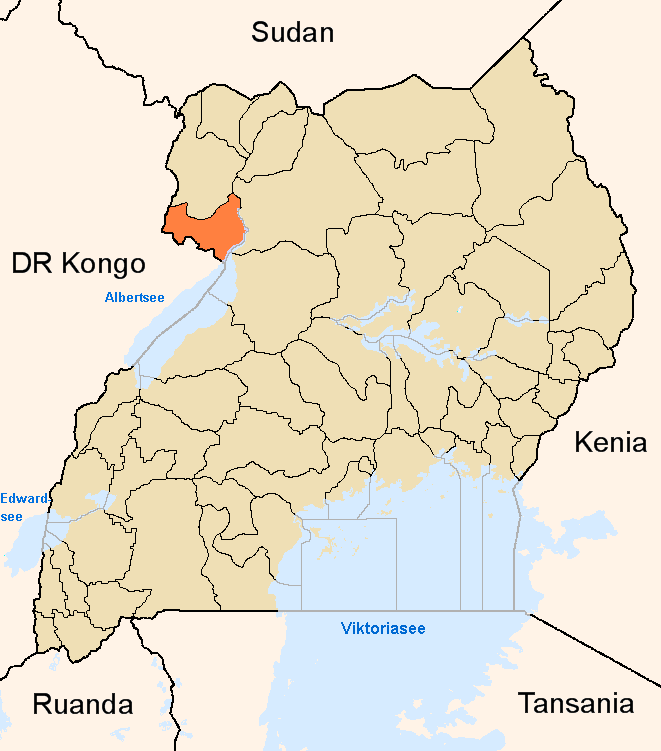
9. UGANDAN OFFICIAL OIL RESERVES UPPED TO 2 BILLION BARRELS, WORRIES ABOUT POTENTIAL CONFLICT WITH THE DEMOCRATIC REPUBLIC OF CONGO
Eric Watkins at the Oil and Gas Journal reports that the Ugandan Finance Minister Syda Bumba announced that Ugandan confirmed oil reserves were at 2 billion barrels as of June, up from 300 million barrels in 2006. The announcement came
"amid concerns about a military confrontation between Uganda and its neighbor, Congo (former Zaire).
According to newswire reports, Congo has established a border post in the disputed region of Goli near the northwestern Ugandan district of Nebbi, near Lake Albert and along the oil-rich Albertine rift.
'I believe this is just aggression,' said Betty Adima, commissioner for Nebbi district. 'It is provocation. That is the simplest way I can put it,' Adima told the Agence France Presse.
The Ugandan government has sent a protest note to Congo over the incursion, but has no plans to deploy troops of its own in the disputed region at the moment, according to a spokesman for the Ugandan defense ministry."
10. GLOBOVISIÓN CALLS FOR DIALOGUE WITH CHÁVEZ, LLOYD'S LIST PUTS VENEZUELA ON LIST OF MOST RISKY COUNTRIES FOR SHIPPING
Patrick Markey at Reuters reports that Globovisión owner Alberto Ravell on Saturday appealed for a dialogue with the Chávez administration, saying:
"The president should know that if he wants to talk we are ready. We should have a dialogue like in any civilized country. Our door is always open, now it is up to the president to decide. ... The president has called and told us to behave correctly or he'll close us down, but what is behaving correctly? Not informing people?"Meanwhile, Jerry Frank at Lloyd's List reports that the Lloyd’s and London company insurance markets’ Joint War Committee has reacted to Chávez's renewed nationalization drive by placing the country on its list of most risky places for shipping. The list includes Somalia, Nigeria, Ivory Coast, Pakistan, Sri Lanka, the southern coast of Thailand, Georgia and parts of Indonesia, Malaysia and Philippines. In March, the National Assembly passed a law transferring the administration of ports from state and municipal authorities to the federal government--see Daily Sources 3/16 #11. In April, the Chávez administration began a campaign to oust those governors that opposed his move to federalize the ports--see Daily Sources 4/22 #7.
"[Neil] Roberts [the Lloyd’s Market Association-based secretary of the JWC, said]: 'The US has also raised its fears over the substandard implementation of the International Ship and Port Facilities Security Code.'Meanwhile, Robert Mayer at Platts reports that Venezuelan oil minister Rafael Ramirez said Friday that it has entered into negotiations to acquire a 49% stake in the Dominican Republic's Refidomsa 34 kb/d refinery. "Refidomsa gained 100% control of the refinery in June 2008 upon buying Shell's 50% stake in the company for $110 million." The purchase reportedly would include plans for expanding the refinery.
Most of the world’s marine hull war risk insurance business is written out of London, and Venezuela’s new status will mean shipowners operating in the country could face new terms and conditions and/or additional premiums.
'Ultimately, this is an advisory note and it up to underwriters to decide how they wish to act on this decision,' added Mr Roberts.
The JWC’s decision covers the whole of Venezuela, including all of its offshore installations stretching 200 nautical miles off the coast that as part of its international law of the sea Exclusive Economic Zone."
11. US HOUSEHOLD NET WORTH FELL AT 16.25% ANNUAL RATE IN Q1
Rebecca Wilder at News N Economics reports that the Federal Reserve's flow of funds report for the first quarter of 2009 indicates that household net worth fell at an annual rate of 16.25%. She plots a graph of the ratio of net wealth to disposable income from Q1 1951 to Q1 2009:

and comments:
"Between 2005 and 2007, this ratio averaged a whopping 6.2. During the period 2005-2007, tangible asset values fell almost 1%, while financial assets grew a huge 16%! Liabilities likewise grew almost 18%, mostly on accumulated mortgage debt. Oh man."Well worth reading in full.
Monday, March 30, 2009
Daily Sources 3/30
1. Jason Clenfield at Bloomberg reports that Japanese industrial production fell by 9.4% in February from January, as per the Trade Ministry. "Inventories fell an unprecedented 4.2%."
3. Juan Cole at Informed Comment helpfully provided the USG Open Source Center's translation of the March 22nd speech of the Supreme Leader [more accurately Leader of the Revolution or LOTR] Ayatollah Ali Khamenei in response to the overture made directly by President Obama. (The USG Open Source Center paradoxically does not just simply publish their efforts.) This section of the speech begins with a long recitation of historical offenses of the US--real and imagined. (For example, Khamenei indicates that the US green-lighted Saddam Hussein's initial attack on Iran, something I believe is not the case.) The LOTR is not respectful, ironically enough--even if predictably enough--in the way he addresses the President's speech. For example, the LOTR says
That said, some argue the move is a clear opening. Juan Cole's response is here, and he wrote
Farideh Farhi--a very well-respected Iran expert--also believes the speech was conciliatory, though she disagrees with the "grumpy old man" characterization and does not think that everything is on the table. Her take is:
4. Stuart Williams at AFP reports that the World Bank forecasts that Russian GDP will shrink by 4.5% in 2009.
7. Reuters reports that the Bank of England today released data showing that the number of new mortgages approved in the UK in February grew at the fastest rate seen since May 2008.


10. Shailagh Murray and Karen DeYoung at the Washington Post reports that at a Capitol Hill news conference slated for tomorrow a bill will be introduced to lift the travel ban to Cuba. If the measure were to pass it would be an extremely significant reversal of long standing US-Cuba policy.
11. Liz Capo McCormick at Bloomberg reports that the Fed purchased $2.499 billion of US treasuries in its third direct purchase of US debt. The number was much less than the market was anticipating given the size of the Fed's program as announced.
12. An extremely interesting article discussing whether Goldman Sachs deliberately manipulated the price of oil upwards in June-July 2008 in a short squeeze, by Christopher Helman and Liz Moyer at Forbes.
"There are signs a recovery may be stirring in the US, Japan’s biggest market. US orders for durable goods rose in February for the first time in seven months. Inventories of long-lasting durable goods fell for a second month and new home sales increased for the first time since July.2. Volkhard Windfuhr and Bernhard Zand at Der Spiegel recently conducted an interview with Sheik Hamad bin Khalifa Al-Thani, the Emir of Qatar in which he addressed a wide range of issues, and indicated that as a member of OPEC Qatar's position was that oil should be at $40/b to help support a global recovery. Key excerpts:
In Japan, the drop in inventories adds to evidence that the worst of the manufacturing slump may be over. Companies said they would increase production 2.9% this month and 3.1% in April, today’s survey showed."
"SPIEGEL: How do you believe oil prices will develop now?Interestingly, the Emir appears to believe that Europe will not be as badly affected by the economic crisis as the US. The Emir also addressed the issue of the emerging natural gas cartel:
Hamad: I think the oil price should continue (to stay) in the $40 range for at least one or two more years.
SPIEGEL: Why so modest?
Hamad: Because this way we can help the world out of this crisis. If the world economy recovers, it will be good for us, too. Automatically, the price of oil will go up again. I don't see why OPEC countries should continue to cut production just to keep the price of oil high. This will not affect the industrial countries alone, it will also hit poor countries in Africa, Asia and Latin America. Who will look after them?
SPIEGEL: That's not the kind of argument you often hear when talking to oil producers.
Hamad: Yes, but I believe this battle is a battle for the whole world. Everybody should be helping each other for the next two years."
"SPIEGEL: Europe has staked its future on natural gas, but we are concerned about supplies. Can Qatar step in to fill the breach if Russia fails to deliver?The Emir also stated unequivocally that Qatar would not stand with the US against Iran. But, similarly, he thinks it would be hard for the Arab countries of the Gulf to stand with Iran against the US. He further states that though he welcomes the Obama Administration's new timbre in its approach to the region, that the other conflicts in the region also need to be addressed. He indicates Qatar's continued support for the Arab Peace Plan of 2002, with qualifications:
Hamad: We are selling gas to Italy, Spain, Belgium and, starting within the next few weeks, to Britain. I know that the Germans prefer to have their own gas supply, but I think our gas could come to Germany through another European country. However, this depends on the quantities we have on hand and the price.
SPIEGEL: Europeans are also worried about the creation of a so-called Gas-OPEC. Is there another cartel in the making that will be able to set prices at will?
Hamad: With OPEC they have a cartel. Why don't we have this gas cartel as well? And why don't we make a sort of agreement between consumers and producers? I wouldn't mind such a gas cartel, but it will take time because some countries today sell for high prices and others sell for low prices. It will be hard for those selling high to bring their prices down. So we will need time."
"Hamad: I think Israel will not accept the return of the Palestinian refugees. But on the issue of dividing the city of Jerusalem (and turning over East Jerusalem to the Palestinians), I think they should accept it."Which seems reasonably rational to me. He also addressed the issue of the ICC's arrest warrant for Sudan President al-Bashir:
"SPIEGEL: The International Criminal Court has issued an arrest warrant against Sudan's president, Omar al-Bashir. Why are you opposed to this?The Emir is extremely frank for the duration of the interview--a must read.
Hamad: If anything happened to Omar al-Bashir and Sudan ended up in chaos, the whole of Africa would also sink into chaos. Sudan is a vast land with a lot of borders. Al-Qaida would be happy to see Sudan become like Iraq.
SPIEGEL: Isn't it time for the Arab world to finally do something about the Darfur problem?
Hamad: We have been mediating in Sudan for a long time, particularly because the groups in Darfur do not want the Arab League to get involved. My hope is that we do not see interference from some other Arab countries. We are confident. We need to give the parties time--we have to let them shout and issue their grievances, and finally we need to get the process of negotiations going and discuss the future of their country.
SPIEGEL: Al-Bashir is now in Doha to attend the Arab summit.
Hamad: I sent my prime minister to invite him."
3. Juan Cole at Informed Comment helpfully provided the USG Open Source Center's translation of the March 22nd speech of the Supreme Leader [more accurately Leader of the Revolution or LOTR] Ayatollah Ali Khamenei in response to the overture made directly by President Obama. (The USG Open Source Center paradoxically does not just simply publish their efforts.) This section of the speech begins with a long recitation of historical offenses of the US--real and imagined. (For example, Khamenei indicates that the US green-lighted Saddam Hussein's initial attack on Iran, something I believe is not the case.) The LOTR is not respectful, ironically enough--even if predictably enough--in the way he addresses the President's speech. For example, the LOTR says
"They have the slogan of change. Where is the change? What has changed? Clarify this to us."Which on one level is fair enough, but also just off kilter, given that the change promised was to the American people, not the Islamic Republic of Iran. He also has a rather different take on the world's reception of the new POTUS than I, insofar as the LOTR remarks that the US is "hated in the world."
"Today, you are hated in the world. You should know this, if you do not already. Nations set fire to your flag. Muslim nations across the world chant 'Death to America.'"The last bit being true of few nations outside of Iran itself. Just prior to this the LOTR chooses to question whether or not the POTUS is indeed in charge in the US, which seems to me a rather pointed insult.
"I would like to say that I do not know who makes decisions for the United States, the President, the Congress, elements behind the scenes?He then manages to come quite close to calling the President a liar. (Remember, the US's official position in the IAEA is that Tehran is lying about its nuclear program.)
"You may say that you want to change policies, but not your aims, that you will change tactics. This is not change. This is deceit."He also brings up the question of translation in a somewhat insulting way--and I might even be inclined to concede this point, so to speak, but Juan Cole, who is clearly a partisan of reconciliation seems to think this is a reasonable translation, so I imagine it is a fair representation.
"This is my advice to US officials, the President, and others. Listen well to these words, and have them translated for you. Of course, do not give it to the Zionists to translate for you. Consult healthy people, and seek their opinions."(In fact, the government did release an official translation of bits and pieces of the speech in a summary in English here.) That noted, there are a few elements of the speech which could be regarded as an opening.
"But I would like to say that we have logic. Since the beginning, the Iranian nation moved with logic. Regarding our vital issues, we are not sentimental. We do not make decisions based on emotion. We make decisions through calculation."And he concludes the section of the speech dealing with the Obama Nowruz greeting with:
"If you go on with the slogan of discussion and pressure, saying that you will negotiate with Iran, and at the same time impose pressure, threats, and changes, then our nation will not like such words. We do not have any experience with the new US President and Government. We shall see and judge. You change, and we shall change as well. If you do not change, our people became more and more experienced, stronger, and more patient in the past 30 years."This could be seen as an opening, though I would note that the change in tone was not reciprocated--and this is from a culture acutely sensitive to matters of politesse. I would also note that the key section which some argue represents an offering was not included in the official translation of key elements of the speech offered on the LOTR's website.
That said, some argue the move is a clear opening. Juan Cole's response is here, and he wrote
"The US corporate media mysteriously interpreted Khamenei's words as a rebuff to Obama, but in light of the phrase I just quoted, I can't understand how they reached that conclusion."Given the points I mention above, I find it incredibly difficult to understand how it is that Dr. Cole "cannot understand how they reached that conclusion" and how it could even be characterized as "mysterious." In any case, Cole chose to frame the speech as a "grumpy old man's" response to the Obama overture in which he was making his first offer in what he expects to be a long period of haggling toward a grand bargain.
Farideh Farhi--a very well-respected Iran expert--also believes the speech was conciliatory, though she disagrees with the "grumpy old man" characterization and does not think that everything is on the table. Her take is:
"Clearly from [the LOTR's] view, engagement in talks must be accompanied with some concrete steps that show Iran that the United States is interested in a process and give and take and not a process based on 'either deception or intimidation.' Deception because the objective remains the same while the softer language is a mere tactical change. Intimidation because talks are combined with further squeeze of Iran."It is worth reading the speech for yourself. Meanwhile, on Saturday Ernesto Londoño at the Washington Post reported that the Mujaheddin-e Khalq, or MEK, will be removed from their camp near the Iranian border and that the leaders will be separated from followers who will be "de-brainwashed" or "re-educated" depending on your point of view. The question of US support for the organization is one of the major sticking points addressed by the LOTR's speech.
4. Stuart Williams at AFP reports that the World Bank forecasts that Russian GDP will shrink by 4.5% in 2009.
"The forecast is considerably more pessimistic than that of the Russian government, which is predicting a contraction of 2.2 percent in GDP in 2009."5. Nadia Rodova and Stuart Elliott at Platts report that Surgutneftegaz informed the press today that it had purchased a 21.2% stake in Hungarian oil and gas company MOL from Austria's OMV.
"This price represents a 93% premium to Friday's closing price, a 27% premium to the 12-month average price, and a 19% discount to the 12-month peak price of Hungarian Forint 23,700, Renaissance Capital said in a research note."6. Edward Hugh at Fistful of Euros reported Sunday that the Bank of Spain intervened to take over Caja Castilla La Mancha, whose losses are estimated to be as much as €3 billion. Spanish financial shares fell sharply today in reaction to the news.
7. Reuters reports that the Bank of England today released data showing that the number of new mortgages approved in the UK in February grew at the fastest rate seen since May 2008.
"Mortgage lending rose by £1.507 billion, almost double analysts' forecasts for an £800 million rise, and up from just over £1 billion in January."8. Chris Baldwin and David Sheppard at Reuters report that Europe's oil refining sector is shutting down gasoline units, given the collapse in demand from the US. Topper refineries--simple refineries without additional sophisticated processing units which increase production of certain products like gasoline or diesel--account for about 1 mb/d of Europe's 16 mb/d throughput capacity are the most likely to be decommissioned. Traditionally European surplus gasoline production has often been shipped to the US, serving as an upper boundary, so to speak, on the price of gasoline.
"'Europe's oil demand may never reach its peak again,' Leo Drollas, chief economist at the Center of Global Energy Studies (CGES), said."9. Eric Watkins at the Oil & Gas Journal reports that Habib Kagimu, chairman of Tamoil Uganda Ltd., has suggested that Kenya's Mombasa-to-Eldoret oil pipeline could eventually be extended to Uganda's Albertine rift basin, where several big crude discoveries have been made recently.


10. Shailagh Murray and Karen DeYoung at the Washington Post reports that at a Capitol Hill news conference slated for tomorrow a bill will be introduced to lift the travel ban to Cuba. If the measure were to pass it would be an extremely significant reversal of long standing US-Cuba policy.
11. Liz Capo McCormick at Bloomberg reports that the Fed purchased $2.499 billion of US treasuries in its third direct purchase of US debt. The number was much less than the market was anticipating given the size of the Fed's program as announced.
12. An extremely interesting article discussing whether Goldman Sachs deliberately manipulated the price of oil upwards in June-July 2008 in a short squeeze, by Christopher Helman and Liz Moyer at Forbes.
Thursday, September 18, 2008
Daily Sources 9/18
1. AFP reported that Jacques Diouf, Director General of the UN Food and Agriculture Organization [FAO], told the Italian Parliament that the number of people in the world facing "acute hunger" by the end of 2008 is likely to exceed one billion. So far this year the number globally has risen to 925 million from 850 million. The World Bank estimates that 100 million people have been pushed below the poverty line by risign food prices. The rise in food prices globally are mostly attributed to the rise in oil prices, the dedication of arable land to biofuel production, and the increased consumption of land, food and energy intensive meat in the emerging economies. "Hunger hotspots" identified by the FAO include Ethiopia, Djibouti, Ghana, Guinea, Haiti, Liberia, Mauritania, Mozambique, Nepal, the occupied Palestinian territories, Pakistan, Senegal, Tajikistan, Uganda and Yemen.
2. Dow Jones Newswires reported that Abbas Naki, Secretary General of OAPEC (Organization of Arab Petroleum Exporting Countries), said that Middle Eastern oil producing countries are likely to shelve a number of production boosting projects should the price of oil drop below $80/b.
3. Lyubov Pronina and Greg Walters at Bloomberg report that Alexei Kudrin, Russian Finance Minister, announced today that Russia will reduce its duty on crude exports from $495.90 a tonne to $372 a tonne beginning October 1. (A metric ton of oil roughly equals 7.3 barrels assuming 33 ºAPI. Urals Blend is about 30.9 ºAPI. Various Urals crudes range from 26.69-33.61 ºAPI. i.e. ~ 6 - 7.3 barrels/tonne) The tarrif on light oil products will be cut to $263.10/tonne and the heavy products tarrif will be cut to $141.70/tonne. Light products generally include jet fuel, diesel, and gasoline. Heavy products usually refers to the various varieties of fuel oil, asphalt, etc.
4. Dow Jones reports that the Norwegian Foreign Minister Jonas Gahr Stoere told reporters today that all territorial claims in the Artic must fall, as it has so far, under the international Law of the Sea, following Russian call to formally establish the claims of all bordering countries.
5. Marcin Grajewski at Reuters reports that the European Commission has denied Lithuania's request to keep its Ignalina nuclear power plant open. The Baltic States hope to build a modern nuclear plant to handle energy generation requirements, but one will not be operational until 2015 at the earliest. Under its treaty to join the European Union, Lithuania was obliged to shutter the plant by the end of 2009. There is a question of how the Baltic states are to handle their energy requirements in the interim. Russia is considered especially suspect given Polish control of the Mazeikiai Refinery (in Lithuania and the only refinery in the Baltic) and rumors surrounding a fire that shut the complex down in 2006. Russia stopped all deliveries of crude oil to Lithuania via the Druzhba pipeline system in 2006, apparently in retaliation for selling the Yukos stake in the Mazeikiai to PKN Orlen instead of a Russian company. Druzhba is Russian for "friendship."
6. The Wall Street Journal has an editorial about the "Run on Russia." Though the crowing tone, probable mistaking of correlation with causation, and self-congratulatory bellicose tone is useless, the implied admission of the correlation of Russian interests with Western interests is, at least, useful.
7. Henry A. Kissinger and Martin Feldstein have an interesting op-ed in the Washington Post advocating the establishment of closer cooperation between oil consumers. I think this is a good idea, generally speaking, and have argued as much in the past. The devil is in the details, though. Making coal clean by any environmental standard, for example, would be a neat trick.
8. Chris Buckley at Reuters reported that on Wednesday the People's Daily called for a new world financial order that was not dependent upon the United States. (h/t Jesse's Cafe Americain) Still, Vice Premier Wang Qishan told U.S. trade officials in a meeting in the US on Tuesday, "The Chinese government is well aware of the fact that the United States, which is the world's largest developed country, and China, which is the world's largest developing country, should have constructive and cooperative economic and trade relations."
9. Dealbook writes that the rumor mill now floats the story that Goldman Sachs and Morgan Stanley, the two remaining investment banks, are not long for this earth. Yesterday, Morgan Stanley and Goldman Sachs were down 24% and 14%, respectively. Brad Setser's Follow the Money has a response to the news that the Chinese Investment Company is being asked if it would be interested in acquiring 49% of Morgan Stanley by executives there. I can only begin to imagine the political storm that would take place if that happened. Remember Unocal?
10. The Associated Press reported that the British Financial Authority has banned all short selling until January 16, 2009, as per Jesse's Cafe Americain.
11. The Global Director of Market Pricing at Platts, Jorge Montepeque, told a Standard & Poor's commodity investing conference today in London that oil companies are unwilling to trade with their banks, according to Chanyaporn Chanjaroen, Alaric Nightingale and Lars Paulsson at Bloomberg. Nonetheless, E.ON Energy Trading said the had not seen liquidity drying up in any of the energy markets.
12. Patricia Lui and Wes Goodman at Bloomberg report that central bankers in South Korea, the Philippines, India and Thailand are stopping using their currency reserves to defend their currencies for now, accepting lower rates versus the dollar. South Korea's cash reserves dropped 8% in the last five months to $243.2 billion. India's dropped 7.4% this quarter to $280 billion. Thailand's dropped 5% to $101 billion. "Barclays Plc, the third-biggest currency trader, predicts the won will fall to 1,200 by year-end, the baht to 37 and the rupiah to 9,450 and is now revising those forecasts lower."
13. Platts reports that the Nigerian government has been forced to use proceeds from crude export sales to pay for the subsidies on oil product imports, as the cost has exceeded the budgeted amount. The cost of subsidies this year are expected to exceed 1 trillion Naira, or about $8.6 billion.
2. Dow Jones Newswires reported that Abbas Naki, Secretary General of OAPEC (Organization of Arab Petroleum Exporting Countries), said that Middle Eastern oil producing countries are likely to shelve a number of production boosting projects should the price of oil drop below $80/b.
3. Lyubov Pronina and Greg Walters at Bloomberg report that Alexei Kudrin, Russian Finance Minister, announced today that Russia will reduce its duty on crude exports from $495.90 a tonne to $372 a tonne beginning October 1. (A metric ton of oil roughly equals 7.3 barrels assuming 33 ºAPI. Urals Blend is about 30.9 ºAPI. Various Urals crudes range from 26.69-33.61 ºAPI. i.e. ~ 6 - 7.3 barrels/tonne) The tarrif on light oil products will be cut to $263.10/tonne and the heavy products tarrif will be cut to $141.70/tonne. Light products generally include jet fuel, diesel, and gasoline. Heavy products usually refers to the various varieties of fuel oil, asphalt, etc.
4. Dow Jones reports that the Norwegian Foreign Minister Jonas Gahr Stoere told reporters today that all territorial claims in the Artic must fall, as it has so far, under the international Law of the Sea, following Russian call to formally establish the claims of all bordering countries.
5. Marcin Grajewski at Reuters reports that the European Commission has denied Lithuania's request to keep its Ignalina nuclear power plant open. The Baltic States hope to build a modern nuclear plant to handle energy generation requirements, but one will not be operational until 2015 at the earliest. Under its treaty to join the European Union, Lithuania was obliged to shutter the plant by the end of 2009. There is a question of how the Baltic states are to handle their energy requirements in the interim. Russia is considered especially suspect given Polish control of the Mazeikiai Refinery (in Lithuania and the only refinery in the Baltic) and rumors surrounding a fire that shut the complex down in 2006. Russia stopped all deliveries of crude oil to Lithuania via the Druzhba pipeline system in 2006, apparently in retaliation for selling the Yukos stake in the Mazeikiai to PKN Orlen instead of a Russian company. Druzhba is Russian for "friendship."
6. The Wall Street Journal has an editorial about the "Run on Russia." Though the crowing tone, probable mistaking of correlation with causation, and self-congratulatory bellicose tone is useless, the implied admission of the correlation of Russian interests with Western interests is, at least, useful.
7. Henry A. Kissinger and Martin Feldstein have an interesting op-ed in the Washington Post advocating the establishment of closer cooperation between oil consumers. I think this is a good idea, generally speaking, and have argued as much in the past. The devil is in the details, though. Making coal clean by any environmental standard, for example, would be a neat trick.
8. Chris Buckley at Reuters reported that on Wednesday the People's Daily called for a new world financial order that was not dependent upon the United States. (h/t Jesse's Cafe Americain) Still, Vice Premier Wang Qishan told U.S. trade officials in a meeting in the US on Tuesday, "The Chinese government is well aware of the fact that the United States, which is the world's largest developed country, and China, which is the world's largest developing country, should have constructive and cooperative economic and trade relations."
9. Dealbook writes that the rumor mill now floats the story that Goldman Sachs and Morgan Stanley, the two remaining investment banks, are not long for this earth. Yesterday, Morgan Stanley and Goldman Sachs were down 24% and 14%, respectively. Brad Setser's Follow the Money has a response to the news that the Chinese Investment Company is being asked if it would be interested in acquiring 49% of Morgan Stanley by executives there. I can only begin to imagine the political storm that would take place if that happened. Remember Unocal?
10. The Associated Press reported that the British Financial Authority has banned all short selling until January 16, 2009, as per Jesse's Cafe Americain.
11. The Global Director of Market Pricing at Platts, Jorge Montepeque, told a Standard & Poor's commodity investing conference today in London that oil companies are unwilling to trade with their banks, according to Chanyaporn Chanjaroen, Alaric Nightingale and Lars Paulsson at Bloomberg. Nonetheless, E.ON Energy Trading said the had not seen liquidity drying up in any of the energy markets.
12. Patricia Lui and Wes Goodman at Bloomberg report that central bankers in South Korea, the Philippines, India and Thailand are stopping using their currency reserves to defend their currencies for now, accepting lower rates versus the dollar. South Korea's cash reserves dropped 8% in the last five months to $243.2 billion. India's dropped 7.4% this quarter to $280 billion. Thailand's dropped 5% to $101 billion. "Barclays Plc, the third-biggest currency trader, predicts the won will fall to 1,200 by year-end, the baht to 37 and the rupiah to 9,450 and is now revising those forecasts lower."
13. Platts reports that the Nigerian government has been forced to use proceeds from crude export sales to pay for the subsidies on oil product imports, as the cost has exceeded the budgeted amount. The cost of subsidies this year are expected to exceed 1 trillion Naira, or about $8.6 billion.
Monday, September 15, 2008
Daily Sources 9/15
The news today is overwhelmingly about what is beginning to look like a full-fledged financial meltdown in the US. Obviously, the consequences of a meltdown would be profound, but take a little while to think through. Here are the major stories on what's happening in NYC, and a few interesting items that could have been lost in the mix:
1. Heather Landy and Neil Irwin at the Washington Post write that Lehman Brothers filed for bankruptcy Monday morning. (I wonder whether the new draconian private bankruptcy laws passed at the behest of the banking industry apply to them.)
2. David Hilzenrath at the Washington Post reports that New York will allow AIG to lend money to itself.
3. Michael J. de la Merced and Mary Williams Walsh at the New York Times report that the Fed has asked Goldman Sachs and JP Morgan Chase to put together a $70 billion bail out package for AIG.
4. Binyamin Appelbaum and Zachary A. Goldfarb at the Washington Post report that the Bank of America made a deal to purchase Merrill Lynch for $50 billion over the weekend.
5. The Associated Press reports that the Federal Reserve reported today that industrial output dropped 1.1% last month, far exceeding analyst expectations of 0.3%. The decline was led by an 11.9% decline in motor vehicle and motor vehicle parts production. Output in mining--which includes oil and gas--fell 0.4% in August.
6. Andrew Batson at the Wall Street Journal reports that China abruptly decided to lower benchmark interest rates today on the fear of an economic slow down, and in response to financial news out of NY. The People's Bank of China will reduce the one year benchmark lending rate 0.27 percentage points to 7.2%. Inflation in China fell below 5% in August. Deposit rates (for individual savers) at banks remain at 4.4%, which presumably encourages spending.
7. Randy Fabi at Reuters reports that MEND declared an oil war on Sunday, warning all oil workers to leave the Niger Delta. Evidently the fighting is the worst the region has seen in some time with the Nigerian army, navy, and air force all involved in moves against the militants. Militants set fire to one of Shell's flow stations in the region today. This follows a call for a ceasefire by the MEND on Thursday.
8. Chris Obore of the Kampala Monitor writes that Erik Solheim, the Norwegian Minister of Environment and International Development, has warned Ugandan officials that Norwegian aid was at risk if the country did not more carefully address environmental and transparency concerns.
9. Alison Smale at the New York Times reports that the former European Union envoy to Kabul--Francesc Vendrell--has said that Afghanistan is in the worst shape it has been in since 2001.
10. Interesting op-ed in Wall Street Journal Asia by Richard Bush and Kenneth Lieberthal pointing out the main differences in American foreign policy messages to Taiwan and Georgia. Countries the authors believe face similar dilemmas.
1. Heather Landy and Neil Irwin at the Washington Post write that Lehman Brothers filed for bankruptcy Monday morning. (I wonder whether the new draconian private bankruptcy laws passed at the behest of the banking industry apply to them.)
2. David Hilzenrath at the Washington Post reports that New York will allow AIG to lend money to itself.
3. Michael J. de la Merced and Mary Williams Walsh at the New York Times report that the Fed has asked Goldman Sachs and JP Morgan Chase to put together a $70 billion bail out package for AIG.
4. Binyamin Appelbaum and Zachary A. Goldfarb at the Washington Post report that the Bank of America made a deal to purchase Merrill Lynch for $50 billion over the weekend.
5. The Associated Press reports that the Federal Reserve reported today that industrial output dropped 1.1% last month, far exceeding analyst expectations of 0.3%. The decline was led by an 11.9% decline in motor vehicle and motor vehicle parts production. Output in mining--which includes oil and gas--fell 0.4% in August.
6. Andrew Batson at the Wall Street Journal reports that China abruptly decided to lower benchmark interest rates today on the fear of an economic slow down, and in response to financial news out of NY. The People's Bank of China will reduce the one year benchmark lending rate 0.27 percentage points to 7.2%. Inflation in China fell below 5% in August. Deposit rates (for individual savers) at banks remain at 4.4%, which presumably encourages spending.
7. Randy Fabi at Reuters reports that MEND declared an oil war on Sunday, warning all oil workers to leave the Niger Delta. Evidently the fighting is the worst the region has seen in some time with the Nigerian army, navy, and air force all involved in moves against the militants. Militants set fire to one of Shell's flow stations in the region today. This follows a call for a ceasefire by the MEND on Thursday.
8. Chris Obore of the Kampala Monitor writes that Erik Solheim, the Norwegian Minister of Environment and International Development, has warned Ugandan officials that Norwegian aid was at risk if the country did not more carefully address environmental and transparency concerns.
9. Alison Smale at the New York Times reports that the former European Union envoy to Kabul--Francesc Vendrell--has said that Afghanistan is in the worst shape it has been in since 2001.
10. Interesting op-ed in Wall Street Journal Asia by Richard Bush and Kenneth Lieberthal pointing out the main differences in American foreign policy messages to Taiwan and Georgia. Countries the authors believe face similar dilemmas.
Subscribe to:
Posts (Atom)

 Posts
Posts

