Showing posts with label Georgia. Show all posts

Wednesday, July 7, 2010

Daily Sources 7/7

1. CHINA'S US TREASURY HOLDINGS UP $5 BILLION IN APRIL

Bloomberg reports that China's State Administration of Foreign Exchange urged markets to not consider changes in US treasuries political statements. It further indicated that gold is not likely to become a major part of its reserves holdings because of its volatility and lack of interest payments. Some think this is just Beijing talking its book so it can buy further gold at depressed prices. Last year Beijing doubled its gold holdings.

2. FREE EXCHANGE HOSTS A NEAT INTERACTIVE MAP OF THE EU


3. NEW POLISH PRESIDENT AN EUROPEANIST

Greg Scoblete at Real Clear World reports that the new Polish President is a committed Europeanist as opposed to his predecessor, who was a committed Atlanticist.

4. US RHETORIC IN GEORGIA DESIGNED TO CALM FEARS IN T'BLISI

Mary Beth Sheridan at the Washington Post reports that in her visit to Georgia, Secretary Clinton indicated the US's opposition to Russia's "invasion and occupation" of Georgia. Prime Minister Putin took issue with the characterization of the Secretary of State, calling the Russian troop presence an effort to liberate the Abkhazians and South Ossetians.

5. DRILLING IN GREENLAND'S ARCTIC WATERS BEGAN LAST WEEK

Kate MacKenzie at FT Energy Source reports that deep water drilling in Greenland's Arctic waters began last week. And so the race for Arctic natural resources begins.


6. AUSTRALIA KEEPS BENCHMARK RATE AT 4.5%

Jacob Greber at Bloomberg reports that Central bank Governor Glenn Stevens yesterday left the benchmark cash rate at 4.5% for a second month. Australia's central bank had raised interest rates six times since October when it stood at a low of 3%. Inflation is expected to increase to more than 3% in the coming months.

7. INDIA DEPLOYS TROOPS IN KASHMIR IN EFFORT TO SUPPRESS UNREST

Lydia Polgreen at the New York Times reports that the Indian Army has deployed troops in Kashmir in an effort to calm the region after large street protests resulted in paramilitary units firing into the crowds.

8. RUMORS THAT MUBARAK'S HEALTH IS IN SERIOUS DECLINE

Michael Collins Dunn at the MEI Editor's Blog reports that Ha'aretz has picked up a rumor from a London-based daily that Mubarak's trip to France was for medical reasons. The story is that Mubarak's health is in serious decline and that his son is in line for succession.

9. OBAMA EXPECTS NETANYAHU TO BEGIN TALKS WITH PALESTINIANS BEFORE MORATORIUM ON NEW SETTLEMENT BUILDING EXPIRES IN SEPTEMBER

Sheryl Gay Stolberg and Mark Landler at the New York Times report.

10. BANK CARD DELINQUENCIES FALL BELOW 4%; SERVICE SECTOR NOT ADDING JOBS QUICKLY ENOUGH

In a good sign for the economy, Darrell A. Hughes at Real Time Economics reports that bank credit-card delinquencies dropped below 4% for the first time in eight years.
[ABA Chief Economist James] Chessen said the anticipated slow growth is unlikely to cause delinquencies to rise significantly, but there could be some impact. 'Until we get a sustained level of new jobs in this economy, we’re not going to see delinquencies fall to very low levels,' he said.
In the meantime, Phil Izzo at Real Time Economics reports that the Institute for Supply Management subindex for employment fell below 50, indicating a fall in employment.


11. THE EIA REPORTS THAT CRUDE STORAGE IS DOWN 2 MILLION BARRELS, STILL 12.9 MILLION MORE IN STORAGE THAN LAST YEAR

The EIA reports that crude stocks fell to 363.1 million barrels, down 2 million from last week, up 12.9 million from last year. Gasoline stocks rose by half a million while diesel stocks rose 2.5 million. Average US gasoline prices rose by 1.4 cents to 275.7 cents the week ended June 28. In the week ended June 25, refinery capacity utilization stood at 88.4%, down 1% from the week previous.

Thursday, August 6, 2009

Daily Sources 8/6

1. JAPANESE GOVT REPORT COMPARES PARTY PLANS FOR GREENHOUSE GAS EMISSIONS REDUCTIONS ON ECONOMY

Yoko Kubota at Reuters reports that the plan by Japanese opposition party to cut greenhouse gas emissions by 25% from 1990 levels by 2020 would, per a government report, "push down real gross domestic product growth by 3.2 percentage points and the unemployment rate could grow by 1.3 percentage points." The government plan for an 8% reduction from 1990 levels by 2020 would, per the report, "push down Japan's economic growth by 0.6 percentage points and raise unemployment by 0.2 percentage points in 2020."

2. PBOC'S MONETARY REPORT INDICATES EASY CREDIT POLICY TO CONTINUE, MINISTRY OF HUMAN RESOURCES WARNS EMPLOYMENT SITUATION GRAVE, ELECTRICITY DATA SHOWS STEEP FALLS IN CONSUMPTION, BANKS LEND LESS IN JULY CONTRA PBOC REPORT, AND BP SAYS GDP DATA MORE OR LESS TRUSTWORTHY

Andrew Batson at the Wall Street Journal reports that the People's Bank of China's quarterly monetary report reaffirmed its commitment to continuing easy credit policies.
"'China's economy is now in a critical period of stabilization and recovery, and maintaining stable and rapid economic growth is still the most important task we face ... . Although the general trend of stabilization in the [global] economy has been basically established, the process of recovery may be slow and tortuous.'

With global demand for China's exports still weak, a solid rebound depends on domestic consumption and investment, the central bank said. Chinese companies may be more willing to ramp up production now that inventories have been reduced.

Sentiment among private-sector businesses remains weak, it said, and consumers' worries about future income could crimp spending. 'The foundation of the economic recovery is not yet stable,' it said, echoing other agencies' recent comments."
In a somewhat different take on the question of whether migrant unemployed in China are a reason to worry from the story cited yesterday--see Daily Sources 8/5 #1--Yves Smith links to an AFP report that
"China Tuesday warned of a 'grave' situation in the jobs market with millions of graduates and migrant workers yet to find work as companies continue to struggle with the effects of the global slump...

'China's current employment situation is still grave and the pressure for job creation remains large,' said Wang Yadong, a senior official at the Ministry of Human Resources and Social Security's employment section."
She also notes that:
"First-half electricity use by small and medium-sized enterprises fell almost 50% year-on-year, as these companies were more exposed to the economic downturn, the National Bureau of Statistics said on August 3.

SMEs saw power consumption plunge 48.9% year-on-year, against a 5.9% industry-wide drop."
And in contrast to the affirmation of the People's Bank of China in its quarterly report mentioned above:
"China's big state-owned commercial banks extended around 168 billion yuan worth of new loans in July, down sharply from the 497 billion issued in June, banking sources told Caijing on August 4."
And she picks up on the story in the FT yesterday that if you add up the output numbers of the various provinces, they are 10% more than overall national output as reported by Beijing. And to muddy the waters further, Sheetal Nasta at Platts reports that the chief Asia economist of BP, Chi Zhang, said at an event at the British Chamber of Commerce in Shanghai Wednesday that
"'in general, [the] data reflects economic growth reality,' given that China is 'very manufacturing intensive and there has been a lot of industrialization and an urbanization process is going on.'

While he admitted the Chinese have been likely 'taking advantage of low energy prices,' he retreated from the notion that government stockpiling was inflating prices.

Speaking of the oil price spike in 2008, he said data from BP's annual statistical review, issued earlier this year, shows that the 'big spike' in (price) coincided with related economic activity, primarily supply-side constraints due to investment shortfalls, geopolitical issues and few technological breakthroughs."
The continuing incredulity regarding official output growth numbers in China was driven by the disparity between the electricity consumption numbers, which are no longer published--see Daily Sources 6/8 #6--later reinforced by skepticism expressed in the May report by the International Energy Agency which suggested that oil demand would have been stronger than reported if it were to reconcile with the GDP numbers and suggested the possibility that "Real GDP data aren’t accurate and shouldn’t be taken at face value"--see Daily Sources 5/14 #2.

3. GERMAN FINANCE MINISTER SAYS FINANCIAL SECTOR RETURNING TO 'CASINO CAPITALISM', ECB MAINTAINS BENCHMARK RATE AND INDICATES THERE WILL BE NO ADDT'L STIMULUS

Der Spiegel reports that Finance Minister Peer Steinbrück is in the media warning against the return of 'casino capitalism.' Among other comments, he said:
"In the United States and Britain, lobbyists are already questioning some regulatory measures."
and, in Germany,
"Taxpayers are continuing to completely finance big bonuses [at banking firms]."
Meanwhile, Christian Vits and Simone Meier at Bloomberg report that European Central Bank president Jean-Claude Trichet indicated that the bank is unlikely to provide further stimulus after its monetary committee left the benchmark interest rate at 1%.
"Rates are 'appropriate' and policy makers are 'satisfied' with their asset-purchase program and measures to improve the flow of credit, he said."
"The ECB currently predicts the euro-region economy will contract about 4.6% this year and 0.3% in 2010. Inflation will average about 0.3% this year and 1% in 2010. The bank aims to keep inflation just below 2%."
4. BANK OF ENGLAND TO EXPAND QUANTITATIVE EASING, LONDON TO REPLACE SHORT HAUL AVIATION WITH HIGH SPEED RAIL

Niel Shah at the Wall Street Journal reports that the Bank of England today announced it would expand its quantitative easing program, increasing purchases by £50 billion (~ $85 billion) to a total of £175 billion.
"The increase required the bank to get special permission from the UK Treasury, which had previously capped the program at £150 billion.

The expansion of the program suggests policy makers are still worried about the long term outlook for the UK economy despite a recent spate of positive data pointing to recoveries in house prices, manufacturing and services."
"While banks' reserves of cash have more than tripled since the central bank launched the program back in March, one broad measure of lending in the economy--M4 money supply excluding certain financial intermediaries--has hardly budged. In the second quarter, the measure was up just 3.1% from the same period a year earlier, the weakest expansion since 1999.

Beyond that, rising unemployment and peoples' efforts to pare down heavy debt loads are likely to weigh on consumer spending, by far the largest driver of demand in the UK economy. As of May, the UK unemployment rate stood at 7.6%, the highest level in 12 years."
Meanwhile, Dan Milmo and Julian Glover at the Guardian report that Downing Street has announced plans which would replace domestic air travel with a high speed--250 mph--rail.
"The transport secretary, Lord Adonis, said switching 46 million domestic air passengers a year to a multibillion-pound north-south rail line was 'manifestly in the public interest'. Marking a government shift against aviation, Adonis added that rail journeys should be preferred to plane trips.

'For reasons of carbon reduction and wider environmental benefits, it is manifestly in the public interest that we systematically replace short-haul aviation with high-speed rail. But we would have to have, of course, the high-speed network before we can do it,' he said."


5. GEORGIAN AND RUSSIAN OFFICIALS TRY TO CALM WORRIES ABOUT NEW FIGHTING BREAKING OUT, SAAKASHVILI LAYS BLAME FOR 2008 CONFLICT ON MOSCOW IN OP ED

Jim Heintz at the Associated Press reports that senior officials in Tblisi and Moscow are walking back from rhetoric suggesting the possibility of renewed fighting.
"The deputy chief of Russia's general staff says Georgia is too weak after the war that devastated its military and caused an estimated $1 billion damage to the struggling country.

Georgia's national security adviser, however, says the danger of new fighting appears low because of 'preventive diplomacy' and because Russia knows a new war would undermine its influence among neighbors and rapprochement with the West."
In the meantime, Georgian President Mikheil Saakashvili has an op ed in today's Washington Post which lays the blame on last year's conflict squarely on Russia. Key excerpt:
"Russian provocations have not stopped; snipers in Russian-controlled areas have killed 28 Georgian policemen. In recent days, Moscow has engaged in a series of provocative acts and statements, echoing its prelude to last year's invasion. Even as the world watches, Moscow has vetoed monitoring missions from the United Nations and the Organization for Security and Cooperation in Europe. In violation of the cease-fire, Russia also denies European Union monitors access to the occupied territories.

Despite all this, and contrary to some expectations, Georgia has rebounded. Our democratic institutions are growing. Foreign investors are returning. The world should recognize that the kind of behavior Russia exhibited last August threatens not only Georgia but our entire region."
6. TURKISH PM MEETS WITH HEAD OF LARGEST TURKISH KURD PARTY, ANKARA SIGNS ON TO SOUTH STREAM

Nicholas Birch at the Wall Street Journal reports that Prime Minister Recep Tayyip Erdogan of Turkey met with the leader of the main Kurdish party in the country Wednesday, in what is the first meeting of the head of government with the party in the country's history.
"[M]any analysts say the new Kurdish opening is qualitatively different from anything that came before.

'For the first time ever, Turkish state institutions are working in synch to solve the problem,' said Henri Barkey, a Turkish expert at the Carnegie Endowment for International Peace, a Washington-based think tank.

The main catalyst for Turkey's new sense of urgency is Washington's announcement that it plans to pull its soldiers out of Iraq, Turkey's southern neighbor, by 2011.

The planned withdrawal has speeded up a rapprochement between Turkey and Iraqi Kurds, whose relations have been blighted for years by the PKK's use of Iraqi Kurdish mountains for its military bases."
"'There is an economic side to the rapprochement. "Turkey wants to use northern Iraqi gas for Nabucco,' says Bayram Bozyel, a Turkish Kurdish politician, referring to a pipeline project that the US and EU hope will help break a Russian stranglehold on European natural-gas supplies. 'And the [Iraqi] Kurds want to pump gas north.' That would be risky in the midst of a guerrilla war. The PKK claimed responsibility last year for a bomb attack on a major oil pipeline that passes through the same region."
Well worth reading.Today Russia and Turkey signed a deal to route Russia's South Stream pipeline through Turkey, per Charles Recknagel at RFE/RL.
"'The South Stream pipeline is a much needed project that is particularly important in the context of ensuring the energy security of the whole of Europe and the development of a broad range of ties between Russia and Turkey,' Putin said. 'Our negotiations showed that we can find solutions, together with the Turkish leadership, that open the way to new, large-scale energy projects.'"
7. IRAN LOWERS OFFICIAL PRICE OF OIL SOLD TO ASIA, QATAR LOWERS OFFICIAL PRICE OF OIL, FOLLOWING SAUDI ARAMCO REDUCTION ON PRICE TO ASIA

Yee Kai Pin at Bloomberg reports that the National Iranian Oil Company will reduce the official selling price of Iranian Light into Asia for the first time in four months.
"[NIOC] will set Iranian Light for September at 9 cents a barrel above the average of Persian Gulf benchmarks Oman and Dubai grades, based on a quarterly formula tied to prices set by Saudi Arabian Oil Co. The premium will be down $1.75, or 95%, from August and will be the smallest in seven months."
Meanwhile, Yee Kai Pin reports that Qatar Petroleum will also reduce the official selling price of Qatari crudes.
"The state-owned company cut its July price of Qatar Land crude oil to $65.50/b, down $5.60 from June, the official Qatar News Agency said on its Web site. The July price of Qatar Marine grade was reduced by $5.38 to $64.72/b. The cuts are the first in five months."
Earlier this week, Saudi Aramco cut its official selling price of Arab Light into Asia--see Daily Sources 8/3 #6. (The middle eastern national oil companies have different official prices for different regions of the world.)

8. DUBAI'S PROPERTY PRICE COLLAPSE SHARPEST IN WORLD

Kevin Brass at the New York Times reports that Dubai's property market is leading the world in price collapse.
"Dubai prices have dropped 32% in the last year and 40% in the last quarter, according to the latest edition of the Knight Frank Global House Price Index, released today.

Along with Dubai, Latvia (36%) and Singapore (23.8%) saw the largest declines since the first quarter of 2008, the property firm reports."
9. MEND LEADER INDICATES MOST NIGER DELTA MILITANTS WANT TO TAKE ADVANTAGE OF AMNESTY PROGRAM WHICH OFFICIALLY BEGAN TODAY; ANALYSTS DOUBT DIRE NIGERIAN PRODUCTION NUMBERS

Dulue Mbachu at Bloomberg reports that the leader of Nigerian militant group MEND indicated in a telephone interview that most fighters want to accept the government's amnesty program, saying "Like the government, we also want peace for there to be development."
"A government panel set up last year recommended raising the share of revenue going to states in the oil region to 25% from the current 13%. MEND wants the oil region to control 100% of oil revenue and pay a tax to the central government, according to the group’s spokesman, Jomo Gbomo.

'Whatever the people are demanding is also what I want,' Okah said, declining to commit to a figure.

The MEND leader said militant commanders in the oil region are divided between those who want money in exchange for weapons, as offered by the government, and those who want their political demands met.

'Personally I want a situation where weapons will be surrendered without cash,' Okah said. 'Because people can submit their weapons and buy new ones.'"
BBC News reports on the amnesty program which officially began today.
"Officials said gunmen who accept amnesty would be given 65,000 naira ($433; £255) a month for food and living expenses during the rehabilitation program, which runs from 6 August to 4 October.

But the main rebel group in the region, the Movement for the Emancipation of the Niger Delta (MEND), has not yet said it will take part in the amnesty.

'When we choose to disarm, it will be done freely, knowing that the reason for our uprising which is the emancipation of the Niger Delta from neglect and injustice has been achieved,' the group said in statement e-mailed to the AFP news agency.

The group, which called a temporary ceasefire last month after one of its leaders was freed from jail, is in talks with senior officials about the terms of any possible amnesty."


Tom Burgis at FT Energy Source reports that many believe that the current numbers for oil production coming from official Nigerian government sources are deliberately understated.
"On Wednesday afternoon, a Nigerian oil executive speaking in private snorted at the idea that production could be so low, suggesting 1.6m b/d was more accurate. Stewart Williams, principal sub-Saharan Africa analyst at energy consultancy Wood Mackenzie, puts production at 1.5m b/d to 1.6m b/d.

Why the discrepancy? Analysts with a cynical streak (easily acquired in a country so riddled with corruption and electoral violence) remark that it is in the state’s interest to create a sense of crisis as it tries to force through a comprehensive reform of the oil sector.

That the bill has merits--including the promise of greater transparency and restructuring the hopelessly ineffective state company--misses the point. Oil companies and the delta’s influential governors, who stand to get less cash as a result, are united in opposition to it.

The oil companies, too, are making data scarce at the moment. Like the government, they may have an interest in uncertainty as the negotiations continue."
10. BRAZILIAN SENATE'S INVESTIGATION INTO PETROBRAS TAX EVASION AND CORRUPTION CHARGES BEGIN TODAY, LULA INDICATES THAT HE BACKS FULL CONTROL OF PRE-SALT FOR PETROBRAS

Helder Marinho and Alexander Ragir at Bloomberg report that the Brazilian Senate's investigation into tax evasion and corruption allegations against state oil company Petrobras began today.
"An 11-member Senate committee, led by a member of [Brazilian President Luiz Inacio Lula da Silva's], Workers’ Party, is investigating the allegations. [CEO Jose Sergio] Gabrielli told Petrobras’s 74,000 employees in a July 14 letter that the company fired three employees after an internal investigation, and cooperated with the prosecutor’s office and federal police, into the bidding process for oil platforms.

Gabrielli, Chief Financial Officer Almir Barbassa and Haroldo Lima, the head of Brazil’s petroleum regulator, are among officials the committee in charge of the probe will invite to testify, according to a list senators handed to reporters during a session of the probe committee held today.

The officials will not be legally summoned or required to speak under oath, and the hearings will be arranged at their convenience, Senator Romero Juca said today in Brasilia. Juca, the head of the government coalition in the Senate, is responsible for leading the probe and writing its reports. Fired Petrobras executives will not be called to testify, he said."
"Since Lula first took office in January 2003, lawmakers have set up 25 committees to investigate everything from health insurance plans to piracy of industrial goods and corruption, according to CAC Consultoria Politica, a Brasilia-based political consultancy. While some ended without any conclusion, a 2005 investigation into allegations the Workers’ Party paid bribes to legislators in exchange for votes in Congress led to the resignation of Lula’s chief of staff, Jose Dirceu."
Natuza Nery at Reuters reported yesterday that Lula was to propose to Congress today that Petrobas be the exclusive operator of new offshore sub-salt oil fields. In June, resolutions were being introduced in the Brazilian Senate to create a new, 100% state-owned company, to lease Brazil's sub-salt fields--see Daily Sources 6/12 #11. (A majority of voting shares in Petrobras are owned by the government, but foreign investors own about 60% of its total outstanding stock.)

11. VENEZUELA TO PURCHASE SEVERAL DOZEN TANKS FROM RUSSIA, BANS COLOMBIAN STATE OIL COMPANY FROM PARTICIPATION IN ORINOCO BELT

Fabiola Sanchez at the Associated Press reports that President Hugo Chávez in a news conference yesterday said that Venezuela was going to purchase several dozen Russian tanks in a deal he wants to seal during a visit to Russia in September.
"'We're going to buy several battalions of Russian tanks,' Chavez said ...

Chavez's government has already bought more than $4 billion worth of Russian arms since 2005, including helicopters, fighter jets and Kalashnikov assault rifles.

The socialist leader called Colombia's plan to host more US soldiers a 'hostile act' and a 'true threat' to Venezuela and its leftist allies. He warned that a possible US buildup could lead to the 'start of a war in South America,' but gave no indication that Venezuela's military is mobilizing in preparation for any conflict."
"Cuban ex-President Fidel Castro supported Chavez in a column published Wednesday on the Cubadebate Web site, saying that 'Venezuela isn't arming itself against the sister nation of Colombia, it's arming itself against the (US) empire.'

'The threat ... is directed at all the countries' of South America, Castro wrote."
Meanwhile, Upstream online reports that Chávez told journalists yesterday that Ecopetrol, Colombia's national oil company, will have no role in developing the Orinoco belt.
"Chávez said ... that Colombia’s increased cooperation with the US to fight guerrillas and drugs is part of the US’s long- term plan to invade Venezuela and seize the Orinoco Belt."
"Ecopetrol was one of 19 companies that paid $2 million apiece for detailed information on the Carabobo block in the Orinoco Belt."
12. 24% OF OWNER-OCCUPIED HOMES UNDER WATER IN US, PERSONAL SAVINGS RATE INCREASE AHISTORICAL IN FACE OF REDUCED FEDERAL TAX RECEIPTS, AND AS UNEMPLOYMENT LOOKS SET TO CONTINUE TO RISE

Nick Timiraos at Developments reports that 24% of owner-occupied homes had mortgage debt which exceeded the market value of the home in question at the end of June, according to data from Equifax and Moody’s Economy.com.
"That number rises to 32% when looking at the share of homeowners with mortgages that don’t have equity left in their homes.

Overall, 16 million homeowners are 'upside-down' on their mortgages, up from 10 million, or 15% of owner-occupied homes, one year ago.

Nearly 10% of owner-occupied homes now have mortgage debt with loan-to-value ratios of at least 125%, and roughly half of those homes have mortgage debt with loan-to-value ratios of 150% or more."
In her most recent series of posts, Rebecca Wilder at News N Economics notes that a) this recession is different from past recessions in the sense that the personal savings rate is trending up:


And b) that the Daily Treasury Statement of August 4 "shows that the 1-month cumulative sum of income tax receipts (withheld plus paid taxes) is dropping at a 13% annual pace." She comments:
"This is the most up-to-date macroeconomic information out there, as most of the reports are 1-2 months old at the time of release. And the implication of this DTS is: that personal income and spending, which just released this week for June ... are likely to be weak into July."
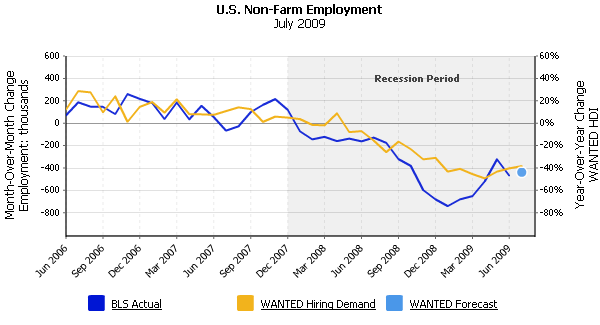
In that vein, Barry Ritholtz links to a graph by Bruce Murray, CEO of WANTED USA, plotting the actual month over month change in non-farm unemployment against year over year percent change in hiring demand:


13. RAIL TRAFFIC VOLUMES BOTTOMED OUT AT 18.9% BELOW LAST YEAR'S NUMBERS

The Railfax report is out today, and seems to indicate that rail traffic volumes have reached a bottom and holding steady at about 18.9% below their seasonal levels. Their chart for weekly loaded units in North America for the week ended August 1 in four week rolling averages:


Their chart for crushed stone and lumber and wood products, key components in construction, in four week rolling averages for North America:

Monday, August 3, 2009

Daily Sources 8/3

1. EUROPE RETURNING TO NUCLEAR POWER

Kate Mackenzie at FT Energy Source has a good summary of the nuclear renaissance in Europe--where several countries have reversed, or are in the process of reversing, decisions to eliminate nuclear power from the generation mix.

2. TBLISI SAYS MOSCOW ATTEMPTING LAND GRAB FROM SOUTH OSSETIA

Misha Dzhindzhikhashvili at the Associated Press reports that Tblisi today accused Russia of attempting to take more territory outside the breakaway province of South Ossetia.
"'It's very alarming that as the first anniversary of the Russian aggression against Georgia comes close, Russia and its puppets are deliberately inciting tensions and behave defiantly,' the Georgian Foreign Ministry said.

But South Ossetia's spokeswoman Irina Gagloyeva told The Associated Press that the border move was legitimate and rejected any land-grabbing ambitions.

'Let the Georgians relax about their territory. We don't need a single centimeter of their soil,' Gagloyeva said."
3. CHINESE CRUDE STOCKS FALL 2.7% IN JUNE FROM MAY, REFINERIES PRODUCED 7.77 MB/D

Jim Bai and Aizhu Chen at Reuters write that Xinhua reported that Chinese crude stocks fell by 2.7% in June from May to 275 million barrels.
"Chinese refineries boosted production by 6% in June to a record 7.77 mb/d after a rise in domestic motor fuel prices aided margins."
4. TOKYO CONCERNED BY SLATE OF IRANIAN NEWS OF NEW CHINESE-IRANIAN OIL DEALS

Kyodo News reports that Tokyo has responded to the news aired in Iran that CNPC was to take a 70% share in South Azadegan, a field which Japan had secured interest earlier but dropped it on international concern about Tehran's nuclear program, by calling for renewed international cooperation on the issue. Japanese Vice Economy, Trade and Industry Minister Harufumi Mochizuki said "It is not desirable that international cooperation collapses this way." CNPC on Friday had denied that a new MOU regarding the field had been signed--see Daily Sources 7/31 #7. Tamsin Carlisle at the National reports that on Saturday a Chinese consortium signed a deal to build a new 360 kb/d refinery in Khuzestan province and expand the capacity of a refinery in Abadan to 360 kb/d from 210 kb/d. Carlisle provides a decent summary of Chinese-Iranian energy deals this year and further in the past as well as different details on the CNPC Azadegan deal:
"The agreement called for CNPC to purchase a 63% stake in the $2.5bn project from NIOC, leaving the Iranian state oil company with a 27% interest and Japan’s Inpex with 10%."
5. INDIA AND CHINA TO COOPERATE ON MONITORING HIMALAYAN MELTING GLACIERS

James Lamont at the Financial Times reports that India and China will collaborate on monitoring melting glaciers in the Himalayas, a crucial source of water supply for both countries.
"Jairam Ramesh, India's environment minister, said academic research bodies on both sides would share information. He also told the FT that New Delhi was also open to a dialogue about water resources with Beijing, saying the two countries had shared concerns."
6. SAUDI ARAMCO TO CUT PRICES, OPEC PRODUCING SLIGHTLY MORE IN JULY FROM JUNE

Christian Schmollinger at Bloomberg report that Saudi Aramco may cut the price of Arab Light crude oil by as average of $1.30/b,
"according to a survey of refiners from South Korea, Japan, Singapore and India. The company is expected to set new official levels this week. Extra Light may fall by $1.40/b, said the traders who asked not to be identified, citing confidentiality agreements.

Saudi Arabian Oil, known as Saudi Aramco, last month raised Arab Light by 10 cents to a premium of $1.50/b to the average of Persian Gulf benchmark’s Oman and Dubai. That was the highest price since July 2008. Asian refiners have been reducing their output as falling consumer demand has cut their so-called crack spreads, or profit margins."
Meanwhile, Karyn Peterson and Mark Shenk at Bloomberg report that the news wire's latest survey showed that OPEC increased oil output by 45kb/d to 28.39 mb/d in July from June."The 11 OPEC members with quotas ... pumped 26.035 mb/d, 1.19 million more than their target."
"Iran, the member that’s least compliant with output limits, according to the survey, expects oil prices to reach $80/b by the end of the year on 'optimistic' signs in the market, the country’s OPEC Governor, Mohammad Ali Khatibi, said.

Angola increased production by 20,000 barrels to 1.81 mb/d. The gain left output 293,000 barrels above the nation’s target, the second-biggest excess in the group. Output in the African country surpassed Nigeria’s for the first time since June 2008.

Venezuela raised output by 10,000 barrels to 2.21 mb/d. The South American country pumped 224 kb/d above its target of 1.986 million last month, the survey showed."
7. 100 IRANIAN POLITICIANS PUT ON TRIAL FOR FOMENTING UNREST IN COOPERATION WITH FOREIGNERS, LOTR FORMERLY INAUGURATES AHMADINEJAD'S SECOND TERM

Borzou Daragahi at the LA Times reported yesterday that Iran put 100 prominent politicians on trial, charging them with fomenting unrest in conspiracy with foreigners.
"Analysts say the confessions read at the trials are meant to lift the morale of hard-liners upset by coverage by reformist news outlets and Persian-language news channels abroad as well as to frighten opponents and take the wind out of the sails of the protest movement.

But as night fell, Tehran, the capital, erupted in angry cries of 'Allahu Akbar!' or 'God is great!' in what has become a daily rooftop ritual of protest."
The nighttime chants deliberately mirror events of the 1979 revolution. Thomas Erdbrink at the Washington Post reports that today Mahmoud Ahmadinejad was inaugurated by Leader of the Revolution Ayatollah Ali Khamenei as president for a second term. Karroubi, Mousavi, and Rafsanjani all elected not to attend the ceremony.
"Relatives of the late Ayatollah Ruhollah Khomeini, who led Iran's 1979 Islamic revolution, also failed to show up. According to pro-opposition Web sites, Hassan Khomeini, a grandson who usually attends such ceremonies, left for Pakistan some days ago. Other prominent absentees were two Friday prayer leaders from the Shiite holy city of Qom, the Parlemannews Web site reported."
8. NIGERIAN AGRICULTURAL POTENTIAL UNTAPPED, LEAVING FOOD SUPPLY VULNERABLE

David Hecht at the Washington Post notes that Nigeria's food supply is especially vulnerable to a disruption caused by low rainfall or other climate-driven variables. He concludes:
"The good news is that Nigeria has boundless agricultural potential. Of the 3.14 million irrigable hectares of land in the country, the World Bank says only 7% is currently being utilized. And though large tracts of farmland have been lost to desertification, more than half the country's estimated 98 million hectares of arable land currently lie fallow.

'The opportunities for our farmers are enormous if only they were to get the right institutional support,' said Sabo Nanono, the head of Kano state's commercial farmers association. 'We could feed the entire West African region; we could produce enough rice in just two or three [of Nigeria's 36] states to feed the nation and even to export.'

Somehow, the supply chain that feeds 140 million people keeps cranking along. The country has not seen a major famine for nearly four decades, since the Biafran civil war. But Nanono warned that it wouldn't take much to send this vulnerable country--and region--over the edge.

'The reality is that if the rains are bad throughout the region or the price of inputs became unaffordable, there could be massive food shortages, and neither the government nor any other institution stands ready to help,' he said. 'Then only God could save us.'"
Hecht's report is part of the Food Insecurity Project.

9. SOUTH AFRICAN PMI DOWN TO 37.3 IN JULY

Nasreen Seria at Bloomberg reports that South Africa's PMI fell to 37.3 in July from 37.9 in June. It is the first fall in PMI seen in three months.
"Manufacturing output, which makes up 15% of the economy, fell 17.1% in May from a year ago, after dropping a record 21.8% in the previous month, the statistics office said on July 9. Production has dropped every month since October 2008."
10. SETSER AND ZIEMBA ESTIMATE MAJOR SOVEREIGN WEALTH FUNDS HOLD ABOUT $1.5 TRILLION IN FOREIGN ASSETS, DOWN FROM $1.8 TRILLION LAST YEAR

Brad Setser and Rachel Ziemba at Follow the Money estimate, in contrast to other estimates, that total external assets of major sovereign wealth funds roughly were about $1.5 trillion as of June 2009, down from their estimate of roughly $1.8 trillion held in the middle of 2008.
"$1.5 trillion is lot of money. But it is substantially less than $7 trillion or so held as traditional foreign exchange reserves."
The post includes an extremely interesting table of estimated assets held by each major sovereign wealth funds at the bottom.

11. 1.5 MILLION TO EXHAUST INITIAL UNEMPLOYMENT INSURANCE IN THE NEXT FEW MONTHS, 1-IN-3 GROCERY SHOPPERS NOW ONLY PURCHASE ITEMS ON SALE

Barry Ritholtz has a pair of posts looking at the rate of people who have exhausted their unemployment insurance. In the first, he notes that the New York Times estimates that about 1.5 million more people will have exhausted their unemployment insurance over the course of the next few months. He links to a helpful graph from the NY Times:


In the second, he notes, as have others such as Rebecca Wilder at News and Economics, that there are additional unemployment programs available after one exhausts the initial unemployment insurance:
"[T]he Emergency Unemployment Compensation (EUC) which is good for 20 weeks. Then, there is the Supplemental EUC, which depending upon what your state thinks of the Federal largesse of handing out money to the recently unemployed, ranges anywhere from 13 to 20 more weeks."
Evidently, as of July 11, the number of people who have exhausted their initial unemployment insurance and are now on EUC or supplemental EUC, has gone from 127,000 a year ago to 2.66 million. The worry is that given that 70% of the economy is based on household consumption, growing unemployment will undermine any nascent recovery. In that vein, Credit Bubble Stocks notes that Information Resources Inc. has published market research which concludes that now
"about 1 in 3 [grocery] shoppers buy exclusively items on sale, twice as many as 18 months ago."
12. US PMI UP TO 48.9 IN JULY

Mark Shenk at Bloomberg reports that the Institute for Supply Management released its PMI today showing an uptick to 48.9 in July from 44.8 in June. (A reading above 50 indicates expansion; below 50 indicates contraction.) It is the highest reading seen since August 2008.

13. CHEVRON TO END ALL ONSHORE GAS DRILLING IN THE US

I missed the interesting factoid reported Friday by the Associated Press that Chevron will stop all US onshore gas rigs on low profitability this year.
"'By the end of the year, we will not have a single gas land-rig running,' George Kirkland, Chevron’s executive vice president for global upstream and gas said in a conference call."

Friday, July 24, 2009

Daily Sources 7/24

1. XINJIANG AUTHORITIES TO "HELP" DEFENDANTS BY ASSURING THEM THAT THEIR COUNSEL IS OF THEIR ETHNICITY, BUT NOT ESPECIALLY QUALIFIED TO REPRESENT CRIMINAL DEFENDANTS

Sky Canaves at China Journal reports that Xinjiang authorities plan to provide all Uighur defendants with legal representation free-of-cost. Further, they will use Uighur lawyers after providing them with quick legal training in criminal defense. It seems rather unusual to think that a lawyer could be quickly retrained into an entirely new specialty, but that appears to be the plan. Canaves notes that when human rights lawyers offered their services free in the aftermath of the recent troubles in Tibet, they were prevented from taking the cases and some subsequently lost their licenses to practice. Indeed, several human rights lawyers based in Beijing this year have yet to receive the renewal of their licenses to practice. These are capital cases. If those lawyers chosen are chosen for their ethnicity as opposed to their ability in the relevant field of law--and if those lawyers particularly interested in defending people suspected of having had their human rights abused are banned from practicing in general--it hardly seems like much of a benefit, but I suppose they will identify more closely with their (mostly) defenseless clients.

2. EICHENGREEN ARGUES CHINESE IMPORTS BEST WAY OUT OF GLOBAL CRISIS

Barry Eichengreen says increased Chinese imports is the best road out of the current financial crisis.
"China can purchase more industrial machinery, transport equipment, and steelmaking material, which are among its leading imports from the US. Directing spending toward imports of capital equipment would avoid overheating China’s own markets, boost the economy’s productive capacity (and thus its ability to grow in the future), and support demand for US, European, and Japanese products just when such support is needed most.

This strategy is not without risks. Allowing the renminbi to appreciate as a way of encouraging imports may also discourage exports, the traditional motor of Chinese growth. And lowering administrative barriers to imports might redirect more spending toward foreign goods than the authorities intend. But these are risks worth taking if China is serious about assuming a global leadership role."
Worth reading.

3. CHINA TO RAISE $2 BILLION FOR FINANCIAL BUSINESS EXPANSION IN AFRICA

Terence Poon and Aaron Back at the Wall Street Journal report that the China Development Bank has plans to raise $2 billion by November of this year for the China-Africa Development Fund. The funds will be used to finance the expansion of financial business ties to Africa.

4. SHANGHAI ADOPTS TWO CHILD POLICY IN ATTEMPT TO DEAL WITH AGING POPULATION

Sky Canaves at China Journal also notes that the city of Shanghai, faced with an aging population, has embarked upon a policy designed to encourage families to have two children.
"For several years, officials at various levels across the country have touted the possibility of allowing couples made up of people who grew up as only children to have two kids to have two kids. Such policies are gaining impetus as the first generation of women born under the one-child policy is now at the peak of its childbearing years. In 2004, Shanghai revised its family planning rules to specify the types of couples who would be eligible to have more than one child."
Evidently no one wants to use productivity gains to cover the costs of an inverted population pyramid just quite yet, meaning, I suspect, that the gains have been overstated (and not just in China).

5. CHINA MAY BE SET TO BECOME LARGEST CONSUMER OF GOLD

Sophie Leung at Bloomberg reports that China is set to overtake India as the world's largest consumer of gold, according to the World Gold Council.
"Jewelry demand in China expanded in the first quarter while dropping in India, Marcus Grubb, a managing director at the London-based council, said today at a conference in Hong Kong. Chinese gold demand will keep rising, he said."
"Total demand from India in the first quarter fell 83 percent to 17.7 metric tons, from 107.2 tons a year earlier, according to figures from the World Gold Council. Purchases in China rose 1.8 percent to 105.2 tons from 103.3 tons. Total Chinese demand for gold was six times that of India in the first quarter, the council said in May."
In the beginning of May, the Financial Times reported that some analysts were arguing that Beijing had embarked upon a policy of increasing the share of its reserves held in gold bullion as a diversification measure--see Daily Sources 5/7 #2.

6. BUITER CALLS BS ON CHINA, INDIA, BRAZIL, SOUTH AFRICA, AND AFRICAN UNION'S CALL FOR THE DEVELOPED WORLD TO PAY FOR CARBON EMISSIONS CUTS

Willem Buiter makes the rather important point that China and India received a great deal of benefit, directly and indirectly, from industrialism, though it was developed in the West. It is not clear that the West today should suffer for the poor policy choices of medieval to twentieth century China. Thus, the argument that the West should be responsible for the cost of carbon emission reductions in the developing world can be described as disingenuous--though it will have a lot of appeal to, well, the vast majority of people in the world. True, but the costs of inaction, should predictions be true, will fall just as generally upon the developing countries as it will on the rich. Very much worth reading, IMO.

7. UK 2Q GDP DOWN 0.2% FROM 1Q, DOWN 5.2% YOY

Laurence Norman at the Wall Street Journal reports that the UK Office for National Statistics announced today that UK GDP in the second quarter fell 0.8% from the first and was down 5.2% on the year.
"Output dropped 2.4% in the first quarter and was down 4.9% on the year. ... In the first half of the year, output fell 3.2%. The government had forecast a GDP decline of 3.5% for the whole year."
8. SPANISH UNEMPLOYMENT TO CLIMB TO 22% IN 2010 PER CITIBANK REPORT

Ed Harrison notes at naked capitalism that a recent report by Citigroup expects unemployment in Spain to climb to 22% in 2010 after having just hit 17.9%. He translates a Spanish article on the report:
"In the opinion of the experts at the company, the recovery will reach Spain later than elsewhere in Europe because of the extent of deleveraging facing the Spanish economy. Therefore, there remains a substantial possibility that unemployment will continue to rise, after the withdrawal of the effects of fiscal measures taken by the Government."
9. RUSSIA WILL SANCTION COMPANIES SELLING OFFENSIVE ARMS TO GEORGIA, PUTIN INDICATES MOSCOW IS READY TO PROTECT DOMESTIC STEEL INDUSTRY

Ellen Barry at the New York Times reports that:
"Dmitri O Rogozin, Russia’s envoy to NATO, said on Friday that Russian President Dmitri A Medvedev had issued a decree that would impose sanctions on any manufacturer who sells offensive weapons to Georgia, 'wherever he is, in the Arctic or Antarctic region or in the United States.'"
Meanwhile, Maria Kolesnikova and Ilya Khrennikov at Bloomberg report that in an address in Magnitogorsk, Prime Minister Vladimir Putin indicated that Moscow is prepared to protect the Russian steel industry.
"Metals companies in Russia may receive preferential treatment in supplying so-called natural monopolies, Putin said, using a phrase employed in the country to refer to state-controlled companies such as natural-gas provider OAO Gazprom.

'We could consider passing a special law on this,' he said."
10. ECUADOR SIGNS DEAL TO PROVIDE CHINE 3 MILLION BARRELS OF CRUDE A MONTH

Eduardo Garcia at Reuters reports that Ecuador has signed a deal to export 3 million barrels of crude oil a month (~ 100 kb/d) to China. Quito will receive a $1 billion advance payment in the first week of August.

11. FED CREATES INVESTORS ADVISORY COMMITTEE MADE UP ALMOST ENTIRELY OF REPRESENTATIVES OF BIG SPECULATIVE CAPITAL

Jesse's Café Américain links to the Federal Reserve Bank's press release announcing the establishment of an investors advisory committee, which will have no policy-making power, but a lot of extra access to decision-makers at the Fed. Jesse makes the point that no member of this committee meant to represent the interests of investors could plausibly represent most investors, but rather big capital. At least Goldman Sachs isn't on the list.

Thursday, July 23, 2009

Daily Sources 7/23

1. UNEMPLOYMENT GROWING RAPIDLY IN THE G-7, BUT BRAZILIAN UNEMPLOYMENT UNEXPECTEDLY DOWN

Rebbeca Wilder at News N Economics notes that unemployment continues to grow quickly in the G7, which should damper consumption:


However, Helder Marinho and Andre Soliani at Bloomberg reported that Brazil's June jobless rate in six main metropolitan areas fell to 8.1% from 8.8% in May.
"Policy makers cut the so-called Selic rate by a half-point to a record 8.75 percent yesterday and said that level was adequate to spur growth and bring inflation back to target.

The drop in the jobless rate 'indicates how strong the domestic market is,' Pedro Tuesta, senior economist for Latin America with 4Cast Inc., said in a telephone interview. 'It reinforces the idea the bank should stop cutting rates.'"
"Annual inflation, as measured by Brazil’s IPCA index, slowed to 4.8% in June, down from 5.2% in May and the lowest since March 2008. Policy makers last month reaffirmed that they seek to slow inflation to 4.5% by year-end."
Average wages, however, are not keeping pace with inflation.

2. ICELAND FORMALLY APPLIES FOR EU MEMBERSHIP

Karl Ritter at the Associated Press reports that Iceland formally applied for membership in the EU today.
"'To be frank with you, if we would get a rotten deal on the fisheries, the Icelandic people would get quite angry,' Foreign Minister Ossur Skarphedinsson said after presenting the EU application to his Swedish counterpart, Carl Bildt. Sweden currently holds the EU presidency.

'This is not only an issue of economics. It is also an emotional issue. It is also an issue that is related to sovereignty,' said Skarphedinsson, a former fisherman."
3. UK RETAIL SALES UP 1.2% IN JUNE FROM MAY, 2.9% YOY, GOVT ANNOUNCES £1.1 BN PLAN TO ELECTRIFY MORE OF ITS RAIL SYSTEM

Svenja O’Donnell at Bloomberg reports that UK retail sales rose 1.2% in June from May, and 2.9% from June 2008.
"Sales at food stores increased by 0.7%, while they rose 1.6% at non-food retailers, the statistics office said. Textile, clothing and footwear shops saw sales increase for the first time in three months, by 4.7%."
Meanwhile, Nicholas Winning at the Wall Street Journal reports that the UK has announced plans to spend £1.1 billion ($1.81 billion) on electrifying two rail routes.
"The works represent the first big electrification of the rail network since the 1980s and will increase the proportion of electric rail journeys in the UK to 67% from 60%, the government said."
4. RUSSIAN MINISTERS TO CONSIDER 0% TAX ON INITIAL MINERAL EXTRACTION IN THE BLACK SEA AND SEA OF OKHTOSK, BUT WARNS MOL THAT IT HAD BETTER COMPLY WITH LICENSING IN SIBERIAN FIELD

Kate Mackenzie at FT Energy Source reports that Russian ministers today will discuss setting a zero rate of taxation for mineral extraction for the initial stages of development in the Black Sea and the Sea of Okhotsk.
"The tax breaks will apply until accumulative output reaches 20 million metric tons (~ 144 million barrels) at Black Sea fields and 30 million metric tons (~210 million barrels) in the Sea of Okhotsk, off Russia’s Pacific Coast. Alternatively, the zero rate may be applicable for 10 years or 15 years for fields being developed under combined exploration and production licenses, according to the statement."
Though I feel sure that it will be tempting enough to make some majors bite, the problem is that when the price of oil rises, Moscow will likely take measures to re-nationalize production at the fields, given their view of their strategic value. Meanwhile, Stephen Bierman and Edith Balazs at Bloomberg report that Mol--Hungary's largest refiner--pledged to meet all requirements in the license terms of a Siberian oil-production venture with OAO Russneft.
"'Mol always acts in accordance with the rules of the Russian Federation and the company will do everything on its part to fulfill all the requirements described in the license agreement,' Mol said today in an e-mailed statement.

On July 2 Russia’s subsoil agency, Rosnedra, gave the Zapadno-Malobalykskoye LLC oil venture six months to correct violations relating to its drilling plan and its use of so-called associated gas, Larisa Kalacheva, a spokeswoman for Russneft, said today. 'The time allotted to correct license infractions is very tight,' she said. 'Action is needed.'

Tensions between Mol and the Russian government have increased since Moscow-based OAO Surgutneftegaz bought a 21.2% share in the Budapest-based refiner in March. Mol called the move hostile and has barred the Russian company from participating in corporate meetings."
5. BIDEN CALLS ON RUSSIA TO REMOVE TROOPS FROM GEORGIAN BREAKAWAY REGIONS, BUT ALSO INDICATES THERE IS NO MILITARY OPTION FOR THEIR REMOVAL

Philip P Pan at the Washington Post reports that in Tblisi today Vice President Joe Biden urged Russia to withdraw its troops from the breakaway regions of Georgia.
"'What we can do is make clear to the whole world, and to the Russians particularly, that we stand with you, and that if they fail to meet their commitments, that it is a problem for them,' Biden told the children, referring to a ceasefire agreement that the Georgia and the United States say Russia is violating.

'A lot of you think maybe Russia did what they did, and they paid no price,' Biden added. 'They paid a pretty big price already diplomatically. The countries that surround Russia, even those that have been very, very loyal to Russia in their freedom, are now saying very harsh things.'"
However, earlier in the day in a speech before the Georgian parliament, Biden said there was "no military option" for Georgia to regain sovereignty over the breakaway regions.

6. CHINESE DEFENSE MINISTRY TO LAUNCH CHINESE / ENGLISH WEB SITE, CENTRAL BANKS OF CHINA, JAPAN, AND SOUTH KOREA ATTEND FIRST TRIPARTITE MEETING

Tini Tran at the Associated Press reports that the Chinese defense ministry will launch an official web site in both Chinese and English on August 1.
"The Web site appears aimed at reassuring Asian and Western nations that the PLA is becoming more accessible to the outside world, experts told the China Daily.

'As more attention is being given to online information, the Chinese army has moved one step forward in its public diplomacy,' Professor Li Xiguang, dean of Tsinghua University's journalism school, was quoted as saying.

The Web site's launch 'is a major step for the PLA to open up to the outside world,' Sr Col Huang Xueping, deputy director of the ministry's information office, said in an interview with the newspaper. The office was only set up last year.

The site will 'cover a large amount of information,' featuring regular activities and background of the Chinese military."
(h/t Sky Canaves at China Journal.) Meanwhile, the first tripartite meeting of the central banks of China, Japan, and South Korea took place today in Shenzhen.
"On December 10, 2008, in order to strengthen their mutual cooperation and communication and better safeguard economic and financial stability in the region, the three central banks jointly announced the establishment of a formal Tripartite Governors’ Meeting mechanism, based on the existing dialogue, which will take place once a year."
(h/t Rebecca Wilder at News N Economics.)

7. CLINTON SAYS US PREPARED TO EXPAND COMMERCIAL RELATIONSHIP WITH MYANMAR IF THEY RELEASE POLITICAL PRISONERS

Glenn Kessler at the Washington Post reports that Secretary Clinton told the media that the US was prepared to expand its commercial and aid relationship with Myanmar if it were to release political prisoners, and specifically Nobel Peace Prize laureate Aung San Suu Kyi.

8. AHMADINEJAD APPARENTLY DEFYING LOTR CALL FOR HIM TO WITHDRAW VP NOMINATION, IRAN SAYS IT HAS FOUND 46 OIL FIELDS IN THE CASPIAN

Ali Akbar Dareini and Lee Keath at the Associated Press report that Iranian President Mahmoud Ahmadinejad has apparently chosen to defy the Leader of the Revolution, Ayatollah Khamenei, who has called upon the president to withdraw his choice for first Vice President,Ahmadinejad's son-in-law.
"Arguing for a further chance to make his case, Ahmadinejad said, 'there is a need for time and another opportunity to fully explain my real feelings and assessment about Mr Mashai.'"
Dareini and Keath observe
"Now Khamenei is facing tests to his authority on two fronts. One is from Ahmadinejad, the other is the open defiance from the reformist opposition, which has continued its campaign against Ahmadinejad despite the supreme leader's declarations that the election dispute is over."
I would put it more as tests of authority from those who see the representative elements of the Constitution in their best interests and those who see it as protecting the vested interests of the old guard, but the point is salient nonetheless. Meanwhile, Xinhua reports that Iran's Oil Minister Gholam Hossein Nozari has reportedly said that Iran has identified 46 oil fields in the Caspian Sea, of which eight are ready for exploitation immediately. (h/t Leanan at the Oil Drum.)

9. MOODY'S UPGRADES PHILLIPINE SOVEREIGN DEBT

Karl Lester M Yap at Bloomberg reports that Moody's rating on Philippine sovereign debt was raised to Ba3 from B1, the highest the country has received in more than three years.
"'The upgrade was prompted by the relatively high degree of resiliency exhibited by both the country’s financial system and external payments position in face of the global financial and economic crises,' Moody’s said. 'International reserves of the central bank are at a historical high and exceptional policy measures have not been required to shield the banking system.'

Philippine international reserves climbed to a record $39.56 billion in January, as rising remittances sent home by citizens abroad countered collapsing exports. Higher debt ratings reduce the cost of borrowing, making it easier for the Philippines to sell debt to fund government spending plans."
10. MEXICAN IMMIGRATION TO THE US HAS SLOWED MARKEDLY SINCE 2006, BUT EMIGRATION BACK TO MEXICO HOLDING STEADY

In a report released yesterday, the Pew Hispanic Center concluded that:
"The flow of immigrants from Mexico to the United States has declined sharply since mid-decade, but there is no evidence of an increase in Mexican-born migrants returning home from the US.

Survey data from the US and Mexico reveal a large flow of migrants back to Mexico, but the size of the return flow appears to be stable since 2006."


(h/t Conor Dougherty at Real Time Economics.)

11. NAR ANNOUNCES THAT EXISTING HOME SALES ROSE 3.6% IN JUNE FROM MAY, DOWN 0.2% YOY; MEDIAN PRICES DOWN 15.4% FROM JUNE 2008

Maya Jackson Randall at the Wall Street Journal writes that the National Association of Realtors announced that existing home sales in June rose 3.6% from May, but are still down 0.2% from June 2008.
"Foreclosures and short sales reflect 31% of sales in June. Distressed property sales have pushed prices lower, year over year. The median price for an existing home last month was $181,800, a 15.4% decrease from June 2008."
Meanwhile, the Department of Labor announced today that seasonally adjusted initial unemployment insurance claims for the week ended July 18 were
"554,000, an increase of 30,000 from the previous week's revised figure of 524,000. The 4-week moving average was 566,000, a decrease of 19,000 from the previous week's average of 585,000."
12. USDA REPORT CONCLUDES FARMERS SITTING ON GOLD MINE IN CARBON OFFSETS INCLUDED IN CLIMATE BILL

Keith Johnson at Environmental Capital writes that a new report from the Agricultural Department concludes that farmers stand to make a fortune from the carbon offsets included in the climate bill.
"To wit: Farmer’s incomes will take a hit in the short term, falling by 1% through 2018. Things will get worse by 2027 (a 3.5% decline) and even worse by 2048 (a 7.2% decline.) That’s because things like fuel and fertilizer will cost more under the climate bill.

But farmers’ net incomes will keep rising, because they will be literally standing on a gold mine in the form of carbon offsets, which will become increasingly valuable. The goods:

'EPA’s analysis projects annual net returns to farmers of about $1-2 billion per year from 2012-18, rising to $20 billion per year in 2050. USDA’s analysis strongly suggests that revenue from agricultural offsets (afforestation, soil carbon, methane reduction, nitrous oxide reductions) rise faster than costs to agriculture from cap and trade legislation. It appears that in the medium to long term, net revenue from offsets will likely overtake net costs from HR 2454, perhaps substantially.'

It might be even juicier; the EPA’s Ms. Jackson estimated the value of agricultural offsets at more than $3 billion in 2020.

And wait—there’s more. '[W]e believe our analysis is conservative--it’s quite possible farmers will actually do better,' Secretary Vilsack said.

That’s because farmers also stand to make a fortune off of other government energy policies, such as ambitious mandates for renewable energy and biofuels that will create lucrative, mandatory markets for crops and even agricultural waste."
Today's must read. The USDA report itself can be found here.

13. OCCIDENTAL FINDS SIZABLE NEW OIL FIELD IN CALIFORNIA

The Los Angeles Business Journal reports that Occidental has announced a significant oil and gas find in Kern County, California.
"The company said in a statement that it believes there are between 150 million and 250 million gross barrels of oil equivalent reserves within the area. Approximately two-thirds of the discovery is believed to be natural gas.

Occidental holds an approximate 80% stake in the property, with Chevron Corp. holding the remaining interest."
That represents about 1.8-3 global days of oil demand.

Thursday, July 16, 2009

Daily Sources 7/16

1. CHINESE MONEY SUPPLY GROWTH 28.5% YOY IN JUNE, CHINA PUBLISHES DATA CLAIMING 7.9% GDP GROWTH, REVISITS "MADE IN CHINA" CAMPAIGN

Yesterday, Macro Man called out Prime Minister of China, Wen Jiabao, for having spurred China's M2 growth to 28.5% year over year, asked whether he deserves the moniker "Helicopter Wen" more than Ben does. He asks:
"Unfortunately, in an act reminiscent of Gordon Brown Stalin, the early 90's data has been wiped from the historical record. A cynic might suggest that this is because China's leadership doesn't want to remind people that one upon a time, money growth was this high and it didn't end well. Judge for yourselves."


Today, the National Statistics Bureau published new figures showing that Chinese GDP growth was 7.9% in the second quarter from the year previous, up from the growth of 6.1% in the first quarter, per Terence Poon and Andrew Batson at the Wall Street Journal.
"Also Thursday, the finance and economic committee of the National People's Congress, China's legislature, warned that the government must prevent the "extraordinary growth" of credit that could lead to inflation risks and problems for the financial system. It said China should strengthen credit checks and prevent a rebound in bad loans. The committee includes influential members but doesn't have a role in setting economic policy.

The People's Bank of China has already started to take some measures to fine-tune the rapid flow of credit. On Thursday, the central bank used its weekly sale of three-month bills to continue to guide money-market interest rates higher for the third straight week."
The Economist notes:
"In the year to June fixed investment surged by 35%, car sales rose by 48%, and purchases of homes by more than 80%. After falling last year, home prices are now rising briskly in some big cities, and share prices have soared by 80% from their November low. Domestic spending has been spurred partly by the government’s stimulus package, but probably even more important was the scrapping of restrictions on bank lending late last year. In June new lending was more than four times larger than a year earlier."


The Economist notes that the importance of property to domestic demand means it is unlikely that Beijing will clamp down too hard on the lending. In the meantime, Carlos Tejada at the China Journal reports that China is revisiting plans to launch a "Made in China" campaign.

2. WORLD BANK WARNS OF DEFLATION ON EXCESS INDUSTRIAL PRODUCTION

Ambrose Evans-Pritchard at the UK Telegraph reports that the chief economist at the World Bank, Justin Lin, in Cape Town recently warned that excess industrial capacity will cause a deflationary spiral unless it is addressed.
"Mr Lin said capacity use had fallen to 72% in Germany, 69% in the US, 65% in Japan, and as low as 50% in some developing countries, mostly touching lows not seen in modern times."
Lin suggests that competitive devaluation will have little productive effect in this environment, saying:
"No country can count on currency depreciation and exports as a way out of recession. Unless we deal with excess capacity, it will wreak havoc on all countries. There is urgent need for global, co-ordinated fiscal stimulus."
(h/t Yves Smith at naked capitalism.)

3. UK SETS GOAL OF 40% RENEWABLE SOURCE FOR ELECTRICITY GENERATION BY 2020

Selina Williams at the Wall Street Journal reports that the UK has set as its goal sourcing 40% of its electricity generation from low carbon energy sources by 2020, with fully 30% to come from wind power, wave and tidal energy and other renewables. The other 10% is to be from coal-powered plants with carbon capture technology and nuclear. (As of 2006, per the IEA, nuclear power generation accounted for 18.6% of total electricity supply in the UK. Coal accounted for 37.5%. All renewables accounted for 6.1%.)
"'Renewables, nuclear, clean fossil fuels, as this plan sets out, are the trinity of low carbon and the future of energy in Britain,' [Energy and Climate Change Secretary Ed] Miliband said yesterdat. 'All of them should be part of our future energy mix.'

The government wants the power sector to be almost completely free of carbon emissions by 2050 as it strives to meet a commitment to cut overall emissions by 80% by 2050. The UK has already cut its emissions by 21% since 1990."
4. TURKEY INCREASES FUEL AND RESTAURANT TAXES, REDUCES BENCHMARK INTEREST RATE TO 8.25%

Delphine Strauss at the Financial Times reports that Ankara yesterday announced that it would raise taxes on petroleum products and restaurants with immediate effect. The new taxes will add roughly 8% to prices at the pump and between 8 and 18% at high end hotels and restaurants.
"'The government is speeding up its efforts to tighten fiscal policy,' said Yakin Cebeci, economist at JPMorgan, estimating the measures could improve budget performance by 0.8% of GDP within 12 months.

Stimulus packages and a spending splurge before local elections in the spring have led to a rapidly widening budget deficit. Figures published on Wednesday by the finance ministry showed a deficit of 23.2bn lira ($15.2bn) in the first half of the year, compared with a surplus of 1.9bn lira in the same period of 2008."
Effective tax collection has been a point of dispute at the IMF in terms of approving a new financing package for Ankara. Meanwhile, Steve Bryant at Bloomberg reports that the Turkish central bank today cut its benchmark interest rate by half a point to 8.25%, it's ninth consecutive monthly cut, indicating that further cuts may be in the works.
"The inflation rate reached a 39-year low of 5.2% in May, before rising to 5.7% last month, a pick-up the central bank says will prove temporary. The bank’s target for this year is 7.5% and its most recent survey of economists and businessmen forecast a year-end rate of 6%.

'Inflation will remain at low levels for a long time,' the bank said in today’s statement."
"Industrial output fell 17.4% in May, extending a decline that drove a record 13.8% contraction in gross domestic product in the first three months of the year."
5. PRESIDENT OF ABKHAZIA SPEAKS OF RELATIONSHIP WITH RUSSIAN RAILWAYS JUST AFTER EBRD LOAN

In light of the EBRD's recent decision to make a $500 investment in Russian Railways, the following portion of a Der Spiegel interview of the President of Abkhazia, Sergei Bagapsh, might be of some interest:
"SPIEGEL ONLINE: There are Russian military bases in Abkhazia, Russian troops guard your external borders, and your currency is the ruble. And, then, you want the Russians to manage your railways for 10 years. Is it possible that you're getting just a little too dependent on Russia?

Bagapsch: We are dealing with the Russian railways because we have to modernize our own. We would be equally pleased to deal with the German railways if they were interested. In any case, there are no completely independent nations in this world. Liechtenstein is dependent on Switzerland, Luxembourg on France. We are all dependent on one another. Georgia is dependent on America; we are on Russia."
6. LOCKHEED MARTIN INDIA CEO STEPS DOWN AMIDST ESPIONAGE SCANDAL, WILL US, AUSTRALIA, INDIA AND JAPAN JOINTLY OPERATE AIR CRAFT CARRIERS IN RESPONSE TO CHINESE CONSTRUCTION OF 6?, INDIA SELECTS 2 SITES FOR US COS TO BUILD NUCLEAR POWER PLANTS

Ajai Shukla at the Business Standard reported on Monday that
"Ambassador Douglas A Hartwick, Lockheed Martin India’s CEO, who was spearheading the world’s largest defense manufacturer’s campaign to sell India the F-16 IN medium fighter aircraft, was withdrawn from India in an unusual hurry."
According to Indian Defense Ministry sources, Hartwick was removed as CEO of Indian operations after the company was discovered to be in possession of classified information regarding defense purchases. Meanwhile, Manu Sood at 8ak recently interviewed US historian Jason Verdugo on the possibility of the Quadrilateral Initiative (or Quad) countries (the US, Australia, India, and Japan) jointly operating the recently decommissioned US aircraft carrier--the USS Kitty Hawk--on the recent news that China has been secretly constructing six aircraft carriers. (I am indebted to Galrahn at Informed Comment for both of these items.) Meanwhile, Amol Sharma at the Wall Street Journal reports that India has selected two sites on which US companies could build nuclear power plants, which will be announced when Secretary Clinton arrives in the country next week.
"The two countries may also use Mrs. Clinton's trip to announce completion of an agreement for the US to track sales of defense equipment and ensure it is used for its stated intent, according to people familiar with the matter. That 'end-use monitoring' agreement will be crucial, experts say, as US companies compete for major contracts such as India's plans to purchase 126 fighter jets at an estimated cost of $11 billion.

A spokesman for India's Ministry of External Affairs said that some agreements will 'naturally' be finalized between the US and India during Mrs. Clinton's trip but declined to elaborate."


7. INDIA AND PAKISTAN AGREE TO INTELLIGENCE SHARING ON BACK OF AL QAEDA CALL FOR GENERAL REVOLT AGAINST ISLAMABAD

Rama Lakshmi at the Washington Post reports that the prime ministers of India and Pakistan met for two hours on the sidelines of a Non-Aligned Movement meeting in Cairo after which released a joint statement in which they agreed to share "real-time, credible and actionable" information on terrorist activities.
"[T]he text of the jointly agreed statement on Thursday said that 'action on terror should not be linked to the composite dialogue process and these should not be bracketed' and that 'terrorism is the main threat to both countries.'"
The statement follows the call by Al-Zawahiri, a key figure in al-Qaeda, for cooperation in its attacks on Pakistani interests, suggesting that the current government is actually in the employ of the US Ambassador. Juan Cole at Informed Comment posts the entire text per the Open Source Center's translation--note that it includes the nationalist refrain that "the West" seeks to break the country up:
"In Pakistan in particular, the Crusade aims at eradicating the growing jihadi nucleus in order to break up this nuclear-capable country, and transform it into tiny fragments, loyal to and dependent on the neo-Crusaders."
This seems increasingly desperate to me and that this particular band of extremists have worn out their welcome in Pakistan.

8. IRAN'S 12 YR CHIEF OF ATOMIC ENERGY ORGANIZATION--FORMERLY 12 YRS AS OIL MINISTER--LINKED TO MOUSAVI STEPS DOWN

BBC News reports that Gholam Reza Aghazadeh, the head of Iran's Atomic Energy Organization, has resigned.
"Mr Aghazadeh is a veteran official who served in the 1980s as a deputy to Mir Hossein Mousavi--the defeated candidate in Iran's disputed presidential elections last month.

In 1985 he began a 12-year stint as oil minister, staying in the post during the presidency of Ali Akbar Hashemi Rafsanjani.

He then moved to his job at the head of the atomic agency in 1997 under the reformist former president, Mohammad Khatami.

He continued in the post when Mr Ahmadinejad was first elected in 2005."
9. IRAQ'S OIL EXPORTS UP ON INCREASED NORTHERN PRODUCTION (STILL SIGNIFICANTLY BELOW PRE WAR PRODUCTION)

Faleh al-Khayat at Platts reports that Iraq's total oil exports rose by 19 kb/d in June to 1.925 mb/d.
"Exports from northern fields rose to 528 kb/d in June, a post-war record and 7 kb/d higher than May exports.

The ministry did not say if the figure for the north included exports from the Tawke and Taq Taq fields in Iraqi Kurdistan, which began exporting crude oil on June 1."
"Production from southern oil fields rose slightly to 1.794 mb/d from 1.759 mb/d in May.

Although this increase is a continuation of the recent improvement in production from the south, the rate achieved is still 161 kb/d below the 1.955 mb/d produced in July last year.

The steep decline in production from southern fields since last July lies behind recent escalation in criticism of oil minister Hussein al-Shahristani and led to his summons by parliament to answer questions about oil policy."
10. VIOLENT CLASH BETWEEN STATE GOVT BACKERS AND NATIONAL GUARD IN TOWN EAST OF CARACAS

Christopher Toothaker at the Associated Press reported yesterday that hundreds locals in a small town east of Caracas by the name of Curiepe reacted to the National Guard seizing a police station controlled by an elected figure from the opposition by massing outside it and hurling rocks, bottles and Molotov cocktails at the troops.
"The conflict began shortly before dawn when about 40 soldiers from the National Guard tossed tear gas canisters at the police post, forced officers to leave and took over the building, said Elisio Guzman, director of the Miranda state police. He contended the troops were following orders from the mayor."
"As the conflict wound down later Wednesday, Adriana D'Elia, a Miranda state government representative, said state authorities agreed to move their police to another building after meeting with the municipality's pro-Chávez mayor, Liliana Gonzalez."
11. FORECLOSURES UP 15% YOY IN 1H 2009, INITIAL UNEMPLOYMENT INSURANCE CLAIMS AT HALF MILLION

Barry Ritholtz at the Big Picture links to RealtyTrac's country-wide county foreclosure map, noting that
"1,905,723 foreclosure filings were reported on 1,528,364 US properties in the first six months of 2009, a 9% increase in total properties from the previous six months and a nearly 15% increase in total properties from the first six months of 2008."


Meanwhile, Reuters reports that initial jobless claims for state unemployment were a seasonally-adjusted 522,000 in the week ended July 11, 47,000 fewer than what was seen in the previous week, per the Labor Department.
"Continued claims of people still on jobless aid after an initial week of benefits fell to 6.273 million in the week ending July 4, the latest for which data is available.

It was the lowest reading since April and the largest one-week decline on record. Analysts had forecast continued claims would decline to 6.85 million."
12. US OIL IMPORTS DOWN 7.6% IN 1H 2009 YOY, JET FUEL IMPORTS HALVED

Robert DiNardo at Platts reports that US imports of crude oil and petroleum products fell in the first half of 2009 by 7.6% from the first half of 2008 to 12.048 mb/d, per the American Petroleum Institute's monthly statistical review.
"Crude oil imports in June were down by 12.2% at 8.754 mb/d from 9.974 mb/d in June 2008. For the January-June period, crude imports were down by 6.2% at 9.191 mb/d versus 9.801 mb/d in the prior period, according to API's estimate.

Product imports in June were also mostly lower. For instance, imports of gasoline fell by 27.5% from a year earlier to 981 kb/d from 1.353 mb/d."
Jet fuel imports collapsed, falling 57% to 39 kb/d in June from 91 kb/d in June 2008.

Monday, June 29, 2009

Daily Sources 6/29

1. IEA REVISES GLOBAL OIL DEMAND DOWN TO AN AVERAGE ANNUAL RATE OF 0.6% FROM 2008-14

Carola Hoyos at the Financial Times reports that the IEA has cut its forecast for incremental global oil demand from 2008-14 to an average annual rate of 0.6% or 540 kb/d, bring total consumption to 89 mb/d from 85.8 mb/d.
"This latest forecast is 3.3 mb/d lower than the previous forecast for 2013 volumes. If the agency’s most pessimistic economic scenario proves correct, oil demand could contract, with consumption falling to 84.9 mb/d by 2014, it said in a report."
Managing Director Nobuo Tanaka suggested that the current environment makes forecasting especially difficult and noted that the data on which the forecast was made, for April, is already old.

2. JAPANESE LNG IMPORTS DOWN 19.6% IN MAY FROM APRIL, BUT INDUSTRIAL PRODUCTION UP 5.9% IN MAY FROM APRIL--BOTH ARE DOWN 18.8% AND 30% FROM MAY 2008, RESPECTIVELY

Jonty Rushforth at Platts reports that Japan imported 4.24 million metric tons of LNG in May, down 18.8% from May 2008 and "19.6% from April, when Japan imported 5.27 million metric tons." (The Platts story includes a table of imports by source, month over month and year over year.) It is interesting in the context of the report released Sunday by the Ministry of Economy Trade and Industry (METI) which showed industrial production up 5.9% in May from April, though still down 30% year over year, as per Jake at Econopix. Their chart:


There has evidently been a rebound in production of passenger cars, which account for about 8.5% of the industrial production index. Worth a look.

3. NDRC RAISES GUIDELINE PRICES ON DIESEL & GASOLINE (SLIGHTLY LESS IN THE SOUTH)

Bloomberg reports that the National Development and Reform Commission announced yesterday that it will raise the price of diesel and gasoline today by as much as 11%. Prices for both will be lifted by 600 renminbi a metric ton ($87.80 or roughly $11.71/b ~ $0.28/gallon).
"Today’s price increases will vary by city and region, according to the NDRC’s statement.

In Beijing, the new ceiling price per ton for the retail grade of gasoline that meets euro III standards, known as 90 octane, will be 7930 yuan a ton (~$1,162/ton ~ $136.71/b ~ $3.26/gallon), while the ceiling price in southern Guangdong province is set at 7795 yuan (~1,142/ton ~ $134.38/b ~ $3.20/gallon)."
Guangdong is the center of economic growth in China, if I understand correctly. The NDRC is raising prices in part due to the surge in demand for cars, driven by the stimulus program.

4. PBOC GOVERNOR SAYS CHINESE RESERVE POLICY WILL NOT CHANGE SUDDENLY

Stephanie Phang at Bloomberg reports that People’s Bank of China Governor Zhou Xiaochuan told journalists today that "Our foreign-exchange reserve policy is always quite stable. There are not any sudden changes." This follows the release of the bank's review on Friday, which appeared to reiterate formally the call for an alternative to the dollar--see Daily Sources 6/26 #1. Yves Smith at naked capitalism comments:
"This certainly looks like a retreat, although Zhou may simply be clarifying the difference between long term policies and immediate plans. But that still begs the question of when and how the transition between the two comes into play.

The tension may also reflect the need to posture aggressively before a domestic audience without unduly rattling markets. But it may also result from the need to appease certain interests within the government. A New York Times article last year explained that as the central bank took foreign exchange losses as the RMB rose, it may have to go hat in hand to the finance ministry, which opposes many of the central bank's policies, particularly on the dollar ...."
5. CHINA PASSES NEW STATISTICS LAW

Andrew Batson at China Journal reports that on Saturday China passed a new law to take effect next year which will stiffen penalties for falsifying social and economic data.
"Recently, officials of the National Bureau of Statistics have become more forthcoming about deficiencies in their data, and have also started publishing a more detailed accounting of economic growth. And this year’s economic census, a quinquennial attempt to obtain basic information on every company of economic significance in the nation, is the centerpiece of the bureau’s effort to build up more accurate figures through the use modern survey techniques."
Batson quotes some examples of the misreporting the government is trying to eradicate:
"* In 2001, a township government in Liaoning province in 2001 instructed the villages it oversees to report quarterly economic indicators that were precisely one-fourth of the annual target, to ensure that the target was met.

* In one town near Ningbo, Zhejiang province, a party secretary reported a total industrial output of 463 million yuan in 2001, which was later determined to be 76% more than the actual figure.

* The leaders of one town near Chongqing in 2004 altered the statistical reports of local companies they sent to higher authorities, in one case changing output of 5 million yuan to 8 million yuan, and in another adding a zero to make output of 3 million yuan into 30 million yuan.

* Over-reporting is not confined to eager officials: one company in Wenzhou, Zhejiang province reported output of 32.15 million yuan in 2003, which was then discovered to exceed the actual figure by 71%."
The post includes a number of links to sources--worth a look.

6. NATO & RUSSIA RESUME OFFICIAL TIES; RUSSIA STARTS WARGAMES IN THE CAUCASUS, A FEW WEEKS AFTER NATO WARGAMES IN GEORGIA

The Associated Press reports that NATO and Russia have resumed ties after NATO suspended them in reaction to the Georgia conflict.
"Russian Foreign Minister Sergei Lavrov met his counterparts from NATO's 28 member nations on the western Greek island of Corfu ahead of a broader informal meeting of ministers from the 56-nation Organization for Security and Cooperation in Europe.

Mr. Scheffer described the talks as 'open and constructive, which means we did not try to paper over our differences on Georgia, for example. But we agreed not to allow those agreements to bring the [NATO-Russia Council] to a halt.'

He said the renewed military contacts would involve meetings of the chiefs of staff of Russia and NATO countries.

The meeting in Corfu, which came as President Barack Obama and Russian President Dmitry Medvedev prepare to hold a summit next week, reflected the trend toward improved relations with Russia."
Meanwhile, Michael Schwirtz at the New York Times reports that Russia has begun war games using 8,500 troops from all branches of the armed services in the Caucasus region.
"The event is also occurring a few weeks after NATO concluded its own exercises in Georgia, drawing complaints from the Russians.

'The Russian exercises, given the timing, are a definitive response,' said Dmitri O. Rogozin, Russia’s envoy to NATO, Interfax reported. 'We are conducting them to ensure the defensive capabilities of Russia in those areas where we see threats.'

Georgia on Monday expressed worry about Russian exercises so close to its borders.

'These exercises are a source of concern because they involve an unprecedented number of servicemen and the newest military hardware of Russia,' said Alexander Nalbandov, Georgia’s deputy foreign minister, Interfax reported. 'We hope that the events of last August, when the Russian army invaded Georgia and occupied its lands, will not repeat.'"
7. GAZPROM SEALS PURCHASE OF 500 MILLION CU M OF NAT GAS FROM AZERBAIJAN IN 2010, SAYS IT WILL RECEIVE PREFERENTIAL TREATMENT ON SHAH DENIZ GAS

Lyubov Pronina and Lucian Kim at Bloomberg report that Russian President Medvedev sealed a deal in Baku today for Gazprom to purchase 500 million cubic meters of natural gas from Azerbaijan next year.
"Gazprom will get priority treatment when the State Oil Co. of Azerbaijan determines the buyers for the [Shah Deniz] offshore field, said Alexei Miller, chief executive officer of the Russian company. Azerbaijan’s gas production will rise 11% to 30 billion cubic meters next year, Aliyev said."
Shah Deniz is a key source of potential supply for the Nabucco pipeline project--the alternative possibility of sourcing from Iran looks particularly politically difficult at the moment.


This follows the news Friday that former German foreign minister Joschka Fischer has been signed on as a consultant to Nabucco--see Daily Sources 6/26 #3.

8. INDIAN REFINERS RUN 2.4% MORE CRUDE IN APRIL, DOWN 4.3% FROM MAY 2008

Vandana Hari at Platts reports that Indian refiners ran 12.77 million metric tons (~3.02 mb/d) of crude in May, up about 2.4% from April, but down 4.3% from May 2008.
"The utilization rate against the country's total installed refining capacity was 102.5% in May, versus 107.1% a year ago.

Between January and May, Indian refiners have run around 65.57 million metric tons of crude, roughly 1.5% lower from a year ago. The trend contrasts with a 3.6% year-on-year increase in 2008 crude throughput over 2007."
Reliance started operating the Jamnagar addition of 500 kb/d capacity on Christmas--see Daily Sources 1/7 #3.

9. IRAQI VP TO BOYCOTT TUESDAY AUCTION, OIL EXPORTS UP 80 KB/D IN MAY (THE ADDT'L OIL CAME FROM THE NORTH), AND THE CABINET WILL NOW DELAY RATIFICATION OF THE OIL AUCTIONS TOMORROW INDEFINITELY

Ahmed Rasheed at Reuters reports that Iraqi Vice President Tareq al-Hashemi has announced on his website that he will boycott the auction on Tuesday to award concessions for eight oil and gas fields.
"'There are many existing reservations over this vital issue concerning Iraq's oil resources,' Hashemi said in a letter, posted on his website, to Oil Minister Hussain al-Shahristani.

He urged the minister to 'hold off on awarding bids to the winning companies and give parliament enough time to study these bids,' said the letter, released by Hashemi's office."
Ben Lando at the Iraq Oil Report notes that Iraqi oil exports grew to 1.9 mb/d in May from 1.823 million in April.
"In the south, where most of Iraq’s production and exports are located, May was a down month, exporting only 1.38 mb/d compared to 1.413 mb/d in April. In the north, however, exports increased to 522.6 kb/d from 410 kb/d in April."
Meanwhile, Faleh al-Khayat at Platts reports that the oil ministry said today that it will not announce the winners of the auction tomorrow, and instead only provide the names of the bidders and a score card of their bidding parameters.
"The cabinet may refer the contracts for approval by the parliament if it
deems this as necessary, marking another new element in the process.

As a result, the August 15 deadline for contract ratification by the council of ministers has been pushed back indefinitely, senior sources close to the licensing department said.

'The winner will not be declared by the score of each bidder and the name of the bidder will be declared,' said one source.

The formula to determine the winning bid has also been changed whereby the ministry will give more weight to the incremental production rather than the remuneration fee submitted by each of the bidding companies, the sources said."
10. ISLAMIC EMIRATE OF AFGHANISTAN THINKS OBAMA IS A BIGGER THREAT TO THE JIHADIST MOVEMENT THAN BUSH

Thomas Hegghammer at jihadica reports that the main story of the July issue of the Arabic-language magazine of the Islamic Emirate of Afghanistan argues that the Obama administration is more dangerous to al-Qaeda than the Bush administration was. The primary reason is that Bush, through foolhardy policies, did much to undermine American power, in language the Obama administration has already disavowed. However, the writer argues that the policies, in effect, will not change. I couldn't agree more insofar as the writer believes that Obama will work to protect the national interest of the US, something that the Bush administration seemed to abandon. (The president's ability to wield soft power is generally more unbounded than hard power--I suggested, as did others, that Obama's credibility advantage will present the largest challenge to our enemies in a piece in March 2008:The Geopolitical Consequences of the Candidates.) Hegghammer's post is worth reading in full.

11. ISRAEL NOT TO PURCHASE LCS'S FROM LOCKHEED MARTIN

Galrahn at Information Dissemination reports that Israel has decided not to go ahead with plans to purchase a number of Lockheed Martin's Littoral Combat Ship (or LCS). Galrahn notes:
"The interesting part of this story isn't necessarily that Israel doesn't want to buy the LCS anymore, and that is a big deal. The interesting thing is that the US would fund the LCS, but not the MEKO [built by the Hamburg-based ThyssenKrupp Marine Systems (TKMS)], through FMS [the Financial Management Service bureau of the Treasury] grant money. By choosing to buy the MEKO, Israel will try to fudge the system and get some of the parts paid for by buying US, with US funding."
12. FAO POLICY BRIEF ON INTERNATIONAL INVESTMENTS IN THE AGRICULTURAL SECTOR IN AFRICA SUGGESTS CONCERN A LITTLE OVERPLAYED

Denis Drechsler and David Hallam at VoxEU argue that concern regarding foreign acquisition of African farmlands is somewhat misplaced. They note that official development assistance going to agriculture has been on a downward trend since 1995:


Key findings:
"* Investments have increased
* Deals seek access to resources, not markets
* Main form of investment: land purchase or long-term lease
* Share of total land assets owned by foreigners is small
* Major investors: Gulf States, China, Republic of Korea
* Main target region: Africa
* Investors: mostly private sector, but governments involved
* Investment partners in host countries: mainly governments
* New focus: production of basic foods and animal feed"
Worth a look.

13. HONDURAN PRESIDENT OUSTED BY MILITARY, HONDURAN SUPREME COURT AND CONGRESS SUPPORT THE MOVE, THE REST OF THE WORLD EXPRESSES CONCERN

William Booth and Juan Forero at the Washington Post report that soldiers forcibly removed President Manuel Zelaya from the Honduran presidential palace yesterday and put him on a plane to Costa Rica.
"Zelaya was removed from office as Hondurans prepared to vote Sunday in a nonbinding referendum asking them whether they would support a constituent assembly to rewrite the constitution. Zelaya's critics said he wanted to use the referendum to open the door to reelection after his term ends in January 2010, an assertion that he denied.

The referendum--which US officials described as more of a 'survey' than a true vote--was condemned by broad swaths of Honduran society as an obvious power grab. The Honduran Supreme Court called the referendum unconstitutional, and leaders of Zelaya's own party denounced the measure."


Both the Honduran National Congress and the Supreme Court voiced support for the move by the military to oust Zeyala. The Honduran military broke off contact with the US following the coup. (The Post article is worth reading in full.) Condemnation of the move was widespread, coming from the OAS to Venezuela to Cuba to the US.

15. CANADA PASSES SUBSIDY FOR PAPER SECTOR IN RESPONSE TO (ALTERNATIVE FUELS) SUBSIDY FOR US PAPER SECTOR

The Wall Street Journal's editorial board notes that in 2007 Congress extended a $0.50 credit for every gallon of a blend of traditional and alternative fuels used to a broad spectrum of corporations, and it turned out that "'black liquor,' a carbon-rich substance the paper industry has used for decades to power its mills, qualified.
"All the paper industry had to do was blend some fossil fuel in with their alternative fuel and--voila!--billions of dollars in federal subsidies were within reach. So they did."
The Journal notes that the US paper industry is set to collect $6 billion in tax credits in 2009, enough to reduce the cost of paper products by 25%.
"Not surprisingly, Canadian paper companies are miffed at this subsidized windfall to their competition. Now they've gotten their Parliament to do something about it. Following the two-wrongs-make-a-right logic of trade wars, Canadian lawmakers recently passed a subsidy worth $882 million for their domestic paper industry."
Worth reading in full.

16. BANK FAILURES UP IN US, CONCENTRATED IN GEORGIA, BUT CONSOLIDATION LIKELY HAS A WAYS TO GO

Rebecca Wilder at News N Economics reports that bank failures are up slightly in 2009 from 2008, but the sector's consolidation has yet to see the number of failures experienced during the S&L crisis. Her graph:

"Notice that roughly 20% of the bank failures in 2008 and 2009 have been in Georgia, or as Camden Fine says to the WSJ, 'Georgia is basically the Chernobyl of banking right now; it's radioactive down there'. And according to the Wall Street Journal, the failures in Georgia have only just begun ..."
Worth reading in full.

17. COLORADO PASSES NEW LAWS PERMITTING RAINWATER HARVESTING

Kirk Johnson at the New York Times reports that two new laws have been passed in Colorado which allow people with private wells to legally collect rainwater, formerly they had only been allowed to do so if they possessed the water rights on their property.
"State water officials acknowledged that they rarely enforced the old law. With the new laws, the state created a system of fines for rain catchers without a permit; previously the only option was to shut a collector down.

But Kevin Rein, Colorado’s assistant state engineer, said enforcement would focus on people who violated water rules on a large scale.

'It’s not going to be a situation where we’re sending out people to look in backyards,' Mr. Rein said.

Science has also stepped forward to underline how incorrect the old sweeping legal generalizations were.

A study in 2007 proved crucial to convincing Colorado lawmakers that rain catching would not rob water owners of their rights. It found that in an average year, 97 percent of the precipitation that fell in Douglas County, near Denver, never got anywhere near a stream. The water evaporated or was used by plants.

But the deeper questions about rain are what really gnawed at rain harvesters like Todd S. Anderson, a small-scale farmer just east of Durango. Mr. Anderson said catching rain was not just thrifty--he is so water conscious that he has not washed his truck in five years--but also morally correct because it used water that would otherwise be pumped from the ground."