
Friday, April 3, 2009


Daily Sources 4/3
1. Reuters reports that the Markit Eurozone Composite PMI employment index for the eurozone showed that corporations continue to fire workers in response to the crisis, falling to 40.3, down from February's 40.8. Edward Hugh at Fistful of Euros reports that unemployment in Spain rose by 123,543 in March, a slower rate of increase than what was seen in February and March. But if you look at the annual rate, unemployment in March grew by 56.69%. His chart:

Worth reading.
2. Jane Baird and Douwe Miedema at Reuters note that after yesterday's European Central Bank decision, Governor Jean Claude Trichet indicated that the bank was preparing to consider "non-standard measures," by which he is understood to mean "quantitative easing."
3. In a very helpful analysis, Simon Johnson at Economix argues that the Obama Administration managed to pull of a coup by getting the European members of the G20 to agree to make the selection process for the head of the IMF open transparent and competitive.
4. Czech Prime Minister Mirek Topolánek has a piece in today's Wall Street Journal which argues that NATO is indispensable.
5. Xinhua reports that Russian Prime Minister Vladimir Putin indicated that Moscow supported continuing talks with Ukraine regarding natural gas transit.

7. UPI reports that IRNA reported that Iranian Oil Minister Gholamhossein Nozari in talks with his Syrian counterpart, Sufian Allaw, in Damascus argued that natural gas export deals to Syria should be concluded as quickly as possible. "'Iran will transfer gas to Greece and Italy through Iraq, Syria and the Mediterranean Sea,' Nozari said." The Turkish Weekly reported on Iran's case for an alternative to the Nabucco Pipeline today:

The "haste" so "urged" sounds to me like Iran is beginning to get worried about the fact of potential Russian cooperation with US efforts to put the kibosh on the nuclear power program.
8. Shamal Aqrawi and Ahmed Rasheed at Reuters report that South Korea's SK Energy has yet to withdraw from contracts with the Kurdish Regional Government, which Baghdad insists it must cancel in order to be approved as a bidder for the central government's oil concessions.
9. Zhou Xin at Reuters reports that the official Chinese PMI for March indicates expansion, moving from 49.0 in February to 52.4 in March.
10. Robert Campbell at Reuters reports that in a report delivered to the US Congress on Wednesday states that the Mexican finance ministry expects crude oil production to fall below 2.5 mb/d in 2011.
12. Barry Ritholtz at the Big Picture reports that the non-farm payroll employment number out today from the Bureau of Labor Statistics fell by 663,000 in March, bringing the headline unemployment number to 8.5%, from 8.1% in February. Calculated Risk plots the trajectory of the decline in employment against the post war recessions in a useful graph:

The U-6 number, or total unemployed plus the total of "marginally attached" workers plus total employed part-time for economic reasons has reached 15.6% in March from 14.8% in February.
13. Rebecca Wilder at News N Economics has a post showing that although the number of bank failures due to this financial crisis have been high, at 46, the number is not especially large historically-speaking, "the Fed and the Treasury likely enabled the economy to skirt a depression-sized disaster."

She argues that the financial situation will require consolidation, sooner or later. Well worth a look.
14. James Hamilton at UCSD has authored a very important report for the Brookings Institution which shows--to his own disbelief, evidently--that the oil shock of 2008 was a primary cause of the current financial crisis. As Justin Lahart's post on the piece in Real Time Economics summarizes:
15. Charles Abbott and Russ Blinch at Reuters reported yesterday that 32.2 million Americans received food stamps in January, or 1 in 10, 10%.
Worth reading.
2. Jane Baird and Douwe Miedema at Reuters note that after yesterday's European Central Bank decision, Governor Jean Claude Trichet indicated that the bank was preparing to consider "non-standard measures," by which he is understood to mean "quantitative easing."
3. In a very helpful analysis, Simon Johnson at Economix argues that the Obama Administration managed to pull of a coup by getting the European members of the G20 to agree to make the selection process for the head of the IMF open transparent and competitive.
"The managing director of the IMF is very powerful, with a great deal of authority and discretion, and has always been a European--in effect, appointed by European governments to represent their interests. The G-20 made it clear that this will stop--the communiqué says the selection process will be open, transparent and competitive. But really this is code for saying they will pick someone from an emerging-market country, such as India or Brazil (and there are some excellent candidates). The right person in this job could have a huge positive effect on the IMF’s legitimacy.C. Randall Henning at the Peterson Institute for International Economics drew attention to the worries that the nations of the Asia Pacific were going to basically abandon the IMF via the Chiang Mai Initiative [CMI] in a paper published on February 27:
To make things matters more interesting, the IMF’s managing director is expected by insiders to resign within a year, to resume his (promising) pursuit of the French presidency. The leadership race for the next managing director effectively starts today; the stakes are high, and competition will be intense.
How did the Obama administration pull this off? In a brilliant move, they took the lead by volunteering to open up the selection process for the World Bank, the IMF’s sister organization, which has always been run by an American. The next president of the World Bank is very likely to be Chinese."
"Steve Weisman: Do you see any danger of them going separately from the IMF and having their own deals to bail out countries in times of crises?(h/t RGE Monitor)
C. Randall Henning: That of course is what a number of people are worried about. I’m not worried about that at this point. First of all, there are differences of view within Asia about how to construct and administer these arrangements, and I don’t
think that they are willing to break with the IMF right now. They’re aware that they have to make more progress in the development of their regional surveillance mechanism. Before East Asia is going to be in a position to define any conditionality that would flow through a multilateralized CMI, until they develop a regional capacity for analysis and surveillance, they’re going to continue to rely on the IMF to help define the conditions that should be attached to the financing. So the way it’s structured now in the bilateral swap arrangements under the CMI is that most of that money would not flow to a borrower in Southeast Asia unless that borrower also negotiated an IMF program. So it’s designed as a parallel line of defense. But that will continue under a multilateralized CMI, although they may change the ratio between the linked portion and the unlinked portion in these arrangements."
4. Czech Prime Minister Mirek Topolánek has a piece in today's Wall Street Journal which argues that NATO is indispensable.
"When thinking about the further development of NATO, I try to imagine a world without it. I imagine countries threatened with terrorism (and which country would dare say that it is not?) left alone to defend themselves. I imagine invaded countries scrambling to find allies too late. I imagine Afghanistan or another unstable country becoming the center of militant organizations and drug cartels. I imagine countries in strategic locations becoming toys in the hands of powerful neighbors.One suspects that Topolánek, whose coalition was recently ousted by a no confidence vote, is trying to undo some of the damage done by framing US fiscal policy as "the way to hell"--see Daily Sources 3/25 #4. Meanwhile, Edward Cody at the Washington Post reports that the Europeans are unlikely to commit more troops to Afghanistan in support of the new US plan for addressing the situation there.
As President Barack Obama rightly said in his recent speech unveiling a new strategy on Afghanistan and Pakistan, 'the very idea that free nations can come together on behalf of our common security . . . was the founding cause of NATO six decades ago, and that must be our common purpose today.' If such a world without NATO indeed existed, I would be the first to call, on the basis of historical experience encompassing the Munich Treaty and the end of democratic Czechoslovakia, for the creation of an alliance that would protect freedom, equality and respect for human dignity and life."
"European officials said Obama is likely to come away from the summit Saturday with a broad endorsement of his idea that stabilizing Afghanistan is a strategic goal for NATO and support for his decision to devote more civilian as well as military resources to eliminating al-Qaeda havens there and in Pakistan. But they also said that summit pleasantries are unlikely to mask Europe's refusal to commit to major new troop deployments.That said, the Washington Post has published the transcript of a joint press conference of Chancellor Angela Merkel and President Obama in which she said,
Europe's main new contribution for now, French officials said, will be a 300-member corps of paramilitary gendarmes to mentor Afghan policemen in the provinces. France, Italy, Spain and Portugal have expressed interest in participating, the officials said, but the project is still under discussion and, in any case, the force would be deployed only in areas considered pacified enough for NATO soldiers to turn the area over to Afghan authorities."
"Well, what is indeed gratifying to note is that the new approach of the new administration of the United States as regards Afghanistan is very much in step with what Germany is envisaging, the sort of networked security, as we call it, or an integrated security, where you have a civilian component of rebuilding, training, and last, but not least, obviously, also, the capacity of the Afghans to really defend themselves.The transcript is worth reading in full. It seems to me that Obama's commitment to transition the US effort out of Iraq into Afghanistan will remind many in Europe of the original reasons for their support for the US effort in Afghanistan--and may well produce more cooperation in that effort than we have seen so far. I find this line of thinking convincing in part because of the US's decision to include Iran in the recent negotiations. In the meantime, a Spanish magistrate, Baltasar Garzon, has asked a Spanish prosecutor to file charges against Douglas Feith. I believe this is the same magistrate who pursued a case against Pinochet. Feith has written an op ed in the Wall Street Journal, serving as his own defense attorney.
That is actually what we were after with our mission to Afghanistan."
5. Xinhua reports that Russian Prime Minister Vladimir Putin indicated that Moscow supported continuing talks with Ukraine regarding natural gas transit.
"At the corporate level, of course, the dialogue must continue in all areas. Ukraine is our important partner from the standpoint of gas transit."Meanwhile, CJ Chivers at the New York Times reports that Russia has maintained troops in the breakaway regions of Abkhazia and South Ossetia in violation of the cease fire agreement which called for both sides to withdraw their troops to the positions held before the war broke out.
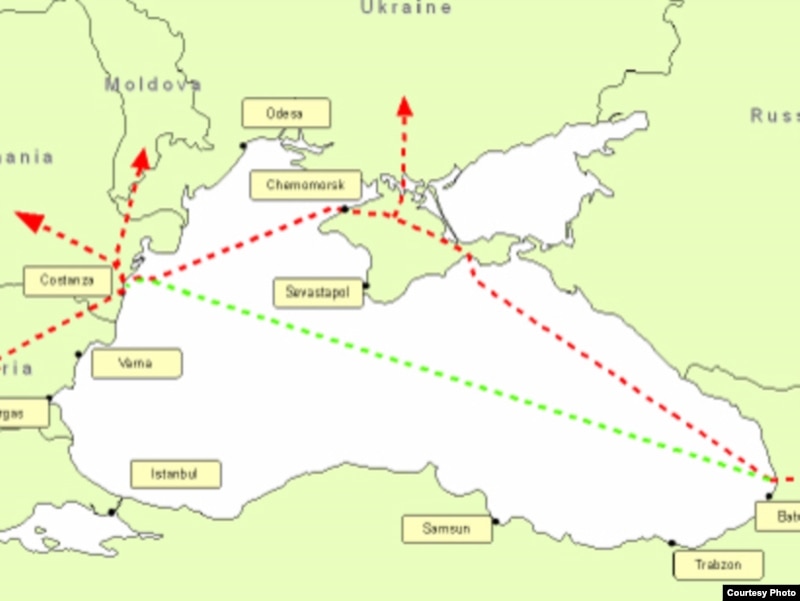
"Gilles Janvier, deputy head of the European monitoring mission, said in an interview that Russia had told diplomats that it had entered its own military agreement with the two breakaway regions in Georgia, which the Kremlin recognizes as independent states, and that these newer arrangements rendered the troop withdrawal component of the cease-fire plan obsolete."6. John Roberts at Platts reports that the Georgian government signed a memorandum of understanding with the GUEU-White Stream Pipeline Company to support a natural gas pipeline which would pass through Georgia, the Black Sea, to Romania and onwards towards the rest of Europe. Romania has yet to sign an MOU in support of the project. White Stream corporate development director Giorgi Vashakmadze told Platts that "It will take us five years to start laying the first pipeline after we have completed all the necessary agreements," and that the planned pipeline is meant to be complementary with the Nabucco pipeline. Alternatively, the pipeline might pass through the Ukraine, though recent events would seem to make that an unlikely choice. The two proposed paths of the pipeline are indicated in the map below.
7. UPI reports that IRNA reported that Iranian Oil Minister Gholamhossein Nozari in talks with his Syrian counterpart, Sufian Allaw, in Damascus argued that natural gas export deals to Syria should be concluded as quickly as possible. "'Iran will transfer gas to Greece and Italy through Iraq, Syria and the Mediterranean Sea,' Nozari said." The Turkish Weekly reported on Iran's case for an alternative to the Nabucco Pipeline today:
"Safe transit routes will be determined based on political and strategic realities. The Nabucco pipeline will pass through Turkey and the Balkans. The Persian Pipeline might pass through Iraq, Syria and the Mediterranean to Europe. These alternative routes will be discussed by the buyers, suppliers and transit countries."Up until now, the Persian Pipeline, aka Pars Pipeline, has been envisioned as passing through Bazargan, a city on the Turkish border--completely bypassing Syria and Iraq. Bazargan is about where I indicate on the map below.

The "haste" so "urged" sounds to me like Iran is beginning to get worried about the fact of potential Russian cooperation with US efforts to put the kibosh on the nuclear power program.
8. Shamal Aqrawi and Ahmed Rasheed at Reuters report that South Korea's SK Energy has yet to withdraw from contracts with the Kurdish Regional Government, which Baghdad insists it must cancel in order to be approved as a bidder for the central government's oil concessions.
9. Zhou Xin at Reuters reports that the official Chinese PMI for March indicates expansion, moving from 49.0 in February to 52.4 in March.
"'The continuous increase in PMI, along with positive signs I can witness from different places, showed that the Chinese economy may have started to warm up,' Ma Jiantang, the head of China's National Bureau of Statistics, told the China Information Daily, the statistics bureau's mouthpiece."The official index stands in contrast to the private CLSA China PMI, which fell to 44.8 in March, down from 45.1 in February--see Daily Sources 4/1 #6. (Readings above 50 imply expansion; below 50 implies contraction.)
10. Robert Campbell at Reuters reports that in a report delivered to the US Congress on Wednesday states that the Mexican finance ministry expects crude oil production to fall below 2.5 mb/d in 2011.
"The finance ministry estimated oil exports would drop to 1.125 mb/d in 2010 from 1.370 mb/d forecast for this year."11. Jens Erik Gould at Bloomberg reports that Manuel Marrero Faz, senior oil adviser at Cuba's Ministry of Basic Industries, said that the country would welcome US participation in its offshore oil fields were the embargo ended.
"We are open. ... We’re very close to each other. We’re neighbors. Why not do business?""The US Geological Survey estimates Cuba’s North Basin region, one of three offshore areas believed to hold oil, has 4.6 billion barrels." To put that in context, 4.6 billion barrels is about 55 days of global oil consumption (at a rate of 84 mb/d).
12. Barry Ritholtz at the Big Picture reports that the non-farm payroll employment number out today from the Bureau of Labor Statistics fell by 663,000 in March, bringing the headline unemployment number to 8.5%, from 8.1% in February. Calculated Risk plots the trajectory of the decline in employment against the post war recessions in a useful graph:
The U-6 number, or total unemployed plus the total of "marginally attached" workers plus total employed part-time for economic reasons has reached 15.6% in March from 14.8% in February.
13. Rebecca Wilder at News N Economics has a post showing that although the number of bank failures due to this financial crisis have been high, at 46, the number is not especially large historically-speaking, "the Fed and the Treasury likely enabled the economy to skirt a depression-sized disaster."

She argues that the financial situation will require consolidation, sooner or later. Well worth a look.
14. James Hamilton at UCSD has authored a very important report for the Brookings Institution which shows--to his own disbelief, evidently--that the oil shock of 2008 was a primary cause of the current financial crisis. As Justin Lahart's post on the piece in Real Time Economics summarizes:
"[Maybe] what happened to oil prices had something to do with credit markets seizing up. The housing bubble saw people of lesser means traveling further afield to buy homes. That gave them long commutes that they were able to afford when gas was $2 a gallon, but maybe they couldn’t at $3. Housing in the exurbs got hit hardest, and one reason why is that high gasoline prices made it hard for people to lived in them to keep up with their mortgage payments, and hard for them to sell their homes without taking a steep loss. In some meaningful way, that has to have contributed to mortgage problems."Hamilton's own summary is here. The report--quite long at 70 pages, is here.
15. Charles Abbott and Russ Blinch at Reuters reported yesterday that 32.2 million Americans received food stamps in January, or 1 in 10, 10%.
"The average benefit was $112.82 per person in January. ... Food stamp benefits get a temporary 13% increase, beginning with this month, under the economic stimulus law signed by President Barack Obama. The increase equals $80 a month for a household of four."Seriously worrisome stuff. I personally feel--strongly--that more should be offered ... especially given that food stamps produce the largest "multiplier" of all stimulus measures, as they must be spent in a set time--see Menzie Chinn's post on October 27, 2008. Food security is the most critical measure of stability, always. As Bob Marley put it, "A hungry man is an angry man."
Thursday, April 2, 2009
Daily Sources 4/2
1. Daniel Pimlott at the Financial Times reports that the G20 agreed today to provide $1.1 trillion to fight the financial crisis. Of that, $750 billion would go to the IMF, $250 billion would go to trade finance, and $100 billion would go to multilateral development banks.
2. Chris Giles, George Parker and Gillian Tett at the Financial Times report that Dominique Strauss-Khan, the managing director of the IMF, argued in an interview with the paper yesterday that the G20 was failing to recognize that in order to resolve the financial crisis, you must first resolve the issues facing the financial sector. Quote:
5. Jonathan Weisman at Real Time Economics posts that in a translation of parts of a speech that Russian President Medvedev made at the G20 summit, he suggested that a basket of currencies replace the dollar as the global financial system's reserve currency. The speech was provided to the Wall Street Journal by a Kremlin aide--and so far I have been unable to find a translation of the entire document on the web. The translation also includes the following point:
6. Alex Morales and Gaurav Singh at Bloomberg reports that Indian and Chinese officials in interviews with the news wire said that global warming policies being considered by Japan and the US are being seen as protectionist measures.
8. On March 27, China and Myanmar agreed to the construction of pipelines to transport African and Middle Eastern crude oil from Myanmar's Arakan coast to Kunming. Construction is expected to commence on the pipeline soon and scheduled to be complete in 2013. The oil pipeline is expected to cost $1.5 billion and the natural gas pipeline $1 billion. The pipeline will create an alternative to the Strait of Malacca for African and Middle Eastern crude en route to China. (I've drawn a rough idea of the route on the map below--it has no relationship to the actual route, it only connects the start and end points.)

15 million barrels pass through the Strait of Malacca every day, on average--the article gives no sense of the throughput planned for the two pipelines. About 80% of Chinese crude oil imports of about 3.3 mb/d pass through the Strait.
9. Jeff Stein at Spy Talk reports that a Uighur dissident, Rebiya Kadeer, in the US is being harassed by Chinese agents.
10. Blaine Harden at the Washington Post reports that Pyongyang warned via a radio broadcast yesterday that it "will relentlessly shoot down" reconnaissance aircraft of the US and allied nations seeking to monitor its satellite launch.
11. Muriel Boselli and Ikuko Kao at Reuters report that the CEO of Total, Christophe de Margerie, told a conference today that the investment terms offered by Iran for the development of South Pars were commercially unattractive.
"On financial regulation, the G20 agreed to 'extend regulation and oversight to all systemically important financial institutions, instruments and markets', including for the first time big hedge funds. It also said that credit agencies would be registered and monitored for the first time, after the failing of credit ratings played a big part in exacerbating the credit crisis.No globally coordinated stimulus program was agreed upon, nor was a globally coordinated method of addressing the financial sector's balance sheets. The communique did explicitly provide support for Mexico's application for a $47 billion flexible credit line. The communique itself can be found here.
The communique said that the G20 would extend 'regulatory oversight and registration to credit rating agencies to ensure they meet the international code of good practice, particularly to prevent unacceptable conflicts of interest.'"
2. Chris Giles, George Parker and Gillian Tett at the Financial Times report that Dominique Strauss-Khan, the managing director of the IMF, argued in an interview with the paper yesterday that the G20 was failing to recognize that in order to resolve the financial crisis, you must first resolve the issues facing the financial sector. Quote:
"[You] never recover before the cleaning up of the banking sector has been done. The US ... is rightly insisting on stimulus and the EU rightly insisting on regulation. They are not yet moving quickly enough in doing the cleaning up of the financial system."3. Gabi Thesing at Bloomberg reports that the European Central Bank cut its benchmark interest rate by 0.25% to 1.25%, 0.25% less than what most economists had expected.
"'The latest economic data and survey information confirm that the world economy and the euro area is going through a severe downturn,' said ECB President Jean-Claude Trichet at a press conference in Frankfurt after the decision. 'Available indicators of inflation expectations remain firmly anchored.'"4. Frank-Walter Steinmeier, the German Foreign Minister, has a piece on the future of NATO in today's Der Speigel. Reflecting on the purpose of NATO in anticipation of the organization's weekend summit marking its 60 year anniversary in Strasbourg, Steinmeier argues that the organization is still required. Regarding Afghanistan, Steinmeier says:
"We certainly welcome the new US strategy. We have to work together to ensure that Afghanistan never again becomes a safe haven for terrorists. We have to enable the Afghans to assume themselves the responsibility for security in their country. And there was a broad and common understanding at the recent conference in The Hague that we need to devote more efforts and means to civil reconstruction, and that we have to develop a regional approach that includes Pakistan."Regarding Russia, he says:
"It's a fact that Russia is and will remain a difficult partner. But at the same time it is true that in the end we can only achieve pan-European security by working with, and not against, Russia. That's why I'm advocating an active NATO policy toward Russia. We must use the instruments we have for dialogue, such as the NATO-Russia Council. And at the same time we have to do more than just formally revive them. We must strive to develop these instruments into a platform for active security cooperation. From Afghanistan to fighting pirates, the list of relevant areas for cooperation is long."Steinmeier also argues that the return to full-membership of France to NATO is further evidence that NATO is not a competitor of the EU, but a partner. Worth reading in full.
5. Jonathan Weisman at Real Time Economics posts that in a translation of parts of a speech that Russian President Medvedev made at the G20 summit, he suggested that a basket of currencies replace the dollar as the global financial system's reserve currency. The speech was provided to the Wall Street Journal by a Kremlin aide--and so far I have been unable to find a translation of the entire document on the web. The translation also includes the following point:
"It is not our goal to destroy existing institutions or to weaken the dollar, pound or euro. We are simply calling for a joint assessment of how the global currency system can most favorably be developed for the sake of the global economy ... ."Meanwhile, Stephen Bierman at Bloomberg reports that Russia increased oil output as OPEC pursued cuts.
"March output advanced 0.4% a day in comparison with both the previous year and month to 9.8 mb/d, the Energy Ministry’s CDU-TEK unit said in an e-mailed statement today. It was the first increase on year-on-year production since 2007."Platts reports that Oil Movements, a London-based consultancy, estimates that OPEC oil exports, excluding Ecuador and Angola, will fall to 22.15 million b/d in the four weeks ending April 18, down 960,000 b/d from the previous four-week period. Rachel Jones at the Associated Press reports that the EIA released data yesterday showing that Venezuela increased oil exports to the United States by about 14% in January from December. Venezuela had promised to cut its exports to the US by 16% starting January 1 to comply with the embargo. The country still sends about half of its oil exports to the US, according to EIA estimates.
6. Alex Morales and Gaurav Singh at Bloomberg reports that Indian and Chinese officials in interviews with the news wire said that global warming policies being considered by Japan and the US are being seen as protectionist measures.
"'If there’s going to be a border tax imposed, that would very much have the danger of triggering a trade war,' Su said in a telephone interview from Beijing. 'That’s not something that we would be happy to see,' he said before the start of United Nations talks running through April 8 in Bonn.7. Keith Bradsher at the New York Times reports that Beijing has adopted a plan to become one of the leading producers of hybrid and all-electric cars within three years. I would add that all electric cars mean, in China, more coal consumption--the dirtiest carbon-based fuel of all.
...
'We should be very careful that climate change doesn’t become a peg on which we start hanging protectionist tendencies,' Shyam Saran, India’s special envoy on climate change, said in an interview in New Delhi two days ago."
8. On March 27, China and Myanmar agreed to the construction of pipelines to transport African and Middle Eastern crude oil from Myanmar's Arakan coast to Kunming. Construction is expected to commence on the pipeline soon and scheduled to be complete in 2013. The oil pipeline is expected to cost $1.5 billion and the natural gas pipeline $1 billion. The pipeline will create an alternative to the Strait of Malacca for African and Middle Eastern crude en route to China. (I've drawn a rough idea of the route on the map below--it has no relationship to the actual route, it only connects the start and end points.)

15 million barrels pass through the Strait of Malacca every day, on average--the article gives no sense of the throughput planned for the two pipelines. About 80% of Chinese crude oil imports of about 3.3 mb/d pass through the Strait.
"Over the past few years, Chinese analysts and leaders have been describing the strait, as a strategic vulnerability, drawing attention to the consequences for China if this shipping channel were to fall into the hands of 'hostile powers' or pirates or terrorists. What if the US were to block China's access to the strait in the event of a China-Taiwan conflict?Perhaps, but the project actually extends the arena which China's navy might be called upon to be able to project force to from the Malaccan Strait to the coasts of Arakan--well into the Indian Ocean. So it doesn't really obviate the possibility of a naval disruption to supply.
In November 2003, Chinese President Hu Jintao articulated this fear when he declared that 'certain major powers' were bent on controlling the strait. Analysts have been discussing the country's 'Malacca dilemma' since then and exploring options to overcome it. One proposal, partially undertaken, is to develop a port and pipeline terminal at Gwadar, in southwest Pakistan, from where Middle East fuel could also be pumped to western China."
9. Jeff Stein at Spy Talk reports that a Uighur dissident, Rebiya Kadeer, in the US is being harassed by Chinese agents.
"Her accusations are backed up by other dissidents, the FBI and a Virginia congressman whose own files were infiltrated by Chinese hackers.""Information management" is clearly a priority of many closed societies, but allegations of intimidation on US soil are especially serious--proof would absolutely have the effect of souring the view of the PRC by many in Congress and the Administration. Meanwhile, Dennis C. Wilder, China director and then senior director for East Asian affairs at the National Security Council from August 2004 to January 2009, has an op ed in the Washington Post which argues that we would do well to reassure our allies in the Asia Pacific that we are not seeking to partner with China in such a way as to subordinate their interests to a "G-2".Key excerpt:
"A more realistic Chinese goal may be to create a partnership with the United States in which our Asian allies, such as Japan, South Korea, Australia, Thailand and the Philippines, are relegated to a subordinate status and the United States and China would share Asian preeminence--at least for a time.A very worthwhile read in full.
The G-2 moniker worries Asians for just this reason. From Japan to India, there are concerns that America's search for a solution to its worst economic crisis since the Great Depression may lead the Obama administration into not only expanded strategic economic and political dialogues with China but a full-blown strategic partnership. As the center of gravity of US economic interests moves from Europe to Asia, they worry, the United States could become enamored of a 'China first' approach. Notably, the career Indian diplomat MK Bhadrakumar recently lamented that 'the US-India relationship is entering a phase of lull' while Washington engages in 'Chinamania.'"
10. Blaine Harden at the Washington Post reports that Pyongyang warned via a radio broadcast yesterday that it "will relentlessly shoot down" reconnaissance aircraft of the US and allied nations seeking to monitor its satellite launch.
"Experts who have examined recent satellite photographs of the rocket said its payload is probably a satellite-like device."BR Myers, a researcher of North Korean ideology and propaganda at Dongseo University in Busan, South Korea, has a very useful opinion piece in today's New York Times, despite it's very misleading and rather unhelpful title (decided upon by the editors, not the author) "To Beat a Dictator, Ignore Him."Instead, what the piece argues is that a regime considers its ideological self-justification and propaganda regarding its own accomplishments and stature as critical to its survival--"information management."
"This means demanding changes where they matter most, and can be immediately verified — on the propaganda front — before putting our faith in some grandiose timetable of disarmament. If Kim Jong-il will not cease referring to himself as a 'military first leader,' or stressing that America and North Korea 'can never share the same sky,' we can be certain, without letting yet another deadline elapse, that he is negotiating in bad faith. For far too long, American diplomats have treated Kim Jong-il’s political culture as his business. It is ours as well."Well worth reading in full.
11. Muriel Boselli and Ikuko Kao at Reuters report that the CEO of Total, Christophe de Margerie, told a conference today that the investment terms offered by Iran for the development of South Pars were commercially unattractive.
"It is very important to reduce the costs of energy projects, we will see if we can get acceptable terms, but frankly today the terms offered today (in Iran) are not attractive enough. Because of the unsatisfactory conditions, Total was never able to strike a real deal for the South Pars project."12. Nick Bunkley at the New York Times reports that at an annual rate GM's sales were down 45% in March; Chrysler’s were down 39%; Toyota's were down 9%; Nissan's were down 38%; and Honda's were down 36 percent.
"Over all, industry sales fell 37% in March from a year ago, but they rose nearly 25% from February’s 27-year low, the biggest February-to-March increase since 2005."13. The Associated Press reports that initial claims for jobless insurance rose to a seasonally adjusted 669,000. 5.73 million are continuing to claim benefits.
Wednesday, April 1, 2009
Daily Sources 4/1
1. Michael D. Shear at the Washington Post reports that Russia and the US released a joint statement today after a closed-door meeting in which the two countries pledged to begin work on a new treaty to reduce offensive nuclear weapons to replace START.
2. Edward Hugh at Russia Economy Watch reports that VTB Bank's Russian PMI rose slightly to 42 in March from 40.6 in February.
4. President of France Nicolas Sarkozy has a piece in today's Washington Post in which he argues that a primary prerequisite to resurrecting global economic growth is to reform its financial regulatory structure.
7. Jonathan Nonis at Platts reports that March bunker fuel sales are expected to rise 10% from February, but fall 5% year over year. Since the Singapore bunker fuel numbers are reported in a monthly weight as opposed to daily volume measure, the monthly increase is mostly explained by the fact that March has about 10% more days than February. Bunker fuel is an indicator of shipping volumes as it is a primary marine fuel.
8. Fausta Wertz at The Compass reports that although Venezuela has been a signatory to the ICC since 1998, Hugo Chávez said in Doha today that the ICC "has no power to make a decision against a sitting president, but does so because it is an African country, the third world." Chavez invited Sudanese President al-Bashir to visit Venezuela, saying
9. The Associated Press reports that the Kuwait Stock Exchange halted trading in 36 companies because they had failed to meet the deadline for providing financial results. Two of Kuwait's largest firms, Global Investment House and Investment Dar, are of the number.
11. Jens Erik Gould at Bloomberg reports that Mexico will seek for a $47 billion credit line from the IMF.
12. The Associated Press reports that a Mexican gang was captured which was being paid by US refiners to steal oil from Pemex and smuggle it into the US for processing. (Believe it or not.) The refiners involved were not named. US authorities assisted in the year long investigation leading to the gang's capture.
13. Brad Setser at Follow the Money reports that global foreign exchange reserves are shrinking, mostly because surplus tax receipts are declining on shrinking economies. Setser produces a graph showing that foreign dollar holdings are growing much more slowly.

14. Sudeep Reddy at Real Time Economics reports that the Institute for Supply Management's PMI rose slightly to 36.3--the third consecutive increase.
16. Nick Bunkley at the New York Times reports that automobile sales by Ford and Volkswagen continued to fall in March. Ford reported today that sales fell by 41% in March on an annual basis, though its share of the market is its highest since December 2006. Volkswagen announced its sales fell by 20%. Other carmakers are expected to announce their sales figures later today.
17. The EIA reported today that crude oil stocks grew by 2.8 million barrels in the week ended March 27 to 359.4 million barrels, still below the high seen 15 years ago of 362.2 million barrels on July 16, 1993. According to a Bloomberg survey, analysts had expected a 3 million barrel build. Gasoline stocks grew by 2.2 million barrels to climb above the historical range for this time of year and against Wall Street expectations of a 1.5 million barrel draw. Distillate stocks also rose by 300kb and are currently well above the historical range for this time of year, staying roughly level when typically stocks will have been drawn down by 20 million barrels by now. Taken in isolation, the news should be bearish on the price of crude.
"The Presidents decided to begin bilateral intergovernmental negotiations to work out a new, comprehensive, legally binding agreement on reducing and limiting strategic offensive arms."President Obama told reporters after the meeting that he plans to visit Moscow in July.
"The statement reflects a desire by both nations to put more pressure on Iran to end its pursuit of nuclear weapons. While giving a nod toward Iran's claim that it is developing a civilian nuclear program, the document puts the Russians on the record calling on Iran to implement UN Security Council resolutions regarding the confirmation of its nuclear capabilities and intentions.Worth reading in full.
'Iran needs to restore confidence in its exclusively peaceful nature' the document says."
2. Edward Hugh at Russia Economy Watch reports that VTB Bank's Russian PMI rose slightly to 42 in March from 40.6 in February.
"'Stocks of unsold goods declined which, combined with a sluggish contraction of the new business sub-index, suggest that the headline index may keep rising into the second quarter,' Dmitri Fedotkin, a VTB economist, said in the statement. Still, 'no sharp recovery' in the index is to be expected."3. Reuters reports that Eurostat released data today showing that unemployment in the eurozone rose to 8.5% in February from 8.3% in January.
4. President of France Nicolas Sarkozy has a piece in today's Washington Post in which he argues that a primary prerequisite to resurrecting global economic growth is to reform its financial regulatory structure.
"This week we must attach the same sense of urgency to the regulation of financial markets. World growth will be all the stronger for being sustained by a stable, efficient financial system and by the kind of renewed confidence in the markets that would enable resources to be better allocated, encourage lending to pick up again and foster the return of private investment capital to developing countries.Well worth reading in full. Tony Czuczka and Mark Deen at Bloomberg report that Sarkozy and German Chancellor Angela Merkel appeared together in a news conference to call for better financial regulation and general reform. Meanwhile, Mure Dickie at the Financial Times reports that Japan's Prime Minister Taro Aso dismissed Merkel's concerns about excessive public spending to address the crisis in an interview with the newspaper.
We agreed in November that not one financial player, institution or product could be beyond the control of a regulatory authority. This rule must be applied to credit rating agencies, speculative investment funds and tax havens. On the latter point, I want us to go far indeed, adopting a resolution that identifies tax havens and that details the changes we expect from them and the consequences should they fail to respond. The debate on tax havens initiated by the Washington summit has begun to bear fruit, particularly in Europe.
We must reform the required disclosure standards and levels of prudential oversight for financial firms. Sadly, in many countries, this issue has not been getting the attention it deserves."
"Because of the experience of the past 15 years, we know what is necessary, whilst countries like the US and European countries may be facing this sort of situation for the first time. I think there are countries that understand the importance of fiscal mobilization and there are some other countries that do not–-which is why, I believe, Germany has come up with their views."5. Ben Blanchard at Reuters reports that China's President Hu Jintao and French President Nicolas Sarkozy will meet on Thursday in order to repair ties which have been frayed by a series of disputes, including French rhetorical support for the Dalai Lama. A joint statement of the two countries hosted by the Chinese Foreign Ministry's website said:
"Both sides reaffirm the high importance of Sino-French relations and are willing to strengthen the all-round strategic partnership on the basis of mutual respect and paying attention to each sides basic interests.6. Bettina Wassener at the New York Times reports that the Tankan survey in Japan--a quarterly poll conducted by the Bank of Japan which measures the sentiment of manufacturing--fell to -58 in March from -24 in December. Exports in South Korea fell by an annual rate of 21.2% in March; imports fell by an annual rate of 36%. In addition, the CLSA China PMI fell to 44.8 in March, down from 45.1 in February. (Readings below 50 implies contraction, above 50 implies expansion.)
...
On the basis of this spirit and the principle of not interfering in internal affairs, France refuses to support any kind of 'Tibet independence'."
7. Jonathan Nonis at Platts reports that March bunker fuel sales are expected to rise 10% from February, but fall 5% year over year. Since the Singapore bunker fuel numbers are reported in a monthly weight as opposed to daily volume measure, the monthly increase is mostly explained by the fact that March has about 10% more days than February. Bunker fuel is an indicator of shipping volumes as it is a primary marine fuel.
8. Fausta Wertz at The Compass reports that although Venezuela has been a signatory to the ICC since 1998, Hugo Chávez said in Doha today that the ICC "has no power to make a decision against a sitting president, but does so because it is an African country, the third world." Chavez invited Sudanese President al-Bashir to visit Venezuela, saying
"Today I talked to al-Bashir and I asked him what risks does he run when he travels around here. I invited him to Caracas but told him, 'I hope you don't have any problems over there'."Carlos Camacho at Platts reports that following Doha, Chávez will visit China and then Japan, where he will sign a loan agreement with the Japan Bank for International Cooperation for $1.5 billion to expand Venezuela's El Palito and Puerto La Cruz refineries.
9. The Associated Press reports that the Kuwait Stock Exchange halted trading in 36 companies because they had failed to meet the deadline for providing financial results. Two of Kuwait's largest firms, Global Investment House and Investment Dar, are of the number.
"The state-owned Kuwait News Agency reported March 24 that the country’s 99 investment companies lost nearly $32 billion between August and January, a third of what those companies once owned.10. Charles Levinson at Real Time Economics reports that the Israeli central bank Gov. Stanley Fischer said in an interview yesterday that:
Global and Investment Dar have faced some of the biggest challenges. Global has been in negotiations with creditors for several months after announcing in December that it had defaulted on about $3 billion in debt."
"Monetary policy will continue to be expansionary until there are signs of inflation. We’re doing very expansionary things now, and we’re going to have to be prepared to undo them when the economy starts recovering."The bank expects Israeli GDP to contract by 1.5% in 2009.
11. Jens Erik Gould at Bloomberg reports that Mexico will seek for a $47 billion credit line from the IMF.
"Mexican Finance Minister Agustin Carstens, speaking at a news conference today in London, said the lending facility would 'bullet proof' the country’s financial position."The government is seeking the credit line as a measure of insurance, and may choose not to use it.
12. The Associated Press reports that a Mexican gang was captured which was being paid by US refiners to steal oil from Pemex and smuggle it into the US for processing. (Believe it or not.) The refiners involved were not named. US authorities assisted in the year long investigation leading to the gang's capture.
13. Brad Setser at Follow the Money reports that global foreign exchange reserves are shrinking, mostly because surplus tax receipts are declining on shrinking economies. Setser produces a graph showing that foreign dollar holdings are growing much more slowly.

"A chart of central bank purchases of Treasuries against reserve growth shows that central bank purchases of Treasuries soared even as dollar reserve growth fell. That can only go on for so long."Given that tax receipts continue to fall--meaning that the US will need to finance its sovereign debt domestically. Meanwhile, Yu Qiao, professor of economics at Beijing's Tsinghua University, has an opinion piece in yesterday's Financial Times which notes that if the "bond bubble" bursts, it is the Asian governments which will suffer most.
"The provision of stable, reliable and viable dollars may be subordinated to short-term US interests, posing a risk to global monetary stability. In the long term, America may seek to resolve its economic mess by devaluing the dollar at best and a default at worst. This is depicted in a Chinese proverb: 'Drinking poisonous liquid to quench thirst.' History points to examples such as the collapse of the Bretton Woods system in the early 1970s. It is the foreign holders of US obligations denominated in dollars that would end up paying."Qiao suggests that a solution to this dilemma is to take Asian dollar savings and use them to invest in US businesses, and presumably, real estate. But, given a lack of familiarity with "cultural, legal and regulatory issues in US businesses" and market turbulence, Asian investors are reluctant to enter the market. Qiao suggests that Asian nations could pool a proportion of their treasury holdings to convert them into equity investments in the US. The US would be called upon the guarantee the investment and the Fed would arrange a special account to ensure the Asian pool has liquidity. Qiao concludes,
"Conventional Keynesian policies – fiscal and monetary expansion on a national basis–-cannot solve the problem but will make it worse."Well worth reading in full.
14. Sudeep Reddy at Real Time Economics reports that the Institute for Supply Management's PMI rose slightly to 36.3--the third consecutive increase.
"The headline purchasing managers index only needs to top 41.2 to indicate expansion of the overall economy (beyond manufacturing). So the improvement in new orders, if it remains on track, would suggest that the economy stops contracting and returns to growth sometime in the third quarter. Could forecasters’ expectations for a mid-2009 turnaround actually be right?"15. Jack Healy at the New York Times reports that a report from ADP and Macroeconomic Advisers estimates that the private sector lost 742,000 jobs in March. The Labor Department publishes the official report on Friday.
16. Nick Bunkley at the New York Times reports that automobile sales by Ford and Volkswagen continued to fall in March. Ford reported today that sales fell by 41% in March on an annual basis, though its share of the market is its highest since December 2006. Volkswagen announced its sales fell by 20%. Other carmakers are expected to announce their sales figures later today.
17. The EIA reported today that crude oil stocks grew by 2.8 million barrels in the week ended March 27 to 359.4 million barrels, still below the high seen 15 years ago of 362.2 million barrels on July 16, 1993. According to a Bloomberg survey, analysts had expected a 3 million barrel build. Gasoline stocks grew by 2.2 million barrels to climb above the historical range for this time of year and against Wall Street expectations of a 1.5 million barrel draw. Distillate stocks also rose by 300kb and are currently well above the historical range for this time of year, staying roughly level when typically stocks will have been drawn down by 20 million barrels by now. Taken in isolation, the news should be bearish on the price of crude.
Tuesday, March 31, 2009
Daily Sources 3/31
1. Chris Giles, Ralph Atkins, and Mark Mulligan at the Financial Times reported yesterday that the head of the OECD said Monday that there will be a 10% rate of unemployment by 2010 in all the developed economies, "practically with no exceptions."
2. Julie MacIntosh, Francesco Guerrera and Bernard Simon at the Financial Times reported that Canadian Prime Minister, Stephen Harper, told the newspaper yesterday that Canadian banks should capitalize on their solid balance sheets to acquire assets in the US and other foreign nations.
4. Richard K. Green at Richard's Real Estate and Urban Economics Blog drew up a graph of property prices against property rights in Asia:

5. James Hookway at Real Time Economics reports that Vietnam's economy is managing to avoid the worst of the financial crisis. The Asian Development Bank released its forecast for Asian Pacific nations today and forecast that Vietnam's GDP will grow by 4.5% this year.
7. Munir Ahmad at the Associated Press reports that the newly reconstituted Supreme Court in Pakistan restored the province of Punjab to the main opposition party, under Shahbaz Sharif, the brother of the head of Pakistan Muslim League (N) Nawaz Sharif.
8. Edward Hugh at Fistful of Euros reports that the EU Economic Sentiment Indicator for the EU27 fell by 0.6 points to 60.3 and for the eurozone fell by 0.7 points to 64.6. The post looks at economic sentiment in most of the major economies in the region as well as Eastern Europe. However, "economic sentiment recovered slightly in the Netherlands (1.3) and (amazingly) in Spain (0.8)." Worth a look.
9. Brian Murphy at the Associated Press reports that Venezuelan President Hugo Chávez, upon setting foot in Qatar, proposed a "petro-currency" as an alternative to the dollar, to be backed by the oil producing nations.
10. David M. Herszenhorn and Clifford Krauss at the New York Times report that a bill in the House, sponsored by Representative Betty Sutton of Ohio, seeks to give those trading in a new car for a fuel efficient model a $4,000 voucher if the car gets at least 27 miles per gallon and is assembled in the US. Cars assembled outside the US would qualify if they got at least 30 miles per gallon. Cars assembled inside the US getting 30 miles per gallon would receive a voucher for $5,000.
11. Mark Pittman and Bob Ivry at Bloomberg report that the US Government and Federal Reserve have "spent, lent, or committed" $12.8 trillion, close to 2008 GDP.
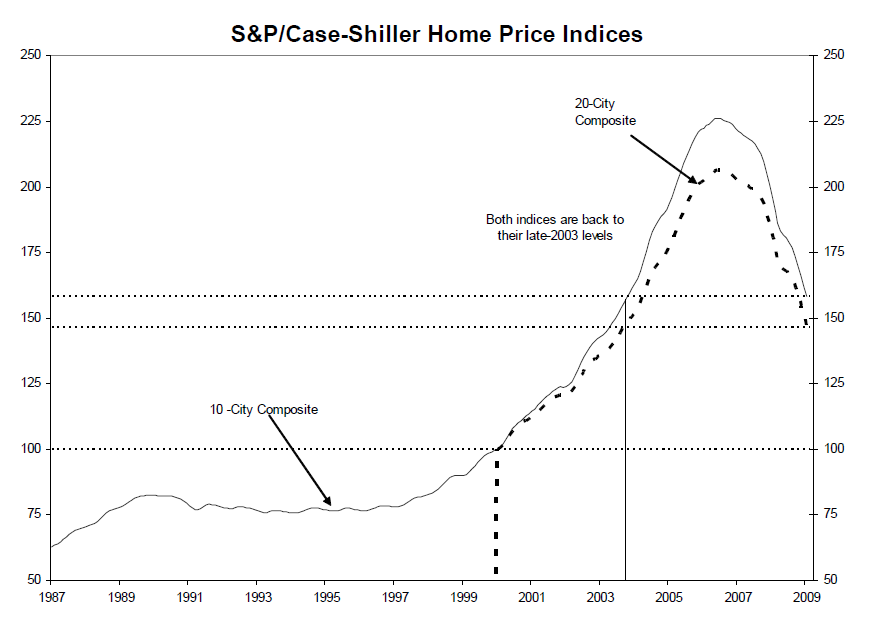
12. Barry Ritholtz at the Big Picture reports that Standard & Poor's Case Shiller 20 city Home Price Index fell at an annual rate of 18.97% in January. Prices have fallen to late 2003 levels as per an S&P graph:

Worth a look. The full S&P Case-Shiller US National Home Price Index can be found here.
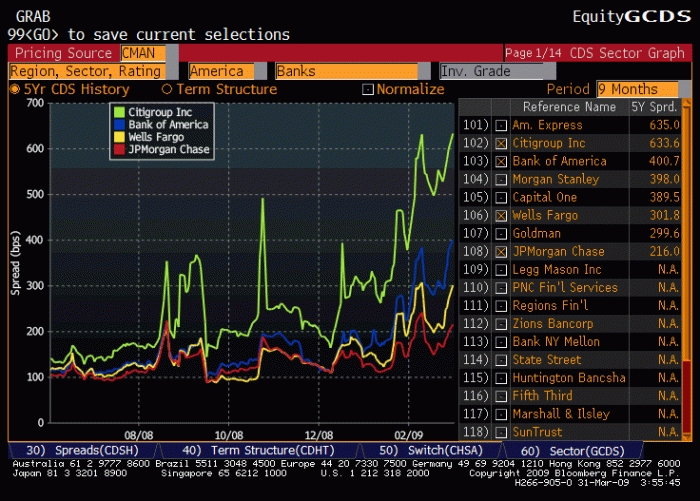
13. Simon Johnson at Baseline Scenario notes that CDS spreads are the highs last seen in early February.

14. Jeanne Meserve and Mike M. Ahlers at CNN report that the Federal Aviation Administration released its forecast today which sees the number of travelers using US airlines will fall 7.8% in 2009, the steepest decline seen since the period following 9/11.
15. Amartya Sen, in the New York Review of Books, has a piece which points out that historically "capitalism" can only exist in a framework of trust and rule of law--the tradition of keeping one's contracts, of course, obviating the need of recourse to the courts too often. Long, but should you have the time, worth reading. (h/t Justin Fox at The Curious Capitalist.)
"Angel Gurría warned that the ranks of the unemployed in the 30 advanced OECD countries would swell 'by about 25m people, by far the largest and most rapid increase in OECD unemployment in the postwar period.'"(h/t Yves Smith at naked capitalism for this and a few other pieces listed.)
2. Julie MacIntosh, Francesco Guerrera and Bernard Simon at the Financial Times reported that Canadian Prime Minister, Stephen Harper, told the newspaper yesterday that Canadian banks should capitalize on their solid balance sheets to acquire assets in the US and other foreign nations.
"Mr. Harper indicated Canada’s banks could lead an eventual charge toward consolidation, and said he would support such efforts as 'an opportunity for Canada to expand its role in the world financial sector.'3. Rick Carew at Deal Journal gives some details on the financing terms Aluminum Corp. of China [Chinalco] is getting for its proposed $19.5 billion investment in Rio Tinto.
'I’m not going to try running banks, but I hope our banks will see this as an opportunity to build the brand--the country’s brand, their own brand--and to expand their scope and profitability over time,' Mr. Harper said. 'I can assure you that the steps we’re taking in the financial sector will not be designed to promote greater protectionism.'"
"An SEC filing released Monday shows that policy lender China Development Bank is leading a syndicated loan by four Chinese banks offering the cash at 0.90 point more than the sixth-month benchmark London interbank offered rate. With sixth-month Libor rates at just 1.75% these days that means Chinalco, as the Chinese aluminum maker is known, is looking at payments starting at 2.65%.Meanwhile, Bettina Wassener at the New York Times reports that Australian Treasurer approved a bid by Hunan Valin Iron and Steel Group to take as much as 17.55% in iron ore miner Fortescue for $438 million.
That is cheap money compared with the roughly 9.25% coupon Rio is paying Chinalco on $7.2 billion of convertible bonds Rio issued under the deal. In short, Chinalco will pocket the 6.60-point spread between its cost of capital and coupon payments from Rio, though the spread could narrow if Libor rates rise on a global economic recovery. That demonstrates the government’s desire to keep Chinalco afloat despite it being highly indebted and its publicly traded subsidiary barely profitable."
4. Richard K. Green at Richard's Real Estate and Urban Economics Blog drew up a graph of property prices against property rights in Asia:
"The X axis is a measure of property rights by country: property rights are weakest in Vietnam and strongest in Singapore and Hong Kong. Note the correlation. Even though the property rights index is only ordinal, it has a correlation of .78 with the price per square meter of a 120 square meter flat in the national and or financial capital of each country."India is explained, per Prof. Green, by supply constraints. Well-worth a look. (h/t Mark Thoma at Economist's View.)
5. James Hookway at Real Time Economics reports that Vietnam's economy is managing to avoid the worst of the financial crisis. The Asian Development Bank released its forecast for Asian Pacific nations today and forecast that Vietnam's GDP will grow by 4.5% this year.
"There is now a brand new middle class in the country which didn’t exist before and its spending power has kept Vietnam chugging through the downturn. In fact, the ADB’s Hanoi-based economist Bahodir Ganiev told reporters earlier, 'when it comes to Vietnam, we actually should not use the word "downturn" or "recession". It’s just a slowdown.'"6. Reuters reports that Ali Asghar Arshi, executive director for international affairs at National Iranian Oil Co (NIOC), told the newswire that Iran has made no allocation for diesel purchases in its budget starting March 21 on the expectation that increased natural gas production will cover the country's requirements.
"'We will substitute with gas from our network,' Arshi told Reuters. 'Because we now have new production from South Pars... and other fields.'FACTS Global Energy estimates that Iran imported about 550kb/d in 2007.
In the first three months of this year Iran imported as much as 5 million barrels of diesel, or around 55,0000 barrels per day (bpd), traders and analysts said."
"Iran had taken advantage of cheaper prices to build inventories earlier this year, storing as much as 2 million barrels of gas oil [diesel] on ships.Blockading or otherwise putting a halt to Iranian imports of petroleum products has been mooted by various policy analysts as a way to put pressure on Iran. Meanwhile, Ali Akbar Javanfekr, the presidential advisor for press affairs to Iranian President Mahmoud Ahmadinejad, has an opinion piece in the Los Angeles Times today which is a response to President Obama's Nowruz greeting. Continuing in the vein of the March 22 speech by Leader of the Revolution Ayatollah Ali Khamenei, it begins by insulting the Democratic Party:
Arshi said Iran had drawn down those inventories and would not continue stockpiling the fuel."
"America's Democratic Party has historically been less honest than its rival Republican Party. I hope President Obama can change this approach and that he will turn out to be the most honest US president of all."He also repeats the message of Khamenei that Iran distrusts the rhetoric of change and will reserve judgment until it sees action--and in fact demands it:
"President Obama has proclaimed a policy of 'change,' and the American people have embraced it. But to remedy its image in the world, the US needs to truly change its past methods.The piece also reiterates the Iranian historical complaint against the US. It further makes the odd claim that Ahmadinejad is loved round the world:
Change is mandatory for the US administration. For as history demonstrates, either you change, or you are forced to change."
"Mr. Obama expressed his country's willingness to see our Islamic Republic take its true position in the international community. This new approach by the United States is appreciated, but we would note that Iran already occupies a distinguished position in the international community. President Ahmadinejad is one of the most beloved dignitaries in the world, and freedom-loving nations in all corners of the Earth love Iran."That said, the piece does indicate the willingness to engage in talks,
"The president expressed a willingness to talk openly with Iran's leaders. This willingness is promising. The Islamic Republic of Iran appreciates friendly behavior that stems from respect and courtesy toward other cultures and nations."and
"Mr. Obama has talked about his commitment to creating constructive diplomatic ties between the US and Iran. He must first begin dressing the deep and old wounds inflicted on the Iranian nation and start to correct the misunderstandings created by the misconduct of previous US administrations in their actions against Iran."Meanwhile, Mark Landler at the New York Times reports that Secretary of State Hillary Clinton confirmed today that Richard C. Holbrooke met in an unplanned meeting on the sidelines of a conference devoted to Afghanistan with Iran’s deputy foreign minister, Mohammad Mehdi Akhondzadeh. Clinton told reporters:
"It was cordial, unplanned, and they agreed to stay in touch. I myself did not have any direct contact with the Iranian delegation."and
"The fact that they came today, that they intervened today, is a promising sign that there will be future cooperation.The piece is worth reading in full. The State Department offered further clarification of the US position today:
The questions of border security, and in particular the transit of narcotics across the border from Afghanistan to Iran is a worry that the Iranians have, which we share."
"MR. DUGUID: I think the Secretary has answered the question that Iranian participation was welcome and that we wanted to make sure that this conference was one that included everyone in the region. Everyone in the region has a role to play to help Afghanistan. We should not look for, at this time, individual and uncoordinated approaches to Afghanistan. We should look for a regionally based and coordinated approach to dealing with the problems in Afghanistan and with Pakistan.It seems to me that Tehran regards cordial relations with the US as difficult to sustain, given the ideological self-justification of the regime. That said, it does seem that they are feeling the pinch of the growing possibility of being caught by a deal with Moscow regarding their nuclear program--and likely some pressure at home for reconciliation. Insofar as that is the case, they appear willing, as in the past, to cooperate on mutual interests quietly and, as much as possible, out of the public eye, but remain wedded to revanchist rhetoric. Meanwhile, President of Russia, Dmitry A. Medvedev, proffered a much more conciliatory tone in a piece published in the Washington Post today.
QUESTION: But Iranian action today in the conference criticized increased – troop increase––US troop increase in Afghanistan and kind of confronting this concept.
MR. DUGUID: The Iranians expressed their opinions. That’s what they were there to do. And we were there listening to what they had to say. We have gone through a 60-day intensive review of our strategy. We have come forth and laid that out for everyone. The conference itself was our first foray into an international fora to explain our policy and to show that this is – these are the reasons why we see this as being the best way forward. You cannot have a solely military solution in Afghanistan and our strategy recognizes that. That is why we are looking for an increase in resources not only on the military side, but on the civilian side, on the side of trainers for economic development, for other institutional-building and capacity-building efforts that we see as necessary."
"Unfortunately, relations soured because of the previous US administration's plans--specifically, deployment of the US global missile defense system in Eastern Europe, efforts to push NATO's borders eastward and refusal to ratify the Treaty on Conventional Armed Forces in Europe. All of these positions undermined Russia's interests and, if implemented, would inevitably require a response on our part.Medvedev also asserts:
I believe that removing such obstacles to good relations would be beneficial to our countries--essentially removing 'toxic assets' to make good a negative balance sheet--and beneficial to the world.
This will require joint efforts. The exchange of letters between myself and President Obama this year showed mutual readiness to build mature bilateral relations in a pragmatic and businesslike manner. For that we have a 'road map'--the Strategic Framework Declaration our countries signed in Sochi in 2008. It is essential that the positive ideas in that declaration be brought to life. We are ready for that.
Possible areas of cooperation abound."
"Neither Russia nor the United States can tolerate drift and indifference in our relations. I spoke in Washington last November about the need to put an end to the crisis of confidence. To begin with, we should agree that overcoming our common negative legacy is possible only by ensuring equality and mutual benefit and by taking into account our mutual interests. I am ready for such work with President Obama on the basis of these principles, and I hope to begin as early as tomorrow at our first meeting in London before the Group of 20 summit. "Well worth reading in full. Further, Abdullah Gül, the President of Turkey, has a piece in the Wall Street Journal which argues for stronger efforts to establish law and order in Afghanistan.
"But more troops and more money alone will not be enough. The Afghan government needs military force to operate from a position of strength. But real improvement requires embracing every Afghan ready to work through peaceful means for the good of their country.Also well worth reading in full.
Political, diplomatic, economic, and social efforts must be increased and focused on consolidating national unity to bring about tangible improvement to people's lives. To have peace, we must win over the people.
There is a role here for the international community in enabling Afghan officials working to meet the basic needs of their people. Health care and education must both be top priorities. The country's civil service needs work. Its judiciary and police forces need to be strengthened. The people must come to believe that change is underway that will create a sense of normalcy for them."
7. Munir Ahmad at the Associated Press reports that the newly reconstituted Supreme Court in Pakistan restored the province of Punjab to the main opposition party, under Shahbaz Sharif, the brother of the head of Pakistan Muslim League (N) Nawaz Sharif.
8. Edward Hugh at Fistful of Euros reports that the EU Economic Sentiment Indicator for the EU27 fell by 0.6 points to 60.3 and for the eurozone fell by 0.7 points to 64.6. The post looks at economic sentiment in most of the major economies in the region as well as Eastern Europe. However, "economic sentiment recovered slightly in the Netherlands (1.3) and (amazingly) in Spain (0.8)." Worth a look.
9. Brian Murphy at the Associated Press reports that Venezuelan President Hugo Chávez, upon setting foot in Qatar, proposed a "petro-currency" as an alternative to the dollar, to be backed by the oil producing nations.
"The idea never reached the full agenda of a summit of leaders from South America and the Arab League--and has little hope of gaining any momentum among the US allies in the Middle East."Meanwhile, Daniel Cancel at Bloomberg reports that Venezuela, according to a resolution published today in the Official Gazette, will sell 2.68 billion bolivars ($1.2 billion) of bonds in the local market as part of an effort to fund the budget. The bonds will be sold in two tranches, will have a fixed coupon and mature between 2010 and 2016.
10. David M. Herszenhorn and Clifford Krauss at the New York Times report that a bill in the House, sponsored by Representative Betty Sutton of Ohio, seeks to give those trading in a new car for a fuel efficient model a $4,000 voucher if the car gets at least 27 miles per gallon and is assembled in the US. Cars assembled outside the US would qualify if they got at least 30 miles per gallon. Cars assembled inside the US getting 30 miles per gallon would receive a voucher for $5,000.
"Officials said the program could cost $2 billion or more depending on how long it operated. Ms. Sutton said the most important thing was to get the program started quickly. 'The urgency for its initiation is extraordinary,' she said."The Senate version is slightly less generous. The Obama Administration indicted that it supported an effort along these lines on Monday.
11. Mark Pittman and Bob Ivry at Bloomberg report that the US Government and Federal Reserve have "spent, lent, or committed" $12.8 trillion, close to 2008 GDP.
"New pledges from the Fed, the Treasury Department and the Federal Deposit Insurance Corp. include $1 trillion for the Public-Private Investment Program, designed to help investors buy distressed loans and other assets from U.S. banks. The money works out to $42,105 for every man, woman and child in the U.S. and 14 times the $899.8 billion of currency in circulation. The nation’s gross domestic product was $14.2 trillion in 2008.'The piece includes a useful balance sheet of commitments and expenditures. Worth a look.
12. Barry Ritholtz at the Big Picture reports that Standard & Poor's Case Shiller 20 city Home Price Index fell at an annual rate of 18.97% in January. Prices have fallen to late 2003 levels as per an S&P graph:
Worth a look. The full S&P Case-Shiller US National Home Price Index can be found here.
13. Simon Johnson at Baseline Scenario notes that CDS spreads are the highs last seen in early February.
14. Jeanne Meserve and Mike M. Ahlers at CNN report that the Federal Aviation Administration released its forecast today which sees the number of travelers using US airlines will fall 7.8% in 2009, the steepest decline seen since the period following 9/11.
"The short-term forecast is downbeat for virtually every segment of the aviation business, the Federal Aviation Administration predicted. Major airlines are expected to bear the brunt of the decline, with a projected 8.8% drop that would return them to passenger levels last seen in 1995.Private industry analysts disagree with long-term analysis of the FAA that passenger levels will rebound in 2010.
Regional airlines will see business drop 4.5%, taking them back to volumes they had four or five years ago, while air cargo is expected to slide 2.8%."
15. Amartya Sen, in the New York Review of Books, has a piece which points out that historically "capitalism" can only exist in a framework of trust and rule of law--the tradition of keeping one's contracts, of course, obviating the need of recourse to the courts too often. Long, but should you have the time, worth reading. (h/t Justin Fox at The Curious Capitalist.)
Subscribe to:
Posts (Atom)

 Posts

