Thursday, March 19, 2009

Daily Sources 3/19

1. Zhang Xin at China Daily reports that Wu Zhuang, director of China's Administration of Fishery and Fishing Harbor Supervision of the South China Sea, told the media that Beijing will step up patrols of China's exclusive economic zone in the South China Sea.
"Faced with a growing amount of illegal fishing and other countries' unfounded territorial claims of islands in China's EEZ, it has become necessary to step up the fishery administration's patrols to protect China's rights and interests. China will make the best use of its (retired) naval ships and may also build more fishery patrol ships, depending on the need."
On March 5, Malaysian Prime Minister Abdullah Ahmad Badawi claimed the Nansha Islands (aka the Spratley Islands) despite Chinese counterclaims. On March 10, Philippine President Maria Gloria Macapagal-Arroyo signed into law a bill which claimed Huangyan Island (aka the Scarborough Shoals) and the Nansha Islands as Philippine territory over Beijing's objections.


(h/t Carlos Tejada at China Journal.)

2. Fu Chenghao at Shanghai Daily reports that he China Iron and Steel Association said in a statement on its website yesterday that steel exports may fall as much as 80% in 2009 from 2008, a sharper contraction than the 50% the organization had previously predicted.
"A survey showed China's 28 largest steel exporters would ship only 299,100 tons this month and 129,600 tons in April, and China would probably become a net importer of steel products in March, it said."
(h/t Yves Smith at naked capitalism, who also notes that the Baltic Dry Index has fallen 20% in the last five days.)


Meanwhile, Tian Ying at Bloomberg reports that the Chinese cut in retail taxes has resulted in GM's Chinese minivan venture increasing sales by 32% in the first two months of 2009. The government has also announced the details of a rural auto subsidy program--see Daily Sources 3/16 #3.
"'Every farmer in China wants a new vehicle, all 800 million of them,' said Yale Zhang, a consultant at CSM Asia in Shanghai. 'It looks like the government wants to make that happen.'
...
Vehicle sales in China may rise between 5 percent and 10 percent this year, according to GM, the largest overseas automaker in the country. It had previously forecast sale growth of less than 3 percent. The automaker expects to outperform the wider market by as much as 3 percentage points, helped by sales at SAIC-GM-Wuling Automobile Co., the largest minivan-maker in China. The venture accounts for at least half of GM’s China sales."
3. Charles Lee at Platts reports that Korea Gas February sales fell by 22.9% from February 2009.
"Of the total, [LNG] sales to power generators plunged 35.5% to 731,692 mt, while retail gas companies accounted for 1.7 million mt, down 16.1% from the same month last year."
It was the fifth consecutive month of sales contraction.

4. Agence France Presse reported that Kuwaiti Emir Sheikh Sabah al-Ahmad al-Sabah dissolved Parliament yesterday, calling for a snap election in the next two months. The Emir is expected to issue by decree a stimulus bill that had been held up in Parliament for the last six weeks.

5. Takeo Kumagai at Platts reports that Japan's Minister of Economy, Trade and Industry, Toshihiro Nikai, signed today a memorandum of understanding with the Venezuelan Oil Minister, Rafael Ramirez, in Tokyo regarding broad cooperation in the energy sector.
"Details of the MOU were not made public, but sources close to the matter said Japan and Venezuela will form a joint committee to consider opportunities Venezuela's upstream and downstream oil and gas sectors."
An unnamed official told Platts that in the light of Japan's downstream investment, Tokyo would likely be looking for upstream natural gas opportunities.
"Earlier this month, Venezuela's state-owned PDVSA, US major Chevron, Japan's Mitsubishi and Mitsui, and a few other oil companies signed an agreement to develop the Delta Caribe LNG project.

The $12 billion project will comprise two 4.8 million mt/year gas liquefaction plants and includes development of dedicated gas fields."
Ramirez also indicated to the media in Tokyo outside METI that it was the position of Caracas that the market was 1 mb/d oversupplied. Bloomberg reports that Chávez will visit Japan on April 6. Meanwhile, Matthew Walter and Daniel Cancel at Bloomberg report that Venezuela is postponing payments to foreign contractors as the low price of oil cuts into the budget. Brazil's Odebrecht SA indicated last week that it was engaging in a work slowdown on the Caracas subway system because the government was late in payments. The government also is estimated to still owe $10.2 billion on nationalizations it has carried out in pursuit of Chávez's revolution.
"[PdVSA] has amassed at least $7.86 billion in back payments to oil service companies and suppliers, according to its third-quarter earnings statement. Dallas-based Ensco International Inc. and Helmerich & Payne Inc., headquartered in Tulsa, Oklahoma, idled rigs in Venezuela this year because of payment problems."
One wonders what kinds of assurances Ramirez gave Nikai that Japan's investments wouldn't be simply expropriated at a later date--especially given Tokyo's close ties to the US. Are Chevron, Mitsubishi and Mitsui simply betting that Chávez will not be encouraged by future high prices to go on another nationalization spree? That we will not see high prices again any time soon ... and that they will outlast Chávez?

6. The Associated Press reported that Iranian Oil Minister Gholam Hossein Nozari said yesterday in Vienna that Iran was diverting funds from other sectors of its national budget to oil production. The comments suggest that the oil sector, which supplies about 60% of the Tehran's budget, is losing money. In a conversation with AP reporters later, Nozari indicated that a substantial enough share of its oil production is unprofitable at current prices that it is making a net loss. It is unclear why, under those circumstances, that Iran would fail to comply fully with its OPEC quota as of December 17.

7. Platts reports that Eni CEO Paolo Scaroni told reporters in Vienna today that it had been tendered Iraq's Nassiriya field in a no-bid contest with Japan's Nippon Oil and Spain's Repsol. The field, which is estimated to have sustained production capacity of about 300 kb/d and 4.4 billion barrels of proven reserves, would be developed by the winner on a an engineering, procurement and construction (EPC) basis. Meanwhile, Upstream online reports that Scaroni told the conference that industry needs oil prices above $60/b to maintain investments, but that economic growth cannot be maintained at prices above $75/b. Meanwhile, Keith Johnson at Environmental Capital reports that Saudi Oil Minister Ali al Naimi told that $40/b oil only affects the investment plans of marginal producers.
"Despite the current economic situation and other challenges to the energy sector, Saudi Arabia will stay the course with our long-term capital investments for oil and gas expansion."
Some corporations expect upstream costs--which are about 2.2 times higher than they were in 2000--to fall precipitously in 18 months or so. Their investment plans are centered around that forecast.
"Just one problem with those hopes, says OPEC secretary general Abdullah Salem El-Badri: 'We have not seen costs coming down.'"
8. The Associated Press reports that al-Qaeda has posted a new tape by Osama bin Laden which urges Somali militants to overthrow the new government in Mogadishu. Bin Laden's 11 1/2 minute message was entirely focused on Somalia.

9. Sangar Rahimi and Carlotta Gall at the New York Times report that a spokesman for the Afghan National Security Directorate said in a news briefing yesterday that the February 11 attack on the Justice Ministry in Kabul was organized in Pakistan's tribal areas. The spokesman also
"suggested that Pakistani intelligence had a role in planning the attacks. 'I would like to say specifically that the intelligence agency of our neighboring country is involved and behind these attacks and organizing these activities.'"
Sens. John McCain and Joe Lieberman have an op ed in today's Washington Post arguing that a "minimalist" strategy in Afghanistan would be a mistake. Key excerpt:
"Loose rhetoric about a minimal commitment in Afghanistan is counterproductive for another reason: It exacerbates suspicions, already widespread in South Asia, that the United States will tire of this war and retreat. These doubts about our staying power deter ordinary Afghans from siding with our coalition against the insurgency. Also important is that these suspicions are a major reason some in Pakistan are reluctant to break decisively with insurgent groups, which, in a hedging strategy, they view as integral to positioning Pakistan for influence 'the day after' the United States gives up and leaves Afghanistan. That is why it is so important for the president to reject the temptations of minimalism in Afghanistan and instead adopt a fully resourced, comprehensive counterinsurgency strategy, backed by an unambiguous American commitment to success over the long term. In doing so, he must invest the political capital to remind Americans why this fight is necessary for our national security, speak openly and frankly to our nation about the difficult path ahead, and--most of all--explain clearly to our fellow citizens why he is confident that we can prevail."
Well worth reading in full.

10. Platts reports that Nigerian militants sabotaged a second Shell-operated pipeline in the Niger Delta today. The volume of oil lost has yet to be confirmed.

11. Matthew Saltmarsh and David Jolly at the New York Times reports that French unions have gone on strike today in the rail, airports, utilities and public sector.
"Two-thirds of the country’s high-speed TGV trains were canceled. Air France said most of its flights were operating normally from Roissy Charles de Gaulle International Airport, while about one-third of its flights from Orly Airport had been canceled. Traffic on the Paris Métro and bus networks were close to normal, according to transit officials, but suburban rail line service was disrupted."
The unions are calling upon the government to protect jobs and worker purchasing power. A poll has found that 78% of the French support the strikes. Workers have stopped six Total refineries, but the company claims that the impact on production is limited. Eurointelligence reports that the French Parliament has proposed a rider which would place a tax surcharge of 5% on top income earners for the next two years.

12. Tracy Rucinski at Reuters reports that Spain will withdraw its 600 troops in Kosovo. Spain has yet to recognize Kosovo as an independent nation. Spain, once known as Las Españas, or "the Spains," has several secessionist movements of its own to contend with--especially in the Basque region and Catalonia.

13. Tony Barber at the Financial Times reports that European Commission president, José Manuel Barroso, told reporters that EU member nations should spend more on stimulus programs if they could afford to.

14. Rebecca Wilder at News N Economics has a weekly world economic update for March 12-18 which has graphs demonstrating that the unemployment rate is "surging in every corner of the world," that industrial production is similarly "cliff diving," that retail sales are "anemic" globally, and that inflation is in full retreat. Worth a look. She also points out that Canada and the US, each others largest trade partners by far, are reporting extremely limited demand for imports.


15. Christine McGourty at BBC News reports that the UK's chief scientist forecast that by 2030 global resource demand will create a crisis akin to a "perfect storm."
"Demand for food and energy will jump 50% by 2030 and for fresh water by 30%, as the population tops 8.3 billion, he told a conference in London.

Climate change will exacerbate matters in unpredictable ways, he added."
Grim reading.

Wednesday, March 18, 2009

Daily Sources 3/18

1. Krishna Guha, Bertrand Benoit, Chris Giles and Daniel Pimlott at the Financial Times report that the IMF will reduce today its forecast for global GDP in 2009 to a contraction of 0.6%.
"The eurozone economy was forecast to contract by 3.2% in 2009, [Ms. Ter-Minassian, an adviser to IMF managing director Dominique Strauss-Kahn] said, against the earlier forecast of a 2% decline. The US would shrink by 2.6% (1.6%), and Japan 5% (2.6%), making it the worst-hit big economy. The IMF in Washington said the figures cited by Ms Ter-Minassian were 'unofficial' and 'out of date'."
In early March the IMF began indicating that a downward revision was under way--see Daily Sources 3/3 #1.

2. Philip P. Pan and Karen DeYoung at the Washington Post report that many Russia analysts believe that Moscow is signaling interest in a deal on Iran.
"In a meeting last week with a bipartisan commission studying US policy toward Russia, President Dmitry Medvedev expressed alarm in 'very graphic language' over Iran's successful test launch of a satellite last month, linking it to Tehran's nuclear program, said Dmitri Simes, director of the commission.

'Medvedev said it demonstrated how far-reaching Iran's nuclear ambitions are, and that he was very concerned,' said Simes, who is also president of the Nixon Center in Washington. 'He felt it was a clear challenge to both Russian and American interests and said he would like both countries to work on this challenge together.'"
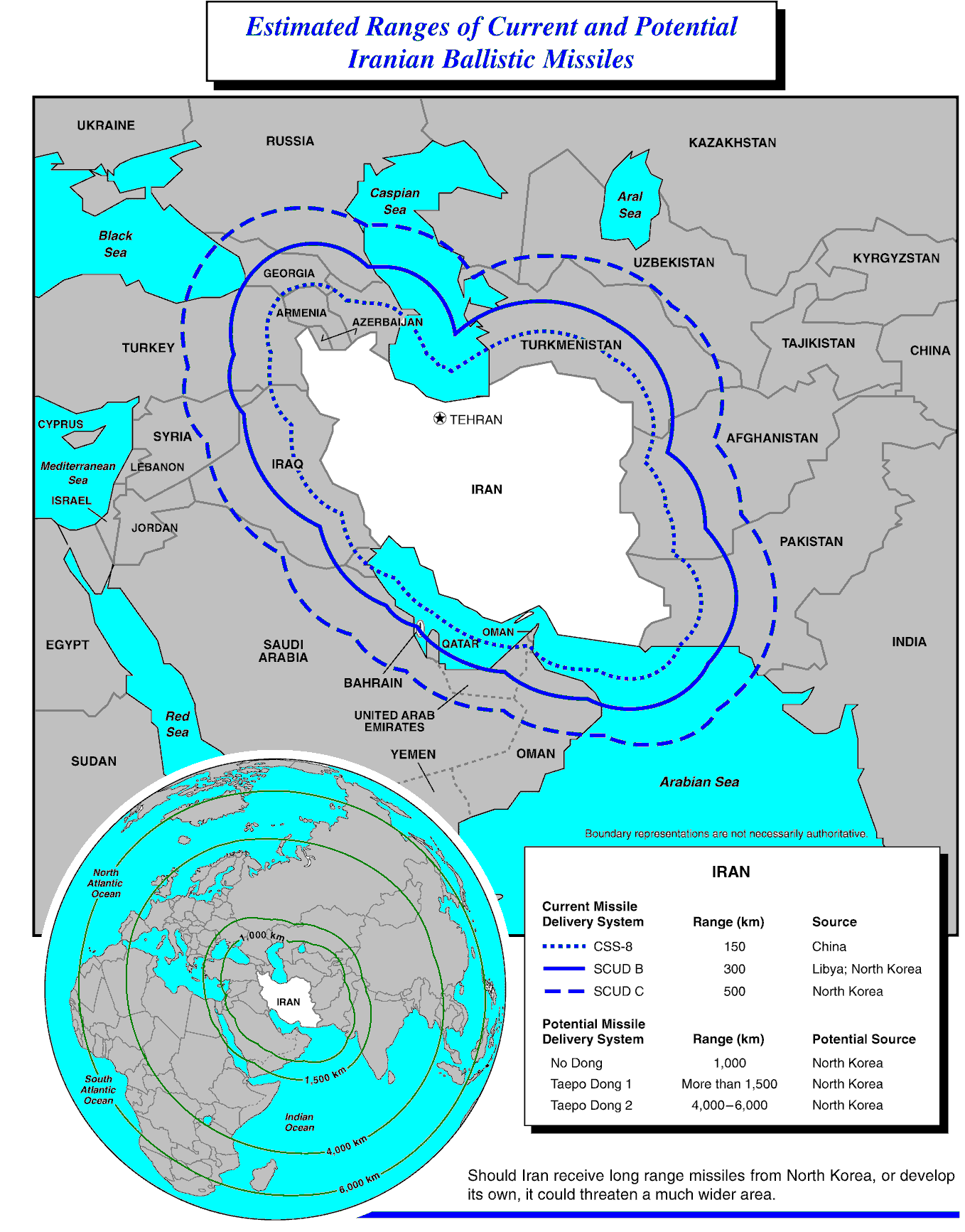
The Federation of American Scientists provide the following illustration of Iranian missile capabilities.


Satellite launches reportedly use technologies required for the development of ICBMs. In November, Iran claimed it had successfully tested missiles with a range of 1,200 miles, which as you can see from the map does not quite put Moscow in range--and obviously is even further from presenting any potential threat to, say, Warsaw. That said, it plainly makes a lot of sense that Iran's perennial missile tests would have the--likely unintended--effect of ruffling Moscow's feathers, given that a nuclear armed Tehran which could reach Moscow is definitely not in their interests.
"Alexander Pikayev, a top arms control scholar in Moscow, said Russian policy toward Iran will be determined by competing interest groups and political factions. Defense manufacturers and the atomic energy industry oppose tougher sanctions, for example, but the United States could win over the latter by reviving a bilateral pact on civilian nuclear cooperation that was frozen after the Georgian war, he said.

Pikayev said Medvedev may be more likely to support sanctions because a breakthrough in US relations would boost his political stature at home and set him apart from his powerful predecessor, Prime Minister Vladimir Putin. Putin might resist, but his relationship with Iranian President Mahmoud Ahmadinejad is said to be strained and he surprised Russia's foreign policy establishment by endorsing earlier U.N. sanctions, Pikayev said."
Frankly, I doubt this assessment--I think the notion of a nuclear armed Iran with the capability of hitting Moscow will outweigh the economic considerations involved in putting the kibosh on nuclear power cooperation with Iran. Indeed, it is hard to see many places in which Iranian and Russian interests coincide. Perhaps they do in terms of energy pricing, but Iran's potential as an alternative source of gas for European industry is probably a critical item in Moscow's long term thinking. And as the weekend's events proved, Russia still regards oil production coordination with OPEC as being less in its interest than good terms with Europe--and producing at full bore to claim all price increases produced by the cartel. (A policy which Iran appears to follow with respect to the organization's production quotas as well, ironically enough.)

3. The Associated Press reports that North Korea yesterday gave the organizations distributing US food aid inside that country till the end of March to leave--rejecting all future food aid.

4. Judy Dempsey at the New York Times yesterday reported that Russia signed two natural gas deals with Hungary yesterday. One deal signed last week has the Budapest and the Hungarian Development Bank to finance the South Stream project on Hungarian soil.


The other deal has Gazprom and MOL establishing a 1.3 billion cubic meters storage facility in Hungary. To make sense of that, here is a map that Jérôme Guillet drew up of Ukraine's gas infrastructure--note the three asterixes to the West, which represent gas storage facilities.


As Guillet pointed out in a piece for the European Tribune:
"Storage capacity is important in the gas business, as demand is seasonal (there is more in winter for heating) and can almost triple in Europe between summer and winter. If you can pre-position your gas near the markets when transport capacity becomes strained, you can extract a lot more value from that seasonality. The storage facilities near the Hungarian and Slovak borders were ideal for Soviet exports, but now they are in Ukrainian hands, and thus Russia must have a minimum of technical cooperation from the Ukrainians, who physically control and operate these facilities, not to lose a lot of money in their export markets. More, unavoidable leverage for the Ukrainians."
Hungarian Prime Minister Ferenc Gyurcsany's plea for a regional aid package from the EU was turned down last week. He has been a supporter of the Nabucco Pipeline, but questions of sourcing the gas (which would likely have to come from Iran) and project financing continue to bedevil the project.

5. Edward Hugh at Fistful of Euros posts that Poland's Central Statistical Office has released its industrial output data for February showing a 14.3% annual rate of decline in February, following a revised annual rate of decline of 15.3% in January. Output was up 2.7% in February from January however. Hugh provides a helpful graph of industrial production for the last two years:


Hugh points out that industrial production is on the decline across the spectrum of export-oriented Eastern European economies, warning against too much disambiguation between them. Worth reading and mercifully short.

6. Bettina Wassener at the New York Times reports that the World Bank lowered its forecast for Chinese growth in GDP for 2009 to 6.5%. 6.5%, though quite high by global standards just now, is well below the Chinese principle of "bao ba"--or "protect the 8"--below which conventional wisdom holds that Beijing will begin to see significant, read destabilizing, social unrest. Kevin Hamlin at Bloomberg reports that bank sees signs China's economy is stabilizing faster than the rest of the world.
"'The government’s stimulus is working,' said Louis Kuijs, a senior economist at the World Bank in Beijing. 'China’s fundamentals are strong enough to ride out this storm.'"
Meanwhile, Andrew Batson at China Journal helpfully translated the complete text of Chinese Ministry of Commerce’s statement announcing its decision to block Coca Cola’s proposed acquisition of China Huiyuan Juice Group Ltd. Key excerpt:
"Through its review, the Ministry of Commerce found that this concentration will have an adverse impact on competition. After the concentration is completed, Coca-Cola could use its market dominance in carbonated soft drinks to limit competition in the market for juice through tying, bundling or other exclusive transactions, resulting in consumers being forced to accept higher prices and reduced variety. At the same time, because brands can restrict entry to the market, it would be hard for the threat of potential competition to remove the restrictive effect on competition. In addition, the concentration will also reduce the room for small and medium-sized juice companies to survive, and will have an adverse effect on the structure of competition in China’s juice market."
The notion that dominance in the carbonated drink market could adversely affect competition in the juice market is unlikely to please most corporate headquarters. The fact that the Ministry of Commerce took stock of the market power of brands is interesting given that some have written that the primary value-addition that Western corporations bring to emerging markets is, well, brands. Meanwhile, the Sydney Morning Herald reports that shares in Rio Tinto have taken a beating on fears that the deal with Chinalco taking a 18% stake in the company.
"'[The 8.7% decline in share price] is [due to] the uncertainty surrounding the Chinalco deal, there has been a bit of talk out today that there is a lot of opposition to the deal and this is what's weighing on it,' MF Global senior trader Anthony Anderson said.

'The FIRB extension and the senate inquiry into foreign investment is adding to the uncertainty.'

The mounting political concern follows a decision by the Foreign Investment Review Board (FIRB) to extend its review to 90 days and initiate a more in-depth examination of the transaction, after the initial 30-day evaluation period closed on Monday.

The transaction, which has been backed by the Rio Tinto board, will also allow Chinalco to appoint two new non-executive board members to the global miners board."
(h/t Emmanuel at International Political Economy Zone.)

7. Platts reports that Italian major Eni has signed a major cooperation agreement with Pakistan to develop major projects all along the oil and gas product chain.
"The agreement also allows Eni to become a strategic partner in developing the oil and gas sector in Pakistan and to enter fields which are currently managed by state-run oil companies."
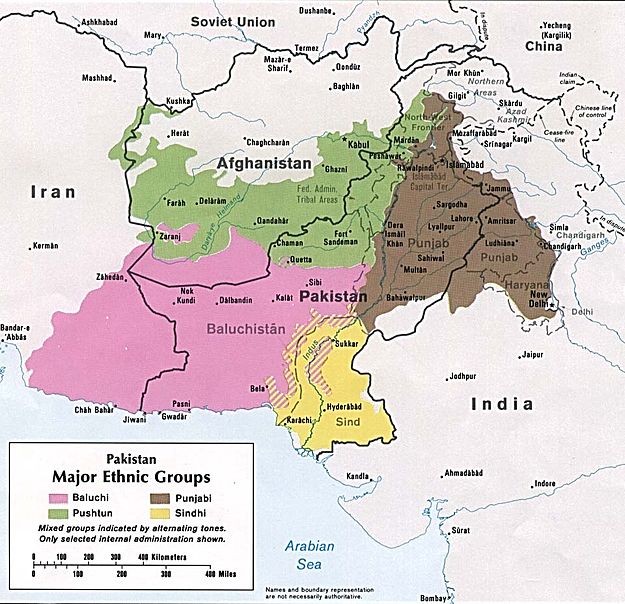
8. David E. Sanger and Eric Schmitt at the New York Times reports that "two of the high-level reports on Pakistan and Afghanistan that have been forwarded to the White House in recent weeks have called for broadening the target area to include a major insurgent sanctuary in and around the city of Quetta."


Baluchistan has separatist tendencies and is in the middle of a small bore separatist struggle, both in Pakistan and Iran.


Note that Baluchis can be found in southern Afghanistan where most of that country's opium production--and violence--is concentrated.

9. Galrahn at Information Dissemination notes that due to the Obama Administration's review of all military ties, GE has been asked to freeze work on turbines it was to provide the Indian navy for three Shivalik-class stealth frigates. Though I strongly disagree with the way Galrahn frames the story, I think it is an important data point. Clearly the US is likely to approve continued sales of engines to the Indian Navy.

10. Maher Chmaytelli and Juan Pablo Spinetto at Bloomberg report that Shokri Ghanem, chairman of Libya’s state-run National Oil Corp., told journalists today in Vienna that Libya will exercise its right to buy Calgary-based Verenex Energy Inc., which would effectively block CNPC's bid for the E&P company.
"Verenex has assets in Libya that are worth 'hundreds of millions' of dollars, Ghanem said in an interview with Bloomberg on March 16."
It is an interesting signal given China's Africa Policy announced in 2006 and Ghaddafi's recent selection as chair of the African Union--see Daily Sources 2/3 #9.

11. Justin Stares at Lloyd's List reports that the Bangladeshi High Court ordered the closure of all ship breaking yards operating without environmental clearance.
"Industry sources said they were 'staggered' by the ruling, which if confirmed will close down one of the world’s largest breaking industries just as scrapping activity peaks.

'None of the 36 shipbreaking yards in Chittagong currently have an environmental clearance,' said the NGO Platform on Shipbreaking. 'The decision therefore effectively shuts down an industry that has been highly criticized by environmentalists and human rights activists for many years for operating with complete disregard for the law, human health and the environment.'

The scrapping industry, which claims to employ 250,000 either directly or indirectly in Bangladesh, is expected to appeal.

The court was ruling on a petition filed by the Bangladesh Environmental Lawyers Association. Judges ordered that no ship on the Greenpeace 'dangerous ships list' be allowed into the country, according to reports by the platform and local media."
It is a decision bound to amplify the effects of the financial crisis, economically-speaking ... it seems that probity only comes when it will hurt the most, ironically. Note the significance of the courts in the Muslim-majority nation. Well-worth reading in full.

12. Nasreen Seria at Bloomberg reports that the South African Reserve Bank's Monetary Policy Committee will meet next week and accelerate its schedule to monthly meetings for the rest of the year from planned meetings every two months.
"Global economic conditions 'are getting worse' and the 'changed' environment requires the MPC to meet more regularly, Governor Tito Mboweni said in a phone interview from Pretoria today."
13. Victor L. Simpson at the Associated Press reports that in Cameroon Pope Benedict XVI reiterated yesterday that condoms were not an answer to the fight on AIDS--"You can't resolve it with the distribution of condoms. ... On the contrary, it increases the problem." I would note that Africa is one region where Catholicism--and more conservative Catholicism--is growing quickly. However, perhaps the one really impressive and compellingly moral US foreign policy triumph under the Bush Administration was the huge increase in aid to Africa in terms of the fight on AIDS, including condoms and retro-viral drugs. The people in Africa are well aware of how these aid programs have reduced the mortality rate in the continent. The notion that condoms are against life and a concession to death, and thus amoral, as opposed to a way to protect life and thus moral, will not, I believe, make much sense to them. Pope Benedict XVI appears to have a tin ear when it comes to husbanding the moral authority of the Church.

14. The Port of Long Beach recently posted its numbers for February, showing a 40% decline in container traffic from February 2008:


So far in 2009 the port has recorded a 20.2% decline in traffic. The Port of Marseilles, France, also recently posted its report for February, showing a 21% annual decline in total traffic. It registered a 16% decline from the traffic seen in January:


Hydrocarbons account for about 74% of Marseilles' traffic and it lost about 12% in volume from the year before. The grim trade data continue their march.

15. Bob Willis at Bloomberg reports that the consumer price index rose by 0.4% in February from January. Excluding fuel and food, prices climbed by 0.2% from the month prior. On an annual basis, the consumer price index rose by 0.2%, up from the 0% annual rate seen in January. Excluding fuel and food, prices climbed by an annual rate of 1.8% in February, up from a 1.7% annual rate of increase seen in January.
"Energy expenses increased 3.3%, led by an 8.3% increase in gasoline prices. Still, the fuel’s cost is down 36% from a year earlier.

Food prices, which account for about a fifth of the CPI, fell 0.1%, the first drop since April 2006."
16. The Federal Open Market Committee met today and decided to keep the federal funds rate unchanged at 0-.25%. Excerpt from its press release:
"To provide greater support to mortgage lending and housing markets, the Committee decided today to increase the size of the Federal Reserve’s balance sheet further by purchasing up to an additional $750 billion of agency mortgage-backed securities, bringing its total purchases of these securities to up to $1.25 trillion this year, and to increase its purchases of agency debt this year by up to $100 billion to a total of up to $200 billion. Moreover, to help improve conditions in private credit markets, the Committee decided to purchase up to $300 billion of longer-term Treasury securities over the next six months."
This follows the latest Treasury International Capital data which shows, courtesy of Brad Setser at Follow the Money, that foreign purchases of long term treasuries have collapsed:


Foreign government demand for US agency debt fell off a cliff late last year and purchases were even banned by Moscow just the other week. Meanwhile, Jon Hilsenrath at Real Time Economics reports that the Fed's quarterly survey of banks shows that during the week of February 2-6, banks extended $85.6 billion in credit to businesses, an increase of 13% from the first quarter of 2008--per JP Morgan Chase economist Michael Feroli:


17. The EIA reported that crude oil stocks built by 2 million barrels in the week ended March 13 to 353.3 million barrels, well above the historical average for this time of year, but still below the most recent peak of 354 million barrels seen on June 29, 2007. According to a survey by Bloomberg, analysts had expected a 1.5 million barrel build. Gasoline stocks grew by 3.2 million barrels, are near the top of the historical average. Analysts had expected a 1.5 million barrel draw. Distillates stocks grew by 100,000 barrels, are well above the five year historical average range as well as counter-cyclical, and versus analyst expectations of a 1 million barrel build. Taken in isolation, the data would be bearish on the price of crude.

Tuesday, March 17, 2009

Daily Sources 3/17

1. Doris Leblond at the Oil & Gas Journal reports that Eurogas released preliminary data showing that European demand for natural gas grew by 2.1% in 2008, from from 506.4 bcm to 517 bcm.
"The total number of gas customers connected to the EU27 gas grid rose 1% to 112.5 million customers. ... Although natural gas markets vary significantly from one EU country to another, Eurogas believes some general trends may explain the overall increase. The main one is that the weather was mild in 2007 but rather cold in 2008 which, in addition, was a leap year of 366 days."
2. Eurointelligence notes that Le Monde reported that support for a 50% cap on income taxes and the "detaxation" of extra working hours no longer has majority support in France.
"Ahead of the parliamentary budget examination this week, several MEPs called for a suspension of this measure to make high income earners participate in an effort to re-establish confidence in the economic relaunch plan. Even former prime minister Dominique de Villepin called in an interview with Les Echos for a burden share and an increase of the cap to 60%."
3. Dinah Deckstein at Der Spiegel reports that in February senior executives from Airbus and Emirates--which has ordered 54 A380 super-jumbos--to conduct an emergency meeting regarding problems with the plane after having taken delivery of its first two nearly two years late.
"It is still not clear how the spat between the aircraft maker and its dissatisfied customer will end. Competitors Singapore Airlines and Qantas have also had to ground their A380 jets several times in recent weeks and months.

The Asians have had trouble with the fuel pumps and the on-board electronics. The Australians noticed that the highly sensitive measuring sensors in the tank were not working properly, although it is still unclear whether the problem was attributable to the devices themselves or was caused by impurities in the fuel.

Unlike Emirates, Singapore Airlines and Qantas have taken a more relaxed approach to the problems. However they, unlike the Arabs, have not just ordered dozens of new A380s.

Since the end of last week, the Dubai-based airline has however tried to defuse the conflict. 'Technical problems are to be expected in a new aircraft, especially one in which so many new technologies are used,' says an Emirates spokesman."
Worth reading in full.

4. Platts conducted a survey of 27 Chinese state-run refineries which indicated that they were likely to maintain crude runs at about 81% of nameplate capacity in March on high stocks and weak demand.
"The survey covered Sinopec's 19 refineries, which have an overall nameplate crude processing capacity of 3.56 mb/day, accounting for 89% of Sinopec's total refining capacity of 4 mb/d.

Meanwhile, the eight PetroChina refineries surveyed have an overall nameplate crude processing capacity of 1.43 mb/d, which accounts for 51% of PetroChina's total crude processing capacity of 2.8 mb/d."
5. Razib Ahmed at the South Asia Blog posts on the return of immigrant workers to South Asia and the recent decision by Malaysia to cancel visas for some 55,000 Bangladeshi workers. Ahmed also notes that Kuwait's foreign workforce shrank for the first time since 1990 and that there has been a fall in the number of people leaving Nepal in search of work. (h/t Mark Thoma at Economist's View.)

6. Simon Romero at the New York Times reports that the Shining Path in Peru has recently turned to the cocaine trade after the end to the war in 2000--and that the trade is heating up the conflict with Lima again.
"[Vizcatán], a 250-square-mile region in the Apurímac and Ene River Valley, nine hours by four-wheel drive along switchbacks from the Maoist rebels’ Andean cradle of Ayacucho, is Peru’s largest producer of coca, the raw ingredient for cocaine.

The Shining Path controls a large part of the cocaine trade here, and as Peru’s production has thrived, now second only to Colombia’s, the rebel group has used its profits to rebuild."
7. Brad Setser at Follow the Money posted on the latest Treasury International Capital data for January which showed a net outflow in capital of $148.9 billion, and Setser notes that net capital outflows from the US cannot sustain a budget deficit.
"Setting December (when foreign private investors bought a bunch of US corporate bonds) aside, foreign investors haven’t been buying long-term US assets since the crisis hit.

The swing came from two sources:

1) US investors bought a bunch of foreign bonds. That is a change. US investors had been net sellers of foreign bonds and equities through out the fall.

2) Banks stopped piling into US assets. In October — at the peak of the crisis — private investors abroad bought $64 billion US t-bills and increased their dollar deposits by $196 billion (see line 29 of the TIC data; “change in banks own (net) dollar-denominated liabilities). In January, credit conditions eased a bit, and private investors reduced their t-bill holds by $44 billion and the banks reduced their (net) dollar deposits by $119 billion."
"Incidentally China is still buying Treasuries. It bought $12.2 billion in January, including $11.6b in short-term Treasury bills. It also is still selling Agencies — its Agency holdings fell by $3.1 b.

Russia also, interestingly, added to its holdings of short-term Treasury bills. The Gulf reduced its dollar deposits (now at $114.3b, down from a peak of $125.5b in November) whether to support its domestic banks or to cover stretched budgets. The Gulf (and Brazil) also bought a decent number of long-term Treasuries. Most official buying, though, came at the short-end. In aggregate, the official sector sold $1.9 billion of long-term Treasuries while adding $29 billion to its short-term bills.

That continues a broader trend. Over the last 12 months official investors added close to $280 billion to their bill portfolio."
Well worth reading in full.

8. Keith Johnson at Environmental Capital reports that a new Accenture survey of attitudes toward nuclear power has been released, showing growing support for nuclear worldwide. The survey was of 10,500 people in 20 countries.
"The upshot? About 69% of people favor adding more nuclear power; 31% are opposed. In the past three years, 29% of people have become more supportive, and 19% have become more entrenched in their opposition."
China has the highest level of unconditional support for nuclear power at 50%. In the US, 37% say they have become more supportive of nuclear recently with 81% in favor of using more.
"One of the most surprising findings is the erosion of support for nuclear power in France, which gets almost 80% of its electricity from nuclear plants, and which is often held up by nuclear-energy proponents as a model for the US.

Hardcore French support for nuclear power stands at just 20%, similar to levels in anti-nuclear Germany. Over the past three years, opposition to nuclear power has grown in France more than in any of the other countries in the survey."


9. Courtney Schlisserman at Bloomberg reports that the producer price index grew by 0.1% in February from January. Core producer prices--prices excluding energy and food--grew by 0.2% for that time period. At an annual rate, producer prices fell by 1.3% in February. Core producer prices rose by 4% from a year earlier.

10. Shobhana Chandra at Bloomberg reports that housing starts grew by 22% in February from January.
"While the glut of unsold properties on the market means the housing industry’s recession will probably continue for some time, economists said today’s report indicates the worst of the contraction may have passed. Retail sales figures for February last week also indicated a slower rate of decline."
Year over year, housing starts are still down nearly 50% in February.

11. Bob Willis at Bloomberg yesterday reported that US industrial production fell by 1.4% in February from January. Year over year industrial production fell by 11.2%, the sharpest contraction seen since 1975.
"Excluding automobiles, factory output dropped 1.2%.

Utility production decreased 7.7%, propelled by unseasonably warm weather that caused declines in the use of electricity and natural gas. Mining output, which includes oil drilling, decreased 0.4%.

The auto industry is at the center of the manufacturing slump. Car sales in February slid 41% to the lowest rate since December 1981, according to Autodata Corp., led by a 53% drop for General Motors Corp."
12. Macro Man posts the data on the increased defaults seen in January from credit card holders, suggesting that many have made the New Year's Resolution to stop paying their credit card bills.

Monday, March 16, 2009

Daily Sources 3/16

1. Real Time Economics carries the full text of the G20 communique released on Saturday. Key excerpts:
"2. Our key priority now is to restore lending by tackling, where needed, problems in the financial system head on, through continued liquidity support, bank recapitalisation and dealing with impaired assets, through a common framework (attached). We reaffirm our commitment to take all necessary actions to ensure the soundness of systemically important institutions.
...
5. We are committed to helping emerging and developing economies to cope with the reversal in international capital flows. We recognise the urgent need to pursue all options for mobilising International Financial Institution (IFI) resources and liquidity to finance countercyclical spending, bank recapitalisation, infrastructure, trade finance, rollover risk and social support. We agreed on the urgent need to increase IMF resources very substantially. This could include further bilateral support, a significantly expanded and increased New Arrangements to Borrow (NAB), and an accelerated quota review. We should also ensure that all Multilateral Development Banks have the capital they need, beginning with a substantial capital increase for the Asian Development Bank, and put it to best use to help the world’s poorest.
...
7. We have also agreed to: regulatory oversight, including registration, of all Credit Rating Agencies whose ratings are used for regulatory purposes, and compliance with the International Organisation of Securities Commissions (IOSCO) code; full transparency of exposures to offbalance sheet vehicles; the need for improvements in accounting standards, including for provisioning and valuation uncertainty; greater standardisation and resilience of credit derivatives markets; the FSF’s sound practice principles for compensation; and the relevant international bodies identify non-cooperative jurisdictions and to develop a tool box of effective counter measures."
2. Michael Wines, Keith Bradsher, and Mark Landler at the New York Times reported on Friday that Chinese Prime Minister Wen Jiabao aired some of Beijing's worries with regard to their holdings of US debt ahead of the G20 meeting in London.
"'President Obama and his new government have adopted a series of measures to deal with the financial crisis. We have expectations as to the effects of these measures. ... We have lent a huge amount of money to the U.S. Of course we are concerned about the safety of our assets. To be honest, I am definitely a little worried.'

He called on the United States to 'maintain its good credit, to honor its promises and to guarantee the safety of China’s assets.'"
3. Xinhua reports that the Chinese Ministry of Finance announced on Friday that the 5 billion yuan (~$732 million) stimulus plan directed at subsidizing the purchase of automobiles and motorcycles in rural areas will translate into a 10-13% discount, respectively.
"Farmers who buy light trucks and minivans from March 1 to Dec. 31, would get a 10 percent discount, with the ceiling subsidies of 5,000 yuan (~$732.29).

Subsidies of 2,000 and 3,000 yuan (~$292.92 and ~$439.37) can be use to replace old three-wheeled and four-wheeled vehicles respectively.

From this Feb. 1 to Jan. 31 in 2013, farmers who buy motorcycles would get 13 percent of the purchase price back, with ceiling subsidies of 650 yuan (~$95.20)."
4. Borzou Daragahi at the Los Angeles Times reports that Iranian state television on Saturday carried an announcement by government officials that a $3.2 billion deal to develop the South Pars natural gas fields had been stuck with China.

5. Marcus Hand at Lloyd's List reports that Singapore port container cargo traffic fell by an annual rate of 20% in February. The number of containers that went through the port fell by 6% from January to 1.85m teu. Singapore's port is the world's largest container port.

6. Pamela Constable at the Washington Post reports that Pakistani President Zadari announced early today that he would reinstate a number the judges deposed by Pervez Musharraf in 2007, including former Chief Justice Iftikhar Mohammed Chaudhry.
"Zardari's turnabout came after thousands of demonstrators poured into the streets of this leafy capital of Punjab province [Lahore] Sunday, throwing rocks at police and cheering wildly. A wide cross section of Pakistan's political, social and religious sectors joined the day-long protests.

As the demonstrations escalated, police first responded with volleys of tear gas. But by mid-afternoon they suddenly withdrew from the streets, while numerous city and provincial officials were reported to have resigned. The swift collapse of authority signaled the end of Zardari's bid to seize control of Punjab, the most politically influential region of the country, and raised serious questions about his ability to remain president."
Worth reading in full. Includes links to fascinating pictures of hordes of lawyers protesting in Pakistan.

7. Haig Simonian at the Financial Times reports that on Friday Switzerland's finance minister, Hans Rudolf Merz, "said Bern would abolish the strict distinction between tax fraud, a crime in Swiss law, and tax evasion, a civil offence." Merz stressed that customer accounts would remain secret in all but exceptional cases, meaning that a specific request from an investigative body would be required in order to obtain the data, or so I infer. As I've said before, changes of 500 plus year traditions are better indicators, to me, of what kind of stresses the financial system is under than most. (h/t Yves Smith at naked capitalism.)

8. Eurointelligence notes a media report that Finnish manufacturing orders are down 38% year over year in January.

9. OPEC decided in its meeting Sunday to maintain the current quota allocations, and called on its members to fully comply with them. Current compliance is 79% according to the cartel--the producers which are probably the largest over-suppliers are Iran and Venezuela, ironically usually the biggest hawks in the group. The OPEC press release following the meeting can be found here. Key excerpt:
"The Conference, however, welcomed, some initial signs reported of a reversal in crude oil-stock trends, and a narrowing of the contango in the front price structure, indicating that the adjustment process instigated through OPEC measures vis-à-vis excess supply in the market is gradually helping to redress balance, and was also pleased to observe that following the decision taken by the 151st (Extraordinary) Meeting of the Conference in December 2008 to cut 4.2 mb/d from the actual September 2008 OPEC-11 production level with effect from 1st January 2009, compliance for the month of February, according to secondary sources, was 79%, which has contributed to balancing the price of the OPEC Reference Basket at around US$40/b since the beginning of the year, despite the critical economic outlook.

The Conference therefore emphasized its commitment to comply fully with its decision of December 2008, in order to further contribute to market stability. The Secretariat will monitor very closely developments in the market. Furthermore, the Conference will convene in Vienna, on Thursday 28th May 2009, to consider any further actions deemed necessary."
On a side note, the cartel decided to lengthen Abdullah Salem el-Badri's (of Libya) stay as Secretary General of the organization for another three year term. At Environmental Capital, Spencer Swartz reports that Russia decided not to join the organization or coordinate any serious production cuts.
"[Russian deputy prime minister Igor Sechin] proposed a slew of things for Russia and OPEC ministers to work on together, such as coordinating (i.e., raising) taxes on foreign oil firms’ crude production and refining operations."
Moscow had indicated that it would consider to what extent OPEC was complying with headline cuts before it joined in cooperation. Even so, this has to be considered good news in the West, given recent noise from Moscow and hints from Tehran.

10. Rania El Gamal at Reuters reports that Sheikh Nasser al-Mohammad al-Sabah told al-Watan newspaper that the country would officially cancel the al-Zour 615 kb/d export refinery construction project today in remarks published Sunday. In May, KNPC awarded $8.4 billion in construction tenders to four South Korean and one Japanese firm to build the refinery.

11. Rainbow Nelson at Lloyd's List reports that the Chavez administration expects the Venezuelan Congress to pass a law tomorrow which would transfer the administration of ports from the regional to the state level.
"'We are going to recover the ports and airports in the whole republic, oppose it whoever wants to, this is the law of the republic,' Mr Chavez said on his weekly television program ‘Alo Presidente’.

He warned Henrique Salas, who governs the department of Carabobo and oversees Venezuela’s most important port, Puerto Cabello, and Manuel Rosales, the governor of Zulia, which oversees the port of Maracaibo, that the navy and army would be used to quell any opposition to the move."
Opponents have pledged to resist the law.

12. The Associated Press reports that Mexico has slapped import duties on 90 US products in retaliation for the cancellation of a program that had allowed Mexican trucks to trasnport goods within the US.

13. Mary Williams Walsh at the New York Times reports that AIG issued a press release Sunday which provided the names of the institutions and governments which received payments via the bailout monies provided to the insurance company.
"Financial companies that received multibillion-dollar payments owed by AIG include Goldman Sachs ($12.9 billion), Merrill Lynch ($6.8 billion), Bank of America ($5.2 billion), Citigroup ($2.3 billion) and Wachovia ($1.5 billion).

Big foreign banks also received large sums from the rescue, including Société Générale of France and Deutsche Bank of Germany, which each received nearly $12 billion; Barclays of Britain ($8.5 billion); and UBS of Switzerland ($5 billion).

AIG also named the 20 largest states, starting with California, that stood to lose billions last fall because AIG was holding money they had raised with bond sales."


14. Justin Fox at the Curious Capitalist dug up the Bureau of Economic Research data on unemployment in the Great Depression to compare them to the financial crisis of 2008.


As Fox notes, nonfarm employment accounts for a much larger share of total employment in the US today than it did in 1929. Still, nonfarm employment accounted for about 78% of all private sector hours worked at that time, according to Robert Higgs at the Independent Institute.

Thursday, March 12, 2009

Daily Sources 3/12

1. Edward Cody at the Washington Post reports that France will return to a full membership in NATO after a 43 year departure.
"'The time has come,' [President Nicolas Sarkozy] said in a speech to France's Strategic Research Foundation, adding, 'Our strategy cannot remain stuck in the past when the conditions of our security have changed radically.'"
I never thought I'd see it happen.

2. Platts reports that Prime Minister Putin said today that Russia will not fine Naftogaz for not taking the contracted for volumes of natural gas from Gazprom. Quote:
"[We] forgive these fines because we understand the reality--they have nothing to pay with. They are on the verge of bankruptcy, and you understand perfectly well that you can't kill your partner, because it will then not be capable of anything."
3. Eurointelligence reports that the US is calling for the tripling of funds available to the IMF in preparation for the G20 meeting in London this weekend. "Geithner also said that each G20 country should set a target of spending 2% of GDP for 2009 and 2010 in fiscal stimulus, and that the IMF should monitor progress towards that goal." David Cho and Anthony Faiola at the Washington Post reports that the Administration will ask Congress for nearly double the US commitment to the IMF to $100 billion.

4. Edward Wong at the New York Times reports that China has officially protested the passage of non-binding resolution H. Res. 226 passed by Congress yesterday. In a news conference today, Chinese foreign ministry spokesman Ma Zhaoxu, said that the resolution "makes groundless accusations against China’s religious policies" and "rudely intervenes in China’s internal affairs." HR226 was introduced on Monday and passed on Wednesday with a roll call vote of 422-1. Key language:
"Resolved, That the House of Representatives--

(1) recognizes the Tibetan people for their perseverance in face of hardship and adversity in Tibet and for creating a vibrant and democratic community in exile that sustains the Tibetan identity;

(2) recognizes the Government and people of India for their generosity toward the Tibetan refugee population for the last 50 years;

(3) calls upon the Government of the People's Republic of China to respond to the Dalai Lama's initiatives to find a lasting solution to the Tibetan issue, cease its repression of the Tibetan people, and to lift immediately the harsh policies imposed on Tibetans, including patriotic education campaigns, detention and abuses of those freely expressing political views or relaying news about local conditions, and limitations on travel and communications; and

(4) calls upon the Administration to recommit to a sustained effort consistent with the Tibetan Policy Act of 2002, that employs diplomatic, programmatic, and multilateral resources to press the People's Republic of China to respect the Tibetans' identity and the human rights of the Tibetan people."


5. Tracy Withers at Bloomberg reports that the Reserve Bank of New Zealand cut its benchmark rate by 0.5% to 3%.

6. Seyoon Kim at Bloomberg reports that the Bank of South Korea today decided to leave its benchmark interest rate unchanged at 2%.
"South Korea’s government said today it will provide cash, loans, school fees and other financial incentives valued at 6 trillion won to help those on lower incomes cope with rising unemployment. The aid package will use funds from the extra budget being proposed this month, the finance ministry said.

Bank of Korea Governor Lee said he expects the government to propose 'a significant' extra spending package, financed through bond sales. The central bank will watch the effect of debt sales on financial markets as it decides whether to purchase bonds, he added.

'The Korean economy is likely to remain in recession due to the persistent weakness of both domestic and overseas demand.'"
7. Juan Cole at Informed Comment has a pretty good overview of the situation in Pakistan as the government there rounds up lawyers involved in this year's long march under Section 144 of the Criminal Procedure Code. Cole concludes that the situation is rapidly becoming an open invitation to the military to take over again.

8. Andre Soliani and Joshua Goodman at Bloomberg report that the policy makers at the Brazilian central bank unanimously voted to cut the benchmark interest rate by 1.5% to 11.25% last night.
"The central bank, in a statement accompanying its decision, said it would evaluate the 'magnitude and speed' of 2.5 percentage points in cuts since January and their cumulative effect before deciding on its next steps."
9. Daniel Cancel at Bloomberg reports that Barclay's analyst Alejandro Grisanti said in a speech today in Caracas that Venezuelan GDP was likely to contract by 4.1% in 2009.

10. Vanessa Ronsisvalle and Beth Evans at Platts reports that the EU imposed anti-dumping duties on imports of US biodiesel today.
"The anti-subsidy duty, designed to offset financial incentive offered to US producers by the US government has been set at rates varying from €211.2/mt-€237/mt [$270-$303/mt or ~$36.00-$40.40/b], according to the Commission's decision published in the official journal of the European Union.

The anti-dumping duty has been set at rates varying from €23.6/mt to €208.2/mt [$30.02-$264.81/mt or ~$4.00-$35.31/b]. The anti-subsidy duties specified by the commission vary less, ranging from a low of €211.2/mt to a high of €237/mt [$268.63-$301.44/mt or ~$35.82-$40.19/b].

Details of the EC's decision showed some companies were given individual anti-dumping duties, ranging from as little as €23.60/mt (~$4/b) for Archer Daniels Midland and €60.50/mt (~$10.26/b) for Cargill to a high of €208.20/mt (~$35.31/b) for Peter Cremer North America.

All other companies listed in the commission's statement, including ED&F Man, Louis Dreyfus, Trafigura, Vinmar and Vitol, face an anti-dumping duty of €122.90/mt (~$20.84/b), while imports from companies not named in the document are subject to a €182.40/mt (~$30.93/b) duty."


11. Shobhana Chandra at Bloomberg reports that the Commerce Department today announced that retail sales fell by 0.1% in February from January. The decline was much less than had been expected by most analysts and if you exclude automobile sales from the numbers retail sales climbed by 0.7%.