Showing posts with label Goldman Sachs. Show all posts

Monday, July 19, 2010

Daily Sources 7/19

GOLDMAN SACHS BEING FROZEN OUT OF EUROPEAN SOVEREIGN DEBT OFFERINGS

Elena Moya at the Guardian UK reports that European governments are freezing Goldman Sachs out of debt offerings. An observer in France says that there would be rioting in the streets if Paris chose Goldman to lead a bond sale. Worth reading in full.

PRIVATE EQUITY INVESTMENT IN INDIA GROWING RAPIDLY

James Lamont at beyondbrics reports that India's private equity market is predicted to reach $17 billion this year.
"New investments will originate from the US where investors seek to participate in India and China’s high growth profiles. Average deal size among private equity investments this year is already between $50m and $200m, up from an average of $21m last year."
CLINTON ANNOUNCES NEW AID PROJECTS FOR PAKISTAN

BBC News reports that US Secretary of State Hillary Clinton announced a number of new aid projects for Pakistan worth $500 million. The projects include the building of two new hydroelectric dams. The aid money comes from a five year $7.5 billion aid package agreed to by Congress last year.

HUNGARY SUSPENDS BUDGETARY REVIEW BY IMF AND EU

Judy Dempsey at the New York Times reports that Hungary's government has stated that it will not pursue further austerity measures despite pressure from international creditors. The IMF and EU suspended a budgetary review of Hungary over the weekend.

MOODY'S DOWNGRADES IRISH DEBT

Matthew Saltmarsh at the New York Times reports that Ireland's debt has been downgraded by Moody's to Aa2 from Aa1. It's outlook has been changed from stable to negative. Not sure why anyone would pay any attention to the ratings agencies after this last bugaboo, but there you have it. The rating is still well above junk.

IRANIAN REVOLUTIONARY GUARD PULLS OUT OF PHASES 15 AND 16 OF SOUTH PARS

Aresu Eqbali at Platts reports that due to sanctions, the Iranian Revolutionary Guard has pulled out of phases 15 and 16 of the South Pars project.
"The IRGC and its affiliates have grown into an economic power in Iran, largely as a result of a succession of UN sanctions imposed by the international community over suspicions that Tehran is secretly developing nuclear weapons, a charge the Iranians deny.

The involvement of IRGC or its subsidiaries would make it difficult to source parts and equipment from foreign companies, which run the risk of being in breach of the sanctions should they have to deal with Khatam al-Anbiya or any other banned entity."
BOEING SELLS 30 777S TO DUBAI

Christopher Drew at the New York Times reports that the Dubai-based Emirates Airlines has put in a purchase order to Boeing for 30 777s. Airbus has sold 131 commercial airplanes this year; Boeing has sold 177.

WATER START UP SEEKS MARKETS IN INDIA, SAUDI ARABIA, CYPRUS AND IRAQ

John Collins Rudolf reports that a start up company in Texas plans to ship fresh water from Sitka, Alaska, to markets in India, Saudi Arabia, Iraq, and Cyprus. The company has no contracts yet, but has signed a deal with Sitka.

MOZAMBIQUE SOURCE OF COKING COAL FOR CHINA, INDIA, AND SOUTH AFRICA

Frontier Markets reports that interest is growing in Mozambique from China, India, and South Africa due to its reserves of coking coal for use in their steel plants.

BUILDER CONFIDENCE IN NEWLY BUILT, SINGLE FAMILY HOMES DECLINES ACCORDING TO HMI

Free exchange opines that the outlook for housing will be grim for the foreseeable future.


TWO AND HALF MILLION UNEMPLOYED LOSE ACCESS TO UNEMPLOYMENT BENEFITS

Phil Izzo at Real Time Economics reports that 2,502,000 jobless Americans have lost access to unemployment benefits since June 2.
"The Senate is expected next week to vote to extend unemployment benefits, but the delay has caused a lapse in benefits for some 2.5 million of the nation’s jobless."
Meanwhile, Tom Barkley at Real Time Economics reports that the National Association for Business Economics survey of 84 companies found that they were back in hiring mode. Meanwhile, Free Exchange reproduces a Brookings graph which plots the length of time it will take for jobs to reach the height seen prior to the recession with how many jobs need to be created.


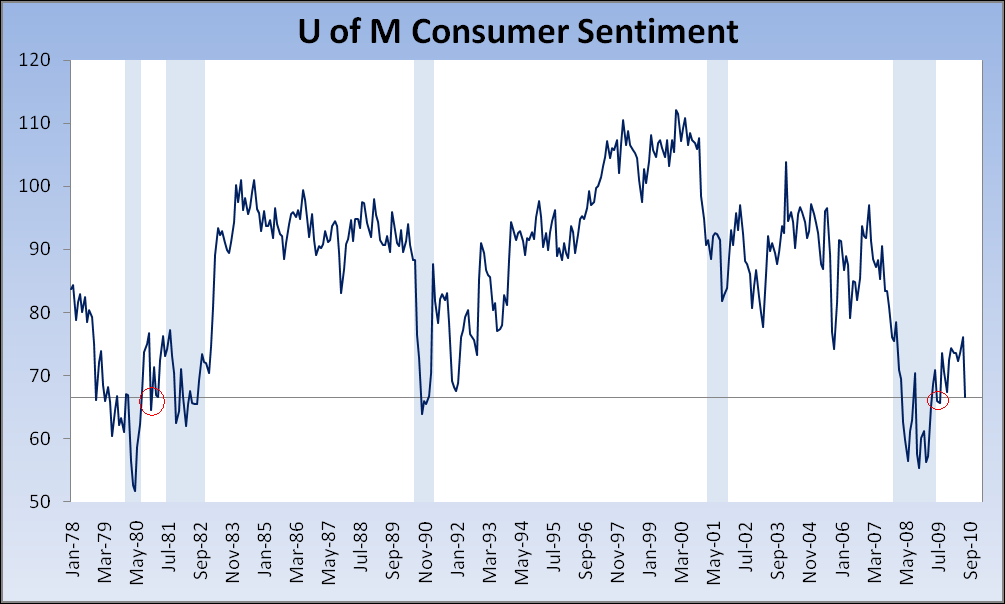
Invictus at the Big Picture reproduces a graph from the University of Michigan's Consumer Sentiment Survey and notes that the reading looks a lot like the last time we had a double dip recession.


THE CLEVELAND FED REPORTS THAT THE PUBLIC EXPECTS INFLATION TO STAY BELOW 2% OVER THE NEXT DECADE
"The Cleveland Fed’s estimate of inflation expectations is based on a model that combines information from a number of sources to address the shortcomings of other, commonly used measures, such as the "break-even" rate derived from Treasury inflation protected securities (TIPS) or survey-based estimates."

Monday, July 27, 2009

Daily Sources 7/27

1. US-CHINA STRATEGIC AND ECONOMIC DIALOGUE KICKS OFF TODAY

Secretary of State Hillary Clinton and Treasury Secretary Timothy Geithner have an op ed in today's Wall Street Journal to outline the aims of the US-China Strategic and Economic Dialogue which kicks off today. Key excerpt:
"To keep up with these changes that affect our citizens and our planet, we need to update our official ties with Beijing. During their first meeting in April, President Barack Obama and President Hu Jintao announced a new dialogue as part of the administration’s efforts to build a positive, cooperative and comprehensive relationship with Beijing. So this week we will meet together in Washington with two of the highest-ranking officials in the Chinese government, Vice Premier Wang Qishan and State Councilor Dai Bingguo, to develop a new framework for US-China relations. Many of our cabinet colleagues will join us in this 'Strategic and Economic Dialogue,' along with an equally large number of the most senior leaders of the Chinese government. Why are we doing this with China, and what does it mean for Americans?

Simply put, few global problems can be solved by the US or China alone. And few can be solved without the US and China together. The strength of the global economy, the health of the global environment, the stability of fragile states and the solution to nonproliferation challenges turn in large measure on cooperation between the US and China. While our two-day dialogue will break new ground in combining discussions of both economic and foreign policies, we will be building on the efforts of the past seven US administrations and on the existing tapestry of government-to-government exchanges and cooperation in several dozen different areas.

At the top of the list will be assuring recovery from the most serious global economic crisis in generations and assuring balanced and sustained global growth once recovery has taken hold. When the current crisis struck, the US and China acted quickly and aggressively to support economic activity and to create and save jobs. The success of the world’s major economies in blunting the force of the global recession and setting the stage for recovery is due in substantial measure to the bold steps our two nations have taken.

As we move toward recovery, we must take additional steps to lay the foundation for balanced and sustainable growth in the years to come. That will involve Americans rebuilding our savings, strengthening our financial system and investing in energy, education and health care to make our nation more productive and prosperous. For China it involves continuing financial sector reform and development. It also involves spurring domestic demand growth and making the Chinese economy less reliant on exports. Raising personal incomes and strengthening the social safety net to address the reasons why Chinese feel compelled to save so much would provide a powerful boost to Chinese domestic demand and global growth."
2. CHINA TO LAUNCH ARABIC-LANGUAGE TV STATION IN MIDDLE EAST AND AFRICA

The AFP reported on Saturday that China Central Television launched an Arabic-language channel which will air in the Middle East and Africa.
"Beijing is carrying out a multibillion-dollar effort to raise the profile of its state media abroad by expanding CCTV, the Communist Party newspaper People's Daily and the official Xinhua News Agency.

The effort has a budget of 45 billion yuan ($6.6 billion), according to a report last month by the Hong Kong newspaper South China Morning Post.

The Arabic channel will carry news, feature stories, entertainment and education programs and will gradually expand its offerings, CCTV said. The network already broadcasts in English, French and Spanish as well as in Mandarin."
It also has plans for a Russian language channel. (h/t Sky Canaves at China Journal.)

3. FIRST PUBLIC PRESIDENT-TO-PRESIDENT EXCHANGE BETWEEN BEIJING AND TAIPEI IN 60 YEARS


Weiyi Lim at Bloomberg reports that China’s President Hu Jintao sent a message congratulating Taiwanese President Ma Ying-jeou on his election to the head of the Kuomintang Party. It was the first public exchange between the leaders of mainland China and Taiwan in 60 years.

4. PETROCHINA BUYS 70.13% OF SINGAPORE PETROLEUM COMPANY

Norazlina Juma'at at Platts reports that PetroChina International on Friday announced it had increased its holdings of Singapore Petroleum Company to approximately 70.13% of the shares outstanding.
"On June 21 PetroChina had completed a deal to buy 45.51% in SPC from Singapore's Keppel Corp. for just over $1 billion and had launched an offer for all remaining shares."
SPC operates one of the three major refining projects in Singapore, which is a major trading and shipping hub for petroleum products in the Asia Pacific. The city state's total refining capacity is about 1.3 mb/d. SPC owns 50% of Singapore Refining Company Private Limited which has a 50% stake in the 273.6 kb/d refinery joint venture with Chevron on Jurong Island.

5. INDIA LAUNCHES FIRST INDIGENOUS NUCLEAR POWER SUBMARINE FOR SEA TEST

Voice of America reports that India has launched its first indigenously built nuclear-powered submarine, the Arihant or "Destroyer of Enemies," for sea trials in the Bay of Bengal. The Arihant was built with the assistance of Russia, has a crew of about 100 men, and will be armed with ballistic missiles.
"India already has fighter aircraft and missiles capable of carrying nuclear warheads. If all goes well with the trials, the Arihant will give India an underwater ballistic missile capability after the tests are conducted.

After launching the submarine, Prime Minister Singh said 'we do not have any aggressive designs nor do we seek to threaten anyone.' But he said that the sea is increasingly becoming relevant in the context of India's security interests, making it necessary to 're-adjust our military preparedness to this changing environment.'"
Galrahn at Information Dissemination comments:
"This beings India closer to becoming the first nation in decades to develop a nuclear triad, and the first nation to do so in the Indian Ocean area. While this development does not shift any balance of power in the region, it certainly gives both Pakistan and China something to think about. There is something else though, it will also give India a case for becoming a permanent member of the UN Security Council, a discussion the current permanent five members are not looking forward to."
6. RUSSIAN ORTHODOX CHURCH PATRIARCH IN KIEV TO TRY AND MEND RIFT WITH UKRAINIAN METROPOLITAN

Maria Danilova at the Associated Press reports that the Russian Orthodox Church Patriarch Kirill led a prayer service in Kiev today in part of a 10-day visit intended to mend the rift between the Russian Orthodox Church and a breakaway Ukrainian Orthodox church.
"Currently, Ukraine's main Orthodox church answers to Kirill, but a breakaway church that has proclaimed itself independent from Moscow in the 1990's has been gaining popularity and political support in this predominantly Orthodox country of 46 million.

[Ukrainian President Viktor] Yushchenko, who has sought to break free from Russia's centuries-old political dominance and integrate with the West, has appealed to the spiritual leader of the world's 250 million Orthodox believers, Patriarch Bartholomew I of Constantinople, to recognize a local Ukrainian church that would be independent of the powerful Moscow patriarchate.

Bartholomew, who visited Kiev last summer, has not given a clear response.

Kirill is to meet with Yushchenko later in the day. He told reporters after the prayers that he had no immediate plans to meet with the representatives of the breakaway church, the Ukrainian Orthodox Church Kiev Patriarchate."


7. TURKMENISTAN SAYS IT WILL HONOR DECISION OF INTERNATIONAL ARBITRATION COURT'S RULING ON CASPIAN BORDER WITH AZERBAIJAN

John Roberts at Platts reports that Turkmen President Gurbanguly Berdimukhammedov on Friday officially asked foreign minister Rashid Meredov to file a request before an international court of arbitration asking it to settle a long-standing dispute between Ashgabat and Baku on their Caspian borders.
"'The issue of demarcation of the sea bed and the sea's mineral resources between Turkmenistan and Azerbaijan, as well as the definition of median line there, remain unresolved for a long time due to Azerbaijan's specific position,' Berdimukhammedov [reportedly said on Saturday].

'Turkmenistan will be ready to accept any ruling to be issued by the International Court of Arbitration on this issue,' he said.

In its first response to the Berdymukhammedov declaration, Azerbaijan made no direct reference to arbitration, but the statement from deputy foreign minister Xalaf Xalafov to Azerbaijan's ANS television Saturday that Baku would defend its position could be interpreted as an indication that it was prepared to submit its case to arbitration."
Any planned natural gas pipeline that would traverse the Caspian would theoretically at least require the demarcation and sea bed issues resolved previous to construction. One potential pipeline to be routed through the Caspian is Nabucco. Worth reading in full.

8. 80-90% VOTER TURNOUT REPORTED IN KURDISH REGIONAL GOVERNMENT ELECTIONS THIS WKEND

Ben Lando, Serage Malik, Rawsam Latif and Istifan Braymok at Iraq Oil Report that turnout in the Kurdish Regional Government's elections this weekend was at, according to early estimates, between 80 and 90% of eligible voters.
"To be sure, there have been complaints, during the campaign and at the polls, and it’s up to the Independent High Electoral Commission in the coming days to determine how serious they are. Preliminary results are expected by Sunday, and final results certified by the IHEC within five days. But in a region specifically and in a country generally where the challenger has seen bullets and prison instead of campaign flyers, the general sentiment is forward looking."
9. IRANIAN PARLIAMENTARIANS CRITICIZE PRESIDENT'S RELUCTANCE TO IMMEDIATELY HONOR LOTR'S INSTRUCTIONS, SOME CALL FOR VOTE OF CONFIDENCE

Press TV reports that more than 200 members of Iran's parliament, the Majlis, have called upon President Ahmadinejad to "fully and promptly comply with the Leader's instructions."
"[T]he president's reluctance to reverse the decision [to appoint his son in law first Vice President] was called into question even by his own ministers. As a sign of protest, three of the ministers--Intelligence Minister Gholam-Hossein Mohseni-Ejei, Culture and Islamic Guidance Minister Mohammad-Hassan Saffar-Harandi and Labor Minister Mohammad Jahromi--walked out of a Cabinet meeting on Thursday.

Although news broke out that the Ahmadinejad administration had sacked the ministers, the government moved to clarify the issue after a senior member of parliament suggested that the administration had lost its legitimacy with the measure as it had removed too many Cabinet members during the first Ahmadinejad tenure.

Only the intelligence minister has been removed, said an official working for the presidential office.

The dismissal has intensified pressures on Ahmadinejad by parliament members who contend that the ninth government is obliged to seek a new vote of confidence in its remaining 7 days in office.

According to parliament Vice Speaker Mohammad-Reza Bahonar, all Cabinet sessions of the current government are 'illegal' until the official second-term inauguration of the president."
Article 136 of the Constitution requires the President to call for a vote of confidence at the Majlis is half or more of his cabinet is replaced.

10. KUWAIT, QATAR, BAHRAIN LINK ELECTRICITY GRIDS

Miriam Amie at Platts writes that KUNA reported today that Sunday Kuwait, Qatar, and Bahrain successfully linked their electrical power grid networks.
"Over a decade ago, the six GCC states agreed at a summit to set up the power grid to cope with the regions rapidly increasing electricity consumption. Draws on electrical power stations throughout the GCC increase dramatically during peak usage times in summer between April and September.

The estimated $1.4 billion electrical network is being initiated one year later than previously expected.

Earlier this month, five of the GCC states, except Oman, signed a power trading agreement setting terms between transmission system operators, and power procurement companies for the purpose of exchanging or trading electrical power."
11. DECOUPLING WAS ALWAYS A MYTH, ARGUES WÄLTI

Sébastien Wälti at VoxEU argues that the notion that the developing economies were decoupling from the developed economies was always a myth, and that the process of globalization leads, intuitively even, to greater business cycle synchronization.

"Figure 2 shows that the degree of business cycle synchronicity between emerging markets and advanced economies has not decreased in recent years. The evidence on individual emerging markets shows that there is no country (except for Peru) which reports a general decline in its degree of synchronicity with all four groups of advanced economies."
12. IEA OIL DEMAND FORECAST AHISTORICAL RELATIONSHIP TO GDP PREDICTION

Mark Shenk at Bloomberg notes that the most recent IEA forecast of a 1.7% increase in oil consumption in 2010 does not fit the historical relationship between GDP growth as forecast by the IMF and oil consumption.
"[T]he IEA’s projections for oil demand growth will trail the World Bank’s forecast for GDP growth by 0.8 percentage points, the least in 14 years. Since 1997, oil use has followed GDP by an average of more than 2 percentage points and in 2006 the spread widened to 3.9 percentage points."
"'There’s been a remarkable correlation between GDP and oil demand growth,' said Edward Morse, head of economic research at LCM Commodities LLC in New York. 'The IEA numbers are implausible.'"
(h/t Joshua Keating at the FP Morning Brief.)

13. NEW SINGLE FAMILY HOME SALES DOWN 21.3% (±11.4%) FROM JUNE 2008

Barry Ritholtz at the Big Picture reports that US Census Bureau and Department of Housing and Urban Development announced today that sales of new one-family homes were up 11.0% (±13.2%) in June from May, which is statistically insignificant. They are down 21.3% (±11.4%) from June 2008, which is statistically significant.

14. 80% OF DERIVATIVE ASSETS AND LIABILITIES HELD BY 5 FIRMS (ENERGY FIRMS USING DERIVATIVES MOSTLY FOR HEDGING) PER FITCH REPORT

In a story picked up on in the econoblogosphere over the weekend, David M Katz at CFO.com wrote on July 24 that a Fitch Ratings report released a week prior to his story indicated that about 80% of derivative assets and liabilities are held by five firms--JP Morgan Chase, Bank of America, Goldman Sachs, Citigroup, and Morgan Stanley.
"Those five banks also account for more than 96% of the companies' exposure to credit derivatives.

About 52% of the companies reviewed disclosed there were credit-risk-related contingent features in their derivative positions. Such features require a company to post collateral or settle outstanding derivative liabilities if there's a downgrade of the company's credit rating.

The Fitch analysts also found that just 22 companies disclosed the use of equity derivatives. Just six nonfinancial firms--IBM, General Motors, Verizon, Comcast, Textron, and PG&E--reported exposure to share-based derivatives.

For the report, the rating agency reviewed first-quarter 2009 filings of the companies, which come from a range of industries and represent almost $6.4 trillion in aggregate outstanding debt. The companies also recorded a total notional amount of derivative positions of more than $296 trillion.

Unlike the financial firms, which both use derivatives and issue them for profit, nonfinancial companies seem mostly to use derivatives just to hedge specific risks, according to Fitch. While 'derivatives trading by utilities and energy companies appear to be very limited,' for instance, 'most of the companies reviewed in both industries report the use of derivatives for hedging commodity risks,' the report found."
It is rather hard to disaggregate hedging from speculative use of derivatives by major energy firms, I would be rather interested to see the methodology for that in this report.

Wednesday, May 13, 2009

Daily Sources 5/13

1. EUROZONE INDUSTRIAL PRODUCTION DOWN 20% IN MARCH YOY, EVEN AS GERMAN IP IS FLAT

Jan Strupczewski at Reuters reports that Eurostat released data today showing the industrial production in the eurozone fell by 20% in March from the year previous. From February, industrial production for the 16 members of the monetary union fell 2% in March.
"Industrial production accounts for roughly 17% of euro zone gross domestic product and the grim March output data could mean the economy shrank more than economists expect.

'Following today's release this indicator is pointing to a -2.2-2.3% quarter-on-quarter reading in Q1. This suggests downside risks to our 2% forecast,' said Saleem Bahaj, economist at Goldman Sachs.

Eurostat also revised down production data for February to a monthly fall of 2.5% from the initially reported decline of 2.3% and, in year-on-year terms, to a plunge of 19.1% from 18.4%."
However, Germany, the largest economy in the eurozone, announced flat industrial production in March last week, though exports continued to drop--see Daily Sources 5/8 #4.

2. CHINESE INDUSTRIAL PRODUCTION UP 7.3% IN APRIL YOY, EVEN AS ELECTRICAL GENERATION DOWN AS MUCH AS 4% YOY AND INDUSTRIAL PRODUCTS IMPORTS FALL BY 14.3%

The AFP reports that Chinese industrial output rose by 7.3% in April year over year according to data released by the National Bureau of Statistics today.
"The figure was down from 8.3% growth in March, and 11.0% in February, according to earlier data issued by the government.

'It was a small fluctuation in a generally upgoing trend,' said Lian Ping, a Shanghai-based economist with the Bank of Communications.

'It's rather unlikely it will go back to a rate of around five percent,' he said.

Growth in industrial output--a main gauge of activity in factories and plants across China--hit lows of little more than five percent at the end of last year."
On May 5, the China Electricity Council released preliminary data that electricity generation was down 3.55% from a year previous and that the finalized statistic--to be released later this month--was likely to be a 4% decline. This was also in the face of CLSA Asia Pacific Markets' positive PMI reading for April--see Daily Sources 5/5 #3 for both of these. I find the notion of industrial production continuing to increase at annual rates of 7% or more difficult to reconcile with electrical generation decreases of annual rates of up to 4%.
"Exports of industrial products totaled 566.2 billion yuan (~ $83 billion ) last month, a steep decline of 14.3% from the same month in 2008, the statistics bureau said."
3. CHINA BANKING REGULATORS PROPOSE RULES FOR ESTABLISHMENT OF CONSUMER LENDING FIRMS AS WESTERN BANKS EXIT CHINESE FINANCIAL SECTOR IN ORDER TO SHORE UP BOOKS

Sky Canaves at the China Journal reports that the China Banking Regulatory Commission told Xinhua that it had issued a draft of new regulations that establish guidelines for the establishment of new consumer financing corporations. Although there was a record number of new loans made in the first quarter and April, consumer lending accounts for only 12% of total loans--see Daily Sources 5/7 #2 and Daily Sources 5/12 #2.
"Under the proposed rules, domestic and foreign-invested consumer finance companies would be able to make loans for durable goods, as well as general-purpose personal loans, in amounts up to five times the borrower’s monthly income.

The finance companies would not be allowed to accept deposits and would have to maintain a minimum registered capital of 300 million yuan (~ $44 million). Prospective applicants should have at least 80 billion yuan in total assets, five years of experience in consumer financing, and profitability in the last two fiscal years, according to the draft rules."
Canaves notes that private consumption currently accounts for about 35% of Chinese GDP. Chen Qiong, an official with the commission said,
"The establishment of consumer finance companies will expedite an increase in personal consumption, thus driving increases in the production and sales volumes of manufacturers and retailers, while also driving demand in related industries and altering the GDP’s over-reliance on exports and fixed asset investment."
In the meantime, Louise Story and David Barboza at the New York Times reports that Bank of America agreed yesterday to sell about a third of its 16% stake in China Construction Bank for $7.3 billion.
"[A] person involved in the deal said Bank of America agreed to a private placement sale to a consortium that includes China Life Insurance, Temasek Holdings of Singapore and the private investment firm Hopu Investments of China, which is partly controlled by Fang Fenglei, the Chinese partner of Goldman Sachs. ...
Bank of America’s move comes a few weeks after Allianz and American Express sold nearly $2 billion worth of shares in another big Chinese bank, the Industrial and Commercial Bank of China, according to Reuters. The Royal Bank of Scotland also recently sold its stake in the Bank of China."
4. CHINA MAY HAVE RESTARTED AS MUCH AS 1.4 MMT OF ALUMINUM CAPACITY IN APRIL AS RIO TINTO DEAL LOOKS LIKELY TO SOUR

Richard Dobson at Bloomberg report Ru Xiaojie, an analyst at Aluminum Corp. of China Ltd., indicated at a conference today that the country may have restarted as much as 1.4 million metric tons of capacity in April. Ms. Ru indicated that the country may produce as much as 12.6 million tonnes of aluminum this year. Alcoa notes there is oversupply on the market. Meanwhile, the Rio Tinto Chinalco deal appears unlikely to go through.

5. KAZAKH PRESIDENT SIGNS BILL INTO LAW SENDING MORE GAS VIA RUSSIA, EU NABUCCO EFFORT DOESN'T SECURE FEEDSTOCK PARTICIPATION AS THE U.S. SEEMS TO RELAX SUPPORT FOR NABUCCO

Upstream online.com reports that Kazakh President Nursultan Nazarbayev has signed into law Kazakhstan's agreement with Russia and Turkmenistan today to carry more natural gas via the Central Asia-Center pipeline system, which would take the gas to Europe through Russia.

"The Russian pipeline plan is expected to transport up to an extra 10 billion cubic metres of Turkmen gas a year and the same volume of extra Kazakh supplies, according to the original deal."
Last Friday's the EU, meaning I infer Andris Piebalgs, signed an "energy agreement" with Azerbaijan, Georgia, Turkey and Egypt regarding a southern transit corridor. The Southern Corridor Summit apparently failed to seal the deal with other key meeting participants: Turkmenistan and Kazakhstan, ie most of the feedstock, which now appears to have gone north. On Friday the rumor that the US was not unequivocal in its support for Nabucco was mooted at the USDOS daily press briefing:
"QUESTION: Robert, just a quick thing on energy issues. The new Obama Administration envoy for energy Richard Morningstar was in a conference in Bulgaria, and he seemed to say that the Nabucco pipeline, which is EU-backed, was not, quote, 'the holy grail,' and suggested that the Russian alternative, South Stream, might work as well. Is this part of the reset in relations with Russia and the US? And what’s the US position on the two pipelines?

MR. WOOD: I think it--I think--and I haven’t seen the remarks from Ambassador Morningstar. But we have always supported diversification of energy supply and resources. And--but I don’t have the specifics with regard to the two pipelines. I haven’t heard--you know, only--I’ve only heard what you have said about it. I’d have to talk to Ambassador Morningstar to get further clarification. But as I said, we want to see a diversification of energy resources in that region, as we said, and worldwide in general."


6. OFFICIAL KREMLIN STRATEGY FORECAST EXPECTS RESOURCES TO BE CENTER OF FUTURE INTERNATIONAL DISPUTES

Al Jazeera reports today that the Kremlin released its National Security Strategy today which forecast that
"The attention of international politics in the long-term perspective will be concentrated on the acquisition of energy resources.

Amid competitive struggle for resources, attempts to use military force to solve emerging problems can't be excluded.

The existing balance of forces near the borders of the Russian Federation and its allies can be violated."
The document identified the Middle East, the Barents Sea, the Arctic, the Caspian Sea and Central Asia as likely loci of future resource conflicts. (h/t Leanan at the Oil Drum's Drumbeat.)

7. BANK ROSSI CUTS RATES ON OIL PRICE INCREASES, WHILE OPEC MONTHLY OIL REPORT SHOWS INCREASE IN SUPPLY IN APRIL, BIGGEST CHEATER IS IRAN

Emma O’Brien at Bloomberg reports that Bank Rossi cut its benchmark interest rates effective tomorrow today, the refinancing rate, seen as the limit for borrowing, was cut to 12% from 12.5% and the repurchase rate charged on central bank loans was cut to 11% from 11.5%.
"Bank Rossii has been buying foreign currency on the market as a way of reducing the ruble’s volatility and controlling its advance, [First Deputy Chairman Alexei] Ulyukayev said. The central bank is purchasing dollars and euros at about 37.20 versus the basket, after earlier defending 37.25, MDM [Bank]’s [Mikhail] Galkin, [head of fixed-income and credit research in Moscow] said, adding that policy makers bought about $1 billion yesterday."
The ruble has been climbing on stronger oil prices.


Spencer Swartz at Environmental Capital reports that OPEC's monthly report released today found that its eleven central members increased oil production by 220 kb/d.
"The production increase--as if the global recession and rising oil prices weren’t already a good enough deterrent--further diminishes the prospect of OPEC announcing any production cut when it meets in Vienna May 28. After months of reducing its output by around 150,000 barrels a day more than its OPEC quota obliges it to, Saudi Arabia, OPEC’s top dog, will be in no mood to hear Iran talk about more cuts when the Persian state is pumping some 400,000 barrels over its quota, according to OPEC’s latest data.

The kingdom was already annoyed privately in March when OPEC last met about the “cheaters” within OPEC. Ditto with the other OPEC Gulf producers, like Kuwait, which have also been carrying their full weight of OPEC cuts and forgoing oil revenue.

The April rise in production 'buries the chance of a fresh cut,' says one analyst who tracks OPEC closely."
Jackson Thies and Mine Yücel at the Dallas Federal Reserve Bank produce a graph showing OPEC production as a percentage of the (implied) quota in February and March:


The EIA produced a graph of OPEC surplus capacity versus price in today's Week in Petroleum report as well:


All fundamentals--even with the reduction in commercial stockpiles reported on below--do seem to point toward a downward pressure on price.

8. UZBEKISTAN, VIA SOUTH KOREA, TO ALLOW NATO SUPPLY TO AFGHANISTAN VIA NAVOI, OBVIATING MANAS CONTROVERSY

Deirdre Tynan at EurasiaNet.org reports that Uzbek President Islam Karimov announced during the state visit of South Korean President Lee Myung-Bak that a cargo airport in the city of Navoi is being used for non-lethal supply of NATO forces in Afghanistan.


A South Korean corporation is heading a renovation project at the airport which would convert it into a world-class air freight hub.
"South Korea’s involvement in the project provides a face-saving way for the resumption of US-Uzbek strategic cooperation, capping over a year of US diplomatic efforts to bridge the rift that opened amid the fallout from the 2005 Andijan massacre.

Karimov evicted US forces from an air base in Karshi Khanabad in late 2005 as a response to US protests over his administration’s handling of the Andijan events.

The Uzbek-South Korean agreement regarding Navoi airport gives Karimov the ability to deny to Moscow that he has cut a deal with the United States. But at the same time, Washington stands to get what it needs--a transit base that can take over much of the load from the American base in Kyrgyzstan, which is scheduled to close this summer."
Though the deal is publicly a commercial arrangement between South Korean and Uzbek entities, the US Transportation Command in late 2008 conducted a market survey which concluded that the hub at Navoi could provide "an integrated commercial-based solution to meet US forces’ transportation requirements to Afghanistan." In late February, the Kyrgyz Parliament voted nearly unanimously to formally cancel the US lease to Manas, giving the President the power to serve US forces an eviction notice within 180 days--see Daily Sources 2/20 #4. In the beginning of February the Kyrgyz President, Kurmanbek Bakiyev, announced in Moscow that he had secured $150 million in aid from Moscow, the forgiveness of $180 million in debt, and $2 billion in loans. Kyrgyz nominal GDP in 2008 was about $5 billion. US annual aid was running at about $150 million, but mostly was directed to non-governmental recipients--see Daily Sources 2/5 #6. Navoi's use as a supply route for NATO forces came as KNOC signed deals to explore five oil and gas fields as part of an oil for infrastructure strategy being employed by the big four energy importers in Asia--China, India, Japan, and South Korea--see Daily Sources 5/12 #6. If Seoul is coordinating its energy security policy with US general security concerns in Asia that may well, in certain corners of the world, give it a considerable edge, in a way similar to, say, Total's decision to enter a new upstream venture in Venezuela in conjunction with China's CNPC--see Daily Sources 4/14 #6. Tynan's piece at EurasiaNet is well worth reading in full. (h/t FP Passport's Morning Brief.)

9. POPE CALLS FOR TWO STATE SOLUTION TO ISRAEL PALESTINE CONFLICT AND END TO GAZA EMBARGO, ANGERS EVERYONE

Howard Schneider at the Washington Post reports that Pope Benedict called for greater international pressure on Israel for the creation of a Palestinian state as well as urging an end to the embargo on Gaza. Scneider quotes the Pope as telling the crowd in Bethlehem, which is located in the West Bank:
"I call on the international community to bring its influence to bear in favor of a solution. ... I pray too that, with the assistance of the international community, reconstruction work can proceed swiftly wherever homes, schools or hospitals have been damaged or destroyed, especially during the recent fighting in Gaza. ... Please be assured of my solidarity with you in the immense work of rebuilding which now lies ahead, and my prayers that the embargo will soon be lifted."


Unsurprisingly, the pontiff managed to displease everyone, as Israelis condemned him for not making stronger expressions of regret for the Holocaust and Palestinians said that since he did not refer to the situation as the "Israeli occupation," he is a tacit ally of Tel Aviv. However, perhaps Benedict's overriding concern was to assure--in light of his speech in 2006 which highlighted a dialogue of Manuel II Paleologus saying that the spread of faith by the sword was irrational and contrary to God's will which offended so many and the recent televised meeting of US Christian soldiers in Afghanistan mulling over how best to proselytize given their situation--that Islamic community that Catholicism, insofar as he is its highest plenipotentiary, is not a sponsor of what many in the Muslim community regard as a Crusade.

10. MEND SAYS CIVIL WAR EMERGING IN NIGERIA

Platts reports that Nigeria's MEND released an email statement warning oil companies to remove personnel from the region as the conflict with the central authorities flared up.
"Oil companies operating in the region are advised to evacuate their staff within the next 24 hours to avoid them being part of the statistics of an emerging civil war.

All freedom fighters in the Niger Delta have been placed on alert to defend their positions and unleash a horrible toll on the oil industry and the Nigerian economy."
11. US RETAIL SALES DOWN 0.4% IN APRIL FROM MARCH

Jeff Bater at the Wall Street Journal reports that US retail sales fell by 0.4% in April from March, according to the latest data from the Commerce Department.
"Sales in March were revised down, decreasing 1.3% instead of 1.2% as previously reported. Sales rose in January and February, after sliding six straight months."
Import prices rose by 1.6% in April from March, completely due to the 15.4% increase in petroleum prices during that time. Excluding oil, import prices were down 0.4% in April from March, and 5.6% down in April from a year previous. Including oil, import prices in April were down 16.3% from the year previous, "the biggest one-year drop since the index was first published in 1982."

12. GOVERNMENT ONLY GUY HIRING, BUT GOVERNMENT IS BROKE, WILL IT GO AFTER PREDATORY LENDERS TO SHORE UP REVENUES?

Rebecca Wilder makes the point that the April jobs report showed that the government was adding a record number of jobs, but that this is taking place as state budgets generally are sharply in the red. She notes that federal jobs only account for 13% of all government jobs (as of April), whereas state jobs have a 24% share and local governments account for 64%. She links to Conor Dougherty's story at Real Time Economics which notes that revenue has declined in 45 of the 47 states which have reported their first quarter numbers. The WSJ helpfully provides a map:


Dougherty notes that the steepest decline in revenue was seen in Alaska, where first quarter revenues were down a whopping 74.1%, primarily on oil prices. In the meantime, Bruce Krasting at his blog notes that Goldman Sachs settled with the Massachusetts Attorney General for $60 million in a case which charged GS with predatory lending practices in Boston. Krastings notes:
"This means next to nothing for Goldman Sachs. However, a very dangerous precedent has been set. In the critical years 2005-2007 Goldman was ranked 15th in the League Tables for sub prime and Alt-A origination/securitization. Goldman’s management must be pleased as punch with that poor showing today. Those that ranked high on that list are no doubt consulting with their attorneys.

If Goldman gets its hand slapped for $60 million over 714 mortgages what does this mean for Countrywide Financial?"
(h/t Yves Smith at naked capitalism.)

13. FORECLOSURES UP, SPREADING TO SUBURBS, AND CORRELATED TO JOB LOSSES, WHICH ARE EXPECTED TO CONTINUE

On top of this news, Dan Levy at Bloomberg reports that US foreclosure filings rose to a record level for the second consecutive month in April, per data released from RealtyTrac today. 342,038 properties received an auction or default notice in April, as banks have increased their efforts to seize properties.
"Foreclosure filings jumped 32% from the year-earlier period, RealtyTrac said. Filings were little changed from March as some states delayed seizures. Ten states accounted for three-quarters of all foreclosures in April, with California leading the nation."
The culprit? "The inevitable result" of steep job losses. (California, incidentally, is one of the state's facing the worst budget shortfall this year.) And Crain's Chicago Business News notes that the foreclosure wave has headed out to the Chicago suburbs from the city proper according to data from the Woodstock Institute, perhaps indicating that the same is happening generally across the nation.
"Foreclosure cases filed in the first quarter jumped between 25% and 70% from the fourth quarter in DuPage, Will, McHenry, Lake and Kane counties, according to new data provided to Crain's by the Woodstock Institute, a Chicago-based housing advocacy group. Meanwhile, foreclosures fell 8% in Chicago, the first quarterly decline in a year.

Across the six-county Chicago metropolitan area, foreclosure filings rose 6% in the first quarter to 17,819, the highest one-quarter total since the housing crisis began in mid-2006.

The shifting locus of new foreclosures shows how the recession and job losses are supplanting subprime lending as the main driver of mortgage defaults, says Geoff Smith, vice-president in charge of research at Woodstock. While the first wave of foreclosures hit hardest in poorer city neighborhoods targeted by high-interest-rate lenders with loose credit standards, the latest round is striking middle-class areas where most borrowers qualified for standard-rate mortgages."
(I also came across this article due to Yves Smith's daily links.)


And on top of that, Phil Izzo at Real Time Economics records that the National Association of Realtors reported yesterday that the median single-family home price fell 14% in the first quarter from the year previous to $169,000. Izzo's post includes a useful sortable chart of the rate of change in home prices by region correlated to job losses for the same. "The data are sortable by city, state, price, percent change from a year earlier and unemployment rate." Michael Shenk, a Research Assistant at the Federal Reserve Bank of Cleveland plots a graph of the number of new single family home sales versus the median sales price for those houses:


(I wonder whether the average sales price would look worse than the median sales price.) Shenk notes:
"[T]he most positive sign for housing markets is that the home-price indexes are beginning to suggest that price declines may be slowing. Both the latest S&P/Case-Shiller indexes and the FHFA index indicate some stability in the 12-month growth rate of prices as of February. The FHFA index shows prices actually improving in February, while the Case-Shiller index, which is narrower than the FHFA index in terms of geographic coverage but also includes nonconforming loans which the FHFA index leaves out, simply has prices falling at a slower pace."


(h/t Mark Thoma at Economist's View.)

14. MIT COMMERCIAL REAL ESTATE INDEX SHOWS PRICES FELL 28% YOY

In the meantime, the MIT commercial property price transactions-based index developed by Professor David Geltner showed that transaction prices of commercial property sold by major institutional investors fell by 5.8% in the first quarter. The index is now down 21% on the year and 26% below its peak in mid-2007. Geltner commented:
"It's possible that the first quarter of 2009 was the nadir in market sentiment. Sales volume is down almost to nothing, as reflected in our demand index. The prices buyers are willing to pay fell a record 12% in the first quarter and is now 28% below a year ago and 39% below its mid-2007 peak."
(I also came across this story via Mark Thoma's blog.)

15. OBAMA ADMINISTRATION TO REGULATE DERIVATIVES

Stephen Labaton at the New York Times reports that the Obama Administration will ask Congress to pass legislation which would require that all derivatives instruments be traded via an exchange and be subject to tight regulatory oversight.

16. COMMERCIAL OIL STOCKS UNEXPECTEDLY FALL, SENATE TO CONSIDER STRATEGIC PETROLEUM PRODUCTS RESERVE

In a sharp reversal from weeks of stock builds, the EIA today announced that commercial stocks of crude oil fell by a whopping 4.7 million barrels in the week ended May 8 to 370.6 million barrels. Though the stocks are still well above the five year historical range for this time of year and at highs last seen in the early 90s, a Bloomberg survey indicated that the median expectation of analysts was for a one million barrel build. Gasoline inventories also fell by 4.1 million barrels, and are now in the middle of the five year historical range for this time of year, versus a split analyst expectation for builds and draws. Distillate stocks built by a million barrels to 147.5 million barrels and are completely counter-cyclical with 40.4 million barrels (37.7%) more in storage than this week last year.


Nick Snow at the Oil & Gas Journal reports that the US Senate Energy and Natural Resources Committee will consider a bill introduced by Jeff Bingaman (D-NM)--S. 967, the Strategic Petroleum Reserve Modernization Act of 2009--which would create a strategic petroleum products reserve. Europe maintains products reserves, but the US strategic reserve is entirely made of crude. There are two primary difficulties with creating strategic products reserves:

One: Petroleum products degrade in storage at relatively speedy rates; crudes do not.
Two: The specifications for each petroleum product in the US varies by state. So, for example, gasoline stored for use in Texas would meet the environmental regulations for Texas gasoline, much more lax than those in California.

Of course, in an emergency Washington has in the past relaxed specifications requirements to meet products shortages, so this second objection is more about the rationality of the US products market than a products SPR, per se.

Monday, March 30, 2009

Daily Sources 3/30

1. Jason Clenfield at Bloomberg reports that Japanese industrial production fell by 9.4% in February from January, as per the Trade Ministry. "Inventories fell an unprecedented 4.2%."
"There are signs a recovery may be stirring in the US, Japan’s biggest market. US orders for durable goods rose in February for the first time in seven months. Inventories of long-lasting durable goods fell for a second month and new home sales increased for the first time since July.

In Japan, the drop in inventories adds to evidence that the worst of the manufacturing slump may be over. Companies said they would increase production 2.9% this month and 3.1% in April, today’s survey showed."
2. Volkhard Windfuhr and Bernhard Zand at Der Spiegel recently conducted an interview with Sheik Hamad bin Khalifa Al-Thani, the Emir of Qatar in which he addressed a wide range of issues, and indicated that as a member of OPEC Qatar's position was that oil should be at $40/b to help support a global recovery. Key excerpts:
"SPIEGEL: How do you believe oil prices will develop now?

Hamad: I think the oil price should continue (to stay) in the $40 range for at least one or two more years.

SPIEGEL: Why so modest?

Hamad: Because this way we can help the world out of this crisis. If the world economy recovers, it will be good for us, too. Automatically, the price of oil will go up again. I don't see why OPEC countries should continue to cut production just to keep the price of oil high. This will not affect the industrial countries alone, it will also hit poor countries in Africa, Asia and Latin America. Who will look after them?

SPIEGEL: That's not the kind of argument you often hear when talking to oil producers.

Hamad: Yes, but I believe this battle is a battle for the whole world. Everybody should be helping each other for the next two years."
Interestingly, the Emir appears to believe that Europe will not be as badly affected by the economic crisis as the US. The Emir also addressed the issue of the emerging natural gas cartel:
"SPIEGEL: Europe has staked its future on natural gas, but we are concerned about supplies. Can Qatar step in to fill the breach if Russia fails to deliver?

Hamad: We are selling gas to Italy, Spain, Belgium and, starting within the next few weeks, to Britain. I know that the Germans prefer to have their own gas supply, but I think our gas could come to Germany through another European country. However, this depends on the quantities we have on hand and the price.

SPIEGEL: Europeans are also worried about the creation of a so-called Gas-OPEC. Is there another cartel in the making that will be able to set prices at will?

Hamad: With OPEC they have a cartel. Why don't we have this gas cartel as well? And why don't we make a sort of agreement between consumers and producers? I wouldn't mind such a gas cartel, but it will take time because some countries today sell for high prices and others sell for low prices. It will be hard for those selling high to bring their prices down. So we will need time."
The Emir also stated unequivocally that Qatar would not stand with the US against Iran. But, similarly, he thinks it would be hard for the Arab countries of the Gulf to stand with Iran against the US. He further states that though he welcomes the Obama Administration's new timbre in its approach to the region, that the other conflicts in the region also need to be addressed. He indicates Qatar's continued support for the Arab Peace Plan of 2002, with qualifications:
"Hamad: I think Israel will not accept the return of the Palestinian refugees. But on the issue of dividing the city of Jerusalem (and turning over East Jerusalem to the Palestinians), I think they should accept it."
Which seems reasonably rational to me. He also addressed the issue of the ICC's arrest warrant for Sudan President al-Bashir:
"SPIEGEL: The International Criminal Court has issued an arrest warrant against Sudan's president, Omar al-Bashir. Why are you opposed to this?

Hamad: If anything happened to Omar al-Bashir and Sudan ended up in chaos, the whole of Africa would also sink into chaos. Sudan is a vast land with a lot of borders. Al-Qaida would be happy to see Sudan become like Iraq.

SPIEGEL: Isn't it time for the Arab world to finally do something about the Darfur problem?

Hamad: We have been mediating in Sudan for a long time, particularly because the groups in Darfur do not want the Arab League to get involved. My hope is that we do not see interference from some other Arab countries. We are confident. We need to give the parties time--we have to let them shout and issue their grievances, and finally we need to get the process of negotiations going and discuss the future of their country.

SPIEGEL: Al-Bashir is now in Doha to attend the Arab summit.

Hamad: I sent my prime minister to invite him."
The Emir is extremely frank for the duration of the interview--a must read.

3. Juan Cole at Informed Comment helpfully provided the USG Open Source Center's translation of the March 22nd speech of the Supreme Leader [more accurately Leader of the Revolution or LOTR] Ayatollah Ali Khamenei in response to the overture made directly by President Obama. (The USG Open Source Center paradoxically does not just simply publish their efforts.) This section of the speech begins with a long recitation of historical offenses of the US--real and imagined. (For example, Khamenei indicates that the US green-lighted Saddam Hussein's initial attack on Iran, something I believe is not the case.) The LOTR is not respectful, ironically enough--even if predictably enough--in the way he addresses the President's speech. For example, the LOTR says
"They have the slogan of change. Where is the change? What has changed? Clarify this to us."
Which on one level is fair enough, but also just off kilter, given that the change promised was to the American people, not the Islamic Republic of Iran. He also has a rather different take on the world's reception of the new POTUS than I, insofar as the LOTR remarks that the US is "hated in the world."
"Today, you are hated in the world. You should know this, if you do not already. Nations set fire to your flag. Muslim nations across the world chant 'Death to America.'"
The last bit being true of few nations outside of Iran itself. Just prior to this the LOTR chooses to question whether or not the POTUS is indeed in charge in the US, which seems to me a rather pointed insult.
"I would like to say that I do not know who makes decisions for the United States, the President, the Congress, elements behind the scenes?
He then manages to come quite close to calling the President a liar. (Remember, the US's official position in the IAEA is that Tehran is lying about its nuclear program.)
"You may say that you want to change policies, but not your aims, that you will change tactics. This is not change. This is deceit."
He also brings up the question of translation in a somewhat insulting way--and I might even be inclined to concede this point, so to speak, but Juan Cole, who is clearly a partisan of reconciliation seems to think this is a reasonable translation, so I imagine it is a fair representation.
"This is my advice to US officials, the President, and others. Listen well to these words, and have them translated for you. Of course, do not give it to the Zionists to translate for you. Consult healthy people, and seek their opinions."
(In fact, the government did release an official translation of bits and pieces of the speech in a summary in English here.) That noted, there are a few elements of the speech which could be regarded as an opening.
"But I would like to say that we have logic. Since the beginning, the Iranian nation moved with logic. Regarding our vital issues, we are not sentimental. We do not make decisions based on emotion. We make decisions through calculation."
And he concludes the section of the speech dealing with the Obama Nowruz greeting with:
"If you go on with the slogan of discussion and pressure, saying that you will negotiate with Iran, and at the same time impose pressure, threats, and changes, then our nation will not like such words. We do not have any experience with the new US President and Government. We shall see and judge. You change, and we shall change as well. If you do not change, our people became more and more experienced, stronger, and more patient in the past 30 years."
This could be seen as an opening, though I would note that the change in tone was not reciprocated--and this is from a culture acutely sensitive to matters of politesse. I would also note that the key section which some argue represents an offering was not included in the official translation of key elements of the speech offered on the LOTR's website.

That said, some argue the move is a clear opening. Juan Cole's response is here, and he wrote
"The US corporate media mysteriously interpreted Khamenei's words as a rebuff to Obama, but in light of the phrase I just quoted, I can't understand how they reached that conclusion."
Given the points I mention above, I find it incredibly difficult to understand how it is that Dr. Cole "cannot understand how they reached that conclusion" and how it could even be characterized as "mysterious." In any case, Cole chose to frame the speech as a "grumpy old man's" response to the Obama overture in which he was making his first offer in what he expects to be a long period of haggling toward a grand bargain.

Farideh Farhi--a very well-respected Iran expert--also believes the speech was conciliatory, though she disagrees with the "grumpy old man" characterization and does not think that everything is on the table. Her take is:
"Clearly from [the LOTR's] view, engagement in talks must be accompanied with some concrete steps that show Iran that the United States is interested in a process and give and take and not a process based on 'either deception or intimidation.' Deception because the objective remains the same while the softer language is a mere tactical change. Intimidation because talks are combined with further squeeze of Iran."
It is worth reading the speech for yourself. Meanwhile, on Saturday Ernesto Londoño at the Washington Post reported that the Mujaheddin-e Khalq, or MEK, will be removed from their camp near the Iranian border and that the leaders will be separated from followers who will be "de-brainwashed" or "re-educated" depending on your point of view. The question of US support for the organization is one of the major sticking points addressed by the LOTR's speech.

4. Stuart Williams at AFP reports that the World Bank forecasts that Russian GDP will shrink by 4.5% in 2009.
"The forecast is considerably more pessimistic than that of the Russian government, which is predicting a contraction of 2.2 percent in GDP in 2009."
5. Nadia Rodova and Stuart Elliott at Platts report that Surgutneftegaz informed the press today that it had purchased a 21.2% stake in Hungarian oil and gas company MOL from Austria's OMV.
"This price represents a 93% premium to Friday's closing price, a 27% premium to the 12-month average price, and a 19% discount to the 12-month peak price of Hungarian Forint 23,700, Renaissance Capital said in a research note."
6. Edward Hugh at Fistful of Euros reported Sunday that the Bank of Spain intervened to take over Caja Castilla La Mancha, whose losses are estimated to be as much as €3 billion. Spanish financial shares fell sharply today in reaction to the news.

7. Reuters reports that the Bank of England today released data showing that the number of new mortgages approved in the UK in February grew at the fastest rate seen since May 2008.
"Mortgage lending rose by £1.507 billion, almost double analysts' forecasts for an £800 million rise, and up from just over £1 billion in January."
8. Chris Baldwin and David Sheppard at Reuters report that Europe's oil refining sector is shutting down gasoline units, given the collapse in demand from the US. Topper refineries--simple refineries without additional sophisticated processing units which increase production of certain products like gasoline or diesel--account for about 1 mb/d of Europe's 16 mb/d throughput capacity are the most likely to be decommissioned. Traditionally European surplus gasoline production has often been shipped to the US, serving as an upper boundary, so to speak, on the price of gasoline.
"'Europe's oil demand may never reach its peak again,' Leo Drollas, chief economist at the Center of Global Energy Studies (CGES), said."
9. Eric Watkins at the Oil & Gas Journal reports that Habib Kagimu, chairman of Tamoil Uganda Ltd., has suggested that Kenya's Mombasa-to-Eldoret oil pipeline could eventually be extended to Uganda's Albertine rift basin, where several big crude discoveries have been made recently.


10. Shailagh Murray and Karen DeYoung at the Washington Post reports that at a Capitol Hill news conference slated for tomorrow a bill will be introduced to lift the travel ban to Cuba. If the measure were to pass it would be an extremely significant reversal of long standing US-Cuba policy.

11. Liz Capo McCormick at Bloomberg reports that the Fed purchased $2.499 billion of US treasuries in its third direct purchase of US debt. The number was much less than the market was anticipating given the size of the Fed's program as announced.

12. An extremely interesting article discussing whether Goldman Sachs deliberately manipulated the price of oil upwards in June-July 2008 in a short squeeze, by Christopher Helman and Liz Moyer at Forbes.

Tuesday, February 3, 2009

Daily Sources 2/3

1. Maya Jackson Randall at Real Time Economics reports that the Federal Reserve plans to continue its dollar swap arrangements through the Fall.
"The Fed said the extension applies to the temporary reciprocal currency arrangements it has with each of the following banks: the Reserve Bank of Australia, the Banco Central do Brasil, the Bank of Canada, Denmark’s Nationalbank, the Bank of England, the European Central Bank, the Bank of Korea, the Banco de Mexico, the Reserve Bank of New Zealand, the Norges Bank, the Monetary Authority of Singapore, the Sveriges Riksbank and the Swiss National Bank.

The Fed said the Bank of Japan will consider the extension at its next monetary policy meeting."
2. Sophie Tedmanson at the London Times reports that the Reserve Bank of Australia yesterday cut its benchmark interest rate by 1% to 3.25%, the lowest in 45 years. Prime Minister Kevin Rudd also announced a new stimulus package of $42 billion to be known as the "Nation Building and Jobs plan."
"Mr. Rudd said that $28.8 billion would be invested in schools, housing and roads and a further $12.7 billion will provide cash support for lower-income families to be paid next month. This means low-income earners such as farmers, students and stay-at-home mothers will receive a one-off payment of $950."
Stimulus measures announced since September 2008 amount to $78 billion, nearly 8% of Australian GDP.

3. Keith Bradsher, the longtime China journalist for the New York Times, reports that currency flows are reversing and now moving out of China.
"In Shanghai, cash-rich Chinese companies are buying high-yield bonds issued by distressed American companies at a time when many Western investors are steering clear of bonds even from solid companies.

All over the world, Chinese companies are sending home fewer of the billions of dollars they earn from exports, parking them in overseas bank and brokerage accounts instead.

And in Hong Kong, wealthy mainlanders are turning up at jewelry stores in growing numbers seeking diamonds, big ones."
Total outflows in the fourth quarter of 2008 were as much as $240 billion. The "accumulation in China’s foreign exchange reserves plunged 74% over the course of last year" to $40.45 billion in the fourth quarter. Mostly anecdotal, but worth reading.

4. In a post Sunday on his Maverecon blog, Willem Buiter takes aim at the buy American provisions in the House version of the $819 billion stimulus plan. The prevailing theory regarding the Great Depression is that protectionist measures were responsible for deepening and lengthening the downturn. At Davos, Buiter reports that the finance ministers of the rest of the world were quick to threaten retaliation should the provision become law. But, Buiter is quick to note, protectionism is on the rise globally. Worth reading in full.

5. Niall Ferguson at the Financial Times argues that the banks must be nationalized and new banks established from their ruins. He goes on to say,
"The second step we need to take is a generalized conversion of American mortgages to lower interest rates and longer maturities. The idea of modifying mortgages appalls legal purists as a violation of the sanctity of contract. But there are times when the public interest requires us to honor the rule of law in the breach. Repeatedly during the course of the 19th century governments changed the terms of bonds that they issued through a process known as 'conversion'. A bond with a 5% coupon would simply be exchanged for one with a 3% coupon, to take account of falling market rates and prices. Such procedures were seldom stigmatized as default. Today, in the same way, we need an orderly conversion of adjustable rate mortgages to take account of the fundamentally altered financial environment."
Well worth reading. I certainly think nationalization will be more politically viable than a "bad bank"--and obviously restructuring mortgages will be politically popular generally, and have the potential benefit of improving the debt-equity ratio of a great number of people, thus potentially increasing consumption via a resurrection of disposable income. Barry Ritholtz at the Big Picture posts that he has been led to understand that Goldman Sachs representatives effectively lobbied the senior staff of Senate Banking, House Financial Services, the Joint Economic Committee late last week. Ritholtz highlights the following points of the alleged Goldman presentation:
"'- Government actions to date have prioritized interacting with banking institutions rather than directly influencing troubled asset prices;
- 'To date, banks have executed minimal de-risking, have not attracted meaningful additional common equity capital or sufficiently increased lending'; and
- 'A government program which provides non-recourse loans for asset markets should have a material impact on addressing these current challenges and could be an attractive alternative for the "aggregator bank" to explore'"
He includes a copy of the complete bullet points allegedly presented to the staffers. Both are worth reading in full.

6. Fredrik Dahl and Parisa Hafezi at Reuters report that Iran placed its first satellite in orbit today. It is a telecommunications and research satellite, but the analyst community has noted that putting a satellite in orbit requires some of the same science needed for intercontinental ballistic missiles. The launch also should have the effect of bolstering morale of the regime as well. (The launch coincides with the 30th anniversary of the Islamic Revolution in Iran.) The Reuters piece notes that Iran is the ninth country in the world to be both capable of domestically manufacturing a satellite and launching it into space. Meanwhile, Thomas Erdbrink at the Washington Post reports that in a visit to Tehran, Hamas leader Khaled Meshal was told in a Sunday meeting with the Supreme Leader, Ayatollah Ali Khamenei, that "Islamic resistance needs to be ready for every eventuality, even for another war in Gaza." Meshal is on a regional tour to drum up support for Hamas, and in a speech at Tehran University Monday thanked Iranian supporters, "Thank you for all your support--the financial, political and media and popular support which you gave to us."

7. In light of recent pronouncements by Russian US analysts Andrew Pronin and Igor Panarin about the incipient break up of the United States (see Daily Sources 12/30 #12 and Daily Sources 1/22 #5) it is interesting to see, via an anonymous comment to yesterday's post, that the New Hampshire House of Representatives State-Federal Relations and Veteran's Affairs Committee will consider a bill which would deem any act not explicitly authorized by the US Constitution as a nullification of the compact itself. HCR 6--text here--is sponsored by four GOP state representatives, was introduced on January 8, and is scheduled to be considered by the committee next on Thursday. Not likely to go anywhere, but surely will be seen as grist for the mill overseas.

8. Ben Block at the World Watch Institute reports that the The International Renewable Energy Agency (IRENA) was launched yesterday. 75 nations have signed the treaty establishing the international agency, which would be dedicated to help governments and private industry expand renewable energy installments in the developed world and assist the developing world acquire the expertise to develop domestic alternative energy industries. The agency was an initiative of Germany, Spain and Denmark, and signatories include France, India, the UAE, and Kenya, though the US, UK, Japan, Australia, and China have chosen so far to remain observers. (An official from the US Embassy in Berlin served as the US representative at the meeting.) At this stage it is difficult to see how much clout this organization could potentially hold, but an interesting development nonetheless. 25 nations will need to ratify the treaty prior to their final accession to it.

9. Lydia Polgreen at the New York Times reports that the President of Libya, Muammar el-Qaddafi, was named chairman of the African Union yesterday.
"Colonel Qaddafi is an ardent supporter of a long-held dream of transforming Africa, a collection of post-colonial fragments divided by borders that were drawn arbitrarily by Western powers, into a vast, unified state that could play a powerful role in global affairs. He has repeatedly proposed immediate unity and the establishment of a single currency, army and passport for the entire continent. He pledged Monday to bring up the issue for a vote at the African Union’s next summit meeting, in July."
Quixotic, but those member nations which would be made uncomfortable by some of Qaddafi's more explosive announcements have apparently been outvoted.

10. Rebecca Wilder at News N Economics reports that 34.6% of national home sales were sold at a loss in 2008. In the fourth quarter, 42.2% were at a loss. In 2008 as a whole, 19.9% of the houses sold were in foreclosure. Ms. Wilder drew up a graph tracking sales at a loss from the first quarter of 2004:


Worth a look.

Friday, November 28, 2008

Daily Sources 11/28

1. Somini Sengupta and Keith Bradsher report on the efforts of the security forces in Mumbai to put an end to the terrorist attack there instigated on Thursday, with over a hundred dead and as many as 300 wounded. Salman Masood at the New York Times reports that the chief of Pakistan's Inter-Services Intelligence will visit New Delhi shortly in an effort to allay suspicions that elements in Islamabad were behind the attack on Mumbai.

2. Sudarsan Raghavan at the Washington Post reports that the Iraqi Parliament approved the status of forces agreement with the US. 149 members endorsed the security agreement, 35 opposed it, 14 abstained, and 77 were not present. Juan Cole at Informed Comment carries the text of a translation by the Open Source Center of a radio broadcast of the Voice of the Islamic Republic of Iran which endorses the agreement. Tehran seems to especially welcome the notion of a referendum on the matter, which appears to have been the compromise the pact required for passage.

3. Oleg Shchedrov at Reuters reports that Moscow today welcomed the news that the US has abandoned their effort to suspend the traditional application process for NATO membership for the Ukraine and Georgia on Wednesday. Conor Sweeney, also of Reuters, writes that Colonel-General Nikolai Solovtsov, Commander of Russia's Strategic Missile Forces, told the media that Russia has intensified its efforts to develop a new missile system given the plans for a US missile shield in eastern Europe which Moscow believes it will need by 2020.

4. Galrahn at Information Dissemination takes a look at the Russian Navy's shipbuilding plan through 2015 and concludes that their naval strategy in the short term will be underwater strength and nuclear capability. Moscow plans no new aircraft carriers through 2015.

5. Nadia Rodova at Platts reports that Moscow has cut its export tariff on crude again to $192.10/mt ($26.31/barrel) from December 1, 33.1% down from the current $287.30/mt.

6. Ralph Atkins at the Financial Times reports that analysts expect the European Central Bank to cut rates by at least 50 basis points (0.5%) next week.

7. Eurointelligence reports that the German Finance Minister, Peer Steinbruck, has rejected the pan-European stimulus package proposed by the European Commission earlier this week, saying that Berlin wants to see how the current programs play out before committing more funds.

8. Jim O’Neill, chief economist at Goldman Sachs, has an opinion piece at the Financial Times which argues that China, India, and Germany must increase domestic consumption growth in order to make up for the decline in US imports and thus avoid a serious global downturn.

9. Polly Yam at Reuters reports that the Chinese State Reserve Bureau is considering purchasing as much as 20-30 billion yuan ($2.93 billion-$4.39 billion) in base metals. Apparently Beijing wants to help the metals industry in an effort to restrain job losses. Such a move would be very welcome by emerging nations with commodities based currencies in what is beginning to look like a strategic stance in Beijing.

10. Li Yanping at Bloomberg reports that Zhang Ping, chairman of the National Development and Reform Commission, told the media yesterday that several economic indicators in China showed that the economy was rapidly weakening in November. He told reporters, "Employment is being impacted by factory closures and many migrant workers are returning to their home towns."

11. Michiyo Nakamoto at the Financial Times writes that Japan is facing a serious downturn as Chinese imports are not making up for the fall in demand for products in the United States. The Japanese demographic situation--where the size of the population is shrinking and the share of the elderly is getting larger--is leading to a decline in consumption as a percentage of GDP. It now stands at 57%. Growth has to come, therefore from exports. Exports have grown from 11.4% of GDP in 2002 to 17.6% in 2007. China has recently edged out the US as the largest destination for Japanese exports, but slackening demand overseas looks like it will result in a very weak economic picture. Well-worth reading in full. Toru Fujioka and Jason Clenfield at Bloomberg report that factory output fell 3.1% in October from September and that household spending fell 3.8% in its eighth consecutive decline.

12. The JoonYang Daily reports that Seoul has delayed a plan to send ships to help police the waters off Somalia, citing the costs of the effort in the current economic crisis and the need for more talks with the United States. I suspect that the naval traffic passing the Gulf of Aden important to Seoul is their trade with Europe, which may not represent a particularly large share of the export-import market. Their energy security is not threatened as their imports do not pass by it.

13. The AP reports that Venezuela is reconsidering several foreign refinery projects, including ones in Nicaragua and Ecuador, due to the fall in oil prices. Caracas is looking for other ways to finance the projects.

14. Daniel Denvir at Alter.net reports that a special debt audit commission in Ecuador released a report that argued that much of the country's foreign debt was illegitimate or illegal. The commission recommended that Quito default on $3.9 billion in foreign commercial debts. It doesn't look like Quito will follow-through on the recommendations, but that it will use the report as leverage in its renegotiation of debt going forward. (h/t Jesse's Café Américain.)

15. Platts reports that Nigerian crude production has fallen to 2.14 mb/d after the sabotage seen in the last few weeks. "The head of crude marketing at state oil company NNPC, Aminu Baba-Kusa, said that around 1.2 million b/d of the country's crude production was currently shut in."

16. Andrew Martin at the New York Times reports that food prices are expected to continue rising in the United States despite the fall in energy prices.

17. Daniel C. Vock at Stateline.org reports that several US states have either already passed their own stimulus programs or are in the process of doing so, as opposed to waiting for the Federal government to act. Florida, Ohio and Vermont have already passed programs and California, New Jersey, Washington, and Wisconsin are considering them. Worth reading in full. (h/t Real Time Economics.)