Showing posts with label chad. Show all posts

Friday, July 17, 2009

Daily Sources 7/17

1. UN SECURITY COUNCIL FREEZES ASSETS AND BANS TRAVEL FOR 10 NORTH KOREAN INDIVIDUALS AND CORPORATIONS; RECENT PUBLICATION SEEMS TO INDICATE GROWING NERVOUSNESS ABOUT PYONGYANG IN BEIJING

Colum Lynch at the Washington Post reports that the UN Security Council yesterday froze assets and banned the travel of 10 North Korean individuals and corporations involved in the country's nuclear and ballistic missile programs. Meanwhile, the Fabius Maximus blog notes two recent articles which reporting on a piece by Zhang Liangui, an expert on North Korea at the Central Party School in Beijing, this month in World Affairs magazine, which is sponsored by the Chinese Ministry of Foreign Affairs, which seem to indicate rising concern in Beijing about the possibility of armed conflict with Pyongyang.

2. MARATHON TO SELL 20% OF ANGOLAN CONCESSION TO CNOOC AND SINOPEC, US COMMERCE SECY SAYS AMERICANS NEED TO REALIZE THAT THEIR CONSUMPTION IS DRIVING GREENHOUSE GAS EMISSIONS OVERSEAS

Platts reports that Marathon has signed an agreement to sell a 20% stake in Angola's block 32 concession to CNOOC and Sinopec for $1.3 billion, maintaining a 10% stake in the project.
"There is no doubting the prolific nature of the deepwater block they are buying into. Block 32 has already seen a mouth-watering 12 oil discoveries: Gindungo, Canela, Cola, Gengibre, Mostarda, Salsa, Caril, Manjericao, Louro, Cominhos, Colorau and Alho."
"Block 32 is operated by France's Total, which has a 30% stake. The remaining equity is owned by Sonangol (20%), ExxonMobil (15%) and Portugal's Petrogal (5%).

The existing partners in the block have the right of first refusal over the interest Marathon is selling."
Marathon has stated it hopes to conclude the deal by the end of the year. Meanwhile, Keith Johnson at Environmental Capital reports that the US Commerce Secretary, Gary Locke, told the American Chamber of Commerce in Shanghai yesterday:
"It’s important that those who consume the products being made all around the world to the benefit of America--and it’s our own consumption activity that’s causing the emission of greenhouse gases, then quite frankly Americans need to pay for that."
3. CHINA SHUTS DOWN HUMAN RIGHTS LEGAL CENTER IN BEIJING

Audra Ang at the Associated Press reports that Chinese officials shut down a legal research center led by human rights activist lawyers in Beijing today. In late May it was reported that Beijing had begun denying licenses to practice to law firms which take human rights cases--see Daily Sources 5/28 #1.

4. SOUTH KOREA TO SPEND $100 MILLION IN AID TO ASIAN NATIONS COPING WITH WATER SHORTAGES AND FLOODS

Shinhye Kang and Heejin Koo at Bloomberg report that South Korea plans to spend $100 million by 2012 to help Asian nations deal with water shortages and floods.
"Asia, with half the world’s population, has less available fresh water than any continent except Antarctica, Suzanne DiMaggio, director at the Asia Society, said in April. Glacier runoff is the primary water source for many nations in the region, and they are shrinking with climate change.

'Asian countries have depended on Himalayan glaciers as their main water sources may face water shortage as the glaciers are melting rapidly,' said Park, who also directs the nation’s task force on international cooperation at the Presidential Committee on Green Growth.

South Korea’s government announced a plan last month to spend 22.2 trillion won (~$17.7 billion) over four years to upgrade the water quality and supply systems of the nation’s four major rivers."
5. BP DROPS JATROPHA

Keith Johnson at Environmental Capital reports that BP has abandoned its jatropha venture, from which it had hoped to harvest biodiesel, selling its half of the project to its partner, D1 Oils.
"[T]he inedible but hardy plant that just a few years ago seemed like it could revolutionize biofuels has turned into a bust. The initial attraction was that it grows on marginal land, so it wouldn’t compete with food crops. But marginal land means marginal yields. And jatropha turned out to be a water hog as well, further darkening its environmental credentials."
The joint venture had planted more than 200,000 hectares of jatropha, about a quarter of worldwide jatropha planting. New Delhi has also bet on the plant's potential only to see protests break out over plans to reclassify land for seeding it--see Daily Sources 6/9 #6.

6. EASTERN EUROPEAN DIGNITARIES PUBLISH OPEN LETTER EXPRESSING SOME WORRY ABOUT OBAMA'S "RESET" WITH MOSCOW

Yesterday the Polish Gazeta Wyborcza published an open letter from 22 major political figures from Eastern Europe, including Lech Walesa and Vaclav Havel indicating worry about the Obama administration's "reset" policy with Russia. Key excerpts:
"Our hopes that relations with Russia would improve and that Moscow would finally fully accept our complete sovereignty and independence after joining NATO and the EU have not been fulfilled. Instead, Russia is back as a revisionist power pursuing a 19th-century agenda with 21st-century tactics and methods. At a global level, Russia has become, on most issues, a status-quo power. But at a regional level and vis-a-vis our nations, it increasingly acts as a revisionist one. It challenges our claims to our own historical experiences. It asserts a privileged position in determining our security choices. It uses overt and covert means of economic warfare, ranging from energy blockades and politically motivated investments to bribery and media manipulation in order to advance its interests and to challenge the transatlantic orientation of Central and Eastern Europe.

We welcome the 'reset' of the American-Russian relations. As the countries living closest to Russia, obviously nobody has a greater interest in the development of the democracy in Russia and better relations between Moscow and the West than we do. But there is also nervousness in our capitals. We want to ensure that too narrow an understanding of Western interests does not lead to the wrong concessions to Russia. Today the concern is, for example, that the United States and the major European powers might embrace the Medvedev plan for a 'Concert of Powers' to replace the continent's existing, value-based security structure. The danger is that Russia's creeping intimidation and influence-peddling in the region could over time lead to a de facto neutralization of the region. There are differing views within the region when it comes to Moscow's new policies. But there is a shared view that the full engagement of the United States is needed."
"When it comes to Russia, our experience has been that a more determined and principled policy toward Moscow will not only strengthen the West's security but will ultimately lead Moscow to follow a more cooperative policy as well. Furthermore, the more secure we feel inside NATO, the easier it will also be for our countries to reach out to engage Moscow on issues of common interest. That is the dual track approach we need and which should be reflected in the new NATO strategic concept."
"[T]he thorniest issue may well be America's planned missile-defense installations. Here too, there are different views in the region, including among our publics which are divided. Regardless of the military merits of this scheme and what Washington eventually decides to do, the issue has nevertheless also become--at least in some countries--a symbol of America's credibility and commitment to the region. How it is handled could have a significant impact on their future transatlantic orientation. The small number of missiles involved cannot be a threat to Russia's strategic capabilities, and the Kremlin knows this. We should decide the future of the program as allies and based on the strategic pluses and minuses of the different technical and political configurations. The Alliance should not allow the issue to be determined by unfounded Russian opposition. Abandoning the program entirely or involving Russia too deeply in it without consulting Poland or the Czech Republic can undermine the credibility of the United States across the whole region."
A must read.

7. TURMENISTAN SIGNS DEAL WITH GERMAN NABUCCO PARTNER FOR GAS EXPLORATION, EC PROPOSES NEW RULES FOR EU FOR HANDLING NAT GAS DISRUPTIONS

AFP reports that Turkmenistan signed a deal with RWE--a German firm involved in the Nabucco pipeline project--giving it a license to explore a block for six years and after finding gas the right to extract it for a period of 25 years.
"Moscow has a virtual monopoly on the export of Turkmen gas through its state-run energy giant Gazprom, but there have been signs of strain recently between the two countries ... .'"
Ashgabat publicly accused Gazprom of blowing up a pipeline sending its gas through Russia in order to put an end to payments it had contracted for at exorbitant prices late last year. In late June, Turkmenistan also inked a deal to increase its natural gas exports to China by 30%. On the first of July, Turmen President Kurbanguly Berdymukhamedov invited Russian President Medvedev to Ashgabat to discuss the resumption of exports--see Daily Sources 7/1 #3. Meanwhile, Alessandro Torello at the Wall Street Journal reports that the European Commission has proposed new rules to ensure that the European Union is prepared to weather a disruption in gas supplies such as the one caused by the cut off of supplies through Ukraine by Russia at the start of the year. The rules are designed, in part, to allow the EU to respond as a single entity to future disruptions.
"Under the proposals, each of the EU's 27 countries would have to designate an authority to look after security of their gas supplies, preparing plans aimed at preventing disruptions and dealing with any shortages that arise. The new rules would give the commission--the EU's executive arm--authority to ask for changes to these national plans if it considered them 'not effective' or incompatible with those of other EU countries.

The European Parliament and the 27 EU governments must back the proposal before it becomes law. Talks are expected to take months and might lead to a watered-down version of the rules."
8. OIL STOCKPILES IN ASIA BEING DRAWN DOWN ON LOW REFINERY UTILIZATION

Yuji Okada at Bloomberg reports that oil stockpiles in Asia are being drawn down on low refinery utilization rates.
"The fuel oil inventory in Singapore, Asia’s biggest oil-trading center, was 14.1 million barrels in the week ended July 15, 38% lower than a year earlier, said International Enterprise Singapore, a unit of the trade ministry. Refiners in South Korea and Japan are cutting crude throughput after the recession reduced demand, leading to high product stockpiles and reduced margins.

'The narrowing fuel oil crack in Singapore was mainly caused by the refinery run cut among Asian refiners, particularly ones in Japan and South Korea,' said Akira Kamiyama, a Tokyo-based trader at Mitsui & Co. 'Refinery utilization rates in these countries have been around 70%, while rates in the U.S. have been close to 90%.'

The refinery operating rate in Japan was 64.1% for the week ended June 20 and rose to 70% for the week ended July 11., according to the Petroleum Association of Japan."
10. EIGHT KILLED IN BOMB BLASTS IN TWO JAKARTAN HOTELS

John Aglionby at the Washington Post reports that eight people were killed in bomb blasts in two hotels in Jakarta.
"Speaking from the presidential palace in a live television address, the angry and visibly shaken president said the attackers were irresponsible and inhumane. While their identities remained unknown, the president said, the government will 'use the full extent of the law' to bring to justice 'those who did it, those who helped them, and the masterminds.'

Yudhoyono--who was reelected July 8 by a wide margin and is set to begin a second five-year term--said it was too early to say whether the bombing was linked to Jemaah Islamiah. But other officials and independent analysts said the radical Islamist group or an offshoot is the likeliest suspect."
11. KURDISH LEADERS WARN OF ARMED CONFLICT WITH BAGHDAD, IRAQI CLERICAL ESTABLISHMENT BELIEVES IRANIAN CLERICAL ESTABLISHMENT UNDERMINED BY ELECTIONS, RAFSANJANI USES FRIDAY SERMON TO CRITICIZE ELECTION RESULTS

Anthony Shadid at the Washington Post reports that the Kurdish Prime Minister, Nechirvan Barzani, said in an interview that
"If the problems are not solved [with the Maliki administration] and we're not sitting down together, then the risk of military confrontation will emerge."
Interviews with the Prime Minister and President Massoud Barzani
"described a stalemate in attempts to resolve long-standing disputes with Iraqi Prime Minister Nouri al-Maliki's emboldened government. Had it not been for the presence of the U.S. military in northern Iraq, Nechirvan Barzani said, fighting might have started in the most volatile regions."
Well worth reading in full. Meanwhile, Anthony Shadid at the Washington Post reports that the clerical elite in Iraq believes that the election crisis in Iran has strengthened the religious credibility of their own at the expense of the Shi'a leadership in Iran.
"'It's true,' said Ghaith Shubar, a cleric who runs a foundation in Najaf aligned with Grand Ayatollah Ali Sistani, Iraq's most powerful cleric. 'The spiritual guidance of the people in Iraq has become stronger than the guidance offered under the system in Iran. The marjaiya'--the term used to describe the authority of the most senior ayatollahs--'has more influence in Iraq, spiritual and otherwise, than it does in Iran.'"
The article--well worth reading--concludes with the following statement by Ali al-Waadh, a cleric and representative of Sistani's near the Kadhimiyah shrine in Baghdad, "We're not following Iran; Iran should follow Najaf." (Najaf is where Khomeini himself penned much of his criticisms of the Shah.) I alluded to some of the consequences of the supremacy of the Koran in Iran's legal and political system, given the relative lack of religious credentials of the Leader of the Revolution in a post early last year Law and Revolution in Iran. Meanwhile, in today's Friday prayer sermon, Rafsanjani said the following per a post at the Revolutionary Road blog:
"I have some suggestions. I have spoken to some members of the the expediency council and the assembly of experts about them too.

We must bring back the trust of the people. First of all, everyone must accept the law. The people, the parliament, everyone.

We must create a condition so that everyone can speak. We must speak logically. And a part of this is on the shoulders of the broadcasting corporation.

The Guardian Council did not make good use of the extra fives days given to them by the leader.

We do not need people in prison for this. Let’s allow them to return to their families."
On Wednesday, Borzou Daragahi at the Los Angeles Times reported that respect for the Leader of the Revolution has been diminished in Iran itself after taking sides in the election:
"'Public respect for him has been significantly damaged,' said one analyst, speaking on condition of anonymity. 'Opposing him is no longer the same as opposing God.'"
Protests followed Rafsanjani's sermon which were reportedly put down by security troops.

12. OLMERT SAYS SETTLEMENTS A SIDE ISSUE

Former Prime Minister of Isreal, Ehud Olmert, has an opinion piece in the Washington Post which argues that the current focus on Isreali settlements misplaces the focus of the peace talks. Key excerpt:
"Yet today, instead of a political process, the issue of settlement construction commands the agenda between the United States and Israel. This is a mistake that serves neither the process with the Palestinians nor relations between Israel and the Arab world. Moreover, it has the potential to greatly shake US-Israeli relations."
Worth reading.

13. SUDAN ACCUSES CHAD OF LAUNCHING AIR RAIDS INTO WESTERN SUDAN, ADDITIONAL MEASURES AGREED TO BY NORTHERN AND SOUTHERN SUDANESE OFFICIALS IN ANTICIPATION OF HAGUE RULING

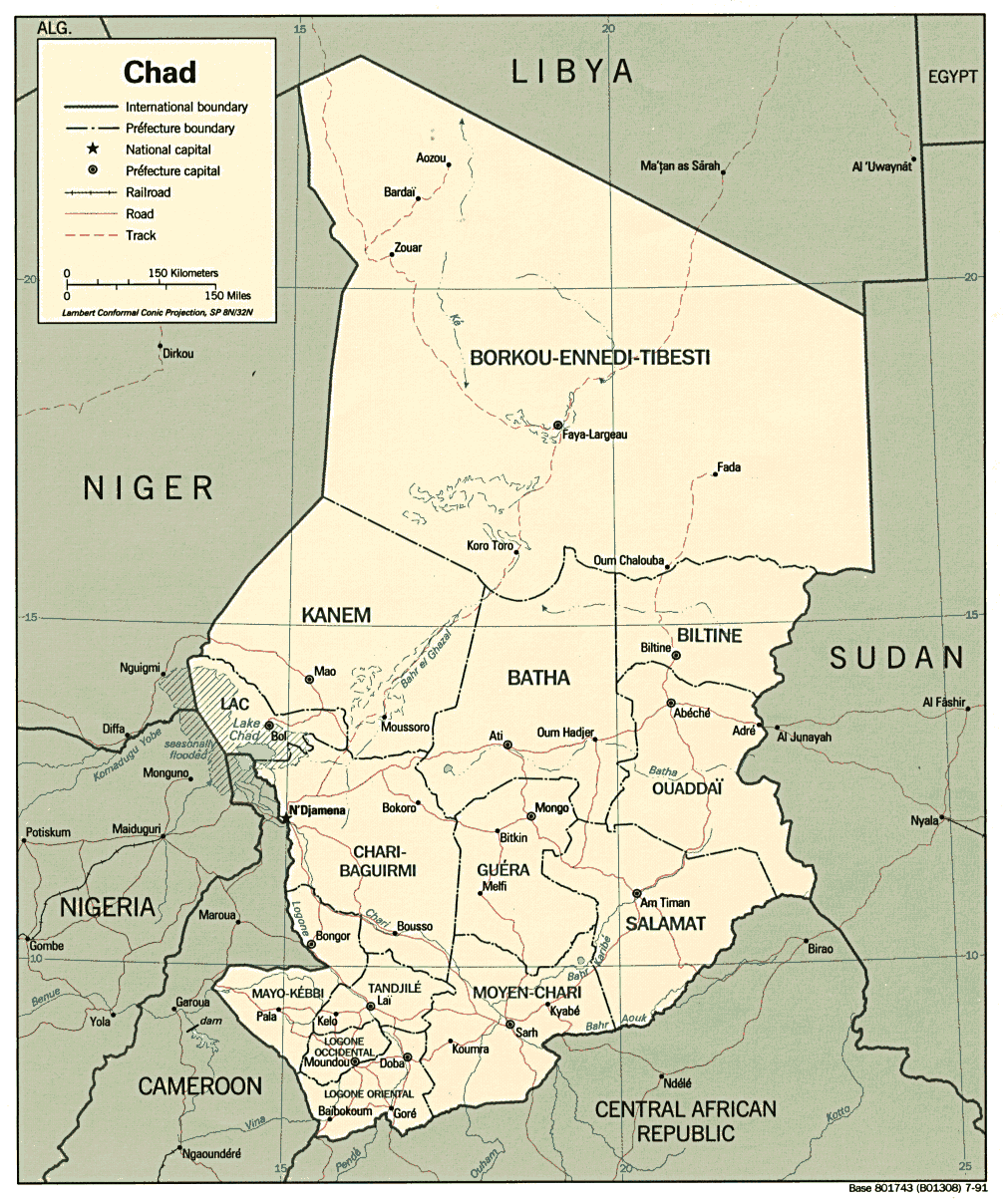
AFP reports that the cross border conflict between Chad and Sudan is heating up again. Yesterday, state-Sudanese media reported that Chad had launched air raids in western Darfur.
"The website, quoting senior military officials, said there were no causalities but that the Sudanese army was on 'standby' and waiting for 'the green light for retaliation'."
Meanwhile, BBC News reports that southern and northern interlocutors in Sudan have agreed to new measures to quell any violence that could erupt in response to the Hague ruling on the border between the two regions expected next Thursday. The UN peacekeeping presence will be increased in the south, and both sides will send officials to explain the ruling once it is handed down.
"Tensions are rising ahead of national elections put back until April 2010 and a referendum on whether the south should secede, due in 2011."
In early June both sides began demobilizing their troops and on June 24th the two sides agreed to abide by the Hague's ruling--see Daily Sources 6/24 #10.

14. PETROECUADOR SEIZES PERENCO OILFIELDS, CHILE SIGNS CONTRACT FOR ECUADORIAN SUPPLY

Stephan Kueffner and Matthew Campbell at Bloomberg reports that PetroEcuador has seized the oilfields of Perenco SA, which operated the block 7 and 21 concessions producing about 21 kb/d.
"Perenco said yesterday it would suspend production after Ecuador started expropriating its crude oil in March because of a dispute over $327 million in back taxes. Ecuador, which increased a windfall tax on oil to 99% in October 2007, has said that Perenco and other companies haven’t paid the full levy, which has since been cut to 70%."
Perenco SA is an independent international oil firm whose main offices are in London and Paris with annual revenues of about $3 billion. Meanwhile, Tom Azzopardi at Platts reports that ENAP, Chile's national oil company, has signed a deal with PetroEcuador to import 800,000 barrels a month (~ 26.7 kb/d) to up to 10 million barrels a year (27.4 kb/d) of crude.
"Shipments are due to begin next month with two shiploads of 400,000
barrels each to Chilean ports ... ."
ENAP is the only refiner in Chile with a capacity of about 230 kb/d. Chile produces about 11 kb/d of its own crude needs. Ecuador stopped making payments on its sovereign debt on December 12 and later in that month pressured its social security system to purchase $1.2 billion in new bonds--see Daily Sources 12/29 #14. Ecuador currently uses the US dollar as its currency.

15. MEXICAN CENTRAL BANK CUTS BENCHMARK RATE TO 4.5%

Jens Erik Gould and Hugh Collins at Bloomberg reports that Mexico's central bank cut its benchmark rate by 0.25% to 4.5% in the seventh consecutive month of cuts. The bank's statement from the board indicated it will henceforth "pause its current monetary easing cycle" and that "[a]n improved performance in the general economic activity is expected in the second half of the year."
"Mexico’s annual inflation rate slowed to 5.74% in June, the lowest in nine months. While the rate was within the central bank’s forecast of 5.5% to 6% in the second quarter, it was above policy makers’ forecast of no more than 5.25% for the third quarter.

The bank aims to meet its inflation target of 3% by the end of 2010."
Remittances from abroad contracted by 20% in May, the sharpest drop on record.

16. NEW BUILDING PERMITS & HOUSING STARTS UP STATISTICALLY INSIGNIFICANT AMOUNT

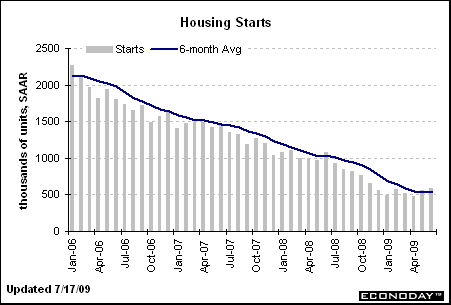
Barry Ritholtz at the Big Picture notes that new building permits in June were 8.7% (±3.0%) above May and that housing starts were up 3.6% (±11.3%). He comments:
"The year-over-year data is much clearer: New Starts down 46% [±4.3%], Permits down 52% [±3.6%]."
He links to a Barron's Econoday graph:

Wednesday, May 20, 2009

Daily Sources 5/20

1. JAPAN'S GDP FALLS 4% QUARTER OVER QUARTER, AT AN ANNUALIZED RATE OF 15.2%

United Press International reports that Japan's Cabinet Office released preliminary data today showing that GDP contracted by 4% in the first quarter from the fourth.
"Based on the latest numbers, the GDP contracted at an annual rate of 15.2%, Kyodo news service reported.

That beat the previous annual worst performance record of 13.1% in the January-March quarter of 1974, which was blamed on the global oil crisis."
2. AMOUNT OF NATURAL GAS TRANSITING UKRAINIAN PIPELINE SYSTEM IN FIRST FOUR MONTHS DOWN 50% YEAR OVER YEAR--LIKELY CULPRIT REDUCED INDUSTRIAL PRODUCTION

Upstream online reports that the volume of natural gas transiting the Ukrainian pipeline system to Europe has fallen by 50% in the first four months of 2009 from the first four of 2008, per a statement on the Ukrainian energy ministry's website.
"Russia transported 23.2 billion cubic metres of gas through Ukraine to Europe against 46.3 Bcm last year in January-April, according to the ministry's statement, wrote Reuters."
3. CHINA INTRODUCES NEW RURAL STIMULUS FOR LENDING, TAKES MEASURES TO REDUCE STIMULUS-BASED CORRUPTION, AND REPORTS THAT REGIONAL STIMULUS OBLIGATIONS NOT BEING MET

Jason Subler at Reuters reports that China's Ministry of Finance today announced that it would provide qualified rural financial institutions with subsidies equal to 2% of their loan books. In the meantime, the Associated Press reports that Tuesday the China Banking Regulatory Commission announced new rules governing loans of more than 5 million yuan (~ $732,000) or which account for more than 5% of the project financed. The new rules are in effect anti-corruption legislation.
"[T]he National Audit Office [NAO] said in a report released earlier this week that it found that local governments were failing to disburse funds allocated for projects, causing delays and other problems.

Less than half of the funding due from local governments had been invested, it said."
JR WU at the Wall Street Journal also reports on the NAO's audit, writing:
"The report 'has some substantial findings,' said Xianfang Ren, an analyst with IHS Global Insight. She said the issues it raised--funding delays and not enough stimulus for small- and medium-size enterprises--are big problems that have long been suspected. The report also raised the matter of speculative bill financing, which occurs when borrowers use loans not for working capital but to buy stocks or speculate in other assets.

The auditor called for a review of how some financial institutions are carrying out their work to expand domestic demand and promote economic growth. The review would include some state-controlled commercial banks; Agricultural Bank of China; policy lenders Agricultural Development Bank of China and Export-Import Bank of China; and China Credit & Export Insurance Corp., or Sinosure, a policy-oriented export credit-insurance firm.

A China Ex-Im Bank spokesman said he didn't know when the review would take place. Reviews of state-owned institutions are regularly conducted by the audit office, he said."
4. BRAZIL AND CHINA 'FINALIZE' $10 BILLION LOAN PACKAGE, PETROBRAS AGREES TO PROVIDE 4%+ OF CHINESE CRUDE OIL IMPORT REQUIREMENT, BOTH STUDY OPTION TO SETTLE BILATERAL TRADE IN THEIR OWN CURRENCIES

Yesterday Brazil and China appeared to finalize a $10 billion loan package first announced in February in da Silva's visit to Beijing. Winnie Lee at Platts reports that part of the agreement, per a statement on Sinopec's website posted today, is for Petrobras to export 150 kb/d of crude oil to China in 2009 and for volumes to rise to 200 kb/d between 2010-2019.
"The 150 kb/d of crude supply which Petrobras has promised Sinopec for 2009 is equivalent to about 4.2% of China's overall crude imports last year, and would catapult Brazil to the ranks of top foreign crude suppliers of China."
In January, Brazil was the 10th largest supplier of crude to Beijing, exporting 88 kb/d, up 50.6% from exports to China of 58.5 kb/d in December. In January 2008, Brazil exported zero crude to China. Dune Lawrence and Paul Panckhurst at Bloomberg report that Brazil's foreign minister, Celso Amorim, said in a press briefing in Beijing yesterday that the two countries are researching a plan to conduct bilateral trade in local currencies--effectively eschewing the dollar. Even if priced in dollars, or if contracts for oil were linked to futures prices listed in dollars, there is no reason actual transactions for oil would have to be conducted in dollars. Why not in reais, if the renminbi remains restricted?


5. UAE DROPS OUT OF GCC MONETARY UNION, UAE NUCLEAR ENERGY MAY BE DOOMED BY VIDEO OF ROYAL BEATING MERCHANT

Maher Chmaytelli and Camilla Hall at Bloomberg reports that a UAE foreign ministry spokesman told the media that the confederation will withdraw from the Gulf Cooperation Council's planned monetary union. UAE Central bank Governor Sultan bin Nasser al-Suwaidi told journalists "the UAE will continue to maintain its expansionary monetary policy and will keep the exchange rate of the dirham pegged to the dollar."
"'This decision seems to be linked to the decision to locate the GCC Monetary Council in Riyadh,' Tristan Cooper, chief regional economist at Moody’s Investors Service, said by e-mail. 'It remains to be seen what the ramifications of this decision will be for the UAE’s bilateral relations with Saudi Arabia, but clearly it is not positive.'"
Meanwhile, Mary Beth Sheridan at the Washington Post reports that the UAE nuclear energy accord with the US has been put in jeopardy by the emergence of a tape of a half brother of a UAE crown prince beating a merchant.
"Screened for a stunned congressional audience last week, it shows a robed sheik heaping sand into the mouth of a writhing Afghan merchant pinned to the ground by uniformed police.

The sheik later slams a board with a protruding nail into the Afghan's naked backside. In a gruesome conclusion, a black SUV is driven over the victim's bruised and bleeding body."
6. US AND ISREAL FORM WORKING GROUP ON IRAN, IRAN TEST-FIRES MISSILE WITH 1,200 MILE RANGE

Eli Lake at the Washington Times reports that Israel and the US have formed a high-level joint working group to share intelligence on Iran.
"The agreement, reached during Monday's meeting between Israeli Prime Minister Benjamin Netanyahu and Mr. Obama, gives the US a clear channel for communicating with the new Israeli government and a vehicle for keeping tabs on any military contingency plans Israel might make if diplomacy fails and Iran develops nuclear weapons capability."
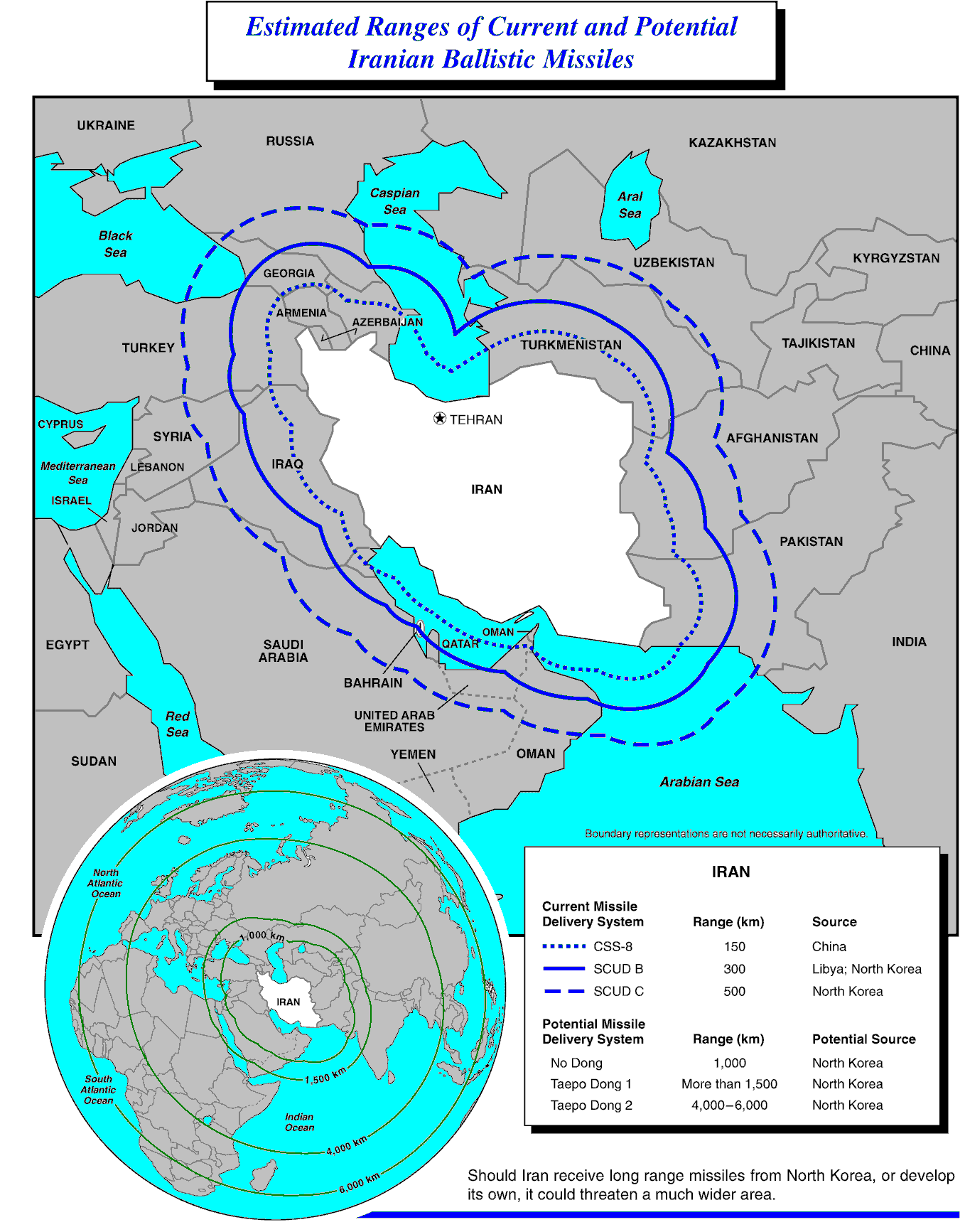
A day after a joint Russian-US analysis determined that a US missile shield based in Europe would likely be ineffective against an ICBM launched from Iran, Nazila Fathi and Alan Cowell at the New York Times report that President Mahmoud Ahmadinejad told the media today that the country had test-fired a missile with a range of 1,200 miles today. The Federation of American Scientists plotted a map illustrating the relative reach of Iranian missiles.


As I have noted in the past, Tehran does not appear to be especially keen on rapprochement with the US.

7. TALIBAN FORCING MARRIAGE AND MILITARY SERVICE IN SWAT, AFGHAN TALIBAN FOUND WITH US MUNITIONS, US PLEDGES $110 MILLION IN AID FOR THOSE DISPLACED BY SWAT OFFENSIVE

As Pakistan pursues its military offensive in Taliban held areas, the Afghanistan News Network reports that Taliban is forcing the daughters of locals in Swat to marry its operatives at gunpoint, evidently in order to force allegiance in the oldest way on record. (h/t Juan Cole at Informed Comment.) Cole also notes that the Taliban is allegedly forcing the sons of locals into military service. Meanwhile, CJ Chivers at the New York Times reports that arms and ordnance collected from Taliban dead from firefights with NATO forces appear to be identical to those given by the US to the Afghan Army.
"The scope of that diversion remains unknown, and the 30 magazines represented a single sampling of fewer than 1,000 cartridges. But military officials, arms analysts and dealers say it points to a worrisome possibility: With only spotty American and Afghan controls on the vast inventory of weapons and ammunition sent into Afghanistan during an eight-year conflict, poor discipline and outright corruption among Afghan forces may have helped insurgents stay supplied."
Some are beginning to wonder what conceivable point our military occupation in Afghanistan might have. Fabius Maximus, for example, thinks the reason we cannot get our NATO allies to commit more troops to the conflict are--an issue which Defense Secretary Gates recently found "puzzling":
"How might the leaders of our NATO allies answer, after we injected them with truth serum?

(1) There is no point to this occupation of Afghanistan. They will find their own destiny, and our armies can do little to influence this. Neither can your flocks of airborne killers, nor your legions of special ops assassins.

(2) Afghanistan poses no conceivable threat to us--nor to you, and probably none to Pakistan. The Taliban’s support for al Qaeda’s attack on the US (to the extent that they did support or facilitate it) was a one-off event, for which they paid dearly. There is no evidence or logic to suggest they found the experience so enjoyable that they will repeat it."
I'm not sure I entirely agree--clearly Islamabad regards the government of Karzai as potentially problematic. But, therein lies the rub, there are many governments more directly affected by the events in Afghanistan than the US and to which their national interest is quite closely tied. Three major powers--Russia, China, and India--are all more directly affected by instability in Afghanistan than the US. Furthermore, a regional power historically constantly in conflict with Russia is also directly affected by such instability. I doubt that their respective analysts believe our current efforts are particularly stabilizing for the region, but, I imagine that some of NATO allies calculate that it may make more sense, in terms of blood and treasure, to leave the question of stabilizing Afghanistan, a country with few raw resources and little industry, to those nations which are more likely to regard a rapid US withdrawal from the country with real concern. In the meantime, Arshad Mohammed at Reuters reports that the US announced yesterday that it would provide $110 million to Pakistan to help attend to the needs of the two million people that have reportedly fled the Swat Valley to get out of the way of the Pakistan armed forces' operation there.
"The White House said that the United States would provide $100 million in humanitarian aid such as food, tents, radios, generators and other items and that the US Defense Department would give a further $10 million in unspecified assistance."
Unfortunately, the President of Pakistan just now is known to his own people as Mr 5%.

8. ETHIOPIA DENIES THAT TROOPS HAVE CROSSED INTO SOMALIA

Mohamed Olad Hassan at the Associated Press reports that Ethiopia has officially denied allegations that its troops had re-entered Somalia yesterday.
"'Our troops have not returned to Somalia,' Ethiopian Foreign Ministry spokesman Wahde Belay said. 'Our troops are on our side of the border.'"
9. CHAD ANNOUNCES NEW CROSS-BORDER OFFENSIVE VS REBELS IN SUDAN

Reuters reports that Chad has announced that it will send troops into Sudan again today in order to intercept a rebel assault being prepared there, two days after calling a halt to cross-border bombing raids into the country.
"Sudan called last week's bombing raids on its territory an 'act of war' and issued another warning on Tuesday.

'We would urge Chad to refrain from violating the sovereignty of the country and stop its aggression,' Ali Youssef Ahmed, an official in Sudan's foreign ministry, told Reuters.

'Chad needs to come to its senses and respect the agreement which was signed in Doha. We hold them responsible for any repercussions that may arise from such actions.'

Chad and Sudan held reconciliation talks in Doha earlier this month and agreed to refrain from using force to resolve their conflicts. But N'Djamena accused Khartoum of sending armed groups over its border just hours after the deal was signed."
10. CALIFORNIA AND FRENCH PORT DATA STILL SHOWING LARGE ANNUAL DECLINES IN VOLUME

The Port of Long Beach has released its April TEU data, showing a 26.6% year over year decline in volume for the month:


The Port of Los Angeles has also released its April TEU data, showing a 12.11% decline year over year in volume:


And the Port of Marseilles has released its April TEU data, showing a 12% decline year over year in volumes handled:


It does look from the Marseilles data the the worst declines may be over, though the contraction is still pretty steep.

11. UN NEGOTIATING TEXT ON CLIMATE TREATY WANTS NEAR ELIMINATION OF DEVELOPED WORLD EMISSIONS, 25% REDUCTION IN DEVELOPING WORLD EMISSIONS

Alex Morales and Jeremy Van Loon at Bloomberg report that the UN's negotiating draft for a new treaty to put a stop to global warming was published today.
"The United Nations’ first draft of a new treaty to stem global warming suggests goals such as the near elimination of greenhouse-gas emissions by mid-century in developed countries including the US and Japan.

China, India and other emerging economies would have to aim for a 25% reduction of heat-trapping gases, under a separate option that would mark the first-ever target for developing nations."
The 50 odd page negotiating text can be found here.

12. IEA PUTS NUMBER ON OIL DEFERRED BY PRICE DECLINE

The Paris-based IEA put a number on the delayed investments in new oil supply, per Kate McKenzie at FT Energy Source:
"In a new report, the agency reportedly warned that oil companies and investors have postponed about $170 billion of projects, equivalent to about 2 mb/d, and a further 4.2 [mb/d] in future oil supply capacity has been delayed by at least 18 months."
13. THE CENTER FOR NAVAL ANALYSES SAYS FOSSIL FUEL USE IS AN URGENT NATIONAL SECURITY THREAT

The Military Advisory Board of the Center for Naval Analyses has concluded that fossil fuel use is an urgent national security threat. (h/t reader Dee Illuminati.)

14. WET WEATHER DELAYING PLANTING OF US WHEAT CROP

Tony C. Dreibus at Bloomberg reports that wheat prices have risen to the highest levels seen since January as wet weather in the US has hindered the planting of the crop.
"About 50% of the spring crop was planted as of May 17, down from the five-year average of 90%, the Department of Agriculture said this week. Parts of central Kansas have received as much as three times the normal rainfall in the past month, National Weather Service data show."
The US is the world's largest exporter of wheat.

15. EIA DATA SHOWS CRUDE STOCKS STILL AT HIGHS, BUT BIG DRAWDOWNS IN BOTH CRUDE AND GASOLINE--NATIONAL GAS AND DIESEL PRICES CLIMBING BACK UP ... NOT FAR FROM DEMAND DESTRUCTION TERRITORY

The EIA announced today that commercial stocks of crude oil fell by 2.1 million barrels in the week ended May 15 to 368.5 million barrels, a big drop, but still the most seen since September 1990. The median expectation of analysts was, according to a Bloomberg survey, for a 400,000 stock draw. Gasoline stocks fell by a whopping 4.3 million barrels to 204 million barrels, moving in the course of a month from holdings in excess of the five year historical range for the time of year to below the five year historical range for the time of year.


The decline in gasoline stocks was "more than three times what was forecast." Distillate stocks, by which the EIA primarily means diesel and heating oil, built by 600,000 barrels to 148.1 million barrels, 40.8 million barrels or 27% more distillates are in storage than this time last year. They also produce a chart of retail gasoline and diesel prices in the US over the last six years or so:


I've previously remarked that at about $2.50-$3.00/gallon you start seeing Americans reducing their driving ... we are beginning to enter that price range now.

16. SF FED'S REPORT ON HOUSEHOLD DELEVERAGING AND FUTURE CONSUMPTION GROWTH SEEMS TO SUGGEST THAT CONSUMPTION GROWTH IS UNLIKELY

Mike Shedlock at Mish's Global Economic Trend Analysis notes the recent release of the Federal Reserve Bank of San Francisco's report on Household Deleveraging and Future Consumption Growth. Mish republishes a graph from the report:


and comments:
"Notice the enormous gap between debt and income. This gap will be filled by deleveraging (increased savings), by default, or a combination of both. Either way, given consumer spending is close to 70% of the economy, it is irrational to expect the stock market to come roaring back anytime soon."
and points to another revealing graph from the bank:


Well worth reading in full.

17. COULD SPENDING ON RAIL CREATE AS MANY JOBS AS SPENDING ON THE CAR INDUSTRY?

Yonah Freemark at The Infrastructurist argues that investing in rail will employ more people than commensurate investments in the auto industry would.
"France’s TGV high-speed trains, which criss-cross that country, carried 100 million people in 2008, and the national rail company employs about 200,000 people (that number includes people working on commuter trains). France is 1/5th the size of the US in population.

One can extrapolate: an equivalent American rail network could transport 500 million passengers a year on fast rail and provide jobs for one million people operating trains, maintaining track, and serving customers. There are about as many people working in motor vehicle and part manufacturing in the US today. A vibrant rail industry would mostly be a service-oriented one, rather than a manufacturing one.

The US isn’t close to providing anything of the sort today: Amtrak’s 18,000 employees served only 29 million passengers in 2008. It’s hard to imagine an $8 billion dollar investment from Washington being enough to stimulate the 20-fold expansion of a transportation sector, but it’s a start."
(h/t Kate McKenzie at FT Energy Source.)

Monday, May 18, 2009

Daily Sources 5/18

1. GLOBAL HOUSING BUBBLE STILL LOOKS UNPOPPED

On Saturday, Rebecca Wilder at News N Economics took a look at the global housing bubble. She plots a graph of price-rent ratios for Ireland, Spain, the UK, Germany and the US indexed to 1997:


She says she "included the German price-rent ratio to show that housing bubbles are not uniformly the root cause of economic decline." Worth a look.

2. SUPPORT FOR LISBON TREATY IN IRELAND, ITS NEXT BATTLEGROUND, GROWS

Stephen Collins at the Irish Times reports that 52% of respondents in a new survey indicated that they would support the upcoming referendum for the Lisbon Treaty.
"Asked if, in the current crisis, it is better for Ireland to be part of the EU, an overwhelming majority of 79 per cent to 10 per cent say Yes, with a very small number of undecided voters at 11 per cent.

There is a substantial majority in favor of the EU among all social classes, age groups and party supporters.

Not surprisingly, Sinn Féin supporters are easily the most negative about the EU, although a decisive majority are still in favor.

What is surprising is that the most enthusiastic supporters of the EU are Green Party supporters, followed by Fianna Fáil, Fine Gael and Labour in that order."
The largest trend spotted by the survey was a softening of the stance of women toward the treaty, where a significant percentage switched from "No" to "I Don't Know." Dublin registered the largest majority in support of the treaty. (h/t Eurointelligence.)

3. EU ENERGY COMMISSIONER GIVES CREDENCE TO PEAK OIL THEORY

The Oil Drum has reproduced the comments of Andris Piebalgs, the European Energy Commissioner, in which he suggests that he thinks that peak oil analysts may well be right.Key excerpt:
"The world is aware that the production of the existing oil wells is decaying and that new discoveries are more scarce and more expensive. Some experts consider that global oil production may have peaked at [84] million barrels a day. The current economic crisis can make the situation worse. The lower prices that we are enjoying now can be in fact bad news. At this price oil producers have been forced to postpone many necessary investments in new production capacity. These investments take decades to be accomplished. In consequence, if the current economic crisis finished and demand recovers we could be facing huge shortage of supplies that can lead to extremely high prices."
4. BAGHDAD-KRG DISPUTE HEATING UP FURTHER ON KURDISH INDEPENDENT OIL EXPORTS, KRG BECOMES LINKED TO BATTLE BETWEEN THE NABUCCO AND SOUTH STREAM PIPELINE ALTERNATIVES, RUSSIA STRENGTHENS LINKS TO KEY TRANSPORT AND DELIVERY NATIONS--ITALY, AUSTRIA, HUNGARY

Missy Ryan and Mohammed Abbas at Reuters report that Iraqi Prime Minister Nuri al-Maliki said in a televised interview last Thursday that power-sharing pacts that have Sunnis and Kurds a greater say in the affairs of the country need to be pared back. He said,
"In the beginning, consensus was necessary for us. In this last period, we all embraced consensus and everyone took part together. We needed calm between all sides and political actors. But if this continues it will become a problem, a flaw, a catastrophe. The alternative is democracy, and that means majority rule ... From now on I call for an end to that degree of consensus."
The rule of consensus has resulted in minority groups taking posts in senior administrative roles regardless of their share of the national vote. Moves to end the custom would clearly benefit the Shi'a majority in the country. In the meantime, Saifur Rahman at Gulf News reports that Sharjah-based upstream energy explorers Dana Gas and Crescent Petroleum, in conjunction with Austrian energy group OMV and Hungary's MOL have signed a partnership to invest as much as $8 billion in the Kurdish region's energy sector.
"The strategic partnership is expected to boost gas output in Iraq's ... northern Kurdistan province from the current 90 million standard cubic feet of gas per day to a potential 3 billion by 2014 and help meet the growing energy demand in the region and beyond."
Part of the notion touted by OMV and MOL is to find gas supply for the Nabucco pipeline. However, in March Gazprom signed a deal with MOL to establish a 1.3 billion cubic meters storage facility in Hungary--see Daily Sources 3/18 #4. And Euroactive today reports that Russian oil company Surgutneftgas recently took a 21.2% stake in MOL, for €1.4 billion (~ $1.86 billion at the interbank exchange rate of the time.) OMV had launched a failed takeover bid for MOL in 2007, which led to it selling its stake to Surgutneftgas in March. Surgutneftgas is thought to be close to Prime Minister Vladimir Putin.


The Kurdish Regional Government's oil minister, Ashti Hawrami indicated last week that oil from concessions signed without Baghdad's approval will begin to flow through the Iraq-Turkish pipeline and that the only way for Baghdad to put a stop to that would be to shut all exports via that line--see Daily Sources 5/12 #8. In a likely related development, Faleh al-Khayat at Platts reports that Iraq's parliamentary committee has asked the speaker to summon Iraqi oil minister Hussein al-Shahristan to be queried on his failures to move central government oil policy forward.
"The call for a summons came in a statement read out by an official from the speaker's office on Iraq's Al-Sharqiya satellite television channel. The official said the request was signed by 140 of parliament's 275 members."
Shahristani is in open conflict with the Kurdish Regional Government, refusing to grant the legitimacy of 20 oil and gas concessions the region has granted without central government say so. In the meantime, Isabel Gorst at the Financial Times reported Saturday that Berlusconi and Putin signed a deal in Sochi Friday to increase the capacity of the planned South Stream gas pipeline to 63bn cubic meters a year.
"Paolo Scaroni, Eni chief executive, said South Stream would improve Europe's energy security. "What is the meaning of this capacity extension of South Stream? It means 1 billion cubic meters more here will be 1 billion cubic meters less gas crossing Ukraine.""
It is interesting in this context that Iran appears to be arguing at this time for the Pars Pipeline, and now has it moving not through Turkey, but through Iraq and Syria to the Mediterranean, which could potentially thread it through Iraqi Kurdistan. Iran has its own concerns about its Kurdish minority, and has an interest in maintaining strong relations with a Shia-dominated government in Baghdad, so the fact that such a move has even been placed on the table is of some interest.

5. RUSSIAN ANALYSTS SAYING MOSCOW SHOULD FOLLOW THE US AND TURN TO THE FAR EAST

Yevgeny Bendersky at the Compass translates some geopolitical analysis from Russia's Daily Izvestia:
"So whats for Russia in all of this? At present, we stand on the sidelines of the revolutionary transformation of the economic world order. We pray for high oil prices. Why? So that once again we can accumulate dollar reserves and invest in the United States? What for? At the same time, Russia does not belong to any serious economic bloc.

The world will be divided into three main regions: the Americas, Europe and the East, warn the economists. United States will lose some of its power, the leadership will shift towards Asia. That is why America is in a hurry to make friends with China, in order to prevent the creation of a powerful Asian bloc. Where is Russia in the new structure of the world? The East, of course, is closer to us. Already, 96% of Russia's far eastern exports are geared for consumption by the neighboring Asian countries. We need to unite with them--especially in an era of globalization."
6. THE PLA ORDERED TO ESCHEW HEDONISM

Sky Canaves at China Journal reports that the Central Military Commission, the powerful Communist Party organ that controls the People’s Liberation Army, issued a directive over the weekend warning PLA officers against ostentatious displays of wealth. It is only anecdotal, but I have been led to understand that in order to do business in China, you must have contacts with the PLA.
"Today the People’s Liberation Army Daily carried a front-page article ... on the directive, pledging more stringent controls over mid-level and senior military officers, emphasizing accountability and party loyalty."
7. BRAZILIAN PRESIDENT IN BEIJING TO TRY AND MAKE FINANCING DEALS REALITIES

Andre Soliani at Bloomberg reports that Brazil's President, Luiz Inacio Lula da Silva, is in Beijing today where he hopes to make reality financing plans for a variety of projects.
"If Lula’s plans pan out, he’ll return with a $10 billion credit for Petroleo Brasileiro SA, an $800 million loan for the state development bank, and financing for ports and waterways. He expects he’ll be able to open China to Brazilian poultry."
(In February, Petrobras announced it had signed a $10 billion loan agreement with China’s Development bank--see Daily Sources 2/19 #1.)
"China, according to central bank figures, has invested $141.6 million in Brazil since Nov. 12, 2004 when Lula, with Hu beside him, said Brazilians could look forward to $7 billion of Chinese financing.

'Given the potential of both economies, the investments both ways could be much bigger,' China’s ambassador to Brazil, Qiu Xiaoqi, told reporters May 7 in Brasilia when asked why the plans hadn’t materialized.

The biggest Brazilian project announced by the Chinese, a joint venture of Baosteel Group Corp. and Vale to build a $3.6 billion steel-slab plant, was canceled in January.

'The Chinese have made Africa their priority,' said Sandra Rios, coordinator of Brazil-China Observatory, a study group created by Brazil’s Industrial Confederation. 'They expect to have a bigger political influence in that region than in Brazil.'"
8. INDIAN ELECTIONS STRENGTHEN THE MODERATE CONGRESS PARTY

Arvind Subramanian, a senior fellow at the Peterson Institute for International Economics, posts at the Baseline Scenario that the recent elections in India have resulted in a significant victory for the incumbent Congress Party and its allies and defeats for the Communists and the Hindu-nationalist BJP. He comments:
"Going forward, these results augur well for Indian economic policy reform. The Congress will be numerically strong enough not to have to rely on partners for political support and will be able to push through new policy initiatives.

Another likely consequence is that the Nehru family will probably provide India, not immediately but within the next couple of years, with its fourth Prime Minister—Rahul Gandhi, son of Rajiv Gandhi, grandson of Indira Gandhi, and great grandson of India’s first Prime Minister Jawaharlal Nehru.

These results are surprising for two reasons. Indian elections have traditionally been characterized by the phenomenon of anti-incumbency: ruling politicians get routinely thrown out of power. This government is the first in over 40 years that has been re-elected after a full term in office."
Subramanian notes that part of the reason for the Congress Party's success has been that India has been weathering the financial crisis relatively well. Well worth reading in full.

9. US SENATE TOLD PAKISTAN RAPIDLY ADDING TO NUCLEAR ARSENAL

Thom Shanker and David E. Sanger at the New York Times report that a Senate committee Thursday was told that Pakistan is rapidly adding to its arsenal of nuclear weapons. Adm. Mike Mullen, the chairman of the Joint Chiefs of Staff, in response to a question of whether or not aid sent to Islamabad might be diverted to nuclear programs said, "Yes."

10. ISRAEL ALLEGEDLY URGED BY OBAMA ADMINISTRATION TO TONE DOWN IRAN RHETORIC

Steve Linde at the Jerusalam Post reports that the US has been urging Israel to tone down its rhetoric on Iran in advance of Prime Minister Benjamin Netanyahu's visit to DC this week.
"This was one of the purposes of a secret trip to Israel three weeks ago by CIA Director Leon Panetta, foreign diplomatic sources said.

Ostensibly, the CIA chief came to share information on Iran's nuclear program with Israeli intelligence officials and find out how serious the new Israeli government was in its stated position that Jerusalem cannot allow Iran to become a nuclear power.

Panetta was hosted by Mossad chief Meir Dagan and intelligence officials, but also met with Netanyahu and Defense Minister Ehud Barak."
Worth reading in full.

11. MALAYSIAN STATE TO SET UP NEW SOVEREIGN WEALTH FUND ON OIL REVENEUS

Netty Ismail at Bloomberg reports that the Malaysian state of Terengganu is planning to organize a sovereign wealth fund of 11 billion ringgit (~$3 billion).
"The Terengganu Investment Authority, the first sovereign wealth fund set up by a Malaysian state, said it will manage the long-term oil revenue of the state, located on the east coast of peninsular Malaysia."
12. CONFLICT IN NIGERIA CONTINUES TO HEAT UP

Platts reports that tensions continue to escalate in Nigeria as MEND threatened in an emailed statement Sunday to shut all waterways to oil industry vessels. In addition,
"MEND claimed Sunday to have blown up two major oil and gas pipelines in the state. Sources told Platts that one belonged to the state-owned Nigerian National Petroleum Corp. and supplied crude to the 110,000 b/d Kaduna refinery, while the other was a gas pipeline operated by Shell that fed natural gas to power plants in the region. The extent of the damage was unclear."
13. AL-SHABAAB OFFENSIVE APPEARS TO BE MAKING HEADWAY AGAINST CENTRAL GOVT IN SOMALIA, ERITREAN SUPPORT ALLEGED

Stephanie McCrummen at the Washington Post reports that al-Shabaab has launched a ten day offensive across the Somali capital in an attempt to topple the Transitional Federal Government under the new President, Sharif Ahmed.
"Momentum has been swinging back and forth between the government and rebels for days, but on Sunday it seemed to be with the rebels, who include several leaders who US officials have said maintain ties to al-Qaeda. In a major blow, they took a key government stronghold, Ahmed's home town of Jowhar, about 50 miles north of the capital, giving them control of major routes to the north."
Apparently as al-Shabaab has scored military successes, fighters who had switched allegiances to Ahmed have switched back again.
"The Somali government and the United States accused Eritrea of supporting the group by flying cargo planes full of AK-47 assault rifles, rocket-propelled grenades and other weapons to a sandy airstrip outside the capital just before the rebel advance began. Eritrea has denied the allegations."


I am unclear on why it would be in the interests of Eritrea to support a hard line Islamist group's ascent in Somalia, given that it is 98% Orthodox Christian and Sunni Muslim (more or less even divided.) It's longstanding enmity with Ethiopia may account for some sympathy for any organization at odds with Addis Ababa, perhaps Asmara believes that al-Shabaab is the only organization capable of truly creating a state which will impose law and order in Somalia. Still, having done so, it seems that al-Shabaab's ties with al-Qaeda would mean that that would simply result in a state which would seek to export instability to the region.

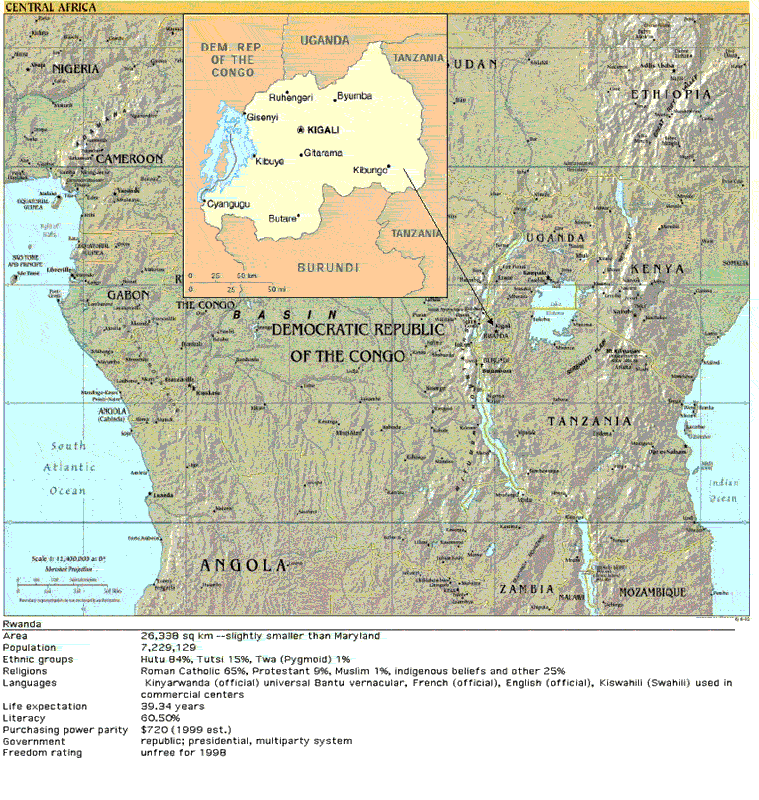
14. RWANDA TELLS SECURITY COUNCIL TO PUT THE KIBOSH ON FOREIGN FINANCING OF REBEL ACTIVITY IN EASTERN CONGO

Anita Powell at the Associated Press reports that Rwandan Foreign Minister Rosemary Museminali told reporters following a meeting of UN Security Council representatives in Rwanda that:
"There are movers and shakers (of the [Hutu opposition group FDLR]) in Europe and the rest of the world. We believe they should be sanctioned, we believe they should be dealt with, if we are to support the peace process in Congo."
Rwandan forces joined the Congolese in a joint military action against rebel Hutu forces in eastern Congo in late January--see Daily Sources 1/23 #9. In that offensive, a rebel Rwandan Powell reports that in 2006 the US imposed sanctions on businessmen and "warlords" who were allegedly financing instability in eastern Congo, near the Rwandan border.


In November, Angola had reportedly sent troops to help Congolese forces combat rebels in the region, but it apparently took the active cooperation of the Rwandan government to make any serious progress--see Daily Sources 11/10 #8.

15. CHAD ENDS AIR STRIKES INTO SUDAN, SUDANESE REBEL APPEARS BEFORE THE ICC

Dany Padire at the Associated Press reports that Chad's interim defense minister, Adoum Younousmi, told the media that N'Djamena had ended air raids against Chadian rebel groups operating out of Sudan Sunday. Younousmi said,
"Our target was not the Sudanese government and less so the general population. Our objective was the Sudanese mercenaries wherever they were to be found, without causing any collateral damage."
The recent air attacks were the first attacks into western Sudan proper, where rebels have allegedly been operating, and whom N'Djamena has alleged Khartoum supports.

"Eastern Chad is a temporary home to about 300,000 refugees who have fled Sudan's Darfur conflict. The region also has camps for 187,000 Chadians displaced by fighting locally and in Darfur."
Younousmi said that the raids had destroyed seven pockets of rebels and that around 100 prisoners had been captured by ground forces operating in conjunction with the air attacks. In the meantime, BCC reports that a former member of the Darfur rebel group, the Justice and Equality Movement (JEM), Bahr Idriss Abu Garda has voluntarily appeared before the International Criminal Court to address charges of crimes against humanity leveled against him. (JEM is an Islamist group fighting the central government.) He is charged with taking part in an attack with killed 12 African Union peacekeepers in northern Darfur.


Mr. Abu Garda has since left JEM to form his own rebel movement, the United Resistance Movement. A spokesman for Mr. Abu Garda has argued that the charges against him are the result of fall out between him and JEM. The President of Sudan, Omar Hassan al-Bashir was charged with war crimes by the ICC in March and promptly expelled aid groups working in the Darfur region in response--see Daily Sources 3/6 #5.

16. NORWEGIAN PARLIAMENTARY VOTE ON CANADIAN OIL SANDS PARTICIPATION PUT OFF

Wojciech Moskwa and Terje Solsvik at Reuters report that the Norwegian government has delayed a parliamentary vote on whether StatOilHydro should withdraw from a $2 billion investment in Canada's oil sands.
"The oil sands issue has put the government in a bind four months before a general election, with political opponents saying state support for the oil sands project was hypocritical given the cabinet's self-professed environmental ambitions."
17. OBAMA ADMINISTRATION TO PROPOSE NEW NATIONAL CAFE STANDARDS

John M. Broder at the New York Times reports that the Obama Administration is set to announce as early as Tuesday new regulations for the emissions and mileage of cars and light trucks which will combine California's new auto-emissions rules with the existing corporate average fuel economy (CAFE) standard to create a single new national standard.
"Under the new standard, the national fleet mileage rule for cars would be roughly 42 miles a gallon in 2016. Light trucks would have to meet a fleet average of slightly more than 26.2 miles a gallon by 2016."
This is a big deal. Transportation accounts for about 60% of US oil consumption.

18. INDUSTRIAL REVOLUTION CAUSED BY CHEAP ENERGY, EXPENSIVE LABOR

In an extremely interesting piece, Robert C. Allen on Friday posted an article asking why the Industrial Revolution took place in England at Vox EU. His answer:
"The famous inventions of the Industrial Revolution were responses to the high wages and cheap energy of the British economy. These inventions also substituted capital and energy for labor."


It was difficult to transfer the technologies to places where either coal was expensive or labor was cheap. A must read. Note, just now many analysts expect the West, and the world, to enter a period where energy is expensive and labor is cheap.