Showing posts with label north korea. Show all posts

Monday, August 9, 2010

Daily Sources 8/9

1. SOUTHEAST ASIA BUYING WEAPONS AT BREAKNECK RATE

Jon Ponfret at the Washington Post reports that a recent publication by the Stockholm International Peace Research Institute shows that concerns over China's rise has pushed countries in Southeast Asia to almost double their weapons purchases from 2005 to 2009.
"The buying spree is set to continue, with reports that Vietnam has agreed to pay $2.4 billion for six Russian Kilo-class submarines and a dozen Su-30MKK jet fighters equipped for maritime warfare. This is in addition to Australia's stated commitment to buy or build nine more submarines and bolster its air force with 100 U.S.-built F-35s. Malaysia has also paid more than $1 billion for two diesel submarines from France, and Indonesia has recently announced that it, too, will acquire new submarines."
2. CHINA TO CLOSE 2,000 ENERGY INEFFICIENT FACTORIES

Keith Bradsher at the New York Times reports that China will close 2,087 steel mills, cement works and other energy-intensive factories by September 30 in order to try and increase its energy efficiency.

3. CHINA MAKES NO PUBLIC COMMENT ON SEIZURE OF ITS FISHERMEN

Brian Spegele at China Real Time reports that China has still made no public statement regarding the seizure of three fishermen by North Korea, allegedly for fishing in the North Korean exclusive economic zone.

4. HUGO CHAVEZ TO MEET NEW COLOMBIAN PRESIDENT TO TRY AND DAMP DOWN TENSIONS

Christopher Toothaker at the Associated Press reports that Hugo Chavez will meet the new Colombian president--Juan Manuel Santos--will meet in Colombia to discuss how to reduce tensions between the two countries.

5. PRESIDENT MEDVEDEV ARRIVES IN ABKHAZIA ON SUNDAY

CNN reports that Russian President Medvedev arrived Sunday in Abkhazia where he will meet with his counterpart, Sergey Bagapsh.

6. FORMER PRESIDENT OF MEXICO FOX CALLS FOR THE LEGALIZATION OF DRUGS

Jonathan J. Levin and Jens Erik Gould at Bloomberg report that the former President of Mexico, Vicente Fox, has called on the country to legalize drugs as a way of tamping down drug cartel violence.

8. COMPANIES ARE SEEKING LICENSES TO BUILD 22 NEW REACTORS

Chuck McCutcheon at the Christian Science Monitor reports that companies in the US are seeking licenses from the US Nuclear Regulatory Commission to build and operate 22 new reactors. A Gallup poll in March found that 62% of Americans now favor nuclear power.

9. US INCOMES FELL BY 1.8% IN 2009

Phil Izzo at Real Time Economics reports that US incomes fell by an average of 1.8% in 2009. The article includes a sortable chart of income growth by city.

10. KRUGMAN NOTES THAT CRITICAL INFRASTRUCTURE IN THE US IS BEING ALLOWED TO FALL INTO DISREPAIR

Paul Krugman at the New York Times reports that localities are letting their roads go to gravel, turning off the lights, and pushing through big cutbacks in education funding while the rest of the world is in the process of building up their infrastructure. A good read.

Wednesday, July 21, 2010

Daily Sources 7/21

1. BANK OF CANADA RAISES INTEREST RATE TO 0.75%

Greg Quinn at Bloomberg reports that Canada yesterday raised its benchmark interest rate by a quarter percent to 0.75%. The central bank indicated that it would consider international developments before raising the rate further.

2. MEXICAN RETAIL SALES UP 5% IN MAY

Jonathan J. Levin at Bloomberg reports that Mexico's retail sales were up 5% from last year in May. The increase took place outside of Mexico's border regions with the US where drug cartel-inspired violence has become endemic. Americans are "thinking twice" before crossing the border to shop.

3. JF-17 MAKES A SPLASH AT FARNBOROUGH

Brian Spegele at China Real Time reports that the Chinese and Pakistani new fighter jet--the JF-17--made a splash at this year's Farnborough International Air Show in England.
"Aircraft sales are the most lucrative part of Beijing’s weapons exports, totaling some $815 million, China Daily reported."
The plane relies on Russian made jet engines, but the fact that China is willing to export its latest technology makes for a different arms theory than that practiced by the US.

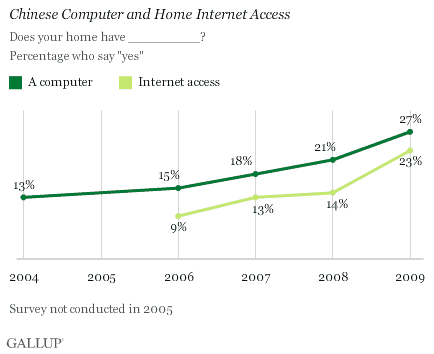
4. INTERNET USAGE IN CHINA IS SURGING

Kevin Sullivan at the Compass reports that Chinese internet usage is surging.


23% of a billion is a lot of people.

5. CHINA FACING HOUSING BUBBLE?

James Hamilton at Econbrowser asks whether China is facing a housing bubble.


6. NEW SANCTIONS ON NORTH KOREA

Craig Whitlock and Karen DeYoung at the Washington Post report that the US has announced that it will impose further sanctions on North Korea.

7. INSURANCE COMPANIES ABANDONING IRANIAN SHIPPING

Thomas Erdbrink and Colum Lynch at the Washington Post report that insurance companies have abandoned their relationship with Iranian shipping in order to comply with new US sanctions. Ports will refuse to allow Iranian ships entry if they are not covered for potential damages. Worth reading in full.

8. KURDS BLOW UP TURKO-IRANIAN GAS PIPELINE

Ivan Watson and Yesim Comert at CNN report that Kurdish rebels today took credit for the bombing of a Turkish-Iranian gas pipeline.
"An official from BOTAS, Turkey's state oil and gas company, speaking on condition of anonymity, told CNN that the fire had been extinguished. However, the official said, it will take at least six days to resume pumping fuel through the pipeline. In the meantime, BOTAS has increased the flow of gas from Azerbaijan to compensate for the gas cut."
9. INDIA AND PAKISTAN DISPUTE KASHMIR DAM

Lydia Polgreen and Sabrina Tavernise at the New York Times report that tensions are rising over the construction of a dam in Jammu-Kashmir. Pakistan is worried that India will be able to control water flow to its farmers during planting season. Worth reading in full.

10. COLOMBIA LOOKING UP

Frontier Markets optimistically notes that Colombia is emerging from its drug war. Investors will be more likely to place their money in Colombia than, say, Venezuela.

12. HOUSING HEADED FOR A DOUBLE DIP?

Barbara Kiviat at the Curious Capitalist argues that a double dip in housing is likely.

13. CRUDE AND PRODUCTS STORAGE INCREASES

The EIA reports that crude oil stocks grew by .4 million barrels in the week ended July 16th. Gasoline stocks grew by 1.1 million and distillate stocks grew by 3.9 million barrels. The national price of gasoline rose by 0.4 cents to 272.2 cents per gallon for the week ended July 19th. (Prices between $2.50 and $3.00 per gallon is where you start to see modification of use.) For the week ended 7/16 refinery utilization crept up to 91.5%.

Tuesday, August 4, 2009

Daily Sources 8/4

1. IEA WARNS THAT $70 OIL COULD UNDERMINE ECONOMIC RECOVERY

Kate Mackenzie at the Financial Times reports that the IEA's chief economist, Fatih Birol, told the newspaper in an interview that oil prices above $70/b would likely undermine any economic recovery.
"'If we go one step further, if we see prices go much higher than that, we may see it slow down and strangle economic recovery,' he said of oil prices on Friday, when the European benchmark was around $70."
2. CHINA MAY CHANGE RULES TO MAKE SUBORDINATED BONDS INELIGIBLE AS CAPITAL, WHICH SHOULD REDUCE THE VOLUME OF CREDIT

Wang Ming and Rose Yu at the Wall Street Journal report that the China Banking Regulatory Commission
"may deem subordinated bonds issued by a bank ineligible as capital if those bonds are held by another bank, the person said. The banking regulator estimates about half the subordinated bonds in circulation are held by other banks.

The amount that banks in China can lend is governed by technical capital ratios -- the more capital, the more room to lend. A big way banks have raised capital is by selling yuan-denominated subordinated bonds, or debt instruments that offer investors less protection in the event an issuer can't repay but also a higher yield than regular bonds."
"Analysts said any curb on how subordinated debt can be used would likely slow lending, because it would limit the appetite of the market's biggest investors, which are banks.

'If the regulator excludes cross-held subordinated bonds from being classified as part of banks' capital, banks will have to try to sell their bonds to nonbanking investors,' said Guo Tianyong, the director of the Finance Research Center at Beijing's Central University of Finance and Economics. That will be difficult, Mr Guo said, and 'as a result, banks will slow the pace of subordinated-bond issues, which would eventually lead to a slowdown in credit growth.'

She Minhua, an analyst at Haitong Securities, said, 'Changing the rules would effectively cause a further decline in banks' capital adequacy ratios, so the fastest way for them to maintain a healthy ratio would be to cut loans.'"
3. CHINESE SEABORNE OIL IMPORTS UP 26% IN JULY YOY

Bloomberg reports that preliminary data from the Chinese Ministry of Transportation indicates that Chinese seaborne imports grew by 26% in July from a year previous.
"Chinese ports unloaded about 16.27 million metric tons, or 3.8 million barrels a day, of imported crude last month ... ."
4. NORTH KOREA RELEASES US JOURNALISTS DURING FORMER POTUS VISIT

Heejin Koo at Bloomberg reports that North Korean leader Kim Jong Il pardoned and ordered the release of two American journalists who had been arrested after allegedly crossing into North Korean territory.
"By seeking an amnesty, the US appears to be conceding that the two reporters broke North Korea’s laws, Paik [Hak Soon, a researcher on North Korean issues at Sejong Institute] said.

'The visit indicates that the US and North Korea are willing to resolve this matter through dialogue,' he said. 'We’ll have to see if this expands to the nuclear issue.'"
"The former president and the North Korean leader 'had an exhaustive conversation' and a 'wide-ranging exchange of views on the matters of common concern,' [the] Korean Central News Agency said without giving further details. The country’s National Defense Commission hosted Clinton at a dinner in his honor, the agency said."
Pyongyang has been long seeking direct bilateral talks with the US regarding its disputes with the international community.

5. AUSTRALIAN CENTRAL BANK LEAVES BENCHMARK INTEREST RATE UNCHANGED AT 3%, RETAIL SALES ARE DOWN 1.4% IN JUNE FROM MAY

EcPulse reports that the Reserve Bank of Australia decided today to maintain their benchmark interest rate at 3%.
"[Reserve Bank Governor] Stevens said in his statement that the world economy started to show clear signs of stability, thanks for the global stimulus plans set by governments around the world that led to an improving outlook for the world economy. He added that the US economy reached a turning point, while the economy in the euro zone is still weak."
Meanwhile, Jacob Greber at Bloomberg reports that Australian retail sales fell by 1.4% in June from May.
"Today’s report suggests the impact from A$12 billion ($10 billion) in government cash handouts to households is waning after consumer spending helped Australia avoid a recession in the first quarter. Still, the economy may expand in the second quarter after retail sales rose 2% in the three months through June. Economists forecast a 1.3% gain.

'We still have retail sales at a very strong levels,' said Ben Dinte, an economist at Macquarie Group Ltd. in Sydney. 'With the strengthening consumer sentiment, we should see retail sales hold up.'

The quarterly retail sales figure accounts for as much as 25% of Australia’s gross domestic product, Dinte added."
6. RUSSIA AND TURKEY TO SIGN PACT TO BUILD OIL PIPELINE WHICH WOULD BYPASS THE BOSPHORUS

Ali Berat Meric and Stephen Bierman at Bloomberg report that Russia and Turkey will sign an accord to build a pipeline to send oil to the Mediterranean bypassing the Strait of Bosphorus.
"OAO Gazprom, Russia’s largest company, and Turkey’s Calik Holding AS will sign an accord to build a pipeline between the northeastern port of Samsun and a terminal at Ceyhan on Turkey’s Mediterranean coast, Russian Energy Minister Sergei Shmatko told reporters in Ankara today before a visit by Russian Prime Minister Vladimir Putin later this week."
7. GERMAN BIRTH RATE MAY HAVE DECLINED

Der Spiegel reports that a report released yesterday by Eurostat indicates that
"for every thousand inhabitants in Germany, only 8.2 children were born in 2008. Which indicates a decrease of 0.1% in the German birth rate and makes Germany the only EU member in which the crude birth rate did not increase between 2007 and 2008."
8. HILLARY CLINTON EXPRESSES CONCERN REGARDING HIKERS ARRESTED NEAR IRANIAN BORDER

Nada Bakri at the Washington Post reports that yesterday Secretary of State Hillary Clinton expressed concern about the welfare of three American hikers who were arrested after entering an area near the Iranian border. Of course, the incident will be used by elements in Tehran as evidence that the recent elections unrest is the result of foreign meddling.

9. MEXICO MAY INTRODUCE FUEL EFFICIENCY STANDARDS

Robert Campbell at Reuters reported yesterday that the head of the Mexican National Ecology Institute, Adrian Fernandez, said in an interview that Mexico is planning to introduce fuel efficiency standards for all new cars sold in the country.
"The government is currently studying which type of standards to impose but it is leaning towards a plan that would be similar to proposed fuel efficiency rules in California or other parts of the United States, ... Fernandez said in an interview.

'The standard will cut gasoline imports by as much as a new refinery.'"
Imprecise, but it would have a significant effect.

10. VENEZUELA TO NATIONALIZE COFFEE COMPANIES, LAUNCHES INVESTIGATION INTO SWEDISH ARMS FOUND IN FARC CAMP

Steven Bodzin and Daniel Cancel at Bloomberg report that Venezuelan President Hugo Chávez said today on state television that he was considering nationalizing two coffee companies after having seized their processing plants yesterday. He said,
"We’ve intervened in these big companies. Now we are conducting a study to expropriate them. They will become property of the nation."
Meanwhile, the Associated Press reports that Caracas has indicated it has launched a probe into how arms purchased from Sweden ended up in the hands of FARC guerrillas in Colombia.
"Justice Minister Tareck El Aissami said authorities had launched 'an internal investigation ... to determine the origin and destination of these weapons,' referring to Swedish-made AT-4 launchers that Colombia says were found in a cache belonging to guerrillas.

El Aissami gave no indication, however, that Chavez's administration was easing its stance toward Colombia amid a diplomatic fight that erupted last week after Colombian President Alvaro Uribe complained the weapons had been acquired by the Revolutionary Armed Forces of Colombia ... ."
12. RUSSIA SIGNS ACCORD WITH NICARAGUA TO EXPLORE FOR OIL AND GAS

Eric Watkins at the Oil & Gas Journal reports that the Nicaraguan government has signed accords with a Russian consortium allowing for oil and gas exploration and production in the country.
"'The concessions include the Caribbean and Pacific, both offshore and on land,' said Francisco Lopez, president of the Nicaraguan Petroleum Enterprise. He said a technical board would be installed to analyze implementation of the agreement.

Russia’s Deputy Prime Minister Igor Sechin said the proposed exploration in Nicaragua would be carried out by the Russian National Oil Consortium, created on Oct. 8, 2008, and comprising Rosneft, Gazprom, Lukoil, TNK-BP, and Surgutneftegaz."
13. ANTIGUA AND BARBUDA NAMES HIGHEST PEAK ON ISLANDS "MOUNT OBAMA"

Nika Kentish at the Associated Press reports that the Antiguan Prime Minister, Baldwin Spencer, today renamed the highest mountain in Antigua and Barbuda "Mount Obama." He said at the dedication ceremony:
"This great political achievement by Barack Obama resonated with me in a way that I felt compelled to do something symbolic and inspiring. As an emancipated people linked to our common ancestral heritage and a history of dehumanizing enslavement, we need to at all times celebrate our heroes and leaders who through their actions inspire us to do great and noble things."
14. HAVIV ARGUES 'SHADOW INVENTORY' LOOMS OVER US HOUSING MARKET

Julie Haviv at Reuters reports that so-called "shadow inventory" is hanging over the US home market.
"'The number of homes listed officially on the market, while still at historically high levels, might be only the tip of the iceberg,' said Stan Humphries, chief economist at real estate website Zillow.com in Seattle, Washington.

According to Zillow's latest Homeowner Confidence Survey, 12% of homeowners said they would be 'very likely' to put their home on the market in the next 12 months if they saw signs of a real estate market turnaround, 8% said 'likely,' while 12 percent said 'somewhat likely.'

The survey of 2,123 adults aged 18 and older, of whom 1,357 are homeowners, was conducted online.

Survey results could translate into around 20 million homeowners trying to sell their homes, a startling number given that the Census bureau indicates there are 93 million US houses, condos and co-ops, Humphries said."
15. HURRICANE SEASON UNDERWAY IN US, GAO STUDY FINDS REFINERY OUTAGES HAVE VERY SMALL AFFECT UPON PRICE

Jesse's Café Américain notes that the hurricane season is underway, and that the peak is usually in mid-September. He notes that "Hurricanes offer a tempting opportunity for energy 'investment.'" I would note, however, that insofar as a legitimate reason for hedging goes, hurricanes are certainly one--and those who want to hedge will need counterparties. Meanwhile, Michael Giberson at Knowledge Problem has the fascinating news that the Government Accountability Office has released a report showing that refinery outages generally have a very small affect upon prices. The report, which I have not had time to read, can be found here.

16. WAL-MART LAST WEEK ISSUED $1.1 BILLION IN SAMURAI BONDS

In a story I missed last week, Lisa Twaronite at MarketWatch reported that Wal-Mart issued US$1.1 billion in yen-denominated bonds (¥100 billion).
"The market for samurai bonds--yen-denominated bonds issued by foreign institutions in Japan--evaporated in the global credit storm. But including Wal-Mart's offering, samurai issuances in July are expected to exceed 200 billion yen--the largest amount since June 2008, Japanese business daily Nikkei reported Wednesday."
Apparently the market is drowning in dollars. (h/t Chuck Butler's Daily Pfenning.)

Friday, July 17, 2009

Daily Sources 7/17

1. UN SECURITY COUNCIL FREEZES ASSETS AND BANS TRAVEL FOR 10 NORTH KOREAN INDIVIDUALS AND CORPORATIONS; RECENT PUBLICATION SEEMS TO INDICATE GROWING NERVOUSNESS ABOUT PYONGYANG IN BEIJING

Colum Lynch at the Washington Post reports that the UN Security Council yesterday froze assets and banned the travel of 10 North Korean individuals and corporations involved in the country's nuclear and ballistic missile programs. Meanwhile, the Fabius Maximus blog notes two recent articles which reporting on a piece by Zhang Liangui, an expert on North Korea at the Central Party School in Beijing, this month in World Affairs magazine, which is sponsored by the Chinese Ministry of Foreign Affairs, which seem to indicate rising concern in Beijing about the possibility of armed conflict with Pyongyang.

2. MARATHON TO SELL 20% OF ANGOLAN CONCESSION TO CNOOC AND SINOPEC, US COMMERCE SECY SAYS AMERICANS NEED TO REALIZE THAT THEIR CONSUMPTION IS DRIVING GREENHOUSE GAS EMISSIONS OVERSEAS

Platts reports that Marathon has signed an agreement to sell a 20% stake in Angola's block 32 concession to CNOOC and Sinopec for $1.3 billion, maintaining a 10% stake in the project.
"There is no doubting the prolific nature of the deepwater block they are buying into. Block 32 has already seen a mouth-watering 12 oil discoveries: Gindungo, Canela, Cola, Gengibre, Mostarda, Salsa, Caril, Manjericao, Louro, Cominhos, Colorau and Alho."
"Block 32 is operated by France's Total, which has a 30% stake. The remaining equity is owned by Sonangol (20%), ExxonMobil (15%) and Portugal's Petrogal (5%).

The existing partners in the block have the right of first refusal over the interest Marathon is selling."
Marathon has stated it hopes to conclude the deal by the end of the year. Meanwhile, Keith Johnson at Environmental Capital reports that the US Commerce Secretary, Gary Locke, told the American Chamber of Commerce in Shanghai yesterday:
"It’s important that those who consume the products being made all around the world to the benefit of America--and it’s our own consumption activity that’s causing the emission of greenhouse gases, then quite frankly Americans need to pay for that."
3. CHINA SHUTS DOWN HUMAN RIGHTS LEGAL CENTER IN BEIJING

Audra Ang at the Associated Press reports that Chinese officials shut down a legal research center led by human rights activist lawyers in Beijing today. In late May it was reported that Beijing had begun denying licenses to practice to law firms which take human rights cases--see Daily Sources 5/28 #1.

4. SOUTH KOREA TO SPEND $100 MILLION IN AID TO ASIAN NATIONS COPING WITH WATER SHORTAGES AND FLOODS

Shinhye Kang and Heejin Koo at Bloomberg report that South Korea plans to spend $100 million by 2012 to help Asian nations deal with water shortages and floods.
"Asia, with half the world’s population, has less available fresh water than any continent except Antarctica, Suzanne DiMaggio, director at the Asia Society, said in April. Glacier runoff is the primary water source for many nations in the region, and they are shrinking with climate change.

'Asian countries have depended on Himalayan glaciers as their main water sources may face water shortage as the glaciers are melting rapidly,' said Park, who also directs the nation’s task force on international cooperation at the Presidential Committee on Green Growth.

South Korea’s government announced a plan last month to spend 22.2 trillion won (~$17.7 billion) over four years to upgrade the water quality and supply systems of the nation’s four major rivers."
5. BP DROPS JATROPHA

Keith Johnson at Environmental Capital reports that BP has abandoned its jatropha venture, from which it had hoped to harvest biodiesel, selling its half of the project to its partner, D1 Oils.
"[T]he inedible but hardy plant that just a few years ago seemed like it could revolutionize biofuels has turned into a bust. The initial attraction was that it grows on marginal land, so it wouldn’t compete with food crops. But marginal land means marginal yields. And jatropha turned out to be a water hog as well, further darkening its environmental credentials."
The joint venture had planted more than 200,000 hectares of jatropha, about a quarter of worldwide jatropha planting. New Delhi has also bet on the plant's potential only to see protests break out over plans to reclassify land for seeding it--see Daily Sources 6/9 #6.

6. EASTERN EUROPEAN DIGNITARIES PUBLISH OPEN LETTER EXPRESSING SOME WORRY ABOUT OBAMA'S "RESET" WITH MOSCOW

Yesterday the Polish Gazeta Wyborcza published an open letter from 22 major political figures from Eastern Europe, including Lech Walesa and Vaclav Havel indicating worry about the Obama administration's "reset" policy with Russia. Key excerpts:
"Our hopes that relations with Russia would improve and that Moscow would finally fully accept our complete sovereignty and independence after joining NATO and the EU have not been fulfilled. Instead, Russia is back as a revisionist power pursuing a 19th-century agenda with 21st-century tactics and methods. At a global level, Russia has become, on most issues, a status-quo power. But at a regional level and vis-a-vis our nations, it increasingly acts as a revisionist one. It challenges our claims to our own historical experiences. It asserts a privileged position in determining our security choices. It uses overt and covert means of economic warfare, ranging from energy blockades and politically motivated investments to bribery and media manipulation in order to advance its interests and to challenge the transatlantic orientation of Central and Eastern Europe.

We welcome the 'reset' of the American-Russian relations. As the countries living closest to Russia, obviously nobody has a greater interest in the development of the democracy in Russia and better relations between Moscow and the West than we do. But there is also nervousness in our capitals. We want to ensure that too narrow an understanding of Western interests does not lead to the wrong concessions to Russia. Today the concern is, for example, that the United States and the major European powers might embrace the Medvedev plan for a 'Concert of Powers' to replace the continent's existing, value-based security structure. The danger is that Russia's creeping intimidation and influence-peddling in the region could over time lead to a de facto neutralization of the region. There are differing views within the region when it comes to Moscow's new policies. But there is a shared view that the full engagement of the United States is needed."
"When it comes to Russia, our experience has been that a more determined and principled policy toward Moscow will not only strengthen the West's security but will ultimately lead Moscow to follow a more cooperative policy as well. Furthermore, the more secure we feel inside NATO, the easier it will also be for our countries to reach out to engage Moscow on issues of common interest. That is the dual track approach we need and which should be reflected in the new NATO strategic concept."
"[T]he thorniest issue may well be America's planned missile-defense installations. Here too, there are different views in the region, including among our publics which are divided. Regardless of the military merits of this scheme and what Washington eventually decides to do, the issue has nevertheless also become--at least in some countries--a symbol of America's credibility and commitment to the region. How it is handled could have a significant impact on their future transatlantic orientation. The small number of missiles involved cannot be a threat to Russia's strategic capabilities, and the Kremlin knows this. We should decide the future of the program as allies and based on the strategic pluses and minuses of the different technical and political configurations. The Alliance should not allow the issue to be determined by unfounded Russian opposition. Abandoning the program entirely or involving Russia too deeply in it without consulting Poland or the Czech Republic can undermine the credibility of the United States across the whole region."
A must read.

7. TURMENISTAN SIGNS DEAL WITH GERMAN NABUCCO PARTNER FOR GAS EXPLORATION, EC PROPOSES NEW RULES FOR EU FOR HANDLING NAT GAS DISRUPTIONS

AFP reports that Turkmenistan signed a deal with RWE--a German firm involved in the Nabucco pipeline project--giving it a license to explore a block for six years and after finding gas the right to extract it for a period of 25 years.
"Moscow has a virtual monopoly on the export of Turkmen gas through its state-run energy giant Gazprom, but there have been signs of strain recently between the two countries ... .'"
Ashgabat publicly accused Gazprom of blowing up a pipeline sending its gas through Russia in order to put an end to payments it had contracted for at exorbitant prices late last year. In late June, Turkmenistan also inked a deal to increase its natural gas exports to China by 30%. On the first of July, Turmen President Kurbanguly Berdymukhamedov invited Russian President Medvedev to Ashgabat to discuss the resumption of exports--see Daily Sources 7/1 #3. Meanwhile, Alessandro Torello at the Wall Street Journal reports that the European Commission has proposed new rules to ensure that the European Union is prepared to weather a disruption in gas supplies such as the one caused by the cut off of supplies through Ukraine by Russia at the start of the year. The rules are designed, in part, to allow the EU to respond as a single entity to future disruptions.
"Under the proposals, each of the EU's 27 countries would have to designate an authority to look after security of their gas supplies, preparing plans aimed at preventing disruptions and dealing with any shortages that arise. The new rules would give the commission--the EU's executive arm--authority to ask for changes to these national plans if it considered them 'not effective' or incompatible with those of other EU countries.

The European Parliament and the 27 EU governments must back the proposal before it becomes law. Talks are expected to take months and might lead to a watered-down version of the rules."
8. OIL STOCKPILES IN ASIA BEING DRAWN DOWN ON LOW REFINERY UTILIZATION

Yuji Okada at Bloomberg reports that oil stockpiles in Asia are being drawn down on low refinery utilization rates.
"The fuel oil inventory in Singapore, Asia’s biggest oil-trading center, was 14.1 million barrels in the week ended July 15, 38% lower than a year earlier, said International Enterprise Singapore, a unit of the trade ministry. Refiners in South Korea and Japan are cutting crude throughput after the recession reduced demand, leading to high product stockpiles and reduced margins.

'The narrowing fuel oil crack in Singapore was mainly caused by the refinery run cut among Asian refiners, particularly ones in Japan and South Korea,' said Akira Kamiyama, a Tokyo-based trader at Mitsui & Co. 'Refinery utilization rates in these countries have been around 70%, while rates in the U.S. have been close to 90%.'

The refinery operating rate in Japan was 64.1% for the week ended June 20 and rose to 70% for the week ended July 11., according to the Petroleum Association of Japan."
10. EIGHT KILLED IN BOMB BLASTS IN TWO JAKARTAN HOTELS

John Aglionby at the Washington Post reports that eight people were killed in bomb blasts in two hotels in Jakarta.
"Speaking from the presidential palace in a live television address, the angry and visibly shaken president said the attackers were irresponsible and inhumane. While their identities remained unknown, the president said, the government will 'use the full extent of the law' to bring to justice 'those who did it, those who helped them, and the masterminds.'

Yudhoyono--who was reelected July 8 by a wide margin and is set to begin a second five-year term--said it was too early to say whether the bombing was linked to Jemaah Islamiah. But other officials and independent analysts said the radical Islamist group or an offshoot is the likeliest suspect."
11. KURDISH LEADERS WARN OF ARMED CONFLICT WITH BAGHDAD, IRAQI CLERICAL ESTABLISHMENT BELIEVES IRANIAN CLERICAL ESTABLISHMENT UNDERMINED BY ELECTIONS, RAFSANJANI USES FRIDAY SERMON TO CRITICIZE ELECTION RESULTS

Anthony Shadid at the Washington Post reports that the Kurdish Prime Minister, Nechirvan Barzani, said in an interview that
"If the problems are not solved [with the Maliki administration] and we're not sitting down together, then the risk of military confrontation will emerge."
Interviews with the Prime Minister and President Massoud Barzani
"described a stalemate in attempts to resolve long-standing disputes with Iraqi Prime Minister Nouri al-Maliki's emboldened government. Had it not been for the presence of the U.S. military in northern Iraq, Nechirvan Barzani said, fighting might have started in the most volatile regions."
Well worth reading in full. Meanwhile, Anthony Shadid at the Washington Post reports that the clerical elite in Iraq believes that the election crisis in Iran has strengthened the religious credibility of their own at the expense of the Shi'a leadership in Iran.
"'It's true,' said Ghaith Shubar, a cleric who runs a foundation in Najaf aligned with Grand Ayatollah Ali Sistani, Iraq's most powerful cleric. 'The spiritual guidance of the people in Iraq has become stronger than the guidance offered under the system in Iran. The marjaiya'--the term used to describe the authority of the most senior ayatollahs--'has more influence in Iraq, spiritual and otherwise, than it does in Iran.'"
The article--well worth reading--concludes with the following statement by Ali al-Waadh, a cleric and representative of Sistani's near the Kadhimiyah shrine in Baghdad, "We're not following Iran; Iran should follow Najaf." (Najaf is where Khomeini himself penned much of his criticisms of the Shah.) I alluded to some of the consequences of the supremacy of the Koran in Iran's legal and political system, given the relative lack of religious credentials of the Leader of the Revolution in a post early last year Law and Revolution in Iran. Meanwhile, in today's Friday prayer sermon, Rafsanjani said the following per a post at the Revolutionary Road blog:
"I have some suggestions. I have spoken to some members of the the expediency council and the assembly of experts about them too.

We must bring back the trust of the people. First of all, everyone must accept the law. The people, the parliament, everyone.

We must create a condition so that everyone can speak. We must speak logically. And a part of this is on the shoulders of the broadcasting corporation.

The Guardian Council did not make good use of the extra fives days given to them by the leader.

We do not need people in prison for this. Let’s allow them to return to their families."
On Wednesday, Borzou Daragahi at the Los Angeles Times reported that respect for the Leader of the Revolution has been diminished in Iran itself after taking sides in the election:
"'Public respect for him has been significantly damaged,' said one analyst, speaking on condition of anonymity. 'Opposing him is no longer the same as opposing God.'"
Protests followed Rafsanjani's sermon which were reportedly put down by security troops.

12. OLMERT SAYS SETTLEMENTS A SIDE ISSUE

Former Prime Minister of Isreal, Ehud Olmert, has an opinion piece in the Washington Post which argues that the current focus on Isreali settlements misplaces the focus of the peace talks. Key excerpt:
"Yet today, instead of a political process, the issue of settlement construction commands the agenda between the United States and Israel. This is a mistake that serves neither the process with the Palestinians nor relations between Israel and the Arab world. Moreover, it has the potential to greatly shake US-Israeli relations."
Worth reading.

13. SUDAN ACCUSES CHAD OF LAUNCHING AIR RAIDS INTO WESTERN SUDAN, ADDITIONAL MEASURES AGREED TO BY NORTHERN AND SOUTHERN SUDANESE OFFICIALS IN ANTICIPATION OF HAGUE RULING

AFP reports that the cross border conflict between Chad and Sudan is heating up again. Yesterday, state-Sudanese media reported that Chad had launched air raids in western Darfur.
"The website, quoting senior military officials, said there were no causalities but that the Sudanese army was on 'standby' and waiting for 'the green light for retaliation'."
Meanwhile, BBC News reports that southern and northern interlocutors in Sudan have agreed to new measures to quell any violence that could erupt in response to the Hague ruling on the border between the two regions expected next Thursday. The UN peacekeeping presence will be increased in the south, and both sides will send officials to explain the ruling once it is handed down.
"Tensions are rising ahead of national elections put back until April 2010 and a referendum on whether the south should secede, due in 2011."
In early June both sides began demobilizing their troops and on June 24th the two sides agreed to abide by the Hague's ruling--see Daily Sources 6/24 #10.

14. PETROECUADOR SEIZES PERENCO OILFIELDS, CHILE SIGNS CONTRACT FOR ECUADORIAN SUPPLY

Stephan Kueffner and Matthew Campbell at Bloomberg reports that PetroEcuador has seized the oilfields of Perenco SA, which operated the block 7 and 21 concessions producing about 21 kb/d.
"Perenco said yesterday it would suspend production after Ecuador started expropriating its crude oil in March because of a dispute over $327 million in back taxes. Ecuador, which increased a windfall tax on oil to 99% in October 2007, has said that Perenco and other companies haven’t paid the full levy, which has since been cut to 70%."
Perenco SA is an independent international oil firm whose main offices are in London and Paris with annual revenues of about $3 billion. Meanwhile, Tom Azzopardi at Platts reports that ENAP, Chile's national oil company, has signed a deal with PetroEcuador to import 800,000 barrels a month (~ 26.7 kb/d) to up to 10 million barrels a year (27.4 kb/d) of crude.
"Shipments are due to begin next month with two shiploads of 400,000
barrels each to Chilean ports ... ."
ENAP is the only refiner in Chile with a capacity of about 230 kb/d. Chile produces about 11 kb/d of its own crude needs. Ecuador stopped making payments on its sovereign debt on December 12 and later in that month pressured its social security system to purchase $1.2 billion in new bonds--see Daily Sources 12/29 #14. Ecuador currently uses the US dollar as its currency.

15. MEXICAN CENTRAL BANK CUTS BENCHMARK RATE TO 4.5%

Jens Erik Gould and Hugh Collins at Bloomberg reports that Mexico's central bank cut its benchmark rate by 0.25% to 4.5% in the seventh consecutive month of cuts. The bank's statement from the board indicated it will henceforth "pause its current monetary easing cycle" and that "[a]n improved performance in the general economic activity is expected in the second half of the year."
"Mexico’s annual inflation rate slowed to 5.74% in June, the lowest in nine months. While the rate was within the central bank’s forecast of 5.5% to 6% in the second quarter, it was above policy makers’ forecast of no more than 5.25% for the third quarter.

The bank aims to meet its inflation target of 3% by the end of 2010."
Remittances from abroad contracted by 20% in May, the sharpest drop on record.

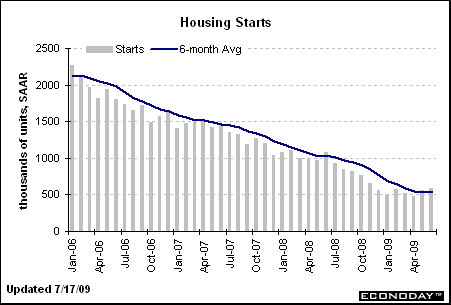
16. NEW BUILDING PERMITS & HOUSING STARTS UP STATISTICALLY INSIGNIFICANT AMOUNT

Barry Ritholtz at the Big Picture notes that new building permits in June were 8.7% (±3.0%) above May and that housing starts were up 3.6% (±11.3%). He comments:
"The year-over-year data is much clearer: New Starts down 46% [±4.3%], Permits down 52% [±3.6%]."
He links to a Barron's Econoday graph:

Wednesday, June 17, 2009

Daily Sources 6/17

1. JAPAN TO FINANCE CLEAN ENERGY EXPORTS

Keith Johnson at Environmental Capital notes that Japan plans to underwrite the switch of other countries to clean energy, but only if they use Japanese technology. Johnson quotes from a report from Bloomberg:
"Japan plans to offer loans to power producers in the US and Australia that buy so-called clean coal generators from Japanese manufacturers, according to a government document obtained by Bloomberg News. Funding from state-owned Japan Bank for International Cooperation would help drive sales of the plants that cost about $3.1 billion apiece, said a senior trade ministry official involved in producing the 113-page draft plan, due to be released today."
2. RUSSIA & CHINA RELEASE JOINT STATEMENT EXPRESSING CONCERN RE: NORTH KOREA

Steve Gutterman at the Associated Press reports that Chinese President Hu Jintao and Russia's Dmitry Medvedev issued a joint statement today after meeting in Moscow:
"expressed serious concern in connection with the situation on the Korean peninsula."
"Hu and Medvedev called for the 'swiftest renewal' of the talks involving their countries as well as North and South Korea, Japan and the United States, which broke down months ago.

The statement included no new initiatives on the mounting problem and used language that appeared aimed at avoiding raise North Korea's ire further."
3. US EXPLORING RUSSIAN PARTICIPATION IN MISSILE SHIELD SCHEME

Walter Pincus at the Washington Post reports that Deputy Defense Secretary William J. Lynn III told Congress yesterday that the US is considering ways to incorporate Russia into a missile defense system for Europe.
"Lynn said that a radar installation in Armavir in southern Russia 'would provide helpful early-warning detection in the case of an Iranian ballistic missile attack.' [Lt. Gen. Patrick] O'Reilly [director of the Missile Defense Agency] told the panel that he had visited a Russian radar facility at Gabala, Azerbaijan, and that both Russian radars would be helpful in monitoring Iranian missile tests. The data gained 'would significantly help our development of our missile defenses,' O'Reilly added.

Overall, Lynn said, 'the involvement of Russian assets, particularly Russian radars, would enhance the capability of that kind of European-based system.'

He also suggested another potential advantage of including Moscow in the effort: 'A US-Russian collaboration would have an additional benefit of a diplomatic signaling to the Iranians that this is an unacceptable course for them to pursue and that they will face a concerted international front, should they proceed down that path.'"
Confirmation, as far as I'm concerned, that the Obama administration is putting the squeeze on Iran by pursuing a "reboot" in relations with Moscow.

4. BRIC SUMMIT ENDS WITH JOINT STATEMENT CALLING FOR LARGER SAY IN INTERNATIONAL FINANCIAL SYSTEM, RUSSIA AND CHINA AGREE TO EXPLORE MORE SETTLEMENT IN DOMESTIC CURRENCIES IN BILATERAL TRADE, BUT GAZPROM ANNOUNCES GAS PIPELINE TO CHINA DELAYED BY NO AGREEMENT ON PRICE, AND LUKOIL VP CALLS FOR MOSCOW TO JOIN OPEC

Andrew Osborne at the Wall Street Journal reports that the BRIC countries released a joint statement following their summit yesterday in Ekaterinburg saying:
"The emerging and developing economies must have greater voice and representation in international financial institutions. There is a strong need for a stable, predictable and more diversified international monetary system."
Meanwhile, Lyubov Pronina and Alex Nicholson at Bloomberg report that following their bilateral meeting in Moscow of President Hu Jintao said that they agreed to expand the use of the yuan and ruble in settling bilateral trade between the two countries. Medvedev told reporters:
"We agreed to take further steps in this direction, including, perhaps, by adjusting contracts and laws that already exist."
However, Vladimir Soldatkin at Reuters reports that Gazprom deputy chief executive Alexander Ananenkov told a news conference that construction on natural gas pipelines to China have been delayed, as "it still cannot reach a pricing deal with Beijing." Further differences in perceived interests between Russia and China were illustrated by the comments by Lukoil VP Leonid Fedun made in an interview with the Kommersant newspaper reported in Reuters,
"Russia should join OpEC and move to direct contracts. Then we will jointly control 51% of world output and we can dictate the price by directive."
5. ACCESS TO CHINESE STIMULUS PROGRAM MONIES REQUIRES PREFERENCE FOR CHINESE FIRMS

Ian Johnson at the Wall Street Journal reports that a recent directive issued by various central government agencies, including from the National Reform and Development Commission, seems to require that projects receiving stimulus-mandated funds give preference to Chinese companies.
"The notice, dated May 26 but only posted on the commission's Web site this month, is part of a broader buy-local push in recent months by authorities, who have quietly been indicating that most of the two-year four trillion yuan ($588 billion) in stimulus spending will be aimed at Chinese companies.

'Apart from engineering goods or service that cannot be obtained under reasonable business conditions inside China, domestic products should be purchased for the government investment program,' according to the official notice."
6. LACK OF INDEPENDENT JUDICIARY IN CHINA LEAVES JUSTICE SYSTEM MORE VULNERABLE TO MOB RULE

Sky Canaves at China Journal notes that the lack of an independent judiciary in China works both ways:
"But nowadays, courts also seem to take guidance from below.

Deng Yujiao, a young hotel worker charged with killing a local official (who she alleged tried to rape her), was set free yesterday after a brief trial and the murder charges against her dismissed, a result that is being cited as a 'significant victory of the Chinese Internet users and Chinese democracy.'

The unofficial precedents for the outcome of Deng’s case can be seen in a couple of other cases from last year that pitted the small guy against perceived official privilege. Xu Ting, a young migrant worker who took advantage of a faulty ATM to withdraw a load of cash and then ran away, was tried and sentenced to life in prison. But Internet users noted that officials charged with corruption involving similar sums (175,000 yuan) would face much lighter penalties, sparking a media outcry that resulted in a retrial and a much shorter sentence of five years for Xu."
The problem of course is that the law is supposed to act as a barrier to mob rule, not to simply preside over judgments made by rumor and innuendo.

7. IN CENTRAL ASIA FINANCIAL CRISIS MAY DRIVE IMMIGRATION

Erica Alini at Real Time Economics notes that in a recent report by the Central Asia-Caucasus institute, "anecdotal evidence suggests that since the world economy nose-dived last fall, 'a higher number of young men bought one-way tickets to Russian cities in November 2008 through January 2009.'"
"Russia is a prime destination for migrant laborers from Uzbekistan, Kyrgyzstan, and Tajikistan, where remittances account for between 8% and nearly 50% of the national income. Thus, as the Russian economy started contracting amidst the economic downturn last year, Central Asia felt the pinch.

When the downturn poked the Russian housing bubble, Central Asian migrants were hit particularly hard because many of them work in construction, Willem Van Eeghen, a migration expert at the World Bank, said.

By December 2008 remittances were down by nearly half in Tajikistan and Kyrgyzstan, according Ms. Marat.

Uncharacteristically, though, the plunge in remittances seems to be pushing even more Tajiks, Kyrgyzs and Uzbeks toward Russia. That’s because many of them seem to think that home offers no prospect, even as things get tough abroad. "
8. SOUTH KOREAN LNG IMPORTS DOWN 41% YOY

Jonty Rushforth at Platts reports that South Korean LNG imports are down 41% year on year in May to 1.26 million metric tons from 2.13 million metric tons.
"They were also down 28.6% from April this year, when the country imported 1.76 million mt."
Not a green shoot.

9. NIGERIAN NIGER DELTA MILITANT TO ACCEPT AMNESTY OFFER

The BBC reports that one of Nigeria's militant leaders of the Niger Delta, Ateke Tom, has accepted, with provisions, the offer of the President to extend amnesty to those militants who lay down their weapons.
"'If the government is sincere, we are ready to lay down our arms,' Mr Tom told the BBC's Network Africa program.

'If the government is not sincere, we will not lay down our arms and the struggle will continue.'

President Yar'Adua first made the offer of an amnesty several weeks ago.

'It will be a great pleasure for me to personally accept the first militant leader to take advantage of the amnesty,' he said."
11. IEA CHIEF ECONOMIST SUGGESTS THAT $70/B OIL LIKELY TO TRANSLATE INTO INTEREST RATE HIKES ON INFLATION, BUT CPI DOWN 1.3% IN MAY YOY

Eurointelligence reports that Fatih Birol, the chief economist at the IEA, suggested that $70/b oil will lead to inflationary pressures, which will force central banks to raise their benchmark interest rates and undermine any nascent recovery. In the meantime, Brian Blackstone at the Wall Street Journal reports that the Labor Department announced that the consumer price index rose 0.1% in May from April; core CPI, which excludes both energy and food prices, also rose from May by 0.1%.
"Consumer prices fell 1.3% compared to one year ago, the largest 12-month decline since April 1950. That's way below the 2% annual rate of inflation that most Fed officials think is consistent with their dual mandate of price stability and maximum employment.

Earlier this month, San Francisco Fed President Janet Yellen said that after once favoring 1.5% as an inflation objective, 'I think if I now had to write down a number, I'd probably write 2%.'"
Sarah-Jane Belfield at Platts reports that demand for jet fuel in April fell month over month by 1.67% to 1.418 billion gallons, per the Bureau of Transportation Statistics. The drop from a year previous was 6.96%. Not a green shoot.

12. EIA ANNOUNCES CRUDE STOCKS DOWN, BUT REFINERY UTILIZATION FLAT, ARE STOCKS AT SEA SIMPLY BEING RESTOCKED?

The EIA reported that commercial crude stocks fell by 3.9 million barrels in the week ended June 12 to 357.7 million barrels--well above the historical range for this time of year, but well down from previous highs. Gasoline stocks, on the other hand, built by 3.4 million barrels, and are just below the historical range for this time of year. Distillate stocks grew by 300,000 barrels, and remain at levels well above the historical range. Izabella Kaminska at FT Alphaville asks whether or not floating oil storage has been restocked, and not unloaded due to a shrinking contango.
"This certainly would explain the larger than expected crude draw in the face of unchanged refinery utilization, and only a small rise in imports."
13. DOE DECIDES ON COMPANIES TO RECEIVE $18.5 BILLION IN FEDERAL LOAN GUARANTEES TO BUILD FIRST NEW NUCLEAR REACTORS IN THE US IN 30 YEARS

Keith Johnson at Environmental Capital reports that the Department of Energy has settled on the first companies which will receive $18.5 billion in federal loan guarantees to help build four new nuclear reactors--the first to be built in the US in three decades. The winners are UniStar Nuclear Energy, NRG Energy Inc., Scana Corp and Southern Co.
"As the WSJ notes, 'Foreign partners that might be able to contribute loans or equity were also considered a plus.' For instance, UniStar hopes to get the French government to kick in $10 billion; NRG wants the Japanese government to underwrite one-third of its costs.

The $18.5 billion in loan guarantees is a small fraction of the $122 billion that nuclear companies had applied for."

Friday, June 12, 2009

Daily Sources 6/12

1. RECENT MOVES TO PURCHASE IMF SDR BONDS MAY BE MORE ABOUT DEVELOPING NATION PARTICIPATION IN THE IMF THAN CHALLENGE TO THE DOLLAR: JAPAN'S TRUST IN THE US UNSHAKABLE, MEXICO MAY PURCHASE BONDS

Susanne Walker at Bloomberg reports that in an interview with the news wire Japanese Finance Minister Kaoru Yosano said
"The US dollar’s position as the world’s reserve currency isn’t under threat. Our trust in US Treasuries is absolutely unshakable."
Meanwhile, Jens Erik Gould, also at Bloomberg reports that Mexican central bank Governor Guillermo Ortiz said in an interview that Mexico would contribute more to the IMF either by purchasing special drawing rights bonds or by directly lending to the institution. He went on to say:
"The IMF has to be re-energized and revitalized and that of course involves changes in the governing structure, and at the center of those changes is a greater participation from the emerging markets. The other side of the coin is that they also have to contribute."
He further indicated:
"The dollar will remain the central reserve currency probably for some time. I am not really worried about the status of the dollar at the present time."
Simon Johnson's analysis of the April 2 G-20 meeting provides, I think, some insight into what is taking place here--see Daily Sources 4/3 #3. In short, he argued that the Obama Administration convinced the Europeans, who traditionally have led the IMF, to make the selection process for its chief open and transparent. "Insiders" believe the current IMF managing director to resign within the year, meaning that the campaign for the next MD has already begun.
"How did the Obama administration pull this off? In a brilliant move, they took the lead by volunteering to open up the selection process for the World Bank, the IMF’s sister organization, which has always been run by an American. The next president of the World Bank is very likely to be Chinese."


2. CHINA'S NBR SAYS INDUSTRIAL PRODUCTION UP 8.9% IN MAY YOY, TURNS OUT THAT CAR STATS ARE NOT FOR PURCHASES, BUT FOR DELIVERIES FROM FACTORIES TO RETAIL OUTLETS, FITCH RATINGS SKEPTICAL OF CHINESE FINANCIAL SECTOR DATA

Terence Poon and Juan Chen at Dow Jones report that China's National Bureau of Statistics announced that value-added industrial production rose by 8.9% in May from a year previous. And Yves Smith at Naked Capitalism says she feels like she's being gaslighted, given the recent revelation that the data on car sales from China are not for cars that people have bought, but for a shipment from a factory to a retailer. She quotes from MetalMiner:
"There are some apparently contradictory numbers coming out of China at the moment. Take those car sales as an example. Our man on the ground tells us BYD, a noted Chinese car maker, reported 30,000 car sales of one model by end of last year, but the number plate agency recorded only 10,000 new cars of that model registered for use on the road. What happened to the other 20,000 are they running around without number plates? In a police state, I don’t think so. Our understanding is auto sales are recorded in China when they leave the factory, not when they are registered on the road, so dealers can build up inventory while car 'sales' are rising."
So maybe sales of cars in China aren't quite outstripping those in the US. Which is perhaps more reason to doubt the official GDP and industrial production numbers, given electricity generation and consumption and apparent oil demand numbers, as per the IEA--see Daily Sources 5/14 #2. In late May, the China Electricity Council, or association, announced it would stop publishing electricity consumption numbers--see Daily Sources 6/8 #6. Of course, the number of cars on the road have a large effect on oil consumption. (But it would be inadvisable to mount a high horse on this issue, lest it die underneath you--see Michael J. Panzner's elucidation of how the US government cooks its own statistics at Financial Armageddon.) That said, James T. Areddy at China Journal notes that Charlene Chu, a Fitch Ratings analyst in Beijing,
"has compiled numbers that seem to suggest that when credit policy in China has gotten tighter and stock prices have gone lower, banks have started peddling more wealth management products to their rich clients — and in doing so piled up hidden risks for themselves.

After Wall Street collapsed last year and US government was prompted to bail out its biggest banks, China’s financial institutions gained recognition as among the world’s largest and healthiest. After all, nonperforming loan ratios in China were near 2% on average last year from about 15% in 2003.

Chu, a former China watcher for the Federal Reserve Bank of New York, isn’t sanguine about such figures. The Fitch analyst has long argued that NPL ratios and other basic indicators of banking-system health favored by China’s policymakers sometimes mask other concerns. She sees evidence that local banks are downgrading their assessment of loans within the five categories of loan quality, without boosting NPLs, and notes that Chinese banks’ profit margins are getting pinched."
Chu says the sector suffers from "high information risk." Worth reading in full.

3. EUROZONE INDUSTRIAL PRODUCTION DOWN 1.9% IN APRIL MOM, 21.6% YOY

Ralph Atkins at the Financial Times reports that Eurostat announced that eurozone industrial production fell by 1.9% in April from March, down 21.6% since April 2008.
"Economists pointed out that the latest fall in industrial production was noticeably less severe than around the turn of the year, and that other 'hard' data--for instance, German industrial orders figures--have shown a marked improvement.

Still, the sharp contraction in activity has left the eurozone economy badly wounded. Industrial production in April was down to a level not seen for almost 12 years, and the latest monthly fall offered scant hope of an early return to economic growth.

'We are definitely in the recovery phase but today’s data confirm that it will be fragile and there will be negative surprises,' said Marco Annunziata, chief economist at Unicredit. 'Policymakers should not be in any hurry to withdraw [economic] policy stimulus.'"
4. SPAIN TO DECIDE ON RENEWING NUCLEAR POWER LICENSE IN COMING WEEKS

Elisa Santafe at the AFP reports that Madrid will either come down for or against nuclear power in the coming weeks as it decides whether to renew the operating licenses of the oldest of its six nuclear power plants.
"Prime Minister Jose Luis Rodriguez Zapatero, whose socialist government has backed the development renewable energy sources such as solar and wind power, has said he wants to phase out nuclear energy in the country when the life span of its six nuclear plants expires.

But on Monday the five-member board of the country's nuclear watchdog unanimously agreed to recommend that the Garona nuclear plant in northern Spain should get a new 10-year operating license if it upgrades its safety equipment.

Nuclear Safety Council chairwoman Carmen Martinez Ten said the decision was taken on technical and security grounds and not for reasons of 'energy policy, economics or another nature'."
Phasing out nuclear energy doesn't make a lot of sense from the perspective of Spain's energy security--it provides about 20% of the country's electricity generation--be interesting to see. (h/t Leanon at Drum Beat.)

5. ITALY TO RECEIVE PREFERENTIAL TREATMENT IN LIBYA

Adam L. Freeman and Flavia Krause-Jackson at Bloomberg report that Libyan leader Muammar Qaddafi promised today to give Italian companies preferential treatment.
"Qaddafi is visiting Italy for the first time after the country agreed last year to pay the North African nation $5 billion (3.5 billion euros) over 25 years to compensate for the occupation from 1911 to 1943. That paved the way for closer commercial ties and increased efforts by Libya to contain illegal immigration."
"Libya, Africa’s third-largest oil producer, is studying further investment in Italy’s Enel SpA and Eni SpA, Shokri Ghanem, chairman of Libya’s National Oil Corp., said on June 1 in Abu Dhabi. The Libyan Investment Authority, the country’s investment arm, has $80 billion in liquid assets. Libya owns almost 5 percent of UniCredit SpA, Italy’s biggest bank.

'Libya is an important country for us,' Fulvio Conti, chief executive officer of Enel, told reporters in Rome today, news agency Radiocor reported. 'We have always had excellent relations and we will continue to do so in the future.'

Libya accounted for 31% of Italy’s oil imports in the first quarter while the North African country’s gas met 13% of Italian demand, according to the Italian statistics agency."
Italy is also moving to integrate its energy sector more closely with Russia, following, it seems, Berlin's lead in that area.

6. UN SECURITY COUNCIL ANNOUNCES NEW SANCTIONS ON NORTH KOREA

Colum Lynch at the Washington Post reports that the UN Security Council today voted unanimously to impose new financial, military and trade sanctions on North Korea in response to its recent decision to restart its nuclear program, nuclear test blast, and missile launches--as well as its decision to call the 1953 Armistice a dead letter.The sanctions do not provide for a comprehensive trade embargo, however, and China specifically inserted an exception which would allow for continued sales of small arms and light weapons.
"The resolution calls for UN members to inspect all shipments entering or leaving North Korea if there is a reasonable suspicion that the cargo contains banned nuclear or missile technology. Member nations would be given the right to search ships suspected of carrying banned materials on the high seas and to seize any contraband.

The resolution, however, includes important caveats, such as the need for the flag state--the country in which a ship is registered--to approve the searches. If the flag state does not allow inspections on the high seas, it would be required to direct the ship to a nearby port for a search. But council members would not be authorized to use force to ensure that happens."
Galrahn at Information Dissemination notes that a resolution was introduced in Japan yesterday to allow for naval intercepts, ie participation in a blockade:
"Japan may change its laws to allow its navy to inspect North Korean vessels on the high seas if the UN Security Council approves such a step, the government said on Thursday.

'Once the resolution is adopted, we have to clear the issue of enacting a domestic law,' to pave the way for naval intercepts by officially pacifist Japan, said Chief Cabinet Secretary Takeo Kawamura."
Some analysts believe that the recent measures taken by Pyongyang are the result of the question of succession--the USDOS Press Secretary answered some related questions in the briefing today:
"QUESTION: When South Korea media, at the beginning of this month, first started reporting on the existence of documents in which North Korean diplomats stationed overseas were apparently being foresworn to allegiance to Kim Jong-un as the successor of Kim Jong-il, the spokesman for this Department at the podium on June 2, who shall remain nameless, but whose initials are Robert Wood, said – (laughter) – that such reports were speculative. I wonder whether the Department today still regards the reporting surrounding the apparent anointment of Kim Jong-un to be purely speculative.

MR. CROWLEY: Obviously, we have heard the same reports that you have heard, and we know there are questions of succession in North Korea, given the questionable health of Kim Jong-il. As to--as far as we know, Kim Jong-il is still the leader of North Korea. I believe his--he is in firm control of the country. What happens down the road, we don’t know. That is up to North Korea.

QUSTION: So you are no more illuminated on the subject of whether or not Kim Jong-un has been anointed the successor today than the Department was when this question was raised on June 2?

MR. CROWLEY: It is something that we are conscious of. We are looking at it. We don’t know that it necessarily influences what is happening now.

QUESTION: But you don’t question that the anointment has occurred?

MR. CROWLEY: I don’t--I mean, who the--we know who the current leader of North Korea is. Who the next leader of North Korea is is up to North Korea. We are more conscious of what they are doing and for whatever reason, obviously, the actions that North Korea has taken recently are provocative, unhelpful. We expect sometime today there will be a vote on a new Security Council resolution. And at the end of this vote, should the resolution be adopted, North Korea will be facing a sanctions regime unlike any other on earth.

And in that regard, we will continue close consultations with the members of the Security Council, those in the five-party process, for the moment. We will implement those sanctions aggressively. As I think Ambassador Bosworth said in testimony yesterday before the Senate Foreign Relations Committee, we are taking appropriate defensive measures. But he made clear also that the door is still open to negotiations, and we hope that North Korea will, at some point in the future, come back to that process."


7. TALIBAN TARGETS ISLAMIC INSTITUTIONS IN PAKISTAN

Shaiq Hussain and Haq Nawaz Khan at the Washington Post report that a top anti-Taliban cleric was killed in a suicide bomb attack on a religious seminary in Lahore today. An apparently coordinated attack took place in a mosque in the northwestern garrison town of Nowshera, where another bomb killed four and wounded many others. I doubt that the decision by the Taliban to target Islamic institutions will be likely to bolster its reputation in Pakistan, nor cow the population at large. Sounds like they're getting desperate to me.

8. KYRGYZSTAN REBUFFS APPEAL TO KEEP MANAS OPEN ... THE UZBEK CONNECTION

Michael Schwirtz at the New York Times reports that Kyrgyzstan yesterday rebuffed an appeal from the Obama Administration to allow the US to continue to operate from the Manas airbase.
"On Thursday, Foreign Minister Kadyrbek Sarbayev said there were no plans to reverse that decision, despite the appeal by Mr. Obama, who, according to the Kyrgyz government, sent a letter to Mr. Bakiyev seeking greater cooperation between the countries. American officials in the region had no immediate public comment on the Kyrgyz government’s statement."
In May, Uzbek President Islam Karimov announced during a state visit of South Korean President President Lee Myung-Bak that the Navoi cargo airbase is being used for non-lethal supply to NATO forces in Afghanistan. The announcement coincided with a number of agreements with KNOC--Korea's state oil company--and seemed an indication that South Korea was coordinating energy security policy with the US--see Daily Sources 5/13 #8. The Kyrgyz parliament voted to approve its President's measure to end the lease of the Manas base to US forces on February 19. A former Kyrgyz Ambassador to the US published an opinion piece at the time which stated that Russian pressure was not the primary reason for the closure--and that the original reason for allowing the US access was Bishkek's conflict with the Islamic Movement of Uzbekistan and sympathy for the US following 9/11. That said, Russia's offer of aid was almost half of Kyrgyz GDP--$150 million in aid, forgiveness of $180 million in debt, and $2 billion in loans--see Daily Sources 2/20 #4.

9. OBAMA'S CAIRO SPEECH MAY HAVE INSPIRED HAMAS POLICY SHIFT, NETANYAHU GOVT SEEMS UNLIKELY TO ACCEPT TWO-STATE SOLUTION

Middle East Pulse reports that according to Assaf Gabor in Makor Rishon-Hatzofe Obama's Cairo speech may have inspired a shift in Hamas policy:
"Hamas Political Bureau Director Khaled Mashal: 'Hamas will not be an obstacle to a peace agreement in the 1967 borders, Hamas will be a positive element helping to reach a solution that is fair to the Palestinians and will enable them to realize their rights.'

In response, high-ranking Hamas figure Salah Bardawil told Makor Rishon-Hatzofe, 'Mashal disclosed the first details of Hamas's new policy, as a factor that will act in the framework of a Palestinian government, after there is Palestinian unity, and in the framework of the Mecca agreement.'

Bardawil explained Hamas's strategy, which is dealing with a situation of being globally ostracized: 'The change is a response to Israeli pressure to make Hamas irrelevant and to disregard it as representing the Palestinian majority.' He said that the new compromising American policy had an effect: 'Khaled Mashal, after Obama's visit and the change in policy being led by Obama, said this with the goal of showing the world the real problem, which is Israel's attitude."
Bardawil further suggested that the condition for Hamas recognizing Israel is a Palestinian state. Gil Hoffman at the Jerusalem Post seems to suggest that a two-state solution is something that the Netanyahu administration cannot politically accept, however. (h/t to Michael Collins Dunn at MEI's Editor's Blog for both of these.)

10. OPEC SUPPLIED 118KB/D MORE IN MAY THAN APRIL, REDUCES GLOBAL DEMAND FORECAST BY 200 KB/D, UPBEAT ON GLOBAL ECONOMY

Alexander Kwiatkowski at Bloomberg reports that OPEC reported that it supplied 118 kb/d more oil in May than it did in April.
"OPEC reduced the forecast for demand for its crude as global consumption shrinks. The group estimates it will need to produce 28.6 mb/d in 2009 to balance global supply and demand, 2.2 mb/d less than last year. Last month it estimated that it would need to pump 28.8 mb/d."
The report indicated the organization's view that:
"In light of the considerable challenges the world economy and commodity market, particularly the oil market, have undergone, the worst appears to be behind us. Prices have not only remained steady, but have even moved higher."
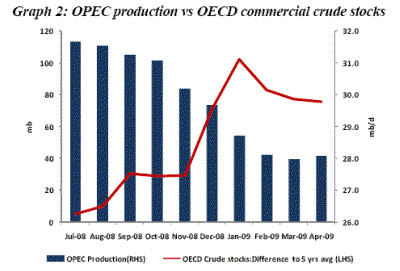
Kate Mackenzie at FT Energy Source puts that in the context of the IEA's decision yesterday to up its demand forecast for 2009 by 120kb/d and the EIA's earlier slight increase in projected world demand--by 5kb/d IIRC. She notes that OPEC indicated that the contango in oil has flattened some as OECD inventories fell in parallel with falling production.


11. BRAZIL'S SENATE TO SET UP NEW OIL COMPANY FOR SANTOS BASIN

Kate Mackenzie at FT Energy Source reports that new regulations are being introduced quickly which, in sum, will create a 100% state-owned company to lease Brazil's pre-salt fields, or Santos basin, to Petrobras and others.
"Petrobras, although state-controlled, is 60% owned by mostly foreign shareholders, and the country’s left-wing government is unenthusiastic about sharing the huge gains from the pre-salt fields with others--hence the creation of the new company. The plan is that the new state-owned company will be able to grant concessions without going to tender, which industry observers believe will favor Petrobras. For international oil companies, however, the outlook is less certain."


12. CHÁVEZ THREATENS TO SHUT GLOBOVISIÓN--A BIT MORE DIRECTLY THIS TIME

Christopher Toothaker at the Associated Press reports that Hugo Chávez yesterday urged executives at Globovisión "to reflect" upon their critical stance towards the government, or the station "won't be on the airwaves much longer."
"Globovisión--a Caracas-based all-news network--has been the only anti-Chavez channel on the open airwaves since 2007, when Chavez refused to renew the broadcast license of another opposition-sided channel, Radio Caracas Television. That network moved to cable."
The best summary of the recent efforts to silence opposition in Venezuela I've seen recently was Fausta Wertz's--see Daily Sources 6/1 #10.

Wednesday, June 10, 2009

Daily Sources 6/10

1. GERMAN EXPORTS FALL BY 29% YOY IN APRIL; THE ECB FORECASTS THAT WEAKNESS IN THE FINANCIAL SECTOR IS LIKELY TO PREVENT ECONOMIC RECOVERY IN THE EUROZONE UNTIL 2010; THE IMF CALLS FOR A REAL ACCOUNTING OF THE EUROPEAN BANKING SECTORS BOOKS

BBC reports that German exports fell by 29% in April from the year previous, per the Federal Statistics Office. (Exports fell by 4.8% in April from March, when they had risen unexpectedly from February.) The economics ministry reported that industrial production fell by 21.6% in April compared with April 2008. On Monday, Walter Münchau noted that it was unlikely, given the current situation, for export-led economies to be able to export their way out of the recession. He further remarked that perhaps the Merkel Administration's apparent decision to push for allowing the euro to appreciate versus the dollar (and other currencies) could exacerbate the situation for Germany--see Daily Sources 6/8 #2. Joellen Perry at the Wall Street Journal reports that officials at the European Central Bank are concerned that financial sector weakness could prevent the eurozone from expanding before the middle of 2010, as per the remarks of Yves Mersch, the head of Luxembourg's central bank and a member of the ECB's Governing Council.
"The ECB expects the euro zone's first quarter--when output contracted by an annualized rate of nearly 10%--to mark the recession's trough, Mr. Mersch said. But he cautioned against overplaying recent signs of stabilization: 'We are reaching the valley, but we have to walk through the valley.'"
Well worth reading in full. A graph plotting the IMF's forecast of eurozone economic growth going forward from the IMF Survey published on Monday:


Meanwhile, Ambrose Evans-Pritchard at the UK Telegraph reports that the IMF's managing director, Dominique Strauss-Kahn, has called on the eurozone countries to take urgent steps to clean up their financial sector.
"To restore confidence, you need total disclosure of possible losses. Not only losses which are linked to the original sub-prime crisis, but also the losses linked to the slowdown in the economy, and impaired assets. There are lots of things that still have to be disclosed."
Strauss-Kahn went on to say that,
"Stresses persist, conditions for access to bank lending are tight, funding costs remain high. Sizeable losses lie ahead as the recession unfolds. The financial sector is hamstrung in fulfilling its vital intermediation role."
The IMF suggested that eurozone banks will need to raise an additional $375 billion as compared to $250 billion for US banks and called for stress tests along the lines of what was imposed by the US Treasury.

2. JAPAN ANNOUNCES GOAL OF REDUCING GREENHOUSE GAS EMISSIONS BY 8% FROM 1990 LEVELS BY 2020; EXPECTED TO ANNOUNCE $2 BILLION IN CLIMATE PROTECTION LOANS TO BANGLADESH, PHILIPPINES, THAILAND, AND VIETNAM

Shingo Ito at the AFP reports that Japanese Prime Minister Taro Aso said today that the government has set as a goal the reduction of greenhouse emissions by 8% from its 1990 levels by 2020.
"Aso said 'Japan must take the initiative in spearheading a global trend,' arguing that the target surpasses US and European goals because, unlike theirs, it does not factor in carbon trading or sequestration through forestry.

Japan's figure is far below the target announced by the European Union, which has said it would slash emissions by 20% from 1990 levels, or by 30% if others set a similarly ambitious goal."
On the other hand, Japanese power consumption has been steadily declining for some time now--in large part because of demographic changes. Mr. Aso also gave Japan's goals for 2050 for a 50% emissions cut, which matches the European Union's goal. In the meantime, Earth Times reports that Japan was expected to announce $2 billion in yen loans to Bangladesh, the Philippines, Thailand and Vietnam over two years for climate protection efforts. On April 29, China, India and South Africa called for at least $200 billion in aid from the developing nations to combat global warming--see Daily Sources 4/29 #1. In late May, African environmental ministers called upon the developed world for aid in combating climate change--analysts have argued that the countries would require at least $1 billion a year in order to effect change--see Daily Sources 5/29 #8.

3. CHINA'S CONSUMER PRICES FALL 1.4% YOY IN MAY, BUT HOUSE SALES VOLUMES INCREASE BY 27% IN JAN-MAY FROM 2008 PERIOD; CHINESE COMMODITIES PURCHASES ARE WELL IN EXCESS OF THE TREND HAD GROWTH CONTINUED AS USUAL FROM 2007

Terence Poon at the Wall Street Journal reports that China's consumer price index fell 1.4% in May from a year previous for the fourth straight month, according to data released by the National Bureau of Statistics today.
"Food prices, a key component of the CPI, fell 0.6% in May from a year earlier, but the decline was smaller than the 1.3% drop in April. The price of grains, a raw material of many food products, has risen sequentially for the past five months, the bureau said, adding 'it remains to be seen if the rise in grain prices will affect future CPI trends.'

China's domestic property market is also showing signs of a sustained recovery. The year-on-year drop in property prices in 70 of China's large and medium-sized cities shrank to 0.6% in May from 1.1% in April, the National Development and Reform Commission said Wednesday."
Further, the volume of housing sales grew by 27% in the period from January to May over the same period in 2008. Meanwhile, MacroMan has a fascinating post on the volume of imports of various raw materials, and notes that they are well-above the trend had China's economy continued to grow at the rates it had previous. His chart for coal:


His chart for copper:


He further notes that Chinese oil imports have returned to trend, and thus suspects that the additional demand is not likely responsible for the boost in price. (I think this reading is wrong, because it has to be taken in the context of OPEC taking a lot of supply off the market and the fact that implied oil consumption is well down, far below what Chinese GDP statistics would imply.) MacroMan summarizes:
"even if China manages to maintain its recent growth path over the next few quarters, its recent commodity buying spree might mean that it buys much less from the rest of the world than one might normally expect, perhaps with the exception of crude oil (the only commodity where Macro Man retains a long exposure.)

For now, the China syndrome giveth....but if Macro Man were long high-beta plays on Chinese growth, he'd be concerned that at some point, the China syndrome may taketh away."
Indeed, and this is the must read post of the day. Again, I think his relative bullishness on oil is misplaced, however, given the director of China's National Energy Administration telling reporters that all available crude storage was full, the State Council Information Office taking reporters on tours of previously secret strategic petroleum reserves apparently so they could confirm this with their own eyes, and the study of satellite images by Sanford Bernstein which suggest that as much as 400 kb/d of additional Chinese oil demand was going straight to those SPRs--see Daily Sources 6/9 #4.

4. US, RUSSIA, AND CHINA AGREE ON DRAFT SANCTIONS ON NORTH KOREA

Colum Lynch at the Washington Post reports that the US, China, and Russia have agreed upon a draft UN resolution which would condemn North Korea's April 5 nuclear test and impose additional military, financial and trade sanctions on Pyongyang. The draft has been presented to the full Security Council and its adoption is expected as early as Friday. In an interesting comment in the Wall Street Journal, Edward N. Luttwak, senior adviser at the Center for Strategic and International Studies, writes that the best diplomatic method of dealing with Pyongyang for the US just now is radio silence. His conclusion:
"The North Korean regime never yielded anything of significance in past negotiations, which have served nobody but them. This time, provocation must not be rewarded. Evidently, the North Korean aim is to evoke more attention, more offers of concessions, more gifts. They must receive nothing at all. Talking has failed utterly. Silence might yet persuade the North Koreans to improve their behavior."
Insofar as North Korea's goal is to have official direct talks with the US, in a way this policy is already in place, though perhaps no response will have the desired effect of moderating Pyongyang's provocative behavior. However, I wonder whether it would be seen as deliberately complicating a "soft solution" desired by Beijing, as evidenced by Tsinghua University professor Sun Zhe's recent interview, where he indicated that China's primary concern regarding North Korean intransigence is that Tokyo will decide to build its own nuclear deterrent--see Daily Sources 6/1 #4. Also, to do so would seem to simply abandon the initiative the US might have in orchestrating "Great Power" coordination on the issue, as per Kissinger's advice--see Daily Sources 6/8 #3.

5. RUSSIA COMMITS TO CONTINUING CURRENT LEVELS OF OIL PRODUCTION, APPARENTLY HAS NO INTENTION OF COORDINATING WITH OPEC; KUWAITI OIL MINISTER SAYS THAT $60-75/B OIL OK FOR WORLD, BUT THAT OPEC WOULD NOT CUT UNLESS PRICES HIT $100/B

The Associated Press reports that Russian Deputy Prime Minister Igor Sechin told Interfax that:
"We are not planning to cut the production in the next three years, but it may happen afterward if there is no investment in exploration and production."
Sechin also indicated that Russia was not interested in capping exports, saying "Exports have become more economically reasonable. So why cut it?"--apparently putting the nail in the coffin of the notion of Russia joining OPEC, worrisome at the time as it would have signified a tectonic shift in Russian foreign policy strategy--see Daily Sources 12/10 #8. Meantime, Fiona MacDonald at Bloomberg reports that Kuwait's Oil Minister Sheikh Ahmed al-Abdullah al-Sabah told reporters that OPEC would only consider increasing production if the price of oil hit $100/b.
"Oil prices have increased because investors have bought crude as a hedge against a weakening US dollar, not because demand is rising, Sheikh Ahmed said.

'The numbers, in terms of economic recovery, are not with the rise of oil,' he said. OPEC is seeing signs of an increase in demand for oil in Asia, Sheikh Ahmed said, 'but overall we don’t see any rise in demand. That’s why we should be cautious not to be driven by the market.'"
This statement is on top of the report by Miriam Amie at Platts yesterday where Sheikh Ahmed indicated that the market was not being driven by fundamentals, but that prices between $60-75/b were acceptable.
"But Sheikh Ahmed warned that a return to $100/b oil would harm the global economy and fuel inflation.

'Hopefully it will not jump to the hundreds, because this will fuel recession,' he said, adding that it would be like 'going back to square one.'"
6. BRAZIL AND RUSSIA ANNOUNCE PLANS TO PURCHASE $20 BILLION IN SPECIAL DRAWING RIGHTS-DENOMINATED BONDS FROM THE IMF, SAY CHINA PLANS A $50 BILLION PURCHASE, INDIA MAY FOLLOW SUIT

Alex Nicholson and Andre Soliani at Bloomberg report that Brazil and Russia announced plans to purchase $20 billion in bonds from the IMF denominated in special drawing rights.
"Alexei Ulyukayev, first deputy chairman of Bank Rossii, said today Russia will cut the share of US Treasuries 'because a window of opportunity for working with other instruments is opening,' according to Interfax news wire. Russia may also place more of the reserves in deposits with foreign banks, he said. The remarks were confirmed by a Bank Rossii official who declined to be named, citing bank policy."
Brazil’s Finance Minister Guido Mantega said of the move:
"For us, there is no interest in weakening the dollar, because when the dollar weakens the real gets stronger and when the real get stronger the exchange rate trips our exports up a bit. What we really want is that other currencies are also behind international transactions."
Mantega also indicated that China will purchase $50 billion of the IMF bonds and that India may well announce something along the same lines.

7. CNPC REPLACES TOTAL IN PHASE 11 OF IRAN'S SOUTH PARS

Reports of Total's ouster from Phase 11 of South Pars were not premature after all, or so I take it given Sanchez Wang at Bloomberg's report that NIOC released a statement saying that it had signed a $5 billion contract with CNPC for that stage of the natural gas development.

8. RAFSANJANI PUBLISHES OPEN LETTER TO LEADER OF REVOLUTION CALLING ON HIM TO CURB PRESIDENT AHMADINEJAD AS TENS OF THOUSAND SUPPORTERS OF PRESIDENTIAL CANDIDATES HIT THE STREETS IN TEHRAN, BRINGING CITY TO A HALT

Thomas Erdbrink at the Washington Post reports that Ayatollah Rafsanjani, former President of Iran and head of the Council of Experts (which determines who is qualified to be the Leader of the Revolution [LOTR]) as well as the Expediency Council (which settles legislative disputes between the Iranian Parliament and the Guardian Council), published an open letter to LOTR Ayatollah Khamenei complaining the he had not acted in the face of President Ahmadinejad's "insults, lies and false allegations" in a televised debate between the President and presidential candidate, former prime minister Mir Hossein Mousavi. Rafsanjani, and by implication other members of the revolutionary old guard in Iran such as Mousavi himself, were called "corrupt" by the President in the televised debate. Rafsanjani wrote:
"If the system cannot or does not want to confront such ugly and sin-infected phenomena as insults, lies and false allegations made in that debate, how can we consider ourselves followers of the sacred Islamic system?"
The letter was published as tens of thousands of supporters for both candidates filled the streets in Tehran, reportedly bringing the city to a halt. Juan Cole at Informed Comment links to reports that Mousavi appears to have detached key support from the Iranian Revolutionary Guards Corps from Ahmadinejad, the main basis of Ahmadinejad's power--a struggle over which may have led to Ahmadinejad's louder than usual complaints of corruption. Michael Collins Dunn at the Middle East Institute Editor's Blog notes that every incumbent president who has run again in Iran has won, so a Mousavi victory would indeed be an upset. He remarks:
"if Ahmadinejad is voted out in Iran, we should not try to claim a great victory: nothing would taint a President Mousavi more, and Khatami never recovered from being portrayed as too soft toward the West."
The links and commentary by both Cole and Dunn are well worth going through, should you have time.

9. RICHMOND FED CHIEF SAYS GROWTH IS WHAT WILL TRIGGER FED FUND RATE HIKES; TIPS YIELDS AND GOOGLE TRENDS SUGGEST INFLATION IS OVERTAKING DEFLATION AS GEN PUBLIC'S CONCERN RE: ECONOMY

Judith Burns at Real Time Economics reports that Richmond Federal Reserve Bank President Jeffrey Lacker told reporters today that
"I think growth is likely to warrant rates as low as they are now for some time. We’ll just have to wait to see how the growth process unfolds for some time."
Lacker added:
"I think the growth process needs to govern our rate decisions and I think the growth process is more important in governing our rate decisions than the unemployment rate per se."
On Friday, Atlanta Fed President Dennis Lockhart suggested that the FOMC should be "anticipatory," and not wait too long to raise the federal funds rate following even more hawkish remarks by Kansas City Fed President Thomas Hoenig, who warned of "significant" inflationary pressures. On that news, the yields on two-year treasuries shot up to an eight-month high on speculation that the FOMC would raise rates in its November meeting--see Daily Sources 6/5 #12. In the meantime, Kelly Evans, also at Real Time Economics, reports that:
"This morning, the 'breakeven' or expected inflation rate for securities [TIPS or Treasury Inflation Protected Secutires] maturing next April moved into positive territory for the first time since the financial crisis intensified in mid-September. That essentially means investors in these securities of any maturity no longer expect deflation to set in by next spring--or indeed at any other point in the future. The 'breakeven' rate on ten-year securities is now over 2%; earlier this year, it was 0%. For 30-year investments, expected inflation is even higher, at about 4.7%."
Evans remarks on another, "unscientific"--though I'm not sure what's so scientific about implied inflation expectations via TIPS, indicator recently was that the number of google searches for "hyperinflation" look set to pass the number of google searches for "deflation":


Both measures seem, to me at least, to be barometers of speculation regarding future conditions--though perhaps, and just perhaps--for there is no precise way to measure this, the expectations inferred from the treasury markets are better informed expectations.

10. HOMEOWNER EQUITY IN HOUSEHOLD REAL ESTATE HAS FALLEN BY NEARLY 50% OF GDP; US IMPORTS AND EXPORTS CONTINUE TO FALL IN APRIL; GASOLINE PRICES RISING ENOUGH TO BEGIN TO SIGNIFICANTLY EAT AWAY AT STIMULUS

Felix Salmon at Reuters notes that homeowner equity in household real estate has declined nationally by nearly 50% of GDP.


Yves Smith, at Naked Capitalism, through whom this piece came to my attention, points out that the bubble begins in 1997. Salmon notes:
"It’s easy to see why this recession is so severe, if you think about the unsustainable consumption boom fueled by mortgage equity withdrawals between 1997 and 2006. The loss in wealth during the dot-com bust might have been similar, but the effect on consumption wasn’t nearly as big: people weren’t borrowing against their tech stocks in order to buy new kitchens."
Put that in the context of Rebecca Wilder's observation that consumer credit is retrenching for pretty much the first time ever in the US both on the back of savings, but also credit card companies slashing credit lines--see Daily Sources 6/8 #15 for an excellent graph of hers--and the average number of work week hours declining to levels not seen since 1964 combined with expectations of more layoffs--see Daily Sources 6/9 #7--it is hard to see the economy recovering on the back of consumption any time soon. (Household consumption is said to account for about 70% of US GDP.) And, in what could be interpreted as evidence backing this concern, Rebecca Wilder at News N Economics reports that the Census Bureau today reported that April imports were down $2.2 billion from March and April exports were down $2.8 billion from March. She plots a graph of US trade since January 2008 showing that trade is down 20-30% from then:


Her blog is always worth a look. The EIA reports that for the week ended June 8, the national average price of gasoline was up $0.10/gallon to $2.624/gallon--at the bottom of the range at which I deduce Americans start driving less, or at which you see further declines in oil demand.

Peter Boockvar at the Big Picture comments on the price of gasoline:

"To quantify, the US uses about 9mm barrels of gasoline per day with 42 gallons in each barrel, thus 378mm gallons per day and almost 140b per year. Therefore, for every $1 move in the price of gasoline, it’s an extra $140b more in consumer spending at the pump. If gasoline prices stay elevated, it will dramatically dilute the tax cut portion of the Obama stimulus plan. On Feb 17th, Pres Obama signed the $787b stimulus plan that included $237b of ‘tax relief’ for individuals, $116b of which was a temporary payroll tax credit for income earners under a certain level."
Chief US economist at IHS Global Insight Nariman Behravesh's rule of thumb is that a $0.10 drop in gas prices equates to about a $12 billion tax cut--see Daily Sources 11/18 #2.

11. US COMMERCIAL CRUDE STOCKS FALL

The EIA reported that for the week ended June 5, commercial stocks of crude oil fell by a whopping 4.4 million barrels. They are still well above the historical range for this time of year, but the move was in contrast to analyst expectations of a 100k stock build, per a Bloomberg survey. Gasoline stocks also fell by 1.6 million barrels,are below the historical average for this time of year, and in contrast to analyst expectations of a 750k barrel build. The surprise however, was that distillate stocks also fell by 300k barrels. Stocks are well above the historical range for this time of year, but the draw was counter-cyclical--and surprising given recent rail and truck freight data--see Daily Sources 6/8 #14.

12. REPORT ARGUES THAT OIL SHALE WATER USE WILL COMPETE WITH WATER DEMAND FOR URBAN GROWTH AND AG USE, MAY RESULT IN "CALL" PROTECTING DOWNSTREAM CONSUMPTION RIGHTS; WATER SHORTAGE IN SAN JOAQUIM VALLEY

Jeremy Miller at Green Inc. writes that a report by the non-profit Western Resource Advocates released in March argues that increased water use for oil shale in the Colorado’s Piceance Basin:
"could hamper urban growth in the Rocky Mountain Front Range, threaten agriculture and critical habitat for endangered fish and increase the likelihood that Lower Basin states like Nevada, Arizona and California would issue a 'call'--a legal decree that forces junior upstream water rights holders to reduce, or eliminate altogether, water use until senior downstream rights are met."
The Western Resource Advocates report can be found here. Meanwhile, the Western Farm Press reports that legislation to protect Delta smelt has reduced water deliveries to San Joaquin Valley farmers by 90% and may cost the area as much as 45,000 jobs. (h/t Aquafornia.)