Showing posts with label hungary. Show all posts

Monday, July 19, 2010

Daily Sources 7/19

GOLDMAN SACHS BEING FROZEN OUT OF EUROPEAN SOVEREIGN DEBT OFFERINGS

Elena Moya at the Guardian UK reports that European governments are freezing Goldman Sachs out of debt offerings. An observer in France says that there would be rioting in the streets if Paris chose Goldman to lead a bond sale. Worth reading in full.

PRIVATE EQUITY INVESTMENT IN INDIA GROWING RAPIDLY

James Lamont at beyondbrics reports that India's private equity market is predicted to reach $17 billion this year.
"New investments will originate from the US where investors seek to participate in India and China’s high growth profiles. Average deal size among private equity investments this year is already between $50m and $200m, up from an average of $21m last year."
CLINTON ANNOUNCES NEW AID PROJECTS FOR PAKISTAN

BBC News reports that US Secretary of State Hillary Clinton announced a number of new aid projects for Pakistan worth $500 million. The projects include the building of two new hydroelectric dams. The aid money comes from a five year $7.5 billion aid package agreed to by Congress last year.

HUNGARY SUSPENDS BUDGETARY REVIEW BY IMF AND EU

Judy Dempsey at the New York Times reports that Hungary's government has stated that it will not pursue further austerity measures despite pressure from international creditors. The IMF and EU suspended a budgetary review of Hungary over the weekend.

MOODY'S DOWNGRADES IRISH DEBT

Matthew Saltmarsh at the New York Times reports that Ireland's debt has been downgraded by Moody's to Aa2 from Aa1. It's outlook has been changed from stable to negative. Not sure why anyone would pay any attention to the ratings agencies after this last bugaboo, but there you have it. The rating is still well above junk.

IRANIAN REVOLUTIONARY GUARD PULLS OUT OF PHASES 15 AND 16 OF SOUTH PARS

Aresu Eqbali at Platts reports that due to sanctions, the Iranian Revolutionary Guard has pulled out of phases 15 and 16 of the South Pars project.
"The IRGC and its affiliates have grown into an economic power in Iran, largely as a result of a succession of UN sanctions imposed by the international community over suspicions that Tehran is secretly developing nuclear weapons, a charge the Iranians deny.

The involvement of IRGC or its subsidiaries would make it difficult to source parts and equipment from foreign companies, which run the risk of being in breach of the sanctions should they have to deal with Khatam al-Anbiya or any other banned entity."
BOEING SELLS 30 777S TO DUBAI

Christopher Drew at the New York Times reports that the Dubai-based Emirates Airlines has put in a purchase order to Boeing for 30 777s. Airbus has sold 131 commercial airplanes this year; Boeing has sold 177.

WATER START UP SEEKS MARKETS IN INDIA, SAUDI ARABIA, CYPRUS AND IRAQ

John Collins Rudolf reports that a start up company in Texas plans to ship fresh water from Sitka, Alaska, to markets in India, Saudi Arabia, Iraq, and Cyprus. The company has no contracts yet, but has signed a deal with Sitka.

MOZAMBIQUE SOURCE OF COKING COAL FOR CHINA, INDIA, AND SOUTH AFRICA

Frontier Markets reports that interest is growing in Mozambique from China, India, and South Africa due to its reserves of coking coal for use in their steel plants.

BUILDER CONFIDENCE IN NEWLY BUILT, SINGLE FAMILY HOMES DECLINES ACCORDING TO HMI

Free exchange opines that the outlook for housing will be grim for the foreseeable future.


TWO AND HALF MILLION UNEMPLOYED LOSE ACCESS TO UNEMPLOYMENT BENEFITS

Phil Izzo at Real Time Economics reports that 2,502,000 jobless Americans have lost access to unemployment benefits since June 2.
"The Senate is expected next week to vote to extend unemployment benefits, but the delay has caused a lapse in benefits for some 2.5 million of the nation’s jobless."
Meanwhile, Tom Barkley at Real Time Economics reports that the National Association for Business Economics survey of 84 companies found that they were back in hiring mode. Meanwhile, Free Exchange reproduces a Brookings graph which plots the length of time it will take for jobs to reach the height seen prior to the recession with how many jobs need to be created.


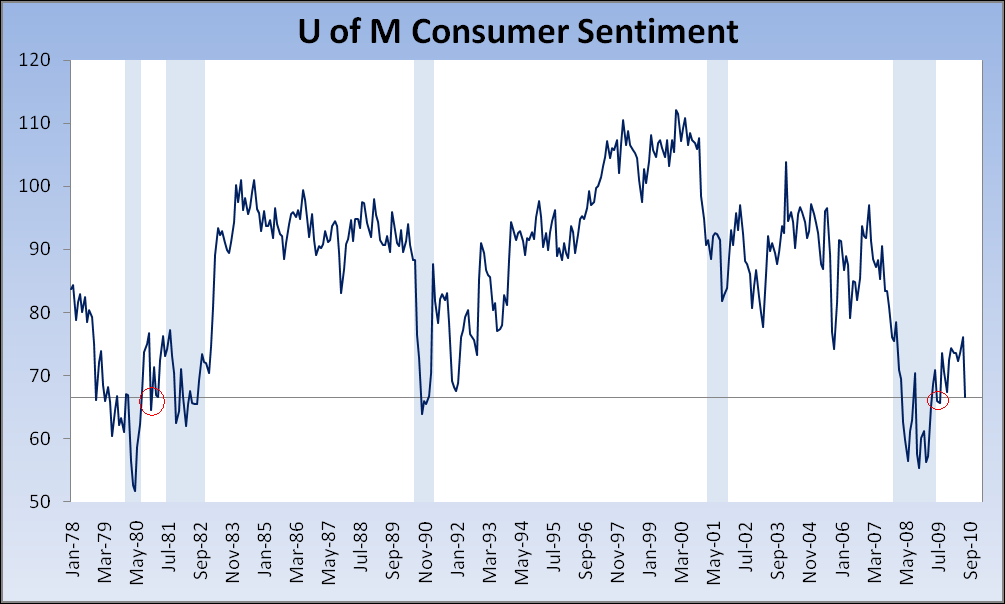
Invictus at the Big Picture reproduces a graph from the University of Michigan's Consumer Sentiment Survey and notes that the reading looks a lot like the last time we had a double dip recession.


THE CLEVELAND FED REPORTS THAT THE PUBLIC EXPECTS INFLATION TO STAY BELOW 2% OVER THE NEXT DECADE
"The Cleveland Fed’s estimate of inflation expectations is based on a model that combines information from a number of sources to address the shortcomings of other, commonly used measures, such as the "break-even" rate derived from Treasury inflation protected securities (TIPS) or survey-based estimates."

Thursday, July 23, 2009

Daily Sources 7/23

1. UNEMPLOYMENT GROWING RAPIDLY IN THE G-7, BUT BRAZILIAN UNEMPLOYMENT UNEXPECTEDLY DOWN

Rebbeca Wilder at News N Economics notes that unemployment continues to grow quickly in the G7, which should damper consumption:


However, Helder Marinho and Andre Soliani at Bloomberg reported that Brazil's June jobless rate in six main metropolitan areas fell to 8.1% from 8.8% in May.
"Policy makers cut the so-called Selic rate by a half-point to a record 8.75 percent yesterday and said that level was adequate to spur growth and bring inflation back to target.

The drop in the jobless rate 'indicates how strong the domestic market is,' Pedro Tuesta, senior economist for Latin America with 4Cast Inc., said in a telephone interview. 'It reinforces the idea the bank should stop cutting rates.'"
"Annual inflation, as measured by Brazil’s IPCA index, slowed to 4.8% in June, down from 5.2% in May and the lowest since March 2008. Policy makers last month reaffirmed that they seek to slow inflation to 4.5% by year-end."
Average wages, however, are not keeping pace with inflation.

2. ICELAND FORMALLY APPLIES FOR EU MEMBERSHIP

Karl Ritter at the Associated Press reports that Iceland formally applied for membership in the EU today.
"'To be frank with you, if we would get a rotten deal on the fisheries, the Icelandic people would get quite angry,' Foreign Minister Ossur Skarphedinsson said after presenting the EU application to his Swedish counterpart, Carl Bildt. Sweden currently holds the EU presidency.

'This is not only an issue of economics. It is also an emotional issue. It is also an issue that is related to sovereignty,' said Skarphedinsson, a former fisherman."
3. UK RETAIL SALES UP 1.2% IN JUNE FROM MAY, 2.9% YOY, GOVT ANNOUNCES £1.1 BN PLAN TO ELECTRIFY MORE OF ITS RAIL SYSTEM

Svenja O’Donnell at Bloomberg reports that UK retail sales rose 1.2% in June from May, and 2.9% from June 2008.
"Sales at food stores increased by 0.7%, while they rose 1.6% at non-food retailers, the statistics office said. Textile, clothing and footwear shops saw sales increase for the first time in three months, by 4.7%."
Meanwhile, Nicholas Winning at the Wall Street Journal reports that the UK has announced plans to spend £1.1 billion ($1.81 billion) on electrifying two rail routes.
"The works represent the first big electrification of the rail network since the 1980s and will increase the proportion of electric rail journeys in the UK to 67% from 60%, the government said."
4. RUSSIAN MINISTERS TO CONSIDER 0% TAX ON INITIAL MINERAL EXTRACTION IN THE BLACK SEA AND SEA OF OKHTOSK, BUT WARNS MOL THAT IT HAD BETTER COMPLY WITH LICENSING IN SIBERIAN FIELD

Kate Mackenzie at FT Energy Source reports that Russian ministers today will discuss setting a zero rate of taxation for mineral extraction for the initial stages of development in the Black Sea and the Sea of Okhotsk.
"The tax breaks will apply until accumulative output reaches 20 million metric tons (~ 144 million barrels) at Black Sea fields and 30 million metric tons (~210 million barrels) in the Sea of Okhotsk, off Russia’s Pacific Coast. Alternatively, the zero rate may be applicable for 10 years or 15 years for fields being developed under combined exploration and production licenses, according to the statement."
Though I feel sure that it will be tempting enough to make some majors bite, the problem is that when the price of oil rises, Moscow will likely take measures to re-nationalize production at the fields, given their view of their strategic value. Meanwhile, Stephen Bierman and Edith Balazs at Bloomberg report that Mol--Hungary's largest refiner--pledged to meet all requirements in the license terms of a Siberian oil-production venture with OAO Russneft.
"'Mol always acts in accordance with the rules of the Russian Federation and the company will do everything on its part to fulfill all the requirements described in the license agreement,' Mol said today in an e-mailed statement.

On July 2 Russia’s subsoil agency, Rosnedra, gave the Zapadno-Malobalykskoye LLC oil venture six months to correct violations relating to its drilling plan and its use of so-called associated gas, Larisa Kalacheva, a spokeswoman for Russneft, said today. 'The time allotted to correct license infractions is very tight,' she said. 'Action is needed.'

Tensions between Mol and the Russian government have increased since Moscow-based OAO Surgutneftegaz bought a 21.2% share in the Budapest-based refiner in March. Mol called the move hostile and has barred the Russian company from participating in corporate meetings."
5. BIDEN CALLS ON RUSSIA TO REMOVE TROOPS FROM GEORGIAN BREAKAWAY REGIONS, BUT ALSO INDICATES THERE IS NO MILITARY OPTION FOR THEIR REMOVAL

Philip P Pan at the Washington Post reports that in Tblisi today Vice President Joe Biden urged Russia to withdraw its troops from the breakaway regions of Georgia.
"'What we can do is make clear to the whole world, and to the Russians particularly, that we stand with you, and that if they fail to meet their commitments, that it is a problem for them,' Biden told the children, referring to a ceasefire agreement that the Georgia and the United States say Russia is violating.

'A lot of you think maybe Russia did what they did, and they paid no price,' Biden added. 'They paid a pretty big price already diplomatically. The countries that surround Russia, even those that have been very, very loyal to Russia in their freedom, are now saying very harsh things.'"
However, earlier in the day in a speech before the Georgian parliament, Biden said there was "no military option" for Georgia to regain sovereignty over the breakaway regions.

6. CHINESE DEFENSE MINISTRY TO LAUNCH CHINESE / ENGLISH WEB SITE, CENTRAL BANKS OF CHINA, JAPAN, AND SOUTH KOREA ATTEND FIRST TRIPARTITE MEETING

Tini Tran at the Associated Press reports that the Chinese defense ministry will launch an official web site in both Chinese and English on August 1.
"The Web site appears aimed at reassuring Asian and Western nations that the PLA is becoming more accessible to the outside world, experts told the China Daily.

'As more attention is being given to online information, the Chinese army has moved one step forward in its public diplomacy,' Professor Li Xiguang, dean of Tsinghua University's journalism school, was quoted as saying.

The Web site's launch 'is a major step for the PLA to open up to the outside world,' Sr Col Huang Xueping, deputy director of the ministry's information office, said in an interview with the newspaper. The office was only set up last year.

The site will 'cover a large amount of information,' featuring regular activities and background of the Chinese military."
(h/t Sky Canaves at China Journal.) Meanwhile, the first tripartite meeting of the central banks of China, Japan, and South Korea took place today in Shenzhen.
"On December 10, 2008, in order to strengthen their mutual cooperation and communication and better safeguard economic and financial stability in the region, the three central banks jointly announced the establishment of a formal Tripartite Governors’ Meeting mechanism, based on the existing dialogue, which will take place once a year."
(h/t Rebecca Wilder at News N Economics.)

7. CLINTON SAYS US PREPARED TO EXPAND COMMERCIAL RELATIONSHIP WITH MYANMAR IF THEY RELEASE POLITICAL PRISONERS

Glenn Kessler at the Washington Post reports that Secretary Clinton told the media that the US was prepared to expand its commercial and aid relationship with Myanmar if it were to release political prisoners, and specifically Nobel Peace Prize laureate Aung San Suu Kyi.

8. AHMADINEJAD APPARENTLY DEFYING LOTR CALL FOR HIM TO WITHDRAW VP NOMINATION, IRAN SAYS IT HAS FOUND 46 OIL FIELDS IN THE CASPIAN

Ali Akbar Dareini and Lee Keath at the Associated Press report that Iranian President Mahmoud Ahmadinejad has apparently chosen to defy the Leader of the Revolution, Ayatollah Khamenei, who has called upon the president to withdraw his choice for first Vice President,Ahmadinejad's son-in-law.
"Arguing for a further chance to make his case, Ahmadinejad said, 'there is a need for time and another opportunity to fully explain my real feelings and assessment about Mr Mashai.'"
Dareini and Keath observe
"Now Khamenei is facing tests to his authority on two fronts. One is from Ahmadinejad, the other is the open defiance from the reformist opposition, which has continued its campaign against Ahmadinejad despite the supreme leader's declarations that the election dispute is over."
I would put it more as tests of authority from those who see the representative elements of the Constitution in their best interests and those who see it as protecting the vested interests of the old guard, but the point is salient nonetheless. Meanwhile, Xinhua reports that Iran's Oil Minister Gholam Hossein Nozari has reportedly said that Iran has identified 46 oil fields in the Caspian Sea, of which eight are ready for exploitation immediately. (h/t Leanan at the Oil Drum.)

9. MOODY'S UPGRADES PHILLIPINE SOVEREIGN DEBT

Karl Lester M Yap at Bloomberg reports that Moody's rating on Philippine sovereign debt was raised to Ba3 from B1, the highest the country has received in more than three years.
"'The upgrade was prompted by the relatively high degree of resiliency exhibited by both the country’s financial system and external payments position in face of the global financial and economic crises,' Moody’s said. 'International reserves of the central bank are at a historical high and exceptional policy measures have not been required to shield the banking system.'

Philippine international reserves climbed to a record $39.56 billion in January, as rising remittances sent home by citizens abroad countered collapsing exports. Higher debt ratings reduce the cost of borrowing, making it easier for the Philippines to sell debt to fund government spending plans."
10. MEXICAN IMMIGRATION TO THE US HAS SLOWED MARKEDLY SINCE 2006, BUT EMIGRATION BACK TO MEXICO HOLDING STEADY

In a report released yesterday, the Pew Hispanic Center concluded that:
"The flow of immigrants from Mexico to the United States has declined sharply since mid-decade, but there is no evidence of an increase in Mexican-born migrants returning home from the US.

Survey data from the US and Mexico reveal a large flow of migrants back to Mexico, but the size of the return flow appears to be stable since 2006."


(h/t Conor Dougherty at Real Time Economics.)

11. NAR ANNOUNCES THAT EXISTING HOME SALES ROSE 3.6% IN JUNE FROM MAY, DOWN 0.2% YOY; MEDIAN PRICES DOWN 15.4% FROM JUNE 2008

Maya Jackson Randall at the Wall Street Journal writes that the National Association of Realtors announced that existing home sales in June rose 3.6% from May, but are still down 0.2% from June 2008.
"Foreclosures and short sales reflect 31% of sales in June. Distressed property sales have pushed prices lower, year over year. The median price for an existing home last month was $181,800, a 15.4% decrease from June 2008."
Meanwhile, the Department of Labor announced today that seasonally adjusted initial unemployment insurance claims for the week ended July 18 were
"554,000, an increase of 30,000 from the previous week's revised figure of 524,000. The 4-week moving average was 566,000, a decrease of 19,000 from the previous week's average of 585,000."
12. USDA REPORT CONCLUDES FARMERS SITTING ON GOLD MINE IN CARBON OFFSETS INCLUDED IN CLIMATE BILL

Keith Johnson at Environmental Capital writes that a new report from the Agricultural Department concludes that farmers stand to make a fortune from the carbon offsets included in the climate bill.
"To wit: Farmer’s incomes will take a hit in the short term, falling by 1% through 2018. Things will get worse by 2027 (a 3.5% decline) and even worse by 2048 (a 7.2% decline.) That’s because things like fuel and fertilizer will cost more under the climate bill.

But farmers’ net incomes will keep rising, because they will be literally standing on a gold mine in the form of carbon offsets, which will become increasingly valuable. The goods:

'EPA’s analysis projects annual net returns to farmers of about $1-2 billion per year from 2012-18, rising to $20 billion per year in 2050. USDA’s analysis strongly suggests that revenue from agricultural offsets (afforestation, soil carbon, methane reduction, nitrous oxide reductions) rise faster than costs to agriculture from cap and trade legislation. It appears that in the medium to long term, net revenue from offsets will likely overtake net costs from HR 2454, perhaps substantially.'

It might be even juicier; the EPA’s Ms. Jackson estimated the value of agricultural offsets at more than $3 billion in 2020.

And wait—there’s more. '[W]e believe our analysis is conservative--it’s quite possible farmers will actually do better,' Secretary Vilsack said.

That’s because farmers also stand to make a fortune off of other government energy policies, such as ambitious mandates for renewable energy and biofuels that will create lucrative, mandatory markets for crops and even agricultural waste."
Today's must read. The USDA report itself can be found here.

13. OCCIDENTAL FINDS SIZABLE NEW OIL FIELD IN CALIFORNIA

The Los Angeles Business Journal reports that Occidental has announced a significant oil and gas find in Kern County, California.
"The company said in a statement that it believes there are between 150 million and 250 million gross barrels of oil equivalent reserves within the area. Approximately two-thirds of the discovery is believed to be natural gas.

Occidental holds an approximate 80% stake in the property, with Chevron Corp. holding the remaining interest."
That represents about 1.8-3 global days of oil demand.

Tuesday, June 9, 2009

Daily Sources 6/9

1. PAKISTANI ARMY JOINS POSSE EFFORTS TO PUNISH TALIBAN, TALIBAN RESPONDS BY KILLING MORE PAKISTANIS

Griff Witte at the Washington Post reports that a truck bomb exploded outside a hotel at the provincial capital of Pakistan's North-West Frontier Province, Peshawar, killing 11 people and wounding at least 50.


Alamgir Bitani at Reuters reports that the Pakistani army is coordinating attacks with the citizen's militias:
"[O]n Tuesday, the army came to the help of a pro-government militia fighting the Taliban in a northwestern district after outrage over a suspected Taliban bomb attack at a mosque last week that killed about 40 people.

The villagers' action is the latest in a series of examples of people turning on the Taliban in recent weeks, underscoring the shift in public opinion away from the Islamists.

Army helicopters had attacked militants surrounded by militia fighters in a village in the Upper Dir district, senior police officer Rahim Gul told Reuters by telephone.

Gul said more people were joining the militia and it was making advances after heavy clashes. Paramilitary soldiers set up mortars on high ground above the village. About 25 militants were killed in the fighting, police and the military said."
2. HERITAGE TO AQUIRE TURKEY'S GENEL ENERJI, KNOC, SINOPEC, CNPC, CNOOC ALL MAY BE BIDDING FOR ADDAX--IS ANKARA EDGING TOWARDS COOPERATING WITH THE KRG AS OPPOSED TO BAGHDAD--IS TEHRAN WORRIED ABOUT THIS POTENTIAL?

Ben Lando at the Iraq Oil Report writes that Canada's Heritage Oil is likely to acquire Turkey’s Genel Enerji, which has a 44% share in a joint venture with Addax, the Taq Taq Operating Co. (TTOPCO).

"If shareholders approve, Heritage will purchase Genel for about $2.5 billion in stock, forming the new company HeritaGE Oil.

Genel is spread throughout the KRG, beyond its 44% stake in TTOPCO. It owns a 25% share in DNO’s Tawke project--the other field to begin exports earlier this month--as well as 40% in the Norwegian firm’s Dohuk project. It owns 40% and 20%, respectively, in two other young projects in the KRG.

And, it has a 25% stake in Heritage’s Miran project."
KRG's Minister of Natural Resources Ashti Hawrami has estimated that the field has recoverable reserves of one billion barrels. Miran is thought to have a 2.3-4.2 billion barrels of recoverable oil--see Daily Sources 5/6 #4. Tawke is thought to have total volumes of oil in place are ranging from 0.9 to 1.9 billion barrels, with an estimate of 1.3 billion barrels in place, and total recoverable oil from 150 million barrels to 370 million barrels, as of 2007. Genel Enerji is a subsidiary of Çukurova Holdings Group, a Turkish conglomerate which has roots dating back to the foundation of the Turkish Republic in 1923 with interests in automotive, paper, chemicals, textiles, telecommunications, construction, banking, insurance, media and services to maritime transportation and information technology services. It has foreign operations in Azerbaijan, Spain, Germany, Switzerland, the Netherlands, Northern Cyprus, the UAE, Moldova, Georgia, Kazakhstan, Qatar, and Ukraine as well as Iraq. Çukurova's business dealings in Iraq date back to 1979, when it worked on water projects for the Hussein government. Ed Crooks and William Macnamara at the Financial Times report that Korea National Oil Corp. (KNOC) is considering a takeover or asset deal with Addax, a partner in the TTOPO joint venture with several interests in Africa. As Lando reports, SK Energy, a South Korean refining firm, was cut off from Iraq's crude supply when it joined a consortium of South Korean firms operating in Kurdish Iraq. It left the consortium, and now is receiving crude as normal. Sinopec, CNPC, and CNOOC are also reportedly considering some sort of participation with or acquisition of Addax, but their participation could jeopardize their potential participation in bidding via Baghdad. For example, Sinopec and CNPC are in a joint bid agreement with Shell for developing the Kirkuk oil field.

However, the KRG effectively presented Baghdad with a fait accompli when it said that oil would begin to flow through the Kirkuk pipeline to Turkey on June 1 from these fields, given that they control the fields and part of the pipeline--see Daily Sources 5/12 #8--and so the oil has begun to flow. In the middle of May, Austria's OMV, Hungary's MOL and UAE-based Crescent Petroleum and Dana Gas entered a partnership to invest as much as $8 billion into the Kurdish Autonomous Region--see Daily Sources 5/18 #4. Russia's Putin-connected Surgutneftgas has recently purchased a 21.2% stake of MOL from OMV and Gazprom signed a deal in March with MOL to establish a 1.3 billion cubic meter natural gas storage facility in Hungary, nearer to Gazprom's potential market than western Ukraine--see Daily Sources 3/18 #4. Of course, no one wants to upset Baghdad, but the KRG is manifestly capable of providing security for operations, and Baghdad is not.

Add to the mix the recent reporting by Delphine Strauss posted at FT Energy Source that Turkey appears to have resurrected the demand that 15% of any gas being sent through Anatolia by the potential Nabucco pipeline be reserved for Turkish consumption.
"Turkey’s ongoing bilateral negotiations over the price and quantity of the gas it buys from Azerbaijan will certainly influence its stance on Nabucco--which could soften if it secures its own share of gas to be pumped from Azerbaijan’s Shah Deniz field.

But analysts say the stubborn negotiating tactics are less about supply concerns and more about Turkey’s ambition of becoming an energy hub, not just a transit country. Turkey is already able to re-export gas it buys from Azerbaijan and is seeking the same right from Russia.

Mr Morningstar puts it differently, saying 'Turkey does have to satisfy internal gas demand but it also has a strategic vision--I believe it wants to play a major role in the Caucasus and Central Asia and this project is a way to do it.'"
Of course, in the middle of May Gazprom's Alexei Miller told Bloomberg TV that the company stood ready to purchase all of the gas from the second phase of the development of the Shah Deniz field--see Daily Sources 5/15 #7.


Clearly Iraq could eventually provide feedstock for Nabucco, but just now only the Kurdish Regional Authority appears ready to provide the relative security required for such a project to really begin. Further, Iran has lately suggested that it's Pars Pipeline could obviate Turkey altogether, going through Iraq to the Syrian Mediterranean Coast--which would make sense, perhaps pressure Anakara, but most likely go directly through KRG-controlled territory, also obviating Baghdad.


Without saying it's gonna happen, it does strike me as ironically possible that Ankara could be considering the KRG a better partner in terms of its goal of regional energy hub than Baghdad. I can't imagine, for example, that folks in Ankara were especially thrilled with the news reported by the Associated Press' Hamza Hendawi and Qassim Abdul-Zahra today that there are negotiations ongoing between al-Maliki's Dawa Party and the Supreme Iraqi Islamic Council to reform the so-called United Iraqi Alliance. The UAE's participation in the Kurdish Autonomous Region [KAR] may well also be designed to off-set the so-called "Shia Crescent." Moscow now may be part of the natural gas troika with Iran and Qatar--see Daily Sources 10/24 #2--but they are still competitors. The fact that MOL--and by extension Surgutneftgas and Gazprom--is also getting involved in the KAR underscores the potential calculation on the part of Ankara that one key bit of leverage they might like to have, vis-a-vis, getting closer to EU acceptance, would likely be being a larger node in their energy supply picture. I further would not be surprised if US diplomats quietly made this point to folks in Ankara, and pointed out how helpful good relations with the KRG might be in terms of Ankara's long-term goals.

Hell, even Tehran's talk of having begun construction of the Pars Pipeline without having actually figured out where it will eventually go--see Daily Sources 6/4 #6--though the first assumption is Turkey, may be an attempt to try and secure a more secure role in European energy supply via supplying Nabucco, pace what Baghdad, even a Shi'a Baghdad, thinks. All speculation, I guess, but interesting speculation.

3. ISRAELI MINISTER URGES SANCTIONS ON U.S.--BOOK SAYS ATTACK ON THE 1967 USS LIBERTY WAS DONE WITH KNOWLEDGE THAT IT WAS AMERICAN

In a fascinating bit of news, Gil Hoffman and Hilary Leila Krieger at the Jerusalem Post report that Likud Minister-without-Portfolio, Yossi Peled, wrote a letter proposing sanctions on the US to the Israeli cabinet this Sunday! Apparently Peled believes that the Obama Administration has an activist agenda which does not mesh with Israel.
"[T]he minister suggests reconsidering military and civilian purchases from the US, selling sensitive equipment that the Washington opposes distributing internationally, and allowing other countries that compete with the US to get involved with the peace process and be given a foothold for their military forces and intelligence agencies.

Peled said that shifting military acquisition to America's competition would make Israel less dependent on the US. For instance, he suggested buying planes from the France-based Airbus firm instead of the American Boeing."
(h/t Michael Collins Dunn at MEI Editor's Blog.) And, Jeff Stein at Spy Talk reports that a new book by James Scott, The Attack on the Liberty: The Untold Story of Israel's Deadly 1967 Assault on a US Spy Ship, alleges that Israeli pilots which were involved in the attack on the US spy ship were told "two times" that the ship was American after radioing the hull number back to air control.
"'There clearly were individuals inside Israel's chain of command who knew this was an American ship in time to prevent the fatal torpedo boat attack that left more than two dozen of the Liberty's sailors dead," Scott says.

Yet the Israelis informed Johnson administration officials that they were innocent--and outraged by such suggestions.

That prompted the State Department's number two official, Nicholas B. Katzenbach, to summon Israel's ambassador Abraham Harman, Scott writes.

'The secret memo of the meeting,' Scott writes, 'declassified 33 years later, records Katzenbach telling the Israeli ambassador' that Tel Aviv's initial protest 'contains some statements they might find hard to live with if the text some day became public.'"
At the time the Johnson Administration was a bit too preoccupied with the Vietnam War and pushing forward the civil rights movement to want to focus on the attack.

4. CHINA DRIVING UPTICK IN BALTIC DRY INDEX / IRON ORE RATES, DOES BEIJING'S BINGE COMMODITIES PURCHASES POLICY UNDERMINE LIKELIEST SOURCE OF RECOVERY?; CHINESE STIMULUS MAY FORCE LOCAL GOVTS INTO BANKRUPTCY; CHINESE SUPREME COURTS INSTRUCTS LOWER COURTS TO COOPERATE WITH AUTHORITIES TO CATCH MASS INCIDENTS BEFORE THEY HAPPEN

Maritime Global Net reported yesterday that Thailand-based Precious Shipping has said that the current rise in the Baltic Dry Index is unsustainable, given binge iron ore purchases in China. The post quotes Precious Shipping as arguing that the:
"rise in iron ore imports is despite the fact that steel production in China in the first four months of 2009 has been roughly at the same levels as we had seen in 2008. An explanation for these increased iron ore imports could be the fact that domestically produced iron ore in China is of a rather poor quality and quite expensive when compared to spot imported prices. Another explanation could be that of speculators getting into the import market to try and get hold of 'cheap' iron ire that would possibly be required under the Chinese government's US$586bn stimulus plan. And a third could be the impending conclusion of the iron ore contract price negotiations."
In any case, the company expects iron ore cargoes to level off. (h/t Yves Smith at naked capitalism.) In the meantime, Michelle Wiese Bockmann at Lloyd's List reports that Chinese steelmakers have accepted contracts on iron ore (from Rio Tinto) at a 33% discount to last year's prices, apparently abandoning allegedly holding out for a 40% discount. Dow Jones reports that the Chinese Ministry of Transport estimated that 3.26 mb/d of crude were delivered to China via seaports in May, up 5.1% from the same month last year.
"However, seaborne imports fell 9.8% from April, according to calculations by Dow Jones Newswires, which may indicate crude demand is slowing from the high levels recorded earlier this year."
On June 1, Zhang Guobao, the director of China's National Energy Administration, told reporters that crude storage facilities in the country had been completely filled--see Daily Sources 6/1 #2. A few days later, journalists were taken to heretofore secret strategic petroleum reserves by the State Council Information Office, apparently to show them that the tanks were indeed full to the brim--see Daily Sources 6/4 #2. All of which followed a report by Sanford Bernstein which used satellite images to deduce that about 400 kb/d of oil was being added to China's SPRs--see Daily Sources 5/22 #2. I wonder to what extent Beijing's central planners' decision to green light large purchases of commodities as the complex's prices have collapsed is based on an effort to provide some economic support to the commodity producing nations, with which Beijing wants a good long-term relationship looking forward. On the other hand, I wonder whether the decision to purchase counter-cyclically may support commodity producing nations while simultaneously undermining the main potential source of recovery: it's export market, or the developed world. Michael Pettis at China Financial Markets wonders whether the stimulus package will bankrupt China's local governments, quoting from Australian paper the Age:
"Beijing will have to jam on the economic brakes to save cities from bankrupting themselves, says a top Chinese adviser. He Fan, an assistant director at the Chinese Academy of Social Sciences who frequently advises top leaders, says as much as two-thirds of Beijing’s 4 trillion yuan ($A773 billion) stimulus program will be spent by local governments, financed mainly by state-owned banks.

'Some local governments will virtually go bankrupt,' Professor He told BusinessDay. 'Previously, local governments got all their money from selling land. This is not sustainable. Some areas have already sold quotas from the next 30 years.' A number of large cities are thought to be at risk, including Kunming and Hangzhou, with their funding problems exacerbated by a slump in real estate sales."
Of the monies already committed to the stimulus, the great majority has come from the central government, while local governments have reportedly lollygagged. In any case, the Professor He notes that the lending institutions can apply for a bailout if their loans go bad--and pretty much expect one--given that they were asked to make the loans by Beijing. Meanwhile, Xie Chuanjiao at China Daily reports that the Supreme People's Court has released guidelines to local courts which requires them to cooperate closely with authorities to reduce "mass incidents."
"'The courts will focus on dealing with a sharp increase in mass incidents especially in the mediation of demonstrations. If there is any trend seen in "mass petitions", the courts should also work closely with local administrative departments,' the document said.

Judicial departments should 'establish an early warning mechanism' and direct their resources in line with law enforcement, the SPC said."
Worth reading in full. In late May, apparently as a warning and part of an effort to anticipate and ward off incendiary cases, Beijing bgean denying license renewals to law firms which practice human rights law in the country--see Daily Sources 5/28 #1.

5. SEOUL PLACES FINANCIAL SANCTIONS ON 3 NORTH KOREAN COMPANIES NOT OPERATING IN SOUTH KOREA

Choe Sang-Hun at the New York Times reports that Seoul has imposed its first financial sanctions on North Korea.
"On Tuesday, the Ministry of Strategy and Finance in Seoul said that it has banned trading with three North Korean firms--Korea Mining Development Trading Corporation, Tanchon Commercial Bank, and Korea Ryongbong General Corporation--and will freeze their assets. But officials said that these firms have no trading with South Korea or assets in the South."


6. JATROPHA TREE WATER GUZZLER

Phil McKenna at MIT Technology Review reports that a recent study done by researchers at the University of Twente, in the Netherlands, shows that the jatropha tree
"requires five times as much water per unit of energy as sugarcane and corn, and nearly ten times as much as sugar beet--the most water-efficient biofuel crop, according to the same study."
Jatropha had been touted as a potential solution because it does relatively well in arid situations. But, according to the research, the Jatropha only really thrives in extremely wet conditions.
"The team calculated that jatropha requires an average of 20,000 liters of water for every liter of biodiesel produced in India, Indonesia, Nicaragua, Brazil, and Guatemala--the only countries for which jatropha production figures were available. For all the other crops, the researchers used much more comprehensive--and thus truly global--data from the Food and Agriculture Organization of the United Nations. Soybeans and rapeseed, the two other biodiesel crops considered in the study, were next highest in terms of water consumption, each requiring roughly 14,000 liters of water per liter of fuel."
India has bet heavily on the jatropha, and apparently the Energy and Resources Institute (TERI)--an Indian research group--began a $9.4 million project to produce genetically altered jatropha with a higher oil content. Protests have taken place in parts of India over government plans to reclassify lands for the seeding of jatropha; unrest over reduced food crop yields due to biodiesel programs via the jatropha tree have also broken out in the Philippines and Myanmar--see Daily Sources 5/6 #6.

7. AVERAGE US HOURS PER WORK WEEK TO 1964 LOW, MEANS NEW HIRING UNLIKELY ANY TIME SOON, POSSIBLY MEANS HOUSING MARKET GOT A LONG WAY TO GO TO RECOVER

Jeff Frankel, a member of the National Bureau of Economic Research's Business Cycle Dating Committee, on his blog argues that the labor market has yet to signal a turnaround, contra much of the reporting last week. Frankel explains why average hours worked is a better indicator of direction, in his estimation, than jobs added or lost:
"I like to look at the rate of change of total hours worked in the economy. Total hours worked is equal to the total number of workers employed multiplied by the average length of the workweek for the average worker. The length of the workweek tends to respond at turning points faster than does the number of jobs. When demand is slowing, firms tend to cut back on overtime, and then switch to part-time workers or in some cases cut workers back to partial workweeks, before they lay them off. Conversely, when demand is rising, firms tend to end furloughs, and if necessary ask workers to work overtime, before they hire new workers. (The hours worked measure improved in April 1991 and November 2001 which on other grounds were eventually declared to mark the ends of their respective recessions.) The phenomenon is called 'labor hoarding' and it is attributable to the costs of finding, hiring and training new workers and the costs in terms of severance pay and morale when firing workers."
By that metric the latest data from the Bureau of Labor Statistics is not so encouraging as the length of the average workweek fell to it's lowest since 1964.


Worth reading in full. Barbara Kiviat at the Curious Capitalist adds the observation that the number of temporary layoffs is low, while the number of people who are involuntarily working part time is "uncharacteristically" high. Thus,
"When sales pick back up, businesses don't have to go out and hire more people--they simply return their workers to full-time schedules.

Put those two things together, and you've got an economic recovery without a particular jump in job growth. The implication, according to the economists: 'a longer and slower recovery path for the unemployment rate.'"
Mark Thoma at Economist's View links to a graph from a report from the Atlanta Fed by Melinda Pitts and Menbere Shiferaw which raised some animal spirits on the job data front:


Note that the only sector hiring since the beginning of 2008 has been the government and that manufacturing has been shedding jobs from the beginning of the data set at the start of '07.

Monday, May 18, 2009

Daily Sources 5/18

1. GLOBAL HOUSING BUBBLE STILL LOOKS UNPOPPED

On Saturday, Rebecca Wilder at News N Economics took a look at the global housing bubble. She plots a graph of price-rent ratios for Ireland, Spain, the UK, Germany and the US indexed to 1997:


She says she "included the German price-rent ratio to show that housing bubbles are not uniformly the root cause of economic decline." Worth a look.

2. SUPPORT FOR LISBON TREATY IN IRELAND, ITS NEXT BATTLEGROUND, GROWS

Stephen Collins at the Irish Times reports that 52% of respondents in a new survey indicated that they would support the upcoming referendum for the Lisbon Treaty.
"Asked if, in the current crisis, it is better for Ireland to be part of the EU, an overwhelming majority of 79 per cent to 10 per cent say Yes, with a very small number of undecided voters at 11 per cent.

There is a substantial majority in favor of the EU among all social classes, age groups and party supporters.

Not surprisingly, Sinn Féin supporters are easily the most negative about the EU, although a decisive majority are still in favor.

What is surprising is that the most enthusiastic supporters of the EU are Green Party supporters, followed by Fianna Fáil, Fine Gael and Labour in that order."
The largest trend spotted by the survey was a softening of the stance of women toward the treaty, where a significant percentage switched from "No" to "I Don't Know." Dublin registered the largest majority in support of the treaty. (h/t Eurointelligence.)

3. EU ENERGY COMMISSIONER GIVES CREDENCE TO PEAK OIL THEORY

The Oil Drum has reproduced the comments of Andris Piebalgs, the European Energy Commissioner, in which he suggests that he thinks that peak oil analysts may well be right.Key excerpt:
"The world is aware that the production of the existing oil wells is decaying and that new discoveries are more scarce and more expensive. Some experts consider that global oil production may have peaked at [84] million barrels a day. The current economic crisis can make the situation worse. The lower prices that we are enjoying now can be in fact bad news. At this price oil producers have been forced to postpone many necessary investments in new production capacity. These investments take decades to be accomplished. In consequence, if the current economic crisis finished and demand recovers we could be facing huge shortage of supplies that can lead to extremely high prices."
4. BAGHDAD-KRG DISPUTE HEATING UP FURTHER ON KURDISH INDEPENDENT OIL EXPORTS, KRG BECOMES LINKED TO BATTLE BETWEEN THE NABUCCO AND SOUTH STREAM PIPELINE ALTERNATIVES, RUSSIA STRENGTHENS LINKS TO KEY TRANSPORT AND DELIVERY NATIONS--ITALY, AUSTRIA, HUNGARY

Missy Ryan and Mohammed Abbas at Reuters report that Iraqi Prime Minister Nuri al-Maliki said in a televised interview last Thursday that power-sharing pacts that have Sunnis and Kurds a greater say in the affairs of the country need to be pared back. He said,
"In the beginning, consensus was necessary for us. In this last period, we all embraced consensus and everyone took part together. We needed calm between all sides and political actors. But if this continues it will become a problem, a flaw, a catastrophe. The alternative is democracy, and that means majority rule ... From now on I call for an end to that degree of consensus."
The rule of consensus has resulted in minority groups taking posts in senior administrative roles regardless of their share of the national vote. Moves to end the custom would clearly benefit the Shi'a majority in the country. In the meantime, Saifur Rahman at Gulf News reports that Sharjah-based upstream energy explorers Dana Gas and Crescent Petroleum, in conjunction with Austrian energy group OMV and Hungary's MOL have signed a partnership to invest as much as $8 billion in the Kurdish region's energy sector.
"The strategic partnership is expected to boost gas output in Iraq's ... northern Kurdistan province from the current 90 million standard cubic feet of gas per day to a potential 3 billion by 2014 and help meet the growing energy demand in the region and beyond."
Part of the notion touted by OMV and MOL is to find gas supply for the Nabucco pipeline. However, in March Gazprom signed a deal with MOL to establish a 1.3 billion cubic meters storage facility in Hungary--see Daily Sources 3/18 #4. And Euroactive today reports that Russian oil company Surgutneftgas recently took a 21.2% stake in MOL, for €1.4 billion (~ $1.86 billion at the interbank exchange rate of the time.) OMV had launched a failed takeover bid for MOL in 2007, which led to it selling its stake to Surgutneftgas in March. Surgutneftgas is thought to be close to Prime Minister Vladimir Putin.


The Kurdish Regional Government's oil minister, Ashti Hawrami indicated last week that oil from concessions signed without Baghdad's approval will begin to flow through the Iraq-Turkish pipeline and that the only way for Baghdad to put a stop to that would be to shut all exports via that line--see Daily Sources 5/12 #8. In a likely related development, Faleh al-Khayat at Platts reports that Iraq's parliamentary committee has asked the speaker to summon Iraqi oil minister Hussein al-Shahristan to be queried on his failures to move central government oil policy forward.
"The call for a summons came in a statement read out by an official from the speaker's office on Iraq's Al-Sharqiya satellite television channel. The official said the request was signed by 140 of parliament's 275 members."
Shahristani is in open conflict with the Kurdish Regional Government, refusing to grant the legitimacy of 20 oil and gas concessions the region has granted without central government say so. In the meantime, Isabel Gorst at the Financial Times reported Saturday that Berlusconi and Putin signed a deal in Sochi Friday to increase the capacity of the planned South Stream gas pipeline to 63bn cubic meters a year.
"Paolo Scaroni, Eni chief executive, said South Stream would improve Europe's energy security. "What is the meaning of this capacity extension of South Stream? It means 1 billion cubic meters more here will be 1 billion cubic meters less gas crossing Ukraine.""
It is interesting in this context that Iran appears to be arguing at this time for the Pars Pipeline, and now has it moving not through Turkey, but through Iraq and Syria to the Mediterranean, which could potentially thread it through Iraqi Kurdistan. Iran has its own concerns about its Kurdish minority, and has an interest in maintaining strong relations with a Shia-dominated government in Baghdad, so the fact that such a move has even been placed on the table is of some interest.

5. RUSSIAN ANALYSTS SAYING MOSCOW SHOULD FOLLOW THE US AND TURN TO THE FAR EAST

Yevgeny Bendersky at the Compass translates some geopolitical analysis from Russia's Daily Izvestia:
"So whats for Russia in all of this? At present, we stand on the sidelines of the revolutionary transformation of the economic world order. We pray for high oil prices. Why? So that once again we can accumulate dollar reserves and invest in the United States? What for? At the same time, Russia does not belong to any serious economic bloc.

The world will be divided into three main regions: the Americas, Europe and the East, warn the economists. United States will lose some of its power, the leadership will shift towards Asia. That is why America is in a hurry to make friends with China, in order to prevent the creation of a powerful Asian bloc. Where is Russia in the new structure of the world? The East, of course, is closer to us. Already, 96% of Russia's far eastern exports are geared for consumption by the neighboring Asian countries. We need to unite with them--especially in an era of globalization."
6. THE PLA ORDERED TO ESCHEW HEDONISM

Sky Canaves at China Journal reports that the Central Military Commission, the powerful Communist Party organ that controls the People’s Liberation Army, issued a directive over the weekend warning PLA officers against ostentatious displays of wealth. It is only anecdotal, but I have been led to understand that in order to do business in China, you must have contacts with the PLA.
"Today the People’s Liberation Army Daily carried a front-page article ... on the directive, pledging more stringent controls over mid-level and senior military officers, emphasizing accountability and party loyalty."
7. BRAZILIAN PRESIDENT IN BEIJING TO TRY AND MAKE FINANCING DEALS REALITIES

Andre Soliani at Bloomberg reports that Brazil's President, Luiz Inacio Lula da Silva, is in Beijing today where he hopes to make reality financing plans for a variety of projects.
"If Lula’s plans pan out, he’ll return with a $10 billion credit for Petroleo Brasileiro SA, an $800 million loan for the state development bank, and financing for ports and waterways. He expects he’ll be able to open China to Brazilian poultry."
(In February, Petrobras announced it had signed a $10 billion loan agreement with China’s Development bank--see Daily Sources 2/19 #1.)
"China, according to central bank figures, has invested $141.6 million in Brazil since Nov. 12, 2004 when Lula, with Hu beside him, said Brazilians could look forward to $7 billion of Chinese financing.

'Given the potential of both economies, the investments both ways could be much bigger,' China’s ambassador to Brazil, Qiu Xiaoqi, told reporters May 7 in Brasilia when asked why the plans hadn’t materialized.

The biggest Brazilian project announced by the Chinese, a joint venture of Baosteel Group Corp. and Vale to build a $3.6 billion steel-slab plant, was canceled in January.

'The Chinese have made Africa their priority,' said Sandra Rios, coordinator of Brazil-China Observatory, a study group created by Brazil’s Industrial Confederation. 'They expect to have a bigger political influence in that region than in Brazil.'"
8. INDIAN ELECTIONS STRENGTHEN THE MODERATE CONGRESS PARTY

Arvind Subramanian, a senior fellow at the Peterson Institute for International Economics, posts at the Baseline Scenario that the recent elections in India have resulted in a significant victory for the incumbent Congress Party and its allies and defeats for the Communists and the Hindu-nationalist BJP. He comments:
"Going forward, these results augur well for Indian economic policy reform. The Congress will be numerically strong enough not to have to rely on partners for political support and will be able to push through new policy initiatives.

Another likely consequence is that the Nehru family will probably provide India, not immediately but within the next couple of years, with its fourth Prime Minister—Rahul Gandhi, son of Rajiv Gandhi, grandson of Indira Gandhi, and great grandson of India’s first Prime Minister Jawaharlal Nehru.

These results are surprising for two reasons. Indian elections have traditionally been characterized by the phenomenon of anti-incumbency: ruling politicians get routinely thrown out of power. This government is the first in over 40 years that has been re-elected after a full term in office."
Subramanian notes that part of the reason for the Congress Party's success has been that India has been weathering the financial crisis relatively well. Well worth reading in full.

9. US SENATE TOLD PAKISTAN RAPIDLY ADDING TO NUCLEAR ARSENAL

Thom Shanker and David E. Sanger at the New York Times report that a Senate committee Thursday was told that Pakistan is rapidly adding to its arsenal of nuclear weapons. Adm. Mike Mullen, the chairman of the Joint Chiefs of Staff, in response to a question of whether or not aid sent to Islamabad might be diverted to nuclear programs said, "Yes."

10. ISRAEL ALLEGEDLY URGED BY OBAMA ADMINISTRATION TO TONE DOWN IRAN RHETORIC

Steve Linde at the Jerusalam Post reports that the US has been urging Israel to tone down its rhetoric on Iran in advance of Prime Minister Benjamin Netanyahu's visit to DC this week.
"This was one of the purposes of a secret trip to Israel three weeks ago by CIA Director Leon Panetta, foreign diplomatic sources said.

Ostensibly, the CIA chief came to share information on Iran's nuclear program with Israeli intelligence officials and find out how serious the new Israeli government was in its stated position that Jerusalem cannot allow Iran to become a nuclear power.

Panetta was hosted by Mossad chief Meir Dagan and intelligence officials, but also met with Netanyahu and Defense Minister Ehud Barak."
Worth reading in full.

11. MALAYSIAN STATE TO SET UP NEW SOVEREIGN WEALTH FUND ON OIL REVENEUS

Netty Ismail at Bloomberg reports that the Malaysian state of Terengganu is planning to organize a sovereign wealth fund of 11 billion ringgit (~$3 billion).
"The Terengganu Investment Authority, the first sovereign wealth fund set up by a Malaysian state, said it will manage the long-term oil revenue of the state, located on the east coast of peninsular Malaysia."
12. CONFLICT IN NIGERIA CONTINUES TO HEAT UP

Platts reports that tensions continue to escalate in Nigeria as MEND threatened in an emailed statement Sunday to shut all waterways to oil industry vessels. In addition,
"MEND claimed Sunday to have blown up two major oil and gas pipelines in the state. Sources told Platts that one belonged to the state-owned Nigerian National Petroleum Corp. and supplied crude to the 110,000 b/d Kaduna refinery, while the other was a gas pipeline operated by Shell that fed natural gas to power plants in the region. The extent of the damage was unclear."
13. AL-SHABAAB OFFENSIVE APPEARS TO BE MAKING HEADWAY AGAINST CENTRAL GOVT IN SOMALIA, ERITREAN SUPPORT ALLEGED

Stephanie McCrummen at the Washington Post reports that al-Shabaab has launched a ten day offensive across the Somali capital in an attempt to topple the Transitional Federal Government under the new President, Sharif Ahmed.
"Momentum has been swinging back and forth between the government and rebels for days, but on Sunday it seemed to be with the rebels, who include several leaders who US officials have said maintain ties to al-Qaeda. In a major blow, they took a key government stronghold, Ahmed's home town of Jowhar, about 50 miles north of the capital, giving them control of major routes to the north."
Apparently as al-Shabaab has scored military successes, fighters who had switched allegiances to Ahmed have switched back again.
"The Somali government and the United States accused Eritrea of supporting the group by flying cargo planes full of AK-47 assault rifles, rocket-propelled grenades and other weapons to a sandy airstrip outside the capital just before the rebel advance began. Eritrea has denied the allegations."


I am unclear on why it would be in the interests of Eritrea to support a hard line Islamist group's ascent in Somalia, given that it is 98% Orthodox Christian and Sunni Muslim (more or less even divided.) It's longstanding enmity with Ethiopia may account for some sympathy for any organization at odds with Addis Ababa, perhaps Asmara believes that al-Shabaab is the only organization capable of truly creating a state which will impose law and order in Somalia. Still, having done so, it seems that al-Shabaab's ties with al-Qaeda would mean that that would simply result in a state which would seek to export instability to the region.

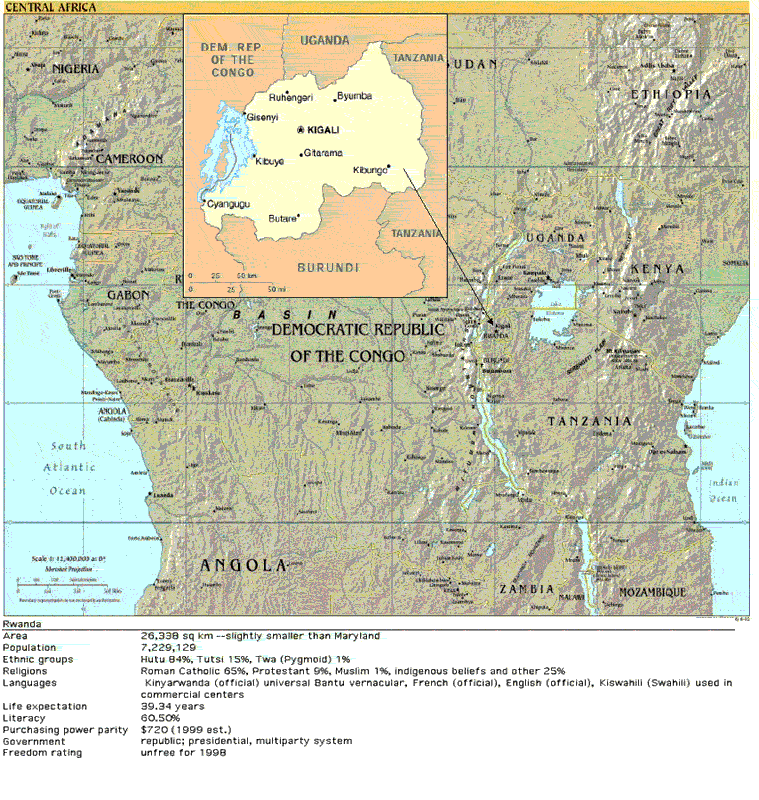
14. RWANDA TELLS SECURITY COUNCIL TO PUT THE KIBOSH ON FOREIGN FINANCING OF REBEL ACTIVITY IN EASTERN CONGO

Anita Powell at the Associated Press reports that Rwandan Foreign Minister Rosemary Museminali told reporters following a meeting of UN Security Council representatives in Rwanda that:
"There are movers and shakers (of the [Hutu opposition group FDLR]) in Europe and the rest of the world. We believe they should be sanctioned, we believe they should be dealt with, if we are to support the peace process in Congo."
Rwandan forces joined the Congolese in a joint military action against rebel Hutu forces in eastern Congo in late January--see Daily Sources 1/23 #9. In that offensive, a rebel Rwandan Powell reports that in 2006 the US imposed sanctions on businessmen and "warlords" who were allegedly financing instability in eastern Congo, near the Rwandan border.


In November, Angola had reportedly sent troops to help Congolese forces combat rebels in the region, but it apparently took the active cooperation of the Rwandan government to make any serious progress--see Daily Sources 11/10 #8.

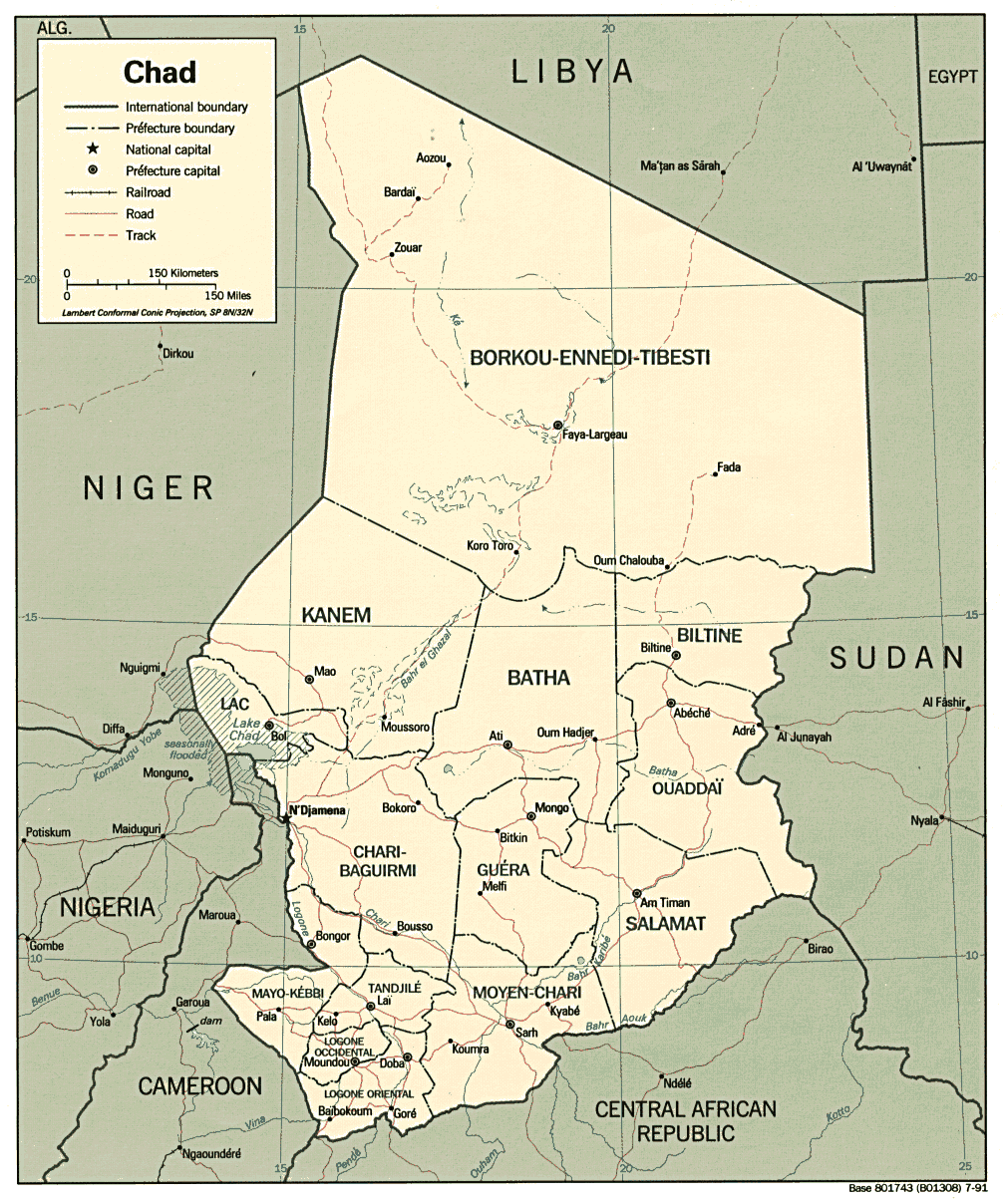
15. CHAD ENDS AIR STRIKES INTO SUDAN, SUDANESE REBEL APPEARS BEFORE THE ICC

Dany Padire at the Associated Press reports that Chad's interim defense minister, Adoum Younousmi, told the media that N'Djamena had ended air raids against Chadian rebel groups operating out of Sudan Sunday. Younousmi said,
"Our target was not the Sudanese government and less so the general population. Our objective was the Sudanese mercenaries wherever they were to be found, without causing any collateral damage."
The recent air attacks were the first attacks into western Sudan proper, where rebels have allegedly been operating, and whom N'Djamena has alleged Khartoum supports.

"Eastern Chad is a temporary home to about 300,000 refugees who have fled Sudan's Darfur conflict. The region also has camps for 187,000 Chadians displaced by fighting locally and in Darfur."
Younousmi said that the raids had destroyed seven pockets of rebels and that around 100 prisoners had been captured by ground forces operating in conjunction with the air attacks. In the meantime, BCC reports that a former member of the Darfur rebel group, the Justice and Equality Movement (JEM), Bahr Idriss Abu Garda has voluntarily appeared before the International Criminal Court to address charges of crimes against humanity leveled against him. (JEM is an Islamist group fighting the central government.) He is charged with taking part in an attack with killed 12 African Union peacekeepers in northern Darfur.


Mr. Abu Garda has since left JEM to form his own rebel movement, the United Resistance Movement. A spokesman for Mr. Abu Garda has argued that the charges against him are the result of fall out between him and JEM. The President of Sudan, Omar Hassan al-Bashir was charged with war crimes by the ICC in March and promptly expelled aid groups working in the Darfur region in response--see Daily Sources 3/6 #5.

16. NORWEGIAN PARLIAMENTARY VOTE ON CANADIAN OIL SANDS PARTICIPATION PUT OFF

Wojciech Moskwa and Terje Solsvik at Reuters report that the Norwegian government has delayed a parliamentary vote on whether StatOilHydro should withdraw from a $2 billion investment in Canada's oil sands.
"The oil sands issue has put the government in a bind four months before a general election, with political opponents saying state support for the oil sands project was hypocritical given the cabinet's self-professed environmental ambitions."
17. OBAMA ADMINISTRATION TO PROPOSE NEW NATIONAL CAFE STANDARDS

John M. Broder at the New York Times reports that the Obama Administration is set to announce as early as Tuesday new regulations for the emissions and mileage of cars and light trucks which will combine California's new auto-emissions rules with the existing corporate average fuel economy (CAFE) standard to create a single new national standard.
"Under the new standard, the national fleet mileage rule for cars would be roughly 42 miles a gallon in 2016. Light trucks would have to meet a fleet average of slightly more than 26.2 miles a gallon by 2016."
This is a big deal. Transportation accounts for about 60% of US oil consumption.

18. INDUSTRIAL REVOLUTION CAUSED BY CHEAP ENERGY, EXPENSIVE LABOR

In an extremely interesting piece, Robert C. Allen on Friday posted an article asking why the Industrial Revolution took place in England at Vox EU. His answer:
"The famous inventions of the Industrial Revolution were responses to the high wages and cheap energy of the British economy. These inventions also substituted capital and energy for labor."


It was difficult to transfer the technologies to places where either coal was expensive or labor was cheap. A must read. Note, just now many analysts expect the West, and the world, to enter a period where energy is expensive and labor is cheap.

Monday, March 30, 2009

Daily Sources 3/30

1. Jason Clenfield at Bloomberg reports that Japanese industrial production fell by 9.4% in February from January, as per the Trade Ministry. "Inventories fell an unprecedented 4.2%."
"There are signs a recovery may be stirring in the US, Japan’s biggest market. US orders for durable goods rose in February for the first time in seven months. Inventories of long-lasting durable goods fell for a second month and new home sales increased for the first time since July.

In Japan, the drop in inventories adds to evidence that the worst of the manufacturing slump may be over. Companies said they would increase production 2.9% this month and 3.1% in April, today’s survey showed."
2. Volkhard Windfuhr and Bernhard Zand at Der Spiegel recently conducted an interview with Sheik Hamad bin Khalifa Al-Thani, the Emir of Qatar in which he addressed a wide range of issues, and indicated that as a member of OPEC Qatar's position was that oil should be at $40/b to help support a global recovery. Key excerpts:
"SPIEGEL: How do you believe oil prices will develop now?

Hamad: I think the oil price should continue (to stay) in the $40 range for at least one or two more years.

SPIEGEL: Why so modest?

Hamad: Because this way we can help the world out of this crisis. If the world economy recovers, it will be good for us, too. Automatically, the price of oil will go up again. I don't see why OPEC countries should continue to cut production just to keep the price of oil high. This will not affect the industrial countries alone, it will also hit poor countries in Africa, Asia and Latin America. Who will look after them?

SPIEGEL: That's not the kind of argument you often hear when talking to oil producers.

Hamad: Yes, but I believe this battle is a battle for the whole world. Everybody should be helping each other for the next two years."
Interestingly, the Emir appears to believe that Europe will not be as badly affected by the economic crisis as the US. The Emir also addressed the issue of the emerging natural gas cartel:
"SPIEGEL: Europe has staked its future on natural gas, but we are concerned about supplies. Can Qatar step in to fill the breach if Russia fails to deliver?

Hamad: We are selling gas to Italy, Spain, Belgium and, starting within the next few weeks, to Britain. I know that the Germans prefer to have their own gas supply, but I think our gas could come to Germany through another European country. However, this depends on the quantities we have on hand and the price.

SPIEGEL: Europeans are also worried about the creation of a so-called Gas-OPEC. Is there another cartel in the making that will be able to set prices at will?

Hamad: With OPEC they have a cartel. Why don't we have this gas cartel as well? And why don't we make a sort of agreement between consumers and producers? I wouldn't mind such a gas cartel, but it will take time because some countries today sell for high prices and others sell for low prices. It will be hard for those selling high to bring their prices down. So we will need time."
The Emir also stated unequivocally that Qatar would not stand with the US against Iran. But, similarly, he thinks it would be hard for the Arab countries of the Gulf to stand with Iran against the US. He further states that though he welcomes the Obama Administration's new timbre in its approach to the region, that the other conflicts in the region also need to be addressed. He indicates Qatar's continued support for the Arab Peace Plan of 2002, with qualifications:
"Hamad: I think Israel will not accept the return of the Palestinian refugees. But on the issue of dividing the city of Jerusalem (and turning over East Jerusalem to the Palestinians), I think they should accept it."
Which seems reasonably rational to me. He also addressed the issue of the ICC's arrest warrant for Sudan President al-Bashir:
"SPIEGEL: The International Criminal Court has issued an arrest warrant against Sudan's president, Omar al-Bashir. Why are you opposed to this?

Hamad: If anything happened to Omar al-Bashir and Sudan ended up in chaos, the whole of Africa would also sink into chaos. Sudan is a vast land with a lot of borders. Al-Qaida would be happy to see Sudan become like Iraq.

SPIEGEL: Isn't it time for the Arab world to finally do something about the Darfur problem?

Hamad: We have been mediating in Sudan for a long time, particularly because the groups in Darfur do not want the Arab League to get involved. My hope is that we do not see interference from some other Arab countries. We are confident. We need to give the parties time--we have to let them shout and issue their grievances, and finally we need to get the process of negotiations going and discuss the future of their country.

SPIEGEL: Al-Bashir is now in Doha to attend the Arab summit.

Hamad: I sent my prime minister to invite him."
The Emir is extremely frank for the duration of the interview--a must read.

3. Juan Cole at Informed Comment helpfully provided the USG Open Source Center's translation of the March 22nd speech of the Supreme Leader [more accurately Leader of the Revolution or LOTR] Ayatollah Ali Khamenei in response to the overture made directly by President Obama. (The USG Open Source Center paradoxically does not just simply publish their efforts.) This section of the speech begins with a long recitation of historical offenses of the US--real and imagined. (For example, Khamenei indicates that the US green-lighted Saddam Hussein's initial attack on Iran, something I believe is not the case.) The LOTR is not respectful, ironically enough--even if predictably enough--in the way he addresses the President's speech. For example, the LOTR says
"They have the slogan of change. Where is the change? What has changed? Clarify this to us."
Which on one level is fair enough, but also just off kilter, given that the change promised was to the American people, not the Islamic Republic of Iran. He also has a rather different take on the world's reception of the new POTUS than I, insofar as the LOTR remarks that the US is "hated in the world."
"Today, you are hated in the world. You should know this, if you do not already. Nations set fire to your flag. Muslim nations across the world chant 'Death to America.'"
The last bit being true of few nations outside of Iran itself. Just prior to this the LOTR chooses to question whether or not the POTUS is indeed in charge in the US, which seems to me a rather pointed insult.
"I would like to say that I do not know who makes decisions for the United States, the President, the Congress, elements behind the scenes?
He then manages to come quite close to calling the President a liar. (Remember, the US's official position in the IAEA is that Tehran is lying about its nuclear program.)
"You may say that you want to change policies, but not your aims, that you will change tactics. This is not change. This is deceit."
He also brings up the question of translation in a somewhat insulting way--and I might even be inclined to concede this point, so to speak, but Juan Cole, who is clearly a partisan of reconciliation seems to think this is a reasonable translation, so I imagine it is a fair representation.
"This is my advice to US officials, the President, and others. Listen well to these words, and have them translated for you. Of course, do not give it to the Zionists to translate for you. Consult healthy people, and seek their opinions."
(In fact, the government did release an official translation of bits and pieces of the speech in a summary in English here.) That noted, there are a few elements of the speech which could be regarded as an opening.
"But I would like to say that we have logic. Since the beginning, the Iranian nation moved with logic. Regarding our vital issues, we are not sentimental. We do not make decisions based on emotion. We make decisions through calculation."
And he concludes the section of the speech dealing with the Obama Nowruz greeting with:
"If you go on with the slogan of discussion and pressure, saying that you will negotiate with Iran, and at the same time impose pressure, threats, and changes, then our nation will not like such words. We do not have any experience with the new US President and Government. We shall see and judge. You change, and we shall change as well. If you do not change, our people became more and more experienced, stronger, and more patient in the past 30 years."
This could be seen as an opening, though I would note that the change in tone was not reciprocated--and this is from a culture acutely sensitive to matters of politesse. I would also note that the key section which some argue represents an offering was not included in the official translation of key elements of the speech offered on the LOTR's website.

That said, some argue the move is a clear opening. Juan Cole's response is here, and he wrote
"The US corporate media mysteriously interpreted Khamenei's words as a rebuff to Obama, but in light of the phrase I just quoted, I can't understand how they reached that conclusion."
Given the points I mention above, I find it incredibly difficult to understand how it is that Dr. Cole "cannot understand how they reached that conclusion" and how it could even be characterized as "mysterious." In any case, Cole chose to frame the speech as a "grumpy old man's" response to the Obama overture in which he was making his first offer in what he expects to be a long period of haggling toward a grand bargain.

Farideh Farhi--a very well-respected Iran expert--also believes the speech was conciliatory, though she disagrees with the "grumpy old man" characterization and does not think that everything is on the table. Her take is:
"Clearly from [the LOTR's] view, engagement in talks must be accompanied with some concrete steps that show Iran that the United States is interested in a process and give and take and not a process based on 'either deception or intimidation.' Deception because the objective remains the same while the softer language is a mere tactical change. Intimidation because talks are combined with further squeeze of Iran."
It is worth reading the speech for yourself. Meanwhile, on Saturday Ernesto Londoño at the Washington Post reported that the Mujaheddin-e Khalq, or MEK, will be removed from their camp near the Iranian border and that the leaders will be separated from followers who will be "de-brainwashed" or "re-educated" depending on your point of view. The question of US support for the organization is one of the major sticking points addressed by the LOTR's speech.

4. Stuart Williams at AFP reports that the World Bank forecasts that Russian GDP will shrink by 4.5% in 2009.
"The forecast is considerably more pessimistic than that of the Russian government, which is predicting a contraction of 2.2 percent in GDP in 2009."
5. Nadia Rodova and Stuart Elliott at Platts report that Surgutneftegaz informed the press today that it had purchased a 21.2% stake in Hungarian oil and gas company MOL from Austria's OMV.
"This price represents a 93% premium to Friday's closing price, a 27% premium to the 12-month average price, and a 19% discount to the 12-month peak price of Hungarian Forint 23,700, Renaissance Capital said in a research note."
6. Edward Hugh at Fistful of Euros reported Sunday that the Bank of Spain intervened to take over Caja Castilla La Mancha, whose losses are estimated to be as much as €3 billion. Spanish financial shares fell sharply today in reaction to the news.

7. Reuters reports that the Bank of England today released data showing that the number of new mortgages approved in the UK in February grew at the fastest rate seen since May 2008.
"Mortgage lending rose by £1.507 billion, almost double analysts' forecasts for an £800 million rise, and up from just over £1 billion in January."
8. Chris Baldwin and David Sheppard at Reuters report that Europe's oil refining sector is shutting down gasoline units, given the collapse in demand from the US. Topper refineries--simple refineries without additional sophisticated processing units which increase production of certain products like gasoline or diesel--account for about 1 mb/d of Europe's 16 mb/d throughput capacity are the most likely to be decommissioned. Traditionally European surplus gasoline production has often been shipped to the US, serving as an upper boundary, so to speak, on the price of gasoline.
"'Europe's oil demand may never reach its peak again,' Leo Drollas, chief economist at the Center of Global Energy Studies (CGES), said."
9. Eric Watkins at the Oil & Gas Journal reports that Habib Kagimu, chairman of Tamoil Uganda Ltd., has suggested that Kenya's Mombasa-to-Eldoret oil pipeline could eventually be extended to Uganda's Albertine rift basin, where several big crude discoveries have been made recently.


10. Shailagh Murray and Karen DeYoung at the Washington Post reports that at a Capitol Hill news conference slated for tomorrow a bill will be introduced to lift the travel ban to Cuba. If the measure were to pass it would be an extremely significant reversal of long standing US-Cuba policy.

11. Liz Capo McCormick at Bloomberg reports that the Fed purchased $2.499 billion of US treasuries in its third direct purchase of US debt. The number was much less than the market was anticipating given the size of the Fed's program as announced.

12. An extremely interesting article discussing whether Goldman Sachs deliberately manipulated the price of oil upwards in June-July 2008 in a short squeeze, by Christopher Helman and Liz Moyer at Forbes.

Wednesday, March 18, 2009

Daily Sources 3/18

1. Krishna Guha, Bertrand Benoit, Chris Giles and Daniel Pimlott at the Financial Times report that the IMF will reduce today its forecast for global GDP in 2009 to a contraction of 0.6%.
"The eurozone economy was forecast to contract by 3.2% in 2009, [Ms. Ter-Minassian, an adviser to IMF managing director Dominique Strauss-Kahn] said, against the earlier forecast of a 2% decline. The US would shrink by 2.6% (1.6%), and Japan 5% (2.6%), making it the worst-hit big economy. The IMF in Washington said the figures cited by Ms Ter-Minassian were 'unofficial' and 'out of date'."
In early March the IMF began indicating that a downward revision was under way--see Daily Sources 3/3 #1.

2. Philip P. Pan and Karen DeYoung at the Washington Post report that many Russia analysts believe that Moscow is signaling interest in a deal on Iran.
"In a meeting last week with a bipartisan commission studying US policy toward Russia, President Dmitry Medvedev expressed alarm in 'very graphic language' over Iran's successful test launch of a satellite last month, linking it to Tehran's nuclear program, said Dmitri Simes, director of the commission.

'Medvedev said it demonstrated how far-reaching Iran's nuclear ambitions are, and that he was very concerned,' said Simes, who is also president of the Nixon Center in Washington. 'He felt it was a clear challenge to both Russian and American interests and said he would like both countries to work on this challenge together.'"
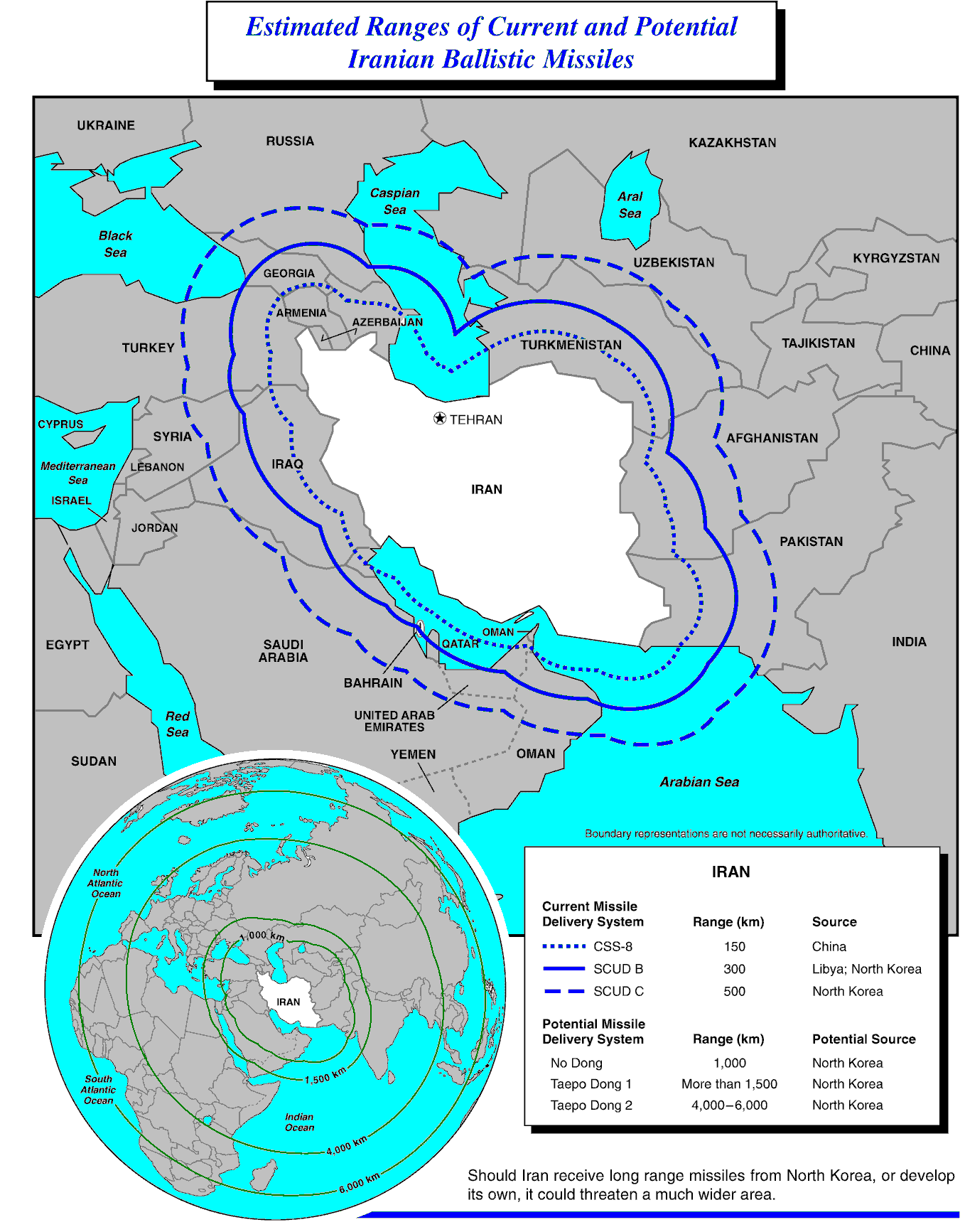
The Federation of American Scientists provide the following illustration of Iranian missile capabilities.


Satellite launches reportedly use technologies required for the development of ICBMs. In November, Iran claimed it had successfully tested missiles with a range of 1,200 miles, which as you can see from the map does not quite put Moscow in range--and obviously is even further from presenting any potential threat to, say, Warsaw. That said, it plainly makes a lot of sense that Iran's perennial missile tests would have the--likely unintended--effect of ruffling Moscow's feathers, given that a nuclear armed Tehran which could reach Moscow is definitely not in their interests.
"Alexander Pikayev, a top arms control scholar in Moscow, said Russian policy toward Iran will be determined by competing interest groups and political factions. Defense manufacturers and the atomic energy industry oppose tougher sanctions, for example, but the United States could win over the latter by reviving a bilateral pact on civilian nuclear cooperation that was frozen after the Georgian war, he said.

Pikayev said Medvedev may be more likely to support sanctions because a breakthrough in US relations would boost his political stature at home and set him apart from his powerful predecessor, Prime Minister Vladimir Putin. Putin might resist, but his relationship with Iranian President Mahmoud Ahmadinejad is said to be strained and he surprised Russia's foreign policy establishment by endorsing earlier U.N. sanctions, Pikayev said."
Frankly, I doubt this assessment--I think the notion of a nuclear armed Iran with the capability of hitting Moscow will outweigh the economic considerations involved in putting the kibosh on nuclear power cooperation with Iran. Indeed, it is hard to see many places in which Iranian and Russian interests coincide. Perhaps they do in terms of energy pricing, but Iran's potential as an alternative source of gas for European industry is probably a critical item in Moscow's long term thinking. And as the weekend's events proved, Russia still regards oil production coordination with OPEC as being less in its interest than good terms with Europe--and producing at full bore to claim all price increases produced by the cartel. (A policy which Iran appears to follow with respect to the organization's production quotas as well, ironically enough.)

3. The Associated Press reports that North Korea yesterday gave the organizations distributing US food aid inside that country till the end of March to leave--rejecting all future food aid.

4. Judy Dempsey at the New York Times yesterday reported that Russia signed two natural gas deals with Hungary yesterday. One deal signed last week has the Budapest and the Hungarian Development Bank to finance the South Stream project on Hungarian soil.


The other deal has Gazprom and MOL establishing a 1.3 billion cubic meters storage facility in Hungary. To make sense of that, here is a map that Jérôme Guillet drew up of Ukraine's gas infrastructure--note the three asterixes to the West, which represent gas storage facilities.


As Guillet pointed out in a piece for the European Tribune:
"Storage capacity is important in the gas business, as demand is seasonal (there is more in winter for heating) and can almost triple in Europe between summer and winter. If you can pre-position your gas near the markets when transport capacity becomes strained, you can extract a lot more value from that seasonality. The storage facilities near the Hungarian and Slovak borders were ideal for Soviet exports, but now they are in Ukrainian hands, and thus Russia must have a minimum of technical cooperation from the Ukrainians, who physically control and operate these facilities, not to lose a lot of money in their export markets. More, unavoidable leverage for the Ukrainians."
Hungarian Prime Minister Ferenc Gyurcsany's plea for a regional aid package from the EU was turned down last week. He has been a supporter of the Nabucco Pipeline, but questions of sourcing the gas (which would likely have to come from Iran) and project financing continue to bedevil the project.

5. Edward Hugh at Fistful of Euros posts that Poland's Central Statistical Office has released its industrial output data for February showing a 14.3% annual rate of decline in February, following a revised annual rate of decline of 15.3% in January. Output was up 2.7% in February from January however. Hugh provides a helpful graph of industrial production for the last two years:


Hugh points out that industrial production is on the decline across the spectrum of export-oriented Eastern European economies, warning against too much disambiguation between them. Worth reading and mercifully short.

6. Bettina Wassener at the New York Times reports that the World Bank lowered its forecast for Chinese growth in GDP for 2009 to 6.5%. 6.5%, though quite high by global standards just now, is well below the Chinese principle of "bao ba"--or "protect the 8"--below which conventional wisdom holds that Beijing will begin to see significant, read destabilizing, social unrest. Kevin Hamlin at Bloomberg reports that bank sees signs China's economy is stabilizing faster than the rest of the world.
"'The government’s stimulus is working,' said Louis Kuijs, a senior economist at the World Bank in Beijing. 'China’s fundamentals are strong enough to ride out this storm.'"
Meanwhile, Andrew Batson at China Journal helpfully translated the complete text of Chinese Ministry of Commerce’s statement announcing its decision to block Coca Cola’s proposed acquisition of China Huiyuan Juice Group Ltd. Key excerpt:
"Through its review, the Ministry of Commerce found that this concentration will have an adverse impact on competition. After the concentration is completed, Coca-Cola could use its market dominance in carbonated soft drinks to limit competition in the market for juice through tying, bundling or other exclusive transactions, resulting in consumers being forced to accept higher prices and reduced variety. At the same time, because brands can restrict entry to the market, it would be hard for the threat of potential competition to remove the restrictive effect on competition. In addition, the concentration will also reduce the room for small and medium-sized juice companies to survive, and will have an adverse effect on the structure of competition in China’s juice market."
The notion that dominance in the carbonated drink market could adversely affect competition in the juice market is unlikely to please most corporate headquarters. The fact that the Ministry of Commerce took stock of the market power of brands is interesting given that some have written that the primary value-addition that Western corporations bring to emerging markets is, well, brands. Meanwhile, the Sydney Morning Herald reports that shares in Rio Tinto have taken a beating on fears that the deal with Chinalco taking a 18% stake in the company.
"'[The 8.7% decline in share price] is [due to] the uncertainty surrounding the Chinalco deal, there has been a bit of talk out today that there is a lot of opposition to the deal and this is what's weighing on it,' MF Global senior trader Anthony Anderson said.

'The FIRB extension and the senate inquiry into foreign investment is adding to the uncertainty.'

The mounting political concern follows a decision by the Foreign Investment Review Board (FIRB) to extend its review to 90 days and initiate a more in-depth examination of the transaction, after the initial 30-day evaluation period closed on Monday.

The transaction, which has been backed by the Rio Tinto board, will also allow Chinalco to appoint two new non-executive board members to the global miners board."
(h/t Emmanuel at International Political Economy Zone.)

7. Platts reports that Italian major Eni has signed a major cooperation agreement with Pakistan to develop major projects all along the oil and gas product chain.
"The agreement also allows Eni to become a strategic partner in developing the oil and gas sector in Pakistan and to enter fields which are currently managed by state-run oil companies."
8. David E. Sanger and Eric Schmitt at the New York Times reports that "two of the high-level reports on Pakistan and Afghanistan that have been forwarded to the White House in recent weeks have called for broadening the target area to include a major insurgent sanctuary in and around the city of Quetta."


Baluchistan has separatist tendencies and is in the middle of a small bore separatist struggle, both in Pakistan and Iran.


Note that Baluchis can be found in southern Afghanistan where most of that country's opium production--and violence--is concentrated.

9. Galrahn at Information Dissemination notes that due to the Obama Administration's review of all military ties, GE has been asked to freeze work on turbines it was to provide the Indian navy for three Shivalik-class stealth frigates. Though I strongly disagree with the way Galrahn frames the story, I think it is an important data point. Clearly the US is likely to approve continued sales of engines to the Indian Navy.

10. Maher Chmaytelli and Juan Pablo Spinetto at Bloomberg report that Shokri Ghanem, chairman of Libya’s state-run National Oil Corp., told journalists today in Vienna that Libya will exercise its right to buy Calgary-based Verenex Energy Inc., which would effectively block CNPC's bid for the E&P company.
"Verenex has assets in Libya that are worth 'hundreds of millions' of dollars, Ghanem said in an interview with Bloomberg on March 16."
It is an interesting signal given China's Africa Policy announced in 2006 and Ghaddafi's recent selection as chair of the African Union--see Daily Sources 2/3 #9.

11. Justin Stares at Lloyd's List reports that the Bangladeshi High Court ordered the closure of all ship breaking yards operating without environmental clearance.
"Industry sources said they were 'staggered' by the ruling, which if confirmed will close down one of the world’s largest breaking industries just as scrapping activity peaks.

'None of the 36 shipbreaking yards in Chittagong currently have an environmental clearance,' said the NGO Platform on Shipbreaking. 'The decision therefore effectively shuts down an industry that has been highly criticized by environmentalists and human rights activists for many years for operating with complete disregard for the law, human health and the environment.'

The scrapping industry, which claims to employ 250,000 either directly or indirectly in Bangladesh, is expected to appeal.

The court was ruling on a petition filed by the Bangladesh Environmental Lawyers Association. Judges ordered that no ship on the Greenpeace 'dangerous ships list' be allowed into the country, according to reports by the platform and local media."
It is a decision bound to amplify the effects of the financial crisis, economically-speaking ... it seems that probity only comes when it will hurt the most, ironically. Note the significance of the courts in the Muslim-majority nation. Well-worth reading in full.

12. Nasreen Seria at Bloomberg reports that the South African Reserve Bank's Monetary Policy Committee will meet next week and accelerate its schedule to monthly meetings for the rest of the year from planned meetings every two months.
"Global economic conditions 'are getting worse' and the 'changed' environment requires the MPC to meet more regularly, Governor Tito Mboweni said in a phone interview from Pretoria today."
13. Victor L. Simpson at the Associated Press reports that in Cameroon Pope Benedict XVI reiterated yesterday that condoms were not an answer to the fight on AIDS--"You can't resolve it with the distribution of condoms. ... On the contrary, it increases the problem." I would note that Africa is one region where Catholicism--and more conservative Catholicism--is growing quickly. However, perhaps the one really impressive and compellingly moral US foreign policy triumph under the Bush Administration was the huge increase in aid to Africa in terms of the fight on AIDS, including condoms and retro-viral drugs. The people in Africa are well aware of how these aid programs have reduced the mortality rate in the continent. The notion that condoms are against life and a concession to death, and thus amoral, as opposed to a way to protect life and thus moral, will not, I believe, make much sense to them. Pope Benedict XVI appears to have a tin ear when it comes to husbanding the moral authority of the Church.

14. The Port of Long Beach recently posted its numbers for February, showing a 40% decline in container traffic from February 2008:


So far in 2009 the port has recorded a 20.2% decline in traffic. The Port of Marseilles, France, also recently posted its report for February, showing a 21% annual decline in total traffic. It registered a 16% decline from the traffic seen in January:


Hydrocarbons account for about 74% of Marseilles' traffic and it lost about 12% in volume from the year before. The grim trade data continue their march.

15. Bob Willis at Bloomberg reports that the consumer price index rose by 0.4% in February from January. Excluding fuel and food, prices climbed by 0.2% from the month prior. On an annual basis, the consumer price index rose by 0.2%, up from the 0% annual rate seen in January. Excluding fuel and food, prices climbed by an annual rate of 1.8% in February, up from a 1.7% annual rate of increase seen in January.
"Energy expenses increased 3.3%, led by an 8.3% increase in gasoline prices. Still, the fuel’s cost is down 36% from a year earlier.

Food prices, which account for about a fifth of the CPI, fell 0.1%, the first drop since April 2006."
16. The Federal Open Market Committee met today and decided to keep the federal funds rate unchanged at 0-.25%. Excerpt from its press release:
"To provide greater support to mortgage lending and housing markets, the Committee decided today to increase the size of the Federal Reserve’s balance sheet further by purchasing up to an additional $750 billion of agency mortgage-backed securities, bringing its total purchases of these securities to up to $1.25 trillion this year, and to increase its purchases of agency debt this year by up to $100 billion to a total of up to $200 billion. Moreover, to help improve conditions in private credit markets, the Committee decided to purchase up to $300 billion of longer-term Treasury securities over the next six months."
This follows the latest Treasury International Capital data which shows, courtesy of Brad Setser at Follow the Money, that foreign purchases of long term treasuries have collapsed:


Foreign government demand for US agency debt fell off a cliff late last year and purchases were even banned by Moscow just the other week. Meanwhile, Jon Hilsenrath at Real Time Economics reports that the Fed's quarterly survey of banks shows that during the week of February 2-6, banks extended $85.6 billion in credit to businesses, an increase of 13% from the first quarter of 2008--per JP Morgan Chase economist Michael Feroli:


17. The EIA reported that crude oil stocks built by 2 million barrels in the week ended March 13 to 353.3 million barrels, well above the historical average for this time of year, but still below the most recent peak of 354 million barrels seen on June 29, 2007. According to a survey by Bloomberg, analysts had expected a 1.5 million barrel build. Gasoline stocks grew by 3.2 million barrels, are near the top of the historical average. Analysts had expected a 1.5 million barrel draw. Distillates stocks grew by 100,000 barrels, are well above the five year historical average range as well as counter-cyclical, and versus analyst expectations of a 1 million barrel build. Taken in isolation, the data would be bearish on the price of crude.