Showing posts with label world bank. Show all posts

Thursday, July 16, 2009

Daily Sources 7/16

1. CHINESE MONEY SUPPLY GROWTH 28.5% YOY IN JUNE, CHINA PUBLISHES DATA CLAIMING 7.9% GDP GROWTH, REVISITS "MADE IN CHINA" CAMPAIGN

Yesterday, Macro Man called out Prime Minister of China, Wen Jiabao, for having spurred China's M2 growth to 28.5% year over year, asked whether he deserves the moniker "Helicopter Wen" more than Ben does. He asks:
"Unfortunately, in an act reminiscent of Gordon Brown Stalin, the early 90's data has been wiped from the historical record. A cynic might suggest that this is because China's leadership doesn't want to remind people that one upon a time, money growth was this high and it didn't end well. Judge for yourselves."


Today, the National Statistics Bureau published new figures showing that Chinese GDP growth was 7.9% in the second quarter from the year previous, up from the growth of 6.1% in the first quarter, per Terence Poon and Andrew Batson at the Wall Street Journal.
"Also Thursday, the finance and economic committee of the National People's Congress, China's legislature, warned that the government must prevent the "extraordinary growth" of credit that could lead to inflation risks and problems for the financial system. It said China should strengthen credit checks and prevent a rebound in bad loans. The committee includes influential members but doesn't have a role in setting economic policy.

The People's Bank of China has already started to take some measures to fine-tune the rapid flow of credit. On Thursday, the central bank used its weekly sale of three-month bills to continue to guide money-market interest rates higher for the third straight week."
The Economist notes:
"In the year to June fixed investment surged by 35%, car sales rose by 48%, and purchases of homes by more than 80%. After falling last year, home prices are now rising briskly in some big cities, and share prices have soared by 80% from their November low. Domestic spending has been spurred partly by the government’s stimulus package, but probably even more important was the scrapping of restrictions on bank lending late last year. In June new lending was more than four times larger than a year earlier."


The Economist notes that the importance of property to domestic demand means it is unlikely that Beijing will clamp down too hard on the lending. In the meantime, Carlos Tejada at the China Journal reports that China is revisiting plans to launch a "Made in China" campaign.

2. WORLD BANK WARNS OF DEFLATION ON EXCESS INDUSTRIAL PRODUCTION

Ambrose Evans-Pritchard at the UK Telegraph reports that the chief economist at the World Bank, Justin Lin, in Cape Town recently warned that excess industrial capacity will cause a deflationary spiral unless it is addressed.
"Mr Lin said capacity use had fallen to 72% in Germany, 69% in the US, 65% in Japan, and as low as 50% in some developing countries, mostly touching lows not seen in modern times."
Lin suggests that competitive devaluation will have little productive effect in this environment, saying:
"No country can count on currency depreciation and exports as a way out of recession. Unless we deal with excess capacity, it will wreak havoc on all countries. There is urgent need for global, co-ordinated fiscal stimulus."
(h/t Yves Smith at naked capitalism.)

3. UK SETS GOAL OF 40% RENEWABLE SOURCE FOR ELECTRICITY GENERATION BY 2020

Selina Williams at the Wall Street Journal reports that the UK has set as its goal sourcing 40% of its electricity generation from low carbon energy sources by 2020, with fully 30% to come from wind power, wave and tidal energy and other renewables. The other 10% is to be from coal-powered plants with carbon capture technology and nuclear. (As of 2006, per the IEA, nuclear power generation accounted for 18.6% of total electricity supply in the UK. Coal accounted for 37.5%. All renewables accounted for 6.1%.)
"'Renewables, nuclear, clean fossil fuels, as this plan sets out, are the trinity of low carbon and the future of energy in Britain,' [Energy and Climate Change Secretary Ed] Miliband said yesterdat. 'All of them should be part of our future energy mix.'

The government wants the power sector to be almost completely free of carbon emissions by 2050 as it strives to meet a commitment to cut overall emissions by 80% by 2050. The UK has already cut its emissions by 21% since 1990."
4. TURKEY INCREASES FUEL AND RESTAURANT TAXES, REDUCES BENCHMARK INTEREST RATE TO 8.25%

Delphine Strauss at the Financial Times reports that Ankara yesterday announced that it would raise taxes on petroleum products and restaurants with immediate effect. The new taxes will add roughly 8% to prices at the pump and between 8 and 18% at high end hotels and restaurants.
"'The government is speeding up its efforts to tighten fiscal policy,' said Yakin Cebeci, economist at JPMorgan, estimating the measures could improve budget performance by 0.8% of GDP within 12 months.

Stimulus packages and a spending splurge before local elections in the spring have led to a rapidly widening budget deficit. Figures published on Wednesday by the finance ministry showed a deficit of 23.2bn lira ($15.2bn) in the first half of the year, compared with a surplus of 1.9bn lira in the same period of 2008."
Effective tax collection has been a point of dispute at the IMF in terms of approving a new financing package for Ankara. Meanwhile, Steve Bryant at Bloomberg reports that the Turkish central bank today cut its benchmark interest rate by half a point to 8.25%, it's ninth consecutive monthly cut, indicating that further cuts may be in the works.
"The inflation rate reached a 39-year low of 5.2% in May, before rising to 5.7% last month, a pick-up the central bank says will prove temporary. The bank’s target for this year is 7.5% and its most recent survey of economists and businessmen forecast a year-end rate of 6%.

'Inflation will remain at low levels for a long time,' the bank said in today’s statement."
"Industrial output fell 17.4% in May, extending a decline that drove a record 13.8% contraction in gross domestic product in the first three months of the year."
5. PRESIDENT OF ABKHAZIA SPEAKS OF RELATIONSHIP WITH RUSSIAN RAILWAYS JUST AFTER EBRD LOAN

In light of the EBRD's recent decision to make a $500 investment in Russian Railways, the following portion of a Der Spiegel interview of the President of Abkhazia, Sergei Bagapsh, might be of some interest:
"SPIEGEL ONLINE: There are Russian military bases in Abkhazia, Russian troops guard your external borders, and your currency is the ruble. And, then, you want the Russians to manage your railways for 10 years. Is it possible that you're getting just a little too dependent on Russia?

Bagapsch: We are dealing with the Russian railways because we have to modernize our own. We would be equally pleased to deal with the German railways if they were interested. In any case, there are no completely independent nations in this world. Liechtenstein is dependent on Switzerland, Luxembourg on France. We are all dependent on one another. Georgia is dependent on America; we are on Russia."
6. LOCKHEED MARTIN INDIA CEO STEPS DOWN AMIDST ESPIONAGE SCANDAL, WILL US, AUSTRALIA, INDIA AND JAPAN JOINTLY OPERATE AIR CRAFT CARRIERS IN RESPONSE TO CHINESE CONSTRUCTION OF 6?, INDIA SELECTS 2 SITES FOR US COS TO BUILD NUCLEAR POWER PLANTS

Ajai Shukla at the Business Standard reported on Monday that
"Ambassador Douglas A Hartwick, Lockheed Martin India’s CEO, who was spearheading the world’s largest defense manufacturer’s campaign to sell India the F-16 IN medium fighter aircraft, was withdrawn from India in an unusual hurry."
According to Indian Defense Ministry sources, Hartwick was removed as CEO of Indian operations after the company was discovered to be in possession of classified information regarding defense purchases. Meanwhile, Manu Sood at 8ak recently interviewed US historian Jason Verdugo on the possibility of the Quadrilateral Initiative (or Quad) countries (the US, Australia, India, and Japan) jointly operating the recently decommissioned US aircraft carrier--the USS Kitty Hawk--on the recent news that China has been secretly constructing six aircraft carriers. (I am indebted to Galrahn at Informed Comment for both of these items.) Meanwhile, Amol Sharma at the Wall Street Journal reports that India has selected two sites on which US companies could build nuclear power plants, which will be announced when Secretary Clinton arrives in the country next week.
"The two countries may also use Mrs. Clinton's trip to announce completion of an agreement for the US to track sales of defense equipment and ensure it is used for its stated intent, according to people familiar with the matter. That 'end-use monitoring' agreement will be crucial, experts say, as US companies compete for major contracts such as India's plans to purchase 126 fighter jets at an estimated cost of $11 billion.

A spokesman for India's Ministry of External Affairs said that some agreements will 'naturally' be finalized between the US and India during Mrs. Clinton's trip but declined to elaborate."


7. INDIA AND PAKISTAN AGREE TO INTELLIGENCE SHARING ON BACK OF AL QAEDA CALL FOR GENERAL REVOLT AGAINST ISLAMABAD

Rama Lakshmi at the Washington Post reports that the prime ministers of India and Pakistan met for two hours on the sidelines of a Non-Aligned Movement meeting in Cairo after which released a joint statement in which they agreed to share "real-time, credible and actionable" information on terrorist activities.
"[T]he text of the jointly agreed statement on Thursday said that 'action on terror should not be linked to the composite dialogue process and these should not be bracketed' and that 'terrorism is the main threat to both countries.'"
The statement follows the call by Al-Zawahiri, a key figure in al-Qaeda, for cooperation in its attacks on Pakistani interests, suggesting that the current government is actually in the employ of the US Ambassador. Juan Cole at Informed Comment posts the entire text per the Open Source Center's translation--note that it includes the nationalist refrain that "the West" seeks to break the country up:
"In Pakistan in particular, the Crusade aims at eradicating the growing jihadi nucleus in order to break up this nuclear-capable country, and transform it into tiny fragments, loyal to and dependent on the neo-Crusaders."
This seems increasingly desperate to me and that this particular band of extremists have worn out their welcome in Pakistan.

8. IRAN'S 12 YR CHIEF OF ATOMIC ENERGY ORGANIZATION--FORMERLY 12 YRS AS OIL MINISTER--LINKED TO MOUSAVI STEPS DOWN

BBC News reports that Gholam Reza Aghazadeh, the head of Iran's Atomic Energy Organization, has resigned.
"Mr Aghazadeh is a veteran official who served in the 1980s as a deputy to Mir Hossein Mousavi--the defeated candidate in Iran's disputed presidential elections last month.

In 1985 he began a 12-year stint as oil minister, staying in the post during the presidency of Ali Akbar Hashemi Rafsanjani.

He then moved to his job at the head of the atomic agency in 1997 under the reformist former president, Mohammad Khatami.

He continued in the post when Mr Ahmadinejad was first elected in 2005."
9. IRAQ'S OIL EXPORTS UP ON INCREASED NORTHERN PRODUCTION (STILL SIGNIFICANTLY BELOW PRE WAR PRODUCTION)

Faleh al-Khayat at Platts reports that Iraq's total oil exports rose by 19 kb/d in June to 1.925 mb/d.
"Exports from northern fields rose to 528 kb/d in June, a post-war record and 7 kb/d higher than May exports.

The ministry did not say if the figure for the north included exports from the Tawke and Taq Taq fields in Iraqi Kurdistan, which began exporting crude oil on June 1."
"Production from southern oil fields rose slightly to 1.794 mb/d from 1.759 mb/d in May.

Although this increase is a continuation of the recent improvement in production from the south, the rate achieved is still 161 kb/d below the 1.955 mb/d produced in July last year.

The steep decline in production from southern fields since last July lies behind recent escalation in criticism of oil minister Hussein al-Shahristani and led to his summons by parliament to answer questions about oil policy."
10. VIOLENT CLASH BETWEEN STATE GOVT BACKERS AND NATIONAL GUARD IN TOWN EAST OF CARACAS

Christopher Toothaker at the Associated Press reported yesterday that hundreds locals in a small town east of Caracas by the name of Curiepe reacted to the National Guard seizing a police station controlled by an elected figure from the opposition by massing outside it and hurling rocks, bottles and Molotov cocktails at the troops.
"The conflict began shortly before dawn when about 40 soldiers from the National Guard tossed tear gas canisters at the police post, forced officers to leave and took over the building, said Elisio Guzman, director of the Miranda state police. He contended the troops were following orders from the mayor."
"As the conflict wound down later Wednesday, Adriana D'Elia, a Miranda state government representative, said state authorities agreed to move their police to another building after meeting with the municipality's pro-Chávez mayor, Liliana Gonzalez."
11. FORECLOSURES UP 15% YOY IN 1H 2009, INITIAL UNEMPLOYMENT INSURANCE CLAIMS AT HALF MILLION

Barry Ritholtz at the Big Picture links to RealtyTrac's country-wide county foreclosure map, noting that
"1,905,723 foreclosure filings were reported on 1,528,364 US properties in the first six months of 2009, a 9% increase in total properties from the previous six months and a nearly 15% increase in total properties from the first six months of 2008."


Meanwhile, Reuters reports that initial jobless claims for state unemployment were a seasonally-adjusted 522,000 in the week ended July 11, 47,000 fewer than what was seen in the previous week, per the Labor Department.
"Continued claims of people still on jobless aid after an initial week of benefits fell to 6.273 million in the week ending July 4, the latest for which data is available.

It was the lowest reading since April and the largest one-week decline on record. Analysts had forecast continued claims would decline to 6.85 million."
12. US OIL IMPORTS DOWN 7.6% IN 1H 2009 YOY, JET FUEL IMPORTS HALVED

Robert DiNardo at Platts reports that US imports of crude oil and petroleum products fell in the first half of 2009 by 7.6% from the first half of 2008 to 12.048 mb/d, per the American Petroleum Institute's monthly statistical review.
"Crude oil imports in June were down by 12.2% at 8.754 mb/d from 9.974 mb/d in June 2008. For the January-June period, crude imports were down by 6.2% at 9.191 mb/d versus 9.801 mb/d in the prior period, according to API's estimate.

Product imports in June were also mostly lower. For instance, imports of gasoline fell by 27.5% from a year earlier to 981 kb/d from 1.353 mb/d."
Jet fuel imports collapsed, falling 57% to 39 kb/d in June from 91 kb/d in June 2008.

Monday, June 22, 2009

Daily Sources 6/22

1. GORDON BROWN ASKS MINISTERS TO FORMULATE PROPOSALS FOR HANDLING OIL PRICE, INCLUDING PLAN TO HAVE IMF ACT AS PRICE REGULATOR; CGES SAYS OPEC SHOULD INCREASE PRODUCTION TO HELP GLOBAL ECONOMIC RECOVERY, BUT WON'T; HAMILTON SHOWS CONSUMER SENTIMENT STRONGLY CORRELATED TO GAS PRICE; AIRLINES COMPLAIN TO OBAMA OF OIL SPECULATION; ANDY XIE ARGUES STIMULUS BACKED LENDING SURGE IN CHINA BEING INVESTED IN COMMODITY SPECULATION

Kate Mackenzie at FT Energy Source reports that UK Prime Minister Gordon Brown asked top ministers at the Treasury and the Department of Business to draw up plans for responding to high oil prices. Apparently the administration is also considering proposals by which the IMF would take a role in monitoring oil prices--and influencing price. (The IEA mostly acts as a data collector and canary.)
"Brown believes that the G20 meeting in London in the spring missed an opportunity to put in place measures to stabilize the oil price, after it fell from a peak of $147 a barrel to less than $35 early this year."
The idea currently being mulled could reportedly form a key element of the UK proposal at the G20 meeting to be held in Pittsburgh in October. In the meantime, Platts reports that the Centre for Global Energy Studies, based in London and led by former Saudi Arabian oil minister Ahmed Zaki Yamani,
"is forecasting that oil prices will rise steadily through the rest of this year, reaching $80/b in the fourth quarter, as OPEC continues to maintain its current levels of quota compliance."
The CGES argues that OPEC should raise production in order to moderate price and gird a potential economic recovery, but is choosing not to do so. James Hamilton at Econobrowser plots the correlation between gasoline price and US consumer sentiment (with the dashed line [RH] being the miles per dollar spent on gasoline and the solid line [LH] representing the Reuters/Michigan index of consumer sentiment):


He comments:
"So how should we assess the likely consequences of the fact that gas prices have now come back up significantly from their lows of December? The Edelstein-Kilian regressions employed in my paper from a recent conference at the Brookings Institution imply that a 20% increase in energy prices would historically be followed within 2 months by a 15-point drop in consumer sentiment and a 1.4% decline (relative to trend) in real consumption spending. From that perspective, the 46% (logarithmic) increase in (seasonally unadjusted) gasoline prices since December is quite worrisome.

On the other hand, since those December prices were 88% (logarithmically) below the July 2008 peak, consumers should have been giddy in December and still be significantly more sanguine now than they had been last summer, if the only thing on their mind was the price of gasoline.

Only problem is, consumers were anything but giddy in December. Credit and employment challenges have weighed far more heavily than gas prices over the last 9 months, and are presumably far more important than gas prices for determining what happens over the next few months as well."
A bit wonky, but nonetheless the must read of the day. And Kyle Peterson at Reuters reports that the Airline Transport Association sent a letter dated June 11 to President Obama, complaining of the role of speculators in the oil market:
"A repeat of last summer's astronomical crude-oil prices will bring the nation's economic recovery to a painful halt. ... Businesses that spend billions of dollars on fuel each year, already dealing with the impacts of decreased consumer spending, are especially vulnerable."
(h/t Kate Mackenzie at FT Energy Source.) In the meantime, Andy Xie on Friday had an opinion piece at Caijin Magazine where he argued that the lending inside mandated by the stimulus program has not been spent on "tangible projects" but in asset markets.
"There's little doubt that China's bank lending since last December has driven speculative inventory demand for commodities. Chinese banks lend for commodity purchases, allowing the underlying commodities to be used as collateral. These loans are structured like mortgages.

Banks usually have to be extremely cautious about such lending, as commodity prices fluctuate far more than property prices. But Chinese banks are relatively lenient. As an industrializing economy, China's support for industrial activities such as raw material purchases for production is understandable. However, when commodities are bought on speculation, lenders face high risks without benefiting the economy.
...
The international media has been following reports of record commodity imports by China. The surge is being portrayed as reflecting China's recovering economy. Indeed, the international financial market is portraying China's perceived recovery as a harbinger for global recovery. It is a major factor pushing up stock prices around the world.

But China's imports are mostly for speculative inventories. Bank loans were so cheap and easy to get that many commodity distributors used financing for speculation. The first wave of purchases was to arbitrage the difference between spot and futures prices. That was smart. But now that price curves have flattened for most commodities, these imports are based on speculation that prices will increase. Demand from China's army of speculators is driving up prices, making their expectations self-fulfilling in the short term."
The other must read of the day.

2. GLOBAL RETAIL SALES NUMBERS DOWN

Rebecca Wilder at News N Economics notes that retail sales are taking a serious hit globally. Here is her graph of retail numbers for Asia:


She observes:
"Out of the 27 countries listed below, 18 posted a positive average annual growth rate in 2008, while just 5 saw the same in 2009 ytd."
Worth reading in full.

3. WORLD BANK SAYS GLOBAL ECONOMY TO CONTRACT BY 2.9% IN 2009, TRADE TO FALL BY 9.7%

Timothy R Homan at Bloomberg reports that the World Bank released a report today forecasting that the global economy will contract by 2.9% in 2009, a rougher contraction than the bank previously forecast of 1.7%. Global trade is expected to fall by 9.7% versus the fall of 6.1% forecast in March.
"'Unemployment is on the rise, and poverty is set to increase in developing economies, bringing with it a substantial deterioration in conditions for the world’s poor,' the World Bank said. While the world is set to return to growth in the second half of 2009, a recovery will be subdued, the report said.

Reduced capital inflows from exports, remittances and foreign direct investment means 'increasingly grave economic prospects' for developing nations, the lender said. After peaking at $1.2 trillion in 2007, inflows this year may fall to $363 billion, it said."
4. SARKOZY TO GIVE "STATE OF THE UNION ADDRESS" IN VERSAILLES, OVERTURN CENTURY OF PRECEDENT

Emmanuel Georges-Picot at the Associated Press reports that French President Nicolas Sarkozy has decided to overturn 136 years of precedent and directly address both houses of the French parliament today at the Chateau of Versailles. Sarkozy means to use the event to establish a platform by which to address the country on big issues along the lines of the American "State of the Nation" address.
"The last presidential speech to France's parliament was in 1873, before lawmakers banned the practice to protect the separation of powers and keep the president in check."
5. MALAYSIA'S CENTRAL BANK TAKES KEY STEP IN DIRECTION OF PURCHASING YUAN-DENOMINATED DEBT AS RESERVE

Denis McMahon at the Wall Street Journal reports that the China Securities Regulatory Commission said on June 12 that it had approved the Malaysian central bank--Bank Negara Malaysia--as a qualified foreign institutional investor [QFII].
"That status allows the Malaysian central bank to invest in China's exchange-traded equities and debt, including Ministry of Finance bonds."
Potentially, therefore, Bank Negara Malaysia could act as the first central bank to buy Chinese debt as a reserve. However, Bank Negara Malaysia has yet to be approved by China's currency regulator to purchase renminbi. In February, China and Malaysia signed a currency swap agreement.

6. RUSSIA INVOLVED IN TAIWANESE JET FIGHTER UPGRADE, BELARUS & RUSSIA ANNOUNCE JOINT MILITARY EXERCISES

Yevgeny Bendersky at the Compass notes the recent report that Russia was involved in the development of the third generation fighter planes for the Republic of Taiwan.
"According to The China Times, Taiwan has begun work on a new military aircraft after appeals to the US with a request for the sale of 66 fighter aircraft F-16C/D. Washington, as previously reported, denied this request, not wanting to spoil relations with Beijing. Chinese journalists also point out that the plane, developed by a public company Taiwan Aerospace Industrial Development Corporation (AIDC), has two engines and has a short take-off capability. Its development, according to The China Times, was completed only after Russia sent its experts to Taiwan--the source did not specify what Russian organization or company they represented.

This is certainly a new turn for the Russian defense industry and presents a dilemma for the United States. Washington and Taipei have a very close defense relationship, even if certain military hardware is not sold to the ROC from time to time. Taiwan is one of the high-tech sources for a great deal of technology that powers high-tech American industry, as well as American military developments. Russians were always keen on seeing first hand how far Western--and US in particular--military development has advanced, since at this time, Moscow can only watch on the sidelines as America and her allies implement next-generation high-tech military gear. Did the Russians get a chance to see first hand the advanced technology that Washington sold to Taipei, and did they take good notes to take back with them? An even larger question is what this news may do to the Moscow-Beijing military cooperation. Russia has sold a wide variety of advanced high-tech aircraft to mainland China recently, including Su-27 multi-role fighter bomber. China, making sure it was able to level the playing field, quickly reverse-engineered the Russian plane and began its indigenous production under J-11 designation.

Russians recently expressed concern that China is making plans to produce its own version of an even more advanced plane that Russia sold to Beijing about 8 years ago--Su-30 Flanker multirole fighter, a more advanced version of Su-27. Since all of Taiwan's military aircraft are designed and fielded against mainland China, Russian know-how now is part of ROC's high-tech air force pointed at the mainland. One has to wonder what Beijing thinks about all this, and whether Moscow's action was a pay back of sorts for China deciding to copy Russian technology."
Bendersky also notes that Belarus and Russia announced their joint military exercises for 2009, on the back of the recent refusal of Minsk to join the Moscow-led Collective Security Treaty--see Daily Sources 6/15 #3.

7. TALIBAN OPERATIONS IN AFGHANISTAN AND PAKISTAN RE-CENTRALIZING

Matthew Rosenberg, Yochi J. Dreazen and Siobhan Gorman at the Wall Street Journal report that Mullah Omar, the head of the Taliban, has been reasserting direct control over the militants in their struggle with NATO in Afghanistan.
"'This is Quetta's answer to Obama's surge,' said a senior member of a militant network led by Gulbuddin Hekmatyar, an independent Afghan warlord who fights alongside the Taliban. He was referring to plans by the administration of President Barack Obama to send an additional 21,000 troops to Afghanistan over the next few months. The Quetta 'are not ready to lay down their weapons,' he said in an interview in the Pakistani city of Peshawar."
Omar is thought to lead the Taliban leadership council from the city of Quetta in south Pakistan. There are some indications that the effort to re-centralize decision-making for the Taliban is upsetting some lieutenants which may make them more amenable to US outreach efforts. Insofar as Omar is directing attacks at Islamic institutions in Pakistan, I suspect he is setting fire to his own bed.

8. ZADARI SAYS US TOO COZY WITH DICTATORS, ASKS FOR MORE MONEY

Pakistan's President, Asif Ali Zardari, has an op ed in today's Washington Post, which sounds more than a little like a rebuke. To wit:
"The West, most notably the United States, has been all too willing to dance with dictators in pursuit of perceived short-term goals. The litany of these policies and their consequences clutter the earth, from the Marcos regime in the Philippines, to the Shah in Iran, to Mohammed Zia ul-Haq and Pervez Musharraf in Pakistan. Invariably, each case has proved that myopic strategies that sacrifice principle lead to unanticipated long-term consequences."
His ask sounds more like a threat than a plea:
"We need immediate assistance. The Obama administration recognizes that only an economically viable Pakistan can contain the terrorist menace. The United States has committed $1.5 billion a year for five years to help stabilize our economy, and the House of Representatives and the Senate Foreign Relations Committee have acted decisively to reorient the Pakistani-American relationship toward not just a military alliance but a sustained economic partnership.

Now, the rest of the world must step up and match the US effort. Pakistan needs a robust assistance package so that we can deliver for the people and defeat the militants. And the rest of the world should again follow the American lead in helping us deal with the millions of internally displaced people who are the most recent victims of terrorism in our nation.

But aid is not enough. In the long term, Pakistan needs trade to allow us to become economically independent. Only such an economically robust Pakistan will be able to contain the fanatics and demonstrate to the 1.5 billion Muslims worldwide that democracy and economic development go hand in hand. Notably, the United States is moving forward with regional opportunity zones in Afghanistan and the Federally Administered Tribal Areas region of Pakistan that will remove trade barriers and provide economic incentives to build factories, start industries, employ workers -- and give hope to the people. This opportunity zone concept should be a model to Europe, as well. Europe must realize that it is in its own self-interest, as the United States has realized, to do everything possible to grow the Pakistani economy and to provide incentives for Pakistani exports to the continent."
I suspect that someone's PR advisers weren't thinking when they composed this. It is not exactly a secret that Zadari is known to his countrymen as Mr. 5% nor that he recently moved to try and bar his main opponent for the office of President from running for office and his brother from running the province he had been elected to govern. Insofar as he backed down in the face of the lawyers' movement, I feel that he is "committed" to rule of law and democracy, but the rhetoric of the piece is rather closer to that of Evita Peron than to Nelson Mandela. Should be read in full, of course.

9. CONTINUED US JOBLESS CLAIMS FALLING MOST LIKELY DUE TO INSURANCE EXPIRING

Barry Ritholtz at the Big Picture observes that the decline reported in continuing claims is not due to the unemployed finding work, but rather to their unemployment insurance expiring. He plots the "exhaustion rate" for jobless benefits:


and notes, "They are now unemployed AND broke. That is hardly a green shoot ..."

Friday, June 12, 2009

Daily Sources 6/12

1. RECENT MOVES TO PURCHASE IMF SDR BONDS MAY BE MORE ABOUT DEVELOPING NATION PARTICIPATION IN THE IMF THAN CHALLENGE TO THE DOLLAR: JAPAN'S TRUST IN THE US UNSHAKABLE, MEXICO MAY PURCHASE BONDS

Susanne Walker at Bloomberg reports that in an interview with the news wire Japanese Finance Minister Kaoru Yosano said
"The US dollar’s position as the world’s reserve currency isn’t under threat. Our trust in US Treasuries is absolutely unshakable."
Meanwhile, Jens Erik Gould, also at Bloomberg reports that Mexican central bank Governor Guillermo Ortiz said in an interview that Mexico would contribute more to the IMF either by purchasing special drawing rights bonds or by directly lending to the institution. He went on to say:
"The IMF has to be re-energized and revitalized and that of course involves changes in the governing structure, and at the center of those changes is a greater participation from the emerging markets. The other side of the coin is that they also have to contribute."
He further indicated:
"The dollar will remain the central reserve currency probably for some time. I am not really worried about the status of the dollar at the present time."
Simon Johnson's analysis of the April 2 G-20 meeting provides, I think, some insight into what is taking place here--see Daily Sources 4/3 #3. In short, he argued that the Obama Administration convinced the Europeans, who traditionally have led the IMF, to make the selection process for its chief open and transparent. "Insiders" believe the current IMF managing director to resign within the year, meaning that the campaign for the next MD has already begun.
"How did the Obama administration pull this off? In a brilliant move, they took the lead by volunteering to open up the selection process for the World Bank, the IMF’s sister organization, which has always been run by an American. The next president of the World Bank is very likely to be Chinese."


2. CHINA'S NBR SAYS INDUSTRIAL PRODUCTION UP 8.9% IN MAY YOY, TURNS OUT THAT CAR STATS ARE NOT FOR PURCHASES, BUT FOR DELIVERIES FROM FACTORIES TO RETAIL OUTLETS, FITCH RATINGS SKEPTICAL OF CHINESE FINANCIAL SECTOR DATA

Terence Poon and Juan Chen at Dow Jones report that China's National Bureau of Statistics announced that value-added industrial production rose by 8.9% in May from a year previous. And Yves Smith at Naked Capitalism says she feels like she's being gaslighted, given the recent revelation that the data on car sales from China are not for cars that people have bought, but for a shipment from a factory to a retailer. She quotes from MetalMiner:
"There are some apparently contradictory numbers coming out of China at the moment. Take those car sales as an example. Our man on the ground tells us BYD, a noted Chinese car maker, reported 30,000 car sales of one model by end of last year, but the number plate agency recorded only 10,000 new cars of that model registered for use on the road. What happened to the other 20,000 are they running around without number plates? In a police state, I don’t think so. Our understanding is auto sales are recorded in China when they leave the factory, not when they are registered on the road, so dealers can build up inventory while car 'sales' are rising."
So maybe sales of cars in China aren't quite outstripping those in the US. Which is perhaps more reason to doubt the official GDP and industrial production numbers, given electricity generation and consumption and apparent oil demand numbers, as per the IEA--see Daily Sources 5/14 #2. In late May, the China Electricity Council, or association, announced it would stop publishing electricity consumption numbers--see Daily Sources 6/8 #6. Of course, the number of cars on the road have a large effect on oil consumption. (But it would be inadvisable to mount a high horse on this issue, lest it die underneath you--see Michael J. Panzner's elucidation of how the US government cooks its own statistics at Financial Armageddon.) That said, James T. Areddy at China Journal notes that Charlene Chu, a Fitch Ratings analyst in Beijing,
"has compiled numbers that seem to suggest that when credit policy in China has gotten tighter and stock prices have gone lower, banks have started peddling more wealth management products to their rich clients — and in doing so piled up hidden risks for themselves.

After Wall Street collapsed last year and US government was prompted to bail out its biggest banks, China’s financial institutions gained recognition as among the world’s largest and healthiest. After all, nonperforming loan ratios in China were near 2% on average last year from about 15% in 2003.

Chu, a former China watcher for the Federal Reserve Bank of New York, isn’t sanguine about such figures. The Fitch analyst has long argued that NPL ratios and other basic indicators of banking-system health favored by China’s policymakers sometimes mask other concerns. She sees evidence that local banks are downgrading their assessment of loans within the five categories of loan quality, without boosting NPLs, and notes that Chinese banks’ profit margins are getting pinched."
Chu says the sector suffers from "high information risk." Worth reading in full.

3. EUROZONE INDUSTRIAL PRODUCTION DOWN 1.9% IN APRIL MOM, 21.6% YOY

Ralph Atkins at the Financial Times reports that Eurostat announced that eurozone industrial production fell by 1.9% in April from March, down 21.6% since April 2008.
"Economists pointed out that the latest fall in industrial production was noticeably less severe than around the turn of the year, and that other 'hard' data--for instance, German industrial orders figures--have shown a marked improvement.

Still, the sharp contraction in activity has left the eurozone economy badly wounded. Industrial production in April was down to a level not seen for almost 12 years, and the latest monthly fall offered scant hope of an early return to economic growth.

'We are definitely in the recovery phase but today’s data confirm that it will be fragile and there will be negative surprises,' said Marco Annunziata, chief economist at Unicredit. 'Policymakers should not be in any hurry to withdraw [economic] policy stimulus.'"
4. SPAIN TO DECIDE ON RENEWING NUCLEAR POWER LICENSE IN COMING WEEKS

Elisa Santafe at the AFP reports that Madrid will either come down for or against nuclear power in the coming weeks as it decides whether to renew the operating licenses of the oldest of its six nuclear power plants.
"Prime Minister Jose Luis Rodriguez Zapatero, whose socialist government has backed the development renewable energy sources such as solar and wind power, has said he wants to phase out nuclear energy in the country when the life span of its six nuclear plants expires.

But on Monday the five-member board of the country's nuclear watchdog unanimously agreed to recommend that the Garona nuclear plant in northern Spain should get a new 10-year operating license if it upgrades its safety equipment.

Nuclear Safety Council chairwoman Carmen Martinez Ten said the decision was taken on technical and security grounds and not for reasons of 'energy policy, economics or another nature'."
Phasing out nuclear energy doesn't make a lot of sense from the perspective of Spain's energy security--it provides about 20% of the country's electricity generation--be interesting to see. (h/t Leanon at Drum Beat.)

5. ITALY TO RECEIVE PREFERENTIAL TREATMENT IN LIBYA

Adam L. Freeman and Flavia Krause-Jackson at Bloomberg report that Libyan leader Muammar Qaddafi promised today to give Italian companies preferential treatment.
"Qaddafi is visiting Italy for the first time after the country agreed last year to pay the North African nation $5 billion (3.5 billion euros) over 25 years to compensate for the occupation from 1911 to 1943. That paved the way for closer commercial ties and increased efforts by Libya to contain illegal immigration."
"Libya, Africa’s third-largest oil producer, is studying further investment in Italy’s Enel SpA and Eni SpA, Shokri Ghanem, chairman of Libya’s National Oil Corp., said on June 1 in Abu Dhabi. The Libyan Investment Authority, the country’s investment arm, has $80 billion in liquid assets. Libya owns almost 5 percent of UniCredit SpA, Italy’s biggest bank.

'Libya is an important country for us,' Fulvio Conti, chief executive officer of Enel, told reporters in Rome today, news agency Radiocor reported. 'We have always had excellent relations and we will continue to do so in the future.'

Libya accounted for 31% of Italy’s oil imports in the first quarter while the North African country’s gas met 13% of Italian demand, according to the Italian statistics agency."
Italy is also moving to integrate its energy sector more closely with Russia, following, it seems, Berlin's lead in that area.

6. UN SECURITY COUNCIL ANNOUNCES NEW SANCTIONS ON NORTH KOREA

Colum Lynch at the Washington Post reports that the UN Security Council today voted unanimously to impose new financial, military and trade sanctions on North Korea in response to its recent decision to restart its nuclear program, nuclear test blast, and missile launches--as well as its decision to call the 1953 Armistice a dead letter.The sanctions do not provide for a comprehensive trade embargo, however, and China specifically inserted an exception which would allow for continued sales of small arms and light weapons.
"The resolution calls for UN members to inspect all shipments entering or leaving North Korea if there is a reasonable suspicion that the cargo contains banned nuclear or missile technology. Member nations would be given the right to search ships suspected of carrying banned materials on the high seas and to seize any contraband.

The resolution, however, includes important caveats, such as the need for the flag state--the country in which a ship is registered--to approve the searches. If the flag state does not allow inspections on the high seas, it would be required to direct the ship to a nearby port for a search. But council members would not be authorized to use force to ensure that happens."
Galrahn at Information Dissemination notes that a resolution was introduced in Japan yesterday to allow for naval intercepts, ie participation in a blockade:
"Japan may change its laws to allow its navy to inspect North Korean vessels on the high seas if the UN Security Council approves such a step, the government said on Thursday.

'Once the resolution is adopted, we have to clear the issue of enacting a domestic law,' to pave the way for naval intercepts by officially pacifist Japan, said Chief Cabinet Secretary Takeo Kawamura."
Some analysts believe that the recent measures taken by Pyongyang are the result of the question of succession--the USDOS Press Secretary answered some related questions in the briefing today:
"QUESTION: When South Korea media, at the beginning of this month, first started reporting on the existence of documents in which North Korean diplomats stationed overseas were apparently being foresworn to allegiance to Kim Jong-un as the successor of Kim Jong-il, the spokesman for this Department at the podium on June 2, who shall remain nameless, but whose initials are Robert Wood, said – (laughter) – that such reports were speculative. I wonder whether the Department today still regards the reporting surrounding the apparent anointment of Kim Jong-un to be purely speculative.

MR. CROWLEY: Obviously, we have heard the same reports that you have heard, and we know there are questions of succession in North Korea, given the questionable health of Kim Jong-il. As to--as far as we know, Kim Jong-il is still the leader of North Korea. I believe his--he is in firm control of the country. What happens down the road, we don’t know. That is up to North Korea.

QUSTION: So you are no more illuminated on the subject of whether or not Kim Jong-un has been anointed the successor today than the Department was when this question was raised on June 2?

MR. CROWLEY: It is something that we are conscious of. We are looking at it. We don’t know that it necessarily influences what is happening now.

QUESTION: But you don’t question that the anointment has occurred?

MR. CROWLEY: I don’t--I mean, who the--we know who the current leader of North Korea is. Who the next leader of North Korea is is up to North Korea. We are more conscious of what they are doing and for whatever reason, obviously, the actions that North Korea has taken recently are provocative, unhelpful. We expect sometime today there will be a vote on a new Security Council resolution. And at the end of this vote, should the resolution be adopted, North Korea will be facing a sanctions regime unlike any other on earth.

And in that regard, we will continue close consultations with the members of the Security Council, those in the five-party process, for the moment. We will implement those sanctions aggressively. As I think Ambassador Bosworth said in testimony yesterday before the Senate Foreign Relations Committee, we are taking appropriate defensive measures. But he made clear also that the door is still open to negotiations, and we hope that North Korea will, at some point in the future, come back to that process."


7. TALIBAN TARGETS ISLAMIC INSTITUTIONS IN PAKISTAN

Shaiq Hussain and Haq Nawaz Khan at the Washington Post report that a top anti-Taliban cleric was killed in a suicide bomb attack on a religious seminary in Lahore today. An apparently coordinated attack took place in a mosque in the northwestern garrison town of Nowshera, where another bomb killed four and wounded many others. I doubt that the decision by the Taliban to target Islamic institutions will be likely to bolster its reputation in Pakistan, nor cow the population at large. Sounds like they're getting desperate to me.

8. KYRGYZSTAN REBUFFS APPEAL TO KEEP MANAS OPEN ... THE UZBEK CONNECTION

Michael Schwirtz at the New York Times reports that Kyrgyzstan yesterday rebuffed an appeal from the Obama Administration to allow the US to continue to operate from the Manas airbase.
"On Thursday, Foreign Minister Kadyrbek Sarbayev said there were no plans to reverse that decision, despite the appeal by Mr. Obama, who, according to the Kyrgyz government, sent a letter to Mr. Bakiyev seeking greater cooperation between the countries. American officials in the region had no immediate public comment on the Kyrgyz government’s statement."
In May, Uzbek President Islam Karimov announced during a state visit of South Korean President President Lee Myung-Bak that the Navoi cargo airbase is being used for non-lethal supply to NATO forces in Afghanistan. The announcement coincided with a number of agreements with KNOC--Korea's state oil company--and seemed an indication that South Korea was coordinating energy security policy with the US--see Daily Sources 5/13 #8. The Kyrgyz parliament voted to approve its President's measure to end the lease of the Manas base to US forces on February 19. A former Kyrgyz Ambassador to the US published an opinion piece at the time which stated that Russian pressure was not the primary reason for the closure--and that the original reason for allowing the US access was Bishkek's conflict with the Islamic Movement of Uzbekistan and sympathy for the US following 9/11. That said, Russia's offer of aid was almost half of Kyrgyz GDP--$150 million in aid, forgiveness of $180 million in debt, and $2 billion in loans--see Daily Sources 2/20 #4.

9. OBAMA'S CAIRO SPEECH MAY HAVE INSPIRED HAMAS POLICY SHIFT, NETANYAHU GOVT SEEMS UNLIKELY TO ACCEPT TWO-STATE SOLUTION

Middle East Pulse reports that according to Assaf Gabor in Makor Rishon-Hatzofe Obama's Cairo speech may have inspired a shift in Hamas policy:
"Hamas Political Bureau Director Khaled Mashal: 'Hamas will not be an obstacle to a peace agreement in the 1967 borders, Hamas will be a positive element helping to reach a solution that is fair to the Palestinians and will enable them to realize their rights.'

In response, high-ranking Hamas figure Salah Bardawil told Makor Rishon-Hatzofe, 'Mashal disclosed the first details of Hamas's new policy, as a factor that will act in the framework of a Palestinian government, after there is Palestinian unity, and in the framework of the Mecca agreement.'

Bardawil explained Hamas's strategy, which is dealing with a situation of being globally ostracized: 'The change is a response to Israeli pressure to make Hamas irrelevant and to disregard it as representing the Palestinian majority.' He said that the new compromising American policy had an effect: 'Khaled Mashal, after Obama's visit and the change in policy being led by Obama, said this with the goal of showing the world the real problem, which is Israel's attitude."
Bardawil further suggested that the condition for Hamas recognizing Israel is a Palestinian state. Gil Hoffman at the Jerusalem Post seems to suggest that a two-state solution is something that the Netanyahu administration cannot politically accept, however. (h/t to Michael Collins Dunn at MEI's Editor's Blog for both of these.)

10. OPEC SUPPLIED 118KB/D MORE IN MAY THAN APRIL, REDUCES GLOBAL DEMAND FORECAST BY 200 KB/D, UPBEAT ON GLOBAL ECONOMY

Alexander Kwiatkowski at Bloomberg reports that OPEC reported that it supplied 118 kb/d more oil in May than it did in April.
"OPEC reduced the forecast for demand for its crude as global consumption shrinks. The group estimates it will need to produce 28.6 mb/d in 2009 to balance global supply and demand, 2.2 mb/d less than last year. Last month it estimated that it would need to pump 28.8 mb/d."
The report indicated the organization's view that:
"In light of the considerable challenges the world economy and commodity market, particularly the oil market, have undergone, the worst appears to be behind us. Prices have not only remained steady, but have even moved higher."
Kate Mackenzie at FT Energy Source puts that in the context of the IEA's decision yesterday to up its demand forecast for 2009 by 120kb/d and the EIA's earlier slight increase in projected world demand--by 5kb/d IIRC. She notes that OPEC indicated that the contango in oil has flattened some as OECD inventories fell in parallel with falling production.


11. BRAZIL'S SENATE TO SET UP NEW OIL COMPANY FOR SANTOS BASIN

Kate Mackenzie at FT Energy Source reports that new regulations are being introduced quickly which, in sum, will create a 100% state-owned company to lease Brazil's pre-salt fields, or Santos basin, to Petrobras and others.
"Petrobras, although state-controlled, is 60% owned by mostly foreign shareholders, and the country’s left-wing government is unenthusiastic about sharing the huge gains from the pre-salt fields with others--hence the creation of the new company. The plan is that the new state-owned company will be able to grant concessions without going to tender, which industry observers believe will favor Petrobras. For international oil companies, however, the outlook is less certain."


12. CHÁVEZ THREATENS TO SHUT GLOBOVISIÓN--A BIT MORE DIRECTLY THIS TIME

Christopher Toothaker at the Associated Press reports that Hugo Chávez yesterday urged executives at Globovisión "to reflect" upon their critical stance towards the government, or the station "won't be on the airwaves much longer."
"Globovisión--a Caracas-based all-news network--has been the only anti-Chavez channel on the open airwaves since 2007, when Chavez refused to renew the broadcast license of another opposition-sided channel, Radio Caracas Television. That network moved to cable."
The best summary of the recent efforts to silence opposition in Venezuela I've seen recently was Fausta Wertz's--see Daily Sources 6/1 #10.

Friday, April 3, 2009

Daily Sources 4/3

1. Reuters reports that the Markit Eurozone Composite PMI employment index for the eurozone showed that corporations continue to fire workers in response to the crisis, falling to 40.3, down from February's 40.8. Edward Hugh at Fistful of Euros reports that unemployment in Spain rose by 123,543 in March, a slower rate of increase than what was seen in February and March. But if you look at the annual rate, unemployment in March grew by 56.69%. His chart:


Worth reading.

2. Jane Baird and Douwe Miedema at Reuters note that after yesterday's European Central Bank decision, Governor Jean Claude Trichet indicated that the bank was preparing to consider "non-standard measures," by which he is understood to mean "quantitative easing."

3. In a very helpful analysis, Simon Johnson at Economix argues that the Obama Administration managed to pull of a coup by getting the European members of the G20 to agree to make the selection process for the head of the IMF open transparent and competitive.
"The managing director of the IMF is very powerful, with a great deal of authority and discretion, and has always been a European--in effect, appointed by European governments to represent their interests. The G-20 made it clear that this will stop--the communiqué says the selection process will be open, transparent and competitive. But really this is code for saying they will pick someone from an emerging-market country, such as India or Brazil (and there are some excellent candidates). The right person in this job could have a huge positive effect on the IMF’s legitimacy.

To make things matters more interesting, the IMF’s managing director is expected by insiders to resign within a year, to resume his (promising) pursuit of the French presidency. The leadership race for the next managing director effectively starts today; the stakes are high, and competition will be intense.

How did the Obama administration pull this off? In a brilliant move, they took the lead by volunteering to open up the selection process for the World Bank, the IMF’s sister organization, which has always been run by an American. The next president of the World Bank is very likely to be Chinese."
C. Randall Henning at the Peterson Institute for International Economics drew attention to the worries that the nations of the Asia Pacific were going to basically abandon the IMF via the Chiang Mai Initiative [CMI] in a paper published on February 27:
"Steve Weisman: Do you see any danger of them going separately from the IMF and having their own deals to bail out countries in times of crises?
C. Randall Henning: That of course is what a number of people are worried about. I’m not worried about that at this point. First of all, there are differences of view within Asia about how to construct and administer these arrangements, and I don’t
think that they are willing to break with the IMF right now. They’re aware that they have to make more progress in the development of their regional surveillance mechanism. Before East Asia is going to be in a position to define any conditionality that would flow through a multilateralized CMI, until they develop a regional capacity for analysis and surveillance, they’re going to continue to rely on the IMF to help define the conditions that should be attached to the financing. So the way it’s structured now in the bilateral swap arrangements under the CMI is that most of that money would not flow to a borrower in Southeast Asia unless that borrower also negotiated an IMF program. So it’s designed as a parallel line of defense. But that will continue under a multilateralized CMI, although they may change the ratio between the linked portion and the unlinked portion in these arrangements."
(h/t RGE Monitor)

4. Czech Prime Minister Mirek Topolánek has a piece in today's Wall Street Journal which argues that NATO is indispensable.
"When thinking about the further development of NATO, I try to imagine a world without it. I imagine countries threatened with terrorism (and which country would dare say that it is not?) left alone to defend themselves. I imagine invaded countries scrambling to find allies too late. I imagine Afghanistan or another unstable country becoming the center of militant organizations and drug cartels. I imagine countries in strategic locations becoming toys in the hands of powerful neighbors.

As President Barack Obama rightly said in his recent speech unveiling a new strategy on Afghanistan and Pakistan, 'the very idea that free nations can come together on behalf of our common security . . . was the founding cause of NATO six decades ago, and that must be our common purpose today.' If such a world without NATO indeed existed, I would be the first to call, on the basis of historical experience encompassing the Munich Treaty and the end of democratic Czechoslovakia, for the creation of an alliance that would protect freedom, equality and respect for human dignity and life."
One suspects that Topolánek, whose coalition was recently ousted by a no confidence vote, is trying to undo some of the damage done by framing US fiscal policy as "the way to hell"--see Daily Sources 3/25 #4. Meanwhile, Edward Cody at the Washington Post reports that the Europeans are unlikely to commit more troops to Afghanistan in support of the new US plan for addressing the situation there.
"European officials said Obama is likely to come away from the summit Saturday with a broad endorsement of his idea that stabilizing Afghanistan is a strategic goal for NATO and support for his decision to devote more civilian as well as military resources to eliminating al-Qaeda havens there and in Pakistan. But they also said that summit pleasantries are unlikely to mask Europe's refusal to commit to major new troop deployments.

Europe's main new contribution for now, French officials said, will be a 300-member corps of paramilitary gendarmes to mentor Afghan policemen in the provinces. France, Italy, Spain and Portugal have expressed interest in participating, the officials said, but the project is still under discussion and, in any case, the force would be deployed only in areas considered pacified enough for NATO soldiers to turn the area over to Afghan authorities."
That said, the Washington Post has published the transcript of a joint press conference of Chancellor Angela Merkel and President Obama in which she said,
"Well, what is indeed gratifying to note is that the new approach of the new administration of the United States as regards Afghanistan is very much in step with what Germany is envisaging, the sort of networked security, as we call it, or an integrated security, where you have a civilian component of rebuilding, training, and last, but not least, obviously, also, the capacity of the Afghans to really defend themselves.

That is actually what we were after with our mission to Afghanistan."
The transcript is worth reading in full. It seems to me that Obama's commitment to transition the US effort out of Iraq into Afghanistan will remind many in Europe of the original reasons for their support for the US effort in Afghanistan--and may well produce more cooperation in that effort than we have seen so far. I find this line of thinking convincing in part because of the US's decision to include Iran in the recent negotiations. In the meantime, a Spanish magistrate, Baltasar Garzon, has asked a Spanish prosecutor to file charges against Douglas Feith. I believe this is the same magistrate who pursued a case against Pinochet. Feith has written an op ed in the Wall Street Journal, serving as his own defense attorney.

5. Xinhua reports that Russian Prime Minister Vladimir Putin indicated that Moscow supported continuing talks with Ukraine regarding natural gas transit.
"At the corporate level, of course, the dialogue must continue in all areas. Ukraine is our important partner from the standpoint of gas transit."
Meanwhile, CJ Chivers at the New York Times reports that Russia has maintained troops in the breakaway regions of Abkhazia and South Ossetia in violation of the cease fire agreement which called for both sides to withdraw their troops to the positions held before the war broke out.
"Gilles Janvier, deputy head of the European monitoring mission, said in an interview that Russia had told diplomats that it had entered its own military agreement with the two breakaway regions in Georgia, which the Kremlin recognizes as independent states, and that these newer arrangements rendered the troop withdrawal component of the cease-fire plan obsolete."
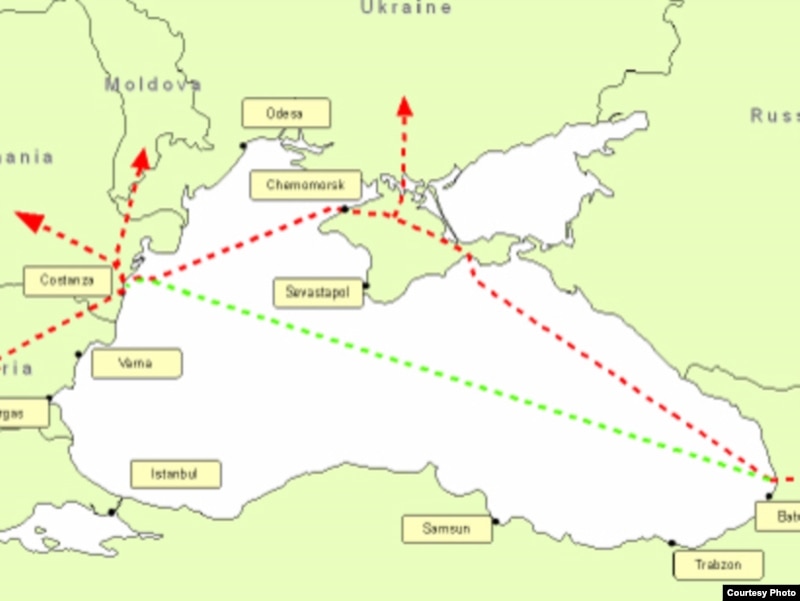
6. John Roberts at Platts reports that the Georgian government signed a memorandum of understanding with the GUEU-White Stream Pipeline Company to support a natural gas pipeline which would pass through Georgia, the Black Sea, to Romania and onwards towards the rest of Europe. Romania has yet to sign an MOU in support of the project. White Stream corporate development director Giorgi Vashakmadze told Platts that "It will take us five years to start laying the first pipeline after we have completed all the necessary agreements," and that the planned pipeline is meant to be complementary with the Nabucco pipeline. Alternatively, the pipeline might pass through the Ukraine, though recent events would seem to make that an unlikely choice. The two proposed paths of the pipeline are indicated in the map below.


7. UPI reports that IRNA reported that Iranian Oil Minister Gholamhossein Nozari in talks with his Syrian counterpart, Sufian Allaw, in Damascus argued that natural gas export deals to Syria should be concluded as quickly as possible. "'Iran will transfer gas to Greece and Italy through Iraq, Syria and the Mediterranean Sea,' Nozari said." The Turkish Weekly reported on Iran's case for an alternative to the Nabucco Pipeline today:
"Safe transit routes will be determined based on political and strategic realities. The Nabucco pipeline will pass through Turkey and the Balkans. The Persian Pipeline might pass through Iraq, Syria and the Mediterranean to Europe. These alternative routes will be discussed by the buyers, suppliers and transit countries."
Up until now, the Persian Pipeline, aka Pars Pipeline, has been envisioned as passing through Bazargan, a city on the Turkish border--completely bypassing Syria and Iraq. Bazargan is about where I indicate on the map below.


The "haste" so "urged" sounds to me like Iran is beginning to get worried about the fact of potential Russian cooperation with US efforts to put the kibosh on the nuclear power program.

8. Shamal Aqrawi and Ahmed Rasheed at Reuters report that South Korea's SK Energy has yet to withdraw from contracts with the Kurdish Regional Government, which Baghdad insists it must cancel in order to be approved as a bidder for the central government's oil concessions.

9. Zhou Xin at Reuters reports that the official Chinese PMI for March indicates expansion, moving from 49.0 in February to 52.4 in March.
"'The continuous increase in PMI, along with positive signs I can witness from different places, showed that the Chinese economy may have started to warm up,' Ma Jiantang, the head of China's National Bureau of Statistics, told the China Information Daily, the statistics bureau's mouthpiece."
The official index stands in contrast to the private CLSA China PMI, which fell to 44.8 in March, down from 45.1 in February--see Daily Sources 4/1 #6. (Readings above 50 imply expansion; below 50 implies contraction.)

10. Robert Campbell at Reuters reports that in a report delivered to the US Congress on Wednesday states that the Mexican finance ministry expects crude oil production to fall below 2.5 mb/d in 2011.
"The finance ministry estimated oil exports would drop to 1.125 mb/d in 2010 from 1.370 mb/d forecast for this year."
11. Jens Erik Gould at Bloomberg reports that Manuel Marrero Faz, senior oil adviser at Cuba's Ministry of Basic Industries, said that the country would welcome US participation in its offshore oil fields were the embargo ended.
"We are open. ... We’re very close to each other. We’re neighbors. Why not do business?"
"The US Geological Survey estimates Cuba’s North Basin region, one of three offshore areas believed to hold oil, has 4.6 billion barrels." To put that in context, 4.6 billion barrels is about 55 days of global oil consumption (at a rate of 84 mb/d).

12. Barry Ritholtz at the Big Picture reports that the non-farm payroll employment number out today from the Bureau of Labor Statistics fell by 663,000 in March, bringing the headline unemployment number to 8.5%, from 8.1% in February. Calculated Risk plots the trajectory of the decline in employment against the post war recessions in a useful graph:


The U-6 number, or total unemployed plus the total of "marginally attached" workers plus total employed part-time for economic reasons has reached 15.6% in March from 14.8% in February.

13. Rebecca Wilder at News N Economics has a post showing that although the number of bank failures due to this financial crisis have been high, at 46, the number is not especially large historically-speaking, "the Fed and the Treasury likely enabled the economy to skirt a depression-sized disaster."


She argues that the financial situation will require consolidation, sooner or later. Well worth a look.

14. James Hamilton at UCSD has authored a very important report for the Brookings Institution which shows--to his own disbelief, evidently--that the oil shock of 2008 was a primary cause of the current financial crisis. As Justin Lahart's post on the piece in Real Time Economics summarizes:
"[Maybe] what happened to oil prices had something to do with credit markets seizing up. The housing bubble saw people of lesser means traveling further afield to buy homes. That gave them long commutes that they were able to afford when gas was $2 a gallon, but maybe they couldn’t at $3. Housing in the exurbs got hit hardest, and one reason why is that high gasoline prices made it hard for people to lived in them to keep up with their mortgage payments, and hard for them to sell their homes without taking a steep loss. In some meaningful way, that has to have contributed to mortgage problems."
Hamilton's own summary is here. The report--quite long at 70 pages, is here.

15. Charles Abbott and Russ Blinch at Reuters reported yesterday that 32.2 million Americans received food stamps in January, or 1 in 10, 10%.
"The average benefit was $112.82 per person in January. ... Food stamp benefits get a temporary 13% increase, beginning with this month, under the economic stimulus law signed by President Barack Obama. The increase equals $80 a month for a household of four."
Seriously worrisome stuff. I personally feel--strongly--that more should be offered ... especially given that food stamps produce the largest "multiplier" of all stimulus measures, as they must be spent in a set time--see Menzie Chinn's post on October 27, 2008. Food security is the most critical measure of stability, always. As Bob Marley put it, "A hungry man is an angry man."

Wednesday, March 18, 2009

Daily Sources 3/18

1. Krishna Guha, Bertrand Benoit, Chris Giles and Daniel Pimlott at the Financial Times report that the IMF will reduce today its forecast for global GDP in 2009 to a contraction of 0.6%.
"The eurozone economy was forecast to contract by 3.2% in 2009, [Ms. Ter-Minassian, an adviser to IMF managing director Dominique Strauss-Kahn] said, against the earlier forecast of a 2% decline. The US would shrink by 2.6% (1.6%), and Japan 5% (2.6%), making it the worst-hit big economy. The IMF in Washington said the figures cited by Ms Ter-Minassian were 'unofficial' and 'out of date'."
In early March the IMF began indicating that a downward revision was under way--see Daily Sources 3/3 #1.

2. Philip P. Pan and Karen DeYoung at the Washington Post report that many Russia analysts believe that Moscow is signaling interest in a deal on Iran.
"In a meeting last week with a bipartisan commission studying US policy toward Russia, President Dmitry Medvedev expressed alarm in 'very graphic language' over Iran's successful test launch of a satellite last month, linking it to Tehran's nuclear program, said Dmitri Simes, director of the commission.

'Medvedev said it demonstrated how far-reaching Iran's nuclear ambitions are, and that he was very concerned,' said Simes, who is also president of the Nixon Center in Washington. 'He felt it was a clear challenge to both Russian and American interests and said he would like both countries to work on this challenge together.'"
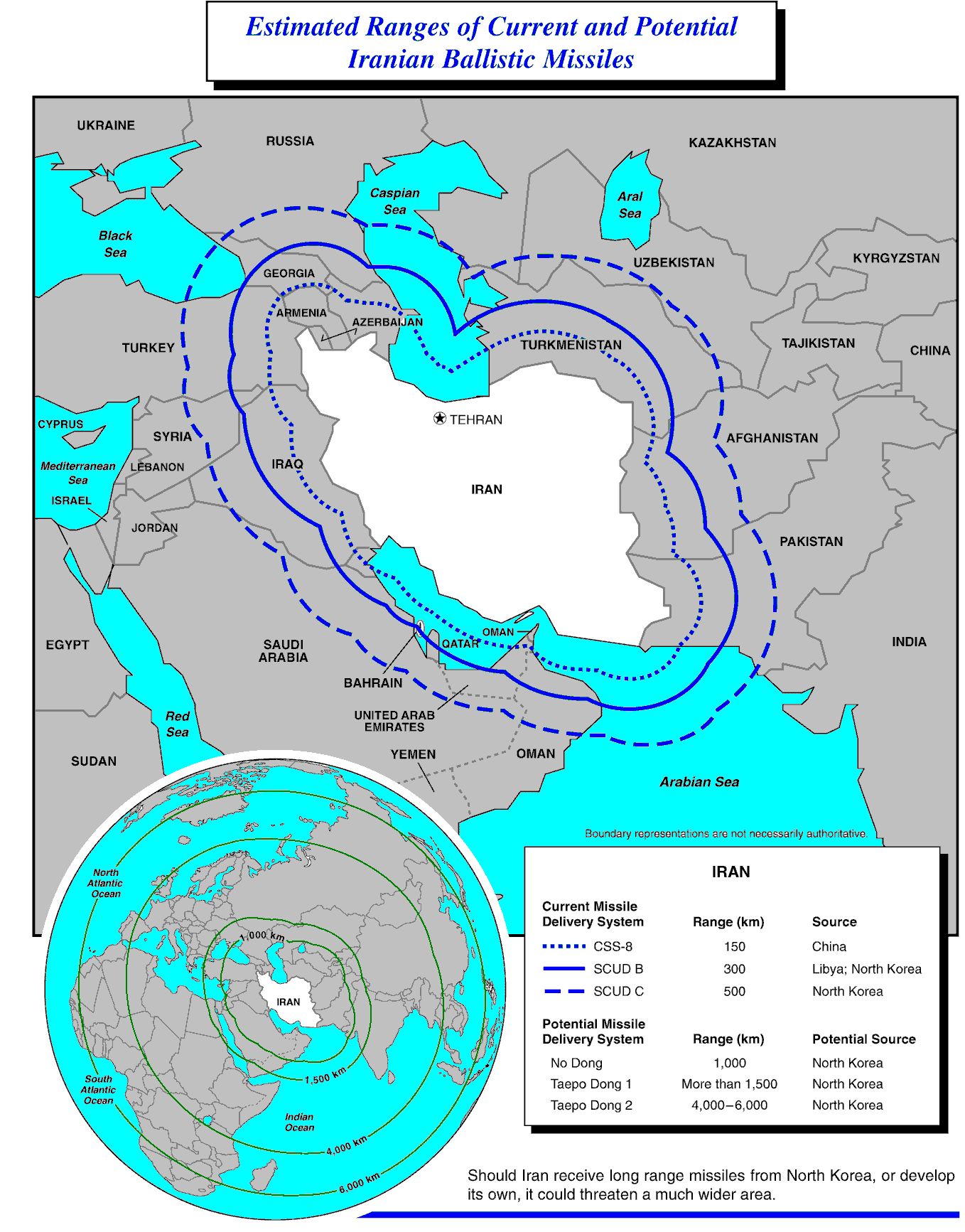
The Federation of American Scientists provide the following illustration of Iranian missile capabilities.


Satellite launches reportedly use technologies required for the development of ICBMs. In November, Iran claimed it had successfully tested missiles with a range of 1,200 miles, which as you can see from the map does not quite put Moscow in range--and obviously is even further from presenting any potential threat to, say, Warsaw. That said, it plainly makes a lot of sense that Iran's perennial missile tests would have the--likely unintended--effect of ruffling Moscow's feathers, given that a nuclear armed Tehran which could reach Moscow is definitely not in their interests.
"Alexander Pikayev, a top arms control scholar in Moscow, said Russian policy toward Iran will be determined by competing interest groups and political factions. Defense manufacturers and the atomic energy industry oppose tougher sanctions, for example, but the United States could win over the latter by reviving a bilateral pact on civilian nuclear cooperation that was frozen after the Georgian war, he said.

Pikayev said Medvedev may be more likely to support sanctions because a breakthrough in US relations would boost his political stature at home and set him apart from his powerful predecessor, Prime Minister Vladimir Putin. Putin might resist, but his relationship with Iranian President Mahmoud Ahmadinejad is said to be strained and he surprised Russia's foreign policy establishment by endorsing earlier U.N. sanctions, Pikayev said."
Frankly, I doubt this assessment--I think the notion of a nuclear armed Iran with the capability of hitting Moscow will outweigh the economic considerations involved in putting the kibosh on nuclear power cooperation with Iran. Indeed, it is hard to see many places in which Iranian and Russian interests coincide. Perhaps they do in terms of energy pricing, but Iran's potential as an alternative source of gas for European industry is probably a critical item in Moscow's long term thinking. And as the weekend's events proved, Russia still regards oil production coordination with OPEC as being less in its interest than good terms with Europe--and producing at full bore to claim all price increases produced by the cartel. (A policy which Iran appears to follow with respect to the organization's production quotas as well, ironically enough.)

3. The Associated Press reports that North Korea yesterday gave the organizations distributing US food aid inside that country till the end of March to leave--rejecting all future food aid.

4. Judy Dempsey at the New York Times yesterday reported that Russia signed two natural gas deals with Hungary yesterday. One deal signed last week has the Budapest and the Hungarian Development Bank to finance the South Stream project on Hungarian soil.


The other deal has Gazprom and MOL establishing a 1.3 billion cubic meters storage facility in Hungary. To make sense of that, here is a map that Jérôme Guillet drew up of Ukraine's gas infrastructure--note the three asterixes to the West, which represent gas storage facilities.


As Guillet pointed out in a piece for the European Tribune:
"Storage capacity is important in the gas business, as demand is seasonal (there is more in winter for heating) and can almost triple in Europe between summer and winter. If you can pre-position your gas near the markets when transport capacity becomes strained, you can extract a lot more value from that seasonality. The storage facilities near the Hungarian and Slovak borders were ideal for Soviet exports, but now they are in Ukrainian hands, and thus Russia must have a minimum of technical cooperation from the Ukrainians, who physically control and operate these facilities, not to lose a lot of money in their export markets. More, unavoidable leverage for the Ukrainians."
Hungarian Prime Minister Ferenc Gyurcsany's plea for a regional aid package from the EU was turned down last week. He has been a supporter of the Nabucco Pipeline, but questions of sourcing the gas (which would likely have to come from Iran) and project financing continue to bedevil the project.

5. Edward Hugh at Fistful of Euros posts that Poland's Central Statistical Office has released its industrial output data for February showing a 14.3% annual rate of decline in February, following a revised annual rate of decline of 15.3% in January. Output was up 2.7% in February from January however. Hugh provides a helpful graph of industrial production for the last two years:


Hugh points out that industrial production is on the decline across the spectrum of export-oriented Eastern European economies, warning against too much disambiguation between them. Worth reading and mercifully short.

6. Bettina Wassener at the New York Times reports that the World Bank lowered its forecast for Chinese growth in GDP for 2009 to 6.5%. 6.5%, though quite high by global standards just now, is well below the Chinese principle of "bao ba"--or "protect the 8"--below which conventional wisdom holds that Beijing will begin to see significant, read destabilizing, social unrest. Kevin Hamlin at Bloomberg reports that bank sees signs China's economy is stabilizing faster than the rest of the world.
"'The government’s stimulus is working,' said Louis Kuijs, a senior economist at the World Bank in Beijing. 'China’s fundamentals are strong enough to ride out this storm.'"
Meanwhile, Andrew Batson at China Journal helpfully translated the complete text of Chinese Ministry of Commerce’s statement announcing its decision to block Coca Cola’s proposed acquisition of China Huiyuan Juice Group Ltd. Key excerpt:
"Through its review, the Ministry of Commerce found that this concentration will have an adverse impact on competition. After the concentration is completed, Coca-Cola could use its market dominance in carbonated soft drinks to limit competition in the market for juice through tying, bundling or other exclusive transactions, resulting in consumers being forced to accept higher prices and reduced variety. At the same time, because brands can restrict entry to the market, it would be hard for the threat of potential competition to remove the restrictive effect on competition. In addition, the concentration will also reduce the room for small and medium-sized juice companies to survive, and will have an adverse effect on the structure of competition in China’s juice market."
The notion that dominance in the carbonated drink market could adversely affect competition in the juice market is unlikely to please most corporate headquarters. The fact that the Ministry of Commerce took stock of the market power of brands is interesting given that some have written that the primary value-addition that Western corporations bring to emerging markets is, well, brands. Meanwhile, the Sydney Morning Herald reports that shares in Rio Tinto have taken a beating on fears that the deal with Chinalco taking a 18% stake in the company.
"'[The 8.7% decline in share price] is [due to] the uncertainty surrounding the Chinalco deal, there has been a bit of talk out today that there is a lot of opposition to the deal and this is what's weighing on it,' MF Global senior trader Anthony Anderson said.

'The FIRB extension and the senate inquiry into foreign investment is adding to the uncertainty.'

The mounting political concern follows a decision by the Foreign Investment Review Board (FIRB) to extend its review to 90 days and initiate a more in-depth examination of the transaction, after the initial 30-day evaluation period closed on Monday.

The transaction, which has been backed by the Rio Tinto board, will also allow Chinalco to appoint two new non-executive board members to the global miners board."
(h/t Emmanuel at International Political Economy Zone.)

7. Platts reports that Italian major Eni has signed a major cooperation agreement with Pakistan to develop major projects all along the oil and gas product chain.
"The agreement also allows Eni to become a strategic partner in developing the oil and gas sector in Pakistan and to enter fields which are currently managed by state-run oil companies."
8. David E. Sanger and Eric Schmitt at the New York Times reports that "two of the high-level reports on Pakistan and Afghanistan that have been forwarded to the White House in recent weeks have called for broadening the target area to include a major insurgent sanctuary in and around the city of Quetta."


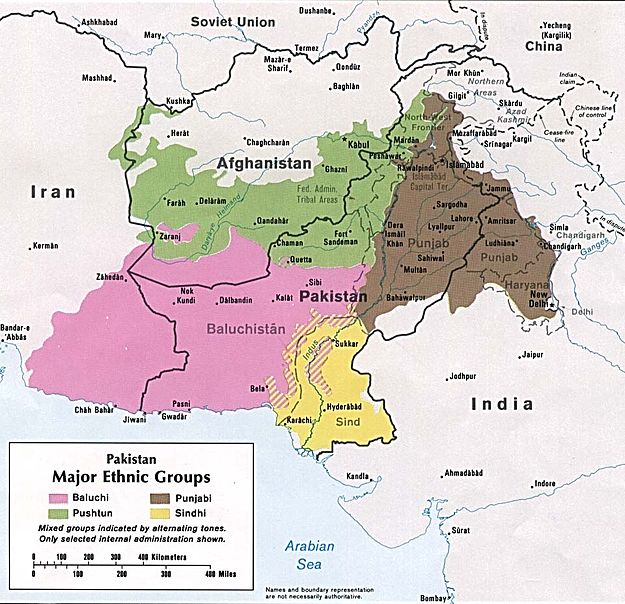
Baluchistan has separatist tendencies and is in the middle of a small bore separatist struggle, both in Pakistan and Iran.


Note that Baluchis can be found in southern Afghanistan where most of that country's opium production--and violence--is concentrated.

9. Galrahn at Information Dissemination notes that due to the Obama Administration's review of all military ties, GE has been asked to freeze work on turbines it was to provide the Indian navy for three Shivalik-class stealth frigates. Though I strongly disagree with the way Galrahn frames the story, I think it is an important data point. Clearly the US is likely to approve continued sales of engines to the Indian Navy.

10. Maher Chmaytelli and Juan Pablo Spinetto at Bloomberg report that Shokri Ghanem, chairman of Libya’s state-run National Oil Corp., told journalists today in Vienna that Libya will exercise its right to buy Calgary-based Verenex Energy Inc., which would effectively block CNPC's bid for the E&P company.
"Verenex has assets in Libya that are worth 'hundreds of millions' of dollars, Ghanem said in an interview with Bloomberg on March 16."
It is an interesting signal given China's Africa Policy announced in 2006 and Ghaddafi's recent selection as chair of the African Union--see Daily Sources 2/3 #9.

11. Justin Stares at Lloyd's List reports that the Bangladeshi High Court ordered the closure of all ship breaking yards operating without environmental clearance.
"Industry sources said they were 'staggered' by the ruling, which if confirmed will close down one of the world’s largest breaking industries just as scrapping activity peaks.

'None of the 36 shipbreaking yards in Chittagong currently have an environmental clearance,' said the NGO Platform on Shipbreaking. 'The decision therefore effectively shuts down an industry that has been highly criticized by environmentalists and human rights activists for many years for operating with complete disregard for the law, human health and the environment.'

The scrapping industry, which claims to employ 250,000 either directly or indirectly in Bangladesh, is expected to appeal.

The court was ruling on a petition filed by the Bangladesh Environmental Lawyers Association. Judges ordered that no ship on the Greenpeace 'dangerous ships list' be allowed into the country, according to reports by the platform and local media."
It is a decision bound to amplify the effects of the financial crisis, economically-speaking ... it seems that probity only comes when it will hurt the most, ironically. Note the significance of the courts in the Muslim-majority nation. Well-worth reading in full.

12. Nasreen Seria at Bloomberg reports that the South African Reserve Bank's Monetary Policy Committee will meet next week and accelerate its schedule to monthly meetings for the rest of the year from planned meetings every two months.
"Global economic conditions 'are getting worse' and the 'changed' environment requires the MPC to meet more regularly, Governor Tito Mboweni said in a phone interview from Pretoria today."
13. Victor L. Simpson at the Associated Press reports that in Cameroon Pope Benedict XVI reiterated yesterday that condoms were not an answer to the fight on AIDS--"You can't resolve it with the distribution of condoms. ... On the contrary, it increases the problem." I would note that Africa is one region where Catholicism--and more conservative Catholicism--is growing quickly. However, perhaps the one really impressive and compellingly moral US foreign policy triumph under the Bush Administration was the huge increase in aid to Africa in terms of the fight on AIDS, including condoms and retro-viral drugs. The people in Africa are well aware of how these aid programs have reduced the mortality rate in the continent. The notion that condoms are against life and a concession to death, and thus amoral, as opposed to a way to protect life and thus moral, will not, I believe, make much sense to them. Pope Benedict XVI appears to have a tin ear when it comes to husbanding the moral authority of the Church.

14. The Port of Long Beach recently posted its numbers for February, showing a 40% decline in container traffic from February 2008:


So far in 2009 the port has recorded a 20.2% decline in traffic. The Port of Marseilles, France, also recently posted its report for February, showing a 21% annual decline in total traffic. It registered a 16% decline from the traffic seen in January:


Hydrocarbons account for about 74% of Marseilles' traffic and it lost about 12% in volume from the year before. The grim trade data continue their march.

15. Bob Willis at Bloomberg reports that the consumer price index rose by 0.4% in February from January. Excluding fuel and food, prices climbed by 0.2% from the month prior. On an annual basis, the consumer price index rose by 0.2%, up from the 0% annual rate seen in January. Excluding fuel and food, prices climbed by an annual rate of 1.8% in February, up from a 1.7% annual rate of increase seen in January.
"Energy expenses increased 3.3%, led by an 8.3% increase in gasoline prices. Still, the fuel’s cost is down 36% from a year earlier.

Food prices, which account for about a fifth of the CPI, fell 0.1%, the first drop since April 2006."
16. The Federal Open Market Committee met today and decided to keep the federal funds rate unchanged at 0-.25%. Excerpt from its press release:
"To provide greater support to mortgage lending and housing markets, the Committee decided today to increase the size of the Federal Reserve’s balance sheet further by purchasing up to an additional $750 billion of agency mortgage-backed securities, bringing its total purchases of these securities to up to $1.25 trillion this year, and to increase its purchases of agency debt this year by up to $100 billion to a total of up to $200 billion. Moreover, to help improve conditions in private credit markets, the Committee decided to purchase up to $300 billion of longer-term Treasury securities over the next six months."
This follows the latest Treasury International Capital data which shows, courtesy of Brad Setser at Follow the Money, that foreign purchases of long term treasuries have collapsed:


Foreign government demand for US agency debt fell off a cliff late last year and purchases were even banned by Moscow just the other week. Meanwhile, Jon Hilsenrath at Real Time Economics reports that the Fed's quarterly survey of banks shows that during the week of February 2-6, banks extended $85.6 billion in credit to businesses, an increase of 13% from the first quarter of 2008--per JP Morgan Chase economist Michael Feroli:


17. The EIA reported that crude oil stocks built by 2 million barrels in the week ended March 13 to 353.3 million barrels, well above the historical average for this time of year, but still below the most recent peak of 354 million barrels seen on June 29, 2007. According to a survey by Bloomberg, analysts had expected a 1.5 million barrel build. Gasoline stocks grew by 3.2 million barrels, are near the top of the historical average. Analysts had expected a 1.5 million barrel draw. Distillates stocks grew by 100,000 barrels, are well above the five year historical average range as well as counter-cyclical, and versus analyst expectations of a 1 million barrel build. Taken in isolation, the data would be bearish on the price of crude.