Showing posts with label egypt. Show all posts

Wednesday, July 28, 2010

Daily Sources 7/28

CHINA HOUSING BUBBLE TO UNDERMINE ECONOMY

Yongheng Deng, Joseph Gyourko and Jing Wu at Vox EU argue that the Chinese housing bubble is likely to undermine the entire economy. Richard Smith at naked capitalism argues that the Chinese banking system is likely to go bust.

NO NEW UK COAL FIRED POWER PLANTS WITHOUT CARBON CAPTURE AND STORAGE TECHNOLOGY

Fiona Harvey at the Financial Times reports that the UK government indicated Tuesday that no new coal-fired power plants can be built without carbon capture and storage technology.
"[Energy Secretary] Mr [Chris] Huhne predicted: 'We will see the first new nuclear power station on track for 2018.'"
JAPAN TO BUILD UP SUBMARINE FLEET

Greg Scoblete at the Compass reports that Japan is to increase its submarine fleet for the first time in 36 years. The plan is apparently to counter the Chinese build-up.

JAPAN'S REFINING UTILIZATION HITS A 10 WEEK HIGH

Yuji Okada at Bloomberg reports that refining utilization hit a 10 week high as Japanese companies restarted idled plants. Capacity utilization hit 75%. A hotter than usual Summer may soften the dent in margins.

JORDAN'S KING ABDULLAH II AND ISRAEL'S NETANYAHU MEET

CNN reports that Jordan's King Abdullah II and Israel's Netanyahu are meeting to discuss the Israeli Palestinian peace process in a regional context.

SAUDI ARABIA'S HOUSING MARKET READY TO TAKE OFF?

Frontier Markets reports that it is.

IS EGYPT TOO BIG TO FAIL?

Michael Collins Dunn at the MEI Editor's Blog considers whether Egypt is too big to fail and if so how that has affected the political culture there.

BANGLADESH TO IMPORT 250 MW FROM INDIA STARTING 2012

UPI reports that India and Bangladesh have concluded a deal for Bangladesh to import 250 megawatts of electricity from India starting 2012.
"Under the deal, state-owned Power Grid Corporation of India Ltd. will invest and construct 50 miles of transmission line, which it will own, operate and maintain. PGCIL will recover the construction costs under a fixed rate over 35 years."


NIGERIAN OIL RESERVES DOWN 4.8%

Platts reports that Nigeria's oil reserves are down 4.8% on the year due to decreased exploration efforts by oil companies in the region. The oil companies are leery of continuing exploration efforts due to legislation the Nigerian government is considering which would leave little room for companies to profit from investments.

INVESTMENT IN DURABLE GOODS UP

Timothy R. Homan at Bloomberg reports that investment in non-military capital equipment climbed 0.6% last month after a revised upwards jump of 4.6% in May.
"'Business investment remains the bright spot in an otherwise dull economic outlook,' said Jay Feldman, an economist at Credit Suisse in New York. 'Corporations have actually underinvested quite dramatically in recent years and, to some extent, we are catching up.'"
CRUDE OIL STOCKS JUMP 7.2 MILLION BARRELS

The EIA reported that crude oil stocks jumped by 7.2 million barrels the week ended July 23rd to 360.8 million barrels. Gasoline stocks climbed by 0.1 million barrels and distillate stocks grew by 0.9 million barrels. Refinery utilization was at 90.6%. The price of gasoline climbed 2.7 cents to 274.9 cents for the week ended July 26th.

Wednesday, July 7, 2010

Daily Sources 7/7

1. CHINA'S US TREASURY HOLDINGS UP $5 BILLION IN APRIL

Bloomberg reports that China's State Administration of Foreign Exchange urged markets to not consider changes in US treasuries political statements. It further indicated that gold is not likely to become a major part of its reserves holdings because of its volatility and lack of interest payments. Some think this is just Beijing talking its book so it can buy further gold at depressed prices. Last year Beijing doubled its gold holdings.

2. FREE EXCHANGE HOSTS A NEAT INTERACTIVE MAP OF THE EU


3. NEW POLISH PRESIDENT AN EUROPEANIST

Greg Scoblete at Real Clear World reports that the new Polish President is a committed Europeanist as opposed to his predecessor, who was a committed Atlanticist.

4. US RHETORIC IN GEORGIA DESIGNED TO CALM FEARS IN T'BLISI

Mary Beth Sheridan at the Washington Post reports that in her visit to Georgia, Secretary Clinton indicated the US's opposition to Russia's "invasion and occupation" of Georgia. Prime Minister Putin took issue with the characterization of the Secretary of State, calling the Russian troop presence an effort to liberate the Abkhazians and South Ossetians.

5. DRILLING IN GREENLAND'S ARCTIC WATERS BEGAN LAST WEEK

Kate MacKenzie at FT Energy Source reports that deep water drilling in Greenland's Arctic waters began last week. And so the race for Arctic natural resources begins.


6. AUSTRALIA KEEPS BENCHMARK RATE AT 4.5%

Jacob Greber at Bloomberg reports that Central bank Governor Glenn Stevens yesterday left the benchmark cash rate at 4.5% for a second month. Australia's central bank had raised interest rates six times since October when it stood at a low of 3%. Inflation is expected to increase to more than 3% in the coming months.

7. INDIA DEPLOYS TROOPS IN KASHMIR IN EFFORT TO SUPPRESS UNREST

Lydia Polgreen at the New York Times reports that the Indian Army has deployed troops in Kashmir in an effort to calm the region after large street protests resulted in paramilitary units firing into the crowds.

8. RUMORS THAT MUBARAK'S HEALTH IS IN SERIOUS DECLINE

Michael Collins Dunn at the MEI Editor's Blog reports that Ha'aretz has picked up a rumor from a London-based daily that Mubarak's trip to France was for medical reasons. The story is that Mubarak's health is in serious decline and that his son is in line for succession.

9. OBAMA EXPECTS NETANYAHU TO BEGIN TALKS WITH PALESTINIANS BEFORE MORATORIUM ON NEW SETTLEMENT BUILDING EXPIRES IN SEPTEMBER

Sheryl Gay Stolberg and Mark Landler at the New York Times report.

10. BANK CARD DELINQUENCIES FALL BELOW 4%; SERVICE SECTOR NOT ADDING JOBS QUICKLY ENOUGH

In a good sign for the economy, Darrell A. Hughes at Real Time Economics reports that bank credit-card delinquencies dropped below 4% for the first time in eight years.
[ABA Chief Economist James] Chessen said the anticipated slow growth is unlikely to cause delinquencies to rise significantly, but there could be some impact. 'Until we get a sustained level of new jobs in this economy, we’re not going to see delinquencies fall to very low levels,' he said.
In the meantime, Phil Izzo at Real Time Economics reports that the Institute for Supply Management subindex for employment fell below 50, indicating a fall in employment.


11. THE EIA REPORTS THAT CRUDE STORAGE IS DOWN 2 MILLION BARRELS, STILL 12.9 MILLION MORE IN STORAGE THAN LAST YEAR

The EIA reports that crude stocks fell to 363.1 million barrels, down 2 million from last week, up 12.9 million from last year. Gasoline stocks rose by half a million while diesel stocks rose 2.5 million. Average US gasoline prices rose by 1.4 cents to 275.7 cents the week ended June 28. In the week ended June 25, refinery capacity utilization stood at 88.4%, down 1% from the week previous.

Wednesday, July 15, 2009

Daily Sources 7/15

1. PETROCHINA'S REFINING PROFITS AT RECORD ON PRICE LIBERALIZATIONS

Wang Ying at Bloomberg reports that PetroChina increased its refining profits in the first half of 2009 on the back of the revised pricing system which allows refiners to pass on the cost of production to consumers. Gasoline and diesel are, as a result, considerably more expensive in China than they are, say, in the US. I suspect it will go some ways to dampen demand. Meanwhile, Beijing made an example of the former ex-Chairman of Sinopec, Winnie Lee at Platts reports that Chen Tonghai was sentenced to death for bribery, but given a two-year reprieve.
"The court said Chen abused his authority ... to pursue material gains for third parties in areas related to business operation, transfer of land, and contract procurement, according to the Xinhua report.

The two-year reprieve means that Chen's sentence will be commuted to life imprisonment if he commits no further crime while in jail.

Chen resigned from his posts as the head of China Petrochemical Corporation Group and Sinopec Corporation in June 2007."
2. SOUTH KOREAN COURT HEARS PROPERTY RIGHTS CLAIM BY NORTH KOREAN CITIZENS

Su-Hyun Lee at the New York Times reports that a South Korean court has for the first time decided to hear a case brought by North Korean citizens attempting to establish property rights in the south.
"Four North Korean brothers and sisters have sued their late father’s second wife and that couple’s four children in South Korea for a share of an inheritance from the estate of the father, a successful doctor.

The suit claims at least a quarter of the father’s land and other property, worth about $8 million. He left North Korea for the South with his eldest daughter during the 1950-53 Korean War and never returned. In 1959, he reported that his first wife had died and married a South Korean woman, with whom he had four more children. He died in 1987.

Family members in the south, including the sister who came there with the father, asked that only the family name, Yoon, be used, to protect the relatives in the North and the privacy of those in the south."
Although this is the first suit by North Korean citizens to be accepted by a South Korean court, the right of North Koreans to sue in South Korean courts has already been established by rulings of "the Supreme Court and the Constitution"--though I am left unsure as to exactly what kind of complaint was addressed by the courts establishing this in the absence of a North Korean plaintiff. In any case, the smooth handling of the case may well reassure some of the anxieties of both Northerners and Southerners.

3. EUROPEAN CASH FOR CLUNKERS PLAN MAY BE REVERSING DIESELIZATION

Tim Worledge at the Barrel makes the especially interesting observation that Europe's "cash for clunkers" program--designed to slow the steep fall in auto sales--has pushed sales of gasoline-driven cars up above diesel-driven ones.
"According to the European Automobile Manufacturers' Association, ACEA, diesel comprised around 53% of all new car sales in 2007 and 2008, before the scrappage schemes were introduced.

For the first five months of this year, diesel sales fell to 46.3% of the total, apparently marking a reversal in the 20-year 'dieselization' of Europe."
"This threat to diesel's dominance represents a seismic shift.

Bolstered by favorable tax regimes, the growing use of diesel in Europe has done more than any other trend to spur refining investment and shape global trading patterns in the oil market. It has been clear in recent years that Europe is very long gasoline, with the surplus largely shipped to the US, and is short diesel, which it takes from anywhere it can get it.

Within Europe, and further afield, this has spawned massive investment programs as refinery kit designed to meet gasoline demand is re-aligned, augmented and upgraded to produce ever greater volumes of diesel."
"It's the same story in France, regarded as the bastion of diesel and birthplace of the engine's inventor Rudolf. In 2008, diesel sales peaked at a whacking 77.3% of all new cars, but this has now fallen to 71.6%.

Whether this is a blip, a temporary stumble along the road to full European dieselization, remains to be seen, although it's worth noting that even those diesel cars that are being purchased are burning up to 48% less of what is an increasingly bio-blended road fuel."
However, if it does represent a long-term reverse in trend, the window for diesel arbitrage to Europe will mostly be closed, meaning that there will be no outlet for excess diesel supply in the US, which would likely result in another retooling of US capacity back to full gasoline maximization.

4. EUROZONE INDUSTRIAL PRODUCTION UP 0.6% IN MAY MOM, DOWN 17% YOY

Gerrit Wiesmann at the Financial Times reports that eurozone industrial production rose by 0.6% in May from April, though it was still down 17% from May 2008.
"Strong monthly increases reported by Germany, France and Italy in recent days had led economists to expect a bounce of 1% in May. However, these hopes were dashed by output decreases in Spain and some smaller countries."
5. RUSSIAN RAILWAYS RECEIVES $500 MILLION LOAN FROM THE EBRD, LARGEST LOAN IN THE BANK'S HISTORY

Paul Abelsky and Denis Maternovsky at Bloomberg report that OAO Russian Railways has borrowed from the European Bank for Reconstruction and Development $500 million over 10 years in what is the largest loan ever provided by the bank.
"The deal is the London-based development bank’s largest single investment since it was founded in 1991 to fund infrastructure in former communist nations in Europe and central Asia, the EBRD said in a statement today. Moscow-based Russian Railways sold 90 billion rubles ($2.8 billion) of domestic bonds this year, more than any other company in the country, to finance its investment program."
"Russian Railways, the country’s biggest commercial employer, is seeking fresh funds after posting a loss of 17.1 billion rubles ($534 million) in the first quarter. Rail cargo shipments fell an annual 23% in the first half and may drop 19% in the year, Vladimir Yakunin, the company’s chief executive officer, said July 6.

Russian Railways cut annual spending by more than 34%, to 252 billion rubles, this year after the government reduced financial support for the company and domestic demand for its services waned, Yakunin said in an interview published today in the Vedomosti newspaper. Railroads account for about 85% of Russia’s total cargo transport capacity, according to VTB Capital data.

EBRD aims to invest a minimum of $3 billion in Russia this year, President Thomas Mirow said last month at an economic forum in St. Petersburg."
6. BULGARIA TO GET SPUR FROM THE ITGI PIPELINE

Kerin Hope and Theodor Troev at the Financial Times reports that Greek, Bulgarian, and Turkish companies signed an agreement to build a spur from the ITGI pipeline carrying natural gas from Azerbaijan to Turkey and Greece and which is to be extended to Italy. The spur would have a 3-5 bcm/year capacity and is scheduled to be completed by 2012 at a cost of €120 million (~ $167 million).

"The project highlights the new spirit of co-operation between Athens and Sofia. The Balkan neighbors have a history of bilateral disputes, from arguments over sharing water resources to stake-holdings in a proposed cross-border oil pipeline.

Both countries are keen to become regional transit hubs for gas pipelines from central Asia and the Middle East.

Bulgaria signed up on Monday to join Nabucco and, like Greece, is also a partner in the proposed South Stream pipeline to bring Russian gas to the EU under the Black Sea."
Sofia has secured about €45 million in EU grants to fund the project. According to a 2007 Edison press release, ITGI as it stands has a capacity of 11.5 bcm/year of which Italy had been slated to receive, following the completion of the final section also in 2012, 8 bcm/year. According to a story featured on the Azerbaijan Business Center, Gian Luigi Mascia, the Italian Ambassador to Azerbaijan, said in Baku today that
"The gas pipeline is designed only for Azeri gas. Its overall capacity will be up to 14 bcm a year, including 1 bcm to be delivered to Greece, 10 bcm to Italy and 1-3 bcm to Bulgaria."


Bulgaria responded to the Russo-Ukrainian gas transit dispute in January by re-starting a nuclear reactor despite it violating the terms for its accession to the EU--see Daily Sources 1/15 #1.

7. ISRAEL HAVING TOUGHER TIME IN EUROPE, ISREALI WARSHIPS PASS THROUGH SUEZ

Juan Cole has an interesting analysis suggesting that Israel is more on the outs with Europe than usual. He notes that Javier Solana called for the recognition of a "Pelstinian state by the world community by a date certain, regardless of the Israeli position" suggesting that he is more or less Europe's foreign minister. (Much much less, actually, though important, and certainly an interesting development. The analysis contains a goodly share of wishful thinking, on Prof. Cole's part, but it is still interesting and what he records may well be a sign of a sharper move in the European capitals.) Meanwhile, Michael Collins Dunn at the MEI's Editor's Blog notes that two Israeli corvettes (warships slightly smaller than frigates) have been allowed, by Cairo, to pass through the Suez. He notes:
"Warship transits, while guaranteed under the Israeli-Egyptian peace treaty, are rare, given the fact that Israel is concerned about security. As anyone who has seen the canal knows, it is narrow, and warships passing are easily viewed by civilians and others along its banks."
8. MEND ANNOUNCES CEASEFIRE, QUICKLY THREATENS TO END IT

Platts reports that MEND earlier Wednesday announced a ceasefire following the release of its leader--Henry Okah--yesterday, but has since threatened to call it off, accusing the government of using it as an opportunity to ramp up its military presence in the region.

9. VENEZUELAN OIL MINISTER SAYS ALL PDVSA EMPLOYEES MUST JOIN "SOCIALIST COMMITTEES"

Marianna Parraga at Reuters reports that Venezuelan oil minister Rafael Ramirez yesterday told a rally of workers who had been employed by PdVSA following the nationalization of oil services firms operating in the country that
"By now, there should not be a single counter-revolutionary in the heart of our company, our industry. There cannot be a single PdVSA installation where socialist committees do not exist. Whoever is not in a committee will be suspected of conspiring against the revolution."
"Socialist committees are loosely defined political groups often organized by Chávez's Socialist Party."

10. US COMMERCIAL CRUDE STOCKS DOWN, GASOLINE & DISTILLATE STOCKS UP, REFINERY UTILIZATION UP, BUT US INDUSTRIAL PRODUCTION DOWN 0.4% IN JUNE FROM MAY, 13.6% YOY, CONSUMER PRICES UP 0.7% NEARLY ALL ON ENERGY COSTS, WHILE US WAGES, ADJUSTED FOR INFLATION, FALL 1.2%

The EIA today reported that commercial crude stockpiles fell by 2.8 million barrels to 344.5 million barrels in the week ended July 10. The amount is storage is still above the five year historical range for this time of year, but the draw was for more than the 2.1 million barrel draw expected by Wall Street analysts, per a survey by Bloomberg. Gasoline stocks grew by 1.5 million barrels versus analyst expectations of a 875 kb build and are now near the top of the five year historical range for this time of year. Distillate stocks grew by 600 kb versus analyst expectations for a 2 mb build and are still at extremely elevated levels, about 28% more than what was in storage in the comparable week of last year. Overall US refining capacity went up in the week ended July 10 to 87.87% of total operable capacity from 86.8%. However, industrial production in June was down 0.4% from May and 13.6% from June 2008 according to the Fed's index. From the report:
"For the second quarter as a whole, output fell at an annual rate of 11.6%, a more moderate contraction than in the first quarter, when output fell 19.1%. Manufacturing output moved down 0.6% in June, with declines at both durable and nondurable goods producers. Outside of manufacturing, the output of mines fell 0.5% in June, and the output of utilities increased 0.8%. The rate of capacity utilization for total industry declined in June to 68.0%, a level 12.9% points below its average for 1972-2008. Prior to the current recession, the low over the history of this series, which begins in 1967, was 70.9% in December 1982."
Meanwhile, Gerry Shih at the New York Times reports that the Labor Department announced that its consumer price index climbed 0.7% in June from May. The "core" index, which excludes food and energy prices, rose by 2%.
"Compared with a year ago, the Consumer Price Index has fallen 1.4%, the steepest plunge since 1950, as the prolonged downturn takes its toll on demand in the economy. ...

A separate Labor Department report released Wednesday said that American wages, adjusted for inflation, fell by 1.2% in June."

Friday, June 26, 2009

Daily Sources 6/26

1. HSBC ISSUES $146.4 MILLION IN YUAN-DENOMINATED BONDS; THE PEOPLE'S BANK OF CHINA REITERATES CALL FOR NEW INTERNATIONAL CURRENCY

Aries Poon at the Wall Street Journal reports that HSBC Holdings PLC issued renminbi-denominated bonds on Thursday.
"SBC's 1 billion-yuan ($146.4 million) bond, aimed at institutional investors, was sold Thursday at 0.38 percentage point above the three-month Shanghai interbank offered rate, a person familiar with the deal said Thursday. That was toward the top end of the indicative range of 0.30 percentage point to 0.40 percentage point above Shibor, which now stands at 1.2925%.

Bank of East Asia plans to launch two-year yuan bonds with a coupon between 2% and 2.8%, with a retail tranche of more than 1 billion yuan, another person familiar with the situation said earlier."
Bloomberg reports that the People's Bank of China reiterated its call for a new international currency:
"To avoid the inherent deficiencies of using sovereign currencies for reserves, there’s a need to create an international reserve currency that’s de-linked from sovereign nations."
Yves Smith at naked capitalism comments:
"The practical impediments to an SDR regime is the lack of deep trading markets for investments, But the transition from sterling as reserve currency to the dollar was a protracted, messy, and disorganized affair. The Chinese prefer order and particularly want a fixed rate (or at least narrow float as they have now) regime. They see floating rates as destabilizing and as bad for trade. They increase uncertainty which deters investment.

Again, this may simply be more insistent posturing. The Chinese tend to be frontal. But if nothing else, the Chinese are signaling that they are not happy with the status quo and expect change. The US simply has not been with that program. And we don't seem to have other ready ways to placate the Chinese. We've nixed deals we considered politically sensitive, to their outrage, and will continue to guard our advanced military technology. It isn't clear what China wants in the way of gives and gets here. Again, this may be playing to a domestic audience, but negotiators can get locked into what was initially mere playing to the gallery.

This salvo coming now is also going to be perceived to constrain US fiscal deficits if we need a second stimulus package (likely). I tend to buy the analysis that the spending shortfall is large enough that this isn't the inflationary monster that it is perceived to be. However, the fly in the ointment is first, that we have already thrown so much firepower into the sinkhole of the financial system with perilous little effect (restructuring debt, shorting up certain borrowers directly, reining in the banks, and smaller capital infusions would have been a much better course of action). In particular, the Fed efforts to create a zillion facilities to shore up TBTF markets that have become important channels for credit extension muddies the picture considerably."
2. SOME GERMAN ANXIETY RE: DIMINISHING INFLUENCE WITH THE US--AND WORLD

Gregor Peter Schmitz at Der Spiegel worries that very few representatives of the US government were at a reception for Chancellor Merkel held at the Library of Congress on Thursday.
"[T]here was just a single member of the House of Representatives (out of a possible 435) who bothered to show up to see the German chancellor. Interest for countries like Germany is no longer seen as a way to advance one's career in the US Congress. Those who take an interest in foreign policy have begun looking to Asia first. The only other politician of note at Merkel's reception [outside of former Sen. Chuck Hagel] was Alan Greenspan. But the 83-year-old is also now in retirement."
The Chancellor will be meeting with President Obama today, on the other hand, but the article does seem to express a genuine worry in Europe that it is being relegated to the margin in determining the international order. I suppose it is a legitimate concern, though Europe's role in the world is hardly marginal. (On the other hand, Germans no longer represent the largest ethnic group in the United States, as they did at the time of WWII.)

3. JOSCHKA FISCHER TO ADVISE NABUCCO

Der Spiegel reports that former German foreign minister Joschka Fischer has taken a job as a consultant to the Nabucco gas pipeline project.
"Fischer has joined the €7.9 billion ($11.1 billion) project as a political adviser, primarily to ensure that Turkey remains on board--but also to manage relations with other countries affected by the pipeline, including transit countries Bulgaria, Romania and Hungary."
"Ironically, Fischer's new position puts him across the fence from [ex-Chancellor Gerhard] Schröder, his former political partner from 1998-2005, when a coalition government of Schröder Social Democrats and Fischer's Greens called the shots in Berlin. Just weeks after losing his chancellor job to Angela Merkel in the 2005 elections, Schröder took a position as chairman of the board of a Gazprom consortium currently building a natural gas pipeline beneath the Baltic Sea from Russia to the northern German coast. Called Nord Stream, the 1,220 kilometer long pipeline is scheduled for completion in 2012 and is estimated to cost some €7.4 billion."
4. IRAQI OIL MINISTER FACES CRITICISM IN IRAQI PARLIAMENT

Samuel Ciszuk at IHS Global Insight reports that Iraqi oil minister Hussein al-Shahristani testified before the Iraqi Parliament on Tuesday and Thursday, meeting a barrage of criticism.
"[Chairman of the parliamentary Oil and Gas Committee, Ali Hussein Balou, led the assault on the oil minister’s policies, saying that the parliament would 'totally reject' the contracts unless it was allowed to ratify them, adding that 'we will not allow the Oil Ministry to move ahead, ignoring parliament and signing contracts in the first bidding round, since they are illegal and unconstitutional'. The outlook for the future was perhaps even more menacing, with Balou—from the Kurdish minority that is claiming full autonomy over its oil industry and reserves—promising that the fight would continue even if the licenses were awarded. 'If [Shahristani] dares to sign these contracts, he must assume responsibility for the consequences', Reuters quoted him as saying."
The energy committee issued a summons for the oil minister to appear in May--see Daily Sources 5/18 #4--and parliamentarians have been openly calling for his resignation since--see Daily Sources 5/21 #6.

5. QATAR AGREES TO SUPPLY PAKISTAN WITH 1.5 MILLION TONS LNG/YEAR

Chris Stanton at the Nation reports that Pakistani and Qatari officials yesterday concluded a preliminary agreement to ship 1.5 million tons of LNG a year to Pakistan.
"Pakistan had originally sought 3.2 million tonnes, but Qatar could not provide that amount, [Asim] Hussain [a petroleum and natural resources adviser to the Pakistani government] said. Pakistan regularly suffers power cuts because it has inadequate supplies of gas to fuel power stations.

The country faces a gas shortage of about 192 million cubic feet per day (cfd), according to estimates released earlier this year by the ministry of petroleum resources. That amount will grow to 507 million cfd next year and reach 3 billion cfd by 2015.

The volumes of LNG under discussion yesterday would work out to about 200 million cfd."
The proposed Iran-Pakistan-India pipeline (or just Iran-Pakistan pipeline) remains bogged down--presumably the problem remains a question of the price Pakistan would pay for the gas.

6. QATARI PM AND CHIEF OF EGYPTIAN INTELLIGENCE MEET IN RIYADH

Khaled Omar Abdel Halim at Almasry Alyoum reports that Qatari Prime Minister and Minister of Foreign Affairs Sheikh Hamad bin Jassem bin Jabr al-Thani told al-Jazeera that he had met with Omar Suleiman, the chief of the Egyptian General Intelligence Services, in Riyadh for talks mediated by Saudi Foreign Minister Saud al-Faisal.
"Hamad denied any rift between Egypt and Qatar. He said the tension between the two countries was caused by some Egyptian officials, who follow the principle of 'either you are with me or you are against me.' He also accused some American officials of trying to exploit their failure by showing incomprehensible sensitivity towards Qatar and all its initiatives. And he expressed that he cannot identify the next steps to bring the two countries closer to each other."
He also denied any link between the Hezbollah cell in Egypt and Qatar. (h/t Michael Collins Dunn at MEI's Editor's Blog.)

7. ISRAEL GRANTS PALESTINIAN SECURITY FORCES MORE FREEDOM TO OPERATE

Isabel Kershner at the New York Times reports that Israel has agreed to give Palestinian security forces more freedom to operate in the cities of Ramallah, Qalqilya, Bethlehem and Jericho.
"The Israeli military also recently removed several significant checkpoints inside the West Bank, in line with a policy of easing movement and improving daily life for the Palestinians so long as calm prevails."
8. 4 NIGER DELTA MILITANT GROUPS AGREE IN PRINCIPLE TO ABUJA'S AMNESTY OFFER; MEND ATTACKS OFFSHORE WELL HOURS AFTER OFFER MADE

Austin Ekeinde at Reuters reports that four militant groups have indicated that they want to meet with representatives of the government to discuss the details of the recent amnesty offer made by Abuja.
"Representatives of Ateke Tom, Farah Dagogo, Soboma George and Boyloaf--key leaders of armed gangs behind some of the most spectacular attacks--said they wanted to meet [President Umaru Yar'Adua] to work out details of the deal.

'We accept peace as encapsulated in the said offer of amnesty,' they said in a joint statement.

'Depending on the outcome (of the meeting with Yar'Adua), the leaders will then announce when they will begin to hand over the arms and munitions in their possession to the federal government,' the statement said.

Nigeria's chief of defense staff, Air Chief Marshall Paul Dike, said the security forces would observe a cease-fire and respect all the terms of the amnesty. But he warned the army would respond if attacked."
The four groups are from the states of Rivers and Bayelsa and all have ties to MEND, the umbrella militant organization. Meanwhile, Dulue Mbachu at Bloomberg reports that MEND said it had blown up an oil well in Shell’s Afremo offshore field hours after the amnesty offer made by President Yar'Adua. The attack was
"in response to 'a punitive' raid by the military on Agbeti community in Delta state, Jomo Gbomo, the spokesman for the group, also known as MEND, said in an e-mailed statement today."
The FT has a cool interactive map of the Niger Delta and its key oil and gas infrastructure here:


9. BRAZIL'S CENTRAL BANK CUTS FORECAST FOR 2009 GDP TO 0.8%, UNEMPLOYMENT FALLS SLIGHTLY

Andre Soliani and Iuri Dantas at Bloomberg report that Brazil's central bank cut its forecast for GDP growth in 2009 to 0.8% from 1.2%.
"'Consumption, which accounts for the bulk of aggregate demand, is relatively resilient,' policy makers said in a quarterly report released today. 'Monetary policy, without hurting the commitment to the inflation target, and fiscal policy tend to help the recovery of economic activity.'"
The national statistics agency announced yesterday that the unemployment rate in the six main metropolitan regions fell in May to 8.8% from 8.9%.

10. PDVSA TO ISSUE $3 BILLION IN DOLLAR DENOMINATED BONDS TO COVER DEBTS

Dulue Mbachu at Bloomberg reported yesterday that PdVSA will sell as much as $3 billion in dollar denominated zero-coupon bonds to cover its obligations, per a statement by central bank President Nelson Merentes.
"No investment bank from outside Venezuela is involved in the bond placement, Merentes said. Local investors will be able to buy the bonds at the official exchange rate of 2.15 bolivars per dollar ... .

Buyers will only be able to trade the bonds in the local market, according to the company statement. The minimum purchase is $2,000 per investor."
11. US PERSONAL INCOME UP 1.4% IN MAY FROM APRIL, PERSONAL SAVINGS AT HIGHEST RATE SINCE DEC 93

Jeff Bater at the Wall Street Journal reports that personal income rose by a seasonally-adjusted rate of 1.4% in May from April, per the Commerce Department.
"Disposable personal income in May--income after taxes--jumped 1.6%, driven by the aid package President Barack Obama signed in February to spur the economy. Disposable income rose 1.3% during April.

Personal saving as a percentage of disposable personal income was 6.9% in May, the Commerce Department said. It was 5.6% in April and 4.3% in March.

The 6.9% rate was the largest since 7.6% in December 1993."
The price index for personal consumption expenditures excluding food and energy rose by 1.8% in May year over year. Core PCE climbed 0.1% in May from April.

12. INTERACTIVE TIME LINES OF FINANCIAL CRISIS FROM THE NY FED

The NY Fed published a useful interactive time line of the financiaL crisis and the international response. It also published one for the US. (h/t James Hamilton at Econobrowser.)

Thursday, April 23, 2009

Daily Source 4/23

1. EVERYONE SAYS THAT CHINA AND THE US NEED TO WORK TOGETHER TO RESOLVE THE FINANCIAL CRISIS AND OTHER GLOBAL ISSUES, ESPECIALLY GIVEN BEIJING'S HUGE HOLDINGS OF US$ ASSETS, WHICH HAPPENS TO MIRROR FRANCE'S SITUATION IN THE GREAT DEPRESSION ... MEANWHILE CHINESE ECONOMIC DATA MIXED AND BEIJING WARNS TOKYO ON YASUKUNI SHRINE AND US ON DALAI LAMA

Brad Setser at Follow the Money reports that the IMF Global Financial Stability Report implies that going forward the only country with a significant trade surplus globally will be China.
"If oil averages $50 or so this year and $60 or so next year--and if intra-European surpluses and deficits are netted out--the world’s macroeconomic imbalances reduce to the United States external deficit (which the IMF estimates will be under 3% of US GDP in 09), a somewhat smaller EU deficit and China’s 10% of GDP surplus.

On the surplus side of the global ledger, the IMF forecasts that there will soon be China--and almost no one else."
Setser comments:
"[The IMF seems to expect] China’s surplus [will] continue to fuel Chinese reserve growth and thus the buildup of Chinese government claims on the US and Europe. And, implicitly, China’s government would risk ever larger losses on its ever growing foreign portfolio--at least so long as China finances the world by buying dollars and euros, not making yuan-denominated loans."
Sky Canaves at China Journal reports that the latest reading of the Nielsen Global Consumer Confidence Index has 65% of Chinese respondents stating that there is no recession in the Middle Kingdom. However, Ms. Canaves notes:
"Perhaps it is a face-saving gesture, as Chinese consumers appeared more ready to admit declining confidence on a personal, rather than national, level. China’s consumer confidence index also fell by seven points over the last six months, though from 96 to 89, putting it well above the global average. (The survey has a baseline of 100, and by way of comparison, US consumers were slightly more confident than average, at 80)."
Perhaps some respondents were afraid of angering the authorities as well. On the other hand, in her weekly roundup of global economic data, Rebecca Wilder at News N Economics notes that Chinese retail sales are up 14.7% year on year in March. Her graph:


Returning to the first hand,China Stakes reports that the China Electricity Regulatory Commission expects a 4% decline in power generation in April (from March, or so I infer).
"According to statistics from the State Grid, power generation dropped 0.7% year on year in March, after a rise of 5.9% in February and a fall of 12.3% in January. Experts believe the fallback indicates economic uncertainties. State Grid figures also show that power generation in the first quarter of this year dropped 2.25%, year on year."
And Olivier Accominotti has the especially interesting post at VOX which points out that China's huge volume of dollar reserves is paralleled by the situation facing France as it entered the Great Depression:
"Economic history offers one striking example of a country being trapped by the huge volume of its foreign reserves. This country was France, the period was the early 1930s, and the currency at stake the pound sterling. The episode ended up dramatically. Sterling suffered a major currency crisis, French authorities lost a lot of money, and their subsequent policy largely contributed to the Great Depression.

The origin of the problem lay in the government’s decision of 1926 to peg the franc to the sterling and dollar, two years before re-establishing the gold standard. Since the trade balance was in surplus and capital was flowing into the country, this goal was achieved through public purchases of foreign exchange. The Bank of France therefore accumulated a bulging portfolio of foreign holdings. At the end of the 1920s, the country held more than half of the world’s volume of foreign reserves."
At the time, the Bank of France room for action was limited by the size of its position, it could not sell large amounts of Sterling without causing a collapse in its value and thus its key holding. The bank was eventually forced to reverse its sales and support the Pound.
"When the pound eventually collapsed, the Bank of France was put into a state of technical bankruptcy. It was only able to survive thanks to a state’s rescue, obtained under tough conditions. Moreover, there were now rising fears over the dollar. The will to avoid further losses therefore led authorities to convert all their dollar assets into gold, a policy that heavily contributed to the global monetary contraction of the 1930s."
Well worth reading in full. And Former Secretary of Defense, William Cohen, has an opinion piece in the Wall Street Journal arguing that "Virtually no global challenge can be met without China-US cooperation." Key excerpt:
"The most immediate opportunity for cooperation is in confronting the international financial crisis. China currently holds $2 trillion worth of largely US dollar-denominated foreign exchange reserves, and it is by far the world's largest holder of US government debt. As the Obama administration increases that debt to finance its economic stimulus plan, China will almost certainly be called upon to purchase the lion's share of new US debt instruments. China also has an interest in working with the US to ensure those efforts succeed, because it depends on economic growth in the US (still its largest single trading partner) to ensure stability at home.

There is a compelling need to create a new dialogue on finance and economics. This conversation began with President Barack Obama and Chinese President Hu Jintao's discussions at the G-20 summit this month in London. Meetings between US and Chinese leaders have been dubbed the 'G-2' by some to reflect the crucial role of economic negotiations between our two countries. This first meeting between the two men, and the agreement reached by world leaders at the close of the summit, mark a positive beginning to the effort to harmonize our financial management and banking regulatory practices, and explore ways to expand bilateral trade opportunities in areas such as energy and environmental technologies."
Cohen also makes special mention of greenhouse gas emissions, the nuclear dilemma in North Korea, and efforts to put an end to the opium trade originating in Afghanistan. Well worth reading in full. In the meantime, the Associated Press's Gillian Wong reports that the Chinese Foreign Ministry Spokesperson stated that it would take umbrage were President Obama to meet with the Dalai Lama when he visits the US in October.
"We firmly oppose the Dalai's engagement in separatist activities in any country under whatever capacity and under whatever name. We have made representations to the United States urging the U.S. to honor its commitments and not allow the Dalai to engage in separatist activities in the United States."
In addition, AFP reports that the Foreign Ministry Spokesperson "expressed concern" over Japanese Prime Minister Taro Aso's Tuesday visit to the Yasukuni shrine:
"The Chinese side has already expressed to the Japanese side through diplomatic channels our serious concern and dissatisfaction. [We] reiterated that the question of history is highly sensitive, that any mistaken action by the Japanese side will bring a serious and negative influence to bilateral relations."
2. JAPANESE DEMOGRAPHY PRESENTS SPECIAL DIFFICULTIES IN RECESSION, LOOKING FOR STRATEGIC OIL SUPPLY BASED IN BRAZIL

Hiroko Tabuchi at the New York Times reports that the Japanese government is offering to pay foreign workers thousands of dollars to return home and pay for their airfare if they promise never to return.
"In 1990, Japan--facing a growing industrial labor shortage--started issuing thousands of special work visas to descendants of these emigrants. An estimated 366,000 Brazilians and Peruvians now live in Japan.

The guest workers quickly became the largest group of foreign blue-collar workers in an otherwise immigration-averse country, filling the so-called three-K jobs (kitsui, kitanai, kiken--hard, dirty and dangerous).

But the nation’s manufacturing sector has slumped as demand for Japanese goods evaporated, pushing unemployment to a three-year high of 4.4%. Japan’s exports plunged 45.6% in March from a year earlier, and industrial production is at its lowest level in 25 years."
The demographic challenge of producing economic growth solely via boosts in productivity as population declines remains a dilemma for Tokyo. In the meantime, Takeo Kumagai at Platts reports that Petrobras is in talks with the Japan Bank for International Cooperation about establishing a "strategic oil supply."
"'We do not have a clear structure yet. We are still discussing a framework, conceptions of transaction,' [Petrobras CFO Almir] Barbassa said. 'As JBIC has been an important finance source for Petrobras, we are leading further development, an opportunity where Japan can be supplied if they need oil.'

'This is not to sell crude oil right now,' Barbassa said. 'This is the strategic oil supply in five years for example if there is lack of oil. We can grant some volume of oil.'"
Japan sources the vast majority of its crude imports from the Middle East and has nearly no domestic production.

3. BANK ROSSI CUTS ITS BENCHMARK LENDING RATES; ARMENIA AND TURKEY ESTABLISH FRAMEWORK FOR THE NORMALIZATION OF RELATIONS, WHICH MAY CAUSE BAKU TO CHOOSE TO SEND MORE NATURAL GAS THROUGH RUSSIA, AS OPPOSED TO WESTERN BACKED CAUCASIAN ROUTES

Emma O’Brien and Alex Nicholson at Bloomberg report that Bank Rossi cut its key benchmark interest rates today, effective tomorrow. It cut the refinancing rate by 0.5% to 12.5% and the repurchase rate charged on central bank loans by 0.5% to 11.5%. "Rates could be reduced further should inflation continue to slow, First Deputy Chairman Alexei Ulyukayev said today, according to the Interfax newswire."

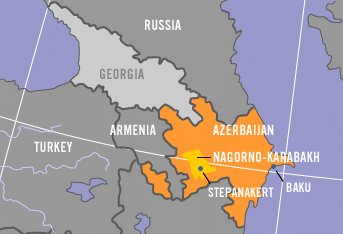
And in a surprising development, Thomas Grove at Reuters reports that Turkey and Armenia have agreed on a framework to normalize ties after Ankara cut them and closed the border in 1993 in solidarity with Azerbaijan in its dispute with Armenia over Nakorno-Karabagh.
"'The two parties have achieved tangible progress and mutual understanding in this process and they have agreed on a comprehensive framework for the normalization of their bilateral relations,' the foreign ministries of both countries said late on Wednesday, without elaborating."
Nagorno-Karabagh is an ethnic enclave of Armenians inside Azerbaijan.


War erupted between Armenian secessionists and Baku in 1991 with the result that the Armenians wresting control of the region. A cease fire was signed in 1994 with Armenia continuing to exercise its control over the area.
"Some analysts have warned a Turkey-Armenia thaw may put at risk gas deals to boost exports to Europe.

'If Azerbaijan feels that Turkey is betraying them, then why would Azerbaijan not move in a Russian direction? And the Russians are offering to buy all their gas at European prices,' Svante Cornell, research director at the Central Asia-Caucasus Institute said.

A key supplier of oil and gas to Turkey and Europe, Azerbaijan said Armenian troops should be withdrawn from Nagorno-Karabakh during the normalization process.

'The opening of the Armenian-Turkish border cannot take place without a process to resolve the conflict over Nagorno-Karabakh,' Azeri Foreign Ministry spokesman Elkhan Polukhov said."
On April 17, following a meeting with Azeri President Ilham Aliyev, Russian President Dmitri Medvedev told reporters "We have a very high chance of entering a full-blown agreement" on natural gas supply from Azerbaijan through Russia--see Daily Sources 4/17 #4.

4. SWAT MILITANTS TAKE ADVANTAGE OF SHARIA DEAL TO OCCUPY ITS SOUTHERN NEIGHBOR

In a very worrisome development, the Associated Press reports that Taliban militants who have recently struck a deal to impose Sharia on Swat Valley have entered neighboring Buner Province in large numbers. Inside Buner they have set up checkpoints and started patrolling roads.


Government paramilitaries are being rushed to the region to protect federal government buildings and infrastructural nodes and have reportedly exchanged gunfire with the militants.
"[A] meeting between tribal elders and the Taliban on Thursday in Daggar, Buner's main town, ended without any indication that the Taliban would withdraw.
...
Two Taliban representatives declined to comment after the meeting, driving away in a pickup truck full of gun-toting associates. However, a Taliban leader who goes by the name Commander Khalil said the militants had agreed to stop patrolling in Buner, though they would still keep armed guards in their vehicles.

'We are here peacefully preaching for Sharia. We don't want to fight,' Khalil told an AP reporter by phone.

Another Taliban leader, Maulana Muhammad Bashir, said the militants had agreed not to target those who had opposed them in the past in Buner--a key demand of local leaders, some of whom had raised tribal militias to fight the Taliban."
Clearly if the Taliban cannot be convinced via compromises to pursue its political aims peacefully, then Islamabad has little option but to allow the civil war to spread.

5. THE UN DELIVERS ITS RECOMMENDATIONS RE: KIRKUK; IRAQI SECURITY FORCES CLAIM THEY HAVE CAUGHT AL-QAEDA IN IRAQ LEADER

Corinne Reilly at McClatchy Newspapers reports that the UN's recommendations on how to resolve the dispute of Kirkuk was distributed to all parties yesterday. The details of the recommendations were not made public, but reportedly included four options for handling Kirkuk. Analysts were skeptical it would produce any solutions:
"'I think everyone will reject the report's findings,' said Joost Hiltermann, the International Crisis Group's senior Iraq analyst. 'I think it presents a brilliant opportunity for compromise, but I'm not convinced either party is ready for that. Both likely think they can win more if they fight.'"
In the meantime, Mark Lynch at the Abu Aardvark's Middle East blog reports that Iraqi security forces have claimed they have captured Abu Omar al-Baghdadi, the Emir of the Islamic State of Iraq (al-Qaeda in Iraq). Lynch comments:
"How much does it matter, if true? Depends on how much you think 'al-Qaeda' is responsible for the recent uptick in violence and the ongoing hot conflict in the northern cities. My guess is that some portion of the recent wave of violence has to do with the disintegration of the Awakenings experiment -- either actively, through the return to the fray of some of the "former" insurgents who populated its ranks than by the remnants of AQI, or passively as they stop working as vigilantly to prevent attacks. Such Sunni groups are not part of AQI or the ISI, and indeed have been fighting against them bitterly for several years. To the extent that a significant portion of the recent violence is driven by their political struggles, then damping it back down requires a political solution with the Iraqi government. Hurting AQI by getting Baghdadi won't do a thing to address the mounting complaints of these non-AQI Sunnis over the Maliki government's foot-dragging on integration of the Awakenings into the security forces, selective repression of various Awakenings leaders, and so forth."
6. EGYPT OFFICIALLY INVITES NETANYAHU FOR A VISIT

BBC reports that Cairo has officially invited Israeli Prime Minister Benjamin Netanyahu to visit Egypt.
"During the Jerusalem talks [between Mr. Netanyahu and Egyptian intelligence chief Omar Suleiman], Mr. Netanyahu told Mr. Suleiman that 'Israel and Egypt have common interests, and the most important one is peace,' Israel's Haaretz newspaper reported."
7. THE CONTANGO IN OIL JUST WON'T GO AWAY

Jonathan Saul at Reuters reports that nearly 100 million barrels of oil is being stored in supertankers at sea per Frontline, the highest level seen since 1991--mirroring the stocks data in the US where commercial crude in storage is at the highest levels seen since September 1990.
"One London-based analyst estimated that the current rate for 30-90 days storage using vessels was $37,500 a day, down from $55,000-$60,000 a day during the first quarter of 2009, making storing oil a cheaper option now."
For VLCCs (which hold about 2 million barrels of oil) that works out to about a $1.68/b for 90 days and $0.56/b for 30. The month 3 contract for sweet light at NYMEX closed yesterday at a $3.34/b premium to front month. The month 2 contract closed at a $1.85/b premium to front. Daily global oil consumption is running at about 84 mb/d, so 100 mb represents about a 1 1/5 days of global consumption.

8. MORE DISMAL NEWS ON THE US ECONOMY

Tom Krisher at the Associated Press reports that GM is set to idle nearly all of its factories in the US for 9 weeks this Summer to reduce inventory.
"One of the people briefed on the plan said details are still being worked out. Some of the closings could be staggered between mid-May and the end of July, but the exact number of plants to be idled has not yet been determined."
In addition, Jeff Bater and Maya Jackson Randall at the Wall Street Journal reports that existing home sales, or "home resales," fell by an rate of 3% for annual sales ended March over annual sales ended February per data released today by the National Association of Realtors. The median price was down 12% from a year earlier. Meanwhile:
"Initial claims for state jobless benefits grew 27,000 to 640,000 in the week ended April 18, the Labor Department said in a weekly report Thursday.

Wall Street economists had expected a 30,000 rise, according to a Dow Jones Newswires survey. The prior week's level was revised to 613,000, which is 2,000 higher than the 610,000 level initially reported."

Wednesday, April 22, 2009

Daily Sources 4/22

1. IMF RELEASES GLOBAL FINANCIAL STABILITY REPORT, CHARTING CURRENT FINANCIAL CRISIS VERSUS PREVIOUS RECESSION ... PERHAPS IT UNDERESTIMATES THE AFFECT ON OIL CONSUMPTION GIVEN THAT THE LAST SHOCK SAW A LARGER DROP AND INDIA AND CHINA, LARGEST CONTRIBUTORS TO INCREMENTAL DEMAND IN RECENT YEARS, APPEAR TO BE SEEING SIGNIFICANT REDUCTIONS IN DEMAND

The IMF has released its Global Financial Stability Report, the first chapter of which can be found here. I have not had time to read it--it comes in at 72 pages--but from all accounts it is sobering reading. Bob Davis at Real Time Economics comments:
"By that definition [a decline in real per-capita world GDP, backed by industrial production, trade, capital flows, oil consumption and unemployment data], this is the fourth global recession since World War II, and deepest by a long shot. The earlier recessions were in 1975, 1982 and 1991. All were one-year recessions when measured by purchasing power parity, which the IMF favors for global comparisons. Those stats take into account the different cost of goods and services in different countries — for instance, a haircut costs a lot less in Beijing than Boston. Looking at global GDP by the more traditional method using exchange rates, the 1991 recession lasted until 1993.

In 2009, the IMF estimates per-capita GDP will decline 2.5%, using purchasing power parity, compared to a 0.4% contraction, on average, during the three previous recessions. Industrial production, trade, capital flows and oil consumption in the 2009 recession will fall much more sharply than in the previous global recessions, while unemployment will increase more."
The post has a helpful (sortable) chart of the recessions of 1975, 1982, 1991, and the forecast for 2009 showing the percentage declines for the indicators of per capita output (PPP weighted), industrial production, total trade, capital flows, oil use, and the jobless rate. My own first impression of the oil use indicator is that it is an under-estimation, given the decline seen in 1982, though, as I've said, I haven't had time to investigate the IMF's analysis of that particular indicator.

In that vein, Vandana Hari at Platts reports that Indian total oil demand rose to 132.4 million tonnes (~ 2.648 mb/d) in the fiscal year ending March 31, or 3.9% from the fiscal year prior.
"The industry had projected a 7% rise in Indian oil consumption in fiscal 2008-09, but the economic downturn that set in during the latter half of 2008 put a damper on consumption, [a senior industry official said late Tuesday.] The 1.5% drop in the combined demand for furnace oil and low sulfur heavy stock to 11.7 million mt in the year ended March 31 was directly related to an industrial slowdown, he said. These heavy products are used as secondary fuel for thermal power plants, as fuel for industrial units and feedstock for fertilizer plants in India."
Haris Zamir at Platts reports that Pakistani petroleum products imports were flat for the period from July 2008 to March 2009 over the same period a year earlier, and crude oil imports were down 11.5% for the same period from a year earlier. The story suggests that the fall in prices may support consumption levels from this point on. Winnie Lee at Platts reports that Chinese apparent oil demand is down about 4.5% in the first quarter from a year earlier. China and India are the two places where most incremental demand growth had been seen in recent years.


Platts also published the oil and production data for March over February and from March a year earlier, as per the official government data. I have changed the reporting to a daily basis, as the March over February data can be misleading given that February is about 10% shorter than March:


The 0.7% increase in crude throughput is the first increase seen since November of last year. Further, Eugene Tang and Dinakar Sethuraman at Bloomberg report that China has resumed spot LNG imports on lower prices for the first time in six months.
"China paid about $493 a metric ton, equivalent to about $9.4/MMBtu, on delivered terms for a spot cargo of 58,064 tons from Trinidad & Tobago last month, customs data released today showed.

Spot supplies of conventional-sized LNG cargoes to China ceased in October after China National Offshore Oil Corp. paid $20.43.MMBtu, a record, in September for a cargo from Algeria. The emergence of China may prop up spot prices that have fallen 70% from last year’s peak because of the global recession, and divert tankers from the US and Europe.

China imported at least three spot cargoes in April and paid less than $5 per million Btu on a free-on-board basis for a shipment from Russia, according to AIS Live ship-tracking data compiled by Bloomberg and an official. That’s a drop of at least 75 percent from the September record high.

Spot LNG sells for $4.60/MMBtu, a 47% discount to crude oil, JPMorgan Chase & Co. said in a note on April 3. LNG sold for a premium to oil in 2008."
2. SACHS ASSESSES REPORTS ON WATER ECONOMICS

Jeffrey Sachs has an opinion piece in Today's Zaman which argues takes stock of a series of recent studies of the water economies of various countries--The UN World Water Development Report 2009, The World Bank's India's Water Economy: Bracing for a Turbulent Future and Pakistan's Water Economy: Running Dry, and the Asia Society's Asia's Next Challenge: Securing the Region's Water Future--and concludes that the leaders from those societies likely to be most affected need to brainstorm in concert on how best to address the coming problems. Key excerpt:
"[T]he precise nature of the water crisis will vary, with different pressure points in different regions. For example, Pakistan, an already arid country, will suffer under the pressures of a rapidly rising population, which has grown from 42 million in 1950 to 184 million in 2010, and may increase further to 335 million in 2050, according to the UN's 'medium' scenario. Even worse, farmers are now relying on groundwater that is being depleted by over-pumping. Moreover, the Himalayan glaciers that feed Pakistan's rivers may melt by 2050, owing to global warming.

Solutions will have to be found at all 'scales,' meaning that we will need water solutions within individual communities (as in the piped-water project in Senegal), along the length of a river (even as it crosses national boundaries), and globally, for example, to head off the worst effects of global climate change. Lasting solutions will require partnerships between government, business and civil society, which can be hard to negotiate and manage, since these different sectors of society often have little or no experience in dealing with each other and may mistrust each other considerably."
Worth reading in full.

3. FRANCE TO INVITE CHINESE PRESIDENT TO VISIT

Carlos Tejada at China Journal links to a China Daily story stating that Paris intends to invite Chinese President Hu Jintao for a state visit, though the link appears broken. The move is part of a thawing of relations between Paris and Beijing after the two released a joint statement stating that "France refuses to support any kind of 'Tibet independence'"--see Daily Sources 4/1 #5.

4. UK DEBT AT HIGHEST LEVEL SEEN SINCE WWII


Julia Werdigier at the New York Times reports that British sovereign debt is slated to reach £175 billion (~$255 billion) in 2009, the highest level since World War II.
"Britain’s net borrowing is expected to reach 11.9% of gross domestic product in 2010 and finances would only balance by 2016. The dismal outlook and rising debt pushed the pound lower against all major currencies on Wednesday and government bonds dropped."
5. RUSSIA FURTHER INTEGRATES INTO ITALIAN ENERGY SECTOR

Svetlana Kovalyova at Reuters reports that Gazprom announced that it will purchase downstream assets in Italy from Chevron.
"Gazprom Neft will buy a plant in Bari, southern Italy, which produces 36,000 tonnes of lubricants a year for cars, trucks and other industrial uses, and fuel marketing and sales operations in Rome, the companies said."
The move does seem to represent an especial affinity for integration with the Italian energy infrastructure.

6. EGYPT'S FEUD WITH HIZBULLAH WIDENS

Michael Collins Dunn at the MEI Editor's blog reports that Egypt's feud with Hizbullah has now expanded to include official protests to the head of Iran's interests section in Cairo as well as allegations that Lebanon was involved in the plot. In the meantime, Nazila Fathi at the New York Times reports that Tehran made an official announcement via the IRNA news agency that it welcomed talks over its nuclear program, and that it had a proposal ready to resolve the dispute over it.
"The statement also said that Iran would continue its ongoing nuclear work in 'active collaboration' with the United Nations nuclear agency and in the framework of the main international treaty that aims to halt the spread of nuclear weapons and promote peaceful uses of nuclear power.

'The Islamic Republic of Iran will continue its nuclear activities in an active collaboration with the International Atomic Energy Agency in the framework of the NPT, along with other member nations,' it said ... ."
7. CHÁVEZ FURTHER CONSOLIDATES POWER

Fausta Wertz at The Compass reports that Hugo Chávez is now moving to oust those governors that have opposed his move to federalize national ports. Manuel Rosales, mayor of Maracaibo, has fled the country and is seeking political asylum in Peru.
"Retired General Raúl Baduel, who brought Chávez to power following the 2002 attempted coup and later was instrumental in defeating Chávez's constitutional referendum in 2007, was arrested at gunpoint on April 7, pending corruption charges. He issued from prison a plea for Venezuelans 'to save democracy,' which was recorded by his son, Raúl Emilio Baduel, with his cell phone. You can watch the video (in Spanish) here."
The governor of the state of Miranda, Henrique Capriles Radonski, is being investigated for corruption; Henrique Salas Feo, governor of the state of Carabobo, is being investigated for "promoting secession;" and César Pérez Vivas, governor of the state of Táchira, is having his election challenged. Further, the mayor of Caracas, Antonio Ledezma, has been forced out of his offices by squatters and Chávez has appointed a vice mayor in his place. Well worth reading in full.

8. MEXICAN CRUDE PRODUCTION CONTINUES TO DECLINE

Robert Campbell at Reuters reports that Mexican oil production declined by 7.8% in the first quarter of 2009 from the first quarter of 2008 to 2.667 mb/d.

9. ZIMBABWE STOCKS REBOUND ON RE-DENOMINATION IN DOLLARS, IS THAT, COMBINED WITH RECORD DOLLAR DENOMINATED DEBT ISSUES, A COUNTERPOINT TO THE ALTERNATIVE TO THE DOLLAR MOVEMENT?

In an interesting story vis-a-vis the global movement for an alternative to the dollar on top of record debt issues denominated in dollars, Janice Kew at Bloomberg reports that Zimbabwean stocks have doubled after shares were re-denominated in dollars and the new coalition government took office two months ago.
"'In an economy which continues to be devoid of dollar liquidity the rise has come as a surprise,' Harare-based Danha wrote in the note. 'Interestingly there is still no evidence of significant foreign portfolio inflows, and much of the trade can be attributable to locals.'

The central bank shut down the exchange in November as inflation estimated at 89.7 sextillion percent, a plunge in the Zimbabwe dollar to 12.6 trillion per US dollar and international sanctions against President Robert Mugabe’s regime caused the economy to collapse. A new coalition government was sworn in on Feb. 11 in a power-sharing agreement between Mugabe and opposition leader Morgan Tsvangirai.

Gains have been led by Innscor Africa Ltd., producer of crocodile skin for Gucci Group NV and Prada SpA, Delta Corp., Zimbabwe’s largest beer and beverages maker, and Econet Wireless Holdings Ltd., the country’s biggest mobile-phone operator, according to Renaissance, a Moscow-based brokerage with offices in Africa."
10. GEITHNER'S SPEECH BEFORE THE ECONOMIC CLUB FAIRLY GLOOMY

The full text of Secretary of Treasury Tim Geithner's remarks today before The Economic Club of Washington can be found here. Key excerpt:
"The International Monetary Fund now expects the world economy to decline this year for the first time in more than six decades. The 1.3% decline forecast by the IMF represents a sharp deterioration from the roughly 4% annual rate at which the world economy normally would be expected to grow. The lost output could be as high as three to four trillion dollars this year alone.

And those numbers mask grave damage to economies around the world.

Only 17 of the 182 economies followed by the IMF are expected to grow faster this year than they did last year. Some 71--including 30 of the world's 34 advanced economies--are expected to shrink. The collapse of world trade is will likely be the worst since the end of World War II.

Several crucial lessons flow from the simultaneous nature of this crisis.

The rest of the world needs the US economy and financial system to recover in order for it to revive. We remain at the center of global economic activity with financial and trade ties to every region of the globe.

Just as importantly, we need the rest of the world to recover if we are to prosper again here at home. Before the crisis, US exports were among our economy's fastest-growing sectors, accounting for more than 6 million American jobs, or about 5% of total private sector employment in the US. Now, they are one of its fastest-shrinking."
(h/t David Wessel at Real Time Economics.) Worth reading in full.

11. MORE SHOES TO DROP IN HOUSING MARKET

The New York Times posts a very illustrative interactive graphic plotting homes prices versus median incomes for twenty cities from the first quarter of 1979 to the second quarter of 2009. In the accompanying article, David Leonhardt notes:
"The glut of foreclosed homes creates a self-reinforcing cycle. Falling prices lead to more foreclosures. Foreclosures lead to an excess supply of homes for sale. The excess supply then leads to further price declines. Jan Hatzius, the chief economist at Goldman Sachs, says that the 'massive amount of excess supply' means that home prices nationwide will probably fall an additional 15%.

This estimate hides a lot of variation, too. In Miami, Goldman forecasts, prices could drop an additional 33%, which is pretty amazing since they’ve already fallen 50% from their 2006 peak."
Barry Ritholtz at the Big Picture quotes from Bloomberg:
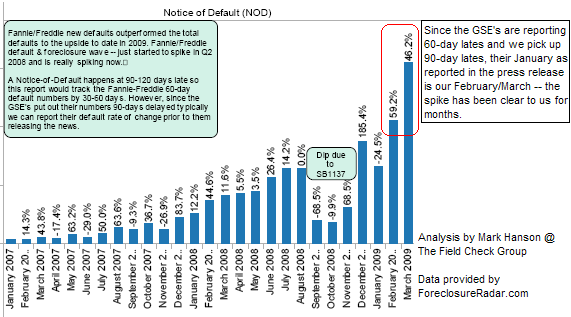
"Fannie Mae and Freddie Mac mortgage delinquencies among the most creditworthy homeowners rose 50 percent in a month as borrowers said drops in income or too much debt caused them to fall behind, according to data from federal regulators . . .

Of all borrowers who ended up in default, 34 percent told Fannie and Freddie they were earning less money, about 20 percent cited excessive debt as a reason for missing mortgage payments, and 8.1 percent blamed unemployment, FHFA said."
Ritholtz links to a chart from the Field Check Group plotting the climb in default notices, remarking: "Note once again these are not Sub-prime or alt-A--they are Prime, the highest quality borrowers possible."


12. CARBON TO BE PRICES AT BETWEEN $13-26 A METRIC TON

Simon Lomax at Bloomberg reports that a proposed law to issue carbon emissions permits as a way to reduce greenhouse gas emissions would price carbon dioxide at about $13 to $26 a metric ton by 2015.
"The price range of $13 to $26 a permit was the result of five rounds of economic modeling that each used different assumptions. For 2020, the estimated permit price range is $17 to $33, the agency said. Each permit, also known as an allowance, would give the holder the right to emit the equivalent of one metric ton of carbon dioxide."
13. COMMERCIAL CRUDE AND PRODUCTS STOCKS CONTINUE TO GROW

The EIA reports that for the week ended April 17 crude stocks grew by 3.9 million barrels to 370.6 million barrels, the largest stock holdings seen since September 1990. Gasoline stocks grew by 800 kb, and are well above the historical range for this time of year. Distillate stocks grew by 2.7 million barrels, and are behaving completely counter-cyclically. A story by Mark Shenk at Bloomberg quotes Tim Evans, an energy analyst with Citi Futures Perspective in New York:
"There are a large number of financial professionals trading oil who are paying more attention to the equity markets and the U.S. dollar, while ignoring the fundamentals of the oil market. There is nothing subtle about the numbers in today’s report."
14. KISSINGER ARGUES THAT FINANCIAL CRISIS FAVORS CONCERT DIPLOMACY

Henry Kissinger has an opinion piece in the Washington Post which argues that the economic crisis favors "concert diplomacy," "in which groupings of great powers work together to enforce international norms." Key excerpt:
"Proliferation is perhaps the most immediate illustration of the relationship between world order and diplomacy. If North Korea and Iran succeed in establishing nuclear arsenals in the face of the stated opposition of all the major powers in the UN Security Council and outside of it, the prospects for a homogeneous international order will be severely damaged. In a world of multiplying nuclear weapons states, it would be unreasonable to expect that those arsenals will never be used or never fall into the hands of rogue organizations. A new, less universal approach to world order would be needed. The next (literally) few years will be the last opportunity to achieve an enforceable restraint. If the United States, China, Japan, South Korea and Russia cannot achieve this vis-à-vis a country with next to no impact on international trade and no resources needed by anyone, the phrase 'world community' will become empty."
Whether you agree with him or not, he is always worth reading in full.

Tuesday, April 14, 2009

Daily Sources 4/14

still working on redrafting the format of Daily Sources ... all comments welcome

1. CHINA PUBLISHES HUMAN RIGHTS GOALS

China yesterday published its "National Human Rights Action Plan of China (2009-10)," which emphasized economic, social, and communal rights though it did outline some aims more in line with traditional western notions of individual human rights--most significantly legal rights of defendants.
"The 22,000-word, two-year plan outlines the government's aim for broader access to social security, health care and education. The death penalty will be 'strictly controlled and prudently applied,' it states, adding that defendants will be guaranteed fair trials. Forced confessions by torture and the mistreatment of detainees will be prohibited. These rights are to be 'promoted and protected' within two years, the document said."
Some international human rights groups criticized the document as being vague and simply reiterating commitments already made, but I rather think the point is that Beijing accepts them as goals. Humans are, after all, teleological creatures, and in order to plot a course to B from A, one must first figure out what B is. (Indeed, this feature of human life is what Machiavelli meant by "the ends justify the means.") The fact that the government accepts a) that Enlightenment and Magna Carta-based rights are in fact rights, entitled to legal protection and b)
"'China has a long road ahead in its efforts to improve its human-rights situation,' the document acknowledges"
is a very important step forward for liberty generally--and the step itself potentially undermines the legitimacy of the regime itself. (Loretta Chao in the Wall Street Journal.)

2. NORTH KOREA PULLS OUT OF NEGOTIATIONS ... WITH EVERYONE

North Korea reacted to the official condemnation by the UN Security Council Monday of its satellite launch by announcing its withdrawal from the six party talks--with China, Japan, Russia, South Korea and the US--which aim to denuclearize the nation and restart its nuclear program:
"'We have no choice but to further strengthen our nuclear deterrent to cope with additional military threats by hostile forces,' the statement [published today by the North Korean Foreign Ministry] said. It also hinted that the North would conduct more satellite tests, saying it will 'continue to exercise its sovereign rights to use space.'"
(Associated Press: "N. Korea to boycott six-party nuclear talks.") The response of to the statement by US and the other members of the six party talks has been to refer to the official condemnation. From the US State Department briefing today:
"[L]et me just say I know you all have a lot of questions about North Korea. I don’t have very much at all today that I’m going to give you. And I know you’re going to come at me with a lot of questions from various angles, but I just want to basically refer you back to the UN Security Council presidential statement that was issued. And this presidential statement made very clear the position of the UN Security Council plus Japan. And as you know, the statement calls for an early resumption of the Six-Party Talks, a verifiable denuclearization of the Korean Peninsula, and full implementation of the joint statement of 2005. I don’t have much more for you right now. At some later point, we’ll have more to say, but right now, that’s all I have."
3. TAIWAN LIKELY TO REVERSE NUCLEAR POWER BAN ON EMISSIONS CONCERNS

Taiwan has scheduled a two-day "state conference" beginning tomorrow which will bring together 205 government officials to debate whether Taipei should overturn its eight year old ban on new nuclear power plants:
"'Nuclear power is an inevitable option because we want to cut carbon emissions,' Tu Yueh-yuan, chief engineer of state-run Taiwan Power Co., said on April 2. The company has room to add as many as 10 reactors at its existing nuclear power plants, she said. To authorize that, [Taiwanese President] Ma [Ying-jeou] would have to reverse a decision by his predecessor, Chen Shui-bian."
The key problem facing the relatively small island nation vis-a-vis expanding its nuclear power capacity is how to safely dispose of the waste. (Yu-huay Sun: "Taiwan Energy Talks Pit Ma Against Nuclear Opponents," Bloomberg News.)

4. BEIJING'S LATEST ALTERNATIVE CURRENCY MOVE TAKES PLACE IN A WORSENING ECONOMIC ENVIRONMENT--AND IN THE PLACE MOST AFFECTED

The latest move in the question of an alternative to the dollar was made by Beijing last week when it decided to allow five of its largest trading cities--Shanghai, Guangzhou, Shenzhen, Zhuhai and Dongguan (four of which are in Guandong Province)--to settle cross-border trade deals in renminbi.
"The yuan settlement move may be a potentially huge boon to Chinese firms, which can sidestep foreign exchange risk without having to buy derivative products to hedge their currency exposure.

But it could be doomed to failure if Beijing can’t convince foreign counterparties to China’s trade that getting paid in yuan is in their own best interest.

That’s not going to be easy. Under current rules, if firms or individuals outside of China were to hold yuan, they wouldn’t be allowed to directly invest it in China’s capital markets. And as for hedging currency risk, Shanghai’s forwards and swaps markets are equally off-limits."
(See Denis McMahon: "The Yuan Abroad: Useful If Strong," China Journal and Denis McMahon: "Beijing Aims to Expand Foreign Trade in Yuan," The Wall Street Journal.)The State Council has asked for the cities involved to submit regulations proposals for the pilot program. It has yet to announce a date for the program to commence. The news comes on top of the recent story that preliminary estimates of GDP growth for Guandong Province in the first two months of 2009 are at 5% and 5.5% for the first quarter, 5% less growth than seen last year.
"Guangdong’s import and export dropped 25.9%, year on year, in January and February, and 22.9% in the first quarter. Guangdong’s foreign trade dependence is as high as 155%, more than double China’s average."
(China Stakes: "Export Plummet Shock: A Guangdong Tiger Under Water," h/t Yves Smith at naked capitalism.) Meanwhile, Cao Jianhai, a professor at the Chinese Academy of Social Sciences, said that the rebound in Chinese property markets was likely unsustainable and that residential property prices were likely to fall by 40 to 50% from their levels in 2008.
"'Prices may not fall in the near term but I expect a collapse starting next year, followed by many years of stagnation,” said Mr Cao, known as one of the 'three swordsmen' of the real estate market because of his influence as an official economist."
(See The Financial Times: "Property prices in China set to halve.")

5. SINGAPORE AND ASEAN 5 POSTING HORRIBLE ECONOMIC GROWTH NUMBERS

Rebecca Wilder notes that Singapore's Ministry of Trade and Industry today announced that it had downwardly revised its 2009 GDP growth forecast from between -2% and -5% in January to between -6% and -9% in April. The revision was made on the base of an advance estimate for first quarter GDP of a 11.5% contraction. Ms. Wilder helpfully produces a graph plotting the annual GDP growth (on a quarterly basis) of the ASEAN 5:


(Her post is worth a look: "Singapore is dropping quickly; dismal growth expected for the ASEAN countries" at News N Economics.)

6. TOTAL'S VENEZUELA GAMBIT ... RISKY AND SEEMS TO IGNORE THE REFINING PICTURE IN THE ASIA PACIFIC ... MEANWHILE RUSSIA AND BRAZIL TAKING MARKET SHARE ON OPEC CUTS

Following the visit of Hugo Chávez to China, the CEO of CNPC, Jiang Jiemin, said he would submit a plan to establish a joint refinery with the PdVSA in Guangdong province. The refinery would have a throughput of 20 million tonnes a year (~400 kb/d) and be 51%-owned by CNPC and 49% by PdVSA. Given that the refinery would be sophisticated, it could make the import of larger volumes of Venezuelan crude--a major goal of the Chávez administration, more viable as most new sophisticated refining capacity on or coming on line in China already has dedicated supply--mostly from the Saudi Arabia. However, there is reason to doubt that these ideas will go forward as planned:
"In May 2008, Chinese state media reported that CNPC subsidiary PetroChina entered into a joint venture agreement with PDVSA to build a 400 kb/d refinery in Guangdong province, configured to process Venezuelan heavy oil.

Under the agreement, witnessed by Chávez and Chinese Vice Premier Hui Liangyu, the crude is to be sourced from the Junin 4 block in the Orinoco belt.

At the time, officials said that the joint refinery, Venezuela's first such investment in China, would advance Chávez's goal of shipping to China 1 mb/d of oil by 2011, or 13% of current Chinese oil demand.

Reports vary on just how much oil Venezuela actually ships to China. Last May, Ramirez said shipments amounted to 500,000 b/d of oil, while Chinese state media reported 300—380 kb/d of products and 80 kb/d of crude."
(Eric Watkins: "China, Venezuela agree to speed up increased oil shipments," The Oil & Gas Journal.) That said, it is reported that senior officials from CNPC, PdVSA and Total SA are scheduled to meet next month in Caracas to discuss a potential 20 year contract to send 200 kb/d of Venezuelan oil to China, possibly starting in 2013, and with volumes rising beyond that.
"CNPC is talking to Total about a package involving a joint bid for Orinoco oil assets, building an upgrader to process the heavy oil produced in Venezuela and shipping it to a CNPC-PDVSA refinery to be built in Guangdong, southern China, a CNPC official told the news agency.

Total declined to comment, but a company spokeswoman told Dow Jones that the company had extensive links with China and confirmed that 'we are in discussions with CNPC on a variety of projects.'"
(Upstream online: "Caracas lines up three-way Orinoco pact.") In February Total CEO Christophe de Margerie told reporters in London that investment in Venezuela was preferable to Brazil, because there was less competition in Venezuela--see Daily Sources 2/13 #9. The statement was somewhat mystifying because, after all, the reason there is less competition in Venezuela is because Chávez has a habit of nationalizing your investments. However, if a project were done in conjunction with Chinese national oil companies, and increased economic integration with China is a goal of Caracas because Chávez believes Beijing may be able to offer military-political defense of his regime from an inevitably hostile US, then perhaps Total may be able to feel better protected against loss of its assets. Indeed, de Margerie may even feel that Chávez would not just be less likely to alienate Paris because of its habitual gad fly approach to US international policies, but also because of the cultural affinity that his first party--The Fifth Republic Movement--claimed with France (see my first post Venezuela vs ExxonMobil). That would be a reasonable strategy--an extremely risky one in my view, but international oil companies are rather experienced in taking such risks.

In the meantime, Brazil and Russia have taken advantage of the supply cuts made by OPEC to take a larger share of the US oil import market (which itself is shrinking).
"US imports from the Organization of Petroleum Exporting Countries fell 818 kb/d, or 14%, to 5.02 million in January from a year earlier, according to the latest monthly report from the Energy Department. At the same time, imports from Brazil more than doubled to 397,000 and Russia’s increased almost 10-fold to 157,000, a trend that continued in February and March, according to data from each country."
The story puts the data in a very strange way, but the latest monthly import data on the EIA website shows that Russian imports grew to 516 kb/d in January from 382kb/d in December (or 35%) and Brazilian imports grew to 450 kb/d in January from 225 kb/d in December (or 100%). (That said, imports from Brazil had been as must as 354 kb/d as recently as October and imports from Russia had been as much as 490 kb/d in August, so although there may be a trend, it is not as pronounced as those percentages would imply. See: EIA: "US Imports by Country of Origin.")
"Russian overall exports climbed 6.3% in February and 2.2% in March, according to the Energy Ministry. Brazilian total exports more than doubled in both February and March, according to Brazil’s Trade Ministry."
(Mark Shenk: "OPEC Cuts Thwarted as Brazil, Russia Grab US Market," Bloomberg News.) Beyond that, Saudi Arabia has put a hold on its two new major export refinery plans--for Tanbu and Jubail--of 800 kb/d in total throughput, but still has a fairly aggressive schedule of capacity addition downstream. Reuters ran the numbers in a series of tables:


As you can see, a fair amount, 440 kb/d is inside China itself--and we can expect a considerable portion of the domestic export refinery plans to target the Chinese market. This is probably true of any excess capacity produced from its JV refineries in Japan and South Korea as well:


7. TURKMEN PIPELINE BLAST ALLEGEDLY DUE TO GAZRPOM'S RELUCTANCE TO HONOR CONTRACT TERMS ... MEANWHILE LUKOIL SEEKS BP'S STAKE IN CPC AND IS DRILLING OVERSEAS DUE TO MOSCOW'S RELUCTANCE TO GRANT MORE DRILLING RIGHTS

Turkmen President Gurbanguli Berdymukhamedov has accused Moscow of being behind the recent natural gas pipeline blast which cut off its exports through Russia to eastern Europe and wants an international investigation into the causes of the pipeline blast.
"'Turkmenistan's president [Gurbanguly Berdymukhamedov] has ordered the government to carry out...an international study to investigate the causes of the incident,' the [Turkmen Foreign] ministry said in a statement."
In a televised speech at a Cabinet meeting the President said:
"We won't allow them to hurt our image as a reliable supplier of energy resources to global markers."
Gazprom has refused to comment on the issue, but Russian Foreign Minister Sergei Lavrov described the explosion as "purely technical." Evidently, Gazprom reduced intake by a full 90% without informing their Turkmen counterparts in advance. This was allegedly done because Gazprom at this time cannot recoup the cost of Turkmen gas, which it reportedly contracted for on December 31, 2008 at $340/tcm (~$9.61/MMBtu.) Yesterday, UK front month natural gas contracts closed at £0.2934/therm (~$4.31/MMBtu). Front month Brent closed at $52.14/b or about $8.99/MMBtu. Urals spot on Friday closed at $50.34/b or about $8.68/MMBtu. (The actual terms of the Turkmen contract are unknown, but it is thought they are tied by some formula to the price of oil, with a floor and a ceiling price.) (See: Alexander Vershinin: "Turkmen leader: Russia must pay for pipeline blast," Associated Press and Nadia Rodova: "Turkmenistan wants international experts to study gas line blast," Platts.) Meanwhile, Lukoil CEO Vagit Alekperov told Bloomberg in a televised interview that the company will seek to buy out BP's stake in the Caspian Pipeline Consortium.
"'Now we need to tie up the formalities and receive permission from the Kazakh government,' Alekperov said. 'I plan to be in Kazakhstan from April 25-30 where I’ll meet with the Kazakh president and I’ll raise that question in the hope of getting a positive answer.'"


Chevron, the operator of the Tenghiz field which is supplies much of the CPC pipeline's throughput, said in February that it intends to increase output in the field to 400 kb/d this year. Shareholders in the consortium plan to invest $1.6 billion to double pipeline capacity to 1.3 mb/d from 2013. (Stephen Bierman and Ellen Pinchuk: "Lukoil to Seek Kazakh Approval to Buy BP’s CPC, Tengiz Stakes," Bloomberg News.)Lukoil also is planning to drill for oil offshore the Ivory Coast and Ghana.
"'After the outstanding discoveries made in the recent years on the sea shelf of Ghana, this area is one of the most promising for exploration in West Africa,' Andrei Kuzyaev, head of Lukoil Overseas Holding Ltd., said in a statement on April 2."
Evidently a part of the thinking behind Lukoil's overseas acquisitions is that Moscow is slowing down the number of licenses to drill it is offering domestically. The number of auctions for oil licenses offered by Moscow last year fell to 147, or by half.
(Stephen Bierman and Ellen Pinchuk: "Lukoil to Drill in Africa as It Urges Russia to Offer Licenses," Bloomberg News.)


8. POLAND TO SEEK $20.5 BILLION CREDIT LINE FROM IMF

IMF Managing Director Dominique Strauss-Khan send an email statement to reporters saying that Poland was seeking a one-year credit line from the institution of $20.5 billion.
"Poland will become the second country after Mexico to use the flexible credit line as its economy faces the sharpest slowdown in almost a decade. The zloty lost almost a third of its value from a record high in July as investors sold riskier emerging-market assets amid the global credit crunch.

'This is the reflection of our cautious and responsible economic policy,' Finance Minister Jacek Rostowski told journalists after the government’s weekly meeting. 'This will help protect the zloty against uncontrolled depreciation that we saw during the first two months of this year. The consequences will be very positive for Poland.'

The loan will raise foreign reserves by almost a third, help cut Poland’s debt-servicing costs and facilitate access to international financing, he said.

'If Poland follows Mexico, maybe other countries would be willing to arrange a credit line,' said Ralph Sueppel, chief economist and strategist at London-based hedge fund BlueCrest Capital Management Ltd., which manages about $2 billion in emerging-market assets. 'The advantage for the Poland is that it provides support at a time when dollar funding is short.'"
(Marta Waldoch and Ewa Krukowska: "Poland to Ask IMF for Credit to Shield Economy, Zloty," Bloomberg News.)

9. CAIRO LOSING PATIENCE WITH HIZBULLAH ... HIZBULLAH MAKES OUT THAT CAIRO IS SUPPORTER OF TEL AVIV

The BBC reports that Egypt has accused 49 suspects of being agents of Hizbullah and planning hostile operations on its soil. Egyptian security forces are searching for 13 additional suspects on the Sinai Peninsula. Michael Collins Dunn comments:
"Part of the surprise here — actually a clever tactical move — is that Nasrullah did not offer the usual flat denial of involvement, but portrayed Hizbullah as trying to relieve the siege of Gaza, thus reminding the world that Egypt's keeping the Rafah crossing closed is as much responsible for Gaza's suffering as Israel's closure of the other crossings. Popular opinion inside Egypt has generally been critical of the government's policies on Gaza, and Hizbullah is playing to that.

Of course, there's a certain disingenuousness to Hizbullah claiming it does not carry out operations in other countries and admitting that it had agents operating in Sinai. But by rationalizing their presence rather than denying it, Nasrullah subtly shifts the debate from one of violating Egyptian sovereignty to one of spotlighting Egypt's keeping Rafah closed."
(see BBC News: "Egypt 'hunts Hezbollah suspects'," and Michael Collins Dunn, "Egypt/Hizbullah Feud Heating Up," MEI Editor's Blog.)

10. IRAN EMBARKS UPON STRATEGY OF MAKING AMICABLE NEGOTIATIONS AS POLITICALLY DIFFICULT TO PURSUE AS POSSIBLE

The US is continuing its strategy of engagement with Iran, as evidenced by yesterday's US Press Briefing:
"QUESTION: Separate issue. On Iran, Javier Solana spoke to Mr. Jalili and it seems that Iran is welcoming what they say – you know, they hope to be a constructive dialogue with the P-5+1. I just wondered whether you had any details on Solana’s call and whether you, you know, welcomed their welcoming of talks?

MR. WOOD: Yeah, I mean, of course, we welcome the fact that they’re, you know, interested in having a dialogue. And you know, I would refer you again to the sincere offer of the P-5+1 to provide Iran with what we believe is a very good, substantive package of incentives. We want to deal with Iran on this issue. It’s an important issue to the international community. And Iran needs to show the international community that its nuclear program is a peaceful one. Right now, the international community is very skeptical about that. But as I’ve said, we want to directly engage Iran on a range of issues, and we encourage Iran to continue – well, we encourage Iran to come forward and provide the international community with all of the assurances that it requires to be convinced that Iran is pursuing a peaceful nuclear program. But as I said, we remain skeptical about it."
And David Sanger at the New York Times reports that the US and its European allies are preparing "proposals" to drop the former US insistence on a rapid shut down of nuclear facilities in the early stages of negotiations with Tehran. But, in the meantime, Tehran appears to be doing much to make the realization of such negotiations more difficult. It has tried Roxana Saberi, a US-Iranian dual citizen and reporter, for espionage in a closed door trial with the verdict expected in two weeks. She has been imprisoned since late January for charges of purchasing alcohol originally. The charges have swiftly escalated to espionage. (The Associated Press: "Iran Says U.S. Journalist Has Been Tried Behind Closed Doors.") Today President Mahmoud Ahmadinejad has announced Iran will launch a satellite soon--on a missile with a range of up to 1,500 km (930 miles). Satellites pose a concern because they can be fitted with weapons and the technology is the basis for ICBMs. (And satellites have also proven to be of particular concern to Moscow.) (Hossein Jaseb and Hashem Kalantari: "Iran Plans to Send Bigger Satellite Into Space," Reuters.) And the Islamic Revolution Passdaran Guards Corp (IRGC) published a statement accusing Amsterdam (!) of attempting to instigate a "color revolution" in Iran via its support of internet websites.
"The statement, released by the 'IRGC Center for Organized Cyber Crimes,' claims, ‎‎'Hostile countries have demonstrated increasing interest in utilizing cyber space with the ‎expansion of the Internet, supporting the creation of websites, blogs and internet radio ‎and television networks.'

The IRGC’s statement identifies the 'Dutch Project' as one of the main soft overthrow ‎threats against the Islamic Republic, noting, 'One such country, which has supported the ‎opposition movement financially in recent years, is the Netherlands, which passed a ‎budget addendum in 2005 sponsored by Farah Karimi, an Iranian-born representative in ‎the Dutch parliament and a member of the leftist Green Party.' ‎

In another part of the IRGC statement, it is claimed that the Dutch budget is part of the ‎‎'long-term and strategic planning along the ideology of NATO,' which is 'pursuing the ‎agenda of global imperialism by absorbing vast capital, expert human resources and ‎political networks, setting up a group of expert journalists from the domestic and foreign ‎opposition with the help of the British, political and diplomatic support from the Dutch, ‎and with planning and secret budgets from the United States.'"
(Rooz online: "Revelations against Dutch Projects‎--Passdaran Guards Corp’s Statement on 'Media Overthrow'.) And Tehran has also given Shell and Repsol until May 20 to "clarify their involvement" in the Phase 13 of the South Pars project.
"'If subsequent to the expiry of the deadline these companies do not make clear their involvement in the Persian LNG project, talks will begin directly with Chinese (companies),' Seifollah Jashnsaz, managing director of the National Iranian Oil Company (NIOC), told the ISNA news agency.

'Presently not much remains to the end of this deadline,' he said, without giving further detail."
(Hashem Kalantari and Jonathan Gleave, "Iran gives Shell/Repsol deadline on LNG project," Reuters.)

11. SWAT VALLEY ADOPTS SHARIA ... TALIBAN EXPANDING TO PUNJAB

Pakistani President Asif Ali Zadari has signed into law legislation which introduces sharia law into the Swat Valley. The Taliban has been de facto in control of the region for some time now. The agreement, it should be noted, maintains the federal judiciary as the court of appeals--and thus superior to the Sharia courts. (See: BBC News, "Pakistan passes Swat Sharia deal.") Meanwhile, Sabrina Tavernise, Richard A. Oppel Jr. and Eric Schmitt at the New York Times report that the Taliban is making inroads in Punjab, the most populous region in Pakistan and the region at the heart of the recent dispute with Nawaz Sharif.

12. RED SHIRT PROTEST IN THAILAND SHUT DOWN BY MILITARY

The Red Shirt protests in Thailand have reportedly come to a halt after a large military presence intimidated the bulk of the protesters.
"'I want to save the people,' Jatuporn Phromphan, one of the protest leaders, said as he walked up to surrender to police with a grim-faced band of supporters. 'But I will continue to fight for democracy.'"
Evidently the military has either decided that it needs to create a sense of stability or it is backing the so-called Yellow Shirts. (Tim Johnston: "Thai Protesters Give Up to Avoid Further Violence Troops, Protesters Clash in Bangkok," The Washington Post -- includes a slide show.)

13. US MARITIME STRATEGY GOING FORWARD

Professor Tom Fedyszyn gave a copy of his power point presentation illustrating the evolution of the thinking behind US grand naval strategy going forward to Steve Clemons at The Washington Note, who made it available to all. Key excerpt:
"Today’s Maritime Strategy “Bottom egg” = Obama Direction

- Maritime security
- Maintenance of global commons
- Promotion of free trade
- Building partnerships
- Anti-piracy
- Humanitarian assistance
- Greatest threat to world instability is economic recession
- Need for US to cooperate and build partnerships
- World trade is cornerstone of strong economy
- US provides strong moral leadership
- Less implied concern over international power rivalries"
Very much worth a look.

14. RETAIL SALES DOWN, CORE CONSUMER PRICES FLAT ... SO MONEY SUPPLY AIN'T GROWING ALL THAT MUCH ... IN THE MEANTIME THE EIA FORECASTS INDUSTRIAL DEMAND FOR NATURAL GAS WILL DROP BY 7.4% IN 2009

The Commerce Department announced today that retail sales had fallen by 1.1% in March from a year earlier.
"Excluding autos, retail sales fell 0.9% after a 1% rise in February. That also was worse than analysts' forecasts of a flat reading for last month.

Sales at appliance stores fell 5.9% last month and furniture stores reported a 1.7% decline. Sales at specialty clothing stores fell 1.8% and dipped 0.2% at general merchandise stores, a category that includes Wal-Mart Stores Inc., Target Corp. and Macy's."
"Meanwhile, the Labor Department reported that wholesale prices plunged 1.2% in March as the cost of gasoline, other energy products and food fell sharply.

Gas prices fell 13.1%, the steepest drop since December, while food costs dipped 0.7%. Excluding volatile food and energy prices, the Producer Price Index was unchanged, below analysts' forecasts of a 0.1% rise."
(Associated Press: "Retail sales tumble unexpectedly in March; Consumer spending subdued amid rising unemployment.") IN the meantime, the EIA released its forecast today that natural gas consumption by the industrial sector is expected to decline by 7.4% in 2009 from 2008. The new forecast cut the average price forecast for natural gas delivered to Henry Hub at $4.24/Mcf.
"[The] EIA said it expects LNG imports to increase to about 480 Bcf this year, from 352 Bcf in 2008. Lower global economic activity and new liquefaction capacity in the Middle East and elsewhere should boost US imports."
(Joel Kirkland: "Industrial sector gas use could decline 7% in 2009: US EIA," Platts.) Not an especially rosy picture of near term economic growth from an official government agency, in other words.