Showing posts with label Gaza. Show all posts

Wednesday, May 13, 2009

Daily Sources 5/13

1. EUROZONE INDUSTRIAL PRODUCTION DOWN 20% IN MARCH YOY, EVEN AS GERMAN IP IS FLAT

Jan Strupczewski at Reuters reports that Eurostat released data today showing the industrial production in the eurozone fell by 20% in March from the year previous. From February, industrial production for the 16 members of the monetary union fell 2% in March.
"Industrial production accounts for roughly 17% of euro zone gross domestic product and the grim March output data could mean the economy shrank more than economists expect.

'Following today's release this indicator is pointing to a -2.2-2.3% quarter-on-quarter reading in Q1. This suggests downside risks to our 2% forecast,' said Saleem Bahaj, economist at Goldman Sachs.

Eurostat also revised down production data for February to a monthly fall of 2.5% from the initially reported decline of 2.3% and, in year-on-year terms, to a plunge of 19.1% from 18.4%."
However, Germany, the largest economy in the eurozone, announced flat industrial production in March last week, though exports continued to drop--see Daily Sources 5/8 #4.

2. CHINESE INDUSTRIAL PRODUCTION UP 7.3% IN APRIL YOY, EVEN AS ELECTRICAL GENERATION DOWN AS MUCH AS 4% YOY AND INDUSTRIAL PRODUCTS IMPORTS FALL BY 14.3%

The AFP reports that Chinese industrial output rose by 7.3% in April year over year according to data released by the National Bureau of Statistics today.
"The figure was down from 8.3% growth in March, and 11.0% in February, according to earlier data issued by the government.

'It was a small fluctuation in a generally upgoing trend,' said Lian Ping, a Shanghai-based economist with the Bank of Communications.

'It's rather unlikely it will go back to a rate of around five percent,' he said.

Growth in industrial output--a main gauge of activity in factories and plants across China--hit lows of little more than five percent at the end of last year."
On May 5, the China Electricity Council released preliminary data that electricity generation was down 3.55% from a year previous and that the finalized statistic--to be released later this month--was likely to be a 4% decline. This was also in the face of CLSA Asia Pacific Markets' positive PMI reading for April--see Daily Sources 5/5 #3 for both of these. I find the notion of industrial production continuing to increase at annual rates of 7% or more difficult to reconcile with electrical generation decreases of annual rates of up to 4%.
"Exports of industrial products totaled 566.2 billion yuan (~ $83 billion ) last month, a steep decline of 14.3% from the same month in 2008, the statistics bureau said."
3. CHINA BANKING REGULATORS PROPOSE RULES FOR ESTABLISHMENT OF CONSUMER LENDING FIRMS AS WESTERN BANKS EXIT CHINESE FINANCIAL SECTOR IN ORDER TO SHORE UP BOOKS

Sky Canaves at the China Journal reports that the China Banking Regulatory Commission told Xinhua that it had issued a draft of new regulations that establish guidelines for the establishment of new consumer financing corporations. Although there was a record number of new loans made in the first quarter and April, consumer lending accounts for only 12% of total loans--see Daily Sources 5/7 #2 and Daily Sources 5/12 #2.
"Under the proposed rules, domestic and foreign-invested consumer finance companies would be able to make loans for durable goods, as well as general-purpose personal loans, in amounts up to five times the borrower’s monthly income.

The finance companies would not be allowed to accept deposits and would have to maintain a minimum registered capital of 300 million yuan (~ $44 million). Prospective applicants should have at least 80 billion yuan in total assets, five years of experience in consumer financing, and profitability in the last two fiscal years, according to the draft rules."
Canaves notes that private consumption currently accounts for about 35% of Chinese GDP. Chen Qiong, an official with the commission said,
"The establishment of consumer finance companies will expedite an increase in personal consumption, thus driving increases in the production and sales volumes of manufacturers and retailers, while also driving demand in related industries and altering the GDP’s over-reliance on exports and fixed asset investment."
In the meantime, Louise Story and David Barboza at the New York Times reports that Bank of America agreed yesterday to sell about a third of its 16% stake in China Construction Bank for $7.3 billion.
"[A] person involved in the deal said Bank of America agreed to a private placement sale to a consortium that includes China Life Insurance, Temasek Holdings of Singapore and the private investment firm Hopu Investments of China, which is partly controlled by Fang Fenglei, the Chinese partner of Goldman Sachs. ...
Bank of America’s move comes a few weeks after Allianz and American Express sold nearly $2 billion worth of shares in another big Chinese bank, the Industrial and Commercial Bank of China, according to Reuters. The Royal Bank of Scotland also recently sold its stake in the Bank of China."
4. CHINA MAY HAVE RESTARTED AS MUCH AS 1.4 MMT OF ALUMINUM CAPACITY IN APRIL AS RIO TINTO DEAL LOOKS LIKELY TO SOUR

Richard Dobson at Bloomberg report Ru Xiaojie, an analyst at Aluminum Corp. of China Ltd., indicated at a conference today that the country may have restarted as much as 1.4 million metric tons of capacity in April. Ms. Ru indicated that the country may produce as much as 12.6 million tonnes of aluminum this year. Alcoa notes there is oversupply on the market. Meanwhile, the Rio Tinto Chinalco deal appears unlikely to go through.

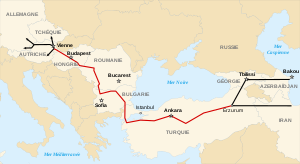
5. KAZAKH PRESIDENT SIGNS BILL INTO LAW SENDING MORE GAS VIA RUSSIA, EU NABUCCO EFFORT DOESN'T SECURE FEEDSTOCK PARTICIPATION AS THE U.S. SEEMS TO RELAX SUPPORT FOR NABUCCO

Upstream online.com reports that Kazakh President Nursultan Nazarbayev has signed into law Kazakhstan's agreement with Russia and Turkmenistan today to carry more natural gas via the Central Asia-Center pipeline system, which would take the gas to Europe through Russia.

"The Russian pipeline plan is expected to transport up to an extra 10 billion cubic metres of Turkmen gas a year and the same volume of extra Kazakh supplies, according to the original deal."
Last Friday's the EU, meaning I infer Andris Piebalgs, signed an "energy agreement" with Azerbaijan, Georgia, Turkey and Egypt regarding a southern transit corridor. The Southern Corridor Summit apparently failed to seal the deal with other key meeting participants: Turkmenistan and Kazakhstan, ie most of the feedstock, which now appears to have gone north. On Friday the rumor that the US was not unequivocal in its support for Nabucco was mooted at the USDOS daily press briefing:
"QUESTION: Robert, just a quick thing on energy issues. The new Obama Administration envoy for energy Richard Morningstar was in a conference in Bulgaria, and he seemed to say that the Nabucco pipeline, which is EU-backed, was not, quote, 'the holy grail,' and suggested that the Russian alternative, South Stream, might work as well. Is this part of the reset in relations with Russia and the US? And what’s the US position on the two pipelines?

MR. WOOD: I think it--I think--and I haven’t seen the remarks from Ambassador Morningstar. But we have always supported diversification of energy supply and resources. And--but I don’t have the specifics with regard to the two pipelines. I haven’t heard--you know, only--I’ve only heard what you have said about it. I’d have to talk to Ambassador Morningstar to get further clarification. But as I said, we want to see a diversification of energy resources in that region, as we said, and worldwide in general."


6. OFFICIAL KREMLIN STRATEGY FORECAST EXPECTS RESOURCES TO BE CENTER OF FUTURE INTERNATIONAL DISPUTES

Al Jazeera reports today that the Kremlin released its National Security Strategy today which forecast that
"The attention of international politics in the long-term perspective will be concentrated on the acquisition of energy resources.

Amid competitive struggle for resources, attempts to use military force to solve emerging problems can't be excluded.

The existing balance of forces near the borders of the Russian Federation and its allies can be violated."
The document identified the Middle East, the Barents Sea, the Arctic, the Caspian Sea and Central Asia as likely loci of future resource conflicts. (h/t Leanan at the Oil Drum's Drumbeat.)

7. BANK ROSSI CUTS RATES ON OIL PRICE INCREASES, WHILE OPEC MONTHLY OIL REPORT SHOWS INCREASE IN SUPPLY IN APRIL, BIGGEST CHEATER IS IRAN

Emma O’Brien at Bloomberg reports that Bank Rossi cut its benchmark interest rates effective tomorrow today, the refinancing rate, seen as the limit for borrowing, was cut to 12% from 12.5% and the repurchase rate charged on central bank loans was cut to 11% from 11.5%.
"Bank Rossii has been buying foreign currency on the market as a way of reducing the ruble’s volatility and controlling its advance, [First Deputy Chairman Alexei] Ulyukayev said. The central bank is purchasing dollars and euros at about 37.20 versus the basket, after earlier defending 37.25, MDM [Bank]’s [Mikhail] Galkin, [head of fixed-income and credit research in Moscow] said, adding that policy makers bought about $1 billion yesterday."
The ruble has been climbing on stronger oil prices.


Spencer Swartz at Environmental Capital reports that OPEC's monthly report released today found that its eleven central members increased oil production by 220 kb/d.
"The production increase--as if the global recession and rising oil prices weren’t already a good enough deterrent--further diminishes the prospect of OPEC announcing any production cut when it meets in Vienna May 28. After months of reducing its output by around 150,000 barrels a day more than its OPEC quota obliges it to, Saudi Arabia, OPEC’s top dog, will be in no mood to hear Iran talk about more cuts when the Persian state is pumping some 400,000 barrels over its quota, according to OPEC’s latest data.

The kingdom was already annoyed privately in March when OPEC last met about the “cheaters” within OPEC. Ditto with the other OPEC Gulf producers, like Kuwait, which have also been carrying their full weight of OPEC cuts and forgoing oil revenue.

The April rise in production 'buries the chance of a fresh cut,' says one analyst who tracks OPEC closely."
Jackson Thies and Mine Yücel at the Dallas Federal Reserve Bank produce a graph showing OPEC production as a percentage of the (implied) quota in February and March:


The EIA produced a graph of OPEC surplus capacity versus price in today's Week in Petroleum report as well:


All fundamentals--even with the reduction in commercial stockpiles reported on below--do seem to point toward a downward pressure on price.

8. UZBEKISTAN, VIA SOUTH KOREA, TO ALLOW NATO SUPPLY TO AFGHANISTAN VIA NAVOI, OBVIATING MANAS CONTROVERSY

Deirdre Tynan at EurasiaNet.org reports that Uzbek President Islam Karimov announced during the state visit of South Korean President Lee Myung-Bak that a cargo airport in the city of Navoi is being used for non-lethal supply of NATO forces in Afghanistan.


A South Korean corporation is heading a renovation project at the airport which would convert it into a world-class air freight hub.
"South Korea’s involvement in the project provides a face-saving way for the resumption of US-Uzbek strategic cooperation, capping over a year of US diplomatic efforts to bridge the rift that opened amid the fallout from the 2005 Andijan massacre.

Karimov evicted US forces from an air base in Karshi Khanabad in late 2005 as a response to US protests over his administration’s handling of the Andijan events.

The Uzbek-South Korean agreement regarding Navoi airport gives Karimov the ability to deny to Moscow that he has cut a deal with the United States. But at the same time, Washington stands to get what it needs--a transit base that can take over much of the load from the American base in Kyrgyzstan, which is scheduled to close this summer."
Though the deal is publicly a commercial arrangement between South Korean and Uzbek entities, the US Transportation Command in late 2008 conducted a market survey which concluded that the hub at Navoi could provide "an integrated commercial-based solution to meet US forces’ transportation requirements to Afghanistan." In late February, the Kyrgyz Parliament voted nearly unanimously to formally cancel the US lease to Manas, giving the President the power to serve US forces an eviction notice within 180 days--see Daily Sources 2/20 #4. In the beginning of February the Kyrgyz President, Kurmanbek Bakiyev, announced in Moscow that he had secured $150 million in aid from Moscow, the forgiveness of $180 million in debt, and $2 billion in loans. Kyrgyz nominal GDP in 2008 was about $5 billion. US annual aid was running at about $150 million, but mostly was directed to non-governmental recipients--see Daily Sources 2/5 #6. Navoi's use as a supply route for NATO forces came as KNOC signed deals to explore five oil and gas fields as part of an oil for infrastructure strategy being employed by the big four energy importers in Asia--China, India, Japan, and South Korea--see Daily Sources 5/12 #6. If Seoul is coordinating its energy security policy with US general security concerns in Asia that may well, in certain corners of the world, give it a considerable edge, in a way similar to, say, Total's decision to enter a new upstream venture in Venezuela in conjunction with China's CNPC--see Daily Sources 4/14 #6. Tynan's piece at EurasiaNet is well worth reading in full. (h/t FP Passport's Morning Brief.)

9. POPE CALLS FOR TWO STATE SOLUTION TO ISRAEL PALESTINE CONFLICT AND END TO GAZA EMBARGO, ANGERS EVERYONE

Howard Schneider at the Washington Post reports that Pope Benedict called for greater international pressure on Israel for the creation of a Palestinian state as well as urging an end to the embargo on Gaza. Scneider quotes the Pope as telling the crowd in Bethlehem, which is located in the West Bank:
"I call on the international community to bring its influence to bear in favor of a solution. ... I pray too that, with the assistance of the international community, reconstruction work can proceed swiftly wherever homes, schools or hospitals have been damaged or destroyed, especially during the recent fighting in Gaza. ... Please be assured of my solidarity with you in the immense work of rebuilding which now lies ahead, and my prayers that the embargo will soon be lifted."


Unsurprisingly, the pontiff managed to displease everyone, as Israelis condemned him for not making stronger expressions of regret for the Holocaust and Palestinians said that since he did not refer to the situation as the "Israeli occupation," he is a tacit ally of Tel Aviv. However, perhaps Benedict's overriding concern was to assure--in light of his speech in 2006 which highlighted a dialogue of Manuel II Paleologus saying that the spread of faith by the sword was irrational and contrary to God's will which offended so many and the recent televised meeting of US Christian soldiers in Afghanistan mulling over how best to proselytize given their situation--that Islamic community that Catholicism, insofar as he is its highest plenipotentiary, is not a sponsor of what many in the Muslim community regard as a Crusade.

10. MEND SAYS CIVIL WAR EMERGING IN NIGERIA

Platts reports that Nigeria's MEND released an email statement warning oil companies to remove personnel from the region as the conflict with the central authorities flared up.
"Oil companies operating in the region are advised to evacuate their staff within the next 24 hours to avoid them being part of the statistics of an emerging civil war.

All freedom fighters in the Niger Delta have been placed on alert to defend their positions and unleash a horrible toll on the oil industry and the Nigerian economy."
11. US RETAIL SALES DOWN 0.4% IN APRIL FROM MARCH

Jeff Bater at the Wall Street Journal reports that US retail sales fell by 0.4% in April from March, according to the latest data from the Commerce Department.
"Sales in March were revised down, decreasing 1.3% instead of 1.2% as previously reported. Sales rose in January and February, after sliding six straight months."
Import prices rose by 1.6% in April from March, completely due to the 15.4% increase in petroleum prices during that time. Excluding oil, import prices were down 0.4% in April from March, and 5.6% down in April from a year previous. Including oil, import prices in April were down 16.3% from the year previous, "the biggest one-year drop since the index was first published in 1982."

12. GOVERNMENT ONLY GUY HIRING, BUT GOVERNMENT IS BROKE, WILL IT GO AFTER PREDATORY LENDERS TO SHORE UP REVENUES?

Rebecca Wilder makes the point that the April jobs report showed that the government was adding a record number of jobs, but that this is taking place as state budgets generally are sharply in the red. She notes that federal jobs only account for 13% of all government jobs (as of April), whereas state jobs have a 24% share and local governments account for 64%. She links to Conor Dougherty's story at Real Time Economics which notes that revenue has declined in 45 of the 47 states which have reported their first quarter numbers. The WSJ helpfully provides a map:


Dougherty notes that the steepest decline in revenue was seen in Alaska, where first quarter revenues were down a whopping 74.1%, primarily on oil prices. In the meantime, Bruce Krasting at his blog notes that Goldman Sachs settled with the Massachusetts Attorney General for $60 million in a case which charged GS with predatory lending practices in Boston. Krastings notes:
"This means next to nothing for Goldman Sachs. However, a very dangerous precedent has been set. In the critical years 2005-2007 Goldman was ranked 15th in the League Tables for sub prime and Alt-A origination/securitization. Goldman’s management must be pleased as punch with that poor showing today. Those that ranked high on that list are no doubt consulting with their attorneys.

If Goldman gets its hand slapped for $60 million over 714 mortgages what does this mean for Countrywide Financial?"
(h/t Yves Smith at naked capitalism.)

13. FORECLOSURES UP, SPREADING TO SUBURBS, AND CORRELATED TO JOB LOSSES, WHICH ARE EXPECTED TO CONTINUE

On top of this news, Dan Levy at Bloomberg reports that US foreclosure filings rose to a record level for the second consecutive month in April, per data released from RealtyTrac today. 342,038 properties received an auction or default notice in April, as banks have increased their efforts to seize properties.
"Foreclosure filings jumped 32% from the year-earlier period, RealtyTrac said. Filings were little changed from March as some states delayed seizures. Ten states accounted for three-quarters of all foreclosures in April, with California leading the nation."
The culprit? "The inevitable result" of steep job losses. (California, incidentally, is one of the state's facing the worst budget shortfall this year.) And Crain's Chicago Business News notes that the foreclosure wave has headed out to the Chicago suburbs from the city proper according to data from the Woodstock Institute, perhaps indicating that the same is happening generally across the nation.
"Foreclosure cases filed in the first quarter jumped between 25% and 70% from the fourth quarter in DuPage, Will, McHenry, Lake and Kane counties, according to new data provided to Crain's by the Woodstock Institute, a Chicago-based housing advocacy group. Meanwhile, foreclosures fell 8% in Chicago, the first quarterly decline in a year.

Across the six-county Chicago metropolitan area, foreclosure filings rose 6% in the first quarter to 17,819, the highest one-quarter total since the housing crisis began in mid-2006.

The shifting locus of new foreclosures shows how the recession and job losses are supplanting subprime lending as the main driver of mortgage defaults, says Geoff Smith, vice-president in charge of research at Woodstock. While the first wave of foreclosures hit hardest in poorer city neighborhoods targeted by high-interest-rate lenders with loose credit standards, the latest round is striking middle-class areas where most borrowers qualified for standard-rate mortgages."
(I also came across this article due to Yves Smith's daily links.)


And on top of that, Phil Izzo at Real Time Economics records that the National Association of Realtors reported yesterday that the median single-family home price fell 14% in the first quarter from the year previous to $169,000. Izzo's post includes a useful sortable chart of the rate of change in home prices by region correlated to job losses for the same. "The data are sortable by city, state, price, percent change from a year earlier and unemployment rate." Michael Shenk, a Research Assistant at the Federal Reserve Bank of Cleveland plots a graph of the number of new single family home sales versus the median sales price for those houses:


(I wonder whether the average sales price would look worse than the median sales price.) Shenk notes:
"[T]he most positive sign for housing markets is that the home-price indexes are beginning to suggest that price declines may be slowing. Both the latest S&P/Case-Shiller indexes and the FHFA index indicate some stability in the 12-month growth rate of prices as of February. The FHFA index shows prices actually improving in February, while the Case-Shiller index, which is narrower than the FHFA index in terms of geographic coverage but also includes nonconforming loans which the FHFA index leaves out, simply has prices falling at a slower pace."


(h/t Mark Thoma at Economist's View.)

14. MIT COMMERCIAL REAL ESTATE INDEX SHOWS PRICES FELL 28% YOY

In the meantime, the MIT commercial property price transactions-based index developed by Professor David Geltner showed that transaction prices of commercial property sold by major institutional investors fell by 5.8% in the first quarter. The index is now down 21% on the year and 26% below its peak in mid-2007. Geltner commented:
"It's possible that the first quarter of 2009 was the nadir in market sentiment. Sales volume is down almost to nothing, as reflected in our demand index. The prices buyers are willing to pay fell a record 12% in the first quarter and is now 28% below a year ago and 39% below its mid-2007 peak."
(I also came across this story via Mark Thoma's blog.)

15. OBAMA ADMINISTRATION TO REGULATE DERIVATIVES

Stephen Labaton at the New York Times reports that the Obama Administration will ask Congress to pass legislation which would require that all derivatives instruments be traded via an exchange and be subject to tight regulatory oversight.

16. COMMERCIAL OIL STOCKS UNEXPECTEDLY FALL, SENATE TO CONSIDER STRATEGIC PETROLEUM PRODUCTS RESERVE

In a sharp reversal from weeks of stock builds, the EIA today announced that commercial stocks of crude oil fell by a whopping 4.7 million barrels in the week ended May 8 to 370.6 million barrels. Though the stocks are still well above the five year historical range for this time of year and at highs last seen in the early 90s, a Bloomberg survey indicated that the median expectation of analysts was for a one million barrel build. Gasoline inventories also fell by 4.1 million barrels, and are now in the middle of the five year historical range for this time of year, versus a split analyst expectation for builds and draws. Distillate stocks built by a million barrels to 147.5 million barrels and are completely counter-cyclical with 40.4 million barrels (37.7%) more in storage than this week last year.


Nick Snow at the Oil & Gas Journal reports that the US Senate Energy and Natural Resources Committee will consider a bill introduced by Jeff Bingaman (D-NM)--S. 967, the Strategic Petroleum Reserve Modernization Act of 2009--which would create a strategic petroleum products reserve. Europe maintains products reserves, but the US strategic reserve is entirely made of crude. There are two primary difficulties with creating strategic products reserves:

One: Petroleum products degrade in storage at relatively speedy rates; crudes do not.
Two: The specifications for each petroleum product in the US varies by state. So, for example, gasoline stored for use in Texas would meet the environmental regulations for Texas gasoline, much more lax than those in California.

Of course, in an emergency Washington has in the past relaxed specifications requirements to meet products shortages, so this second objection is more about the rationality of the US products market than a products SPR, per se.

Tuesday, February 24, 2009

Daily Sources 2/24

1. Ralph Atkins at the Financial Times reports that German business confidence fell from 83.0 in January to 82.6 in February, according to the Munich-based Ifo Institute's index.
"Germany is particularly exposed to eastern European economies, where the economic deterioration has gathered pace recently. German exports to the region, including to Russia, accounted for a higher proportion of the total than to the US, Mr Köbel said.

Hans-Werner Sinn, Ifo’s president, added that, 'overall the [Ifo] survey results do not point to a turn [around] in the economy.'"
2. Keith Johnson at Environmental Capital reports that Italy's industry minister Claudio Scajola told the media yesterday that Rome would sign a nuclear cooperation agreement with France on all aspects of nuclear power. "Scajola says Italy needs eight to 10 European Pressurized Reactors (EPR), known as improved third-generation plants." In October, Scajola indicated that Rome estimates that it paid €50 billion to phase out nuclear in the first place, and now plans to meet 25% of it power requirement from nuclear by 2030. At that time Scajola had complained that Italy's electricity prices were 30% above the European average and 80% above the French average. (see Daily Sources 10/17 #3.)

3. Jane Perlez at the New York Times reports that the Taliban unilaterally announced a cease fire in Swat. Army units in the valley have returned to their barracks, and the government has agreed to the introduction of sharia courts, but will not do so until peace in fact prevails. Islamabad would not confirm that an official agreement had been made, though the Taliban gave as "indefinite" the cease-fire's duration.

4. Charles Lee at Platts reports that Iraqi president Jalal Talabani--in the first state visit by an Iraqi leader to South Korea since the two nations established relations in 1989--signed a $3.5 billion oil for aid deal with South Korean president Lee Myung-Bak today.
"'With this agreement, [South Korea] can now acquire rights to develop oil reserves in Iraq's Basra region, where most Iraqi oil is produced,' the [energy] ministry said in a statement. In return, Seoul will help build social infrastructure such as power plants."
5. Helene Cooper reports that the Obama administration intends to provide Gaza with $900 million in aid. The aid would reportedly be funneled through non-governmental organizations as opposed to through Hamas, ie, the government. It will likely be difficult to get such a proposition through Congress, even as majority party, even with the monies not being sent through Hamas.

6. Platts reports that Shell is planning to lend Nigeria $3 billion at favorable terms to finance Abuja's side of its joint venture projects.
"The Financial Times reported last week that Shell has cut flaring in half but needs a further $3 billion of investment to stop it altogether. To fill that gap, Shell is offering Nigeria $3.1 billion in bridging loans at very low interest rates and project finance.

Some $1.1 billion of the loan has already been agreed, and the remaining $2 billion is expected to be confirmed soon, the UK paper said."
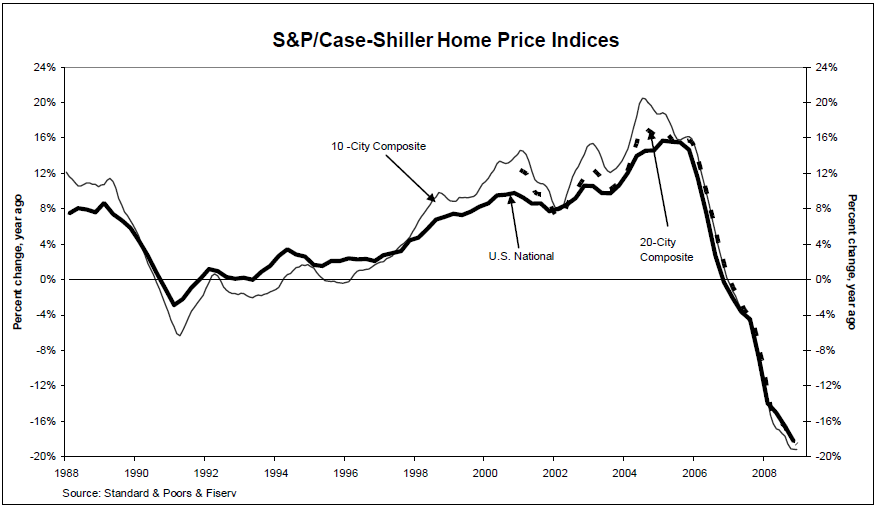
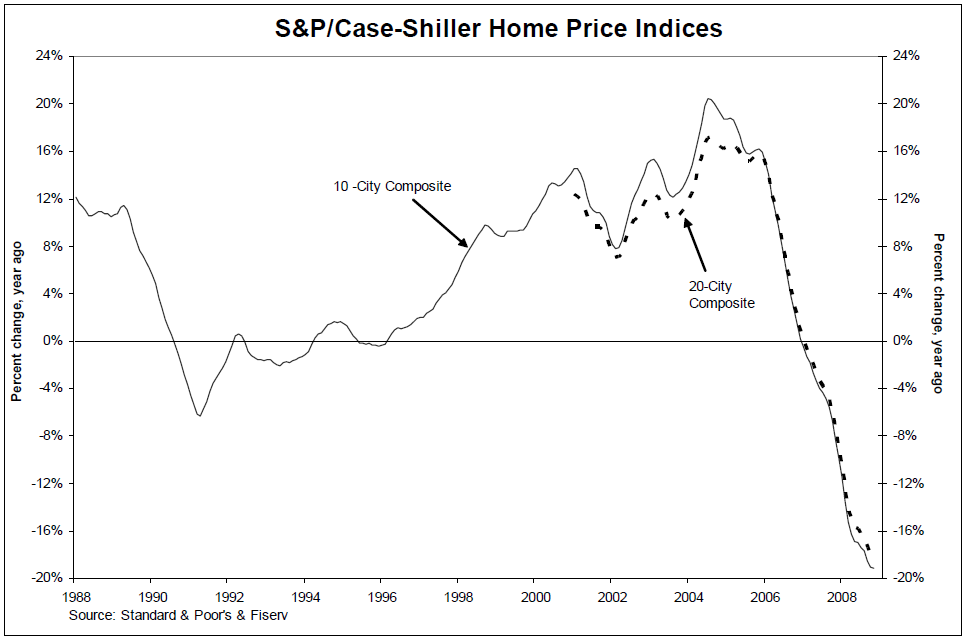
7. Jack Healy at the New York Times reports that the Case-Shiller home price index for December was released today showing that nationally home prices fell 2.5% from November to December. Real Time Economics carries a chart of the numbers for the 20 metro areas individually covered by the index.
"As of December, 18 of the 20 metro areas are in double digit declines from their peaks, with half posting declines of greater than 20% and four of those (Las Vegas, Miami, Phoenix and San Francisco) in excess of 40%."
Barry Ritholtz at the Big Picture provides an illustrative chart of the decline:


8. Melanie Tatum at Platts reports that Ron Denhardt, vice president of natural gas services for Strategic Energy and Economic Research, in his most recent report predicted that natural gas "prices are likely to average below $3.50/MMBtu during April through October and it is quite possible that prices will decline below $2.00/MMBtu."
"Among heavy gas-consuming
industries, primary metals output has fallen 36% [year over year in January], while agricultural chemicals have fallen back 20% and total chemicals production has fallen by 12%."
"Assuming normal weather, Denhardt projects storage levels at the end of March to reach 1.666 Tcf--well above the 1.247 Bcf reached last year and the five-year average of 1.486 Tcf. As a result, he said, unless producers take steps to substantially shut in production, working gas in storage could reach 4.4 Tcf by the end of the traditional injection season on October 31."
9. Juliet Eilperin at the Washington Post reports that the EPA is considering implementing national rules regulating greenhouse gas emissions from automobiles.
"For weeks, administration officials have been meeting with car companies as well as green groups and representatives from California--which is awaiting word on whether it will receive a federal waiver to regulate greenhouse gas emissions from vehicles -- to try to broker a deal on the issue. On Sunday, Carol M. Browner, assistant to the president for energy and climate, said she and others backed the idea of a single standard for cars and trucks.

'The hope across the administration is that we can have a unified national policy when it comes to cleaner vehicles,' Browner said at the Western Governors' Association meeting in Washington."

Friday, February 20, 2009

Daily Sources 2/20

1. President Obama and Canadian Prime Minister Stephen Harper agreed yesterday to establish a senior-level U.S.-Canada Clean Energy Dialogue which will focus cooperation on several issues including:
"- Expand clean energy research and development
- Develop and deploy clean energy technology
- Build a more efficient electricity grid based on clean and renewable generation"
The two leaders also announced that they would work in tandem at the G-20 summit in April in Trinidad and Tobago to ensure it "contributes to restoring confidence in financial markets." (h/t Rachel Ziemba at Follow the Money.)

2. Edward Hugh at Fistful of Euros reports that the initial Markit euro-zone manufacturing index fell to a record low of 33.6 in February from 34.4 in January. (Readings above indicate growth; below 50 indicates contraction.) Services PMI also fell to a record low of 38.9 from 42.2 in January. The composite PMI fell to 36.2 from 38.3 in January. This is how well the flash PMIs have tracked actual GDP in the past, courtesy Fistful of Euros:


Christian Reiermann at Der Speigel reports that Peer Steinbrück now believes that the several members of the EU and, more specifically the eurozone, will require bail outs similar to the financial and auto sector rescues:

"But now Steinmeier is creating the impression that some euro zone members may ultimately require the same kind of bailout already seen in the banking industry and manufacturing. It could come at the cost of billions to taxpayers. "The euro-region treaties don't foresee any help for insolvent countries, but in reality the other states would have to rescue those running into difficulty," Steinbrück said.

For German taxpayers, this would be no small sum. If Germany were to pay into a bailout based on its size relative to other euro zone countries, it would be forced to cover one-fourth of the entire tab."

Helful explanatory illustration from Der Spiegel:


Long, but well-worth the read.

3. Edward Harrison at Credit Writedowns reports that Citibank has cut all lending in Denmark. "Citigroup has sold its German operations to a French bank and I understand they are cutting credit lines in the UK as well." (h/t Yves Smith at Naked Capitalism.)

4. Sarah Schafer at the Washington Post reports that the Kyrgyz Parliament voted Thursday to end the lease of the Manas air base to the US, leaving the decision in the hands of the President, who, today signed the bill, giving him the power to serve the US with an eviction notice with 180 days to end operations there. The vote was 78 to 1 in favor of the bill. Baktybek Abdrisaev, Kyrgyz Ambassador to the US and Canada from 1997 to 2005, has an opinion piece in the Washington Post which states that the base's closure is not primarily due to Russian pressure. Abdrisaev says the primary reason for it's establishment in the first place was Kyrgyzstan's conflict with the Islamic Movement of Uzbekistan and sympathy for the US following 9/11. I suspect the notion of US dollars flowing into the nation and the signal it would send to nations with which it has boundary issues (ie China) were also primary concerns. Abdrisaev suggests, however, that a primary reason for the ouster is that the US subordinated support for democratic institutions and procedures to its prosecution of the wars in Iraq and Afghanistan, allowing authoritarian elements to grab hold of the tiny mountain nation. There is some truth to this, though I suspect Kyrgyzstan's interests calculation has changed more from events outside the nation than its new government.

One: If the war in Afghanistan is calculated to be more destabilizing than allowing whatever Islamist organization to become its sovereign, then it is in the interests of Moscow and Bishkek to end the NATO presence there.

Two: Bishkek is a poor country in a world without a lot of largesse to spread about just now. Its GDP is $5 billion. Russia's offer of aid was almost half of Kyrgyz GDP--$150 million in aid, forgiveness of $180 million in debt, and $2 billion in loans.

5. Linda Gradstein at the Washington Post reports that Israeli President Shimon Peres formally asked Likud leader Binyamin Netanyahu to form the next government. Although Kadima leader Tzipi Livni won more seats in Parliament than Likud, apparently more members of Parliament support Netanyahu for Prime Minister. Livni indicated that she would not join a Netanyahu-led government. Netanyahu had previously indicated that he will not form a coalition with the far right Yisrael Beitenu party led by Avigdor Lieberman, reportedly because Lieberman supports civil marriages in Israel which is anathema to Orthodox support for Netanyahu. All of which is to say that it is unclear whether Netanyahu can at this stage form a governing coalition without Livni or Lieberman and, thus, it might be some time before we see one. Until then, it is unlikely to see a formal cease fire agreement with Hamas.

6. Reem Khalifa at the Associated Press today reports that Bahrain has halted talks over a natural gas import deal with Iran after former Iranian speaker of the Majlis was quoted in the media saying that Bahrain was Iran's 14th province until 1970. Bahrain's Foreign Minister Sheik Khalid bin Ahmed al-Khalifa said that the remark was an "infringement of sovereignty" and a "distortion of historical fact."


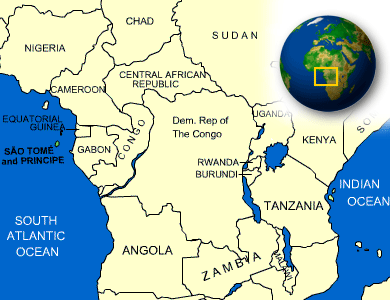
7. Henrique Almeida at Reuters reports that Angolan national oil company Sonangol is close to a deal with Sao Tome for producing oil from the tiny island's waters.


8. Sharon Schmickle at the Washington Post reports that the re-emergence of the stem rust fungus is threatening wheat production throughout East Africa. A must read.

9. Andre Soliani and Joshua Goodman at Bloomberg report that Brazil's unemployment rate has jumped to 8.2% in January from 6.8% according to the national statistics agency.

10. Paul Krugman of the New York Times highlights the following passage from the minutes of the last FOMC meeting:
"All participants anticipated that unemployment would remain substantially above its longer-run sustainable rate at the end of 2011, even absent further economic shocks; a few indicated that more than five to six years would be needed for the economy to converge to a longer-run path characterized by sustainable rates of output growth and unemployment and by an appropriate rate of inflation."
11. Shobhana Chandra at Bloomberg reports that the Department of Labor announced today that the consumer price index grew by 0.3% in January. "Excluding food and fuel, the so-called core rate, prices advanced 0.2%, due to autos, clothing, and medical care. The CPI was unchanged on an annual basis--the first time it hasn’t risen since 1955."

12. Reg Curren at Bloomberg reports that natural gas prices in the US have fallen below $4/MMBtu on the drop in industrial demand, which accounts for about 29% of total natural gas consumption. GM alone closed most of its 22 plants last month.

Friday, February 13, 2009

Daily Sources 2/13

1. Brian Swint at Bloomberg reports that the European Union’s statistics office announced today that GDP in the Eurozone fell by 1.5% in the fourth quarter from the third. GDP in the fourth quarter fell at a rate of 1.2% from the fourth quarter in 2007, the only drop for a full year period on record since the inception of the monetary union.
"[European Central Bank] board members Lucas Papademos, Juergen Stark and Jose Manuel Gonzalez-Paramo as well as Spanish central bank Governor Angel Fernandez Ordonez and Belgian Governor Guy Quaden said this week that the Frankfurt-based bank may cut rates next month."
2. Edward Hugh at Fistful of Euros reports that official German statistics released today show a 2.1% contraction of German GDP in the fourth quarter.
"A 2.1% quarterly contraction, for those who are confused by the way we economists do things is equivalent to an 8.4% annualized rate of contraction, which is quite something (although in fairness some of this comes from Q3 when there was a big build up in inventories, which has now unwound)."
Hugh also posts that the Estonian Finance Ministry released data showing that the economy shrank by an year over year rate of 9.4% in the fourth quarter."The contraction was 4.2% quarter over quarter. That is 16.8% annualized." Analysts are calling the contraction the worst economic crisis in the history of the country since its independence in 1991. Hugh also posts that the Czech Statistical Bureau announced today that GDP dropped by 0.6% in the fourth quarter from the third. At an annual rate it grew by 1% in the fourth quarter. And in a final bit of bleak news from Hugh today, preliminary government estimates are that Italian GDP fell by a seasonally-adjusted rate of 1.8% from the third quarter to the fourth.
"Across 2008 as a whole, the Italian economy fell 0.9%, ISTAT said, the most pronounced decline recorded since 1993.The Italian economy officially fell into recession in the third quarter of 2008. And one more interesting detail, Italian GDP is now back at the same level it was in Q4 2005, and falling. This is pretty worrying, and even more so given there are quite a lot more people in Italy then there were in 2005."
And in another bit of frankly exhausting bad economic news, Eurointelligence reports that French industrial production was down 1.6% quarter over quarter in the fourth, 8.6% year over year.

3. The G7 meeting in Rome began today, and in that context Rebecca Wilder at News N Economics produced an analysis and set of illustrative graphs showing that G7 growth rates are falling across the board while unemployment soars across the board. Here is her graph of G7 economic performance:


Worth a look. Eurointelligence reports that France will seek greater controls over hedge funds in the meeting this weekend--while publicly accusing Berlin of protectionism.

4. Kevin Hamlin at Bloomberg reports the much ballyhooed news that a survey of economists conducted by the wire service produced a median expectation of growth of 6.6% in China in the second quarter following expansion of 6.3% in the first quarter of 2009.
"The value of new loans in January was more than double the record set a year earlier, according to figures released by the People’s Bank of China yesterday.

The lending multiplies the effect of the government’s spending in ways that wouldn’t be possible in the U.S. and Europe, where banks are burdened by toxic assets, said Dwyfor Evans, a strategist with State Street Global Markets in Hong Kong."
Analysts have also taken note of the surge in iron ore imports in China, possibly due to restocking needs, potentially due to the infrastructure spending Beijing announced in December. (The rebound in iron ore imports has been named the primary cause of the rebound in the Baltic Dry Index, an index of shipping which is considered by many economists to be a good indicator of global trade.) Juliet Ye at the China Journal also notes that vouchers which various cities have introduced are spurring some consumption.
"In Hangzhou, capital city of eastern Zhejiang province, civil servants are to get 5% to 10% of their salaries in the form of consumer vouchers, according to one report. The vouchers are intended to be spent at local shops. Unlike actual money, they can’t be deposited at the bank for a rainy day, forcing consumers to spend."
Apparently vouchers are at the center of a discussion in which policymakers are considering how best to goose consumption--and the fact that Beijing is beginning to consider a boost in consumption an important goal is encouraging, from the American perspective.
"Local governments say the results are encouraging. The municipal government of Chengdu said that almost all shopping vouchers have been consumed. In Hangzhou, over 44 million of the 100 million yuan coupons have so been used by Feb. 5, 13 days after delivery of the vouchers, according to the Southern Metro Daily newspaper. On Monday, Jiang Zengwei, China’s vice minister of commerce, said in a press conference that issuing shopping vouchers is a effective way to spur consumption."
Still, some are pessimistic about the extent to which a vouchers program can spur consumption. I have, on the other hand, seen somewhere an analysis showing that in the US food stamps have the largest multiplier effect in terms of stimulus, because they cannot be horded. That said, Yves Smith at Naked Capitalism was at some pains to throw cold water on the estimates in a post today.
"Consider some basics. China's economy is not as export dependent as many believe, but exports have made a significant contribution to growth. Commercial real estate development has been another big driver. Those two have gone into reverse.

Let's deal with the notion of "stimulus" making up for the slack. The famed half trillion dollar plus package announced some months ago was largely spending already budgeted and planned. Analyst views vary (and further input welcomed) but from what I have seen, only 1/6 to 1/3 was new spending, and most of that occurred in the second year of this two-year program."
She also notes that Michael Pettis, one of the more prominent China-watchers, is very skeptical about the loan growth numbers, who argues they are the result of bad lending practices driven by the desire to keep Beijing happy, and thus a credit bubble, likely to burst quickly given the current global economic situation.

5. Alexander Kwiatkowski at Bloomberg reports that OPEC has reduced its forecast for 2009 oil demand by 530 kb/d to 85.13 mb/d. It now predicts a decline in demand in 2009 from 2008 of 580 kb/d or 0.7%. OPEC's numbers are somewhat higher than the EIA and IEA's forecasts for 2009 which are both 84.7 mb/d. However, as Keith Johnson at Environmental Capital notes, OPEC sees new demand destruction coming from Asia as opposed to the developed world. This is especially interesting because OPEC is in a place to know as oil imports for the major economies in Asia are overwhelmingly dominated by Middle Eastern crudes. From OPEC's analysis:
"The Chinese economy is dependent on exports and the slowing world economy is imposing a large burden on Chinese industrial production, which is leading to less use of oil products, particularly diesel. Hence, China’s oil demand is forecast to show a growth of only 2.3% this year down from 4.9% last year, a loss of 210 thousand barrels per day."
6. The January data from the California port of Long Beach shows a 23% decline year over year in container traffic.


Long Beach is the second busiest port in the United States, the 15th busiest container cargo port in the world, and about 13% of total US container cargo passes through it. And in further evidence of a gloomy economic outlook, the port of Marseilles reported a 24% decline in overall traffic in January year over year:


(The graph somewhat confusingly labels 2008 data 2009, but I think demonstrates the point well enough.) Some of the decline in the port is due to strikes, first by the oil workers, and later by nearly all the transportation unions. Still, the numbers from both ports do seem to indicate a weak global economy.

7. Marc Santora at the New York Times reports that a suicide bomber blew herself up in a crowd of Shiite pilgrims south of Baghdad today.
"It was the latest in a series of attacks directed at Shiite pilgrims in recent days, which Iraqi and Western officials said were aimed at stoking sectarian violence."
8. Ethan Bronner at the New York Times reports that Hamas today told the media that an agreement for an 18-month long cease fire was just days away. A senior Israeli official told the journalist that nothing had been agreed upon yet, however.
"The new prospective accord, again being mediated by Egypt, is aimed at rebuilding Gaza after the war and involves both reconstruction and reconciliation between Hamas and the West Bank-based Palestinian Authority, according to Ismael Ridwan, a Hamas spokesman, who spoke by telephone after extensive talks between Egyptian and Hamas officials.

He said among the materials that would be allowed to flow into Gaza in the new arrangement were cement and steel, which Egypt would monitor. Those materials are desperately needed for rebuilding, but the agreement would not allow pipes, cables and chemicals that Israel fears could be used for bombs."
Clearly, Tel Eviv will be unlikely to make deals prior to the formation of a government.

9. In an especially interesting note, Eduard Gismatullin at Bloomberg reports that the CEO of Total, SA, Christophe de Margerie, told reporters in London today that the company plans to expand activities in Venezuela as opposed to Brazil. He said that there was plenty of competition in Brazil and that therefore Venezuela provides a better opportunity.

10. Platts reports that Indonesia has concluded a deal to supply LNG from 2011 to 2020 to the Japanese consortium of Kansai Electric, Osaka Gas, Kyushu Electric, Chubu Electric, Toho Gas and Nippon Steel. However, the contract would be for 3 million tonnes a year from 2011-15 and 2 million tonnes a year from 2016-2020. The current contract through 2011 was for 12 million tonnes a year at $8-9/MMBtu (~ $46.40-$52.20/b on a Btu basis.)

11. James Morgan at the BBC reports that global warming may reduce the number of fish in the oceans by as much as 50% by 2050 according to a report first published at a meeting of the American Association for the Advancement of Science today.
"Thirty-three nations in Africa, Asia and South America are highly vulnerable to the impact of climate change in fisheries, according to scientists from the World Fish Centre.

Of these, 19 were already classified by the United Nations as 'least developed' because of their particularly poor socioenomic conditions.

'Economically, people in the tropics and subtropics likely will suffer most, because fish are so important in their diets and because they have limited capacity to develop other sources of income and food,' said Edward Allison, director of policy, economics and social science at WorldFish. "
(h/t Yves Smith at Naked Capitalism.)

12. Walter Pincus and Joby Warrick at the Washington Post reports that the Director of US National Intelligence, Dennis C. Blair, told the Congress yesterday that the financial crisis is the primary near-term security threat facing the US.He said, "Roughly a quarter of the countries in the world have already experienced low-level instability such as government changes because of the current slowdown." He also indicated that were the financial crisis to continue for a year to two that the world would likely witness "high levels of violent extremism" as well as "regime-threatening instability."
"In answer to a question about whether he was shifting assets to cover the financial downturn, Blair said that by leading off with the economic situation he "was trying to act as your intelligence officer today, telling you what I thought the Senate ought to be caring about." He said he was not refocusing the intelligence community's basic collection and analytic work from traditional concerns such as terrorism, Afghanistan, Pakistan, Iran, North Korea, Russia and China."
Very informative article well-worth reading. I personally am heartened to read that the head of US intelligence has such a clear-headed approach to the analysis of the evolving global environment. That said, perhaps diverting assets to developing scenarios for how the financial crisis in a variety of nations critical to the national interest would be an especially reasonable and wise allocation of funds.

13. Justin Lahart, Timothy W. Martin and Janet Adamy at the Wall Street Journal report that the Commerce Department released data showing that consumer spending fell by the inflation-adjusted rate of 3.7% in the fourth quarter. Apparently a great deal of that reduction is coming out of food purchases:


14. Brian Blackstone at Real Time Economics reports that the latest Fed survey shows that average household worth declined "by 22.7% from 2007 until October 2008. The median, or midpoint, fell a more modest 17.8%, suggesting declines were centered among wealthier families."

Tuesday, February 3, 2009

Daily Sources 2/3

1. Maya Jackson Randall at Real Time Economics reports that the Federal Reserve plans to continue its dollar swap arrangements through the Fall.
"The Fed said the extension applies to the temporary reciprocal currency arrangements it has with each of the following banks: the Reserve Bank of Australia, the Banco Central do Brasil, the Bank of Canada, Denmark’s Nationalbank, the Bank of England, the European Central Bank, the Bank of Korea, the Banco de Mexico, the Reserve Bank of New Zealand, the Norges Bank, the Monetary Authority of Singapore, the Sveriges Riksbank and the Swiss National Bank.

The Fed said the Bank of Japan will consider the extension at its next monetary policy meeting."
2. Sophie Tedmanson at the London Times reports that the Reserve Bank of Australia yesterday cut its benchmark interest rate by 1% to 3.25%, the lowest in 45 years. Prime Minister Kevin Rudd also announced a new stimulus package of $42 billion to be known as the "Nation Building and Jobs plan."
"Mr. Rudd said that $28.8 billion would be invested in schools, housing and roads and a further $12.7 billion will provide cash support for lower-income families to be paid next month. This means low-income earners such as farmers, students and stay-at-home mothers will receive a one-off payment of $950."
Stimulus measures announced since September 2008 amount to $78 billion, nearly 8% of Australian GDP.

3. Keith Bradsher, the longtime China journalist for the New York Times, reports that currency flows are reversing and now moving out of China.
"In Shanghai, cash-rich Chinese companies are buying high-yield bonds issued by distressed American companies at a time when many Western investors are steering clear of bonds even from solid companies.

All over the world, Chinese companies are sending home fewer of the billions of dollars they earn from exports, parking them in overseas bank and brokerage accounts instead.

And in Hong Kong, wealthy mainlanders are turning up at jewelry stores in growing numbers seeking diamonds, big ones."
Total outflows in the fourth quarter of 2008 were as much as $240 billion. The "accumulation in China’s foreign exchange reserves plunged 74% over the course of last year" to $40.45 billion in the fourth quarter. Mostly anecdotal, but worth reading.

4. In a post Sunday on his Maverecon blog, Willem Buiter takes aim at the buy American provisions in the House version of the $819 billion stimulus plan. The prevailing theory regarding the Great Depression is that protectionist measures were responsible for deepening and lengthening the downturn. At Davos, Buiter reports that the finance ministers of the rest of the world were quick to threaten retaliation should the provision become law. But, Buiter is quick to note, protectionism is on the rise globally. Worth reading in full.

5. Niall Ferguson at the Financial Times argues that the banks must be nationalized and new banks established from their ruins. He goes on to say,
"The second step we need to take is a generalized conversion of American mortgages to lower interest rates and longer maturities. The idea of modifying mortgages appalls legal purists as a violation of the sanctity of contract. But there are times when the public interest requires us to honor the rule of law in the breach. Repeatedly during the course of the 19th century governments changed the terms of bonds that they issued through a process known as 'conversion'. A bond with a 5% coupon would simply be exchanged for one with a 3% coupon, to take account of falling market rates and prices. Such procedures were seldom stigmatized as default. Today, in the same way, we need an orderly conversion of adjustable rate mortgages to take account of the fundamentally altered financial environment."
Well worth reading. I certainly think nationalization will be more politically viable than a "bad bank"--and obviously restructuring mortgages will be politically popular generally, and have the potential benefit of improving the debt-equity ratio of a great number of people, thus potentially increasing consumption via a resurrection of disposable income. Barry Ritholtz at the Big Picture posts that he has been led to understand that Goldman Sachs representatives effectively lobbied the senior staff of Senate Banking, House Financial Services, the Joint Economic Committee late last week. Ritholtz highlights the following points of the alleged Goldman presentation:
"'- Government actions to date have prioritized interacting with banking institutions rather than directly influencing troubled asset prices;
- 'To date, banks have executed minimal de-risking, have not attracted meaningful additional common equity capital or sufficiently increased lending'; and
- 'A government program which provides non-recourse loans for asset markets should have a material impact on addressing these current challenges and could be an attractive alternative for the "aggregator bank" to explore'"
He includes a copy of the complete bullet points allegedly presented to the staffers. Both are worth reading in full.

6. Fredrik Dahl and Parisa Hafezi at Reuters report that Iran placed its first satellite in orbit today. It is a telecommunications and research satellite, but the analyst community has noted that putting a satellite in orbit requires some of the same science needed for intercontinental ballistic missiles. The launch also should have the effect of bolstering morale of the regime as well. (The launch coincides with the 30th anniversary of the Islamic Revolution in Iran.) The Reuters piece notes that Iran is the ninth country in the world to be both capable of domestically manufacturing a satellite and launching it into space. Meanwhile, Thomas Erdbrink at the Washington Post reports that in a visit to Tehran, Hamas leader Khaled Meshal was told in a Sunday meeting with the Supreme Leader, Ayatollah Ali Khamenei, that "Islamic resistance needs to be ready for every eventuality, even for another war in Gaza." Meshal is on a regional tour to drum up support for Hamas, and in a speech at Tehran University Monday thanked Iranian supporters, "Thank you for all your support--the financial, political and media and popular support which you gave to us."

7. In light of recent pronouncements by Russian US analysts Andrew Pronin and Igor Panarin about the incipient break up of the United States (see Daily Sources 12/30 #12 and Daily Sources 1/22 #5) it is interesting to see, via an anonymous comment to yesterday's post, that the New Hampshire House of Representatives State-Federal Relations and Veteran's Affairs Committee will consider a bill which would deem any act not explicitly authorized by the US Constitution as a nullification of the compact itself. HCR 6--text here--is sponsored by four GOP state representatives, was introduced on January 8, and is scheduled to be considered by the committee next on Thursday. Not likely to go anywhere, but surely will be seen as grist for the mill overseas.

8. Ben Block at the World Watch Institute reports that the The International Renewable Energy Agency (IRENA) was launched yesterday. 75 nations have signed the treaty establishing the international agency, which would be dedicated to help governments and private industry expand renewable energy installments in the developed world and assist the developing world acquire the expertise to develop domestic alternative energy industries. The agency was an initiative of Germany, Spain and Denmark, and signatories include France, India, the UAE, and Kenya, though the US, UK, Japan, Australia, and China have chosen so far to remain observers. (An official from the US Embassy in Berlin served as the US representative at the meeting.) At this stage it is difficult to see how much clout this organization could potentially hold, but an interesting development nonetheless. 25 nations will need to ratify the treaty prior to their final accession to it.

9. Lydia Polgreen at the New York Times reports that the President of Libya, Muammar el-Qaddafi, was named chairman of the African Union yesterday.
"Colonel Qaddafi is an ardent supporter of a long-held dream of transforming Africa, a collection of post-colonial fragments divided by borders that were drawn arbitrarily by Western powers, into a vast, unified state that could play a powerful role in global affairs. He has repeatedly proposed immediate unity and the establishment of a single currency, army and passport for the entire continent. He pledged Monday to bring up the issue for a vote at the African Union’s next summit meeting, in July."
Quixotic, but those member nations which would be made uncomfortable by some of Qaddafi's more explosive announcements have apparently been outvoted.

10. Rebecca Wilder at News N Economics reports that 34.6% of national home sales were sold at a loss in 2008. In the fourth quarter, 42.2% were at a loss. In 2008 as a whole, 19.9% of the houses sold were in foreclosure. Ms. Wilder drew up a graph tracking sales at a loss from the first quarter of 2004:


Worth a look.

Tuesday, January 27, 2009

Daily Sources 1/27

1. Hillary Mann Leverett, former National Security Council and State Department official who has participated in negotiations with Tehran on behalf of the United States has a guest post at the Washington Note which argues that the US ought to take up Iran's offer to allow US officials to interrogate al Qaeda operatives detained in Iran.
"In the wake of the 9/11 attacks and the U.S. invasion of Afghanistan, Tehran detained literally hundreds of suspected Al Qaida operatives seeking to flee Afghanistan into Iran. Iran repatriated at least 200 of these individuals to the new Karzai government, to Saudi Arabia, and to other countries.

The Iranian government documented these actions to the United Nations and to the United States in February 2002, including by providing copies of each repatriated individual's passport. But Iran could not repatriate all of the individuals it detained; for example, the Islamic Republic has no diplomatic relations with Egypt, and Iranian diplomats told my colleagues and me that Tehran was not able to repatriate Al Qaida operatives of Egyptian origin to Egypt.

They also said that Osama bin Ladin's son, Saad, had tried to enter Iran and that Iranian security forces had turned him away. However, these Iranian diplomats expressed concern that, if Saad bin Ladin managed to penetrate the porous Iranian-Afghan border and enter Iranian territory--as he apparently did in 2003, after the Bush Administration had unilaterally cut off our dialgoue with Iran regarding Afghanistan and Al Qaida--Tehran would encounter difficulty repatriating him to Saudi Arabia, which had already made clear it was not interested in taking either Saad bin Ladin or his father.

Instead of working to establish a framework within which Tehran could have made Al Qaida operatives detained in Iran available to U.S. interrogators--as our Iranian interlocutors requested--the Bush Administration insisted that Iran detain and deport all the Al Qaida figures we believed might be in Iran, without any assistance from or reciprocal understandings with the United States.
The post is constructed to debunk the assertions of an article published elsewhere, but still worth reading. Stephen Kinzer, formerly a journalist at the New York Times, has an opinion piece in the Guardian UK which argues that Tehran is the key to solving most conflicts in the West and that President Obama ought to choose an envoy to Iran with that in mind.
"If Iran can be brought back into the world community as a full and welcome partner, it could pressure militant groups like Hamas and Hezbollah to end their war against Israel. That, in turn, might lead Israel to stop its devastating attacks on nearby populations, which intensify hatreds, create terrorists and horrify the world.

Iran also has tremendous influence in Iraq--more, in fact, and any other country, including the US. It is the only country than can guarantee a modicum of stability in Iraq as American troops depart.

Iran's centuries-old relationship with Afghanistan means that it could also play a decisive role in calming the terrifying crisis that is engulfing that country and threatening to blow Pakistan apart. An Iran that feels safe might even agree to compromise on its nuclear program, which much of the world justifiably fears."
Kinzer goes on to suggest that Dennis Ross, rumored to be Obama's choice (see Daily Sources 1/6 #1), would be a bad selection, because he is so mistrusted by the Islamic world. Perhaps Kinzer is right, but if Iran is the key, then Israel is the lock, and the Administration is probably more interested in finding someone who has credibility in Tel Eviv than in Tehran--for obvious reasons. Although there is much talk about a "grand bargain" with Iran, my guess is that Tehran is extremely unlikely to decide that such a bargain is in its interests. (Which isn't to say that acting as if such a bargain was in its interests wouldn't be in its interests, if you see what I mean.)

As I have noted before, the government of Iran is a revolutionary government, the Supreme Leader's title is literally translated as "Leader of the Revolution," and were the US to come to terms with the government, it would lose its raison d'etre. This is not to say that we shouldn't create a formal relationship with the country, just that much of the opposition to war with Iran appears these days to be positing that solving all problems with Iran in one fell swoop is the only real alternative to acts of force, which is wishful thinking at best, in my opinion. Still, the piece is worth reading.

In the meantime, Reuel Marc Gerecht, senior fellow at the Foundation for Defense of Democracies and former CIA case officer, yesterday had an op ed in the Washington Post in which he suggests that the Obama Administration should conduct a bipartisan review of the intelligence community's operations in Iran. But the piece spends plenty of time discussing just how porous the Iranian border is and how that might be exploited by covert operatives. Without going into the false allegations made by the piece--for example Iran's relationship with al-Qaeda--I would note that it probably has to be read in the context of the warning given by the head of Iranian counter-intelligence last week in the Iranian press for the US not to spy on it. (see Daily Sources 1/20 #2.) Yes, I do believe someone felt that an essay such as this was the best possible response to such a warning.

2. Zoltan Simon and Katarzyna Klimasinska at Bloomberg report that EU Energy Commissioner Andris Piebalgs suggested today in Budapest that the EU should provide €200 (~ $259) million for initial funding for the Nabucco pipeline. The Chairman of the European Investment Bank, Philippe Maystadt, indicated at the conference dedicated to the pipeline that his bank may well find as much as 25% of the €7.9 billion in projected costs of constructing the pipeline.
"Azerbaijan, a potential supplier of gas to the pipe, will only decide whether to commit to Nabucco once questions over financing, transit fees and the construction timetable are resolved, President Ilham Aliyev said in an interview in Budapest yesterday."


3. Alan Cowell at the New York Times reports that in an interview with Al Arabiya TV of the UAE, President Obama said he wants to convince the Islamic world that "the Americans are not your enemy." Critically, he reminds his audience that America "was not born" a colonial power and suggests that the US cannot dictate the decisions of the major actors in the Middle East, but only facilitate political decisions and negotiations by the people on the ground. This is more important than some have given it. Certainly, the efforts of Karen Hughes were laudable, but she had no credibility with the target audience. The current administration does. Meanwhile, Griff Witte at the Washington Post reports that Palestinian fighters detonated a bomb by a border fence with Israel today, killing an Israeli soldier.

4. Bettina Wassener at the New York Times reports that the Japanese trade ministry today announced the outline of a plan to take equity stakes in ailing companies.
"Tuesday’s plan by the trade ministry, to be considered by the cabinet next month, reaches out beyond the banking sector to other parts of the Japanese economy. It foresees the state-owned Development Bank of Japan buying shares in companies that are having trouble raising money amid the lingering credit crunch. The government will guarantee the investments should the companies go bankrupt, the ministry said.

Although it did not specify what type of companies might be eligible for such help, the plan will probably be mainly aimed at the small and medium-size outfits that employ 70 percent of the country’s work force and are crucial suppliers to corporate giants."
5. John Kingston at the Barrel reports that the oil rig count in North America is down 99 rigs in the last four weeks, nearly 23%. Kingston quotes Barclay's Paul Horsnell's comment on this development in full:
"With the backdrop of a hail of recent announcements on capital expenditure reductions for both conventional and non-conventional oil, together with the continuing move away from investment in alternative energy, we believe that the sharp fall in industry confidence is likely to have a more lasting effect on the health of the supply-side. Indeed, for that not to represent a severe problem over the course of the following decade, the weakness in global oil demand would have to become fairly prolonged. It tends to be a far longer process to reinstate projects than it is to mothball or cancel them, and the scale of the current industry freeze and confidence loss seems likely to severely affect non-OPEC production. Further, given how much of expenditure in mature areas is directed at trying to contain decline rates, we suspect that those decline rates might now be set for another step up."
Quite. Meanwhile, Platts reports that the Centre for Global Energy Studies (CGES) in London said that OPEC's actions so far have been sufficient to stabilize Brent at about $45/b. (Special attention is paid to the views of CGES because it was founded by Ahmed Zaki Yamani, who served as Saudi Arabia's Minister of Oil from 1962 until 1986.) However, CGES warned that if prices were pushed much higher, they would likely further depress demand, undermine price advances as well as any potential recovery in world trade.

Meanwhile, Randy Fabi at Reuters reports that Mohammed Sanusi Barkindo, the head of Nigeria's national oil company NNPC, said that global prices need to remain over $40/b in order for their offshore production to remain viable. "Nearly all of Nigeria's oil production growth is expected to come from offshore, which already represents 40 percent of current output of less than 2 million barrels per day." Chris Stanton and Tamsin Carlisle at the Abu Dhabi National report that ADNOC--Abu Dhabi's national oil company--awarded $3.5 billion in contracts to expand onshore oil fields. "ADNOC is moving ahead with its long-term plans to lift capacity by 30%, to 3.5 mb/d, despite a recent dip in global oil demand." Three fields are slated for expansion, the Sahil, Asab and the Shah, and production is scheduled to increase by a total of 60 kb/d by 2012 and 400 kb/d by 2016. The emirate has pushed back the capacity increase plans several times over the years, in part because several concessions to Western oil companies are nearing expiration, meaning that they have little incentive to invest in field capacity increases at this time. Meanwhile, Platts reports that a collapse in palm oil prices has produced a remarkable 520% increase in Malaysian biodiesel exports in December 2008 from a year earlier.

6. Keith Johnson at Environmental Capital reports that Halliburton has announced on its website that it expects to pay $559 million to settle charges it violated the Corrupt Practices Act as it pursued the contract to build the Bonny Island liquefied natural gas plant in Nigeria. The post includes a link to the plea agreement made by the former head of Kellogg Brown & Root for orchestrating over $180 million in bribes to Nigerian officials.

7. Keith Johnson at Environmental Capital reports that Todd Stern, chief climate negotiator in the Clinton Administration, will be "climate envoy." In his remarks, he spoke of how American exceptionalism in this arena was over, but the details of his approach seem to illuminate a certain continuity with the old approach.
"Mr. Stern’s expressed frustration with the 'maddeningly cumbersome' UN-sanctioned process that puts almost 180 countries together at the bargaining table. His preferred venue for hashing out new climate accords is the 'E-8,' a group of eight developed and developing countries that together account for 70% of global greenhouse-gas emissions. He says that would be different from President Bush’s 20-country group of major emitters because it wouldn’t just be a talk shop, but a place to take concrete steps."
I think that there is much merit in the notion of an E-8 to discuss these issues as opposed to a huge unwieldy parliament mostly composed of nations whose efforts will have little to no practical effect upon global climate. That said, as Johnson concludes,
"China is clearly the joker in the global struggle to contain emissions. For all of Team Obama’s ambitious policies, what happens in Beijing may be a lot more important than what happens in Washington."
Worth reading.

8. Yves Smith notes that several nations are involved in bilateral discussions for barter for food, given the difficulty in finding reasonable credit terms.
"[Countries] including Russia, Malaysia, Vietnam and Morocco say they have signed or are discussing inter-government and barter deals to import commodities from rice to vegetable oil.

The revival of these trade practices, used rarely in the last 20 years and usually by nations subject to international embargoes and the old communist bloc, is a result of the countries’ failure to secure trade financing as bank lending has dried up."
Energy security is one thing. Food is another--it's all about calories, but some calories are really more equal than others.

9. Frank Jack Daniel at Reuters reports that Caracas has signaled that it is not ready to invite back an American ambassador to Venezuela.

10. Free Exchange notes that India has decided to ban imports of toys from China for six months.

11. Jane Macartney at the Dublin Independent reported yesterday that a secret meeting was recently held between Communist Party leaders and leaders of the banned underground Protestant leaders in Beijing.
"Officials privately estimate the total number [of Christians in China] at 130 million -- far outstripping the 74 million members of the Communist Party. Most are Protestants and are affiliated with unofficial house churches.

No representatives of the underground Catholic Church were invited -- the Vatican is still viewed by the Communist Party as a rival force and tentative talks yielded little progress."
Meanwhile, on Friday the Vatican launched its own youtube channel. I would imagine that this would be regarded as a serious issue in Beijing if Christians really represent 9.8% of China's population--especially given Pope John Paul II's affect on the Solidarity movement in Poland. (Timothy Garton Ash allegedly once said, "Without the Pope, no Solidarity. Without Solidarity, no Gorbachev. Without Gorbachev, no fall of Communism.")

This savvy is contrasted with the news that Pope Benedict XVI, reported Sunday by Rachel Donadio at the New York Times, has revoked the excommunications of four bishops associated with the St. Pius X Society. The Society had been formed in opposition to the Vatican II reforms, and the bishops had been consecrated by its founder, archbishop Marcel Lefebvre, in 1970 via unsanctioned ritual. They were excommunicated by Pope John Paul II after this consecration. One of them--British-born Bishop Richard Williamson--is a holocaust denier. From what I have gleaned via a short overview of St. Pius X Society materials, they take their cue from St. Pius X, Pope from 1903-1914, because he argues that church teaching cannot change, and that revelation was completed with the apostles. (Though if any readers have insight into some of the deeper intricacies of the movement, I would be obliged if they would enlighten me.) The conservative take is consistent with Benedict XVI's outlook, but seems especially indifferent to the question of husbanding the church's moral authority in the eyes of the world and likely to lose the church some followers. Worth keeping an eye on.

12. Barry Ritholtz at the Big Picture reports that the Case/Shiller report showed a 18.2% annual decline in November in the 20 city Home Price Index. Since August 2006, both the 10 city and 20 city composites have declined each and every month.


Real Time Economics published the data for each of the 20 cities here.

13. John M. Broder at the New York Times has a very useful article on how competing energy concerns are dividing Democrats in Congress. States which have large coal reserves are not especially keen on legislation which would kill its competitiveness. This is especially true of states that also have a substantial portion of their power generated by coal burning power plants. Here is a map illustrating the dilemma courtesy of the New York Times:


I would only add that this divide extends to other energy sources as well, like corn based ethanol and oil, and was one of the means by which the Bush Administration controlled the US Congress. Worth reading.