Showing posts with label Iran. Show all posts

Thursday, August 12, 2010

Daily Sources 8/12

CHINA BUYING YEN

Tim Duy at Tim Duy's Fed Watch reports that the renminbi, dollar and yen are on a collision course. China is buying yen at a time where the yen is hitting record highs. If Japan responds by buying dollars, then China has managed to get Japan to help maintain the value of their dollar holdings as well as their ability to sell them. Well worth reading in full.

CHINESE STRATEGISTS SEE EXERCISES IN YELLOW SEA AS PART OF EFFORT TO ENCIRCLE CHINA WITH AN ASIAN NATO

Dai Xu at China.org.cn argues that the US is trying to build an Asian NATO to encircle China.


JAPANESE CONSIDER OPTIONS AFTER ATTACK ON TANKER

Takeo Kumagai and Pradeep Rajan at Platts report that the Japanese are considering how to increase security at the Straits of Hormuz after the bomb attack on the M Star VLCC. One option being considered is to only send tankers through the strait during the day time. However restricting passage to daytime hours would add to the congestion in traffic through the strait. Japan is stuck with importing oil through the Strait of Hormuz--80% of their oil supplies pass through it.

GREEK ECONOMY SHRINKS BY 1.5% IN THE SECOND QUARTER

The BBC reports that the Greek economy shrank by 1.5% in the second quarter from the first. The economy shrank by 3.5% from this time last year.
"That adds to 0.8% decline in GDP recorded for the first three months of the year, suggesting that the decline in the economy is speeding up."
INDUSTRIAL PRODUCTION IN INDIA RISES 7.1%

Kartik Goyal and Unni Krishnan at Bloomberg report that industrial production in India increased 7.1% in June from a year earlier. 7.1% is the slowest rate in 13 months and some see it as evidence that the economies in Asia are cooling.

TURKEY USED CHEMICAL WEAPONS AGAINST PKK

Daniel Steinvorth and Yassin Musharbash at Der Spiegel report that photos have been taken of dead PKK members which seem to demonstrate that Turkey used chemical weapons to kill them. German politicians are demanding an explanation from Ankara.

TOP IRAQI MILITARY COMMANDER SAYS US EXIT IS COMING TOO SOON

BBC reports that the top Iraqi military commander has indicated that the US plan to remove all its troops by 2011 is too soon. He said that the army will only be ready to take control of the situation in 2020.

IRAQ WILLING TO ACCOMMODATE IRANIAN PIPELINE TO SYRIA

Deutsche Presse-Agentur reports that the Iraqi oil ministry has published a press release stating that the government has no objection to a gas pipeline from Iran crossing Iraqi territory to Syria.
"'Iraq does not mind facilitating the extension of the Iranian gas pipeline through its territory to Syria and the Mediterranean Sea,' Iraqi oil minister Hussein al-Sharistani said in the statement"
CHINA AND IRAN AGREE TO BROADER OIL AND GAS COOPERATION; LUKOIL RESUMES GASOLINE EXPORTS TO IRAN; IRAN CANCELS TWO LNG PROJECTS

The Tehran Times reports that Iran's oil minister and China's vice premier met and agreed to broaden their cooperation in the oil and gas sector. Meanwhile, Reuters reports that Lukoil has resumed exports of gasoline to Iran.
"In July, Russia’s energy minister Sergei Shmatko said Russian companies would be ready to supply fuel to Iran if there were commercial interest and attractive terms."
However, the sanctions appear to be having an effect on Iran's natural gas plans, canceling two LNG projects Spencer Swartz reports in the Wall Street Journal. LNG technology is mostly held by Western firms.

EUROPEAN COMMISSION LAUNCHES INVESTIGATION INTO US BIODIESEL DUMPING

Isis Almeida at Platts reports that the European Commission is investigating whether US biodiesel exporters are avoiding anti-dumping duties by sending the product through a third country like Canada or exporting B19--19% biodiesel, 81% diesel--which is not subject to the anti-dumping tax.
US biodiesel receives a subsidy of $1/gal ($300/mt) if blended with diesel, which the European Union says represents unfair competition.

This led the European Commission to slap provisional anti-subsidy and antidumping duties on imports of US biodiesel in March 2009. The measure was extended for five years last July, with definitive antidumping duties on US biodiesel of Eur200-400/mt ($274-$548/mt).
CONGRESSMEN SEEK TO KILL $100 MILLION IN AID TO LEBANESE ARMY ON HEZBOLLAH FEARS

Daniel W. Drezner at Foreign Policy reports that members of the US Congress are seeking to stop $100 million in aid to the Lebanese Army.
"Now, I understand the Congressional impulse to do something here -- I really do. What I don't understand is how Congress thinks that withholding aid from the Lebanese military will weaken Hezbollah. Congress seems to think that anything that aids the Lebanese Armed Forces (LAF) will concomitantly aid Hezbollah. The latter group, however, has independent sources of financial, political and military support. It's better to think of the LAF as a competing power base than as a conduit to Hezbollah. Anything that weakens national institutions in Lebanon empowers the groups that can survive in a more anarchical environment -- and gee, whaddaya know, that would include Hezbollah."
INITIAL JOBLESS CLAIMS UP

Courtney Schlisserman and Tim Homan at Bloomberg report that initial jobless claims for the week ended August 7th rose by 2,000 to 484,000, the highest level since February.
"The number of people receiving unemployment benefits dropped, while those getting supplemental benefits surged by 1.34 million reflecting the government’s extension of eligibility."
HUD TO OFFER $1 BILLION IN INTEREST FREE LOANS TO FOLKS FACING FORECLOSURE

Lorraine Woellert and Kathleen M. Howley at Bloomberg report that HUD is to offer $1 billion in interest-free loans to help out folks who have lost income and are facing foreclosure on their homes.
"The Department of Housing and Urban Development plans to make loans of as much as $50,000 for borrowers “in hard hit local areas” to make mortgage, tax and insurance payments for as long as two years, according to a statement released today. The Treasury Department will also provide as much as $2 billion in aid under an existing program for 17 states and the District of Columbia, according to the statement."

Wednesday, August 11, 2010

Daily Sources 8/11

CHINESE ECONOMY SLOWING SOME FROM BREAKNECK SPEEDS

Keith Bradsher at the New York Times reports that the Chinese economy is slowing:
"The gradual slowing in China is evident in the factories that have turned the country into the manufacturing center of the world. Industrial output rose 13.4 percent last month compared with the same month last year.

By comparison, industrial output had been up 13.7 percent in June from a year earlier, and was up 16.5 percent as recently as May.

Much the same pattern was evident in fixed asset investment, which was up 24.9 percent last month compared with a year earlier. It had been ahead by 25.5 percent in June, and 25.9 percent in May.

Retail sales rose 17.9 percent in July compared with the same month last year, as Chinese consumers with rising wages continued to flock to stores for ever more spending. But sales had grown 18.3 percent in June compared with a year earlier, and had been up 18.7 percent in May."
What we would do for such growth!

RUSSIA DEPLOYS S-300 MISSILE SYSTEM IN ABKHAZIA

Dmitry Solovyov at Reuters reports that Russia has deployed a S-300 missile system in Abkhazia.
"The S-300, codenamed 'Favorite' in Russia, is a mobile, long-range air defense system that can detect, track and destroy ballistic missiles, cruise missiles and both high- and low-flying aircraft."
RUSSIAN ECONOMY GROWS BY 5.2% IN THE SECOND QUARTER FROM A YEAR EARLIER

Maria Levitov at Bloomberg reports that the Russian Federal Statistics Service said today in an email that its second quarter economic growth came in at 5.2% over the second quarter of last year.

IEA REPORTS THAT IRANIAN IMPORTS OF GASOLINE HURT BY SANCTIONS; TURKEY INDICATES IT WILL NOT COMPLY WITH GASOLINE SANCTIONS ON IRAN

Carola Hoyos at the Financial Times reports that the most recent IEA report says that the tougher sanctions on Iran have halved Tehran's gasoline imports.
"As a result Iran has been forced to pay a 25 per cent premium to market prices for its petrol deliveries as many companies shy away from supplying the country, the International Energy Agency reported on Wednesday."
Meanwhile, Orhan Coskun at Reuters reports that the Turkish Energy Minister told the wire service that Ankara will support sales of gasoline to Iran.
"Tupras, Turkey's sole refiner and gasoline exporter which is owned by Koc Holding, declined to say whether the company had sold anything to Iran. The refiner buys 33 percent of its crude from the Islamic Republic, however."
Also, if I remember correctly, Turkey imports some natural gas from Iran.

UN APPEALING FOR $459 MILLION FOR FLOOD RELIEF IN PAKISTAN

The Associated Press reports that the UN is appealing for $459 million in order to help flood victims in Pakistan.
"The UN Office for the Coordination of Humanitarian Affairs said 'the worst monsoon-related floods in living memory' has affected more than 14 million people and at least six or seven million require immediate humanitarian assistance including food, clean water, shelter and medical care."
AN OVERVIEW OF THE INDIAN ENERGY SECTOR

Utpal Bhaskar and Elizabeth Roche at livemint.com gives a pretty good overview of the energy situation facing India.

VENEZUELA AND COLOMBIA REINSTATE DIPLOMATIC RELATIONS; COLOMBIA INDICATES THAT IT IS OPEN TO TALKS WITH FARC REBELS

The BBC reports that Colombia and Venezuela reinstated diplomatic relations yesterday. Relations were cut off after the Colombian government accused Venezuela of allowing Colombian rebels to operate from Venezuela. Juan Forero at the Washington Post reports that the new Colombian President, Juan Manuel Santos, has indicated that the government is open to talks with FARC.

BRAZILIAN GROWTH Q-O-Q WAS 1.32%

Andre Soliani and Iuri Dantas at Bloomberg report that Brazilian growth from the second quarter over the first quarter was at 1.32%, "compared with a 2.45% jump in the first three months of the year."
"Latin America’s biggest economy is regaining speed in the third quarter, growing 5 percent to 6 percent, after slowing in the second quarter, Finance Minister Guido Mantega said yesterday. Brazil’s gross domestic product expanded 9 percent from a year earlier in the first quarter, the fastest rate since 1995, led by domestic demand and a record rate of investment."
FOMC LEAVES BENCHMARK INTEREST RATE UNCHANGED

The Federal Open Market Committee left the US benchmark interest rates at 0-0.25% yesterday. Real Time Economics hosts the full statement of the FOMC.

US TRADE DEFICIT RISES TO $50 BILLION

Free Exchange reports that the US trade deficit rose to $50 billion:


FOOD PRICES TO STAY HIGH IN NEAR FUTURE; US WILL TAKE ADVANTAGE OF RUSSIAN BAN ON WHEAT EXPORTS

Michael Schuman at the Curious Capitalist reports that food prices are likely to stay high by the standard of recent history.
"But whatever happens to wheat over the next few weeks, food is still expensive by the standards of recent history, and is likely to stay that way. The Organization for Economic Cooperation and Development and the Food & Agriculture Organization spelled that out in a June report. Their outlook sees average wheat and coarse grain prices between 15% and 40% higher in real terms (adjusted for inflation) over the next 10 years than their average levels during the period between 1997 and 2006. Real prices for vegetable oils are projected to be more than 40% higher, while dairy prices are forecast to be on average between 16% and 45% percent higher."
Meanwhile, Alan Bjerga at Bloomberg reports that the US has been contacted by grain importers to see if the US can fill orders for wheat that have been cut off by the recent ban on wheat exports by Russia.
[Agriculture Secretary Tom] Vilsack said he expects markets to stabilize as more information on the drought’s effects, including tomorrow’s USDA crop forecasts, becomes available.
EIA REPORTS THAT CRUDE OIL STORAGE FELL BY 3 MILLION BARRELS IN WEEK ENDED AUGUST 6TH

The EIA today reported that stocks of crude oil fell by 3 million barrels to 355 million barrels the week ended August 6th. The amount of crude in storage is well above the historical average. Gasoline stocks rose by 0.4 million barrels countercyclically and distillate stocks grew by 3.5 million barrels. Both are also well above the historical average. Refining capacity utilization fell to 88.1%. The national price of gasoline rose 4.8 cents to 278.3 cents in the week ended August 9th.

Wednesday, July 21, 2010

Daily Sources 7/21

1. BANK OF CANADA RAISES INTEREST RATE TO 0.75%

Greg Quinn at Bloomberg reports that Canada yesterday raised its benchmark interest rate by a quarter percent to 0.75%. The central bank indicated that it would consider international developments before raising the rate further.

2. MEXICAN RETAIL SALES UP 5% IN MAY

Jonathan J. Levin at Bloomberg reports that Mexico's retail sales were up 5% from last year in May. The increase took place outside of Mexico's border regions with the US where drug cartel-inspired violence has become endemic. Americans are "thinking twice" before crossing the border to shop.

3. JF-17 MAKES A SPLASH AT FARNBOROUGH

Brian Spegele at China Real Time reports that the Chinese and Pakistani new fighter jet--the JF-17--made a splash at this year's Farnborough International Air Show in England.
"Aircraft sales are the most lucrative part of Beijing’s weapons exports, totaling some $815 million, China Daily reported."
The plane relies on Russian made jet engines, but the fact that China is willing to export its latest technology makes for a different arms theory than that practiced by the US.

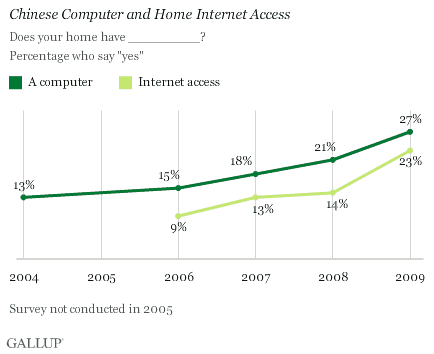
4. INTERNET USAGE IN CHINA IS SURGING

Kevin Sullivan at the Compass reports that Chinese internet usage is surging.


23% of a billion is a lot of people.

5. CHINA FACING HOUSING BUBBLE?

James Hamilton at Econbrowser asks whether China is facing a housing bubble.


6. NEW SANCTIONS ON NORTH KOREA

Craig Whitlock and Karen DeYoung at the Washington Post report that the US has announced that it will impose further sanctions on North Korea.

7. INSURANCE COMPANIES ABANDONING IRANIAN SHIPPING

Thomas Erdbrink and Colum Lynch at the Washington Post report that insurance companies have abandoned their relationship with Iranian shipping in order to comply with new US sanctions. Ports will refuse to allow Iranian ships entry if they are not covered for potential damages. Worth reading in full.

8. KURDS BLOW UP TURKO-IRANIAN GAS PIPELINE

Ivan Watson and Yesim Comert at CNN report that Kurdish rebels today took credit for the bombing of a Turkish-Iranian gas pipeline.
"An official from BOTAS, Turkey's state oil and gas company, speaking on condition of anonymity, told CNN that the fire had been extinguished. However, the official said, it will take at least six days to resume pumping fuel through the pipeline. In the meantime, BOTAS has increased the flow of gas from Azerbaijan to compensate for the gas cut."
9. INDIA AND PAKISTAN DISPUTE KASHMIR DAM

Lydia Polgreen and Sabrina Tavernise at the New York Times report that tensions are rising over the construction of a dam in Jammu-Kashmir. Pakistan is worried that India will be able to control water flow to its farmers during planting season. Worth reading in full.

10. COLOMBIA LOOKING UP

Frontier Markets optimistically notes that Colombia is emerging from its drug war. Investors will be more likely to place their money in Colombia than, say, Venezuela.

12. HOUSING HEADED FOR A DOUBLE DIP?

Barbara Kiviat at the Curious Capitalist argues that a double dip in housing is likely.

13. CRUDE AND PRODUCTS STORAGE INCREASES

The EIA reports that crude oil stocks grew by .4 million barrels in the week ended July 16th. Gasoline stocks grew by 1.1 million and distillate stocks grew by 3.9 million barrels. The national price of gasoline rose by 0.4 cents to 272.2 cents per gallon for the week ended July 19th. (Prices between $2.50 and $3.00 per gallon is where you start to see modification of use.) For the week ended 7/16 refinery utilization crept up to 91.5%.

Monday, July 19, 2010

Daily Sources 7/19

GOLDMAN SACHS BEING FROZEN OUT OF EUROPEAN SOVEREIGN DEBT OFFERINGS

Elena Moya at the Guardian UK reports that European governments are freezing Goldman Sachs out of debt offerings. An observer in France says that there would be rioting in the streets if Paris chose Goldman to lead a bond sale. Worth reading in full.

PRIVATE EQUITY INVESTMENT IN INDIA GROWING RAPIDLY

James Lamont at beyondbrics reports that India's private equity market is predicted to reach $17 billion this year.
"New investments will originate from the US where investors seek to participate in India and China’s high growth profiles. Average deal size among private equity investments this year is already between $50m and $200m, up from an average of $21m last year."
CLINTON ANNOUNCES NEW AID PROJECTS FOR PAKISTAN

BBC News reports that US Secretary of State Hillary Clinton announced a number of new aid projects for Pakistan worth $500 million. The projects include the building of two new hydroelectric dams. The aid money comes from a five year $7.5 billion aid package agreed to by Congress last year.

HUNGARY SUSPENDS BUDGETARY REVIEW BY IMF AND EU

Judy Dempsey at the New York Times reports that Hungary's government has stated that it will not pursue further austerity measures despite pressure from international creditors. The IMF and EU suspended a budgetary review of Hungary over the weekend.

MOODY'S DOWNGRADES IRISH DEBT

Matthew Saltmarsh at the New York Times reports that Ireland's debt has been downgraded by Moody's to Aa2 from Aa1. It's outlook has been changed from stable to negative. Not sure why anyone would pay any attention to the ratings agencies after this last bugaboo, but there you have it. The rating is still well above junk.

IRANIAN REVOLUTIONARY GUARD PULLS OUT OF PHASES 15 AND 16 OF SOUTH PARS

Aresu Eqbali at Platts reports that due to sanctions, the Iranian Revolutionary Guard has pulled out of phases 15 and 16 of the South Pars project.
"The IRGC and its affiliates have grown into an economic power in Iran, largely as a result of a succession of UN sanctions imposed by the international community over suspicions that Tehran is secretly developing nuclear weapons, a charge the Iranians deny.

The involvement of IRGC or its subsidiaries would make it difficult to source parts and equipment from foreign companies, which run the risk of being in breach of the sanctions should they have to deal with Khatam al-Anbiya or any other banned entity."
BOEING SELLS 30 777S TO DUBAI

Christopher Drew at the New York Times reports that the Dubai-based Emirates Airlines has put in a purchase order to Boeing for 30 777s. Airbus has sold 131 commercial airplanes this year; Boeing has sold 177.

WATER START UP SEEKS MARKETS IN INDIA, SAUDI ARABIA, CYPRUS AND IRAQ

John Collins Rudolf reports that a start up company in Texas plans to ship fresh water from Sitka, Alaska, to markets in India, Saudi Arabia, Iraq, and Cyprus. The company has no contracts yet, but has signed a deal with Sitka.

MOZAMBIQUE SOURCE OF COKING COAL FOR CHINA, INDIA, AND SOUTH AFRICA

Frontier Markets reports that interest is growing in Mozambique from China, India, and South Africa due to its reserves of coking coal for use in their steel plants.

BUILDER CONFIDENCE IN NEWLY BUILT, SINGLE FAMILY HOMES DECLINES ACCORDING TO HMI

Free exchange opines that the outlook for housing will be grim for the foreseeable future.


TWO AND HALF MILLION UNEMPLOYED LOSE ACCESS TO UNEMPLOYMENT BENEFITS

Phil Izzo at Real Time Economics reports that 2,502,000 jobless Americans have lost access to unemployment benefits since June 2.
"The Senate is expected next week to vote to extend unemployment benefits, but the delay has caused a lapse in benefits for some 2.5 million of the nation’s jobless."
Meanwhile, Tom Barkley at Real Time Economics reports that the National Association for Business Economics survey of 84 companies found that they were back in hiring mode. Meanwhile, Free Exchange reproduces a Brookings graph which plots the length of time it will take for jobs to reach the height seen prior to the recession with how many jobs need to be created.


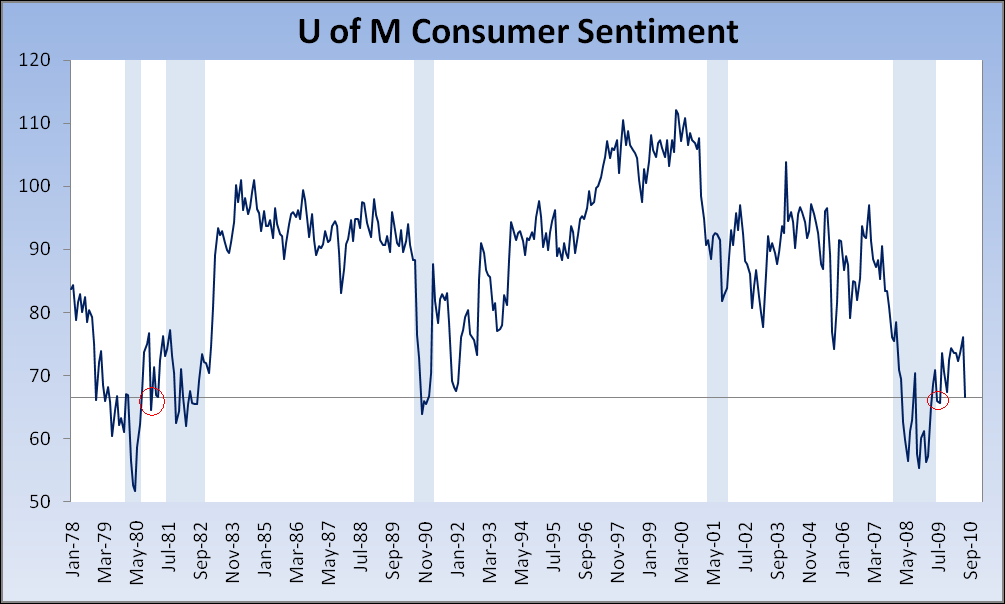
Invictus at the Big Picture reproduces a graph from the University of Michigan's Consumer Sentiment Survey and notes that the reading looks a lot like the last time we had a double dip recession.


THE CLEVELAND FED REPORTS THAT THE PUBLIC EXPECTS INFLATION TO STAY BELOW 2% OVER THE NEXT DECADE
"The Cleveland Fed’s estimate of inflation expectations is based on a model that combines information from a number of sources to address the shortcomings of other, commonly used measures, such as the "break-even" rate derived from Treasury inflation protected securities (TIPS) or survey-based estimates."

Thursday, July 15, 2010

Daily Sources 7/15

1. FRANCE, GERMANY AND THE UK WORKING TO CONVINCE EU TO ADOPT 30% CARBON REDUCTIONS BY 2020

Paul Whitehead at Platts reports that France, Germany and the UK have launched an effort to convince the EU as a whole to adopt a measure calling for 30% carbon reductions by 2020. The current goal for the EU is a 20% reduction by 2020.

2. TURKISH CENTRAL BANK LEAVES BENCHMARK RATE UNCHANGED

Steve Bryant at Bloomberg reports that the Turkish central bank left its key benchmark rate unchanged at 7%.

3. CHINESE GDP GROWTH UP BY 10.3% IN THE SECOND QUARTER

BBC reports that GDP in China grew by 10.3% in the second quarter, down from the 11.9% seen in the first quarter.
"Other official Chinese figures show retail sales are growing at around 18% a year, which suggests that consumption is still rising."
Meanwhile, Frontier Markets reports that manufacturing is already switching from China to other, cheaper, locales. Michael Schuman at the Curious Capitalist notes that some economists expect China to relax lending quotas again in a second stimulus.

4. MICHAEL PETTIS ARGUES THAT A FLOOD OF MONEY TO THE US IS MORE LIKELY THAN CHINA DUMPING US TREASURIES

Michael Pettis at Chinese Financial Markets argues that the US is more likely to see a "tsunami" of foreign capital entering the country than China exercising the "nuclear option" and selling its US treasuries holdings. He says the latter cannot and will not happen. Worth reading in full.

5. JAPANESE CARBON EMISSIONS CUTS GOALS INCOMPATIBLE WITH PROJECTED INDUSTRIAL DEMAND GROWTH

Hong Chou Hui at Platts writes that a new report by a consultancy predicts that Japanese manufacturing may be forced overseas if its goal for carbon emissions reductions--25% by 2020--are to be met. Forecasts of growth in industrial power demand are incompatible with the carbon emissions goals.

6. UAE AMBASSADOR SAYS AN ATTACK ON IRAN PREFERABLE TO IRANIAN NUCLEAR WEAPONS

Alexander Smoltczyk and Bernhard Zand at Der Spiegel report that the UAE ambassador to the US said
"A military attack on Iran by whomever would be a disaster, but Iran with a nuclear weapon would be a bigger disaster."
Spiegel concludes that an axis is forming against Iran in the Middle East.

7. TWO HOUSES BEING KEPT OFF MARKET FOR EVERY HOUSE ON SALE

Yves Smith at naked capitalism reports that for every house on sale there are two houses being kept off the market, or shadow housing.
"James Saccacio, CEO of RealtyTrac, said at the current pace, more than 3m properties will receive a foreclosure filing by the end of the year, and lenders will repossess more than 1m of them. According to a report from the Toronto-based Capital Economics, the weight of the shadow inventory may contribute to a double dip in the housing market. The report found that for every home currently on the market, two homes are waiting to be sold."


8. 429,000 NEW JOBLESS CLAIMS LAST WEEK

Kelly Evans at Real Time Economics reports that there were 429,000 initial jobless claims last week.

9. INDUSTRIAL PRODUCTION UP 0.1%

Courtney Schlisserman at Bloomberg reports that industrial production rose 0.1% in June.

Thursday, August 6, 2009

Daily Sources 8/6

1. JAPANESE GOVT REPORT COMPARES PARTY PLANS FOR GREENHOUSE GAS EMISSIONS REDUCTIONS ON ECONOMY

Yoko Kubota at Reuters reports that the plan by Japanese opposition party to cut greenhouse gas emissions by 25% from 1990 levels by 2020 would, per a government report, "push down real gross domestic product growth by 3.2 percentage points and the unemployment rate could grow by 1.3 percentage points." The government plan for an 8% reduction from 1990 levels by 2020 would, per the report, "push down Japan's economic growth by 0.6 percentage points and raise unemployment by 0.2 percentage points in 2020."

2. PBOC'S MONETARY REPORT INDICATES EASY CREDIT POLICY TO CONTINUE, MINISTRY OF HUMAN RESOURCES WARNS EMPLOYMENT SITUATION GRAVE, ELECTRICITY DATA SHOWS STEEP FALLS IN CONSUMPTION, BANKS LEND LESS IN JULY CONTRA PBOC REPORT, AND BP SAYS GDP DATA MORE OR LESS TRUSTWORTHY

Andrew Batson at the Wall Street Journal reports that the People's Bank of China's quarterly monetary report reaffirmed its commitment to continuing easy credit policies.
"'China's economy is now in a critical period of stabilization and recovery, and maintaining stable and rapid economic growth is still the most important task we face ... . Although the general trend of stabilization in the [global] economy has been basically established, the process of recovery may be slow and tortuous.'

With global demand for China's exports still weak, a solid rebound depends on domestic consumption and investment, the central bank said. Chinese companies may be more willing to ramp up production now that inventories have been reduced.

Sentiment among private-sector businesses remains weak, it said, and consumers' worries about future income could crimp spending. 'The foundation of the economic recovery is not yet stable,' it said, echoing other agencies' recent comments."
In a somewhat different take on the question of whether migrant unemployed in China are a reason to worry from the story cited yesterday--see Daily Sources 8/5 #1--Yves Smith links to an AFP report that
"China Tuesday warned of a 'grave' situation in the jobs market with millions of graduates and migrant workers yet to find work as companies continue to struggle with the effects of the global slump...

'China's current employment situation is still grave and the pressure for job creation remains large,' said Wang Yadong, a senior official at the Ministry of Human Resources and Social Security's employment section."
She also notes that:
"First-half electricity use by small and medium-sized enterprises fell almost 50% year-on-year, as these companies were more exposed to the economic downturn, the National Bureau of Statistics said on August 3.

SMEs saw power consumption plunge 48.9% year-on-year, against a 5.9% industry-wide drop."
And in contrast to the affirmation of the People's Bank of China in its quarterly report mentioned above:
"China's big state-owned commercial banks extended around 168 billion yuan worth of new loans in July, down sharply from the 497 billion issued in June, banking sources told Caijing on August 4."
And she picks up on the story in the FT yesterday that if you add up the output numbers of the various provinces, they are 10% more than overall national output as reported by Beijing. And to muddy the waters further, Sheetal Nasta at Platts reports that the chief Asia economist of BP, Chi Zhang, said at an event at the British Chamber of Commerce in Shanghai Wednesday that
"'in general, [the] data reflects economic growth reality,' given that China is 'very manufacturing intensive and there has been a lot of industrialization and an urbanization process is going on.'

While he admitted the Chinese have been likely 'taking advantage of low energy prices,' he retreated from the notion that government stockpiling was inflating prices.

Speaking of the oil price spike in 2008, he said data from BP's annual statistical review, issued earlier this year, shows that the 'big spike' in (price) coincided with related economic activity, primarily supply-side constraints due to investment shortfalls, geopolitical issues and few technological breakthroughs."
The continuing incredulity regarding official output growth numbers in China was driven by the disparity between the electricity consumption numbers, which are no longer published--see Daily Sources 6/8 #6--later reinforced by skepticism expressed in the May report by the International Energy Agency which suggested that oil demand would have been stronger than reported if it were to reconcile with the GDP numbers and suggested the possibility that "Real GDP data aren’t accurate and shouldn’t be taken at face value"--see Daily Sources 5/14 #2.

3. GERMAN FINANCE MINISTER SAYS FINANCIAL SECTOR RETURNING TO 'CASINO CAPITALISM', ECB MAINTAINS BENCHMARK RATE AND INDICATES THERE WILL BE NO ADDT'L STIMULUS

Der Spiegel reports that Finance Minister Peer Steinbrück is in the media warning against the return of 'casino capitalism.' Among other comments, he said:
"In the United States and Britain, lobbyists are already questioning some regulatory measures."
and, in Germany,
"Taxpayers are continuing to completely finance big bonuses [at banking firms]."
Meanwhile, Christian Vits and Simone Meier at Bloomberg report that European Central Bank president Jean-Claude Trichet indicated that the bank is unlikely to provide further stimulus after its monetary committee left the benchmark interest rate at 1%.
"Rates are 'appropriate' and policy makers are 'satisfied' with their asset-purchase program and measures to improve the flow of credit, he said."
"The ECB currently predicts the euro-region economy will contract about 4.6% this year and 0.3% in 2010. Inflation will average about 0.3% this year and 1% in 2010. The bank aims to keep inflation just below 2%."
4. BANK OF ENGLAND TO EXPAND QUANTITATIVE EASING, LONDON TO REPLACE SHORT HAUL AVIATION WITH HIGH SPEED RAIL

Niel Shah at the Wall Street Journal reports that the Bank of England today announced it would expand its quantitative easing program, increasing purchases by £50 billion (~ $85 billion) to a total of £175 billion.
"The increase required the bank to get special permission from the UK Treasury, which had previously capped the program at £150 billion.

The expansion of the program suggests policy makers are still worried about the long term outlook for the UK economy despite a recent spate of positive data pointing to recoveries in house prices, manufacturing and services."
"While banks' reserves of cash have more than tripled since the central bank launched the program back in March, one broad measure of lending in the economy--M4 money supply excluding certain financial intermediaries--has hardly budged. In the second quarter, the measure was up just 3.1% from the same period a year earlier, the weakest expansion since 1999.

Beyond that, rising unemployment and peoples' efforts to pare down heavy debt loads are likely to weigh on consumer spending, by far the largest driver of demand in the UK economy. As of May, the UK unemployment rate stood at 7.6%, the highest level in 12 years."
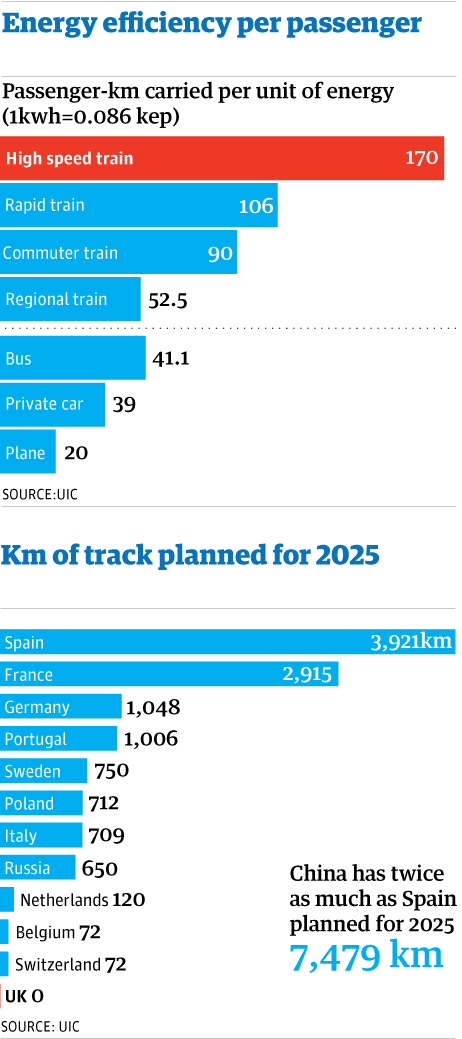
Meanwhile, Dan Milmo and Julian Glover at the Guardian report that Downing Street has announced plans which would replace domestic air travel with a high speed--250 mph--rail.
"The transport secretary, Lord Adonis, said switching 46 million domestic air passengers a year to a multibillion-pound north-south rail line was 'manifestly in the public interest'. Marking a government shift against aviation, Adonis added that rail journeys should be preferred to plane trips.

'For reasons of carbon reduction and wider environmental benefits, it is manifestly in the public interest that we systematically replace short-haul aviation with high-speed rail. But we would have to have, of course, the high-speed network before we can do it,' he said."

5. GEORGIAN AND RUSSIAN OFFICIALS TRY TO CALM WORRIES ABOUT NEW FIGHTING BREAKING OUT, SAAKASHVILI LAYS BLAME FOR 2008 CONFLICT ON MOSCOW IN OP ED

Jim Heintz at the Associated Press reports that senior officials in Tblisi and Moscow are walking back from rhetoric suggesting the possibility of renewed fighting.
"The deputy chief of Russia's general staff says Georgia is too weak after the war that devastated its military and caused an estimated $1 billion damage to the struggling country.

Georgia's national security adviser, however, says the danger of new fighting appears low because of 'preventive diplomacy' and because Russia knows a new war would undermine its influence among neighbors and rapprochement with the West."
In the meantime, Georgian President Mikheil Saakashvili has an op ed in today's Washington Post which lays the blame on last year's conflict squarely on Russia. Key excerpt:
"Russian provocations have not stopped; snipers in Russian-controlled areas have killed 28 Georgian policemen. In recent days, Moscow has engaged in a series of provocative acts and statements, echoing its prelude to last year's invasion. Even as the world watches, Moscow has vetoed monitoring missions from the United Nations and the Organization for Security and Cooperation in Europe. In violation of the cease-fire, Russia also denies European Union monitors access to the occupied territories.

Despite all this, and contrary to some expectations, Georgia has rebounded. Our democratic institutions are growing. Foreign investors are returning. The world should recognize that the kind of behavior Russia exhibited last August threatens not only Georgia but our entire region."
6. TURKISH PM MEETS WITH HEAD OF LARGEST TURKISH KURD PARTY, ANKARA SIGNS ON TO SOUTH STREAM

Nicholas Birch at the Wall Street Journal reports that Prime Minister Recep Tayyip Erdogan of Turkey met with the leader of the main Kurdish party in the country Wednesday, in what is the first meeting of the head of government with the party in the country's history.
"[M]any analysts say the new Kurdish opening is qualitatively different from anything that came before.

'For the first time ever, Turkish state institutions are working in synch to solve the problem,' said Henri Barkey, a Turkish expert at the Carnegie Endowment for International Peace, a Washington-based think tank.

The main catalyst for Turkey's new sense of urgency is Washington's announcement that it plans to pull its soldiers out of Iraq, Turkey's southern neighbor, by 2011.

The planned withdrawal has speeded up a rapprochement between Turkey and Iraqi Kurds, whose relations have been blighted for years by the PKK's use of Iraqi Kurdish mountains for its military bases."
"'There is an economic side to the rapprochement. "Turkey wants to use northern Iraqi gas for Nabucco,' says Bayram Bozyel, a Turkish Kurdish politician, referring to a pipeline project that the US and EU hope will help break a Russian stranglehold on European natural-gas supplies. 'And the [Iraqi] Kurds want to pump gas north.' That would be risky in the midst of a guerrilla war. The PKK claimed responsibility last year for a bomb attack on a major oil pipeline that passes through the same region."
Well worth reading.Today Russia and Turkey signed a deal to route Russia's South Stream pipeline through Turkey, per Charles Recknagel at RFE/RL.
"'The South Stream pipeline is a much needed project that is particularly important in the context of ensuring the energy security of the whole of Europe and the development of a broad range of ties between Russia and Turkey,' Putin said. 'Our negotiations showed that we can find solutions, together with the Turkish leadership, that open the way to new, large-scale energy projects.'"
7. IRAN LOWERS OFFICIAL PRICE OF OIL SOLD TO ASIA, QATAR LOWERS OFFICIAL PRICE OF OIL, FOLLOWING SAUDI ARAMCO REDUCTION ON PRICE TO ASIA

Yee Kai Pin at Bloomberg reports that the National Iranian Oil Company will reduce the official selling price of Iranian Light into Asia for the first time in four months.
"[NIOC] will set Iranian Light for September at 9 cents a barrel above the average of Persian Gulf benchmarks Oman and Dubai grades, based on a quarterly formula tied to prices set by Saudi Arabian Oil Co. The premium will be down $1.75, or 95%, from August and will be the smallest in seven months."
Meanwhile, Yee Kai Pin reports that Qatar Petroleum will also reduce the official selling price of Qatari crudes.
"The state-owned company cut its July price of Qatar Land crude oil to $65.50/b, down $5.60 from June, the official Qatar News Agency said on its Web site. The July price of Qatar Marine grade was reduced by $5.38 to $64.72/b. The cuts are the first in five months."
Earlier this week, Saudi Aramco cut its official selling price of Arab Light into Asia--see Daily Sources 8/3 #6. (The middle eastern national oil companies have different official prices for different regions of the world.)

8. DUBAI'S PROPERTY PRICE COLLAPSE SHARPEST IN WORLD

Kevin Brass at the New York Times reports that Dubai's property market is leading the world in price collapse.
"Dubai prices have dropped 32% in the last year and 40% in the last quarter, according to the latest edition of the Knight Frank Global House Price Index, released today.

Along with Dubai, Latvia (36%) and Singapore (23.8%) saw the largest declines since the first quarter of 2008, the property firm reports."
9. MEND LEADER INDICATES MOST NIGER DELTA MILITANTS WANT TO TAKE ADVANTAGE OF AMNESTY PROGRAM WHICH OFFICIALLY BEGAN TODAY; ANALYSTS DOUBT DIRE NIGERIAN PRODUCTION NUMBERS

Dulue Mbachu at Bloomberg reports that the leader of Nigerian militant group MEND indicated in a telephone interview that most fighters want to accept the government's amnesty program, saying "Like the government, we also want peace for there to be development."
"A government panel set up last year recommended raising the share of revenue going to states in the oil region to 25% from the current 13%. MEND wants the oil region to control 100% of oil revenue and pay a tax to the central government, according to the group’s spokesman, Jomo Gbomo.

'Whatever the people are demanding is also what I want,' Okah said, declining to commit to a figure.

The MEND leader said militant commanders in the oil region are divided between those who want money in exchange for weapons, as offered by the government, and those who want their political demands met.

'Personally I want a situation where weapons will be surrendered without cash,' Okah said. 'Because people can submit their weapons and buy new ones.'"
BBC News reports on the amnesty program which officially began today.
"Officials said gunmen who accept amnesty would be given 65,000 naira ($433; £255) a month for food and living expenses during the rehabilitation program, which runs from 6 August to 4 October.

But the main rebel group in the region, the Movement for the Emancipation of the Niger Delta (MEND), has not yet said it will take part in the amnesty.

'When we choose to disarm, it will be done freely, knowing that the reason for our uprising which is the emancipation of the Niger Delta from neglect and injustice has been achieved,' the group said in statement e-mailed to the AFP news agency.

The group, which called a temporary ceasefire last month after one of its leaders was freed from jail, is in talks with senior officials about the terms of any possible amnesty."


Tom Burgis at FT Energy Source reports that many believe that the current numbers for oil production coming from official Nigerian government sources are deliberately understated.
"On Wednesday afternoon, a Nigerian oil executive speaking in private snorted at the idea that production could be so low, suggesting 1.6m b/d was more accurate. Stewart Williams, principal sub-Saharan Africa analyst at energy consultancy Wood Mackenzie, puts production at 1.5m b/d to 1.6m b/d.

Why the discrepancy? Analysts with a cynical streak (easily acquired in a country so riddled with corruption and electoral violence) remark that it is in the state’s interest to create a sense of crisis as it tries to force through a comprehensive reform of the oil sector.

That the bill has merits--including the promise of greater transparency and restructuring the hopelessly ineffective state company--misses the point. Oil companies and the delta’s influential governors, who stand to get less cash as a result, are united in opposition to it.

The oil companies, too, are making data scarce at the moment. Like the government, they may have an interest in uncertainty as the negotiations continue."
10. BRAZILIAN SENATE'S INVESTIGATION INTO PETROBRAS TAX EVASION AND CORRUPTION CHARGES BEGIN TODAY, LULA INDICATES THAT HE BACKS FULL CONTROL OF PRE-SALT FOR PETROBRAS

Helder Marinho and Alexander Ragir at Bloomberg report that the Brazilian Senate's investigation into tax evasion and corruption allegations against state oil company Petrobras began today.
"An 11-member Senate committee, led by a member of [Brazilian President Luiz Inacio Lula da Silva's], Workers’ Party, is investigating the allegations. [CEO Jose Sergio] Gabrielli told Petrobras’s 74,000 employees in a July 14 letter that the company fired three employees after an internal investigation, and cooperated with the prosecutor’s office and federal police, into the bidding process for oil platforms.

Gabrielli, Chief Financial Officer Almir Barbassa and Haroldo Lima, the head of Brazil’s petroleum regulator, are among officials the committee in charge of the probe will invite to testify, according to a list senators handed to reporters during a session of the probe committee held today.

The officials will not be legally summoned or required to speak under oath, and the hearings will be arranged at their convenience, Senator Romero Juca said today in Brasilia. Juca, the head of the government coalition in the Senate, is responsible for leading the probe and writing its reports. Fired Petrobras executives will not be called to testify, he said."
"Since Lula first took office in January 2003, lawmakers have set up 25 committees to investigate everything from health insurance plans to piracy of industrial goods and corruption, according to CAC Consultoria Politica, a Brasilia-based political consultancy. While some ended without any conclusion, a 2005 investigation into allegations the Workers’ Party paid bribes to legislators in exchange for votes in Congress led to the resignation of Lula’s chief of staff, Jose Dirceu."
Natuza Nery at Reuters reported yesterday that Lula was to propose to Congress today that Petrobas be the exclusive operator of new offshore sub-salt oil fields. In June, resolutions were being introduced in the Brazilian Senate to create a new, 100% state-owned company, to lease Brazil's sub-salt fields--see Daily Sources 6/12 #11. (A majority of voting shares in Petrobras are owned by the government, but foreign investors own about 60% of its total outstanding stock.)

11. VENEZUELA TO PURCHASE SEVERAL DOZEN TANKS FROM RUSSIA, BANS COLOMBIAN STATE OIL COMPANY FROM PARTICIPATION IN ORINOCO BELT

Fabiola Sanchez at the Associated Press reports that President Hugo Chávez in a news conference yesterday said that Venezuela was going to purchase several dozen Russian tanks in a deal he wants to seal during a visit to Russia in September.
"'We're going to buy several battalions of Russian tanks,' Chavez said ...

Chavez's government has already bought more than $4 billion worth of Russian arms since 2005, including helicopters, fighter jets and Kalashnikov assault rifles.

The socialist leader called Colombia's plan to host more US soldiers a 'hostile act' and a 'true threat' to Venezuela and its leftist allies. He warned that a possible US buildup could lead to the 'start of a war in South America,' but gave no indication that Venezuela's military is mobilizing in preparation for any conflict."
"Cuban ex-President Fidel Castro supported Chavez in a column published Wednesday on the Cubadebate Web site, saying that 'Venezuela isn't arming itself against the sister nation of Colombia, it's arming itself against the (US) empire.'

'The threat ... is directed at all the countries' of South America, Castro wrote."
Meanwhile, Upstream online reports that Chávez told journalists yesterday that Ecopetrol, Colombia's national oil company, will have no role in developing the Orinoco belt.
"Chávez said ... that Colombia’s increased cooperation with the US to fight guerrillas and drugs is part of the US’s long- term plan to invade Venezuela and seize the Orinoco Belt."
"Ecopetrol was one of 19 companies that paid $2 million apiece for detailed information on the Carabobo block in the Orinoco Belt."
12. 24% OF OWNER-OCCUPIED HOMES UNDER WATER IN US, PERSONAL SAVINGS RATE INCREASE AHISTORICAL IN FACE OF REDUCED FEDERAL TAX RECEIPTS, AND AS UNEMPLOYMENT LOOKS SET TO CONTINUE TO RISE

Nick Timiraos at Developments reports that 24% of owner-occupied homes had mortgage debt which exceeded the market value of the home in question at the end of June, according to data from Equifax and Moody’s Economy.com.
"That number rises to 32% when looking at the share of homeowners with mortgages that don’t have equity left in their homes.

Overall, 16 million homeowners are 'upside-down' on their mortgages, up from 10 million, or 15% of owner-occupied homes, one year ago.

Nearly 10% of owner-occupied homes now have mortgage debt with loan-to-value ratios of at least 125%, and roughly half of those homes have mortgage debt with loan-to-value ratios of 150% or more."
In her most recent series of posts, Rebecca Wilder at News N Economics notes that a) this recession is different from past recessions in the sense that the personal savings rate is trending up:


And b) that the Daily Treasury Statement of August 4 "shows that the 1-month cumulative sum of income tax receipts (withheld plus paid taxes) is dropping at a 13% annual pace." She comments:
"This is the most up-to-date macroeconomic information out there, as most of the reports are 1-2 months old at the time of release. And the implication of this DTS is: that personal income and spending, which just released this week for June ... are likely to be weak into July."
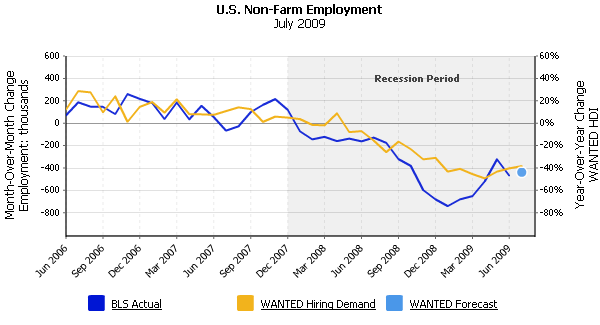
In that vein, Barry Ritholtz links to a graph by Bruce Murray, CEO of WANTED USA, plotting the actual month over month change in non-farm unemployment against year over year percent change in hiring demand:


13. RAIL TRAFFIC VOLUMES BOTTOMED OUT AT 18.9% BELOW LAST YEAR'S NUMBERS

The Railfax report is out today, and seems to indicate that rail traffic volumes have reached a bottom and holding steady at about 18.9% below their seasonal levels. Their chart for weekly loaded units in North America for the week ended August 1 in four week rolling averages:


Their chart for crushed stone and lumber and wood products, key components in construction, in four week rolling averages for North America:

Tuesday, August 4, 2009

Daily Sources 8/4

1. IEA WARNS THAT $70 OIL COULD UNDERMINE ECONOMIC RECOVERY

Kate Mackenzie at the Financial Times reports that the IEA's chief economist, Fatih Birol, told the newspaper in an interview that oil prices above $70/b would likely undermine any economic recovery.
"'If we go one step further, if we see prices go much higher than that, we may see it slow down and strangle economic recovery,' he said of oil prices on Friday, when the European benchmark was around $70."
2. CHINA MAY CHANGE RULES TO MAKE SUBORDINATED BONDS INELIGIBLE AS CAPITAL, WHICH SHOULD REDUCE THE VOLUME OF CREDIT

Wang Ming and Rose Yu at the Wall Street Journal report that the China Banking Regulatory Commission
"may deem subordinated bonds issued by a bank ineligible as capital if those bonds are held by another bank, the person said. The banking regulator estimates about half the subordinated bonds in circulation are held by other banks.

The amount that banks in China can lend is governed by technical capital ratios -- the more capital, the more room to lend. A big way banks have raised capital is by selling yuan-denominated subordinated bonds, or debt instruments that offer investors less protection in the event an issuer can't repay but also a higher yield than regular bonds."
"Analysts said any curb on how subordinated debt can be used would likely slow lending, because it would limit the appetite of the market's biggest investors, which are banks.

'If the regulator excludes cross-held subordinated bonds from being classified as part of banks' capital, banks will have to try to sell their bonds to nonbanking investors,' said Guo Tianyong, the director of the Finance Research Center at Beijing's Central University of Finance and Economics. That will be difficult, Mr Guo said, and 'as a result, banks will slow the pace of subordinated-bond issues, which would eventually lead to a slowdown in credit growth.'

She Minhua, an analyst at Haitong Securities, said, 'Changing the rules would effectively cause a further decline in banks' capital adequacy ratios, so the fastest way for them to maintain a healthy ratio would be to cut loans.'"
3. CHINESE SEABORNE OIL IMPORTS UP 26% IN JULY YOY

Bloomberg reports that preliminary data from the Chinese Ministry of Transportation indicates that Chinese seaborne imports grew by 26% in July from a year previous.
"Chinese ports unloaded about 16.27 million metric tons, or 3.8 million barrels a day, of imported crude last month ... ."
4. NORTH KOREA RELEASES US JOURNALISTS DURING FORMER POTUS VISIT

Heejin Koo at Bloomberg reports that North Korean leader Kim Jong Il pardoned and ordered the release of two American journalists who had been arrested after allegedly crossing into North Korean territory.
"By seeking an amnesty, the US appears to be conceding that the two reporters broke North Korea’s laws, Paik [Hak Soon, a researcher on North Korean issues at Sejong Institute] said.

'The visit indicates that the US and North Korea are willing to resolve this matter through dialogue,' he said. 'We’ll have to see if this expands to the nuclear issue.'"
"The former president and the North Korean leader 'had an exhaustive conversation' and a 'wide-ranging exchange of views on the matters of common concern,' [the] Korean Central News Agency said without giving further details. The country’s National Defense Commission hosted Clinton at a dinner in his honor, the agency said."
Pyongyang has been long seeking direct bilateral talks with the US regarding its disputes with the international community.

5. AUSTRALIAN CENTRAL BANK LEAVES BENCHMARK INTEREST RATE UNCHANGED AT 3%, RETAIL SALES ARE DOWN 1.4% IN JUNE FROM MAY

EcPulse reports that the Reserve Bank of Australia decided today to maintain their benchmark interest rate at 3%.
"[Reserve Bank Governor] Stevens said in his statement that the world economy started to show clear signs of stability, thanks for the global stimulus plans set by governments around the world that led to an improving outlook for the world economy. He added that the US economy reached a turning point, while the economy in the euro zone is still weak."
Meanwhile, Jacob Greber at Bloomberg reports that Australian retail sales fell by 1.4% in June from May.
"Today’s report suggests the impact from A$12 billion ($10 billion) in government cash handouts to households is waning after consumer spending helped Australia avoid a recession in the first quarter. Still, the economy may expand in the second quarter after retail sales rose 2% in the three months through June. Economists forecast a 1.3% gain.

'We still have retail sales at a very strong levels,' said Ben Dinte, an economist at Macquarie Group Ltd. in Sydney. 'With the strengthening consumer sentiment, we should see retail sales hold up.'

The quarterly retail sales figure accounts for as much as 25% of Australia’s gross domestic product, Dinte added."
6. RUSSIA AND TURKEY TO SIGN PACT TO BUILD OIL PIPELINE WHICH WOULD BYPASS THE BOSPHORUS

Ali Berat Meric and Stephen Bierman at Bloomberg report that Russia and Turkey will sign an accord to build a pipeline to send oil to the Mediterranean bypassing the Strait of Bosphorus.
"OAO Gazprom, Russia’s largest company, and Turkey’s Calik Holding AS will sign an accord to build a pipeline between the northeastern port of Samsun and a terminal at Ceyhan on Turkey’s Mediterranean coast, Russian Energy Minister Sergei Shmatko told reporters in Ankara today before a visit by Russian Prime Minister Vladimir Putin later this week."
7. GERMAN BIRTH RATE MAY HAVE DECLINED

Der Spiegel reports that a report released yesterday by Eurostat indicates that
"for every thousand inhabitants in Germany, only 8.2 children were born in 2008. Which indicates a decrease of 0.1% in the German birth rate and makes Germany the only EU member in which the crude birth rate did not increase between 2007 and 2008."
8. HILLARY CLINTON EXPRESSES CONCERN REGARDING HIKERS ARRESTED NEAR IRANIAN BORDER

Nada Bakri at the Washington Post reports that yesterday Secretary of State Hillary Clinton expressed concern about the welfare of three American hikers who were arrested after entering an area near the Iranian border. Of course, the incident will be used by elements in Tehran as evidence that the recent elections unrest is the result of foreign meddling.

9. MEXICO MAY INTRODUCE FUEL EFFICIENCY STANDARDS

Robert Campbell at Reuters reported yesterday that the head of the Mexican National Ecology Institute, Adrian Fernandez, said in an interview that Mexico is planning to introduce fuel efficiency standards for all new cars sold in the country.
"The government is currently studying which type of standards to impose but it is leaning towards a plan that would be similar to proposed fuel efficiency rules in California or other parts of the United States, ... Fernandez said in an interview.

'The standard will cut gasoline imports by as much as a new refinery.'"
Imprecise, but it would have a significant effect.

10. VENEZUELA TO NATIONALIZE COFFEE COMPANIES, LAUNCHES INVESTIGATION INTO SWEDISH ARMS FOUND IN FARC CAMP

Steven Bodzin and Daniel Cancel at Bloomberg report that Venezuelan President Hugo Chávez said today on state television that he was considering nationalizing two coffee companies after having seized their processing plants yesterday. He said,
"We’ve intervened in these big companies. Now we are conducting a study to expropriate them. They will become property of the nation."
Meanwhile, the Associated Press reports that Caracas has indicated it has launched a probe into how arms purchased from Sweden ended up in the hands of FARC guerrillas in Colombia.
"Justice Minister Tareck El Aissami said authorities had launched 'an internal investigation ... to determine the origin and destination of these weapons,' referring to Swedish-made AT-4 launchers that Colombia says were found in a cache belonging to guerrillas.

El Aissami gave no indication, however, that Chavez's administration was easing its stance toward Colombia amid a diplomatic fight that erupted last week after Colombian President Alvaro Uribe complained the weapons had been acquired by the Revolutionary Armed Forces of Colombia ... ."
12. RUSSIA SIGNS ACCORD WITH NICARAGUA TO EXPLORE FOR OIL AND GAS

Eric Watkins at the Oil & Gas Journal reports that the Nicaraguan government has signed accords with a Russian consortium allowing for oil and gas exploration and production in the country.
"'The concessions include the Caribbean and Pacific, both offshore and on land,' said Francisco Lopez, president of the Nicaraguan Petroleum Enterprise. He said a technical board would be installed to analyze implementation of the agreement.

Russia’s Deputy Prime Minister Igor Sechin said the proposed exploration in Nicaragua would be carried out by the Russian National Oil Consortium, created on Oct. 8, 2008, and comprising Rosneft, Gazprom, Lukoil, TNK-BP, and Surgutneftegaz."
13. ANTIGUA AND BARBUDA NAMES HIGHEST PEAK ON ISLANDS "MOUNT OBAMA"

Nika Kentish at the Associated Press reports that the Antiguan Prime Minister, Baldwin Spencer, today renamed the highest mountain in Antigua and Barbuda "Mount Obama." He said at the dedication ceremony:
"This great political achievement by Barack Obama resonated with me in a way that I felt compelled to do something symbolic and inspiring. As an emancipated people linked to our common ancestral heritage and a history of dehumanizing enslavement, we need to at all times celebrate our heroes and leaders who through their actions inspire us to do great and noble things."
14. HAVIV ARGUES 'SHADOW INVENTORY' LOOMS OVER US HOUSING MARKET

Julie Haviv at Reuters reports that so-called "shadow inventory" is hanging over the US home market.
"'The number of homes listed officially on the market, while still at historically high levels, might be only the tip of the iceberg,' said Stan Humphries, chief economist at real estate website Zillow.com in Seattle, Washington.

According to Zillow's latest Homeowner Confidence Survey, 12% of homeowners said they would be 'very likely' to put their home on the market in the next 12 months if they saw signs of a real estate market turnaround, 8% said 'likely,' while 12 percent said 'somewhat likely.'

The survey of 2,123 adults aged 18 and older, of whom 1,357 are homeowners, was conducted online.

Survey results could translate into around 20 million homeowners trying to sell their homes, a startling number given that the Census bureau indicates there are 93 million US houses, condos and co-ops, Humphries said."
15. HURRICANE SEASON UNDERWAY IN US, GAO STUDY FINDS REFINERY OUTAGES HAVE VERY SMALL AFFECT UPON PRICE

Jesse's Café Américain notes that the hurricane season is underway, and that the peak is usually in mid-September. He notes that "Hurricanes offer a tempting opportunity for energy 'investment.'" I would note, however, that insofar as a legitimate reason for hedging goes, hurricanes are certainly one--and those who want to hedge will need counterparties. Meanwhile, Michael Giberson at Knowledge Problem has the fascinating news that the Government Accountability Office has released a report showing that refinery outages generally have a very small affect upon prices. The report, which I have not had time to read, can be found here.

16. WAL-MART LAST WEEK ISSUED $1.1 BILLION IN SAMURAI BONDS

In a story I missed last week, Lisa Twaronite at MarketWatch reported that Wal-Mart issued US$1.1 billion in yen-denominated bonds (¥100 billion).
"The market for samurai bonds--yen-denominated bonds issued by foreign institutions in Japan--evaporated in the global credit storm. But including Wal-Mart's offering, samurai issuances in July are expected to exceed 200 billion yen--the largest amount since June 2008, Japanese business daily Nikkei reported Wednesday."
Apparently the market is drowning in dollars. (h/t Chuck Butler's Daily Pfenning.)

Monday, August 3, 2009

Daily Sources 8/3

1. EUROPE RETURNING TO NUCLEAR POWER

Kate Mackenzie at FT Energy Source has a good summary of the nuclear renaissance in Europe--where several countries have reversed, or are in the process of reversing, decisions to eliminate nuclear power from the generation mix.

2. TBLISI SAYS MOSCOW ATTEMPTING LAND GRAB FROM SOUTH OSSETIA

Misha Dzhindzhikhashvili at the Associated Press reports that Tblisi today accused Russia of attempting to take more territory outside the breakaway province of South Ossetia.
"'It's very alarming that as the first anniversary of the Russian aggression against Georgia comes close, Russia and its puppets are deliberately inciting tensions and behave defiantly,' the Georgian Foreign Ministry said.

But South Ossetia's spokeswoman Irina Gagloyeva told The Associated Press that the border move was legitimate and rejected any land-grabbing ambitions.

'Let the Georgians relax about their territory. We don't need a single centimeter of their soil,' Gagloyeva said."
3. CHINESE CRUDE STOCKS FALL 2.7% IN JUNE FROM MAY, REFINERIES PRODUCED 7.77 MB/D

Jim Bai and Aizhu Chen at Reuters write that Xinhua reported that Chinese crude stocks fell by 2.7% in June from May to 275 million barrels.
"Chinese refineries boosted production by 6% in June to a record 7.77 mb/d after a rise in domestic motor fuel prices aided margins."
4. TOKYO CONCERNED BY SLATE OF IRANIAN NEWS OF NEW CHINESE-IRANIAN OIL DEALS

Kyodo News reports that Tokyo has responded to the news aired in Iran that CNPC was to take a 70% share in South Azadegan, a field which Japan had secured interest earlier but dropped it on international concern about Tehran's nuclear program, by calling for renewed international cooperation on the issue. Japanese Vice Economy, Trade and Industry Minister Harufumi Mochizuki said "It is not desirable that international cooperation collapses this way." CNPC on Friday had denied that a new MOU regarding the field had been signed--see Daily Sources 7/31 #7. Tamsin Carlisle at the National reports that on Saturday a Chinese consortium signed a deal to build a new 360 kb/d refinery in Khuzestan province and expand the capacity of a refinery in Abadan to 360 kb/d from 210 kb/d. Carlisle provides a decent summary of Chinese-Iranian energy deals this year and further in the past as well as different details on the CNPC Azadegan deal:
"The agreement called for CNPC to purchase a 63% stake in the $2.5bn project from NIOC, leaving the Iranian state oil company with a 27% interest and Japan’s Inpex with 10%."
5. INDIA AND CHINA TO COOPERATE ON MONITORING HIMALAYAN MELTING GLACIERS

James Lamont at the Financial Times reports that India and China will collaborate on monitoring melting glaciers in the Himalayas, a crucial source of water supply for both countries.
"Jairam Ramesh, India's environment minister, said academic research bodies on both sides would share information. He also told the FT that New Delhi was also open to a dialogue about water resources with Beijing, saying the two countries had shared concerns."
6. SAUDI ARAMCO TO CUT PRICES, OPEC PRODUCING SLIGHTLY MORE IN JULY FROM JUNE

Christian Schmollinger at Bloomberg report that Saudi Aramco may cut the price of Arab Light crude oil by as average of $1.30/b,
"according to a survey of refiners from South Korea, Japan, Singapore and India. The company is expected to set new official levels this week. Extra Light may fall by $1.40/b, said the traders who asked not to be identified, citing confidentiality agreements.

Saudi Arabian Oil, known as Saudi Aramco, last month raised Arab Light by 10 cents to a premium of $1.50/b to the average of Persian Gulf benchmark’s Oman and Dubai. That was the highest price since July 2008. Asian refiners have been reducing their output as falling consumer demand has cut their so-called crack spreads, or profit margins."
Meanwhile, Karyn Peterson and Mark Shenk at Bloomberg report that the news wire's latest survey showed that OPEC increased oil output by 45kb/d to 28.39 mb/d in July from June."The 11 OPEC members with quotas ... pumped 26.035 mb/d, 1.19 million more than their target."
"Iran, the member that’s least compliant with output limits, according to the survey, expects oil prices to reach $80/b by the end of the year on 'optimistic' signs in the market, the country’s OPEC Governor, Mohammad Ali Khatibi, said.

Angola increased production by 20,000 barrels to 1.81 mb/d. The gain left output 293,000 barrels above the nation’s target, the second-biggest excess in the group. Output in the African country surpassed Nigeria’s for the first time since June 2008.

Venezuela raised output by 10,000 barrels to 2.21 mb/d. The South American country pumped 224 kb/d above its target of 1.986 million last month, the survey showed."
7. 100 IRANIAN POLITICIANS PUT ON TRIAL FOR FOMENTING UNREST IN COOPERATION WITH FOREIGNERS, LOTR FORMERLY INAUGURATES AHMADINEJAD'S SECOND TERM

Borzou Daragahi at the LA Times reported yesterday that Iran put 100 prominent politicians on trial, charging them with fomenting unrest in conspiracy with foreigners.
"Analysts say the confessions read at the trials are meant to lift the morale of hard-liners upset by coverage by reformist news outlets and Persian-language news channels abroad as well as to frighten opponents and take the wind out of the sails of the protest movement.

But as night fell, Tehran, the capital, erupted in angry cries of 'Allahu Akbar!' or 'God is great!' in what has become a daily rooftop ritual of protest."
The nighttime chants deliberately mirror events of the 1979 revolution. Thomas Erdbrink at the Washington Post reports that today Mahmoud Ahmadinejad was inaugurated by Leader of the Revolution Ayatollah Ali Khamenei as president for a second term. Karroubi, Mousavi, and Rafsanjani all elected not to attend the ceremony.
"Relatives of the late Ayatollah Ruhollah Khomeini, who led Iran's 1979 Islamic revolution, also failed to show up. According to pro-opposition Web sites, Hassan Khomeini, a grandson who usually attends such ceremonies, left for Pakistan some days ago. Other prominent absentees were two Friday prayer leaders from the Shiite holy city of Qom, the Parlemannews Web site reported."
8. NIGERIAN AGRICULTURAL POTENTIAL UNTAPPED, LEAVING FOOD SUPPLY VULNERABLE

David Hecht at the Washington Post notes that Nigeria's food supply is especially vulnerable to a disruption caused by low rainfall or other climate-driven variables. He concludes:
"The good news is that Nigeria has boundless agricultural potential. Of the 3.14 million irrigable hectares of land in the country, the World Bank says only 7% is currently being utilized. And though large tracts of farmland have been lost to desertification, more than half the country's estimated 98 million hectares of arable land currently lie fallow.

'The opportunities for our farmers are enormous if only they were to get the right institutional support,' said Sabo Nanono, the head of Kano state's commercial farmers association. 'We could feed the entire West African region; we could produce enough rice in just two or three [of Nigeria's 36] states to feed the nation and even to export.'

Somehow, the supply chain that feeds 140 million people keeps cranking along. The country has not seen a major famine for nearly four decades, since the Biafran civil war. But Nanono warned that it wouldn't take much to send this vulnerable country--and region--over the edge.

'The reality is that if the rains are bad throughout the region or the price of inputs became unaffordable, there could be massive food shortages, and neither the government nor any other institution stands ready to help,' he said. 'Then only God could save us.'"
Hecht's report is part of the Food Insecurity Project.

9. SOUTH AFRICAN PMI DOWN TO 37.3 IN JULY

Nasreen Seria at Bloomberg reports that South Africa's PMI fell to 37.3 in July from 37.9 in June. It is the first fall in PMI seen in three months.
"Manufacturing output, which makes up 15% of the economy, fell 17.1% in May from a year ago, after dropping a record 21.8% in the previous month, the statistics office said on July 9. Production has dropped every month since October 2008."
10. SETSER AND ZIEMBA ESTIMATE MAJOR SOVEREIGN WEALTH FUNDS HOLD ABOUT $1.5 TRILLION IN FOREIGN ASSETS, DOWN FROM $1.8 TRILLION LAST YEAR

Brad Setser and Rachel Ziemba at Follow the Money estimate, in contrast to other estimates, that total external assets of major sovereign wealth funds roughly were about $1.5 trillion as of June 2009, down from their estimate of roughly $1.8 trillion held in the middle of 2008.
"$1.5 trillion is lot of money. But it is substantially less than $7 trillion or so held as traditional foreign exchange reserves."
The post includes an extremely interesting table of estimated assets held by each major sovereign wealth funds at the bottom.

11. 1.5 MILLION TO EXHAUST INITIAL UNEMPLOYMENT INSURANCE IN THE NEXT FEW MONTHS, 1-IN-3 GROCERY SHOPPERS NOW ONLY PURCHASE ITEMS ON SALE

Barry Ritholtz has a pair of posts looking at the rate of people who have exhausted their unemployment insurance. In the first, he notes that the New York Times estimates that about 1.5 million more people will have exhausted their unemployment insurance over the course of the next few months. He links to a helpful graph from the NY Times:


In the second, he notes, as have others such as Rebecca Wilder at News and Economics, that there are additional unemployment programs available after one exhausts the initial unemployment insurance:
"[T]he Emergency Unemployment Compensation (EUC) which is good for 20 weeks. Then, there is the Supplemental EUC, which depending upon what your state thinks of the Federal largesse of handing out money to the recently unemployed, ranges anywhere from 13 to 20 more weeks."
Evidently, as of July 11, the number of people who have exhausted their initial unemployment insurance and are now on EUC or supplemental EUC, has gone from 127,000 a year ago to 2.66 million. The worry is that given that 70% of the economy is based on household consumption, growing unemployment will undermine any nascent recovery. In that vein, Credit Bubble Stocks notes that Information Resources Inc. has published market research which concludes that now
"about 1 in 3 [grocery] shoppers buy exclusively items on sale, twice as many as 18 months ago."
12. US PMI UP TO 48.9 IN JULY

Mark Shenk at Bloomberg reports that the Institute for Supply Management released its PMI today showing an uptick to 48.9 in July from 44.8 in June. (A reading above 50 indicates expansion; below 50 indicates contraction.) It is the highest reading seen since August 2008.

13. CHEVRON TO END ALL ONSHORE GAS DRILLING IN THE US

I missed the interesting factoid reported Friday by the Associated Press that Chevron will stop all US onshore gas rigs on low profitability this year.
"'By the end of the year, we will not have a single gas land-rig running,' George Kirkland, Chevron’s executive vice president for global upstream and gas said in a conference call."

Friday, July 31, 2009

Daily Sources 7/31

1. MESSERLIN AND MAREL ARGUE THE US & EC COULD REAP GAINS BY OPENING SERVICES SECTOR

Patrick A Messerlin and Erik van der Marel at VoxEU argue that the US and the European Commission should launch transatlantic negotiations in opening the services sector as a prelude to multilateral negotiations. Key excerpts:
"Services providers are busy redesigning their strategies for coping with the ongoing economic crisis. To take the appropriate decisions, they need predictable future market access in services. Meanwhile, as many services are still highly protected, opening services markets would deliver large benefits to consumers impoverished by the crisis."
"Is there any appetite for services negotiations now? Yes. The July 2008 Signalling Conference held under the aegis of the Doha Round showed a substantial number of participants expressing strong interests in most services, offers and requests in mode 3 in many services (foreign direct investment), and even a willingness to include mode 4 (movement of natural persons, by far the most contentious part of any service negotiations) in some services.

Such a willingness to negotiate appears particularly strong in three services: business, communication, and distribution services. Together, these three services in the EC, US, and top eight countries represent almost one-third of the world GDP, a size so huge that negotiators could work on deals within as well as between these services sectors. The three services face high levels of regulatory constraints, ensuring huge economic gains in case of market opening. Finally, negotiations are made easier by the fact that business and communication services are resilient to the current crisis, while the inflationist pressures to come should make governments eager to have distribution services as competitive as possible.

Last but not least, the foreign policy dimension of the whole endeavour is crucial for Europe. Many US decision-makers are looking to Asia for good reasons (Bergsten, 2009) while Europeans have not yet fully grasped the growing importance of Asia nor captured its attention, as illustrated by the disappointing June 2009 Asia Europe Ministerial meeting on energy."
2. EUROZONE UNEMPLOYMENT UP TO 9.4% IN JUNE, CONSUMER PRICES FELL AT ANNUAL RATE OF 0.6%

Reuters reports that eurozone unemployment rose to 9.4% in June, up from a revised figure of 9.3% in May.
"The European Union’s statistics office also said on Friday that inflation in the euro area had moved much further into negative territory than forecast in July, with consumer prices falling at an annualized rate of 0.6%.

The drop raised worries about deflation and heightened expectations that the European Central Bank will maintain its loose monetary policy."
3. US OPEN TO BRINGING RUSSIA INTO NATO

Yevgeny Bendersky at the Compass reports that
"Assistant Secretary of State Philip Gordon told US lawmakers Tuesday during the House International Relations Committee hearing that the United States would consider Russian membership in NATO."
Gordon said:
"[I]f Russia meets the criteria and can contribute to common security, and there is a consensus in the alliance, it shouldn't be excluded."
Bendersky points out that some in Eastern Europe might be cold to the idea. Given that membership would freeze, so to speak, the current borders by militarily integrating the members, it may arguably provide superior protection than the current relationship. It certainly would make adventurism a much more complicated affair.

4. NIPPON OIL IN TALKS WITH SK ENERGY TO BUILD NEW REFINERY IN VIETNAM

Megumi Yamanaka and Yuji Okada at Bloomberg report that Nippon Oil Company has announced it might build a refinery in Vietnam with SK Energy Co.
"'We’ve been in talks with SK and have agreed on the need for participating in a refining project' in Asia, Nippon Oil Chairman Fumiaki Watari said in an interview in Tokyo yesterday. Vietnam is a potential location for the first venture between Japan and South Korea’s biggest refiners, and the plant may process 200-300 kb/d of crude oil, he said.

Seo Young Joon, a spokesman at SK Energy in Seoul, said he couldn’t immediately comment. Idemitsu Kosan Co., Japan’s second-largest refiner, and Mitsui Chemicals Inc. plan to spend $5.8 billion to build a 200 kb/d plant in Vietnam."
"'We know that about 25% of Japan’s refining capacity will be unnecessary in the next five years.' Watari said."
Vietnam inaugurated its first refinery this year with capacity of 148 kb/d and which is poised to supply about 30% of Vietnam's product requirement--see Daily Sources 7/28 #8. The EIA projects its total petroleum demand was about 288 kb/d in 2008. Hanoi projects GDP will grow by 5.5% in 2009, adding perhaps as much as 10 kb/d in demand this year.

5. INDIAN FIELD BEGINNING PRODUCTION TO UP INDIAN CRUDE PRODUCTION BY 25%

The Economic Times reports that Indian crude production is expected to rise by about 25% when Cairn begins pumping from the Mangla field of its Rajasthan acreage next month.
"'We are operationally ready to commence oil production in August,' Cairn India CEO Rahul Dhir said. In its various filings to the government, Cairn has indicated that production will quickly touch 30 kb/d by the end of third quarter this year and reach a plateau of 175 kb/d (8.75 million tonnes a year) in 2011. Goldman Sachs, however, has pegged the peak output at 190 kb/d (9.5 million tonnes a year)."
Using EIA projections, Indian crude production in 2008 was 693.7 kb/d. Its imports came in at 2.056 mb/d, so the Mangla field at 175 kb/d would represent about 8.5% of its import requirement. However, some of those imports are reexported as products, for example to the US--Reliance is set to restart its old Jamnagar refinery shortly, bringing another 660,000 kb/d of nameplate capacity on line. It is expected to double Reliance gasoline exports to about 170 kb/d.

6. PAKISTANI SUPREME COURT REJECTS PETITION TO TRY MUSHARRAF ON TREASON CHARGES

BBC News reports that the Pakistani Supreme Court has rejected a petition to try former President Musharraf on charges of treason.
"The court had asked him to explain his decision in 2007 to invoke emergency rule and suspend the constitution.

It has now ruled that parliament is the place to debate Mr Musharraf's actions.

Chief Justice Iftikhar Mohammed Chaudhry rejected a petition to launch a treason case against the former president.

Mr Chaudhry was himself removed from his position as a result of President Musharraf's imposition of emergency rule, but was reinstated after he resigned in August."
For more on the lawyers revolution in Pakistan, I wrote a long piece on it early last year--see The Law in Pakistan.

7. 40 DAY CYCLE OF PROTESTS IN IRAN MIRROR 1979 REVOLUTION, PRESS REPORTS OF CHINESE-IRAN MOU ON SOUTH AZADEGAN FIELD DENIED BY CNPC, US SENATE TO BAR THOSE SELLING PETROLEUM PRODUCTS TO IRAN FROM PARTICIPATION IN SPR

Michael Collins Dunn at the MEI Editor's Blog observes that the 40-day cycle in protests seen in the 1979 Iranian Revolution is being repeated in the current conflict over the elections. Juan Cole at Informed Comment has a good roundup of the recent political events in Iran. Meanwhile, Upstream Online notes that there have been stories that CNPC has signed an MOU with NIOC to develop the South Azadegan oilfield, taking a 70% stake in the field in return for covering 90% of development costs.
"However, a CNPC manager based in Beijing told Reuters today that the MoU was actually signed earlier this year and there has been no real breakthrough in talks with the oil ministry since then.

'The MoU is not a binding contract, and we are still negotiating with NIOC about specific details,' the CNPC source, who declined to be named because he was not authorized to speak to the media, told the news agency."
In the meantime, Jean Chemnick and Katharine Fraser at Platts report that the US Senate has inserted language into the Senate Energy and Water Appropriations bill [H.R. 3183] which would prohibit companies that sell gasoline and diesel to Iran from entering into contracts to fill the Strategic Petroleum Reserve.
"At least three companies fit that bill, Glencore, Shell Trading and Vitol, according to the Foundation for Defense of Democracies. In January, the three were named by DOE as suppliers to the SPR for deliveries this year. While it could not be immediately confirmed whether any of the three currently sell refined products to Iran, all of them are known active traders in oil markets throughout the world."
In June, Reliance--a private oil company in India--halted gasoline exports to Iran, apparently because they expected difficulties for their exports to the US--see Daily Sources 6/4 #8. The UAE provides about 80% of Iranian product requirements, IIRC.

8. BAHRAIN CENTRAL BANK SEIZES TWO BANKS HELD BY SAUDI CONGLOMERATES

Frederik Richter at Reuters reports that the central bank of Bahrain has seized two banks owned by major Saudi conglomerates.
"The central bank said in a statement on Thursday it had assumed control of Awal Bank, owned by Saad Group and The International Banking Corporation, a unit of the Ahmad Hamad Algosaibi and Brothers conglomerate.

The central bank said an investigation at both banks had shown a substantial shortfall in assets compared with their liabilities and that it would appoint an external administrator to identify creditors' claims and manage the distribution of the remaining assets."
9. NIGERIAN PRESIDENT ENTERS TALKS WITH 6 NIGER DELTA GOVERNORS TO PREVENT THREATENED BOYCOTT OF MILITANT AMNESTY PLAN

Platts reports that Nigerian President Umaru Yar'Adua has begun talks with six governors from the Niger Delta in an effort to avert a threatened boycott of the amnesty program for militants in the region.
"The governors of southern Akwa Ibom, Bayelsa, Edo, Delta, Cross River and Rivers states last week said they would pull back their involvement in the amnesty deal for Delta militants in protest of the federal government's plan to relocate the petroleum training college in Delta state to northern city of Kaduna.

'There is a serious misunderstanding about some of the issues raised, but the president is very concerned and has been talking with the Niger Delta governors individually,' Presidential spokesman Olusegun Adeniyi in a statement. 'The president has respect for the Niger Delta region. He did not approach the crisis in the area as a Northerner.'

The governors also had grouse against a provision in the oil sector reform bill, which they said takes away royalties due Delta communities."
Earlier this week, the Nigerian Joint Revolutionary Council--an umbrella group of militants in the Niger Delta which includes MEND--warned a company linked to a current oil minister to stop operations to express their displeasure with the plan to locate the petroleum university in the north--see Daily Sources 7/28 #9.

10. US ENVOY FOR SUDAN RECOMMENDS TAKING KHARTOUM OF TERRORIST LIST

Reuters reports that General Scott Gration, the US special envoy for Sudan, recommended to Congress that Sudan be taken off the state sponsors of terrorism list.
"'There is no evidence in our intelligence community that supports [Sudan] being on the state sponsors of terrorism list,' Gration said. 'It's a political decision.'"
"'We are actually hurting the very development things we need to do help the south become ... if they chose to secede, a viable economic state,' Gration said, noting that Washington could not bring in heavy equipment to build roads and railways.

'At some point we are going to have to unwind some of these sanctions so that we can do the very things that we need to do to ensure a peaceful transition and a state that's viable in the (south) should they choose to do that,' he added.

In its latest report, the State Department described Sudan as 'a cooperative partner in global counterterrorism efforts.'"
11. CHÁVEZ PROPOSES LAW GIVING GOVT ARBITRARY POWER TO CONTROL MEDIA

Fausta Wertz at the Compass has the best summary of the news that Hugo Chávez's administration has now proposed a set of laws which would limit broadcasting rights and would make the rather arbitrarily defined violations are punishable with prison terms.
"The proposed law ... includes all media and applies to not only owners and publishers but also reporters, freelancers and anyone making a statement that could be interpreted as (my translation) 'any person who manipulates or distorts the news, creating a false perception of facts... as long as there is damage to social peace, national security, public order, or the mental health or public morals.'

The charge carries a compulsory 2-4 year prison sentence."
Wertz includes a link to the text of the law. She notes that the UN has registered its worries regarding the proposed legislation, but projects the protest will have little affect upon the administration's decision-making process ... correctly in my view.

12. RESEARCHERS FIND THAT EFFORTS TO HALT OVERFISHING ARE SUCCESSFUL

BBC News reports that a team of researchers have released the findings of a two-year study which concludes that efforts to halt overfishing in 5 of 10 marine ecosytems have helped fishing stocks to recover.
"The authors observed: 'Some of the most spectacular rebuilding efforts have involved bold experimentation with closed areas, [fishing] gear restrictions and new approaches to catch allocations and enforcement.'

But they warned that the signs of recovery should not be interpreted by policymakers as a sign that all was well beneath the waves.

The majority of fisheries were still in trouble, and were not being managed or regulated properly.

But Dr Worm said that the team's 'watershed paper' offered a blueprint for sustainable fishing.

'It clearly shows what needs to be done to not only avoid fisheries collapse, but to actually rebuild fish stocks and ecosystems.'"
(h/t Yves Smith at naked capitalism.)

13. US GDP DOWN AT ANNUALIZED RATE OF 1% IN Q2, CHICAGO PMI INDICATES BOTTOM

The Bureau of Economic Analysis released its estimation today that Q2 GDP fell at an annualized rate of 1%. Ed Harrison of Credit Writedowns observes:
"Down 1.5% was the consensus expectation. But Q1 was revised down to minus 6.4% from 5.5%. The GDP Deflator for Q2 came in at 0.2%, which shows that disinflation risks tipping into deflation still. The dollar is weaker and the short end of the treasury curve is up massively on these data and revisions.

Also ... the 2008 numbers were revised down. Q1 2008 was revised from positive 0.9% to negative –0.7%. Q2 2008 was revised way down as well from 2.8% to 1.5%. Q3 2008 was also very negative, now –2.7%. This confirms the December 2007 recession call.

There was a $140 billion reduction in inventories in Q2. I have been saying for some time that this would set us up for lots of upside come Q3 and Q4 as the inventory purge dissipates. So, we will get a technical recovery in my opinion. The question is whether there is any underlying demand uptick behind the inventory changes. In the data ... from the BEA website, you can clearly see ... that consumers are not even spending on basic items. Spending on non-durable goods was down 2.5% annualized. That is not good."
Peter Boockvar at the Big Picture reports that the Chicago PMI was 43.4 in July, up from 39.9 in June. (PMI readings of above 50 indicate expansion; below 50 indicates contraction.) He observes:
"Inventories remained extremely lean, falling to 25.4 from 34.2, the lowest since 1949 and is the perfect set up for a sharp contribution to GDP from this area in the 2nd half of the year, led by auto’s and related sectors. The employment index rose 6.4 points to 35.3, well below 50 but at the highest level since Dec ‘08. Prices paid fell a touch. Bottom line, the data confirms the backdrop for an improvement in GDP. The degree and sustainability of the recovery will however remain in the hands of end demand, aka, predominantly the US consumer."
Rebecca Wilder at News N Economics observes that
"Households have been 'delevering' for a longer time period than previously thought--as recent as 2008 Q1, the saving rate that was reported to be essentially zero, 0.2%, is now 1.2%."
Her chart of the US savings rate (with revisions as of today):

"The BEA has 'found' that households have been in fact saving roughly 1% of their disposable income per quarter since 1995, 0.9% per quarter in 2008."
Well worth a look, as always.