Showing posts with label Canada. Show all posts

Monday, June 29, 2009

Daily Sources 6/29

1. IEA REVISES GLOBAL OIL DEMAND DOWN TO AN AVERAGE ANNUAL RATE OF 0.6% FROM 2008-14

Carola Hoyos at the Financial Times reports that the IEA has cut its forecast for incremental global oil demand from 2008-14 to an average annual rate of 0.6% or 540 kb/d, bring total consumption to 89 mb/d from 85.8 mb/d.
"This latest forecast is 3.3 mb/d lower than the previous forecast for 2013 volumes. If the agency’s most pessimistic economic scenario proves correct, oil demand could contract, with consumption falling to 84.9 mb/d by 2014, it said in a report."
Managing Director Nobuo Tanaka suggested that the current environment makes forecasting especially difficult and noted that the data on which the forecast was made, for April, is already old.

2. JAPANESE LNG IMPORTS DOWN 19.6% IN MAY FROM APRIL, BUT INDUSTRIAL PRODUCTION UP 5.9% IN MAY FROM APRIL--BOTH ARE DOWN 18.8% AND 30% FROM MAY 2008, RESPECTIVELY

Jonty Rushforth at Platts reports that Japan imported 4.24 million metric tons of LNG in May, down 18.8% from May 2008 and "19.6% from April, when Japan imported 5.27 million metric tons." (The Platts story includes a table of imports by source, month over month and year over year.) It is interesting in the context of the report released Sunday by the Ministry of Economy Trade and Industry (METI) which showed industrial production up 5.9% in May from April, though still down 30% year over year, as per Jake at Econopix. Their chart:


There has evidently been a rebound in production of passenger cars, which account for about 8.5% of the industrial production index. Worth a look.

3. NDRC RAISES GUIDELINE PRICES ON DIESEL & GASOLINE (SLIGHTLY LESS IN THE SOUTH)

Bloomberg reports that the National Development and Reform Commission announced yesterday that it will raise the price of diesel and gasoline today by as much as 11%. Prices for both will be lifted by 600 renminbi a metric ton ($87.80 or roughly $11.71/b ~ $0.28/gallon).
"Today’s price increases will vary by city and region, according to the NDRC’s statement.

In Beijing, the new ceiling price per ton for the retail grade of gasoline that meets euro III standards, known as 90 octane, will be 7930 yuan a ton (~$1,162/ton ~ $136.71/b ~ $3.26/gallon), while the ceiling price in southern Guangdong province is set at 7795 yuan (~1,142/ton ~ $134.38/b ~ $3.20/gallon)."
Guangdong is the center of economic growth in China, if I understand correctly. The NDRC is raising prices in part due to the surge in demand for cars, driven by the stimulus program.

4. PBOC GOVERNOR SAYS CHINESE RESERVE POLICY WILL NOT CHANGE SUDDENLY

Stephanie Phang at Bloomberg reports that People’s Bank of China Governor Zhou Xiaochuan told journalists today that "Our foreign-exchange reserve policy is always quite stable. There are not any sudden changes." This follows the release of the bank's review on Friday, which appeared to reiterate formally the call for an alternative to the dollar--see Daily Sources 6/26 #1. Yves Smith at naked capitalism comments:
"This certainly looks like a retreat, although Zhou may simply be clarifying the difference between long term policies and immediate plans. But that still begs the question of when and how the transition between the two comes into play.

The tension may also reflect the need to posture aggressively before a domestic audience without unduly rattling markets. But it may also result from the need to appease certain interests within the government. A New York Times article last year explained that as the central bank took foreign exchange losses as the RMB rose, it may have to go hat in hand to the finance ministry, which opposes many of the central bank's policies, particularly on the dollar ...."
5. CHINA PASSES NEW STATISTICS LAW

Andrew Batson at China Journal reports that on Saturday China passed a new law to take effect next year which will stiffen penalties for falsifying social and economic data.
"Recently, officials of the National Bureau of Statistics have become more forthcoming about deficiencies in their data, and have also started publishing a more detailed accounting of economic growth. And this year’s economic census, a quinquennial attempt to obtain basic information on every company of economic significance in the nation, is the centerpiece of the bureau’s effort to build up more accurate figures through the use modern survey techniques."
Batson quotes some examples of the misreporting the government is trying to eradicate:
"* In 2001, a township government in Liaoning province in 2001 instructed the villages it oversees to report quarterly economic indicators that were precisely one-fourth of the annual target, to ensure that the target was met.

* In one town near Ningbo, Zhejiang province, a party secretary reported a total industrial output of 463 million yuan in 2001, which was later determined to be 76% more than the actual figure.

* The leaders of one town near Chongqing in 2004 altered the statistical reports of local companies they sent to higher authorities, in one case changing output of 5 million yuan to 8 million yuan, and in another adding a zero to make output of 3 million yuan into 30 million yuan.

* Over-reporting is not confined to eager officials: one company in Wenzhou, Zhejiang province reported output of 32.15 million yuan in 2003, which was then discovered to exceed the actual figure by 71%."
The post includes a number of links to sources--worth a look.

6. NATO & RUSSIA RESUME OFFICIAL TIES; RUSSIA STARTS WARGAMES IN THE CAUCASUS, A FEW WEEKS AFTER NATO WARGAMES IN GEORGIA

The Associated Press reports that NATO and Russia have resumed ties after NATO suspended them in reaction to the Georgia conflict.
"Russian Foreign Minister Sergei Lavrov met his counterparts from NATO's 28 member nations on the western Greek island of Corfu ahead of a broader informal meeting of ministers from the 56-nation Organization for Security and Cooperation in Europe.

Mr. Scheffer described the talks as 'open and constructive, which means we did not try to paper over our differences on Georgia, for example. But we agreed not to allow those agreements to bring the [NATO-Russia Council] to a halt.'

He said the renewed military contacts would involve meetings of the chiefs of staff of Russia and NATO countries.

The meeting in Corfu, which came as President Barack Obama and Russian President Dmitry Medvedev prepare to hold a summit next week, reflected the trend toward improved relations with Russia."
Meanwhile, Michael Schwirtz at the New York Times reports that Russia has begun war games using 8,500 troops from all branches of the armed services in the Caucasus region.
"The event is also occurring a few weeks after NATO concluded its own exercises in Georgia, drawing complaints from the Russians.

'The Russian exercises, given the timing, are a definitive response,' said Dmitri O. Rogozin, Russia’s envoy to NATO, Interfax reported. 'We are conducting them to ensure the defensive capabilities of Russia in those areas where we see threats.'

Georgia on Monday expressed worry about Russian exercises so close to its borders.

'These exercises are a source of concern because they involve an unprecedented number of servicemen and the newest military hardware of Russia,' said Alexander Nalbandov, Georgia’s deputy foreign minister, Interfax reported. 'We hope that the events of last August, when the Russian army invaded Georgia and occupied its lands, will not repeat.'"
7. GAZPROM SEALS PURCHASE OF 500 MILLION CU M OF NAT GAS FROM AZERBAIJAN IN 2010, SAYS IT WILL RECEIVE PREFERENTIAL TREATMENT ON SHAH DENIZ GAS

Lyubov Pronina and Lucian Kim at Bloomberg report that Russian President Medvedev sealed a deal in Baku today for Gazprom to purchase 500 million cubic meters of natural gas from Azerbaijan next year.
"Gazprom will get priority treatment when the State Oil Co. of Azerbaijan determines the buyers for the [Shah Deniz] offshore field, said Alexei Miller, chief executive officer of the Russian company. Azerbaijan’s gas production will rise 11% to 30 billion cubic meters next year, Aliyev said."
Shah Deniz is a key source of potential supply for the Nabucco pipeline project--the alternative possibility of sourcing from Iran looks particularly politically difficult at the moment.


This follows the news Friday that former German foreign minister Joschka Fischer has been signed on as a consultant to Nabucco--see Daily Sources 6/26 #3.

8. INDIAN REFINERS RUN 2.4% MORE CRUDE IN APRIL, DOWN 4.3% FROM MAY 2008

Vandana Hari at Platts reports that Indian refiners ran 12.77 million metric tons (~3.02 mb/d) of crude in May, up about 2.4% from April, but down 4.3% from May 2008.
"The utilization rate against the country's total installed refining capacity was 102.5% in May, versus 107.1% a year ago.

Between January and May, Indian refiners have run around 65.57 million metric tons of crude, roughly 1.5% lower from a year ago. The trend contrasts with a 3.6% year-on-year increase in 2008 crude throughput over 2007."
Reliance started operating the Jamnagar addition of 500 kb/d capacity on Christmas--see Daily Sources 1/7 #3.

9. IRAQI VP TO BOYCOTT TUESDAY AUCTION, OIL EXPORTS UP 80 KB/D IN MAY (THE ADDT'L OIL CAME FROM THE NORTH), AND THE CABINET WILL NOW DELAY RATIFICATION OF THE OIL AUCTIONS TOMORROW INDEFINITELY

Ahmed Rasheed at Reuters reports that Iraqi Vice President Tareq al-Hashemi has announced on his website that he will boycott the auction on Tuesday to award concessions for eight oil and gas fields.
"'There are many existing reservations over this vital issue concerning Iraq's oil resources,' Hashemi said in a letter, posted on his website, to Oil Minister Hussain al-Shahristani.

He urged the minister to 'hold off on awarding bids to the winning companies and give parliament enough time to study these bids,' said the letter, released by Hashemi's office."
Ben Lando at the Iraq Oil Report notes that Iraqi oil exports grew to 1.9 mb/d in May from 1.823 million in April.
"In the south, where most of Iraq’s production and exports are located, May was a down month, exporting only 1.38 mb/d compared to 1.413 mb/d in April. In the north, however, exports increased to 522.6 kb/d from 410 kb/d in April."
Meanwhile, Faleh al-Khayat at Platts reports that the oil ministry said today that it will not announce the winners of the auction tomorrow, and instead only provide the names of the bidders and a score card of their bidding parameters.
"The cabinet may refer the contracts for approval by the parliament if it
deems this as necessary, marking another new element in the process.

As a result, the August 15 deadline for contract ratification by the council of ministers has been pushed back indefinitely, senior sources close to the licensing department said.

'The winner will not be declared by the score of each bidder and the name of the bidder will be declared,' said one source.

The formula to determine the winning bid has also been changed whereby the ministry will give more weight to the incremental production rather than the remuneration fee submitted by each of the bidding companies, the sources said."
10. ISLAMIC EMIRATE OF AFGHANISTAN THINKS OBAMA IS A BIGGER THREAT TO THE JIHADIST MOVEMENT THAN BUSH

Thomas Hegghammer at jihadica reports that the main story of the July issue of the Arabic-language magazine of the Islamic Emirate of Afghanistan argues that the Obama administration is more dangerous to al-Qaeda than the Bush administration was. The primary reason is that Bush, through foolhardy policies, did much to undermine American power, in language the Obama administration has already disavowed. However, the writer argues that the policies, in effect, will not change. I couldn't agree more insofar as the writer believes that Obama will work to protect the national interest of the US, something that the Bush administration seemed to abandon. (The president's ability to wield soft power is generally more unbounded than hard power--I suggested, as did others, that Obama's credibility advantage will present the largest challenge to our enemies in a piece in March 2008:The Geopolitical Consequences of the Candidates.) Hegghammer's post is worth reading in full.

11. ISRAEL NOT TO PURCHASE LCS'S FROM LOCKHEED MARTIN

Galrahn at Information Dissemination reports that Israel has decided not to go ahead with plans to purchase a number of Lockheed Martin's Littoral Combat Ship (or LCS). Galrahn notes:
"The interesting part of this story isn't necessarily that Israel doesn't want to buy the LCS anymore, and that is a big deal. The interesting thing is that the US would fund the LCS, but not the MEKO [built by the Hamburg-based ThyssenKrupp Marine Systems (TKMS)], through FMS [the Financial Management Service bureau of the Treasury] grant money. By choosing to buy the MEKO, Israel will try to fudge the system and get some of the parts paid for by buying US, with US funding."
12. FAO POLICY BRIEF ON INTERNATIONAL INVESTMENTS IN THE AGRICULTURAL SECTOR IN AFRICA SUGGESTS CONCERN A LITTLE OVERPLAYED

Denis Drechsler and David Hallam at VoxEU argue that concern regarding foreign acquisition of African farmlands is somewhat misplaced. They note that official development assistance going to agriculture has been on a downward trend since 1995:


Key findings:
"* Investments have increased
* Deals seek access to resources, not markets
* Main form of investment: land purchase or long-term lease
* Share of total land assets owned by foreigners is small
* Major investors: Gulf States, China, Republic of Korea
* Main target region: Africa
* Investors: mostly private sector, but governments involved
* Investment partners in host countries: mainly governments
* New focus: production of basic foods and animal feed"
Worth a look.

13. HONDURAN PRESIDENT OUSTED BY MILITARY, HONDURAN SUPREME COURT AND CONGRESS SUPPORT THE MOVE, THE REST OF THE WORLD EXPRESSES CONCERN

William Booth and Juan Forero at the Washington Post report that soldiers forcibly removed President Manuel Zelaya from the Honduran presidential palace yesterday and put him on a plane to Costa Rica.
"Zelaya was removed from office as Hondurans prepared to vote Sunday in a nonbinding referendum asking them whether they would support a constituent assembly to rewrite the constitution. Zelaya's critics said he wanted to use the referendum to open the door to reelection after his term ends in January 2010, an assertion that he denied.

The referendum--which US officials described as more of a 'survey' than a true vote--was condemned by broad swaths of Honduran society as an obvious power grab. The Honduran Supreme Court called the referendum unconstitutional, and leaders of Zelaya's own party denounced the measure."


Both the Honduran National Congress and the Supreme Court voiced support for the move by the military to oust Zeyala. The Honduran military broke off contact with the US following the coup. (The Post article is worth reading in full.) Condemnation of the move was widespread, coming from the OAS to Venezuela to Cuba to the US.

15. CANADA PASSES SUBSIDY FOR PAPER SECTOR IN RESPONSE TO (ALTERNATIVE FUELS) SUBSIDY FOR US PAPER SECTOR

The Wall Street Journal's editorial board notes that in 2007 Congress extended a $0.50 credit for every gallon of a blend of traditional and alternative fuels used to a broad spectrum of corporations, and it turned out that "'black liquor,' a carbon-rich substance the paper industry has used for decades to power its mills, qualified.
"All the paper industry had to do was blend some fossil fuel in with their alternative fuel and--voila!--billions of dollars in federal subsidies were within reach. So they did."
The Journal notes that the US paper industry is set to collect $6 billion in tax credits in 2009, enough to reduce the cost of paper products by 25%.
"Not surprisingly, Canadian paper companies are miffed at this subsidized windfall to their competition. Now they've gotten their Parliament to do something about it. Following the two-wrongs-make-a-right logic of trade wars, Canadian lawmakers recently passed a subsidy worth $882 million for their domestic paper industry."
Worth reading in full.

16. BANK FAILURES UP IN US, CONCENTRATED IN GEORGIA, BUT CONSOLIDATION LIKELY HAS A WAYS TO GO

Rebecca Wilder at News N Economics reports that bank failures are up slightly in 2009 from 2008, but the sector's consolidation has yet to see the number of failures experienced during the S&L crisis. Her graph:

"Notice that roughly 20% of the bank failures in 2008 and 2009 have been in Georgia, or as Camden Fine says to the WSJ, 'Georgia is basically the Chernobyl of banking right now; it's radioactive down there'. And according to the Wall Street Journal, the failures in Georgia have only just begun ..."
Worth reading in full.

17. COLORADO PASSES NEW LAWS PERMITTING RAINWATER HARVESTING

Kirk Johnson at the New York Times reports that two new laws have been passed in Colorado which allow people with private wells to legally collect rainwater, formerly they had only been allowed to do so if they possessed the water rights on their property.
"State water officials acknowledged that they rarely enforced the old law. With the new laws, the state created a system of fines for rain catchers without a permit; previously the only option was to shut a collector down.

But Kevin Rein, Colorado’s assistant state engineer, said enforcement would focus on people who violated water rules on a large scale.

'It’s not going to be a situation where we’re sending out people to look in backyards,' Mr. Rein said.

Science has also stepped forward to underline how incorrect the old sweeping legal generalizations were.

A study in 2007 proved crucial to convincing Colorado lawmakers that rain catching would not rob water owners of their rights. It found that in an average year, 97 percent of the precipitation that fell in Douglas County, near Denver, never got anywhere near a stream. The water evaporated or was used by plants.

But the deeper questions about rain are what really gnawed at rain harvesters like Todd S. Anderson, a small-scale farmer just east of Durango. Mr. Anderson said catching rain was not just thrifty--he is so water conscious that he has not washed his truck in five years--but also morally correct because it used water that would otherwise be pumped from the ground."

Tuesday, June 23, 2009

Daily Sources 6/23

1. THE EU SUGGESTS IT IS COMFORTABLE WITH $70/B BUT NOT $80/B, OPEC SUGGESTS $80/B IS REQUIRED; BUNDESBANK ADDS TO LIST OF ECONOMIC ANALYSIS BLAMING OIL FOR PART OF CURRENT CRISIS; VERLEGER SAYS OIL TO GO TO $20/B BY DECEMBER

Kate Mackenzie at FT Energy Source reports that in the annual meeting of the EU and OPEC today the EU's energy commissioner, Andris Piebalgs, suggested that the EU would be comfortable with an oil price of $70/b. She quotes from a Reuters story:
"For the fragile world economy, $80 could be alarming, but representing the European Union, Energy Commissioner Andris Piebalgs said a price approaching $70 was not damaging. 'What we also discussed in our meeting is that $70 per barrel, the current price, definitely does not impede the recovery of the economy,' he said. 'We really believe the current situation has some good stability. If it continues it will be a chance for (economic) recovery and also guarantee that upstream investments will continue.'"
Piebalgs indicated that the EU was in agreement with OPEC insofar as it thought that "speculation" in the oil markets needed to be curbed. Alessandro Torello and Flemming Emil Hansen at Dow Jones Newswires reports that OPEC President Jose Maria Botelho de Vasconcelos told journalists in a press conference following the meeting that OPEC "would like to reach the $80 per barrel, so that investment could be met."
"He said the current level of between $60 a barrel and $70 a barrel is comfortable as it allows some investment, but a higher price would be better."
Eurointelligence notes that a report by the Bundesbank suggests that the oil shock was a contributing cause of the current economic crisis:
"FT Deutschland quotes from a Bundesbank study that apart from the financial crisis, the sharp rise in oil prices was an important contributing factor for the recession. For Germany, the costs of energy imports to from 1.8% of GDP in 2004 to 3.4% in 2008. The shock would have been much harder had it not been for the appreciation of the euro and the increase in energy saving and efficiency. The Bundesbank report also explained that the auto crisis in the US was caused in part by an oil-price induce switch to smaller and medium sized cars, which are mostly produced outside the US."
Tom Liodice at the Platts blog The Barrel reports that Philip Verleger in his Notes at the Margin forecast that oil will fall to as low as $20/b by December 20.
"The $20/b claim is one not just to 'stand out and be different,' but Verleger believes that continuously rising inventories might have something to do with it and points to data released last week by the Energy Information Group.

'[G]lobal supply has been running ahead of global demand since March 2007,' Verleger said. 'Over the first five months of 2009, supply exceeded demand by 1.7 mb/d. The 14-month build in inventories has caused the stock accumulation to approach the peak last record by EIG in 1997.'

Verleger believes that the monthly inventory builds have to stop soon because global consumption will increase or global supply will decline.

'My guess is it will be production, not consumption that falls,' Vergler notes. 'Oil producers will find themselves in the same predicament as natural gas producers today. In the case of gas, output is shut in because there are no buyers.'"
Other bears include Fereidun Fesharaki, who in the beginning of June suggested that there would be a $20/b drop in price in the middle of Summer due to the inventory build-up--see Daily Sources 6/1 #2--and Takayuki Nogami, a senior economist at Japan Oil, Gas and Metals National Corporation, who suggested that oil was likely to fall to $45/b by the end of July after economic optimism evaporates in the face of large inventories--see Daily Sources 5/28 #6.

2. EUROZONE STILL CONTRACTING, BUT AT SLOWER RATE; GERMANY DOING WORSE, FRANCE DOING RELATIVELY BETTER; SARKOZY REJECTS AUSTERITY; HOUSEHOLD SAVINGS RATES IN DEVELOPED WORLD SPIKING; ECB INDICATES IT WILL NOT LOWER RATES FURTHER; FALL IN PRIVATE FINANCIAL FLOWS TO AND FROM THE US FROM 2007 SHARPER THAN FALLS IN TRADE FLOWS

Edward Hugh has a useful post at Fistful of Euros where he notes that the eurozone economy is still contracting, but the rate of contraction has stabilized.
"[T]he flash reading on the composite purchasing managers index (which covers both industry and services) for the 16 nation euro area [rose] to 44.4, fractionally above the 44 registered in May."
(Readings below 50 indicate contraction; above 50 indicates expansion.) He notes that the German private sector contracted slightly in May,
"The flash estimate for the manufacturing PMI index rose to 40.5 from 39.6 in May, but the flash services PMI reading fell to 44.3 from 45.2 last month. And in the manufacturing sector the ratio of new orders to stocks of finished goods fell back to 1.12 after rising to 1.18 in May. Which effectively means inventories started to rise again."


The French economy, on the other hand is recovering, though Hugh notes that the recovery is especially fragile at this stage. Well worth reading in full. Eurointelligence reports that in his speech to the parliament at Versailles yesterday, President Sarkozy rejected austerity measures:
"Sarkozy focused mostly on cushioning the effects of the recession rather than presenting a reinvigorated reform agenda. No tax rise and no austerity policies ('since these have always failed,') but more investment into the future: Reindustrialisation, support for the young and unemployed, universities and schools, etc., as the way out of the crisis.

In his speech Sarkozy distinguished between 'good' (cyclical and 'bad' (structural) deficits and a third type of deficit that would be 'reabsorbed by allocating the proceeds of growth'

He announced a new public bond to raise money for 'priority investments'. In the next three months the government will hold vast consultations with different stakeholders to identify priority investments (Les Echos has more details) Jean Francis Percresse writes that such a public bond could reunite the nation behind a growth strategy while at the same time accepting reforms such as the rise in the pensions age. But this was not a new strategy for France. The old policies had led to the present accumulation of debt."
Rebecca Wilder notes that household savings rates are rising in the US, Canada, the UK, and Germany. She plots a graph of personal savings rates for those countries from the first quarter of 1997:


She comments:
"The wealth effects have been smaller in Germany and Canada ... but the impact on household saving has been very similar. This suggests that the wealth effect is (likely) a dominant determinant of saving patterns. Deleveraging may only be secondary, suggesting that renewed economic growth and a stabilization of asset values may cap the US saving rate below a German-style saving rate, 10%-12%."
Well worth reading in full. Peter Boockvar at the Big Picture notes that European Central Bank [ECB] member Weber today said, in effect, that the ECB would not lower the benchmark rate any further. He also sniped at the Fed's policy, saying
"the past has shown that an overly generous provision of liquidity in global financial markets in connection with a very low level of interest rates promotes the formation of asset price bubbles."
And Brad Setser, at Follow the Money, notes that the fall in private financial flows--both to and from the US--was sharper than even trade flows.

"One thing though is sure: the scale of the collapse in private financial flows the experienced during this crisis is entirely unprecedented. There were a few instances in the past when private flows (excluding flows into Treasuries) were slightly negative. But outflows of 5% of GDP in a quarter are entirely unprecedented. And now that the US data has been revised to reflect the survey, adding private purchases of Treasuries back in doesn’t change all that much …"
Well worth reading in full.

3. PETTIS ARGUES THAT CHINESE GDP GROWTH WILL BE CAPPED BY CONSUMPTION GROWTH AS US SAVINGS RATE GROWS

Michael Pettis at China Financial Markets has an interesting analysis of the effect of the growing US household savings rate on the Chinese economy:
"Now that the US is raising its saving rate, this means among other things that the growth in US consumption will be lower than the growth in US GDP. If the US GDP grows slowly, consumption will be flat. If it contracts, consumption will contract sharply. In either case the US trade deficit should continue declining except in the very unlikely event that US investment grows by more than the increase in savings.

Since the balance of payments must balance, if US GDP growth exceeds US consumption growth, China’s consumption growth must exceed China’s GDP growth, and Chinese savings must decline. Chinese savings can decline because consumption rises, or they can decline because GDP declines, but they must decline.

That implies that Chinese GDP growth, rather than be constrained on the bottom by consumption growth (i.e. GDP must grow faster than consumption), will now be constrained on the top by consumption growth. China’s growth in GDP, in other words, will be less than its growth in consumption unless there is a surge in investment. There has, of course, been a fiscally induced surge in investment, but with rising debt and collapsing corporate profitability, I think this can at best continue for a year or two, and probably much less.

So what does that mean for future Chinese growth? When China was growing at 11-13% a year, Chinese consumption was growing by 9% a year. The rapid reversal in the earlier decline in US savings might cause Chinese GDP growth to grow by at least 1-2% below consumption. So if we assume that Chinese consumption continues growing at 9%, this initially suggests GDP growth rates of 7-8%.

But hold on. If GDP growth rates of 11-13% translate into 9% consumption growth rates, is it reasonable to assume that GDP growth rates of 7-8% will still result in 9% growth rates in consumption? I doubt it. My guess is that the growth in Chinese consumption will also slow. This suggests that while the US is adjusting, China’s annual growth rate must be significantly below 7-8%, perhaps 5-6%, or even lower. The key is the rate of Chinese and US fiscal expansion, in the former case to permit the rise in Chinese savings rates not to constrain domestic growth, and in the latter case to slow down the contraction of the US trade deficit."
Really should be read in full. (h/t Yves Smith at naked capitalism, whose comments on the piece are also worth reading.)

4. JAPAN BANK FOR INTERNATIONAL COOPERATION TO REVIEW LOANS TO VENEZUELA FOR REFINERY EXPANSIONS, NIPPON EXPORT AND INVESTMENT INSURANCE CONSIDERING ENDING COVERAGE FOR PROJECTS IN VENEZUELA ALTOGETHER


Steven Bodzin and Shigeru Sato at Bloomberg report that the Japan Bank for International Cooperation [JBIC] is reviewing agreements to provide Venezuela $1.5 billion in financing for the expansion of the El Palito and Puerto La Cruz refineries after the Chávez administration has moved to nationalize plants owned by Japanese companies and delayed payments to oil services companies.
Further, Nippon Export and Investment Insurance is considering ending coverage for projects in Venezuela altogether.
"Planned Japanese investments in Venezuela include $10 billion in liquefied natural gas projects, $8 billion in petrochemicals and $1.5 billion for the refineries, Chávez said while visiting Japanese Prime Minister Taro Aso in April."
Chávez signed the loan agreement with JBIC in Toyko in April--see Daily Sources 4/1 #8. Last week the the Lloyd’s and London company insurance markets’ Joint War Committee has reacted to Chávez's renewed nationalization drive by placing the country on its list of most risky places for shipping--see Daily Sources 6/15 #10.

5. KURDISH GOV SAYS SCHEDULED BAGHDAD OIL CONCESSIONS UNCONSTITUTIONAL

The AFP reports that the Kurdish government today released a statement labeling the oil and gas contracts Baghdad is set to award this month "unconstitutional." The statement said Baghdad's policy was
"unconstitutional and against the economic interests of the Iraqi people. ... The regional government of Kurdistan has made clear progress in increasing Iraq's oil exports and oil revenues in a short time. This progress has been made by focusing on exploration and not on existing fields, in line with the best practices of international markets, and in accordance with the principles of the Constitution of Iraq. The regional government regrets that it cannot say the same thing on the procedures taken the Federal Ministry of Oil of Iraq."
(h/t Juan Cole at Informed Comment, who sees the conflict over oil concessions as an emerging constitutional crisis.)

6. PALESTINIAN PM CALLS FOR STATE WITHIN TWO YEARS, JUDT IN NY TIMES SAYS DISTINCTION BETWEEN SETTLEMENTS "SPECIOUS"

Howard Schneider at the Washington Post reports that in a speech yesterday, Palestinian Prime Minister Salam Fayyad called for the establishment of a Palestinian state within two years. He called upon Palestinians to accept the Palestinian Authority as the only institution responsible for security in the territories.
"There is no pluralism in security. The Palestinian Authority is solely responsible. We have to put a stop to this senseless argumentation. I call upon you all to line up on the project of state-building, good government and proper management so the Palestinian state can be a reality."
He also promised peace with Israel, saying
"We hope to embody our state next to your state through a meaningful peace. We do not wish to build walls but bridges."
Yesterday, Tony Judt, one of the more influential historians whose focus of study is the 20th century intellectual history, had a remarkable op ed in the New York Times, in which he argues that the distinction between "authorized" and "unauthorized" settlements made by the Israeli government is sophistic.Key excerpt:
"But if I am right, and there is no realistic prospect of removing Israel’s settlements, then for the American government to agree that the mere nonexpansion of 'authorized' settlements is a genuine step toward peace would be the worst possible outcome of the present diplomatic dance. No one else in the world believes this fairy tale; why should we? Israel’s political elite would breathe an unmerited sigh of relief, having once again pulled the wool over the eyes of its paymaster. The United States would be humiliated in the eyes of its friends, not to speak of its foes. If America cannot stand up for its own interests in the region, at least let it not be played yet again for a patsy."
7. MAY EXISTING HOME SALES DOWN 3.6%; MOODY'S SAYS US SOVEREIGN DEBT Aaa RATING SOLID

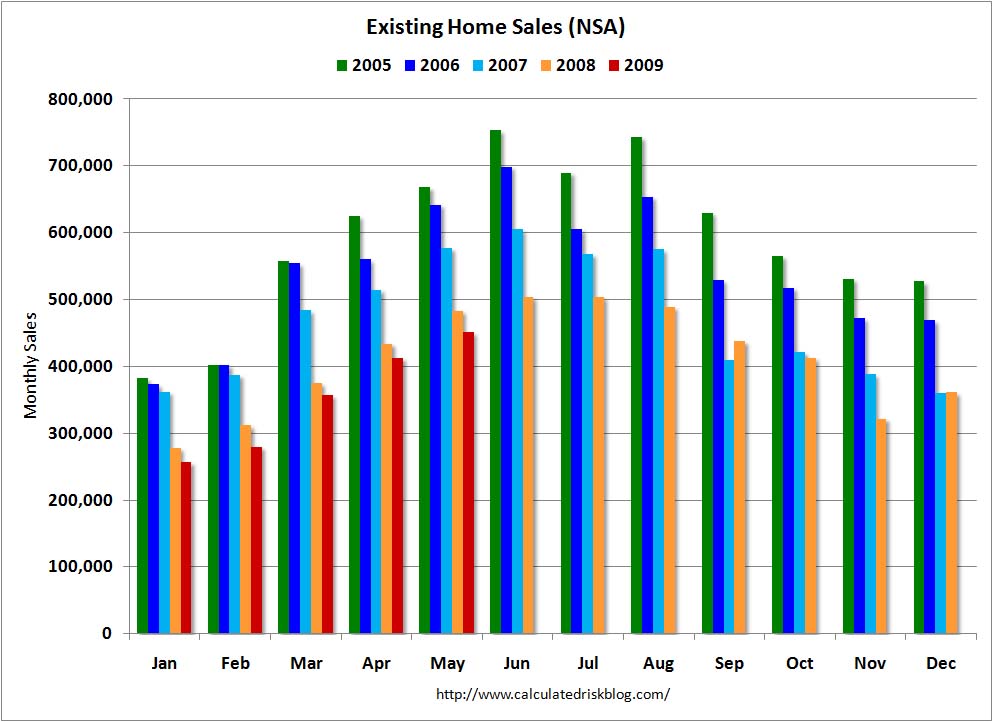
Barry Ritholtz at the Big Picture reports that in May existing home sales fell by 3.6% from May 2008.
"Sales in May 2009 rose 2.4% from April to 4.77 million. Note that these are apple and orange comparisons--revised to unrevised numbers. Once again, the prior monthly number was revised downwards (4.68 million down to 4.66 million)."
He links to a chart plotting monthly existing home sales from 2005 from Calculated Risk:


Meanwhile, Keiko Ujikane and Jason Clenfield at Bloomberg report that Moody's Aaa rating of US sovereign debt 'remains solid."
"'Although the US is losing altitude in the Aaa range, it is starting from a very strong base,' Cailleteau, who is chief international economist at Moody’s, said in Tokyo today. The economy is resilient enough to recover and the government is committed to raising taxes and cutting spending, he said."
8. BLOG COMPARING NEWS HEADLINES FROM GREAT DEPRESSION TO CURRENT CRISIS

An interesting new blog which gives headlines from the week 79 years ago in the Great Depression has been linked to general all over the economic blogosphere.

Monday, June 8, 2009

Daily Sources 6/8

1. ELECTIONS FOR THE EUROPEAN PARLIAMENT END IN VICTORY FOR THE CENTER-RIGHT, LOW TURN OUT HELPS FRINGE RIGHT

Eurointelligence reports that the results of the European Parliament elections basically resulted in a win for the center-right, though it was marred by low participation.
"Overall, the winners are the center-right--and Jose Manuel Barroso, who with this vote will almost certainly stay on as president of the European Commission. Europe’s most successful national leader, in electoral terms, was Silvio Berlusconi, who managed to shrug off, or perhaps even benefit, from a string of scandals. He took 36% of the vote."
Eurointelligence provides the share of votes via this illustration:


However, Eurointelligence notes that voter participation was down to 43%, and has steadily fallen from 62% in 1979, which may lead to some questioning the body's legitimacy. Low participation also seems to have helped the fringe right. As Der Spiegel reports:
"Far-right and right-wing populist parties also did well in the election. In the Netherlands, the anti-Islam Freedom Party of the filmmaker Geert Wilders won around 17% of the vote, making it the second strongest party. The right-wing populist party True Finns won around 14 percent of the vote in Finland, up from just 0.5% in 2004. In Denmark, the right-wing populist DVP increased its share of the vote from 6.8% in 2004 to around 15 percent. Italy's right-wing populist Northern League won around 10% of the vote, giving it 8 seats, while in the UK the far-right British National Party won four seats."
It would seem that there will not be enough political support for Turkish membership in the EU any time soon. Worth reading in full.

2. GERMAN INDUSTRIAL ORDERS FLAT IN APRIL FROM MARCH, MÜNCHAU ARGUES THAT EXPORT LED ECONOMIES WILL NOT BE ABLE TO EXPORT OUT OF RECESSION, E.C.B. FISCAL POLICY MAY EXACERBATE THE PROBLEM

Ralph Atkins at the Financial Times reports that German industrial orders were flat in April from March, and the economic ministry revised upwards the growth in orders seen in March over February to 3.6% from its earlier estimate of 3.3%.
"The economics ministry noted that comparing April and March with the previous two months, industrial orders were up by 2%--the first such increase since December 2007."
Wolfgang Münchau at the Financial Times argues that export-led economies will not be able to rely on their export sectors to pull themselves out of the current economic crisis. Key excerpt:
"Global current account surpluses and deficits add up to zero. So if everybody is saving more, who will be dissaving? It will have to be the corporate sector in the countries with large net exports. So if the US, the UK and Spain are heading for a more balanced current account in the future, so will the surplus countries.

The current account balance can also be expressed as the sum of the trade balance, net earnings on foreign assets, and unilateral financial transfers. In several countries, including the US and Germany, the gap between exports and imports serves as a good proxy for the current account. A fall in the trade deficit in the US, UK and Spain implies a fall in the combined trade surplus elsewhere. And as some of the shifts in the US and the UK are likely to be structural, this will have long-term effects on others. In particular, it means the export model on which Germany, China and Japan rely, could suffer a cardiac arrest."
Münchau notes that the Merkel Administration's apparent decision to allow the euro to appreciate versus the dollar (and other currencies) could exacerbate the situation for Germany. A must read.

3. NORTH KOREA CONVICTS JOURNALISTS IN BID TO GET DIRECT TALKS WITH THE U.S.

Blaine Harden at the Washington Post reports that North Korea's Pyongyang Central Court this weekend sentenced two US journalists to 12 years of "reform through labor."
"'Now that they are sentenced, we can think and talk about making arrangements for their release,' said Han Seung-soo, a former South Korean foreign minister. 'It is ironic but with the sentencing we now have something more tangible to negotiate about.'"
Essentially it appears that the expert view is that Pyongyang expects the US to send a high-level envoy, the verdict being a way to force as direct bilateral negotiations as possible. Henry Kissinger has an op ed at the Washington Post in which he argues that North Korean nuclear non-proliferation is an especially apt issue for the "Great Powers" to cooperate on, given that it borders China, Russia, and is a neighbor of Japan. Key excerpt:
"Too much of the commentary on the current crisis has concerned the deus ex machina of Chinese pressures on North Korea and complaints that Beijing has not implemented its full arsenal of possibilities. For China, the issue is not so much a negotiating position as concern about its consequences. If the Pyongyang regime is destabilized, the future of Northeast Asia would then have to be settled by deeply concerned parties amid a fast-moving crisis. They need to know the American attitude and clarify their own for that contingency. A sensitive, thoughtful dialogue with China, rather than peremptory demands, is essential.

The outcome of such a dialogue is difficult to predict, but it cannot be managed unless America clarifies its own purposes to itself. A new argument in favor of acquiescence in North Korea's nuclear program contends that Pyongyang's conduct is really a cry for assistance against Chinese domination and thus deserves support rather than opprobrium. But turning North Korea into a ward of the United States is neither feasible nor acceptable to the countries whose support is imperative for a solution of the nuclear issue.

Furthermore, some public statements imply the United States will try to deal with specific North Korean threats rather than eliminate the capability to carry them out. They leave open with what determination Washington will pursue the elimination of the existing stockpile of North Korean nuclear weapons and fissionable materials. It is not possible to undertake both courses simultaneously."
Well worth reading in full.

4. PAKISTANI POSSE FORMS TO TAKE ON TALIBAN MOSQUE BOMBERS, MUSHARRAF SAYS THE U.S. DOES NOT UNDERSTAND THE EXTENT TO WHICH PAKISTAN'S SECESSIONIST FORCES ARE DUE TO SITUATION IN AFGHANISTAN

Riaz Khan at the Associated Press reports that as many 1,600 tribesmen have joined a citizen's militia in the Upper Dir district and are retaliating against the Taliban following the group's recent bombing of mosques.
"'The lashkar [aka citizen's militia] has destroyed 25 homes of Taliban commanders and their fighters in various villages,' [Khaista] Rehman [a local police chief] told The Associated Press by phone. 'The Taliban had set up their offices in those villages but the local residents and the lashkar have attacked them, and we hope the lashkar will succeed.'"
Meanwhile, Susanne Koelbl and Britta Sandberg at Der Spiegel conducted an interview with former Pakistani President Pervez Musharraf in which he suggests that the US doesn't understand the extent to which Pakistan's centrifugal inertia is driven by the situation in Afghanistan. Key excerpt:
"SPIEGEL: Are you disappointed by Obama?

Musharraf: No, he is aiming at the right things. He is showing intentions of improving the dialogue with the Muslim world, which is good. He is right when he says that more forces must be deployed in Afghanistan. There is an intention of increasing funding for Pakistan, which is also good. But he also has to understand the reality in Pakistan and I am not sure he does.

SPIEGEL: And how is the situation?

Musharraf: One of the realities is that the Indian intelligence service RAW is interfering in our country. For example in Balochistan, our largest province bordering Iran and Afghanistan. One of the most brutal insurgents against our forces, Brahamdagh Bugti ...

SPIEGEL: ... the grandson of Nawab Bugti, a tribal leader who was killed three years ago in a battle with the Pakistani army ...

Musharraf: ... he is sitting in Kabul, protected by the Afghan government and provided with weapons and money by the Indian intelligence agency RAW. He has his own training camps and sends his fighters to Balochistan where they terrorize people and damage the civil infrastructure. RAW is also interfering in the Swat Valley, I know that. Where do all these Taliban fighters in Swat get their arms and money from? From Afghanistan. The Indian consulates in Jalalabad and Kandahar only exist to be a thorn in the side of Pakistan."
Well worth reading in full. Meanwhile, also in Der Spiegel, German intelligence agencies have warned that al-Qaeda plans to launch attacks on Germans abroad, and perhaps in Germany itself, around German elections on September 27 in retaliation for Berlin's participation in the NATO mission in Afghanistan.

5. CITY OF PARIS MAKES DALAI LAMA AN HONORARY CITIZEN IN FACE OF SARKOZY'S EFFORTS TO RECONCILE WITH BEIJING, REPORTS OF TOTAL LOSING SOUTH PARS PHASE 11 PREMATURE

The BBC reports that the Dalai Lama has been made an honorary citizen of Paris.
"China on Monday called the Paris honor to the Dalai Lama a 'grave interference' in Sino-French ties."
In the beginning of April, the Chinese Foreign Ministry's website published a joint statement by Paris and Beijing intended to resolve tension over the perceived support for the Tibetian independence movement in advance of a meeting between Chinese President Hu Jintao and French President Nicolas Sarkozy on the margins of the G20 summit in London--see Daily Sources 4/1 #5. That meeting appeared to yield results when on April 9, Beijing announced it would send a purchasing junket to France--see Daily Sources 4/9 #2. And a bit later in the month, it looked as if the thaw was well under way when it was reported that France intended to invite Chinese President Hu Jintao to Paris for an official state visit--see Daily Sources 4/22 #3. (h/t Joshua Keating at FP's Passport Morning Brief.) Kate McKenzie at FT Energy Source notes that earlier stories reporting that Total had lost its role in Iran's South Pars phase 11 natural gas project to CNPC were premature, with the French oil and gas company reporting that it is still in negotiations. (For the original story of the switch, see Daily Sources 6/3 #10.)

6. CHINESE MAY POWER GENERATION DATA FOR MAY DOWN 4% Y.O.Y., STILL DOESN'T JIBE WITH G.D.P. DATA, INDONESIAN COAL EXPORT CONTRACTS TO CHINA FOR 2009 ALREADY EXCEED THOSE OF 2008

China Stakes reports that the according to figures from the Chinese State Grid, power generation in the last 11 days of May fell by 5.7% year over year,
"higher than the decline in the second 10 days of May, mainly because working days in the last 11 days of May this year are lower than that in the previous year, as the Dragon Boat Festival occurred at the end of May."
Zhao Guobao, vice director of the National Development and Reform Commission and director of the National Energy Administration, said that power generation fell by about 4% altogether in May, year over year.
"Zhao Bingren [ex-chairman of China Electricity Regulatory Commission] said statistics reported by some local governments representing drastic economic growth might not be true. 'I visited two provinces, and think their statistics are not true. They can never make up two important figures: power consumption and transportation.'"
In the middle of May, the IEA's global energy report cast doubt on China's official GDP numbers, saying that they did not match up with the drop in oil and electricity consumption--see Daily Sources 5/14 #2. In late May, the China Electricity Council, or association, reacted to the criticism by ceasing to publish its data on electricity consumption--see Daily Sources 5/29 #3. Meanwhile, Frontier Markets reports that PT Adaro Energy, Indonesia’s second-largest coal company, has already contracted for more coal sales to China in 2009 from 2008, or 3.5 million tons in 2009–up from roughly 2 million tons last year.
"Australian coal prices on the globalCOAL Newcastle index, a benchmark for Asia, ended Friday at $74.31/ton, while port coal prices at China’s top coal port Qinhuangdao remain around $92 a ton. 'As long as there is a difference between domestic and import prices, China will still be buying coal from overseas,' commented Apimuk Taifayongvichit, chief marketing and logistics planner at PT Indo Tambangraya Megah, the Indonesian unit of Thai Banpu ...."
Indonesia is the second largest exporter of coal globally.

7. CHINA CONSTRUCTION BANK HEAD SUGGESTS U.S. SHOULD SELL YUAN DENOMINATED BONDS IN HONG KONG AND SHANGHAI MARKETS

Martin Howell at Reuters reports that in an interview with Guo Shuqing, the chairman of state-owned China Construction Bank, he suggested that the US government and the World Bank should consider selling yuan-denominated bonds in the Hong Kong and Shanghai markets.
"Guo said it was in American interests to see the yuan, also known as the renminbi, become a currency that is traded across the globe. He said that is largely because of the symbiotic relationship between US purchases of Chinese goods and China's purchases of US assets with the proceeds."
He said that developing the Chinese debt markets would help US companies and international financial institutions fund investments in China--tapping into the Chinese savings, I take it.
"He said that foreign currency risk, particularly the risk that the yuan would continue to appreciate against the US dollar as it has in recent years, could be hedged."
And make folks in DC much more leary of a floating renmimbi. (In May the Japanese opposition platform included the notion of continuing to purchase US debt, but in yen-denominated bonds, so called "samurai bonds."--see Daily Sources 5/14 #1.)

8. SOUTH KOREAN MAY EXPORTS DOWN 28% Y.O.Y.

Brad Setser at Follow the Money reports that South Korea's May export data has exports down 28% year over year. He plots a graph for us:


He notes that exports fell a bit from their April levels, but I think that he puts a little undue emphasis on that, as April is 3.2% shorter than May. As the Reuters article he links notes:
"Exports value per working day--a measure that analysts and government officials use to assess the monthly change in exports--rose slightly to $1.28 billion in May from $1.27 billion in April."
Meaning perhaps the data doesn't exactly provide evidence of a "green shoot," though it may well be a sign that the export situation has bottomed. Setser goes on to note:
"Taiwan also reports its data quickly. Year over year, its exports are still down more than Korea’s (31% v 28%). But May’s exports were a bit higher than April’s exports. That at least hints at a recovery."
Well worth reading in full, as usual.

9. B.R.I.C.S ADD $60 BILLION IN FOREIGN RESERVES IN MAY

Shanthy Nambiar and Lilian Karunungan at Bloomberg report that the BRIC countries added $60 billion in foreign reserves in May in order to protect their export sectors.
"The BRICs are buying dollars at the fastest pace since before credit markets froze in September, protecting exports even as leaders of the biggest emerging markets consider alternatives to the US currency.

... Brazil bought the most dollars in a year, India’s reserves gained the most since January 2008 and Russia added the most foreign exchange since July."
10. IRAQ SAYS IF TURKEY DOESN'T RELEASE MORE WATER IT FACES AN ENVIRONMENTAL AND HUMANITARIAN CATASTROPHE

Aseel Kami at Reuters reports that Iraq's Water Resources Minister Abdul Latif Rasheed on Sunday called on Turkey to increase the flow of water in the Euphrates by 500 cubic meters a second.
"'We are passing through an emergency and the country is threatened with an environmental and humanitarian catastrophe,' said Karim al-Yaqubi, a member of a parliamentary committee that oversees water issues.

He said water purification plants in parts of the country like the province of Diwaniya, southeast of Baghdad, could not pump in water because it was too muddy.

Yaqubi said Turkey had briefly increased the river flow to serve its hydroelectric operations, but had then closed the sluice gates."
The AFP in May reported that experts were predicting an "agricultural disaster" in Iraq if Turkey continues to withhold water from the Tigris and Euphrates--see Daily Sources 5/21 #6.


Turkish President Abdullah Gul promised in March to double the flow of water allocated to Iraq during his visit to Baghdad--see Daily Sources 3/26 #14. It has been suggested that the promise was made in return for a crackdown on Kurdish guerrillas operating out of northern Iraq. On Saturday, farmers and fisherman protested in Najaf, calling on the government to demand the release of more waters from neighboring countries. (h/t Ben Lando at Iraq Oil Report.)

11. OBAMA ADMINISTRATION BACKS NUCLEAR FUEL BANK IDEA

Bryan Bender at the Boston Globe reports that the Obama Administration has thrown its support behind an international nuclear fuel bank, controlled by the IAEA. In his speech in Cairo last week, Obama expressed support for the right guaranteed by the Nuclear Non-Proliferation Treaty whereby every signatory has the right to develop a peaceful nuclear power program, saying "any nation--including Iran--should have the right to access peaceful nuclear power."
"Russia and Kazakhstan have offered to house an agency-supervised fuel bank, while Germany has called for the creation of a multinational enrichment company under the auspices of the IAEA."
(h/t Leanon at the Oil Drum's Drumbeat.)

12. 'MARCH 14' BLOC PREVAILS IN LEBANESE ELECTIONS

Nadim Ladki at Reuters reports that the Lebanese elections this weekend yielded a surprise victory for the anti-Syrian coalition.
"Results declared by Interior Minister Ziad Baroud showed Saad al-Hariri's pro-Western bloc had won 71 of parliament's 128 seats, against 57 for an opposition alliance that groups Shi'ite factions Hezbollah and Amal with Christian leader Michel Aoun.

Hariri's total includes three independents who ran on his lists in Sunday's election, which many had predicted would produce a slim victory for Hezbollah and its partners.

The vote was a blow to Syria and Iran, which support Hezbollah, and welcome news for the United States, Saudi Arabia and Egypt, which back the 'March 14' bloc, named after the date of a huge rally against Syria's military presence in 2005.

The United States had no immediate comment, but France, another backer of the bloc, praised the 'smooth functioning' of the election, which went off in mostly peaceful style."
13. CANADIAN OIL SANDS PRODUCTION COULD GROW TO 3.3 MB/D BY 2025

Platts reported on Friday that the Canadian Association of Petroleum Producers said that Canadian oil sands production could grow by 175% to reach 3.3 mb/d by 2025.
"If growth is confined to projects already operating or under construction, the oil sands will add only 800,000 b/d to the 2008 output of 1.2 mb/d, the report said.

By rolling in conventional and Atlantic Canada offshore volumes, CAPP projects that current total Canadian crude production could, under the minimum outlook, rise from 2.7 mb/d in 2008 to 3 mb/d in the 2015-2020 period, then slip to 2.8 mb/d.

Applying the 'growth case' scenario, the total volumes would reach 3.3 mb/d in 2015, 4 mb/d in 2020 and 4.2 mb/d in 2025."
14. AMERICAN TRUCKERS ASSOCIATION SEES DECLINE IN VOLUMES OF 2.2% YOY IN APRIL, MIRRORS RAIL DATA, I.E., DEMAND FOR DIESEL IS WEAK

Barry Ritholtz at the Big Picture reports that the American Truckers Association Tonnage Index declined a seasonally adjusted 2.2% in April, better than the 4.5% fall seen in March, but still down. Ritholtz quotes the chief economist of the association, Bob Costello, as saying:
"'While most key economic indictors are decreasing at a slower rate, the year-over-year contractions in truck tonnage accelerated because businesses are right-sizing their inventories, which means fewer truck shipments,' Costello said. 'The absolute dollar value of inventories has fallen, but sales have decreased as much or more, which means that inventories are still too high for the current level of sales. Until this correction is complete, freight will be tough for motor carriers.'"
Ritholtz notes that the Association of American Railroads' US rail carload traffic reports are mirroring the trucker results, unsurprisingly, showing a 24.7% year over year decline in May. Atlantic Systems Inc. plots the decline in volume for all North America for the week ended May 30:


Given that much of freight rail is powered by diesel, and most trucks burn it as well, you can see why US commercial distillate stocks are building at rates way above the historical norm:


15. CONSUMER CREDIT IS CONTRACTING FOR THE FIRST TIME EVER

Rebecca Wilder at News N Economics notes that consumer credit is "doing something that it hasn't done in a long, long time (ever)....retrenching."


Ms. Wilder notes:
"Consumers are actively paying down debt because they 'want to' (i.e., demand side), but likewise, they are being forced to as credit card companies slash credit limits."
Worth a look.

16. SOLAR POWER PLANTS WILL COMPETE WITH AG AND CITIES FOR WATER IN THE AMERICAN WEST

Robert Glennon has an opinion piece at the Washington Post which notes that the current technology for large scale solar power plants consumes large amounts of water.
"[M]ost large solar power projects use a system called concentrating solar power, or CSP, that heats a fluid that boils water to turn a turbine. CSP, just like any thermal power plant, produces waste heat as a byproduct. In most cases, cooling towers release the heat to the atmosphere through evaporation, a process that uses gobs of water. In fact, CSP uses four times as much water as a natural gas plant and twice as much as a coal or nuclear plant."
He notes that the water for these plants will have to come from other customers, especially in the American West.
"Over the last year, Arizona Public Service Company, the state's largest electric utility, has partnered with solar power companies to build two large-scale CSP projects on private land. The land, more than six square miles, has been used to grow alfalfa and cotton. These wet-cooled plants will use less water than the farms are already using.

This reallocation of water--from farming to power generation--offers a lesson for the country as a whole. As the United States confronts inevitable water shortages, we need to insist that power companies, developers and others who need water offset the impact of their new uses by persuading existing water customers to use less."
Last week, the Central Valley Business Times reported that three Congressman from California's Central Valley have written a letter to the House Natural Resources Committee saying that water shortages are being exacerbated by Federal decisions:
"They say the San Joaquin Valley and southern California face 'crippling job losses and economic disaster' because of federal decisions involving both the Delta smelt, a minnow-like fish that lives only in the Sacramento-San Joaquin Delta, and a proposal to curtail further water deliveries to California farms and cities to save salmon, steelhead, green sturgeon, and killer whales.

'Very little has been done to help California’s San Joaquin water-starved communities in the last few months,' the congressmen with in their letter to US Rep. Nick Rahall, the chairman of the committee, and US Rep. Doc Hastings, the senior Republican on the panel."
Orange County has reportedly fallen into a "severe drought," just as Summer begins. Connie Lewis at the San Diego Business Journal reports that:
"According to the San Diego County Water Authority, the amount of water it receives from the Metropolitan Water District of Southern California will be reduced by 13% starting July 1.

The county imports 71% of its supply from Metropolitan."
(h/t for these last two items to Aquafornia.)

Friday, June 5, 2009

Daily Sources 6/5

1. BUNDESBANK FORECASTS GERMAN GDP TO CONTRACT BY 6.2% IN 2009

Der Spiegel reports that the Bundesbank expects the German economy to contract by 6.2% in 2009. The bank expects downward pressure on the economy to end by the close of 2009, but only forecasts GDP growth of 0.0% for 2010.
"The low point of the recession could be reached this summer, the forecast noted. Still, Bundesbank President Axel Weber said it was too early to breathe a sigh relief. The report added that unemployment will continue to rise in the coming quarters, and by mid-2010, the number of jobless is expected to be 1 million people greater than it was this spring--reaching a total of around 4.4 million unemployed persons, or 10.5%."
2. DUTCH EUROPEAN PARLIAMENT ELECTIONS BIG WINNER FOR ANTI-ISLAMIST 'PARTY FOR FREEDOM'

Der Spiegel reports that preliminary data on the Dutch European Parliament elections show Geert Wilders' "Party for Freedom" would get four of 25 Dutch seats in the legislature, making it the second largest Dutch party represented in Brussels.
"Wilders, who has become popular in the Netherlands running on an anti-Islam and anti-political establishment platform, promised voters he would be tough on immigration and criticized Turkey's bid to join the EU. 'Should Turkey as an Islamic country be able to join the European Union? We are the only party in Holland that says, it is an Islamic country, so no, not in 10 years, not in a million years,' Wilders said."
3. RUSSIA TO CONSIDER SETTLING CHINESE TRADE IN LOCAL CURRENCIES, GAZPROM AND E.ON FINALIZE ASSET SWAP DEAL

Lyubov Pronina at Bloomberg reports that Russian President Medvedev has joined Brazil and Malaysia in the number of countries considering settling international trade with China in their respective domestic currencies. Meanwhile, Nadia Rodova and Anna Shiryaevskaya at Platts report that Gazprom and Germany's E.ON Ruhrgas have signed an asset swap agreement with E.ON receiving 25% of Severneftegazprom, a Gazprom subsidiary developing the Yuzhno-Russkoye oil and
gas field.
"Following the deal Gazprom will own 50% plus six ordinary registered shares of Severneftegazprom; Germany's BASF will own 25% minus three ordinary registered shares and three preferred shares without voting rights; and E.ON will own 25% minus three ordinary registered shares and three preferred shares without voting rights, Gazprom said.

In turn, the agreement gives Gazprom will take E.ON Ruhrgas' 49% stake in Gerosgaz, which owns 2.93% of Gazprom.

'By implementing this asset exchange transaction, Gazprom and E.ON have once again demonstrated a successful development of long-term Russian-German cooperation in the energy sphere,' [Gazprom CEO] Alexei Miller said in a statement."


The Yuzhno-Russkoye oil and gas field is thought to have 856.2 billion cubic meters of gas and 20.35 million metric tons (~148.6 million barrels) of oil and gas condensate reserves.

4. RIO TINTO BOARD REJECTS CHINALCO BID

David Barboza and Michael Wines at the New York Times report that in a meeting in London Thursday, the board of Rio Tinto rejected an offer of $19.5 billion by the Aluminum Corp. of China, or Chinalco, to take a 15% stake in the company. Chinalco's currently has a 9.3% share of the company. Political opposition to the deal in Australia began early on. In the middle of May, Chinalco revised its offer down from a 18.5% stake to 15--see Daily Sources 5/21 #2.
"Chinalco said it regretted the decision and had worked hard to try to revise the deal to reflect changed market conditions, as well as the response from shareholders and regulators.

'As a result, we are very disappointed with this outcome,' Chinalco’s president, Xiong Weiping, said in a statement."
Rio Tinto will combine its iron ore assets in Australia with those of BHP Billiton.

5. CHINESE MALE-FEMALE RATIO DRIVING UP 'BRIDE PRICES', INCREASINGLY A TARGET OF CONS

Mei Fong at the Wall Street Journal reports that the male-female ratio (120-100) in China has pushed up the dowries--or "bride price"--of potential brides so much that they have become the target of con artists.
"While there are no nationwide statistics, wedding scams have occurred before, but usually isolated cases. Mr. Tang, Xin'an's Communist Party secretary [Xin'an is a village of 14,000 in Shaanxi province], says he has never before seen such clusters of cases. Most of the 11 families involved lost an average of 40,000 yuan (~ $5,862 or roughly GDP per capita in purchasing power parity terms). Officials consider these to be fraud cases. So if caught, the women could serve jail time, according to police."
The story provides more anecdotal evidence for the case made by Shang-Jin Wei of Columbia University and Xiaobo Zhang of IFPRI that the one child policy in China has made the society even more one of saving than in the past--see Daily Sources 5/28 #2.

6. GLOBOVISIÓN PRES TO BE CHARGED WITH 'USURY'

Fabiola Sanchez at the Associated Press reports that Venezuelan prosecutors have charged the president of Globovisión, the sole opposition television station remaining in the country, Guillermo Zuloaga, of "usury."
"Trade Minister Eduardo Saman accused Zuloaga of keeping the cars off the market while waiting for their price to rise--involving a possible violation of foreign exchange rules that give importers access to dollars only if they aren't used to gain a 'disproportionate advantage' over rivals.

It was not clear if Zuloaga received dollars that way from the government, but importers who violate those terms can be prosecuted under Venezuelan usury law."
Last week Hugo Chávez said that the Supreme Court, attorney general, and telecommunications chief should take action against "poisonous media" or resign. Meanwhile, Platts reports that PdVSA said in a statement that it had taken over 45% of all private oil services companies operations in the country since nationalizations began again two weeks ago. "So far, around 76 companies have been nationalized, including the local units of Williams International."

7. CHILE TO COMMISSION LNG GASIFICATION PLANT BY END OF MONTH, EXXON SIGNS CONTRACTS TO BUILD LNG EXPORT FACILITY IN PAPUA NEW GUINEA

SAI reports that Chile will commission its 2.5 million tonne/year LNG-10 million cubic meter natural gas liquefaction plant in Quintero at the end of the month.
"The first vessel carrying LNG to Chile from Atlantic LNG’s facilities in Trinidad & Tobago is due to arrive at the plant owned by Chilean energy company ENAP, Endesa Chile, Metrogas and BG Group before the end of June."
Meanwhile, Russell Gold at Environmental Capital reports that Exxon Mobil has signed two construction contracts in the last 24 hours which lay the groundwork for building an LNG export facility in Papua New Guinea.
"Exxon didn’t cut its capital expenditures program during the oil-price drop, but it’s still noteworthy when they push a couple big high-cost projects ahead. And while Exxon didn’t really slow its spending, others did. But projects are looking more financially robust now because costs are falling. The big energy consultant IHS/CERA updated its upstream operating cost index today: it’s down 8% from six months ago. Meanwhile, capital costs are down 9%.

The question haunting oil circles is whether enough new investment will be undertaken to head off a major supply crunch in coming years as demand for black gold grows in Asia and elsewhere. The McKinsey Quarterly, a publication from the consulting group, recently warned that the 'tight demand–supply balance seen at the end of 2007 could return sooner than many observers might have anticipated' as oil companies--state owned and publicly traded--ease up on capital spending."
All of which may be true, but even if there is a supply shortfall does duly develop in 2010, that shouldn't have the effect of pushing up price on oil for delivery next month.

8. NEW U.S. EMISSIONS REGULATIONS PUSHING CANADIAN OIL SANDS PRODUCERS TOWARD ASIAN MARKET

Gary Park at Platts reported (on May 13) that Canadian oil sands operators are looking for Asian participation as the US Congress considers legislation which could limit the purchase of fuels produced by large carbon emitting processes. There are three key competing pipeline plans for taking oil sands products to the Pacific--Enbridge's 525 kb/d Northern Gateway pipeline, Kinder Morgan's 400 kb/d expansion to its 300 kb/d Trans Mountain pipeline and Kinder Morgan's 400 kb/d Northern Leg Expansion to Kitimat.


As Park reports:
"There has been no more public display of those problems than the roller-coaster efforts since 2005 by Canadian pipeline giant Enbridge to open the door to Asia through its 525 kb/d Northern Gateway pipeline, with 80% of volumes targeted for Asia and the rest for California, although the California option may disappear if the state bans fuels derived from 'dirty oil,' such as oil sands.

The initial plan involved a memorandum of understanding with PetroChina to aggregate 200 kb/d of oil sands production in return for a possible 49% equity stake in the C$5.2 billion venture.

It came to an acrimonious end in mid-2007, with PetroChina refusing to extend its MOU with Enbridge and accusing the Canadian government and producers of not doing enough to support Northern Gateway and allow energy trade between Canada and China.

Enbridge CEO Pat Daniel refused to abandon an idea that had already cost about C$100 million to develop a regulatory application.

'We decided enough of this fun ... we need to have customer support,' he said.

So he embarked on frequent selling trips to Asia, pointedly excluding China, shifting his focus to potential customers in South Korea, Japan, Taiwan and Singapore.

In the process, Enbridge secured financial commitments from unidentified producers and refiners to carry the proposal through Canada's National Energy Board and pay for the initial development costs.

Daniel said Northern Gateway is now a 'broad-based, industry-wide initiative ... we offered 50% of the equity to those companies supporting the project and we've had very good uptake on that.'"
Well worth reading in full. Perhaps the story can be said to put the recent report by the Council on Foreign Relations explaining that the "well-to-wheel" carbon footprint of developing bitumen deposits is "only" 17% more than conventional oil in context--see Daily Sources 5/22 #8.

9. ICAP SHIPPING SAYS 7 SUPERTANKERS USED AS STORAGE TO UNLOAD

Alaric Nightingale at Bloomberg reports that Simon Chattrabhuti, a London-based analyst at ICAP Shipping, in an email note today said that a notice of redelivery had been issued for seven supertankers currently being used for oil storage. In late May, Frontline Ltd. estimated that as many as 60 supertankers had been chartered for oil storage.

10. SOVEREIGN DEBT ISSUES TO CLIMB PRECIPITOUSLY, MAY EXPOSE COUNTRIES FAVORING SHORT-TERM DEBT TO "ROLL-OVER" RISK

Gillian Tett at the Financial Times notes that the projected amount of debt to be issued by OECD countries this year is at $12 trillion, up from $9 trillion in 2008.
"So deep in the bowels of western [Debt Management Offices, or DMOs], some officials are now scanning the calendar and wondering how they can organize all those looming debt sales. Most governments hold auctions on particular days of the week and there are only 52 weeks in the year.

Thus, even if the DMOs cancel their summer holidays--which some will--it may be tough to schedule all these looming sales. No wonder some western government officials are starting to mumble about the risk of 'auction fatigue', or the chance that investors get so overwhelmed with these sales that they go on strike. Nor is it little surprise that some western government officials are quietly debating whether they can can dramatically expand the size of individual auctions, to get these bonds sold, without creating a market glut, or panic.

Thus far, thankfully, there is little sign of any such panic."
"[T]he average US maturity in late 2007, was just 4.7 years and will almost certainly decline further. This year, the OECD projects that no less than 70% of US issuance will be short term. That leaves the treasury market now exposed to a mild version of the same problem that plagued conduits or structured investment vehicles that relied on short-term funding in the commercial paper market: namely 'rollover risk'."
Tett also notes that a number of European countries have average debt maturities of less than five years, including Norway and Hungary. A must read.

11. U.S. UNEMPLOYMENT CLIMBS TO 9.4%, FALL IN TEMP EMPLOYMENT SLOWS, BUT 12 MO MOVING TREND STILL DOWNWARD

Peter S Goodman and Jack Healy at the New York Times report that the US lost another 345,000 jobs in May, pushing the headline unemployment rate to 9.4%.
"[W]age growth has been stagnating even as gasoline and medical costs rise, putting pressure on household finances. Wages were 3.1% higher in May than a year ago, but that growth slowed drastically this year. In April and May, average hourly wages grew just 0.1%, to a seasonally adjusted $18.54, from $18.52, according to the Labor Department. Wages for manufacturing workers fell 0.1%."
The broader U-6 unemployment rate, which includes "marginally attached" workers, rose to 16.4%. Barry Ritholtz at the Big Picture notes that the fall in temporary help has flattened out, though the year over year loss for May is of 26.9%.


Jesse's Café Américain plots a chart of the 12 month moving averages of job growth from the middle of '04:


Jesse comments: "We will get a little more optimistic when the longer term trend turns higher."

12. REGIONAL FED PREZES GETTING NERVOUS ABOUT POTENTIAL INFLATION, TRADERS SEE 67% CHANCE FOMC WILL RAISE FED FUNDS RATE IN NOV MEETING

Sudeep Reddy at Real Time Economics reports that there are signs that some Federal Reserve policy makers are becoming nervous about the potential for inflation. Atlanta Fed President Dennis Lockhart recently told Market News that the central bank must be "anticipatory" and shouldn't wait too long to tighten monetary policy. Earlier this week, Kansas City Fed President Thomas Hoenig warned of "significant" inflationary pressures.
"Mr. Lockhart has suggested that the Fed eventually could start raising rates--he says it’s not time yet--while maintaining an expansionary policy through other programs. The Federal Open Market Committee’s most recent policy statement said the federal funds rate is likely to remain at 'exceptionally low levels ... for an extended period.' The FOMC may soon be discussing what constitutes an extended period."
Susanne Walker and Dakin Campbell at Bloomberg report that US treasuries fell, driving two year yields to an eight month high, on speculation that the FOMC will raise rates later this year.
"Traders see a 67% chance the Fed will raise its target rate for overnight loans between banks at its November policy meeting. The bets increased from 25% a week ago, according to futures traded on the Chicago Board of Trade. 88% of traders see no change in the rate at the central bank’s meeting this month."

Thursday, June 4, 2009

Daily Sources 6/4

1. BANKS OF CANADA, ENGLAND, AND EUROPE MAINTAIN BENCHMARK INTEREST RATES, B.O.E. AND E.C.B. REITERATE INTENTION TO ENGAGE IN SOME Q.E., SPEECH BY GERMAN F.M.--AND S.D.P. CHANCELLOR CANDIDATE--INDICATES INTEREST IN CHANGING THE STRUCTURE OF THE EUROPEAN MONETARY UNION

Daniel Kruger and Chris Fournier at Bloomberg report that the Bank of Canada today decided to leave its benchmark interest rate unchanged at 0.25%.
"The Bank of Canada ... said the 'unprecedentedly rapid rise' in the currency could 'fully offset' recent improvements in financial markets and consumer confidence and prolong the recession.

'The bank is confirming that the rise in the currency isn’t backed up by the fundamentals,' said John Curran, a Toronto-based senior vice president at CanadianForex Ltd., an online foreign-exchange dealing firm. 'While we do see some 'green shoots," for the economy to strengthen we can’t have the Canadian dollar as strong as it’s been in recent weeks. Once everyone gets a chance to digest this, you’ll see some US dollar strength."
Meanwhile, Jennifer Ryan at Bloomberg reports that the Bank of England also left its benchmark interest rate unchanged at 0.5 today, and reiterated its intention to purchase £125 billion (~$205 billion) in government and corporate bonds.
"While the bank’s decision last month was unanimous, some policy makers did favor spending the full authorized total of 150 billion pounds and the panel said it will seek permission to print even more money than the maximum if needed. Minutes of today’s decision will be published on June 17."
And Gabi Thesing and Christian Vits at Bloomberg report that the European Central Bank [ECB] also left its benchmark interest rate unchanged today at 1%.
"Asked if the bank will expand its bond plan, [ECB President Jean-Claude] Trichet replied: 'We have decided to embark on a 60 billion-euro purchase of covered bonds, full stop.'"
Meanwhile, Daniela Schwarzer at Eurozone Watch reports that German Foreign Secretary Frank-Walter Steinmeier in a speech yesterday at Budapest suggested that the current structure for the European monetary union ought, under the current circumstances, be rearranged, Schwarzer's analysis:
"# He explicitly acknowledges the problem of divergent economic developments in the EMU. This fact has been on the table for a few years now. As early as 2005, data on the first years of EMU pointed to these problems, and the trend of cyclical and structural divergence has even been acknowledged by the ECB in pursuing its monetary policy for an increasingly heterogeneous Eurozone economy. But Germany (which itself has been diverging from EMU average for instance in the years of its sever economic slump 2003/4 and subsequently recorded a very strong current account surplus) had so far not picked up this issue politically. It is hence the first time that a German member of government says what the current developments are: a possible threat to the existence of the EMU.
# In order to tackle this problem, Steinmeier suggests stronger policy coordination. In other words: the Lisbon Agenda is not sufficient an instrument to cope with divergence and asymmetric shocks in the EMU. This is no surprise to most economic analysts of EMU (even not in the German administration), but a new political statement from Berlin.
# He explicitly names wage, social and tax policies as an object for closer coordination in the EMU and speeks out strongly against tax and wage dumping. Again, this should be no surprise from a social democrat before two important elections dates - but it is a clear departure from the Berlin mainstream. For instance regarding the commonly held view that due to the 'Tarifautonomie' (i.e. the fact that social partners negotiate wages (more or less) independently in Germany) nothing can be done in the field of wage policy anyway. What Steinmeier may in fact mean is that some countries should be pushed towards giving up certain systems (e.g. wages indexed on inflation as is the case in Spain), which reinforce cyclical divergences in the EMU.
# He also requests a stronger coordination of fiscal stimulus in the current crisis--rightly so, but in direct opposition to the position held by the Chancellor and the Finance Minister."
Worth reading in full.

2. REPORTERS TAKEN TO CHINESE S.P.R.S

Denis McMahon at China Journal reports that he was taken on a reporting trip to Zhenhai and Zhoushan, two SPRs located south of Shanghai, arranged by the State Council Information Office.
"On the face of it, the visit was seemingly a massive step forward in transparency for the Chinese government. But, while staring at 50 identical 100,000 cubic meter (~ 630,000 barrel) tanks neatly formed into rows is certainly impressive, it doesn’t really tell much about the state of China’s reserves. And while the officials we met were friendly and open, the key policy questions of where the oil comes from, how they bought it and under what conditions the reserves may be tapped were deferred to more senior officials--who weren’t there.

While the reporters may have been a little unsure as to what they were getting out of the experience, Beijing clearly knew exactly what it was doing from the unity of message coming from the National Energy Bureau officials traveling with us: The reserves are full."
It seems that Beijing is signaling it would like a lower price, no?

3. MALAYSIA CONSIDERING SETTLING TRADE WITH CHINA IN LOCAL CURRENCIES

Shai Oster at the Wall Street Journal reports that Malaysian Prime Minister Najib Abdul Razak told the media after meeting with China's premier, Wen Jiabao, on Wednesday that:
"We can consider whether we can use local currencies to facilitate trade financing between our two countries. ... What worries us is that the [US] deficit is being financed by printing more money. That is what is happening. The Treasury in the United States is printing more notes."
The notion being to replace trade settlements in dollars with the ringgit and yuan. In May Bloomberg reported that Brazil's foreign minister told the media in Beijing that Brazil and China were considering a plan to settle in local currencies--see Daily Sources 5/20 #4.

4. VIETNAMESE NAVAL STRATEGY VS. CHINA TO MIRROR CHINA'S NAVAL STRATEGY VS. U.S., MALAYSIAN SHIPS MAY HAVE ENTERED OIL RICH AREA DISPUTED WITH INDONESIA

Feng at Information Dissemination comments on Vietnam's recent decision to purchase six project 636 kilo submarines for $1.8 billion. (Kilo class is the NATO designation for diesel-electric submarines made in Russia. Wikipedia states that the project 636 submarines are thought to be one of the quietest diesel-electric submarines in the the world.) Feng believes that the submarine purchase was made in an attempt to be able to project force into the China South Sea, and in particular, to the Spratly Islands, control over which is disputed by all the nearby nations, mostly because it is thought that oil and gas reserves lie under them.


Feng points out that the navies of countries further away from Vietnam, like, say, Australia, present a different challenge for the People's Liberation Army Navy [PLAN] than Vietnam, simply because Vietnamese ships would be operating mostly in areas over which the Chinese would be able to assert air superiority. Thus:
"[Vietnam is] actually adopting the same strategy that PLAN [has] supposedly [adopted to counter the capabilities of the US Navy]. Basically, Vietnam is [buying] a lot [of] small, fast ships equipped with long range missiles (and nothing else much ...) [and] quiet submarines."
Of course, Hanoi cannot make purchases on the scale that Beijing can, but it is presented with more or less the same dilemma facing Beijing when considering what it should do in case of a confrontation with the US. Interesting observation. Meanwhile, AFP reports that Malaysia's deputy prime minister Muhyiddin Yassin called for calm amidst reports that Malaysian warships had entered waters off northeastern Borneo also claimed by Indonesia, saying:
"We want to avoid any form of provocation that can cause unpleasantness. We must handle the matter with caution."
"International borders in the area off Borneo island have yet to be determined, with each country claiming the area as its own.

Malaysia claims the area based on a 1979 maritime chart, while Indonesia bases its claims on the 1982 UN Convention on the Law of the Sea (UNCLOS), which states the area belongs to Indonesia.

Muhyiddin said the Malaysian security forces patrolling the Ambalat waters had performed their duties responsibly and in accordance with regulations."
The head of Malaysia's military, Abdul Aziz Zainal, told the media that ships had not entered the Ambalat region, and that he would be in Jakarta Tuesday to discuss the matter.

5. OBAMA'S SPEAKS AT CAIRO TODAY

The New York Times carried the full text of President Obama's much anticipated speech in Cairo today. Key excerpts:
"Islam has always been a part of America's story. The first nation to recognize my country was Morocco. In signing the Treaty of Tripoli in 1796, our second President John Adams wrote, 'The United States has in itself no character of enmity against the laws, religion or tranquility of Muslims.'"
"Just as Muslims do not fit a crude stereotype, America is not the crude stereotype of a self-interested empire. The United States has been one of the greatest sources of progress that the world has ever known. We were born out of revolution against an empire. We were founded upon the ideal that all are created equal, and we have shed blood and struggled for centuries to give meaning to those words – within our borders, and around the world. We are shaped by every culture, drawn from every end of the Earth, and dedicated to a simple concept: E pluribus unum: 'Out of many, one.'"
"Make no mistake: we do not want to keep our troops in Afghanistan. We seek no military bases there. It is agonizing for America to lose our young men and women. It is costly and politically difficult to continue this conflict. We would gladly bring every single one of our troops home if we could be confident that there were not violent extremists in Afghanistan and Pakistan determined to kill as many Americans as they possibly can. But that is not yet the case."
"
The sooner the extremists are isolated and unwelcome in Muslim communities, the sooner we will all be safer."
"Around the world, the Jewish people were persecuted for centuries, and anti-Semitism in Europe culminated in an unprecedented Holocaust. Tomorrow, I will visit Buchenwald, which was part of a network of camps where Jews were enslaved, tortured, shot and gassed to death by the Third Reich. Six million Jews were killed--more than the entire Jewish population of Israel today. Denying that fact is baseless, ignorant, and hateful. Threatening Israel with destruction--or repeating vile stereotypes about Jews--is deeply wrong, and only serves to evoke in the minds of Israelis this most painful of memories while preventing the peace that the people of this region deserve.

On the other hand, it is also undeniable that the Palestinian people--Muslims and Christians--have suffered in pursuit of a homeland. For more than sixty years they have endured the pain of dislocation. Many wait in refugee camps in the West Bank, Gaza, and neighboring lands for a life of peace and security that they have never been able to lead. They endure the daily humiliations--large and small--that come with occupation. So let there be no doubt: the situation for the Palestinian people is intolerable. America will not turn our backs on the legitimate Palestinian aspiration for dignity, opportunity, and a state of their own.

For decades, there has been a stalemate: two peoples with legitimate aspirations, each with a painful history that makes compromise elusive. It is easy to point fingers--for Palestinians to point to the displacement brought by Israel's founding, and for Israelis to point to the constant hostility and attacks throughout its history from within its borders as well as beyond. But if we see this conflict only from one side or the other, then we will be blind to the truth: the only resolution is for the aspirations of both sides to be met through two states, where Israelis and Palestinians each live in peace and security.

That is in Israel's interest, Palestine's interest, America's interest, and the world's interest."
"Palestinians must abandon violence. Resistance through violence and killing is wrong and does not succeed. For centuries, black people in America suffered the lash of the whip as slaves and the humiliation of segregation. But it was not violence that won full and equal rights. It was a peaceful and determined insistence upon the ideals at the center of America's founding. This same story can be told by people from South Africa to South Asia; from Eastern Europe to Indonesia."
"At the same time, Israelis must acknowledge that just as Israel's right to exist cannot be denied, neither can Palestine's. The United States does not accept the legitimacy of continued Israeli settlements."
"And we will welcome all elected, peaceful governments--provided they govern with respect for all their people.

This last point is important because there are some who advocate for democracy only when they are out of power; once in power, they are ruthless in suppressing the rights of others."
A bit later in the speech, President Obama seems to echo yesterday's op ed in the Wall Street Journal by the prince of Dubai which argued that education was key to winning hearts and minds in the Middle East--see Daily Sources 6/3 #8.
"Many Gulf States have enjoyed great wealth as a consequence of oil, and some are beginning to focus it on broader development. But all of us must recognize that education and innovation will be the currency of the 21st century, and in too many Muslim communities there remains underinvestment in these areas. I am emphasizing such investments within my country. And while America in the past has focused on oil and gas in this part of the world, we now seek a broader engagement.

On education, we will expand exchange programs, and increase scholarships, like the one that brought my father to America, while encouraging more Americans to study in Muslim communities. And we will match promising Muslim students with internships in America; invest in on-line learning for teachers and children around the world; and create a new online network, so a teenager in Kansas can communicate instantly with a teenager in Cairo."
The speech is best read in full.

6. IRAN'S L.O.T.R. DISMISSES CAIRO SPEECH IN ADVANCE, IRAN ANNOUNCES CONSTRUCTION ON PARS PIPELINE BEGINS, WITHOUT HAVING DECIDED ON FINAL PATH

Thomas Erdbrink and William Branigin at the Washington Post report that Iran's Leader of the Revolution [LOTR] Ayatollah Ali Khamenei said:
"People of the Middle East, the Muslim region and North Africa--people of these regions--hate America from the bottom of their heart"
shortly before President Obama's speech in Cairo. LOTR Khamenei said that "beautiful speeches" would not reverse this feeling. Meanwhile, PressTV reports that construction on the Pars (or Persian) Pipeline has begun, but that Ahmad Noorani, the head of economic affairs at the Iranian embassy in Turkey, suggested:
"Another route could go through Iraq and Syria and then go through the Mediterranean to Greece and Italy."
(h/t reader Geoff.)

7. HOLBROOKE SAYS ADMINISTRATION HAS ASKED CONGRESS FOR ADDITIONAL $200 MILLION IN AID FOR PAKISTANIS DISPLACED BY FIGHTING WITH TALIBAN

Karen DeYoung at the Washington Post reports that Richard Holbrooke, special representative for Afghanistan and Pakistan, said at a press conference with Pakistani President Asif Ali Zadari in Islamabad yesterday that President Obama had asked Congress for an additional $200 million in aid for those displaced by the fighting with the Taliban.
"[W]ithin hours of his arrival, Holbrooke said the 'dramatic increase' in aid was 'symbolic of our commitment and support.'

Holbrooke emphasized that his hastily arranged three-day visit was 'at the personal instruction of President Obama' and reflected White House concern about Pakistanis fleeing heavy fighting in the Swat Valley and surrounding regions northwest of Islamabad, the capital."
The trip is also an outgrowth of concern that the central government will not reestablish control in areas where the extremists have been flushed out, failing to provide for security and services, making it a simple matter for the Taliban to return once the offensive has ended.

8. RELIANCE TO HALT GASOLINE EXPORTS TO IRAN ON U.S. SANCTION FEARS

Dev Chatterjee & Piyush Pandey at the Economic Times reports that Reliance has decided to stop exports of petroleum products to Iran in an effort to stave off restrictions on sales of products to the US market.
"Reliance was exporting 2% of its total output, worth around $280 million, from its two refineries in Jamnagar to Iran. A top RIL official, who requested anonymity, confirmed that the gasoline exports to Iran were stopped last month. However, he refused to elaborate on this issue.
...
RIL exports petroleum products worth $14 billion annually, of which around 5% is exporting to the US."
As of late, the UAE has been providing Iran with about 80% of its product imports.

9. ETHIOPIAN SOMALI SECESSIONISTS WARN AWAY OIL PROSPECTORS

Barry Malone at Reuters yesterday reported that the Ogaden National Liberation Front (ONLF)--or secessionists from the ethnically Somali Ogaden region--have emailed a warning to oil companies not to operate in that area of Ethiopia.


The email statement said:
"In order to accommodate these immoral and gluttonous rushes for oil in Ogaden, Ethiopia killed, raped and illegally detained thousands of Ogaden civilian and imposed economic and aid blockade at a time of when there was a full-blown drought in the Ogaden.

ONLF has persistently warned these unscrupulous multinational companies and their governments ... the ONLF has been left no alternative but to take all measures necessary to protect the inalienable rights of the Ogaden people."
10. O.A.S. VOTES TO LIFT BAN ON CUBA, BUT CUBA MUST ENGAGE IN DIALOGUE IN ORDER TO RE-ENTER ORGANIZATION

Mary Beth Sheridan at the Washington Post reports that the Organization of American States [OAS] voted to lift its 47 year old suspension of Cuba. The language of the resolution doesn't seem to explicitly require anything specific of Havana, outside of initiating a process of dialogue which itself must be in conformity with the practices, purposes, and principles of the OAS.The press release includes the actual language of the resolution (in Spanish only).
"RESUELVE:

1. Que la Resolución VI adoptada el 31 de enero de 1962 en la Octava Reunión de Consulta de Ministros de Relaciones Exteriores, mediante la cual se excluyó al Gobierno de Cuba de su participación en el Sistema Interamericano, queda sin efecto en la Organización de los Estados Americanos.

2. Que la participación de Cuba en la OEA será el resultado de un proceso de diálogo iniciado a solicitud del Gobierno de Cuba y de conformidad con las prácticas, los propósitos y principios de la OEA."
More or less:
"RESOLVED:

1. That Resolution VI adopted on January 31, 1962, in the Eighth Consultative Meeting of External Relations Ministers, by which the government of Cuba was excluded from participating in the Inter-American System, is hereby repealed in the Organization of the United States.

2. That the participation of Cuba in the OAS will be a result of a process of dialogue initiated at the request of the government of Cuba and in conformity with the practices, purposes, and principles of the OAS."
(Course, I wouldn't rely on my Spanish for this, but it does seem that only the dialogue itself must be conducted with the principles in mind, and that the sticking point is whether the dialogue would be initiated--or even participated in--by Havana.) Sheridan reports that Dan Restrepo, who is head of Western Hemisphere affairs at the White House, argued that the language was stronger that it might appear given the preamble which emphasize democracy and respect for human rights as part of the OAS's fundamental principles.

11. MEXICAN DRUG GANGS MOVING TO HONDURAS--MAY BE ASSISTED BY CROSS-SPECIAL FORCES TIES

Ken Ellingwood at the Los Angeles Times reports that the drug war in Mexico has spilled over into Guatemala, as gangs have found the environment easier to operate in there.
"During the last year and a half, the Zetas have carved a bloody trail across Guatemala's northern and eastern provinces. More than 6,000 people were slain in Guatemala in 2008. Police say most of the killings were linked to the drug trade.

As the recent blood bath shows, the violence is now threatening the capital, deep in the interior.

Authorities say Mexican drug gangs, primarily the Zetas and rivals from the state of Sinaloa, are ramping up operations in Central America to evade increased marine patrols near Mexico as they relay drug shipments to the United States and Europe."
The Zetas are a gang that was formed by former members of the Mexican special forces in the 1990s.
"Guatemalan police commanders say their 20,000 officers cannot match the firepower of the Mexican traffickers, who have made growing use in Mexico of military-type arms, such as 40-millimeter grenades and .50-caliber rifles capable of piercing armor.

Recent seizures in Guatemala have yielded similar weapons. 'These are things we have seen only in photos of Iraq and the Gulf,' said Larios, the police commander. 'Not in Guatemala.'

But devising a response is complicated by Guatemala's troubled past. The memory of the army's brutal conduct during the civil war means that it would be politically dicey for Guatemalan leaders to respond by mobilizing the military, as Calderon has done in Mexico."
Further, the Zetas have reportedly received assistance from former Guatemalan special forces known as the Kaibiles--named for a Mayan leader who evaded capture by conquistadors led by Pedro de Alvarado in the 16th century. Mexican special forces received training from the Kaibiles in the 1990s, as well as from Brazilian special forces, and the US Army. Analysts are worried that the drug war may spill into Honduras as well.


The best English-language coverage of the drug war's effects on Latin America is in the Los Angeles Times. A must read.

12. GLOBAL AIR PASSENGER TRAFFIC DOWN 7.5% IN 1ST 4 MOS., FREIGHT TRAFFIC DOWN 22%

Eileen Ng at the Associated Press reports that the International Air Transport Association recently announced that global passenger demand fell 7.5% in January-April from the same period a year ago while cargo demand fell 22%.
"IATA Director-General Giovanni Bisignani said airlines are facing an 'emergency situation' and should be given greater commercial freedom to serve global markets and consolidate."
Bisignani said that Asian carriers, which represent 44% of the global air cargo market, will be hit hardest by the crisis.

13. PENSIONS GETTING HIT GLOBALLY

Leo Kolivakis at Pension Pulse gives a rough summary of major difficulties facing major pensions globally, as pensions find themselves unable to meet their obligations given the current crisis. "Pension tension" is being seen in the US, Canada, and throughout Europe, including at the European Central Bank. His list is well worth considering, as well as his comment:
"The global pension crisis is really a crisis of modern day capitalism. If we don't figure out a long-term solution to this crisis, we risk having a new class of elderly poor who were cheated out of their pensions."
14. GEORGETOWN UNIVERSITY MAY LEAD NEW GENEVA CONVENTION PROTOCOL EFFORT

Jeff Stein at Spy Talk reports that Georgetown University's new Center on National Security and the Law's legal scholars have been pushing for a new international agreement to update the Geneva Convention to address terrorism and stateless armies. The center was until recently led by Neal Katyal, who joined the Obama Administration to become the Principal Deputy Solicitor General.
"'Soon,' [Matthew] Gerke, [a fellow at the center who worked for three and a half years in the Pentagon and in Iraq on rule of law issues,] said, the Center on National Security and the Law hopes to 'roll out' a campaign for a new Geneva Convention, hopefully boosted by an American figure with international stature.

Its first step would be to mount a new push for Senate ratification of the 'Additional Protocol No. 2, Relating to the Protection of Victims of Non-International Armed Conflicts.'"
In 1977, the Carter administration signed two additional protocols to the Geneva Convention which had provided rules for handling non-state combatants, but the Senate refused to ratify the treaty, "as it has ever since." Worth reading.

15. LOW SULFUR BUNKER FUEL REQUIREMENTS MAY ADD 4 MB/D NEW DIESEL DEMAND TO MARKET--ROUGHLY 10 MB/D ADDITIONAL CRUDE DEMAND

John Kingston at the Barrel reports on the interesting observation about the incoming low sulfur specifications for shipping use by Carlos Cuervo, SVP for supply and trading at World Fuel Services, who argues that low sulfur product from the bottom of the barrel, or low sulfur fuel, will start seeing considerable more demand starting next year. However, after 2015:
"It won't be even lower-sulfur bunker fuel that will allow shipowners to meet the requirements, Cuervo said. Instead, it will be marine diesel. There just simply won't be enough low-sulfur bottoms, of 0.5% sulfur by 2020, to meet the needs of shipowners. Diesel will fill the gap."
Cuervo estimates that the move to diesel by shipowners driven by the incoming low sulfur requirements will mean for an additional 4 mb/d of demand for diesel globally.
"As he noted, given that an efficient refinery can produce about 40% diesel, it's as if we need another 10 mb/d of crude supply to make 4 mb/d of diesel."
It's an interesting concern ... just now refiners would probably welcome additional diesel demand, given the size of inventories here in the US. But, in the run up of prices from 2007-8, some argue that the price of crude was chasing the diesel crack, and that could get real steep given a recovery in the global economy. Kingston notes there hasn't been a lot of interest so far in setting up refineries to produce low sulfur bunker fuel--
"They generally have viewed fuel oil the way Dracula views sunrise. 'How are you going to put a lot of money into something you've been trying to get rid of?' [Cuervo] said."
Worth reading in full.

16. NORTH AMERICAN RAIL TRAFFIC DOWN

Atlantic Systems Inc.'s Railfax report is out, showing that total North American rail traffic for the week ended May 30 was down 24.7% from the comparable week a year earlier. ASI plots the percent change in total North American rail traffic year over year for the week ended May 30, in 13 week rolling averages:


Coal volumes transported by train for the year ended May 30 was down 9.5% from the year previous.

17. INITIAL JOBLESS CLAIMS DOWN SLIGHTLY LAST WEEK, ANALYSTS EXPECT HEADLINE UNEMPLOYMENT TO HIT 9.2%

The Associated Press reports that the Labor Department released data today showing initial jobless claims fell slightly last week to a seasonally-adjusted 621,000 from the previous week's revised total of 625,000.
"The total jobless benefit rolls fell by 15,000 to 6.7 million, the first drop since early January. Continuing claims had set record highs every week since the week ending Jan. 24. The continuing claims data lag initial claims by one week.

Still, the number of initial claims remains stubbornly high, above the 605,000 level reached five weeks ago. That was the lowest level in 14 weeks.

The four-week average of claims, which smoothes out fluctuations, rose by 4,000 to 631,250."
Analysts expect unemployment to rise to 9.2%.