Showing posts with label FARC. Show all posts

Wednesday, August 11, 2010

Daily Sources 8/11

CHINESE ECONOMY SLOWING SOME FROM BREAKNECK SPEEDS

Keith Bradsher at the New York Times reports that the Chinese economy is slowing:
"The gradual slowing in China is evident in the factories that have turned the country into the manufacturing center of the world. Industrial output rose 13.4 percent last month compared with the same month last year.

By comparison, industrial output had been up 13.7 percent in June from a year earlier, and was up 16.5 percent as recently as May.

Much the same pattern was evident in fixed asset investment, which was up 24.9 percent last month compared with a year earlier. It had been ahead by 25.5 percent in June, and 25.9 percent in May.

Retail sales rose 17.9 percent in July compared with the same month last year, as Chinese consumers with rising wages continued to flock to stores for ever more spending. But sales had grown 18.3 percent in June compared with a year earlier, and had been up 18.7 percent in May."
What we would do for such growth!

RUSSIA DEPLOYS S-300 MISSILE SYSTEM IN ABKHAZIA

Dmitry Solovyov at Reuters reports that Russia has deployed a S-300 missile system in Abkhazia.
"The S-300, codenamed 'Favorite' in Russia, is a mobile, long-range air defense system that can detect, track and destroy ballistic missiles, cruise missiles and both high- and low-flying aircraft."
RUSSIAN ECONOMY GROWS BY 5.2% IN THE SECOND QUARTER FROM A YEAR EARLIER

Maria Levitov at Bloomberg reports that the Russian Federal Statistics Service said today in an email that its second quarter economic growth came in at 5.2% over the second quarter of last year.

IEA REPORTS THAT IRANIAN IMPORTS OF GASOLINE HURT BY SANCTIONS; TURKEY INDICATES IT WILL NOT COMPLY WITH GASOLINE SANCTIONS ON IRAN

Carola Hoyos at the Financial Times reports that the most recent IEA report says that the tougher sanctions on Iran have halved Tehran's gasoline imports.
"As a result Iran has been forced to pay a 25 per cent premium to market prices for its petrol deliveries as many companies shy away from supplying the country, the International Energy Agency reported on Wednesday."
Meanwhile, Orhan Coskun at Reuters reports that the Turkish Energy Minister told the wire service that Ankara will support sales of gasoline to Iran.
"Tupras, Turkey's sole refiner and gasoline exporter which is owned by Koc Holding, declined to say whether the company had sold anything to Iran. The refiner buys 33 percent of its crude from the Islamic Republic, however."
Also, if I remember correctly, Turkey imports some natural gas from Iran.

UN APPEALING FOR $459 MILLION FOR FLOOD RELIEF IN PAKISTAN

The Associated Press reports that the UN is appealing for $459 million in order to help flood victims in Pakistan.
"The UN Office for the Coordination of Humanitarian Affairs said 'the worst monsoon-related floods in living memory' has affected more than 14 million people and at least six or seven million require immediate humanitarian assistance including food, clean water, shelter and medical care."
AN OVERVIEW OF THE INDIAN ENERGY SECTOR

Utpal Bhaskar and Elizabeth Roche at livemint.com gives a pretty good overview of the energy situation facing India.

VENEZUELA AND COLOMBIA REINSTATE DIPLOMATIC RELATIONS; COLOMBIA INDICATES THAT IT IS OPEN TO TALKS WITH FARC REBELS

The BBC reports that Colombia and Venezuela reinstated diplomatic relations yesterday. Relations were cut off after the Colombian government accused Venezuela of allowing Colombian rebels to operate from Venezuela. Juan Forero at the Washington Post reports that the new Colombian President, Juan Manuel Santos, has indicated that the government is open to talks with FARC.

BRAZILIAN GROWTH Q-O-Q WAS 1.32%

Andre Soliani and Iuri Dantas at Bloomberg report that Brazilian growth from the second quarter over the first quarter was at 1.32%, "compared with a 2.45% jump in the first three months of the year."
"Latin America’s biggest economy is regaining speed in the third quarter, growing 5 percent to 6 percent, after slowing in the second quarter, Finance Minister Guido Mantega said yesterday. Brazil’s gross domestic product expanded 9 percent from a year earlier in the first quarter, the fastest rate since 1995, led by domestic demand and a record rate of investment."
FOMC LEAVES BENCHMARK INTEREST RATE UNCHANGED

The Federal Open Market Committee left the US benchmark interest rates at 0-0.25% yesterday. Real Time Economics hosts the full statement of the FOMC.

US TRADE DEFICIT RISES TO $50 BILLION

Free Exchange reports that the US trade deficit rose to $50 billion:


FOOD PRICES TO STAY HIGH IN NEAR FUTURE; US WILL TAKE ADVANTAGE OF RUSSIAN BAN ON WHEAT EXPORTS

Michael Schuman at the Curious Capitalist reports that food prices are likely to stay high by the standard of recent history.
"But whatever happens to wheat over the next few weeks, food is still expensive by the standards of recent history, and is likely to stay that way. The Organization for Economic Cooperation and Development and the Food & Agriculture Organization spelled that out in a June report. Their outlook sees average wheat and coarse grain prices between 15% and 40% higher in real terms (adjusted for inflation) over the next 10 years than their average levels during the period between 1997 and 2006. Real prices for vegetable oils are projected to be more than 40% higher, while dairy prices are forecast to be on average between 16% and 45% percent higher."
Meanwhile, Alan Bjerga at Bloomberg reports that the US has been contacted by grain importers to see if the US can fill orders for wheat that have been cut off by the recent ban on wheat exports by Russia.
[Agriculture Secretary Tom] Vilsack said he expects markets to stabilize as more information on the drought’s effects, including tomorrow’s USDA crop forecasts, becomes available.
EIA REPORTS THAT CRUDE OIL STORAGE FELL BY 3 MILLION BARRELS IN WEEK ENDED AUGUST 6TH

The EIA today reported that stocks of crude oil fell by 3 million barrels to 355 million barrels the week ended August 6th. The amount of crude in storage is well above the historical average. Gasoline stocks rose by 0.4 million barrels countercyclically and distillate stocks grew by 3.5 million barrels. Both are also well above the historical average. Refining capacity utilization fell to 88.1%. The national price of gasoline rose 4.8 cents to 278.3 cents in the week ended August 9th.

Wednesday, July 29, 2009

Daily Sources 7/29

1. UN WARNS THAT DEVELOPED WORLD WILL FACE WATER PROBLEMS DRIVEN BY GLOBAL WARNING AND OUTLINES GRIM SCENARIO FOR DEVELOPING WORLD

Thalif Deen at IPS reports that UN Secretary-General Ban Ki-moon yesterday said that
"The United States, Spain, Australia and the Netherlands are likely to face the consequences of climate change resulting in water-related disasters, including droughts, floods, hurricanes and sea-level rise.

'Even the world's richest nations are not immune,' UN Secretary-General Ban Ki-moon warned Tuesday.

Citing official US figures, he said the state of California, the world's fifth largest economy, 'could see prime farmland reduced to a dustbowl, and major cities running out of water by the end of the century'.

Blaming it on the negative impact of global warming, he said that climate is changing--globally. 'And so, therefore, must we.'

He quoted scientists as saying that by 2020, 75 to 250 million people in Africa will face growing shortages of water due to climate change.

'Yields from rain-fed agriculture could fall by half in some African countries in the next 10 years. These are frightening scenarios,' he declared."
(h/t Aqua Blog Maven at Aquafornia.)

2. JAPANESE RETAIL SALES DOWN 3% YOY IN JUNE

Toru Fujioka at Bloomberg reports that Japanese retail sales fell 3% year over year in June, from May they fell 0.3%.
"'The worst is over but that doesn’t completely wipe out households’ concerns,' said Takeshi Minami, chief economist at Norinchukin Research Institute in Tokyo. 'Japan’s recovery will be weak until a pickup in jobs and wages boosts consumer spending.'"
3. CHINA CUTS GASOLINE AND DIESEL PRICES

Wan Zhihong at China Daily reports that Beijing has cut the prices of gasoline and diesel by 220 yuan per ton or 3%, effective today.
"This equals price cut of 0.16 yuan per liter in gasoline prices (~$0.089/gallon) and 0.19 yuan per liter (~$0.105/gallon) in diesel prices. It is the second price cut on fuel prices this year.

The price cut was in response to recent falls in global crude prices, according to the National Development and Reform Commission (NDRC), the country's top economic planning body.

China adopted a new oil pricing system this year, under which domestic fuel prices would be adjusted when the moving average of a basket of international crude (Brent, Dubai and Cinta) changes more than 4% over a period of 22 working days."
Bloomberg reports:
"Pump prices for 90 octane gasoline will be set at a maximum of 5.7 yuan ($0.83) a liter, or about $3.14 a gallon, in Beijing, the National Development and Reform Commission said in a statement on its Web site. Prices were adjusted to reflect the decline in global crude prices, said China’s top planning agency."
The reduction in price will encourage demand, of course.

4. MANUFACTURERS SAYS CHINESE COST OF LABOR NOT FALLING IN RESPONSE TO GLOBAL DOWNTURN, REPORTS OF ILLUSORY REAL ESTATE BOOM

The American Chamber of Commerce recently released a report which says that the cost of labor is not falling substantially in China despite the global economic slowdown.
"Even with the current economic conditions, manufacturing in China has become more expensive. Companies reported that costs are still rising--up to 15% in 2008 compared to an increase of 10% in 2007--particularly in compensation costs for management, support staff and blue-collar workers as well as raw materials. Although labor and raw materials costs have come down from the premium levels of last summer, they are expected to rise again once market conditions improve.

Finding reliable, experienced talent has always been a challenge in China and despite rising unemployment during the current downturn, companies must ensure turnover remains at a minimum for when growth resumes.

• 86% of companies reported implementing pay-for-performance compensation plans.
• 62% of companies said they were providing training and development programs."
(h/t Carlos Tejada at the China Journal.) Meanwhile, China Stakes reports that while the Chinese real estate market appears to be in the midst of a boom, defaults are on the rise.
"Statistics show that from May 1 to July 24, which seemed to be good days for Shanghai's real estate market, many housing projects were seeing over 30% cancellations, and the cancellation rate of some projects was as high as 125%. Behind the 'boom' of the housing market are irregular behaviors such as getting bank loans by cheating and making fake housing purchasing contracts.

Among the top ten housing projects with the highest cancellation rates, 60% are developments by small and medium real estate companies. 'In fact, it is still difficult for small and medium developer to get credit support from banks,' said a sales manager of a medium real estate company.

Now it is common for developers to sell an apartment to an employee as a "reward" and then secure a loan from a bank with the housing purchasing contract signed by the employee. 'There's a window between the sale and the issuance of housing ownership certificate, during which employees can decide whether to keep or cancel the contract,' the sales manager added."
Prieur du Plessis at Investment Postcards from Cape Town links to a video of Hugh Hendry
"walking around the streets of China (presumably Beijing or Shanghai) and pointing out numerous empty buildings. Huge debt must have been incurred in erecting these buildings and without tenants there is no prospect of servicing the debt. What’s more, the workmanship also seems shoddy as a nearly-completed 13-story building in Shanghai collapsed last month.

Who will pick up the tab for creating all the overcapacity in the Chinese economy?"
Worth checking out.

5. EUROZONE BANKERS TIGHTENING CREDIT, FRUSTRATING STIMULUS EFFORTS

Margot Patrick, Laurence Norman, and Nina Koeppen at the Wall Street Journal report that the European Central Bank released a report today showing that eurozone banks continued to tighten credit in the second quarter, frustrating efforts at stimulus.
"Banks in the 16-country euro zone further tightened their credit standards in the second quarter, and companies and households may even face slightly tougher requirements in the current quarter, the European Central Bank said in a report on bank lending released Wednesday."
"'Access to credit has become clearly more difficult,' said Ifo Institute President Hans-Werner Sinn, commenting on the think-tank's latest credit constraint survey for German industry and trade, also published Wednesday. 'Despite the expansive monetary policy of the ECB, banks have become more restrictive in granting credit,' Mr Sinn said."
Worth reading in full.

6. TURKISH CENTRAL BANK GOVERNOR INDICATES RATE CUTS TO CONTINUE


Ali Berat Meric and Steve Bryant at Bloomberg report that the governor of the Turkish central bank--Durmus Yilmaz--has indicated that it will continue to cut the benchmark interest rate and is unlikely to raise the rate until some point in 2011.
"The bank reduced its forecast for year-end inflation to 5.9% from 6%, assuming that 'policy rates are further lowered in the short term and held unchanged until the end of 2010,' Yilmaz said at a news conference in Ankara today. Inflation was 5.7% in June, compared with the bank’s year-end target of 7.5%."
7. BAGHDAD PLEDGES SUPPORT IN SUPPRESSING THE PKK

Thomas Grove and Pinar Aydinli at Reuters report that Iraqi Minister of State for National Security Shirwan al-Waeli told a news conference in Ankara that Baghdad will cooperate with Turkish and American efforts to suppress the Kurdish Workers' Party (PKK) until it is eliminated.
"Waeli and Turkish Interior Minister Besir Atalay told the joint news conference they expected concrete results of their cooperation by the time they meet again in Iraq in October but provided no further details."
8. IRAQI CABINET APPROVES THE RE-INCORPORATION OF A NATIONAL OIL COMPANY, OIL EXPORTS AND REVENUES INCREASE

Dow Jones Newswires reports that the Iraqi cabinet yesterday approved a law which would establish an Iraqi national oil company; it now must be approved by the parliament.
"The reinstated national oil company would act as the parent of the existing three major Iraqi oil operators--the South Oil Co., Iraq's largest petroleum company in Basra; North Oil Co. in Kirkuk; and Missan Oil Co. in Ammarh in southern Iraq."
"'In the new draft law we didn't mention the fields that the new company would run,' [Thamir] Ghadhban [an energy adviser to Prime Minister Nouri al-Maliki] said. 'The fields to be operated by the company would be determined by a federal oil and gas council yet to be established,' he said.

The previous law stated that the INOC would have authority to conclude service and management contracts with international oil companies to improve oil recovery from producing fields. It isn't known if that provision was retained in the new law."
Meanwhile, Ben Lando at the Iraqi Oil Report reports that the Iraqi Oil Ministry announced that oil exports and revenues increased in June.
"The Oil Ministry data show oil exports reached 1.923 mb/d last month, up from 1.906 mb/d in May. Iraqi crude fetched an average $64.37/b, a more than $7/b increase on May.

Iraq earned nearly $62 billion in oil revenue last year and through July 22 this year’s exports have brought in $17.11 billion, according to the U.S. State Department’s most recent Iraq Status Report. It also estimated July production thus far at 2.46 mb/d and exports at 1.99 mb/d."
9. KYRGYZ POLICE BREAK UP ELECTION PROTESTS

The Associated Press reports that Kyrgyz police broke up opposition rallies protesting the recent Kyrgyz election results, which they contend were rigged.
"The opposition planned separate rallies and marches around the country Wednesday, rather than call all of its supporters to the center of the capital, Bishkek, in an effort to avoid a confrontation with police."
10. IRANIAN DEATHS IN DETENTION FUELING PUBLIC ANGER

Robert F Worth at the New York Times reports that accounts regarding the abuse of protesters arrested in Iran is fueling widespread anger at the administration.
"The head of Iran’s Supreme Administrative Court, Ayatollah Ghorbanali Dorri-Najafabadi, said more prisoners would be released by the end of the week. He added that a 'serious judicial inquiry' was being conducted into the deaths that have occurred in prisons since the June 12 election.

On Wednesday, there were conflicting reports about whether the government had released Saeed Hajjarian, a prominent reformist figure whose family said he was being subjected to torture.

Iran plans to put 20 people accused of rioting on trial starting Saturday, the official IRNA news agency reported. They are charged with 'attacking military units and universities, carrying firearms and explosives, organizing thugs and rioters, and vandalizing public property.'

On Tuesday, the state-financed English-language broadcaster Press TV quoted Farhad Tajari, deputy head of the parliamentary judicial commission, as saying that the former deputy interior minister, Mostafa Tajzadeh, and former deputy speaker of Parliament, Behzad Nabavi, were in detention facing major security charges and could be released on bail.

The prisoner releases appear to be the act of a government desperate to defuse the issue, coming quickly after the head of Iran’s judiciary promised Monday that the detainees’ cases would be expedited."
11. OBAMA ADMINISTRATION TO EASE SANCTIONS ON A CASE-BY-CASE BASIS WITH SYRIA

Sharon Otterman at the New York Times reports that Obama Administration officials yesterday indicated that a message was conveyed by George Mitchell to Syrian President Bashar al-Assad that the US will take new actions to ease sanctions on Syria on a case-by-case basis.
"[T]he American government [will] try to expedite the process for obtaining individual exemptions to the sanctions, which prohibit the export of all American products to Syria except food and medicine.

The move will particularly affect 'requests to export products related to information technology and telecommunication equipment and parts and components related to the safety of civil aviation,' said a State Department spokesman, Andrew J Laine."
The law imposing sanctions on Syria itself will, at this stage, remain untouched, but the Administration is indicating that OFAC will take a broader view when considering corporate requests for individual waivers.

12. UN WARNS OF WORSENING SITUATION IN SOUTH LEBANON

Naharnet News Desk reports that the UN has warned of a deteriorating situation in south Lebanon.
"The warning was made by Oscar Fernandez-Taranco, Assistant Secretary-General for Political Affairs, during a Security Council meeting on the Middle East.

Taranco urged both the Israeli and Lebanese sides to 'end' their violations of Security Council Resolution 1701 which halted a 34-day war between the Jewish state and Hizbullah in the summer of 2006."
(h/t Michael Collins Dunn at the MEI's Editor's Blog.)

13. VENEZUELA RECALLS COLOMBIAN AMBASSADOR, THREATENS TO SHUT OFF TRADE, FARC SAYS HAD MADE NO ELECTION CAMPAIGN CONTRIBUTIONS TO ANY FOREIGN CANDIDATE, VENEZUELAN OIL MINISTER SAYS JAPAN-VENEZUELAN ORINOCO E&P JV WILL BE FINALIZED BY YEAR END

Christopher Toothaker at the Associated Press reported yesterday that Venezuela has recalled its ambassador to Colombia and threatened to halt imports from the country on the accusation aired by Bogota that anti-tank weapons found in a FARC stash came from Venezuela.
"Chávez also said he would sever diplomatic ties completely and seize control of Colombian-owned businesses 'if there's one more accusation against Venezuela.'"
"Chávez also raised the possibility of shutting down a 139-mile (224-kilometer) pipeline that carries 5.7 million to 8.5 million cubic meters (200 million to 300 million cubic feet) of natural gas daily from Colombia to oil installations in western Venezuela.

'The gas that comes from Colombia isn't indispensable for us. We could shut down that gas pipeline,' he said."
Tensions between Caracas and Bogota have long been tense, most recently inflamed by US plans to expand our military presence at three military bases in Colombia--see Daily Sources 7/22 #12. Meanwhile, the Associated Press reported yesterday that FARC officially denied that it had contributed to the 2006 election campaign of Ecuadorian President Rafael Correa. Correa recently publicly asked FARC to confirm that he had received no campaign contributions from the militant organization. FARC stated that it had at no time contributed to any election campaign in any foreign state.
"The FARC's ruling secretariat contends in a July 25 communique that video given to The Associated Press earlier this month by Colombian officials was manipulated by Bogota and Washington. The video shows the FARC's No 2 leader reading a letter in which contributions to Correa's campaign are mentioned."
Meanwhile, Carlos Camacho and Takeo Kumagai at Platts report that Venezuelan oil minister Rafael Ramirez announced yesterday that Japan and Venezuela will have an exploration and production plan for the Junin area of the Orinoco belt ready by October and a JV to carry out the E&P activity will be launched by year-end.
"Ramirez did not mention, which Japanese companies would be given the E&P contract (in a minority role, by law) together with PDVSA, but Mitsubishi, Itochu, Mitsui and Marubeni all have ongoing energy projects in Venezuela."
14. US MANUFACTURED DURABLE GOODS DOWN 2.5% IN JUNE FROM MAY, DOWN 27.7% YOY, MORTGAGE ASSOCIATION WARNS THAT INCENTIVES FOR MODIFYING MORTGAGES INSUFFICIENT

The Commerce Department today announced that new orders for manufactured durable goods in June fell $4.1 billion or 2.5% from May. Excluding transportation equipment, new orders rose 1.1%. Un-seasonally adjusted year over year new orders were down 26.7%, excluding transportation they are down 23.4% year over year. Meanwhile, Al Yoon at Reuters reports that the Independent Mortgage Servicers Coalition has issued a warning that the government incentives to modify bad mortgages may prove counterproductive.
"'We are in a position where it's a very tough balance act, and that's weighing heavily on us now,' said [Bruce] Rose [CEO of Carrington Capital Management, LLC], in an interview on Monday. 'This is a classic case of an unfunded government mandate.'

The costs of borrowing to finance delinquent payments to bond investors far outweigh expected revenue from incentives paid by the government, Rose said. The government will pay servicers $1,000 for every loan modified, and another $1,000 a year for three years if the borrower stays current.

The group since September has approached the Treasury, the Federal Reserve and Congress for help in funding the temporary 'advances' that are fully reimbursed when a loan is modified or foreclosed, Rose said. Help offered through the Fed's Term Asset-Backed Securities Loan Facility (TALF,) which allows for the pooling of advances for sale to investors, has backfired, and is increasing financing costs, he said."
(h/t Yves Smith at naked capitalism.)

15. COMMERCIAL CRUDE STOCKS WAY UP, REFINING UTILIZATION DOWN, IEA SUGGESTS $50-60 BOTTOM FOR OIL PRICE

The EIA reports that commercial crude stocks built by a whopping 5.1 million barrels in the week ended July 24 to 347.8 million barrels. The stock levels are above the five year historical range for this time of year and the build was versus the median expectation of analysts of a 1.5 million barrel draw, per a Bloomberg survey. Gasoline stocks were drawn down by 2.3 million barrels and are near the top of the five year historical range. Distillate stocks, on the other hand, continued to build by another 2.1 million barrels versus analyst expectations of a 1 million barrel build. Distillate--diesel and heating oil--stocks are well above the historical range for this time of year, there are 32.1 million barrels more distillate held in commercial stocks than the equivalent week last year, or 24.6% more.


The ongoing build is consistent with the reports from the American Truckers Association, the American Association of Railroads, and US major ports. Total US refining utilization fell to 84.57% from the 85.84% reported for the week previous. For the week ended July 27, the national average of regular gasoline prices rose by 4 cents to $250.3/gallon, just inside the range where you start to see demand fall. The EIA report includes the following observation:
"On May 21, NOAA predicted a 70% probability that nine to 14 named storms will form within the Atlantic Basin during the current hurricane season, including four to seven total hurricanes of which one to three will be intense. These ranges are slightly above the seasonal average. Using these storm projections, the STEO analysis estimates the uncertainty surrounding seasonal shut-in projections. The median of the probability distribution represents an outage of 4.5 million barrels for the entire season, which is the assumption that the STEO uses for its forecasts for crude oil production."
Upstream online reports that Eduardo Lopez, a senior oil demand analyst at the International Energy Agency told Reuters that
"The evidence so far suggests that prices have probably reached a floor which maybe around $50 to $60. So, unless something dramatic were to happen, its plausible...prices will remain again at around that level, of course with probably a lot of volatility."
Monday Mark Shenk at Bloomberg noted that the current demand projections from the IEA do not correlate well with its past correlation with global GDP growth--see Daily Sources 7/27 #12.

16. FARM STATES INFLUENCE ON FOREIGN ENERGY POLICY--SHOCKED, JUST SHOCKED

Keith Johnson at Environmental Capital has a nice anecdote of how farm-state congressmen influence US foreign policy--including energy policy.
"Iowa’s Republican Sen. Chuck Grassley is holding up the nomination of Thomas Shannon to become ambassador to Brazil. The problem? Mr. Shannon has hinted he’s in favor of repealing the $0.54 cent-per-gallon tariff the US levies on imports of Brazilian sugar-cane ethanol—a direct threat to the farm-state interests Mr. Grassley represents."
Worth reading in full.

Thursday, May 7, 2009

Daily Sources 5/7

1. CZECH SENATE PASSES LISBON TREATY, ALL EYES TURN BACK TO IRELAND; THE EU TO OFFER ADDITIONAL AID TO A STRANGE MEDLEY OF FORMER SOVIET REPUBLICS; THE ECB LOWERS BENCHMARK INTEREST RATE TO 1% AND ENGAGES IN QUANTITATIVE EASING; THE BANK OF ENGLAND ENGAGES IN ADDITIONAL QUANTITATIVE EASING; AND MANY INDICATORS SEEM TO POINT TO A BOTTOMING OF THE FINANCIAL CRISIS ... BUT OIL LOOKS POISED TO PUT THE KIBOSH ON IT ALL

Jess Smee at Der Spiegel reports that the Czech Senate yesterday approved the Lisbon Treaty, with 54 of 79 voting to ratify. President Vaclav Klaus is a euroskeptic and will ensure that the treaty is reviewed by the Czech Republic's high court, but most expect much of that to be a formality.
"The international treaty--which replaces the ill-fated European Constitution rejected by French and Dutch voters with a slightly altered version of the same document, this time written in legalese, filled with caveats for different member states and sans some of the features of a United Europe such as a flag and an anthem--can only be adopted when it is approved by all members. In addition to Ireland, the Czech Republic, Poland and Germany must all still sign the treaty before it can be officially ratified."
Now attention will turn to Ireland, which rejected the treaty last year. In the meantime, Anatoly Medetsky at the Moscow Times reports that the European Union will offer today at a conference better trade ties and visa rules as well as €350 million ($466 million) in aid over four years for six countries neighboring Russia as part of an initiative known as the "Eastern Partnership."
"The EU names as a flagship project to pursue with the eastern partners the development of the 'southern energy corridor'--a term that describes all pipelines needed to bring Caspian Sea and Central Asian gas to the EU. The main part of the corridor is Nabucco, said Ferran Espuny, an EU energy spokesman.

Talks to secure commitments to supply gas and build pipelines for Nabucco are progressing well, Espuny said Wednesday."
The Eastern Partnership specifically refers to Armenia, Azerbaijan, Georgia, Moldova, Ukraine, and Belarus--with Belarus being the most surprising choice of all. In the meantime, the European Central Bank cut its benchmark interest rate by a quarter percent to 1% today, per a Bloomberg story by Jana Randow and Simone Meier. The bank also indicated it would purchase as much as €60 billion (~$80.5 billion) in bonds.
"ECB officials have spent the past months bickering over whether to fight a recession by purchasing assets, with Bundesbank President Axel Weber leading resistance to such a move. The US Federal Reserve, the Bank of England and Bank of Japan have lowered rates close to zero and are already buying bonds, effectively printing money to reflate their economies in a policy known as quantitative easing."
(h/t reader Charles.) Lukanyo Mnyanda at Bloomberg reports that Bank of England decided today to maintain its benchmark interest rate at 0.5%, but that it also announced it will spend an additional £50 billion (~ $75 billion) "of newly printed money to spur economic growth." Rebecca Wilder's weekly summary of global economic data seems to show that the aggressive stimulus measures are having some effect. She concludes that Chinese manufacturing probably has passed a cyclical low and that the same is true of the US, that export declines have slowed in South Korea, but are falling more steeply in India,


and that lagging indicators unemployment and prices are surging and falling on energy, respectively. I always find her analysis helpful and worth checking out. I would only point out, however, that if inflation is falling mostly on energy prices, then recent events in the oil market, counter intuitive as they might be, could translate into a considerable obstacle to global recovery, with the price of WTI having climbed $6/b over the course of the last week and some predicting a spike to $71/b on the back of cash-strapped traders trying to exit short positions--see Daily Sources 5/6 #7. As I've noted before, $70/b looks more or less to be the price after which demand starts to contract, as you can see in this chart of vehicle miles driven over the price of oil:


2. BEIJING ALLEGEDLY TO INCREASE GOLD HOLDINGS, PERHAPS EVEN FROM ITS PURPORTED NEMESIS THE IMF, AND IN THE FACE OF 10 YEAR EUROPEAN MONETARY AUTHORITIES POLICIES OF SELLING THE RESERVE METAL, CHINESE STATE BANKS MET 92% OF LENDING TARGET SET BY STIMULUS IN FIRST QUARTER, BUT WHERE DID THE MONEY GO? AND CAN BEIJING SECURE THE TRUST OF THE INTERNATIONAL FINANCIAL COMMUNITY (AND DOES THAT MATTER?), WELL MIDDLE EASTERN ARAB NATIONS ARE STICKING TO DOLLAR PEG FOR NOW, THANK YOU VERY MUCH--BUT WHAT WOULD THAT MEAN FOR THE COMMON CURRENCY SET FOR 2010?, ARAB FOREIGN MINISTERS IN CAIRO TO COORDINATE POLICY ON ISRAEL/PALESTINE

Patti Waldmeir at the Financial Times reported yesterday that analysts believe that Beijing has embarked upon a policy of increasing its holdings of gold bullion in order to diversify its foreign reserves.
"Beijing and Shanghai-based gold industry analysts said the country had almost doubled its bullion holdings. But they said China was likely to make as many purchases as possible within its borders, rather than turn to international markets where it could push up gold prices."
If it is state policy, turning to domestic markets for gold may be complicated by private household demand for gold, as evidenced by the 19.6% spike in gold and jewelry sales over the May Day Holiday of May 1 - 3 as reported by the Commerce Ministry--see Daily Sources 5/4 #2.
"China’s current gold reserves represent only about 1.6% of total foreign reserves, a vastly smaller percentage than the world’s average of 10.5%. Nevertheless, its percentage is similar to the 2.2% in Japan, the world’s seventh-largest holder. The challenge for Beijing is to attain a similar diversification, requiring large amounts of gold, without disturbing the market."
Ms. Waldmeir indicates that analysts speculate that Beijing may try and increase its holdings via the expected IMF sale of 400 metric tonnes of gold bullion, perhaps in an "off-market agreement." That would be interesting in the context of the speculation that the Chiang Mai Initiative is in effect an attempt to decouple from the IMF and the Western-led international financial system. That said, Javier Blas at the Financial Times also reports that the paper conducted an analysis showing that had several central banks of Europe not embarked upon a policy of selling gold ten years ago, they would be $40 billion richer than they are now. That, in and of itself, is not an astonishingly large number in the context of central banking--or so it seems to me--but the story also notes:
"The proportion of European reserves held as gold remains extremely large even after years of sales, at an average of about 60%, compared with the world average of 10.5%."
Several of the central banks that embarked upon the policy of gold sales had held as much as 90% of their reserves in gold. The move out of gold and into bonds was justified by the notion that bonds are less volatile, and, indeed, it is the case that the so-called "Great Moderation" did not affect commodities, which is why the notion of "core inflation" was invented--or so I surmise.


The FT includes a fascinating and especially informative graphic illustrating global central bank gold holdings and with commentary here. Terence Poon at the Wall Street Journal reports that the People's Bank of China said today that the country had yet to establish a solid economic footing in the crisis, and sounded a note of caution with respect to new lending.
"The central bank reiterated that it will maintain its moderately loose monetary policy and ensure sufficient liquidity in the banking system, but it added that loan quality needs to improve to 'prevent risks of amplifying volatility in the economy and of rebounding nonperforming loans.'

Despite its concerns about the sharp loan growth, the PBOC promised to ensure credit levels will accommodate economic growth. 'If the international financial crisis deepens in the future, credit will need to continue growing at a certain pace,' it said.

China extended 4.58 trillion yuan ($670 billion) of new loans in the first quarter, already 92% of the minimum five trillion yuan target the government set for the full year."
Meaning, I take it, that further strong measures to stimulate domestic demand will be required. Andrew Batson at the China Journal reports that the most recent central bank quarterly monetary policy release gives some hints as to where the loans are coming from and going to:
"China’s state-controlled banks are clearly leading the lending charge, accounting for 50.5% of the new credit extended during the quarter. Foreign banks are, however, behaving more like they are elsewhere, and are not following their Chinese colleagues into the lending surge. Loans by foreign financial institutions declined by 26.4 billion yuan in the first quarter.

The central bank’s breakdown of new medium- and long-term borrowing, the kind most likely to be used to pay for investment, shows that 50.1% went to infrastructure in the first quarter. That clearly reflects how banks are being pressed to give priority to government stimulus projects. But such lending has its own risks. 'Recent bank lending has been concentrated in government projects which, while helping drive rapid investment, also requires evaluation of local governments’ ability to repay the debts,' the central bank said.

Outside of stimulus projects, demand for credit is not as strong. Only 7.9% of new medium- and long-term lending went to manufacturing, and 11.2% to real estate development."
Andrew Batson, in the WSJ, reports that Beijing is responding to concerns about the veracity of the statistics it releases on the economy, by conducting an overhaul of the economic data collection system in the country.
"During the current downturn, China's National Bureau of Statistics has tried to provide more and better information. It is publishing data on food prices more frequently, and promises more detailed figures on output, jobs and wages. New penalties for falsifying statistical reports are also now in force.

But the real test will be whether higher authorities permit the numbers to show politically inconvenient fluctuations in China's economy.

'I think the check is less technical ability and resources, and more whether they are allowed to announce bad news, instead of only good news and okay news,' said Derek Scissors, a fellow at the Heritage Foundation in Washington."
This bit causes just a bit of cognitive dissonance given Beijing's recent decision to allow financial news organizations to operate in the country, but prohibit them from engaging in news gathering operations--see Daily Sources 5/1 #1. Meanwhile, Shanthy Nambiar and Camilla Hall at Bloomberg report that Saudi Arabia, Qatar and Bahrain monetary officials indicated today that they saw no need to move away from the dollar pegs for their currencies.
"A decision on the date for a single currency shared by Saudi Arabia, the UAE, Kuwait, Qatar and Bahrain hasn’t been taken yet, according to [Saudi central bank Governor Mohammed] al-Jasser.

Qatar’s central bank Governor al-Thani said today he still thinks meeting the 2010 target for the currency between Saudi Arabia, the UAE, Kuwait, Qatar and Bahrain is possible.

'We will still continue with 2010 and we’ll be working hard on the schedule to achieve our goals and objectives,' he said."
Meanwhile, the BBC reports that Arab foreign ministers are meeting in Cairo to formulate a common approach to the Middle East process.
"The Arab foreign ministers will also decide whether to send their report on alleged Israeli crimes in Gaza to the International Criminal Court."
3. TEPCO TO RESTART 1.356 GW NO 7 NUCLEAR REACTOR IN THE NEXT COUPLE MONTHS, SHOULD REDUCE DEMAND FOR LNG/CRUDE

Takeo Kumagai and Jonty Rushforth at Platts reports that Tokyo Electric Power Co. is ready to restart the 1.356 GW No. 7 nuclear reactor at the Kashiwazaki-Kariwa nuclear power plant, after receiving approval from the local authorities today.
"All of Tepco's nuclear reactors at the Kashiwazaki-Kariwa nuclear power plant, with a combined capacity of 8.212 GW over seven units, have been offline since they were shut July 16, 2007, following an earthquake.

The earthquake did relatively little damage to units No. 6 and No. 7, which have been repaired, but there is no timeframe for bringing the remaining five units back online. The No. 6 and No. 7 reactors each have a capacity of 1.356 GW."
It can take from two to three months to bring the reactor back on line following the approval of the local authorities. In the absence of the operating plant, Tepco is being forced to directly burn crude, low sulfur fuel oil, LNG, and coal as feedstock replacements.

4. SECTION OF PIPELINE SERVING KURDISH AUTONOMOUS REGION BLOWN UP, JUST AFTER WORLD CLASS GIANT OIL FIELD FIND

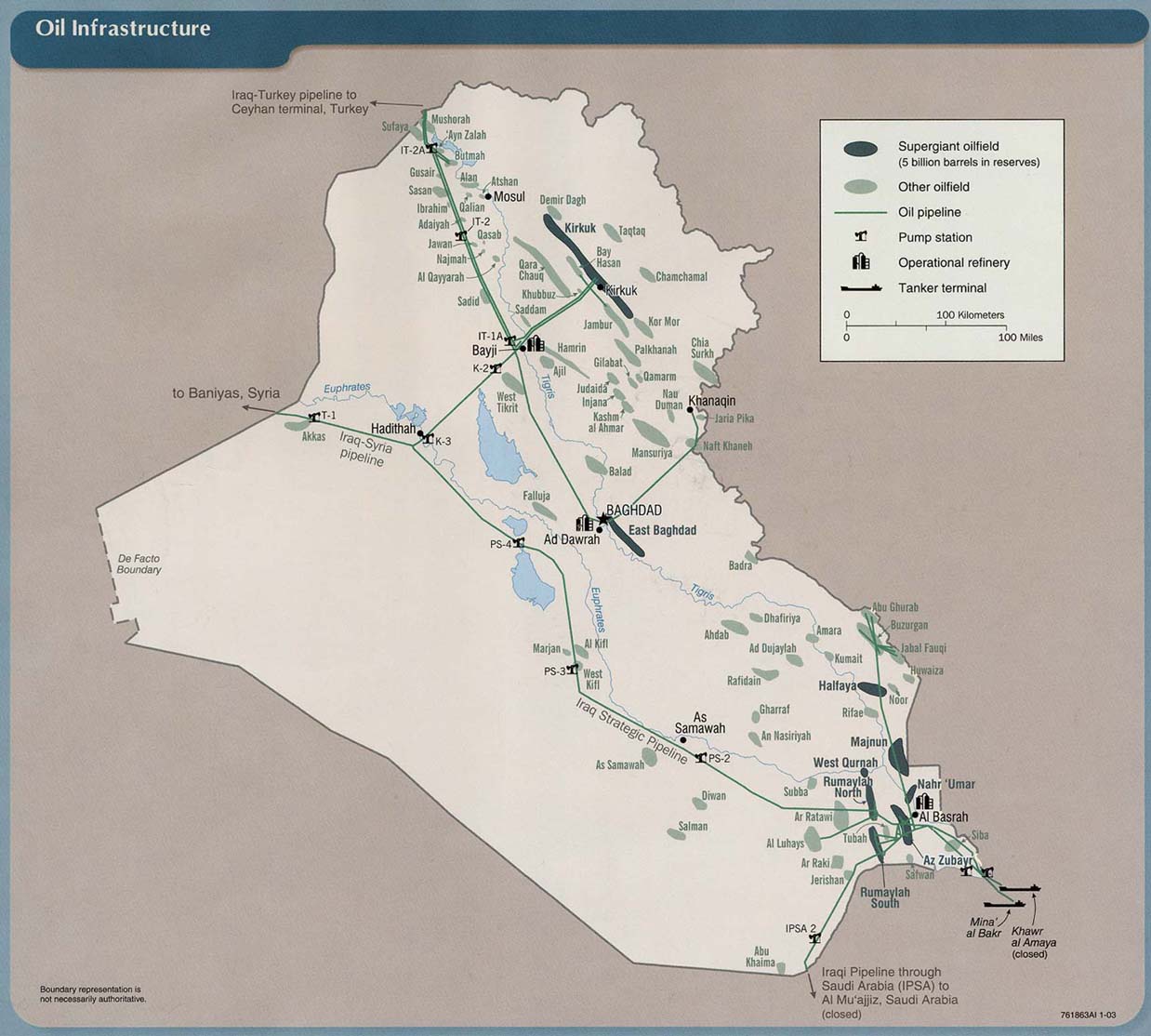
Following the news yesterday that a world class giant oil field find was confirmed in the Kurdish Autonomous Region of Iraq, the AFP reports that a section of the oil pipeline running from the large Bai Hassan oilfield near Kirkuk was blown up.


"'We were forced to interrupt pumping in 15 wells' because of the blast, [a North Oil Company, or government,] official said, adding that repairs will take up to seven days.

The North Oil Company produces 650,000-670,000 barrels of oil per day."
5. APPROX. 500,000 FLEE SWAT, BUNER, AND DIR; IS SHARIF PLAYING POLITICS WITH HIS COUNTRY'S SURVIVAL?

Alan Cowell at the New York Times reports that the International Red Cross published a statement today saying:
"[A]lthough figures remain unverifiable at this stage, reports indicated that up to 500,000 Pakistanis have been recently displaced by conflict in Dir, Buner and Swat."


It has been reported that PML-N's leader Nawaz Sharif has rejected an offer to rejoin the coalition government led by the PPP's Zardari, currently in talks with the Obama Administration in Washington, DC. An editorial in the Karachi Dawn suggests:
"Today, rising militancy is the main threat to national security, but the political class is divided on what is the best response. The PPP has shown itself willing to support military action, but the PML-N has baulked at supporting the option. Perhaps cleverly the PML-N has discerned that the electorate is not ready to support the military option because it causes unacceptable losses to local populations without seemingly being able to defeat the militants. And therefore, while sitting in the opposition, the PML-N can cleave to the populist line and not bear the burden of devising a credible and effective counter-insurgency and counter-terrorism policy which will inevitably involve a long-drawn-out and messy fight.

But what is good for the PML-N’s popularity is not necessarily what is best for the national interest. If the PPP and PML-N are nudged, or themselves agree, to join hands at the centre, they can form a formidable political alliance. The PML-N’s popularity in Punjab is unquestioned and Mr Sharif’s bona fides as the representative of the political right and conservative Pakistan are formidable. With the PML-N on board, the government will genuinely be able to claim its position on militancy represents the national will."
6. EL PAÍS ACCUSES CARACAS OF SHELTERING FARC LEADERS

Fausta Wertz at the Compass reports that Spanish daily El País published an article yesterday which speculates that three top FARC leaders are hiding out in Venezuela.
"The article from El País came up after Colombian president Alvaro Uribe urged Chávez to help destroy the FARC. Chávez flat-out refused, saying that it's not his war."
Ms. Wertz also notes that Chávez blamed the US for the recent crash of a helicopter, saying that the cost of patrolling the border with Colombia was beyond the financial resources of Caracas and that the conflict within Colombia itself is fueled to a great extent by the drug war. Fair points in my view, after all even the US with the largest federal government budget in the world finds cross-border traffic driven by the drug war impossible to police--and the precipitous decline in oil prices has put a serious crimp in Chávez's discretionary funds. (The proposed US budget includes $27 billion for "border and related security," an increase of 8% from last year. $27 billion is more than 8% of Venezuela's total GDP $331.8 billion and a little less than 27% of the 2008 budget in Caracas. It is 0.7% of the US proposed budget. Just sayin'.) However, it is also interesting in the context of Chávez's recent claim that Venezuela will not tolerate incursions by FARC into its territory--see Daily Sources 5/1 #2. Anyone who has been following my thinking on Chavez knows I don't think there's much chance of reconciliation, but in this particular instance I think that El País and Wertz are overstating the shock, just a bit.

7. OBAMA PROPOSES $3.4 TRILLION BUDGET PLAN

Lori Montgomery, Amy Goldstein and William Branigin at the Washington Post have the story on the Obama $3.4 trillion budget plan.
"The new budget documents, totaling more than 1,500 pages, fill in the details of a broad outline that Obama released in February. They include a massive appendix listing program-by-program information on the roughly 40% of the fiscal 2010 budget that constitutes discretionary spending, which will be set by Congress in what is expected to be a contentious appropriations process."
Under the plan, spending on operations in Afghanistan would exceed spending for Iraq for the first time since the second Gulf War began.

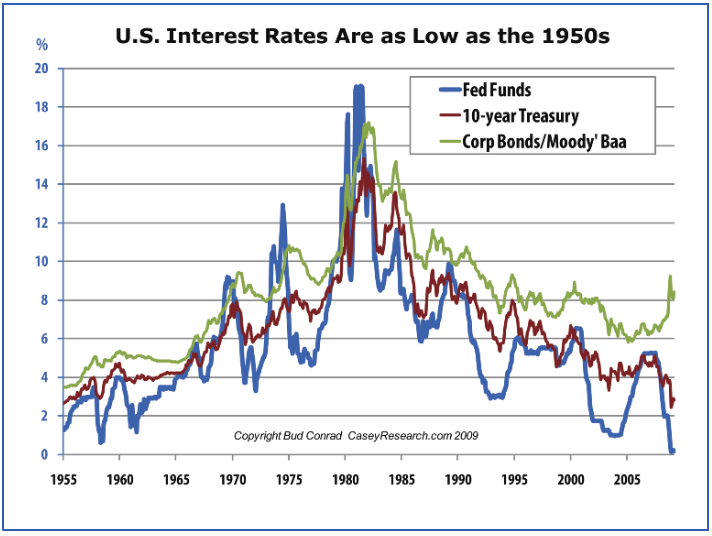
8. FED FUNDS RATE SINCE 1955

Barry Ritholtz at the Big Picture posts a graph plotting the Federal Funds Rate from 1955 on:


9. RETAIL DATA LOOKS BAD FOR ALL BUT APPAREL AND DISCOUNTERS--THE DATA TO BECOME EVEN MORE MURKY GOING FORWARD

Phil Izzo at Real Time Economics reports that a number of large retailers have released their sales data for April today, and RTE has posted a sortable table of the numbers on their site. Luxury retailers fared the worst. Discount and youth apparel firms seem, after a quick look, to have done relatively well. In a related story, Phil Izzo also reports that Wal Mart will no longer publish monthly sales data.
"The change also will remove an important piece for forecasters looking to get a handle on monthly retail sales. Wal-Mart is the nation’s largest retailer with $29.85 billion in sales just for April. An index for retail sales published by Thomson Reuters for April came in up 1.2% for the month, but excluding Wal-Mart’s results it posted a drop of 2.7%."
An already murky picture is thus going to become murkier--almost certainly at the advice of the corporation's investor relations team.

Friday, May 1, 2009

Daily Sources 5/1

Happy May Day!

1. BEIJING PROHIBITS FINANCIAL NEWS GATHERING OPERATIONS, ITS OFFICIAL PMI RISES SLIGHTLY (PUTATIVELY INDICATING A SECOND MONTH OF SLIGHT EXPANSION), AND IT CONSIDERS A CARBON EMISSIONS TAX

Kathrin Hille at the Financial Times reports that in regulations posted yesterday in the cabinet's website on Thursday, Beijing said that foreign media outlets would be allowed to operate out of China, but "foreign financial information providers set up in China ... must not undertake news gathering activities."
"China has required foreign news agencies to distribute to media clients only through Xinhua for more than 50 years. This will not change, and the foreign players do not challenge this arrangement for their news agency business which helps the Chinese government ensure news does not reach the public uncensored.

The companies’ financial information services business had been relatively unrestricted until 2006, when China took the controversial step of ordering distribution through an agent wholly-owned by Xinhua."
In the meantime, the AFP reports that China's official purchasing managers' index, or PMI, rose to 53.5 in April, up from 52.4 in March, per a statement on the the China Federation of Logistics and Purchasing's website. A reading above 50 indicates expansion; below 50 indicates contraction. Manufacturing accounts for more than 40% of Chinese GDP. Meanwhile, Keith Johnson at Real Time Economics reports that Beijing has asked state researchers to draw up proposals on a carbon tax. News of the action has caused some surprise given the recent call by China, India, and South Africa--see Daily Sources 4/29 #1--for $200 billion in contributions from the developed world to help their effort to curb greenhouse emissions and their insistence that the bulk of carbon reductions come from the developed world.
"[T]he idea of a carbon tax is the favored approach of most mainstream economists; cap-and-trade systems, like that under (tortuous) debate in Washington, are seen as more cumbersome systems that require a huge regulatory apparatus.

So what to make of the carbon tax proposal? Maybe the environmental balance of power between the old guard and the new guard in Bejing ... is more equal than many observers think.

Or perhaps China is just polishing its image ahead of the big Copenhagen conference in December that will aim to craft a successor to the Kyoto Protocol. Most Republicans—-and plenty of moderate Democrats—-are loath to take any action to curb US greenhouse-gas emissions unless China and other developing countries play ball, too."
2. CHÁVEZ SAYS VENEZUELA WILL NOT TOLERATE FARC INCURSIONS INTO ITS TERRITORY

Christopher Toothaker at the Associated Press reports that President Hugo Chávez said that Venezuela would not tolerate incursions of FARC guerrillas into its territory.
"Chavez said he was responding to concerns relayed this week by Colombia's government over the killing of eight Colombian soldiers by a rebel ambush in the Sierra de Perija, a mountain range on the 1,400-mile (2,300-kilometer) border separating the two countries"
Bogota has accused Venezuela of providing safe havens for FARC guerrillas for some time now--see Daily Sources 11/25 #12.

3. UK PURSUES ARRANGEMENT BY WHICH TO PROVIDE SECURITY FOR IRAQI OIL FACILITIES, FIRST OIL CONCESSIONS SINCE SADDAM WILL REQUIRE COMPANIES TO OFFER CASH LOANS TO BAGHDAD ... THE STATUS OF THE IRAQI DRAFT OIL AND GAS LAW REMAINS MUCH AS IT WAS ONE YEAR AGO

Eric Watkins at the Oil & Gas Journal reports that following the news of the UK's decision to withdraw its troops from military action in Iraq, London wants to set up an arrangement with Baghdad to protect oil supplies.
"'We hope to sign an agreement with the Iraqi government about the future role that we can play in training and in protecting the oil supplies of Iraq,' said [British Prime Minister Gordon] Brown, adding that the agreement would be 'between our two governments rather than any new United Nations resolution.'"
The statement came after Brown met with the Iraqi Prime Minister and other key officials in London. Spencer Swartz at Environmental Capital reports that Iraqi oil minister Hussein al-Shahristani briefed journalists in London after the meeting on the first licensing round since Saddam's ouster:
"He basically said that to get contracts, oil companies had to be willing to cough up a total of $2.6 billion in cash 'loans' to the government. This caught foreign oil firms off guard. In recent days, Iraq’s government has jacked up the amount of upfront cash oil companies have to pay when contracts are awarded.

In return, Mr. Shahristani said it would pay foreign energy companies with crude oil production in exchange for these giant cash 'soft' loans. Oh yeah, and Baghdad hasn’t said just how much oil that will be—and won’t let companies lay down the drill bit just because of suicide bombings or attacks from militants."
The Iraq Oil Report links to a study done last year by Susan L. Sakmar, adjunct professor of International Trade Law at the University of San Francisco Law School entitled The Status of the Draft Iraq Oil and Gas Law which is still a fairly accurate description of the the proposed legislation, given that the political disputes surrounding it in Iraq remain unresolved.

4. RIYADH DEMANDS USDOS RETRACT STATEMENT THAT KING ABDULLAH MET WITH SHIMON PEREZ IN NOVEMBER

Andrew Hammond at Reuters reports that Riyadh demanded that the US State Department retract the claim that King Abdullah met with the President of Israel at the time, Shimon Perez, in November at the UN interfaith meeting. The Saudi state news agency SPA referred to an "official source:"
"The official source demanded that the State Department retract the news and offer an explanation and clarification of the reasons behind this falsehood that does not serve relations between the two friendly countries."
There are no official ties between Israel and Riyadh.

5. RBC CAPITAL MARKETS PREDICTS 3-4 YR BULL RUN IN URANIUM MARKETS

William MacNamara at FT Energy Source reports that RBC Capital Markets has released a new study which argues that uranium is about to enter a "bull market rally" which could last as long as three to four years.
"Factors cited by the report: A looming supply/demand shortfall, as a new generation of nuclear power plants--largely in Asia, but also in Western Europe--requires more uranium in a world that has not invested properly in new sources of supply. Another factor: Japanese and Korean utility companies’ direct buying of uranium companies, which signals 'the start of utilities looking to secure long-term supplies where they see potential shortfalls.'"
6. MEXICAN ECONOMY SHRINKS BY 7% IN Q1

Valerie Rota at Bloomberg reports that the Mexican economy likely shrank by as much as 7% in the first quarter.
"The country’s gross domestic product fell for a second straight quarter 'due to the deterioration of global economic conditions,' according to an e-mailed statement released late April 30 in Mexico. The official GDP number is scheduled to be released May 20."
7. THE GLOBAL CREDIT CRUNCH IS SHOWING SIGNS OF EASING, BUT QE DOES NOT APPEAR TO HAVE THE DESIRED EFFECT ON 10 YR TREASURIES

Rebecca Wilder at News N Economics reports that the credit crunch is easing according to data from three key central banks--the ECB, the Bank of England, the Bank of Japan, and the Bank of Canada. The ECB reported that the tightening of standards for credit lines was still ongoing, 21% less banks reported doing so in April than had in the fourth quarter of 2008. The Bank of Canada also reported a slight decrease in the percentage of banks that were tightening credit, Ms. Wilder's graph:


The Bank of England reported a small net increase in lending in the three months to mid-March.
"The BoJ's survey report indicates that in the first quarter of 2009 net, lending standards to large firms tightened somewhat, while those to medium-sized firms eased somewhat. Small firm and household lending standards eased somewhat. However, the outlook for small firm and household loans suggests that less easing is on the horizon."
Ms. Wilder concludes that the worst of the global credit crunch is now behind us. Her post is well worth reading in its entirety. Meanwhile, Karl Denninger at The Market Ticker points out that though Fed chief Ben Bernake has pursued a policy of "quantitative easing" putatively in order to suppress yields and push up prices on 10 year Treasuries, precisely the opposite has happened. His chart:


8. INDONESIA TO OFFER GUARANTEES TO SPUR REFINERY CONSTRUCTION

Platts reports that the Indonesian government is considering offering a set of guarantees to encourage the construction of new refineries.
"'Apart from a zero tax incentive for import duties and crude oil imports, we may also give our guarantee to new refinery projects,' oil and gas director general at energy and mines ministry Evita Legowo said. 'Our guarantee will allow investors access to lower interest from lenders.'"
There are three potential refinery projects in the works, a 200 kb/d greenfield refinery in Tuban, the expansion of its 125 kb/d refinery in Balongan, West Java, and a 300 kb/d refinery in Bantan in conjunction with the National Iranian Oil Company and the Malaysian Petrofield Refining Co. (The talk about this last with NIOC has been going on for quite some time now. As it stands, however, even with these guarantees, it seems especially risky to build refineries into the Asia Pacific market, which is facing a glut of refining capacity over the next several years--see Daily Sources 1/12 #6.

9. APRIL CAR SALES DATA CONTINUES TO BE GRIM, CHRYSLER FILES FOR CHP 11

Nick Bunkley at the New York Times reports that sales of new vehicles experienced another sharp drop in April, per preliminary results released today.
Chrysler's sales dropped 48% year-over-year, 24% month-over-month. Ford's sales dropped 35% year over year, and at an annual rate of 35%. GM's sales were down 34% on the year, but up 11% from March. Toyota, Nissan, and Honda reported annual rates of sales declines of 42%, 38%, and 25%, respectively. Chrysler filed for Chapter 11 bankruptcy yesterday and is slated to shutter 13 factories for up to 11 weeks starting as early as next week.

10. US FEB OIL CONSUMPTION REVISED DOWN TO BELOW 19 MB/D

Linda Rafield at Platts reports that total US petroleum demand in February was revised down to 780 kb/d to 18.706 million b/d according to the EIA. The new total is 5.44% below consumption in February 2008. Further:
"US commercial crude inventories ended February at 354.923 million barrels, an upward revision of 4.119 million barrels from preliminary estimates."

Tuesday, November 25, 2008

Daily Sources 11/25

1. Brad Setser at Follow the Money argues that the time of the sovereign wealth funds is over. Those funded by oil revenues are no longer receiving the cash flows that they once enjoyed. Brazil, Russia, South Korea, and India will not have large funds in the near future in Setser's opinion. Abu Dhabi's fund will be hampered by the need to finance Dubai's debt, as the emirate's domestic state firms were heavily leveraged. Norway's fund had $380 billion earlier in the year, and now has about $300 billion. The problem is that the funds were set up to invest surplus funds in equities and it is precisely the equity markets which have been hit the hardest by the current crisis. In an ironic twist, the US is purchasing equities now that they are cheap by taking stakes in firms with large international positions. China is the wildcard. Well worth reading in full.

2. Platts reports that Russian energy minister Sergei Shmatko told reporters in New Delhi that Russia "will coordinate with OPEC." OPEC representatives have recently suggested that one critical element of the November 29 meeting in Cairo would be to secure Russia cooperation with their efforts to shore up the price of oil. Moscow has typically been cool to the idea of coordinating production with the cartel, but yesterday a senior executive at Lukoil suggested that doing so would be in the Russian interest. This is the first indication from an official government representative that Moscow might adopt the strategy of pursuing a closer relationship with producers rather than a symbiotic energy security relationship with Europe. Moscow could potentially play the role of a swing producer--it produces about as much oil as Saudi Arabia--but so far has opted to produce at full tilt and send it all to market.

3. Ulf Laessing at Reuters reports that the Kuwait Investment Authority has repatriated $3.7 billion in foreign investments in order to shore up the local stock market.

4. Eric Watkins at the Oil & Gas Journal reports that Total and Saudi Aramco have decided to delay the award of the $10 billion, 400 kb/d, export refinery in Jubail given the global economic environment. Last week Riyadh decided to suspend development of the Manifa field, which was planned to produce 900 kb/d by 2011 and which was to fuel the Jubail refinery. (Also last week Conoco and Aramco announced they would delay construction of the 400 kb/d export refinery to be built at Yanbu.)


5. The Associated Press reports that Russian warships arrived off Venezuela's coast today. The ships are slated to take part in military exercises this month and were clearly sent in response to the American presence in the Caucasus. US State Department Spokesman Scott McCormack on Monday seemed to mock the move in the State Department's daily briefing of the press, saying "You know, I don’t know. Are they accompanied by tugboats this time? I – you know, look, there’s no – I don’t think there’s any – there’s any question about, you know, who the region looks to in terms of political, economic, diplomatic and as well as military power." (Peter the Great is the Russian Navy's flagship--a nuclear cruiser--which seemed to face some operational difficulties earlier this year.) The joke suggests a certain level of insobriety at the State Department, a not entirely welcome apprehension. Almost immediately afterward, however, he gave the official American response: "I don’t know if the intention was provocative. Certainly, we don’t – we won’t view it that way."

6. Sinan Salaheddin at the Associated Press reports that the chair of the Iraqi Parliament's Committee on Oil and Gas has criticized the deal between the Oil Ministry and Shell to jointly exploit natural gas in the southeastern province of Basra.

7. Galrahn at Information Dissemination posits the argument that it is in the interests of the US to fail to police piracy originating from Somalia because to do so would deny funding to the capitalist elements of society at the very time that the Islamists are struggling for funding. The argument contains some odd presumptions, and, for example, his analysis of the operating cost additions in the shipping industry is misguided. (It is not just, for example, the oil industry which is abandoning the route via the Suez Canal, but all shipping--including container ships, etc.. When so many tonne miles are added, and so much capacity is thereby taken off line, prices should go up. And, the shipping industry certainly hopes so!) Alaric Nightingale at Bloomberg reports that tanker rates have not revived on the back of the route shift, however, with the cost of shipping Middle East crude to Asia, the global benchmark, falling to 66 Worldscale (WS). That is a big decline from the top of the market, but, if I understand correctly, much better than what other categories of shipping are receiving on the market.

"[W]hile hire rates may have declined, returns for shipowners remain profitable. The route from Saudi Arabia to Japan is paying shipowners $44,442 a day, according to the Baltic Exchange. Frontline Ltd. said Aug. 21 it needs $31,500 a day to break even on each of the vessels."
And sending tankers past the Cape of Good Hope instead of through the Suez adds a considerable amount of time to a shipment.
"Sailing at 14 knots, it takes 33.2 days to ship Saudi Arabian crude oil to Rotterdam via the Cape of Good Hope, compared with 19.2 days going through the Suez Canal, according to the world-register.net Web site."
That said, business requires the rule of law in order to operate, which, for example, is why the Islamists have supporters in Somalia, and, as an article today suggests, support is rebuilding for them in Afghanistan. Nonetheless, it would be interesting if the US were put in a position to support the pirates as the only viable governing alternative to the Islamists. It would not, as Galrahn suggests however, be especially supportive of the free market ideology.

8. Steven Bodzin at Bloomberg reports that Hugo Chavez told reporters that OPEC should reintroduce the practice of announcing a price band that it is prepared to defend, and that a fair price for oil is between $80-100/b.

9. AFP reports that on Monday China signed a protocol with Jordan to assist Amman in mining and enriching uranium, as well as with scientific training for the construction and operation of nuclear power plants. "The country's 1.2 billion tonnes of phosphate reserves are estimated to contain 130,000 tonnes of uranium and the government intends to start mining the radioactive ore to fuel its first nuclear plant."

10. Kim Barker at the Chicago Tribune reports that "pervasive corruption" is fueling anger at the Karzai government in Kabul. The corruption is causing many to long for Taliban rule as the Taliban strictly enforced the law. As I have pointed out in a few posts much earlier in the year, one of the central preoccupations of Islam is with the rule of law.

11. Calvin Lee at Platts reports that Yang Qing, deputy director of China's National Development and Reform Commission's price monitoring bureau told a forum in Beijing Tuesday that export growth was falling sharply due to the fall in US demand. According to Yang, a 1% drop in US GDP will cause Chinese export growth to contract by 7-8%. (Not exports, but export growth.) Geoff Dyer at the Financial Times reports that the World Bank's quarterly report on China predicted that China's growth rate will fall to 7.5% next year, 0.5% below the rate generally reported as necessary to absorb growth in the labor market and thus avoid social unrest.

12. José de Cordoba at the Wall Street Journal reports that the government of Hugo Chavez is providing safe havens inside Venezuela for members of FARC to carry out cross-border operations into Columbia. FARC is allegedly setting up road checks, "meting out justice to petty thieves and extorting businessmen." FARC leadership is also apparently living on and operating from the Venezuelan side of the border, and some of the organization's predatory behavior with the locals has apparently roiled some in Caracas. FARC also evidently has offices in Venezuelan cities deep inside the country. The article is worth reading in full and includes, in a sidebar, translations of some of the FARC emails found on a computer captured earlier this year. Below is the Journal's map of the regions where FARC and the ELN have set up shop inside Venezuela.


13. Tim Johnston at the Washington Post reports that Thai protesters broke through riot police lines and stormed the Suvarnabhumi Airport, shutting down the new facility. Generally speaking, this would be pretty startling news, indicating that the government is about to fall in short order. But the protest movement has only been able to muster about 20,000 people, which is not enough, usually, to do things like grab control of major ports or broadcast stations. Either the government is about to change, a crackdown is about to be instituted, or the numbers are being woefully under-reported. This seems especially the case given that the police have been fired upon by some protesters. The Post has a slide show of the protesters--looks like they overpowered a considerable force of riot police.

14. Eurointellingence reports that the Franco-German summit went badly. Angela Merkel wants to schedule another summit for January to see how successful the various national stimulae have been, and just after France has passed on the baton of the EU Presidency.

15. Aaron Eglitis and Ellen Pinchuk at Bloomberg report that the Latvian Finance Minister Atis Slakteris told the journalists that the country will likely ask the IMF and the European Union for emergency funds of as much as €3 billion (~ $3.85 billion).
"'The Baltic countries, in particular Estonia and Latvia that have experienced the strongest upswing, are now facing a severe downturn," Helge Pedersen, global chief economist for Nordea, said in a report. Estonia contracted 3.3 percent in the third quarter. Swedbank AB, the biggest bank in the Baltic states, said on Nov. 20 it expects Latvia’s economy to shrink 4 percent next year."
16. Robert Barnett has an opinion piece at the New York Times which points out that the UK on October 29 recognized Tibet as a part of the People's Republic of China, a switch from its previous position that Tibet was an autonomous region. The British recognition of Tibet as an autonomous region had provided the legal basis for negotiations between Beijing and Tibetan representatives. No more. Barnett suggests that London has reversed course because the UK requires the cooperation of Beijing in the current financial crisis.

17. Norma Cohen at the Financial Times reports that the OECD released its world economic forecast today which predicts that the US and the eurozone both are about to enter four straight quarters of economic contraction. "In pinpointing countries that will experience a severe downturn, in addition to the UK, the OECD lists Hungary, Iceland, Ireland, Spain and Turkey."

18. Stefan Wagstyl at the Financial Times reports that the European Bank for Reconstruction and Development has cut its forecast of GDP growth in 2009 for Central and Eastern Europe from 5.7% to 3%.
"In Russia, the region’s largest economy, the bank forecasts a slowdown in growth from an expected 7.3 per cent this year to 3 per cent, following the drop in oil prices. In neighbouring Ukraine, the decline is predicted to be even steeper, from 6 per cent to 1 per cent. The average for the former Soviet Union (minus the Baltic states) is likely to be 3.4 per cent, from 7.3 per cent this year.

Further west, in Poland, the second biggest economy after Russia, the EBRD predicts a decline from 5.3 per cent to 2.8 per cent.

The worst performance is expected in the Baltic states, with recession in Estonia and Latvia next year. Central Europe and the Baltic states as a whole are predicted to see growth almost halve from 4.3 per cent in 2008 to 2.2 per cent. In south-east Europe the forecast fall is even greater, from 6.5 per cent to 3.1 per cent."
19. The Associated Press reports that the Conference Board said today "that its Consumer Confidence Index was 44.9, up from a revised 38.8 in October. Last month’s reading was the lowest since the research group started tracking the index in 1967."

20. Michael M. Grynbaum at the New York Times reports that most recent numbers for the Case-Shiller Home Price Index were released today and that they suggest that home prices fell across the United States by an annual rate of 16.6% in the third quarter. Also today the Commerce Department revised its estimate of the contraction seen in the third quarter from down 0.3% from the year before to down 0.5%.

21. Damian Paletta at Real Time Economics reports that the FDIC has released its list of troubled banks and the number of challenged banks has grown from 171 at the end of the third quarter from 117 at the end of the second quarter. The post includes a link to an interactive table of the banks that have been forced to shut down by federal regulators this year.

22. Yves Smith provides a quick reaction to the news that the Treasury and Federal Reserve Bank have announced a plan to provide $800 billion to support consumer lending. Real Time Economics provides the text of the announcement.

Wednesday, September 17, 2008

Daily Sources 9/17

1. Andrew E. Kramer at the New York Times reports that trading was halted on the Russian stock market for the second time this week. The market has dropped by more than 25% this week and is off 57% since its peak in May. The Russian Central Bank and regulators also announced a 4% reduction in bank reserve requirements today, which the central bank’s chairman, Sergei Ignatyev, said would free up $11.76 billion. The Russian finance minister, Aleksei L. Kudrin, also announced he would free up about $44 billion by increasing the repayment time of state loans to state banks from one week to three months. Kudrin also said that the discussed measure of having Russia's Sovereign Wealth Fund invest in the market has, for now, been deemed unnecessary.

2. The Moscow Times reports that UBS analysts have said that the price of crude has dropped so much that a barrel is now worth less than the cost of transport and Russian taxes. If you are a pure crude exporter--and don't have a refinery from which you then sell products--you are losing money. (Evidently the mandated prices of transportation fuels in Russia now would not be counted as subsidies.)

3. Margarita Antidze and Matt Robinson at Reuters report that Russia has signed treaties with Abkhazia and South Ossetia which formally commits Moscow to coming to their defense should they be attacked. In 19th century gunboat diplomatic terms, you would call it a "guarantee of independence."

4. AP reports the US Embassy in Yemen was assaulted with a car suicide bomb, rocket-propelled grenades, and automatic weapons today. At least 16 are dead, although apparently no Americans were hurt. President Bush used the incident to say that the attack is a "reminder" that we are "at war with extremists." Officials believe it is likely an al-Qaeda attack. Non-essential personnel were just allowed back into the facility last month.

5. MEND's oil war continues to heat up in Nigeria, as per Ibanga Isine and Victor Sam at the Punch. The "oil war" is also referred to by MEND as "Operation Hurricane Barbarossa"--which is probably meant to evoke the Turkish privateer "Redbeard" who put an end to the damage the Knights of Saint John were doing to Ottoman shipping and eventually became the Fleet Admiral of the Ottoman Navy(a) and not Hitler's "Operation Barbarossa" (or the code name for the invasion plan of the Soviet Union.) The Hurricane part I understand ... and so far many of the attacks seem to have come via speed boats.

It is in this environment that the Nigerian Senate is considering an anti-terrorism bill reports John Alechenu at the Punch. Yet another foreign political utilization of the Bush Administration's "War on Terror" (by the way, just yesterday Putin referred to the Georgian terrorist situation)--and it is worth remembering that America remains very popular in Nigeria.(b) "If passed, the attorney-general will be empowered to detain persons for up to 60 days where he has reasonable grounds to 'believe or suspect' that 'the entity knowingly committed; attempted to commit, participate in committing; or facilitated the commission of terrorist acts.'" I think that such broad language tends to erode the rule of law, and this would be in a country where the rule of law is not particularly strong to begin with.

6. Juan Forero at the Washington Post has an important report on a witness in ongoing trials in Colombia linking Gen. Mario Montoya to death squads in Medellin. Montoya is apparently well-known in Washington and was one of the generals involved in orchestrating the spectacular rescue of hostage Ingrid Betancourt from FARC. The State Department stood behind Montoya today in interviews. Should these allegations prove true, they will likely be very damaging to the Uribe Administration as well as further undermine the American image in South America.

7. Thom Shanker at the New York Times reports that Defense Secretary Gates has apologized for the deaths of non-combatants in recent strikes in Afghanistan. I think that--though it might stick in the craw a little--this was a very wise move.

8. Xinhua reports that China will allow local governments to raise the cost of heating in response to the increased costs of coal.

9. Tom Doggett at Reuters reports that Sam Bodman, Secretary of Energy, told reporters that the Administration is considering asking the IEA for some of its gasoline reserves.

10. Edmund L. Andrews, Michael J. de la Merced and Mary Williams Walsh at the New York Times report that The Federal Reserve Bank has agreed to lend AIG $85 billion for a majority equity stake in the company.

11. David Cho at the Washington Post reports that the Federal Reserve has asked the Treasury for a $40 billion deposit.

12. Brain Setser at Follow the Money yesterday had a blog entry which partially answered my question regarding where foreign banks were going to put their money, following the Treasury's release of the Treasury International Capital data for July (TIC.) Answer: fleeing the US, and insofar as they are investing in the US, investing in the safest possible instrument, Treasuries. To paraphrase:
Before the crisis, foreigners bought roughly:

- $205b of long-term Treasury bonds
- reduced their holdings of bills by $10b
- $285b of long-term Agencies
- $540b of long-term corporate bonds
- $210b of US equity.
or about $1,230 billion per month.

After the crisis:
- $350b of long-term US treasury bonds
- $125b of short-term bills
- $150b in Agency bonds
- $210b of corporate bonds
- $55b of US equity
or about $890 billion per month.

Today the yield on the 3 month Treasury bill went to zero. That suggests to me that the market believes that the dollar will be worth more tomorrow, versus a basket of goods, than it is today. By basket of goods, I mean basket of currencies and securities because commodities appear to have rebounded recently. (Gold for December went up, if I understand correctly, $70 today! h/t Jesse's Cafe Americain) So, does this mean that foreign central banks will now be forced to sell dollars in order to defend their currencies or that they will be forced to buy dollars in order to defend their exports? I dunno.

(a) Wikipedia: Hayreddin Barbarossa
(b) Pew's 47-Nation Global Attitudes Study of 2007 has 70% of Nigerians having favorable views of the United States. Table: "Favorable Views of the U.S.", page 17. You also might want to check out my blog entry from March: The Geopolitical Consequences of the Candidates.

Sunday, May 25, 2008

Update: Venezuela vs. Exxon-Mobil

UPDATE: VENEZUELA

On March 13, 2008, US Representative Connie Mack (R-FL) submitted H.R. 1049 to the US Congress calling for the Bolivarian Republic of Venezuela to be designated a state sponsor of terrorism.(1) This act was basically in response to what is now known as the 2008 Andean diplomatic crisis, where Colombia troops crossed the Ecuadoran border in pursuit of a group of Revolutionary Armed Forces of Columbia (FARC) taking refuge there. The incursion led to the death of Raul Reyes, a senior leader of FARC, as well as the capture of computers which contained evidence of strong ties between Hugo Chavez and the rebel group.(2)

The incident brought into focus the geopolitical battlelines in the struggle that Chavez imagines himself in with the United States.

The President of Ecuador--Rafael Correa--is seen by many to be an ideological fellow-traveller of Chavez's, and just after his election in 2006 began moves to nationalize the petroleum industry in that country.(3) Although the industry there is nowhere near the size of Venezuela's, it is the third largest oil producer in South America, producing around 512 kb/d in 2007 band holding proven reserves of around 4.5 billion barrels.(4) As with Venezuela, the oil sector in Ecuador has ties to the Chinese petroleum industry after CNPC bought the assets of Encana--a Canadian oil producer--there in 2005.(5)

The Colombian raid over the border was quickly condemned by Ecuador, which immediately expelled the Colombian Ambassador from Quito, recalled their own from Bogota, and moved troops to the border. Hugo Chavez also closed its Embassy in Colombia, expelled the Colombian Ambassador to Venezuela, closed the border between the two countries, moved 10 battalions to the border, and threatened to nationalize Colombian assets in Venezuea. Nicaragua, which you'll recall is the beneficiary of Venezuela's special program to sell oil at below-market rates with special financing deals and which has an old border dispute with Colombia, also broke diplomatic relations with Colombia.(6) The current President of Nicaragua, Daniel Ortega, was the head of the Communist Sandanista government of Nicaragua which was brought down, in great part, due to US funding of the Contra movement there in the 1980s.

The diplomatic meltdown seems to have been put a stop to after an emergency meeting of the Rio Group on March 7th, where the presidents of Venezuela, Ecuador, Nicaragua, and Colombia publicly shook hands in a show of peace.(7)

However, allegedly the computer files captured in the raid point to strong Venezuelan support for the Colombian rebel group, FARC, with reference to a $250 million loan made to the organization by Chavez.(8) FARC has long been considered an enemy to American interests because of its connection to the cocaine trade, which it has taxed to finance its political enterprise in Colombia.(9) In the first week of May, President Bush gave a speech which pointedly made reference to FARC's connection to Venezuela and Venezuela's connection to Cuba.(10) This followed a report by the Senate Committee on Foreign Relations which argued that sanctions against Venezuela would be likely to backfire unless the region as a whole were convinced to impose them as well, something the report argued was unlikely.(11)

The Cuba connection is important to understanding the genesis of HR 1049, as Connie Mack and several of the co-sponsors, including Ileana Ros-Lehtinen and Lincoln Diaz-Balart, are luminaries of the Cuba sanctions effort dating back to the Helms-Burton Act of 1996. (The Helms-Burton Act gave Congress the right to override a decision by the Executive to void sanctions on Cuba, strengthened sanctions on that country, and prohibited recognition of any transitional goverment there headed by either Fidel or Raul Castro--currently Cuba's head of state.)(12)

Venezuelan ties to FARC are just the icing on the cake as far as this particular coterie in the Congress goes. Anything which serves their goal to isolate Cuba from the international community--or at least from any reconsideration within the United States--is welcome. Beyond that, their efforts presumably confirm Chavez's suspicion that the United States is committed to his overthrow, by military force if necessary. It is an interesting gambit, for example, to put 10 battalions on the border with Colombia, a country which possesses an army twice the size of those of Venezuela and Ecuador combined.(13) Given that Colombian troops have battle experience fighting its various rebel movements and it's outright backing by the Uniteed States, it is little wonder that Colombia did not decide to do anything as a countermeasure whatsoever. That type of conflict is not one that Chavez would be likely to come out ahead in.

On the other hand, in 2006 Chavez put together a reservist program which counts upwards of 2 million men as its members. These groups are deliberately trained in asymetrical warfare, with lessons gleaned from the Viet Cong(14)--similar to the military doctrine current in Cuba--as protection from an American attack or perhaps that of its perceived proxies, such as Colombia. Indeed, it appears that one of the troubles faced by FARC in its battle with the government of Colombia is that Colombia, aided by the US, has no ability to counteract government air superiority. Russian-made surface-to-air missiles are mentioned,(15) which brings to mind our efforts in Afghanistan twenty years ago. Whether it is just posturing for political gain or not, it does appear that Venezuela is preparing the ground regionally and inside Venezuela for a military confrontation with the United States.

Although some of the current diplomatic sympathy for Chavez in the region likely comes from stronger-than-usual antipathy to the Administration in Washington, DC, it also seems to me that he is making progress towards tying the region closer to Caracas. Ecuador, for example, has seen a drop in production of oil since Occidental was kicked out in 2006, and the sector accounts for fully one-third of the government's tax revenues and nearly half of its export earnings.(16) Ecuador is being forced to import petroleum products to meet local demand--and reportedly is racking up $billion/year in bills to do so.(17) As part of an effort to end this problem Ecuador signed an agreement with Venezuela to build a 300 kb/d refinery for $5.5 billion in February.(18) In 2007 it rejoined OPEC--the brainchild, basically, of Venezuela at its foundation. Moreover, Ecuador is in the process of considering changes to its constitution in a move reminiscent of Chavez's, shortly after coming to power, and several times since.

Nicaragua's Daniel Ortega, of course, has a long history with the United States and may well, therefore, feel strongly sympathetic to Chavez's efforts. (Iran's recent efforts to build strong ties to both Venezuela and Nicaragua--including an MOA to help finance a hydroelectric dam in the latter country(19)--are the most interesting historical irony in this story.)

If, as Franklin Foer's piece in the Atlantic Monthly suggested some time ago(20), Chavez is working to recreate the Gran Colombia that Bolivar liberated from Spain two hundred years ago, it does seem that he has made a good start.


Gran Colombia

The suggested American response of putting Venezuela on the state sponsor of terrorism list does not make much sense to me, however. Any effort at this stage to make life for the Venezuelan energy industry more difficult does not seem to be in American interests, given the current high price environment for oil and the supply concerns which are at least part of the reason for this.

UPDATE: EXXON-MOBIL

It has been reported that Venezuela has had no trouble placing the oil that it traditionally sent to the Chalmette Refinery, having found a buyer for it all in China.(21) However, I find this claim extremely suspicious, because, as I pointed out in my previous blog, there simply aren't enough complicated refineries in China to take this crude. I have heard from a private source that in fact Venezuela did offer the oil to China, which in turn offered to pay a price of WTI minus $35-40 for the crude, given the transportation costs, etc. According to my source, the Venezuelans refused the offer, and sold the oil to traders, who in turn sold the oil to ... Exxon-Mobil, at about the price they were paying the Venezuelans.

(1) House Resolution 1049
(2) "Chavez Aided Colombia Rebels, Captured Computer Files Show," Wall Street Journal, May 9, 2008, by Jose de Cordoba and Jay Solomon
(3) "Ecuador moves to take over Occidental oil operations," International Herald Tribune, May 16, 2006
(4) US Department of Energy's Energy Information Agency Country Analysis Brief on Ecuador
(5) "China oil firm buys EnCana assets in Ecuador," Reuters, September 15, 2005
(6) Wikipedia: 2008 Andean Diplomatic Crisis
(7) Wikipedia: 2008 Andean Diplomatic Crisis
(8) "Chavez Aided Colombia Rebels, Captured Computer Files Show," Wall Street Journal, May 9, 2008, by Jose de Cordoba and Jay Solomon
(9) Testimony Before the Senate Committee on the Judiciary Subcommittee on Technology, Terrorism and Government Information by Rand Beers, Assistant Secretary for International Narcotics and Law Enforcement Affairs and Francis X. Taylor, Ambassador-At-Large For Counterterrorism, March 13, 2002
(10) "Chavez Aided Colombia Rebels, Captured Computer Files Show," Wall Street Journal, May 9, 2008, by Jose de Cordoba and Jay Solomon
(11) "Senate report warns against Venezuela sanctions," by Pablo Bachelet, McClatchy Newspapers, April 28, 2008
(12) Wikipedia: Helms-Burton Act
(13) Wikipedia: 2008 Andean Diplomatic Crisis
(14) "Invasion or civil war for Venezuela?," by Sam Logan, ISN Security Watch, March 24, 2006
(15) "Chavez Aided Colombia Rebels, Captured Computer Files Show," Wall Street Journal, May 9, 2008, by Jose de Cordoba and Jay Solomon
(16) US Department of Energy's Energy Information Agency Country Analysis Brief on Ecuador
(17) "Oil Nationalization Threatens Output, Investment," Reuters, February 15, 2007
(18) "Ecuador and Venezuela will construct oil refinery for 5,5 billion dollars," Business and Financial News, February 3, 2008
(19) "Iran pledges hydro, houses, port for Nicaragua," Reuters, August 4, 2007
(20) The Atlantic Monthly, "The Talented Mr. Chavez" by Franklin Foer, May 2006
(21) "Venezuela Sends Chalmette Oil To China - Ramirez," AFX News Limited, March 31, 2008