Showing posts with label santos basin. Show all posts

Tuesday, January 20, 2009

Daily Sources 1/20

1. Barack Obama was sworn in as President of the United States today. He has a tremendous amount of political capital here in the US--and abroad. The Associated Press carried the full text of his inauguration speech. Some excerpts:
"We will restore science to its rightful place, and wield technology's wonders to raise health care's quality and lower its cost. We will harness the sun and the winds and the soil to fuel our cars and run our factories. And we will transform our schools and colleges and universities to meet the demands of a new age. All this we can do. All this we will do."
"Restore science to its rightful place"--implying that the previous Administration did not have the proper respect for science. But, also, from the historical perspective, it is the restoration of the place of the Enlightenment in the world.
"As for our common defense, we reject as false the choice between our safety and our ideals. Our Founding Fathers, faced with perils we can scarcely imagine, drafted a charter to assure the rule of law and the rights of man, a charter expanded by the blood of generations. Those ideals still light the world, and we will not give them up for expedience's sake. And so to all other peoples and governments who are watching today, from the grandest capitals to the small village where my father was born: know that America is a friend of each nation and every man, woman, and child who seeks a future of peace and dignity, and we are ready to lead once more."
These words should have a powerful effect across the globe. Calling the Bush Administration the exception that proves the rule, and challenging those regimes to explain, if they can, how it is, were their views of the US true, Obama could have ever become President of the United States.
"Guided by these principles once more, we can meet those new threats that demand even greater effort — even greater cooperation and understanding between nations."
One of a series of foreign policy statements that give a broad sense of the stance the Obama Administration will take in the world.
"With old friends and former foes, we will work tirelessly to lessen the nuclear threat, and roll back the specter of a warming planet. We will not apologize for our way of life, nor will we waver in its defense, and for those who seek to advance their aims by inducing terror and slaughtering innocents, we say to you now that our spirit is stronger and cannot be broken; you cannot outlast us, and we will defeat you."
An important holding out of the hand to Moscow and a distancing from "the war on terror" rhetoric which is also much needed.
"To the Muslim world, we seek a new way forward, based on mutual interest and mutual respect. To those leaders around the globe who seek to sow conflict, or blame their society's ills on the West — know that your people will judge you on what you can build, not what you destroy. To those who cling to power through corruption and deceit and the silencing of dissent, know that you are on the wrong side of history; but that we will extend a hand if you are willing to unclench your fist.

To the people of poor nations, we pledge to work alongside you to make your farms flourish and let clean waters flow; to nourish starved bodies and feed hungry minds. And to those nations like ours that enjoy relative plenty, we say we can no longer afford indifference to suffering outside our borders; nor can we consume the world's resources without regard to effect. For the world has changed, and we must change with it."
Referring to Palestine, Iraq, and Iran. The notion of mutual respect is, of course, especially important if the Administration wants to pursue lines of cooperation and potential relations with nations like Iran. Essential to read in full, of course. Debbi Wilgoren and David Nakamura at the Washington Post write of "festive masses converging on the capital" today for the inauguration. Gabriel Schoenfeld, resident scholar at the Witherspoon Institute, has an opinion piece in the Wall Street Journal which reminds readers of the Democratic roots of the neoconservative movement. He argues that it is too early to say which way the Obama Administration's foreign policy will "really swing" and that he has an opportunity to gather support from "hawks." I read Obama's speech as giving little room for the narcissistic approach to the world of the neoconservative movement, but I agree that it is possible.

2. Thomas Erdbrink at the Washington Post reported that the head of the Iranian counter-espionage unit in remarks to the media warned the US yesterday not to spy on Iran.
"He described a 'full-fledged intelligence war' between the two nations and offered rare, detailed comments about what he described as 'heavy damages' suffered by the United States in efforts to recruit agents among doctors, artists and fashion designers in Iran.

The official, who was not named by local media, said two Iranian AIDS specialists, whose arrests last year sparked concern in the West, are part of a group of four 'ringleaders' who were recently convicted of involvement in an alleged U.S.-funded plot to overthrow the Islamic government. Dozens of others have been arrested and interrogated, the official said.

He accused the United States of stationing intelligence agents in neighboring countries, and specifically mentioned the United Arab Emirates, Turkey, Kuwait and Azerbaijan as places from where the United States is designing 'plots' against Iran. The agents are seeking to create 'social crisis, street demonstrations and ethnic disputes,' he said. 'A soft revolution has been programmed against our country and carried out in some instances, but it was suffocated in the cradle,' Fars News quoted the official as saying."
As I have pointed out in the past, xenophobia is enshrined in the Iranian Constitution. The government in Iran is a revolutionary government and the official title of the "Supreme Leader" is "Leader of the Revolution." Their raison d'etre is to rid the country of foreign control, and to that extent it needs the US--and others--as enemies, otherwise the cognitive dissonance between its purpose and the situation will undermine its ideological justification--and thus the political will to fight for the regime.

3. Brussels Gonzo at Fistful of Euros reports that Turkish Prime Minister Recep Tayyip Erdoğan gave a speech to the European Policy Centre in Brussels yesterday. Gonzo reports that the speech was rather long and actually somewhat demagogic in nature, blaming the French for holding up the pace of Turkish accession to the EU and threatening "to review Turkish support for the Nabucco pipeline if the Greek Cypriots were not forced to drop their objections to opening the energy chapter of Turkey’s accession treaty." The Nabucco pipeline would stretch from Turkey to Austria, Germany and the Czech Republic and the just resolved natural gas dispute between Russia and Ukraine has put it in the front of European energy policy priorities.
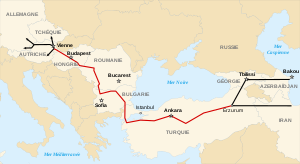


There is the possibility of Iran or Iraq providing gas to the pipeline, given that Turkish demand for natural gas is growing quite rapidly as well. Apparently, Erdoğan backed off on this threat later in the day with European Commission president Barroso. Erdoğan did emphasize his support for Turkish entry to the EU, however. Further, Platts reports that the German economy minister Michael Glos said at conference that Germany's energy future should be in clean coal as opposed to natural gas. Clean coal is mostly a fiction at this stage, but Germany does have considerable reserves. It is hard to see how, given current technology and Germany's climate commitments, clean coal could become a reasonable alternative in the near future, but the remarks do show how much the Russo-Ukrainian dispute is affecting German foreign policy direction. (Glos also reiterated his support for nuclear power at the meeting.)

4. Meanwhile, Upstream online yesterday reported that Noble Energy struck more than 460 feet of net gas pay at the Tamar-1 deep water well off northern Israel. The find is the largest in Noble's history and the reserves are at least equal to reserves of 3 trillion cubic feet. "Analysts estimated the estimated natural gas reserves were worth about $26 billion at current prices and will be sold starting in 2013." The well is 90 miles offshore Haifa.
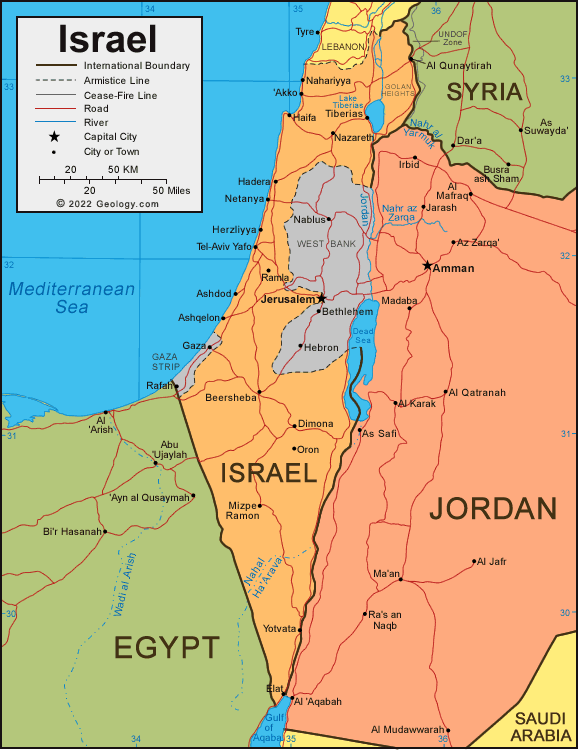


The Jerusalem Post reports that Lebanon was quick to respond to the news, warning Noble Energy that the reserve may in part be in Lebanese waters.
"In a meeting of the Energy, Infrastructure and Public Works Committee in the Lebanese Parliament, Chairman Muhammad Kabbani said Israeli media reports on the recently discovered natural gas reserve raise the possibility that the reserve extends to Lebanon's territorial waters. "We should take every legal measure possible in order to preserve Lebanon's right,' ... Kabbani [said.]

Kabbani added that he was concerned of the possibility that Lebanon would lose because 'Israel is the only country which is not a signatory to [international] maritime agreements.'"
Neal Sandler at BusinessWeek reports that the Israeli National Infrastructure Minister Benjamin Ben-Eliezer said that "The field can meet Israel's natural gas needs for the next two decades." An executive of the consortium that developed the field even predicted that Israel may become a net exporter of gas. Sandler reports that the find will likely spur a rash of oil and gas exploration off the Levantine coast. If further significant finds are made, or the Tamar-1 field proves large enough, Israel will in all likelihood seek to export any surplus gas to Europe via Turkey--and possibly the Nabucco pipeline.

5. Edward Yeranian at Voice of America reported that at the Arab summit in Kuwait yesterday, Saudi King Abdullah pledged $1 billion to help rebuild Gaza. Abdullah was joined by several other Arab leaders in calling on Israel to pursue the peace plan proffered in the 2002 Arab summit. (Riyadh has been reemphasizing their commitment to the 2002 plan recently, including an op ed by former Saudi head of intelligence and ambassador to the US Turki al-Faisal in the Washington Post in December. see Daily Sources 12/26 #6.)

6. Eurointelligence reports that the European Commission forecast a deep, but short, recession for the eurozone.
"The forecast numbers for 2009 are predictably bad. Euro area growth to fall 1.9%, Germany a little worse, France a litte better. Ireland’s economy will collapse by 5%, and Latvia even by 6.9%. But the European Commission is optimistic about 2010, when the Commission forecasts a resumption of a positive, though still subdued, euro area growth rate of 0.4%"
7. Stefan Collignon at the Financial Times argues that the German stimulus program is designed mostly to improve its comparative advantage via increasing labor cost competitiveness, thus pursuing export growth as a way out of the financial crisis and at the expense of Berlin's neighbors. Key excerpts:
"[The] immediate effect of the stimulus program] on private consumption is weak. A person with an annual income of €25,000 will be able to spend an extra €136.67. A Keynesian stimulus alone was not palatable to supply-side-oriented German “ordo-liberals”, the high guardians of the German social market economy. They sought to strengthen German competitiveness. Most importantly, payroll taxes and social insurance contributions were cut with the aim of reducing wage costs. In an economy dependent on manufacturing for the world market, that seems reasonable. However, there comes a point where improving one’s competitive advantage becomes malign. Germany has now reached this point."
"[Germany's] trade surplus with partners in the European Union has more than doubled over the past decade and amounts now to more than 5 per cent of GDP. At the same time intra-European trade balances have deteriorated for all of Germany’s immediate neighbours.

This development must stop. Competitive tensions are increasing rapidly and could soon reach the tipping point where the euro and the single market fall apart. The gleeful policy consensus in Berlin (“We are world champions in exports”) resembles the last dance on The Titanic, moments before it hit the iceberg."
Worth reading in full.

8. Svenja O’Donnell at Bloomberg reports that UK consumer prices rose 3.1% in December from a year earlier, down from 4.1% in November. Still seems pretty high to me, but folks are already mooting the idea of wage cuts, arguing that deflation is still a concern.

9. Michael Schwirtz reported yesterday that Russian human rights lawyer Stanislav Markelov was assassinated last night in what appears to have been a contract killing. A freelance reporter highly critical of the government, who was with Schwirtz at the time, was also murdered.
"Mr. Markelov, at the news conference just before his death, told reporters that he might file an appeal to the European Court of Human Rights against the early release of [Yuri D.Budanov, a former Russian tank commander imprisoned for strangling a young Chechen woman in his quarters and] who was a decorated colonel of the Russian Army before he was stripped of his rank. In an interview last week with The New York Times, Mr. Markelov said he might also file a lawsuit against the administration of the prison that released Mr. Budanov last Thursday."
10. Li Yanping at Bloomberg reports that the Chinese official urban unemployment rate rose to 4.2% in the fourth quarter of 2008, up from 4% in the third quarter.
"The official figure understates unemployment because it doesn’t include those who aren’t registered, including migrant workers. The state-backed Chinese Academy of Social Sciences said the rate including migrant workers may be higher than 9.4 percent in 2009."
11. Joel Martinsen at Danwei reports that
"According to a set of statistics I consulted, the number of bloggers in China exceeded 100 million in 2007. Phenomenally-popular finance blogger Xu Xiaoming was the 'hit king' of Chinese blogs in 2008 with 355 million hits. Other statistics predict that between 2012 and 2015, China will see blogs with hit counts of 1 billion."
An advertisers dream. But it will be hard for Beijing to control the flow of information given those numbers. (h/t Carlos Tejada at China Journal)

12. Reuters reports that the Bank of Canada today cut its benchmark interest rate to 1%.

13. Andres R. Martinez at Bloomberg reports that Petroleos Mexicanos (Pemex) likely extracted about 2.8 mb/d in 2008, down 9% from 20007, when it extracted 3.08 million barrels. Mexico City is considering how best to bring in private industry to help increase its crude oil productivity and exploration efforts. It is the third largest exporter of crude to the US.

14. Gareth Chetwynd at Upstream online reports that ExxonMobil notified Brazilian authorities that it has found oil in a deep water sub salt field in the Santos Basin. The prospect is in block BM-S-22 on the southern flank of the super-structure known as Sugarloaf which some petroleum geologists think might have as much as 10 billion barrels of recoverable oil.


15. Nick Bunkley at the New York Times reports that Fiat agreed to take a 35% stake in Chrysler today. Meanwhile, Russ Dallen at the Latin American Herald Tribune reports that GM will invest $1 billion of its bailout money in Brazil in order to avoid the troubles it faces here in the US. (!) (h/t Robert Oak at the Economic Populist)

Friday, November 21, 2008

Daily Sources 11/21

1. Bill Faries and Shamim Adam at Bloomberg report that the heads of state from the Asia-Pacific Economic Cooperation forum will be meeting this weekend in Lima.
"With talks on a global trade deal stalled, APEC members are unveiling new bilateral agreements this week to sustain growth amid predictions of a prolonged slowdown. Peru and China announced a free trade deal on Nov. 19, while Australia and the U.S. disclosed yesterday they are planning to join a pact with four other nations to lower trade barriers."
The leaders are expected to back the crisis strategy outlined in the November 15 G-20 summit and to look for ways forward on the global trade deal known as the Doha round.

2. Brent Scowcroft and Zbigniew Brzezinski have an op ed in the Washington Post urging President-elect Obama to make the Israeli-Palestinian peace process a priority.
"Resolution of the Palestinian issue would have a positive impact on the region. It would liberate Arab governments to support U.S. leadership in dealing with regional problems, as they did before the Iraq invasion. It would dissipate much of the appeal of Hezbollah and Hamas, dependent as it is on the Palestinians' plight. It would change the region's psychological climate, putting Iran back on the defensive and putting a stop to its swagger.
...
This weakness [the political weakness of the negotiating parties limits their ability to come to an agreement by themselves] can be overcome by the president speaking out clearly and forcefully about the fundamental principles of the peace process; he also must press the case with steady determination. That initiative should then be followed -- not preceded -- by the appointment of a high-level dignitary to pursue the process on the president's behalf, a process based on the enunciated presidential guidelines. Such a presidential initiative should instantly galvanize support, both domestic and international, and provide great encouragement to the Israeli and Palestinian peoples."
Brzezinski is widely known to be a key foreign policy adviser to Obama. The piece is well-worth reading in full.

3. Gregory Gause has an analysis in the UAE paper The Nation, arguing that should Iran acquire the bomb it will not acquire commensurate influence in the Middle East. He points out that Iran's influence is primarily with non-state actors and that their clout with such organizations is unlikely to increase with the nuclear arms. Furthermore, Iranian hard power gains would probably cause other regional actors to work together to offset any perceived imbalance, and, in fact, are already doing so absent an Iranian bomb. Worth reading in full.

4. The Wall Street Journal editorial board takes issue with Democratic efforts to prevent military ties with Indonesia unless more progress is made on the human rights front in that country.
"[T]his issue is starting to impinge on U.S.-Indonesia ties. In February, Secretary of Defense Robert Gates visited Indonesia, pledging full military support. The State Department canceled joint military exercises with Kopassus [a special forces unit which is the cause of much human rights concern] two months later, under pressure from Senator Leahy. In retaliation, Jakarta has stopped cooperating in U.S. counternarcotics efforts in the region."
Indonesia is an important ally of the United States. It is a state with a moderate Muslim majority--a worldview the US wants to encourage. However, the US Navy is probably the most important protector of Indonesian interests outside of Jakarta itself, given the security requirements of the Straits of Malacca, Lomboc, and Sunda. The US is not in the best position, just now, to lecture other countries on human rights abuses. Still, US-Indonesian ties are strong enough (and important enough) to support encouragement by American Senators for an increased respect for human rights.

5. Keith Wallis at Lloyd's List reports that India is considering plans to send four warships to the Gulf of Aden in an effort to police that sea lane in response to a request from the shipping ministry. New Delhi is already replacing the guided missile frigate which destroyed a pirate "mother ship" Tuesday with a larger Delhi-class destroyer. Although India is reportedly eager to increase its naval presence short-term, it appears to be against a long-term role, favoring instead a UN-mandated operation comprised of existing US and European task forces. In the meantime, as Caroline Alexander and Marianne Stigset at Bloomberg write, Saudi Foreign Minister Prince Saud al-Faisal told reporters in Oslo today that the kingdom would contribute "naval assets" to a NATO fleet on an anti-piracy mission in the region.
"The North Atlantic Treaty Organization has four warships off Somalia. India, Malaysia and Russia have sent warships, and a European Union fleet is expected to reach the zone next month. The U.S. coalition in Afghanistan has a task force there, bringing the total of warships in the area to 15, according to French military spokesman Christophe Prazuck."
David Osler, also at Lloyd's List, reports that the UN's International Maritime Organization hailed yesterday last week's decision by the UN Security Council to toughen economic sanctions against Somalia. However, it is not known whether the Security Council extended resolution 1816, which provides the legal basis for naval intervention off the Somalian littoral and is due to expire next month. A press briefing by the Security Council said that
"Prior to the open meeting, the Security Council voted unanimously to freeze, without delay, the funds and other financial assets of individuals designated as engaging in, or providing support for, acts that threaten the peace, security and stability of Somalia."
In the meantime, Reuters reports that dozens of Somali Islamists stormed the port of Haradheere in pursuit of pirates who had hijacked the Sirius Star.
"'Saudi Arabia is a Muslim country and hijacking its ship is a bigger crime than other ships,' Sheikh Abdirahim Isse Adow, an Islamist spokesman, told Reuters. 'Haradheere is under our control and we shall do something about that ship.'"
The Somali Islamist movement--al Shabaab--pledges to stamp out piracy if they gain power.
"Some analysts, however, say Islamist militants are benefiting from the spoils of piracy and arms shipments facilitated by the sea gangs. Analysts also accuse government figures of collaboration with pirates."
6. The New York Times editorial board is skeptical of efforts to negotiate with the Taliban and calls on the Bush Administration to authorize the 20,000 additional troops military commanders have requested for Afghanistan.

7. Stephen Farrell reports in the New York Times that 10,000 supporters of Moktada al-Sadr convened in Baghdad square today to protest the status of forces agreement being debated in the Iraqi Parliament. The protesters do not believe that the agreement guarantees the eventual exit of US forces. The protest was peaceful. From an ideological perspective, the Iranian support for the agreement, which could be characterized as pragmatic, contrasts strongly with Sadr's opposition, which might be seen as principled.

8. Eric Watkins of the Oil & Gas Journal reported yesterday that Myanmar awarded the right to manage two pipelines which the two countries plan to construct to take gas and oil from the Bay of Bengal to the Chinese province of Yunnan. The oil pipeline would carry crude shipped from the Middle East to Myanmar onward to China, thus avoiding the Strait of Malacca. The gas pipeline would carry natural gas from wells in the Bay of Bengal. I've given a rough idea of the planned path of the pipelines below.


China was recently called upon by Myanmar and Bangladesh to resolve their dispute over gas exploration in the Bay of Bengal. The plan may have some added luster given recent concerns about piracy.

10. PFC Energy gave Reuters a useful estimate of the oil prices required by various OPEC countries to balance their external accounts:


The key is Saudi Arabia, the swing producer--the numbers suggest that it will be likely to defend $50/b.

11. Pratik Parija at Bloomberg reports that the Chairman of Indian national oil company ONGC, R.S. Sharma, told the media that he expected the price of oil to rebound to $100/b in the long term. He was offering the price point as justification for the overseas acquisition of Imperial Energy, Plc, which has exploration and production projects in Siberia and registered reserves of 526 million barrels of oil equivalent. ONGC has been unable to build its reserve base and thus overseas acquisitions have become a part of India's long term energy strategy. Overseas acquisitions have also become a key part of the energy security strategies of China, South Korea, and Japan in recent years. Imperial Energy represents the one key acquisition that India has managed to make in competition for overseas assets with Chinese national oil companies, which has led to some hand wringing in New Delhi. Still, recently the cost of reimbursing the oil companies for sales of subsidized petroleum products inside of India has put serious pressure on the country's finances and some may be questioning the wisdom of pursuing high cost assets in a country with a government so tightly aligned to its own domestic oil industry and the current low-price environment.

12. David Brunnstrom and Christian Lowe at Reuters report that U.S. Assistant Secretary of State Dan Fried indicated today that the US was reluctant to renew NATO dialogue with Moscow.

13. The Wall Street Journal's editorial board reports that the Russian Prosecutor General's office warned media outlets to be careful about how they report on the financial crisis. Andrew Osborn in the Wall Street Journal reports that wage arrears in Russia have jumped to over 4 billion rubles (~ $145 million)--the highest seen in a year. Government data shows that over 300,000 people in Russia are owed back pay.

14. Stephen Bierman and Gianluca Baratti at Bloomberg report that Spanish paper El Economista reported today that Lukoil has offered €28 (~ $35) a share to Criteria Caixacorp SA and Sacyr Vallehermoso SA for a stake of just under 30% in Repsol. The Spanish government had earlier voiced opposition to the notion of Gazprom taking a stake in the company. And some suggested that Spain might follow Sarkozy's suggestion of using sovereign wealth funds to defend national assets in a period where they would be sold cheap. Given the financial support provided to the major oil companies by the Kremlin in recent months, such a purchase might strike some as odd. Beyond that consideration, Bierman and Baratti point out that financing for the deal might be difficult to find.

15. Juan Forero at the Washington Post reports that opposition groups expect to make gains in Sunday's elections for governors and mayors in Venezuela.

16. Platts reports that Petrobras announced today that it has discovered an additional 1.5-2 billion barrels of oil equivalent in subsalt in the Santos Basin. The oil is light, with a reported gravity of 30ºAPI.

17. Brian Blackstone at Real Time Economics reports that Federal Reserve Bank of Richmond President Jeffrey Lacker expressed more concern about impending inflation than deflation in prepared remarks to the Tech Council of Maryland. He was skeptical of the theory that there is a causal relationship between a weak economy and a decline in core inflation. (Isn't he taking issue with the notion of supply and demand determining price, then?)
"Once the recovery begins, the temptation is to keep interest rates low until a clear rebound is ensured, Lacker noted. “The risk associated with that path is that inflation may not moderate obediently during the downturn, and may firm with the ensuing recovery,” Lacker said."
Lacker is considered an inflation hawk.

18. Brad Setser at Follow the Money notes that yields on 3 month treasury bills are at nearly zero again. 0.02% to be exact.

Thursday, September 11, 2008

Daily Sources 9/11

1. The economic blogosphere--specifically Follow the Money and naked capitalism--is abuzz regarding the following stories.

a) David Oakley at the Financial Times reported yesterday that outflows from emerging markets reached $29.5 billion over the last three months, the highest levels seen since 1995 (and the Asian Financial Crisis).

"The hardest hit stock markets in dollar terms are Ukraine, which has fallen 58.8 per cent this year in part on geopolitical worries; China, down 57 per cent amid fears it had risen too far on a bubble; Hungary, down 49 per cent on worries over growth; Pakistan, down 46.7 per cent amid political turmoil; and Vietnam, down 46.4 per cent in the face of a sharp rise in inflation.

Russia been under pressure, with the benchmark RTS index down 4.4 per cent yesterday and 46 per cent since its May 19 peak.

Emerging market sovereign bond yield spreads have risen to 330 basis points over Treasuries – highs not seen since mid-2005 – from 300bp at the start of last week amid rising risk aversion."


b) Joanna Slater in today's Wall Street Journal reports that, as one might guess considering the story above, many central banks in emerging economies have begun taking steps to defend their currencies against the dollar. Central Banks involved include those of Argentina, South Korea, Russia, Thailand, India, and Pakistan.

The sums involved are large. Russia spent about $14 billion in August alone, the largest such drawdown in its reserves in at least a decade, as foreign investors fled following the conflict with Georgia. South Korea has spent more than $21 billion -- or roughly 8% -- of its reserves in the past five months to assist the ailing won.


2. The Economic Times has the story that the International Energy Agency has asked India to remove their oil subsidies. Although the government has already reduced its subsidies in some areas, there are some in which I doubt it will ever make reductions. Most importantly: propane, which many poor Indians use to cook.

3. Bloomberg reports that Vietnam may cut coal exports by 89% by 2015 in order to meet domestic demand. It is expected to export 28 million tons this year. The National Coal & Mineral Industries Group said it may face a shortage as early as 2012 and may source imports from Australia and Indonesia at that time.

4. Robin Wigglesworth at the Financial Times reported Tuesday that the Saudi Central Bank has issued three times as much debt so far as of July than it had in all of 2007, in an attempt to absorb excess capital. Since the riyal is pegged to the dollar, the recent rise in both has encouraged international banks to withdraw their riyal deposits. Which in turn has forced Gulf banks to look to local money markets to finance lending, siphoning down the local money supply and raising the cost of money. Saudi Arabia wants to encourage this liquidity squeeze further by introducing more treasuries as part of an effort to curb inflation. Saudi annual inflation hit 10.6% in June.(1)

5. Robin Pagnamenta and Angela Jameson at the London Times report that OPEC is sending a high level delegation to Moscow to discuss closer cooperation.

6. Ian James and Vladimir Isachenkov of the Associated Press report that two Russian strategic bombers landed in Caracas yesterday. The Tu-160s have flown to Venezuela on a training mission, and will carry out maneuvers over neutral waters in the coming days. (The planes are not loaded, so to speak, with bombs during these.) NATO fighters escorted the planes on their trip from Russia to Venezuela.

7. Jeb Blount at Bloomberg reports that Petrobras has announced reserve estimates for the Iara field of 3-4 billion barrels. The Iara field is part of the ongoing deep sea finds Brazil has made in salt deposits known as the Santos Basin.


Iara is part of concession block BM-S-11, which also holds the Tupi field and is estimated to have 5-8 billion barrels in recoverable oil. BG drilled the exploration well and said it found 26-30 APIº oil.(2)


8 billion barrels of oil are equal to about 94 days of world consumption (at ~85 mb/d) and about 400 days of American consumption (at ~20 mb/d) and 640 days of American imports (at ~12.5 mb/d). 12 billion barrels of oil are equal to about 141 days of world consumption, 600 days of American consumption, and 960 days of American imports. (Assuming everything remains constant, of course.)

8. Joe De Capua and Chinedu Offor report via Voice of America that MEND, the primary militant group in the Niger Delta, has called for a cease fire in response to the Nigerian government's decision to create an agency to develop the region. Evidently, MEND trusts this effort more than ones of the past because they believe it comes at the initiative of Vice President Jonathan Goodluck, who is a native of the Niger Delta region.

9. James Kanter at the New York Times writes that members of the European Parliament's Industry Committee backed changing mandated biofuel use from 10% (of the transportation fuel mix) in 2020 to 4%. Environmentalists praised the move, which followed reconsideration of the mandates in the Environment Committee in July. The fledgling biofuel industry is understandably upset, given the cost of the infrastructure in place and under construction.

10. Michael M. Grynbaum at the New York Times reports that the trade deficit reached a record high in July, as larger exports were more than offset by higher oil prices. Economists are looking forward to the numbers for August, as oil fell below $125/b in that month.

11. Craig Torres and Liz Capo McCormick at Bloomberg write that the Fed will likely have to provide the financial industry an unprecedented infusion of cash to prevent further blow ups. (h/t Jesse's Cafe Americain). Yikes.

(1) Reuters: Saudi Inflation Hits 30-Year High on Food, Rent
(2) BG Press Release

Thursday, August 28, 2008

Daily Sources 8/28

1. As per Yves Smith at Naked Capitalism, Credit Suisse recently released a report on the Chinese slowdown concluding that it is mostly not due to the Olympics. (Which is the big question in the oil markets, too.)

2. Kunda Dixit of the Nepali Times writes in the Wall Street Journal that the new Mao-ist government of Nepal is looking to Beijing for ideas on how to approach their economy. Interesting. Likely somewhat troubling to New Delhi.

3. The Wall Street Journal Editorial Board says that the government offensive against Tamil Tiger held areas in Sri Lanka appears to be succeeding, but that the Tamils will likely just fade into the jungle. It offers some good advice as to how the government might proceed with the hopes of bringing the 25 year conflict to an end.

4. Emily Wax at the Washington Post writes that heavy handed responses to peaceful protests in Kashmir is creating more problems than it is solving, and that the independence movement there is gaining substantial momentum.

5. AFP reports that Muqtada al Sadr has suspended the activities of the 60,000 strong militia, the Mahdi Army, in a statement from Najaf. Sadr has set a cultural agenda for the members of the militia and promises that those who don't abide by its precepts will be expelled from the organization.

6. CNPC and the Iraqi Government have renewed their deal on developing the Ahdab oil field, reportedly at $3 billion, as per Elaine Kurtenbach of the AP.

7. Blaine Harden at the Washington Post writes that North Korea is threatening to resume its nuclear program after not being removed from the state sponsor of terrorism list.

8. David Pallister at the Guardian reports that following the withdrawal of the Muslim League from the government coalition, lawyers have renewed their protests calling for the reinstatement of Supreme Court Justice Chaudhry and the conflict in the northern region with extremists continues to spin out of control. The Muslim League withdrew from the coalition because, they argue, the Pakistan People's Party is dragging its feet on the reinstatement of Chaudhry because its leader, Nawaz Sharif, is afraid that charges against him will be resurrected should he do so.

9. Mansoor Ahmad of Pakistan's The International News reports that power generation outages have increased this year, mostly due to inefficiency and lack of fuel. The Pakistan Electric Power Company cannot pass through increased feedstock costs to its customers--its thermal generators run on furnace oil and natural gas.

10. Jim Lobe, of the IPS, in the Asia Times gives a better analysis of how Iran might react to the Georgia crisis than most of what I've seen. However, I think Lobe understates, by a long shot, Iran's view of Russia in its backyard, especially as a supporter of secessionist regions. To begin with, Iran has a long history of trying to push back Russian aggression ... indeed, many of the countries in the Caucasus were part of Persia prior to Russian interference. Iran's biggest oil producing region--Khuzestan--is majority Arab, not Persian aka Aryan, the main ethnic group of Iran. A very large portion of north-western Iran by the Caspian is majority Azeri--indeed two neighboring provinces are known as East Azarbaijan and West Azarbaijan. And there are a large number of Kurds in the western portion of the country. For Iran to lend legitimacy to self-determination efforts by secessionist-minded minorities is a difficult choice for them to make. Farideh Farhi, who Lobe quotes, is especially interesting/useful/credible, on Iranian parliamentary politics.

11. Silly intro analysis from Judy Dempsey at the International Herald Tribune regarding the prospects of the so-called Nabucco pipeline--a proposed gas pipeline which would deliver gas from Azerbaijan and / or Iran to the heart of Europe via Turkey. Russia's move in Georgia hardly kills the project, but has the likely effect of making it more attractive. Iranian gas becomes a more attractive feedstock choice, but the real problem with Iranian gas for Europe has always been that Iran itself can't quite seem to figure out what it wants to do with its gas. (Pipe it to India and Pakistan? Pipe it to Turkey and Europe? Reinject it into oil fields? Ship it as LNG? Use it to fuel fleet of CNG cars? Power generation? So much gas ... so expensive to develop ... so difficult to figure out how to maximize the bang for your buck. Of course, if Iran made a solid commitment to Europe on the gas then it would have a lot of clout in terms of the IAEA/NPT negotiations. But then Russia is building their nuclear plants, and that would surely upset Moscow.) If Georgia enters NATO, which it might have a better chance of doing now, then Nabucco would surely be pushed, and pushed hard, by the US ... even though this would obviously be extremely provocative from the Russian perspective. (This last assumes that old Sovietologist thinking will remain par for course in the US.)

12. NATO Ships in Black Sea Raise Alarms in Russia by Andrew E. Kramer at the New York Times.

13. Reuters FACTBOX: Russian oil and gas export interruptions. In 2006 a Swedish Defense Agency put together a report on Russian oil and gas export interruptions. This factbox lists a few of them (selectively, I would add.) It noted, at the end, that there have been half as many interruptions under Putin than there were under Yeltsin.

14. Yesterday Fabiola Sanchez of the Associated Press reported that Venezuelan lawmakers were ready that day to put a bill through their legislature which would give private fuel retailers 60 days to negotiate the sale of their businesses or face nationalization. PdVSA controls 51% of the retail market. BP has a 9% share; Exxon: 5%; Chevron 3%. I don't imagine that this is an especially lucrative business given that gasoline sells for $.15/gallon in Venezuela, but imagine it is distressing to the IOCs nonetheless.

15. Andrew Downie at the New York Times writes that Brazil has responded to high food prices internationally by providing a subsidy for further planting, while Argentina--the other major agricultural powerhouse in South America--has placed large tariffs on exports, thus ensuring cheap food at home.

16. Todd Benson at Reuters writes that Brazil is in the midst of a difficult political debate over how to approach the exploitation of the new find in the Santos Basin, which may have as much as 80 billion barrels of commercially extractable crude. The government has already suggested creating a new national oil company to handle the new find, which has been nicknamed Petrosal--or Petro Salt--as the oil lies under underwater salt beds.

17. Sam Fletcher of the Oil & Gas Journal writes that Guy Caruso predicted that crude prices will fall to below $100/b in the next 18 months. Caruso also reiterates that drawing from the Strategic Petroleum Reserve would be unproductive--which is counter to the, rather rudely put, advice given by Philip Verleger to the US Senate last December.

18. US GDP grew at 3.3% in the 2nd quarter according to the Commerce Department, rather more than the 1.9% original estimate, as per Michael M. Grynbaum at the New York Times.

19. Jenny Anderson at the New York Times writes that cities are beginning to accept private financing for various infrastructure projects. This financing is coming from large investment banks like Credit Suisse, Carlyle Group, Goldman Sachs and Morgan Stanley. I agree that infrastructure needs to be invested in. I agree that the government has done a poor job of this (outside of the fact that it built it in the first place--private industry thought it too expensive with too low a return.) But, my gut reaction to someone attached to the industry responsible for the current credit and housing crisis saying that infrastructure in ten to twenty years is gonna be bigger than real estate is ... do what we need to, but keep those guys the hell away from anything that strategically important to America.

20. Sabine Vollmer at the News Observer reports that Bayer in under increasing pressure from German authorities for putting a new type of insecticide--known as clothianidin--on the market. The EPA approved clothianidin in 2003 on the condition that Bayer provide additional data on the product, but the EPA has not made any further public statement on the insecticide, and it is not clear if Bayer even submitted the extra data. European environmental regulators suspect that insecticides like clothianidin are responsible for the colony collapse disorder that bee populations worldwide have seen in recent years. Over a third of the bee population in the United States has died off. Bees pollinate about a third of our foods. From a geopolitical standpoint, of course, mass starvation is not good.

21. A report by Konstantinos Giannakouris at EUROSTAT was just released with a set of population predictions for Europe through 2060 which surprisingly give a slight increase in population over that time. Nearly all the population growth will take place in the richer countries in Europe, with Cyprus, Ireland, and Luxembourg showing the most growth, percentage-wise. However, in 2060, for EU27 as a whole, there will be 50 million less people of working age than there are now in 2008. The report projects that, taken as a whole, births will not outnumber deaths from 2015 on, meaning that all population growth will come from immigration--and it looks like from 2035 on immigration will not be able to make up the difference either. Obviously, many things will change between now and then, but useful data nonetheless.