Showing posts with label Ecuador. Show all posts

Friday, July 24, 2009

Daily Sources 7/24

1. XINJIANG AUTHORITIES TO "HELP" DEFENDANTS BY ASSURING THEM THAT THEIR COUNSEL IS OF THEIR ETHNICITY, BUT NOT ESPECIALLY QUALIFIED TO REPRESENT CRIMINAL DEFENDANTS

Sky Canaves at China Journal reports that Xinjiang authorities plan to provide all Uighur defendants with legal representation free-of-cost. Further, they will use Uighur lawyers after providing them with quick legal training in criminal defense. It seems rather unusual to think that a lawyer could be quickly retrained into an entirely new specialty, but that appears to be the plan. Canaves notes that when human rights lawyers offered their services free in the aftermath of the recent troubles in Tibet, they were prevented from taking the cases and some subsequently lost their licenses to practice. Indeed, several human rights lawyers based in Beijing this year have yet to receive the renewal of their licenses to practice. These are capital cases. If those lawyers chosen are chosen for their ethnicity as opposed to their ability in the relevant field of law--and if those lawyers particularly interested in defending people suspected of having had their human rights abused are banned from practicing in general--it hardly seems like much of a benefit, but I suppose they will identify more closely with their (mostly) defenseless clients.

2. EICHENGREEN ARGUES CHINESE IMPORTS BEST WAY OUT OF GLOBAL CRISIS

Barry Eichengreen says increased Chinese imports is the best road out of the current financial crisis.
"China can purchase more industrial machinery, transport equipment, and steelmaking material, which are among its leading imports from the US. Directing spending toward imports of capital equipment would avoid overheating China’s own markets, boost the economy’s productive capacity (and thus its ability to grow in the future), and support demand for US, European, and Japanese products just when such support is needed most.

This strategy is not without risks. Allowing the renminbi to appreciate as a way of encouraging imports may also discourage exports, the traditional motor of Chinese growth. And lowering administrative barriers to imports might redirect more spending toward foreign goods than the authorities intend. But these are risks worth taking if China is serious about assuming a global leadership role."
Worth reading.

3. CHINA TO RAISE $2 BILLION FOR FINANCIAL BUSINESS EXPANSION IN AFRICA

Terence Poon and Aaron Back at the Wall Street Journal report that the China Development Bank has plans to raise $2 billion by November of this year for the China-Africa Development Fund. The funds will be used to finance the expansion of financial business ties to Africa.

4. SHANGHAI ADOPTS TWO CHILD POLICY IN ATTEMPT TO DEAL WITH AGING POPULATION

Sky Canaves at China Journal also notes that the city of Shanghai, faced with an aging population, has embarked upon a policy designed to encourage families to have two children.
"For several years, officials at various levels across the country have touted the possibility of allowing couples made up of people who grew up as only children to have two kids to have two kids. Such policies are gaining impetus as the first generation of women born under the one-child policy is now at the peak of its childbearing years. In 2004, Shanghai revised its family planning rules to specify the types of couples who would be eligible to have more than one child."
Evidently no one wants to use productivity gains to cover the costs of an inverted population pyramid just quite yet, meaning, I suspect, that the gains have been overstated (and not just in China).

5. CHINA MAY BE SET TO BECOME LARGEST CONSUMER OF GOLD

Sophie Leung at Bloomberg reports that China is set to overtake India as the world's largest consumer of gold, according to the World Gold Council.
"Jewelry demand in China expanded in the first quarter while dropping in India, Marcus Grubb, a managing director at the London-based council, said today at a conference in Hong Kong. Chinese gold demand will keep rising, he said."
"Total demand from India in the first quarter fell 83 percent to 17.7 metric tons, from 107.2 tons a year earlier, according to figures from the World Gold Council. Purchases in China rose 1.8 percent to 105.2 tons from 103.3 tons. Total Chinese demand for gold was six times that of India in the first quarter, the council said in May."
In the beginning of May, the Financial Times reported that some analysts were arguing that Beijing had embarked upon a policy of increasing the share of its reserves held in gold bullion as a diversification measure--see Daily Sources 5/7 #2.

6. BUITER CALLS BS ON CHINA, INDIA, BRAZIL, SOUTH AFRICA, AND AFRICAN UNION'S CALL FOR THE DEVELOPED WORLD TO PAY FOR CARBON EMISSIONS CUTS

Willem Buiter makes the rather important point that China and India received a great deal of benefit, directly and indirectly, from industrialism, though it was developed in the West. It is not clear that the West today should suffer for the poor policy choices of medieval to twentieth century China. Thus, the argument that the West should be responsible for the cost of carbon emission reductions in the developing world can be described as disingenuous--though it will have a lot of appeal to, well, the vast majority of people in the world. True, but the costs of inaction, should predictions be true, will fall just as generally upon the developing countries as it will on the rich. Very much worth reading, IMO.

7. UK 2Q GDP DOWN 0.2% FROM 1Q, DOWN 5.2% YOY

Laurence Norman at the Wall Street Journal reports that the UK Office for National Statistics announced today that UK GDP in the second quarter fell 0.8% from the first and was down 5.2% on the year.
"Output dropped 2.4% in the first quarter and was down 4.9% on the year. ... In the first half of the year, output fell 3.2%. The government had forecast a GDP decline of 3.5% for the whole year."
8. SPANISH UNEMPLOYMENT TO CLIMB TO 22% IN 2010 PER CITIBANK REPORT

Ed Harrison notes at naked capitalism that a recent report by Citigroup expects unemployment in Spain to climb to 22% in 2010 after having just hit 17.9%. He translates a Spanish article on the report:
"In the opinion of the experts at the company, the recovery will reach Spain later than elsewhere in Europe because of the extent of deleveraging facing the Spanish economy. Therefore, there remains a substantial possibility that unemployment will continue to rise, after the withdrawal of the effects of fiscal measures taken by the Government."
9. RUSSIA WILL SANCTION COMPANIES SELLING OFFENSIVE ARMS TO GEORGIA, PUTIN INDICATES MOSCOW IS READY TO PROTECT DOMESTIC STEEL INDUSTRY

Ellen Barry at the New York Times reports that:
"Dmitri O Rogozin, Russia’s envoy to NATO, said on Friday that Russian President Dmitri A Medvedev had issued a decree that would impose sanctions on any manufacturer who sells offensive weapons to Georgia, 'wherever he is, in the Arctic or Antarctic region or in the United States.'"
Meanwhile, Maria Kolesnikova and Ilya Khrennikov at Bloomberg report that in an address in Magnitogorsk, Prime Minister Vladimir Putin indicated that Moscow is prepared to protect the Russian steel industry.
"Metals companies in Russia may receive preferential treatment in supplying so-called natural monopolies, Putin said, using a phrase employed in the country to refer to state-controlled companies such as natural-gas provider OAO Gazprom.

'We could consider passing a special law on this,' he said."
10. ECUADOR SIGNS DEAL TO PROVIDE CHINE 3 MILLION BARRELS OF CRUDE A MONTH

Eduardo Garcia at Reuters reports that Ecuador has signed a deal to export 3 million barrels of crude oil a month (~ 100 kb/d) to China. Quito will receive a $1 billion advance payment in the first week of August.

11. FED CREATES INVESTORS ADVISORY COMMITTEE MADE UP ALMOST ENTIRELY OF REPRESENTATIVES OF BIG SPECULATIVE CAPITAL

Jesse's Café Américain links to the Federal Reserve Bank's press release announcing the establishment of an investors advisory committee, which will have no policy-making power, but a lot of extra access to decision-makers at the Fed. Jesse makes the point that no member of this committee meant to represent the interests of investors could plausibly represent most investors, but rather big capital. At least Goldman Sachs isn't on the list.

Friday, July 17, 2009

Daily Sources 7/17

1. UN SECURITY COUNCIL FREEZES ASSETS AND BANS TRAVEL FOR 10 NORTH KOREAN INDIVIDUALS AND CORPORATIONS; RECENT PUBLICATION SEEMS TO INDICATE GROWING NERVOUSNESS ABOUT PYONGYANG IN BEIJING

Colum Lynch at the Washington Post reports that the UN Security Council yesterday froze assets and banned the travel of 10 North Korean individuals and corporations involved in the country's nuclear and ballistic missile programs. Meanwhile, the Fabius Maximus blog notes two recent articles which reporting on a piece by Zhang Liangui, an expert on North Korea at the Central Party School in Beijing, this month in World Affairs magazine, which is sponsored by the Chinese Ministry of Foreign Affairs, which seem to indicate rising concern in Beijing about the possibility of armed conflict with Pyongyang.

2. MARATHON TO SELL 20% OF ANGOLAN CONCESSION TO CNOOC AND SINOPEC, US COMMERCE SECY SAYS AMERICANS NEED TO REALIZE THAT THEIR CONSUMPTION IS DRIVING GREENHOUSE GAS EMISSIONS OVERSEAS

Platts reports that Marathon has signed an agreement to sell a 20% stake in Angola's block 32 concession to CNOOC and Sinopec for $1.3 billion, maintaining a 10% stake in the project.
"There is no doubting the prolific nature of the deepwater block they are buying into. Block 32 has already seen a mouth-watering 12 oil discoveries: Gindungo, Canela, Cola, Gengibre, Mostarda, Salsa, Caril, Manjericao, Louro, Cominhos, Colorau and Alho."
"Block 32 is operated by France's Total, which has a 30% stake. The remaining equity is owned by Sonangol (20%), ExxonMobil (15%) and Portugal's Petrogal (5%).

The existing partners in the block have the right of first refusal over the interest Marathon is selling."
Marathon has stated it hopes to conclude the deal by the end of the year. Meanwhile, Keith Johnson at Environmental Capital reports that the US Commerce Secretary, Gary Locke, told the American Chamber of Commerce in Shanghai yesterday:
"It’s important that those who consume the products being made all around the world to the benefit of America--and it’s our own consumption activity that’s causing the emission of greenhouse gases, then quite frankly Americans need to pay for that."
3. CHINA SHUTS DOWN HUMAN RIGHTS LEGAL CENTER IN BEIJING

Audra Ang at the Associated Press reports that Chinese officials shut down a legal research center led by human rights activist lawyers in Beijing today. In late May it was reported that Beijing had begun denying licenses to practice to law firms which take human rights cases--see Daily Sources 5/28 #1.

4. SOUTH KOREA TO SPEND $100 MILLION IN AID TO ASIAN NATIONS COPING WITH WATER SHORTAGES AND FLOODS

Shinhye Kang and Heejin Koo at Bloomberg report that South Korea plans to spend $100 million by 2012 to help Asian nations deal with water shortages and floods.
"Asia, with half the world’s population, has less available fresh water than any continent except Antarctica, Suzanne DiMaggio, director at the Asia Society, said in April. Glacier runoff is the primary water source for many nations in the region, and they are shrinking with climate change.

'Asian countries have depended on Himalayan glaciers as their main water sources may face water shortage as the glaciers are melting rapidly,' said Park, who also directs the nation’s task force on international cooperation at the Presidential Committee on Green Growth.

South Korea’s government announced a plan last month to spend 22.2 trillion won (~$17.7 billion) over four years to upgrade the water quality and supply systems of the nation’s four major rivers."
5. BP DROPS JATROPHA

Keith Johnson at Environmental Capital reports that BP has abandoned its jatropha venture, from which it had hoped to harvest biodiesel, selling its half of the project to its partner, D1 Oils.
"[T]he inedible but hardy plant that just a few years ago seemed like it could revolutionize biofuels has turned into a bust. The initial attraction was that it grows on marginal land, so it wouldn’t compete with food crops. But marginal land means marginal yields. And jatropha turned out to be a water hog as well, further darkening its environmental credentials."
The joint venture had planted more than 200,000 hectares of jatropha, about a quarter of worldwide jatropha planting. New Delhi has also bet on the plant's potential only to see protests break out over plans to reclassify land for seeding it--see Daily Sources 6/9 #6.

6. EASTERN EUROPEAN DIGNITARIES PUBLISH OPEN LETTER EXPRESSING SOME WORRY ABOUT OBAMA'S "RESET" WITH MOSCOW

Yesterday the Polish Gazeta Wyborcza published an open letter from 22 major political figures from Eastern Europe, including Lech Walesa and Vaclav Havel indicating worry about the Obama administration's "reset" policy with Russia. Key excerpts:
"Our hopes that relations with Russia would improve and that Moscow would finally fully accept our complete sovereignty and independence after joining NATO and the EU have not been fulfilled. Instead, Russia is back as a revisionist power pursuing a 19th-century agenda with 21st-century tactics and methods. At a global level, Russia has become, on most issues, a status-quo power. But at a regional level and vis-a-vis our nations, it increasingly acts as a revisionist one. It challenges our claims to our own historical experiences. It asserts a privileged position in determining our security choices. It uses overt and covert means of economic warfare, ranging from energy blockades and politically motivated investments to bribery and media manipulation in order to advance its interests and to challenge the transatlantic orientation of Central and Eastern Europe.

We welcome the 'reset' of the American-Russian relations. As the countries living closest to Russia, obviously nobody has a greater interest in the development of the democracy in Russia and better relations between Moscow and the West than we do. But there is also nervousness in our capitals. We want to ensure that too narrow an understanding of Western interests does not lead to the wrong concessions to Russia. Today the concern is, for example, that the United States and the major European powers might embrace the Medvedev plan for a 'Concert of Powers' to replace the continent's existing, value-based security structure. The danger is that Russia's creeping intimidation and influence-peddling in the region could over time lead to a de facto neutralization of the region. There are differing views within the region when it comes to Moscow's new policies. But there is a shared view that the full engagement of the United States is needed."
"When it comes to Russia, our experience has been that a more determined and principled policy toward Moscow will not only strengthen the West's security but will ultimately lead Moscow to follow a more cooperative policy as well. Furthermore, the more secure we feel inside NATO, the easier it will also be for our countries to reach out to engage Moscow on issues of common interest. That is the dual track approach we need and which should be reflected in the new NATO strategic concept."
"[T]he thorniest issue may well be America's planned missile-defense installations. Here too, there are different views in the region, including among our publics which are divided. Regardless of the military merits of this scheme and what Washington eventually decides to do, the issue has nevertheless also become--at least in some countries--a symbol of America's credibility and commitment to the region. How it is handled could have a significant impact on their future transatlantic orientation. The small number of missiles involved cannot be a threat to Russia's strategic capabilities, and the Kremlin knows this. We should decide the future of the program as allies and based on the strategic pluses and minuses of the different technical and political configurations. The Alliance should not allow the issue to be determined by unfounded Russian opposition. Abandoning the program entirely or involving Russia too deeply in it without consulting Poland or the Czech Republic can undermine the credibility of the United States across the whole region."
A must read.

7. TURMENISTAN SIGNS DEAL WITH GERMAN NABUCCO PARTNER FOR GAS EXPLORATION, EC PROPOSES NEW RULES FOR EU FOR HANDLING NAT GAS DISRUPTIONS

AFP reports that Turkmenistan signed a deal with RWE--a German firm involved in the Nabucco pipeline project--giving it a license to explore a block for six years and after finding gas the right to extract it for a period of 25 years.
"Moscow has a virtual monopoly on the export of Turkmen gas through its state-run energy giant Gazprom, but there have been signs of strain recently between the two countries ... .'"
Ashgabat publicly accused Gazprom of blowing up a pipeline sending its gas through Russia in order to put an end to payments it had contracted for at exorbitant prices late last year. In late June, Turkmenistan also inked a deal to increase its natural gas exports to China by 30%. On the first of July, Turmen President Kurbanguly Berdymukhamedov invited Russian President Medvedev to Ashgabat to discuss the resumption of exports--see Daily Sources 7/1 #3. Meanwhile, Alessandro Torello at the Wall Street Journal reports that the European Commission has proposed new rules to ensure that the European Union is prepared to weather a disruption in gas supplies such as the one caused by the cut off of supplies through Ukraine by Russia at the start of the year. The rules are designed, in part, to allow the EU to respond as a single entity to future disruptions.
"Under the proposals, each of the EU's 27 countries would have to designate an authority to look after security of their gas supplies, preparing plans aimed at preventing disruptions and dealing with any shortages that arise. The new rules would give the commission--the EU's executive arm--authority to ask for changes to these national plans if it considered them 'not effective' or incompatible with those of other EU countries.

The European Parliament and the 27 EU governments must back the proposal before it becomes law. Talks are expected to take months and might lead to a watered-down version of the rules."
8. OIL STOCKPILES IN ASIA BEING DRAWN DOWN ON LOW REFINERY UTILIZATION

Yuji Okada at Bloomberg reports that oil stockpiles in Asia are being drawn down on low refinery utilization rates.
"The fuel oil inventory in Singapore, Asia’s biggest oil-trading center, was 14.1 million barrels in the week ended July 15, 38% lower than a year earlier, said International Enterprise Singapore, a unit of the trade ministry. Refiners in South Korea and Japan are cutting crude throughput after the recession reduced demand, leading to high product stockpiles and reduced margins.

'The narrowing fuel oil crack in Singapore was mainly caused by the refinery run cut among Asian refiners, particularly ones in Japan and South Korea,' said Akira Kamiyama, a Tokyo-based trader at Mitsui & Co. 'Refinery utilization rates in these countries have been around 70%, while rates in the U.S. have been close to 90%.'

The refinery operating rate in Japan was 64.1% for the week ended June 20 and rose to 70% for the week ended July 11., according to the Petroleum Association of Japan."
10. EIGHT KILLED IN BOMB BLASTS IN TWO JAKARTAN HOTELS

John Aglionby at the Washington Post reports that eight people were killed in bomb blasts in two hotels in Jakarta.
"Speaking from the presidential palace in a live television address, the angry and visibly shaken president said the attackers were irresponsible and inhumane. While their identities remained unknown, the president said, the government will 'use the full extent of the law' to bring to justice 'those who did it, those who helped them, and the masterminds.'

Yudhoyono--who was reelected July 8 by a wide margin and is set to begin a second five-year term--said it was too early to say whether the bombing was linked to Jemaah Islamiah. But other officials and independent analysts said the radical Islamist group or an offshoot is the likeliest suspect."
11. KURDISH LEADERS WARN OF ARMED CONFLICT WITH BAGHDAD, IRAQI CLERICAL ESTABLISHMENT BELIEVES IRANIAN CLERICAL ESTABLISHMENT UNDERMINED BY ELECTIONS, RAFSANJANI USES FRIDAY SERMON TO CRITICIZE ELECTION RESULTS

Anthony Shadid at the Washington Post reports that the Kurdish Prime Minister, Nechirvan Barzani, said in an interview that
"If the problems are not solved [with the Maliki administration] and we're not sitting down together, then the risk of military confrontation will emerge."
Interviews with the Prime Minister and President Massoud Barzani
"described a stalemate in attempts to resolve long-standing disputes with Iraqi Prime Minister Nouri al-Maliki's emboldened government. Had it not been for the presence of the U.S. military in northern Iraq, Nechirvan Barzani said, fighting might have started in the most volatile regions."
Well worth reading in full. Meanwhile, Anthony Shadid at the Washington Post reports that the clerical elite in Iraq believes that the election crisis in Iran has strengthened the religious credibility of their own at the expense of the Shi'a leadership in Iran.
"'It's true,' said Ghaith Shubar, a cleric who runs a foundation in Najaf aligned with Grand Ayatollah Ali Sistani, Iraq's most powerful cleric. 'The spiritual guidance of the people in Iraq has become stronger than the guidance offered under the system in Iran. The marjaiya'--the term used to describe the authority of the most senior ayatollahs--'has more influence in Iraq, spiritual and otherwise, than it does in Iran.'"
The article--well worth reading--concludes with the following statement by Ali al-Waadh, a cleric and representative of Sistani's near the Kadhimiyah shrine in Baghdad, "We're not following Iran; Iran should follow Najaf." (Najaf is where Khomeini himself penned much of his criticisms of the Shah.) I alluded to some of the consequences of the supremacy of the Koran in Iran's legal and political system, given the relative lack of religious credentials of the Leader of the Revolution in a post early last year Law and Revolution in Iran. Meanwhile, in today's Friday prayer sermon, Rafsanjani said the following per a post at the Revolutionary Road blog:
"I have some suggestions. I have spoken to some members of the the expediency council and the assembly of experts about them too.

We must bring back the trust of the people. First of all, everyone must accept the law. The people, the parliament, everyone.

We must create a condition so that everyone can speak. We must speak logically. And a part of this is on the shoulders of the broadcasting corporation.

The Guardian Council did not make good use of the extra fives days given to them by the leader.

We do not need people in prison for this. Let’s allow them to return to their families."
On Wednesday, Borzou Daragahi at the Los Angeles Times reported that respect for the Leader of the Revolution has been diminished in Iran itself after taking sides in the election:
"'Public respect for him has been significantly damaged,' said one analyst, speaking on condition of anonymity. 'Opposing him is no longer the same as opposing God.'"
Protests followed Rafsanjani's sermon which were reportedly put down by security troops.

12. OLMERT SAYS SETTLEMENTS A SIDE ISSUE

Former Prime Minister of Isreal, Ehud Olmert, has an opinion piece in the Washington Post which argues that the current focus on Isreali settlements misplaces the focus of the peace talks. Key excerpt:
"Yet today, instead of a political process, the issue of settlement construction commands the agenda between the United States and Israel. This is a mistake that serves neither the process with the Palestinians nor relations between Israel and the Arab world. Moreover, it has the potential to greatly shake US-Israeli relations."
Worth reading.

13. SUDAN ACCUSES CHAD OF LAUNCHING AIR RAIDS INTO WESTERN SUDAN, ADDITIONAL MEASURES AGREED TO BY NORTHERN AND SOUTHERN SUDANESE OFFICIALS IN ANTICIPATION OF HAGUE RULING

AFP reports that the cross border conflict between Chad and Sudan is heating up again. Yesterday, state-Sudanese media reported that Chad had launched air raids in western Darfur.
"The website, quoting senior military officials, said there were no causalities but that the Sudanese army was on 'standby' and waiting for 'the green light for retaliation'."
Meanwhile, BBC News reports that southern and northern interlocutors in Sudan have agreed to new measures to quell any violence that could erupt in response to the Hague ruling on the border between the two regions expected next Thursday. The UN peacekeeping presence will be increased in the south, and both sides will send officials to explain the ruling once it is handed down.
"Tensions are rising ahead of national elections put back until April 2010 and a referendum on whether the south should secede, due in 2011."
In early June both sides began demobilizing their troops and on June 24th the two sides agreed to abide by the Hague's ruling--see Daily Sources 6/24 #10.

14. PETROECUADOR SEIZES PERENCO OILFIELDS, CHILE SIGNS CONTRACT FOR ECUADORIAN SUPPLY

Stephan Kueffner and Matthew Campbell at Bloomberg reports that PetroEcuador has seized the oilfields of Perenco SA, which operated the block 7 and 21 concessions producing about 21 kb/d.
"Perenco said yesterday it would suspend production after Ecuador started expropriating its crude oil in March because of a dispute over $327 million in back taxes. Ecuador, which increased a windfall tax on oil to 99% in October 2007, has said that Perenco and other companies haven’t paid the full levy, which has since been cut to 70%."
Perenco SA is an independent international oil firm whose main offices are in London and Paris with annual revenues of about $3 billion. Meanwhile, Tom Azzopardi at Platts reports that ENAP, Chile's national oil company, has signed a deal with PetroEcuador to import 800,000 barrels a month (~ 26.7 kb/d) to up to 10 million barrels a year (27.4 kb/d) of crude.
"Shipments are due to begin next month with two shiploads of 400,000
barrels each to Chilean ports ... ."
ENAP is the only refiner in Chile with a capacity of about 230 kb/d. Chile produces about 11 kb/d of its own crude needs. Ecuador stopped making payments on its sovereign debt on December 12 and later in that month pressured its social security system to purchase $1.2 billion in new bonds--see Daily Sources 12/29 #14. Ecuador currently uses the US dollar as its currency.

15. MEXICAN CENTRAL BANK CUTS BENCHMARK RATE TO 4.5%

Jens Erik Gould and Hugh Collins at Bloomberg reports that Mexico's central bank cut its benchmark rate by 0.25% to 4.5% in the seventh consecutive month of cuts. The bank's statement from the board indicated it will henceforth "pause its current monetary easing cycle" and that "[a]n improved performance in the general economic activity is expected in the second half of the year."
"Mexico’s annual inflation rate slowed to 5.74% in June, the lowest in nine months. While the rate was within the central bank’s forecast of 5.5% to 6% in the second quarter, it was above policy makers’ forecast of no more than 5.25% for the third quarter.

The bank aims to meet its inflation target of 3% by the end of 2010."
Remittances from abroad contracted by 20% in May, the sharpest drop on record.

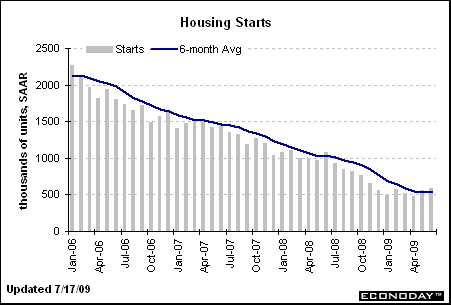
16. NEW BUILDING PERMITS & HOUSING STARTS UP STATISTICALLY INSIGNIFICANT AMOUNT

Barry Ritholtz at the Big Picture notes that new building permits in June were 8.7% (±3.0%) above May and that housing starts were up 3.6% (±11.3%). He comments:
"The year-over-year data is much clearer: New Starts down 46% [±4.3%], Permits down 52% [±3.6%]."
He links to a Barron's Econoday graph:

Tuesday, June 30, 2009

Daily Sources 6/30

1. CHINA'S NDRC HEAD OF METALS SAYS STOCKPILING OVER, DEPENDENCE ON FOREIGN OIL EXCEEDED US DEPENDENCE (PERCENTAGE-WISE) IN MAY

John Garnaut at the Sydney Morning Herald reports that Yu Dongming, the head of the metallurgical department of the National Development and Reform Commission, told the paper that "We don't anticipate that the country will continue to build its reserves." Zhang Bin, an economist at the Chinese Academy of Social Sciences, told the Herald that
"The commission is acting to reduce pressure on commodities prices and discourage over-production in heavy industry, including guiding steel production and reducing the building of excess capacity. Too much increase in inventories of commodities is not a good thing because the economy is still not that strong and cannot consume this level of imports of iron ore and coal."
(h/t Yves Smith at naked capitalism.) In a related piece, Steve Ladurantaye at the Toronto Globe and Mail reports that Bank of Nova Scotia commodity market specialist Patricia Mohr noted in its monthly report yesterday that the share of oil consumed by China coming from external sources surpassed the dependence on foreign oil of the US in May.
"China relied on imports for 57% of its petroleum production in May while the US imported 55% of its needs. ... China imported 4.3 mb/d, while consuming 7.6 mb/d. The US imported 9.9 mb/d, and consumed 18.2 mb/d."
May may well have been an extraordinary month, given that Chinese consumption rose by nearly 6% and oil imports grew by 3.5% from a year previous--a strong deviation from trend. And given noise from the government that the current bate of commodity stockpiling has come to a close, the June 1 announcement by the head of the National Energy Administration which seemed to say that Chinese storage was full, and the raise in prices for gasoline and diesel of 11% this weekend, Chinese demand may be about to take a big dive. We'll see. (h/t Leanan's Drum Beat at the Oil Drum.)

2. GERMAN HIGH COURT OKS LISBON TREATY PROVIDED LAW STRENGTHENING PARLIAMENT'S ABILITY TO IMPLEMENT EUROPEAN LAWS IS PASSED

Der Spiegel reports that the German high court--the Federal Constitutional Court--has ruled that the Lisbon Treaty is not fundamentally at odds with the Constitution, but that the Parliament must pass legislation strengthening its own involvement in the implementation of European law in order for the ratification process to proceed.
"Although the German parliament voted in favor of the treaty last year, a number of members from across the political spectrum petitioned the Constitutional Court to reject the treaty. While most are from the far-left Left Party, Peter Gauweiler, a member of Bavaria's Christian Social Union--the sister party to Chancellor Angela Merkel's Christian Democratic Party--led the challenge. He argued that the Lisbon Treaty would enable the EU to circumvent national parliaments and thus undermine Germany sovereignty.

President Horst Köhler had refused to sign the treaty until after the Karlsruhe court had made its ruling. The parliament will now be under pressure to rapidly bring in new legislation so that the ratification process can continue. The Lisbon Treaty is supposed to be implemented by the beginning of 2010 at the latest. [Andreas] Vosskuhle [the court's presiding judge] said on Tuesday that he was sure that the 'last hurdles' would soon be overcome. The German parliament is to gather for a special sitting on August 26 for a first reading of the new law, a spokesperson for the Social Democrats parliamentary party announced on Tuesday. The vote in the lower house would then take place on Sept. 8, just weeks before Germany's national election."
3. UK GDP FALLS 2.4% IN Q1, MORE THAN PREVIOUSLY ESTIMATED

Svenja O’Donnell at Bloomberg reports that revised figures show UK GDP fell by 2.4% in the first quarter from the fourth quarter of 2008. The Office for National Statistics' prior estimate had been of a 1.9% decline.
"The UK’s GDP will probably fall 4.3% this year, the Organization for Economic Cooperation and Development said in a June 24 report. That compares with a 4.8% drop in the euro area and a 2.8% decline in the US."
4. TURKISH GDP FELL 13.8% IN Q1

Steve Bryant at Bloomberg reports that the Turkish state statistics office published data today showing first quarter GDP falling by 13.8% from a year previous. First quarter GDP fell by 6.2% from the fourth quarter. Exports fell 26% in the first quarter from a year previous. Industrial production fell by 22% in the first quarter from Q1 2008. Unemployment rose to 16.1%.
"The slump in output is adding to pressure on Prime Minister Recep Tayyip Erdogan to accept assistance from the International Monetary Fund, just as Turkey did during the last crisis in 2001. To date, Erdogan has resisted a loan accord with the IMF, opting instead to expand the budget deficit to fund tax cuts and incentives designed to preserve jobs."
4. US TROOPS LEAVE IRAQI CITIES

Ernesto Londoño at the Washington Post reports that US troops left the major metropolitan areas in Iraq, returning responsibility for security to Iraqi forces. More than 130,000 troops remain in the country, but the US has closed or returned to local control 120 bases and facilities, with plans to formally transfer control for another 30 today.
"The government staged a military parade to mark 'National Sovereignty Day,' and Prime Minister Nouri al-Maliki made a triumphant, nationally televised address.

"This day, which we consider a national celebration, is an achievement made by all Iraqis," said Maliki, speaking before the explosion at a market in Kirkuk, which damaged at least 30 shops."
Iraqi Interior Minister Jawad al Bolani has an opinion piece in the Washington Post in which he enumerates the problems the country will face going forward, in "the beginning of a highly uncertain chapter in Iraqi democracy and self-governance." Key excerpt:
"Looking beyond the policing and anti-corruption efforts, ordinary Iraqis will perhaps have the strongest say yet in how their future takes hold. We are already looking well past June 30 to Jan. 30, 2010, the date of our next national elections. Many parties, including my own, will field candidates. But this democratic process is not an end in itself. The mere act of voting does not secure our democracy, for it can easily fall into the hands of separatist or foreign-controlled parties. Each successive election here has been a tug of war for our national survival; perhaps none will be more momentous than 2010."
5. IRAQI OIL AUCTION HITS SOME SNAGS--CHINA NOT FROZEN OUT YET

Carola Hoyos at FT Energy Source reports on the outcome of the auction of rights to develop Iraqi oil and gas fields today.

"BP and CNPC have won the right to help Iraq develop the Rumaila field. The UK and Chinese companies beat ExxonMobil, the US oil company, which had partnered with Petronas, the Malaysian oil company. BP clinched the contract when it agreed to reduce its fee per barrel from $3.99 to $2.
...
The Mansuriyah gas field got no bids.

There were four bids from different consortia for the Zubair oilfield. But in the end the winning bidder rejected the terms on which Iraq was insisting and the field went unawarded. The groups that had initially bid were BP , together with CNPC; India’s ONGC with Gazprom Russia and Turkish Petroleum Corp. The third was headed by Italy’s ENI, with China’s Sinopec, Occidental and Korean Gas; and the fourth was led by Exxon Mobil, with Royal Dutch Shell and Petronas.

The Maysan field failed to find a developer as Iraq and the single consortium that bid (Cnooc and Sinochem) could not agree the terms.

The Kirkuk field got one bid by a group led by Royal Dutch Shell and including Sinopec and the Turkish Petroleum Corp.

The Bai Hassan failed to find a developer as Iraq and the ConocoPhillips-led consortium that bid on it failed to agree terms.

The West Qurna field got five bids, but its future hangs in the balance after ExxonMobil and CNPC both rejected Iraq’s tougher terms.

The Akkas gas field got one bid from a group led by Edison.

The the group led by Cnooc, the Chinese oil company, that bid on the Missan oil field, ended up rejecting Iraq’s tougher terms."
The report yesterday at Platts that winners will not be "announced" may mean that the ratification process leaves room for those who have lost bids to lobby. So far the decision by Sinopec to make an offer on Addax does not appear to have affected the ability of Chinese companies to secure concessions with Baghdad.

6. CHINA EXTENDS $950 M TO ZIMBABWE

The BBC reports that Prime Minister Morgan Tsvangirai told the media that "The government through the minister of finance, secured credit lines of almost $950m from China."
"'We will encourage and facilitate more Chinese companies to seek development in Zimbabwe,' Chinese official Zhou Yongkang told state news agency Xinhua."
I am increasingly becoming convinced that Chinese international loan agreements are mostly headlines, with the actual flow of finances tending to be much smaller.

7. US SUPREME CT SAYS ECUADOR IS NOT REQUIRED TO SUBMIT DISPUTE TO ARBITRATION

Gerald Karey at Platts reports that the US Supreme Court has declined to overrule a lower court ruling which rejected Chevron's claim that the joint operating agreement under which they operated in Ecuador required any dispute to be resolved via arbitration before the American Arbitration Association. In the meantime, Chevron
"is awaiting a ruling by a judge in Ecuador in a lawsuit seeking damages for Amazon residents for what could be upward of $27 billion. A judgment is expected later this year.

The Ecuador suit alleges that Texaco (later acquired by Chevron) dumped billions of gallons of toxic waste in the Ecuadorean rain forest from 1964 to 1990. Chevron has argued that Petroecuador should pay a share of any damages award. Petroecuador partnered with Texaco from 1974 to 1992, when the state-owned company took over sole operations."
8. FAO SAYS 1 BILLION GLOBALLY UNDERNOURISHED

On June 19, the AFP reported that the FAO released figures showing that one billion people globally are undernourished.
"[Jacques] Diouf [FAO chief] said in a statement earlier: 'A dangerous mix of the global economic slowdown combined with stubbornly high food prices in many countries has pushed some 100 million more people than last year into chronic hunger and poverty.'

An FAO statement said 1.02 billion people do not get enough to eat and predicted an 11 percent increase for all of 2009.

An estimated 642 million of the total are in the Asia-Pacific region, the agency said in a statement. Some 265 million are in sub-Saharan Africa, 53 million in Latin America and the Caribbean and 52 million in the Middle East and north Africa.

Some 15 million are hungry in developed countries, the FAO said."
(h/t Charles Kenny at Fistful of Euros.)

9. BIS CALLS FOR SWEEPING REFORMS TO FINANCIAL REGULATION

Chris Giles at the Financial Times yesterday reported that the Bank for International Settlements [BIS]--an international organization of 55 central banks--published its annual report calling for sweeping financial regulation reforms.
"It advocated big reforms to markets to limit bilateral trading between banks and instead introduce central counter parties, with trading on regulated exchanges.

It said institutions, particularly banks which posed a risk to the financial system, should also be subject to higher requirements to hold bigger buffers of capital against a future crisis. The authorities should strive to increase those buffers in good times.

It also recommended 'a scheme analogous to the hierarchy controlling the availability of pharmaceuticals', with a sliding scale topped by the safest products available for everyone to purchase, and tailed by financial instruments deemed illegal."
10. CASE SHILLER APRIL INDEX HOME PRICES DOWN 18% YOY, INITIAL CLAIMS DATA MAY MEAN JOB LOSSES HAVE PEAKED--UNEMPLOYMENT INSURANCE EXHAUSTION'S EFFECT ON CONSUMPTION MAY HAVE BEEN OVERSTATED

Barry Ritholtz at the Big Picture reports that the Case Shiller index showed home prices continuing to decline in April--18% year over year--but at a slower rate than in March.


Rebecca Wilder at News N Economics argues that if you take the four week moving average of initial unemployment claims, it looks likely that job losses are likely to slow from now on.
"Robert Gordon ([in an] Econbrowser post from April 2009) noticed a pattern that is quite evident in the chart [below]: for each recession, the 4-week moving average is a good predictor of the recession's end. We will see if that happens this time."


Wilder further notes that once unemployment claims peak, they tend to fall sharply. She also puts the kibosh on the notion that exhausted claims means that the fall in continuing claims is simply an indicator of people falling off unemployment losing all support for basic necessities. She notes that there are a number of additional unemployment programs not included in the basic state numbers--and
"By including the number of people that are collecting benefits under the [Emergency Benefits] EB and [Emergency Unemployment Compensation] EUC-2008 programs, the total stock of claimants tallies closer to 9 million rather than the 6.1 million (not seasonally adjusted) claiming under the regular program."
Worth reading in full.

11. STATES ONLY ALLOT 0.9% OF STIMULUS FUNDS FOR TRANSPORTATION TO PUBLIC TRANSPORTATION AND OTHER GREEN TRANSPORTATION INFRASTRUCTURE--THE REST GOES TO ROADS

Ana Campoy at Environmental Capital reports that the American Recovery and Reinvestment Act of 2009, which appropriated stimulus money to jump start transportation projects, is being used almost exclusively to fund highway and road construction and repair, per a report released Monday by Smart Growth America--a green transportation advocacy organization.
"Instead of pouring the money into new, cleaner ways of getting around, such as street cars or bike paths, many states fell back on their old habits: more than 30% of the funds are going towards building new roads. Another 63% will be used to fix the nation’s decrepit transportation infrastructure. In contrast, states are only spending 0.9% of the stimulus money on public transportation projects."
Worth reading in full.

Tuesday, June 16, 2009

Daily Sources 6/16

1. IRAN PROTESTS CONTINUE, AHMADINEJAD LEAVES FOR EKATERINBURG, RUSSIA

Protests are continuing. The most interesting data point to me is that President Ahmadinejad either felt the situation secure enough or irrelevant enough to leave the country to observe the goings on at the Shanghai Cooperation Organization's summit today in Ekaterinburg, Russia, per Vladimir Isachenkov at the Associated Press. Will try and put up another post on the ongoing situation a bit later today.

2. MOODY'S DOWNGRADES THE FINANCIAL STRENGTH RATINGS OF 30 SPANISH BANKS, INCLUDING SANTANDER

Izabella Kaminska at FT Alphaville reports that Moody's downgraded the senior unsecured debt and deposit ratings of 25 Spanish banks today, 18 by one notch and seven institutions by two notches.
"At the same time, Moody’s downgraded the Bank Financial Strength Ratings of 30 banks. Among these banks, the rating agency downgraded the dated subordinated debt of 17 institutions, the junior subordinated debt of eight institutions, and the preference shares of 14 banks.

'The rising pressure that many Spanish banks face from a sharp deterioration of their asset quality is reflected in their stand-alone financial strength ratings, a third of which now fall at a “D-” level or lower,' said Maria Cabanyes, a Senior Vice President at Moody’s. 'However, the moderate downgrade of these banks’ senior ratings reflects our expectation that government support would be forthcoming for these institutions should such support become necessary.'"
3. CHINA PROMISES $10 BILLION IN LOANS TO MEMBER STATES OF SCO TO HELP THEM WEATHER ECONOMIC CRISIS, MEDVEDEV CALLS UPON SCO MEMBERS TO SETTLE BILATERAL TRADE IN DOMESTIC CURRENCIES


Lyubov Pronina and Lucian Kim at Bloomberg report that Chinese President Hu Jintao offered to lend $10 billion to member states of the Shanghai Cooperation Organization [SCO] so they might better weather the financial crisis.
Jintao made the offer at the regional organization's summit in Yekaterinberg, Russia, today. The other members of the SCO are Kazakhstan, Kyrgyzstan, Tajikistan, Uzbekistan, and Russia.
"Russian President Dmitry Medvedev is hosting back-to-back summits of developing economies in Yekaterinburg, in the Ural Mountains that divide Europe and Asia, as he seeks to lessen the world economy’s dependence on the US dollar. Medvedev and Hu will hold talks later today with Indian Prime Minister Manmohan Singh and Brazilian President Luiz Inacio Lula da Silva in the first summit of so-called BRIC nations.

Hu called for greater coordination among Shanghai members on monetary policy, including regular meetings of finance ministers."
Medvedev reportedly encouraged China and the other SCO members today to conduct bilateral trade in their domestic currencies as opposed to the dollar. He further said,
"There can be no successful global currency system if the financial instruments that are used are denominated in only one currency. Today this is the case and the currency is the dollar."
4. RUSSIA VETOES CONTINUATION OF UN PEACEKEEPING MISSION IN ABKHAZIA, GEORGIA

John Heilprin at the Associated Press reports that Russia has exercised its veto power at the UN Security Council in order to put an end to the 16 year old UN mission to Georgian breakaway region Abkhazia.
"'It is understandable,' Russia's Foreign Ministry said in a statement Monday, 'that in the new political and legal conditions most of the names and terms previously used in the old documents are inapplicable.'"
What the ministry means is that now Abkhazia is recognized by Moscow as a new state, altogether independent of Georgia. Clearly the move will hurt Saakashvili's political chances, the government is currently bedeviled by constant popular opposition protests.

5. INDIAN PM AND PAKISTANI PRESIDENT MEET IN EKATERINBURG

Vladimir Isachenkov at the Associated Press reports that Indian Prime Minister Manmohan Singh met with Pakistani President Asif Ali Zardari met for talks behind closed doors in Yekaterinberg today for the first time since the Mumbai terror attacks of last year.
"'My mandate is to tell you that Pakistani territory should not be used for terrorism against India,' Indian and Russian news agencies quoted Singh as saying after shaking hands with Pakistani President Asif Ali Zardari ahead of their meeting."
Both India and Pakistan have observer status in the SCO.

6. SAMA CUTS REVERSE REPURCHASE RATE BY 0.25% TO 0.25%

The Associated Press reports that the Saudi Arabian central bank, the Saudi Arabian Monetary Authority, or SAMA, has cut its reverse repurchase rate by 0.25% to 0.25%. It is the second reduction made by the fiscal authorities this year.

6. MICRO-POWER IN BANGLADESH MAY HAVE BENEFITS SIMILAR TO MICRO-FINANCE

Shafiq Alam at AFP has an anecdotal account of how Bangladeshis, frustrated by the governments perennial inability to make good on promises to bring the people electricity, have begun installing solar power panels on their homes if they can afford it. One tailor, for example, can now sew well into the night, and has reportedly doubled his income. So, much like micro-finance, micro-power could have the potential to radically transform the lives of many in the developing world.

7. ANALYSTS THINK MEXICO MAY NOT HEDGE OIL FURTHER ... SOVEREIGN MAY HAVE HAD CONSIDERABLE SHARE OF OPEN INTEREST ON NYMEX

Andres R. Martinez and Carlos Manuel Rodriguez at Bloomberg report that some analysts think that Mexico might not hedge the price of oil going forward. The interesting data point, to me, was that Mexico spent $1.5 billion to buy the option to sell crude oil at $70/b. Apparently it has hedged a total of 330 million barrels for the whole of 2009. That is 330,000 contracts on NYMEX, or over 12.7% of total open interest on both futures and options for light sweet crude for the week ended June 9, as per the commitment of traders report.

8. ABERDEEN ASSET MGMT SAYS CORREA PLAYED MARKET FOR FOOLS

Lester Pimentel at Bloomberg reports that Edwin Gutierrez at Aberdeen Asset Management Plc recently said the Ecuadorian President
"'played the market for fools' by defaulting on $3.2 billion of debt six months ago and then repurchasing the bonds at less than 40 cents on the dollar."
"'Ecuador won,' Edwin Gutierrez, who manages $5 billion at Aberdeen and sold his Ecuador holdings before the default, said in a telephone interview from London. Correa’s government 'played the market for fools. Remind me never to play poker with that guy,' he said.

Correa, a 46-year-old economist who counts Venezuelan President Hugo Chavez as one of his closest allies, halted payments on the bonds because he said they were issued illegally. He called the bondholders 'true monsters who won’t hesitate to crush the country' when he announced the default on Dec. 12 and said in a national radio address the next day that he wanted to force them to accept a 'big discount.'"
Ecuador stopped making payments on its sovereign debt on December 12 and later in that month pressured its social security system to purchase $1.2 billion in new bonds--see Daily Sources 12/29 #14. Ecuador currently uses the US dollar as its currency.

9. HOUSING STARTS AND PERMITS DOWN 45.2% IN MAY FROM YEAR PREVIOUS, UP 17.2% FROM APRIL

Barry Ritholtz at the Big Picture reports that housing starts and permits increased in the month of May from April with Starts at 17.2% (±14.4%) and Permits at 4.0% (±1.7%)--ie, both above the statistical margin of error. However, "The stunning news was the 45.2% (±5.8%) collapse below the May 2008 rate. That is simply an unbelievable free fall."

Tuesday, May 26, 2009

Daily Sources 5/26

1. JAPAN MAINTAINS 0.1% INTEREST; WILL ACCEPT US, UK, AND FRENCH DEBT FROM DISTRESSED BANKS IN RETURN FOR EMERGENCY FUNDS

The AFP reports that on Friday the Bank of Japan [BoJ] decided to maintain its benchmark interest rate at 0.1%.
"The BoJ also expanded the types of debt it will accept from banks in return for emergency funds to include bonds issued by the governments of the United States, Britain, Germany, and France."
2. E.U. PARLIAMENT PRESIDENT INDICATES THAT BERLIN IS UNLIKELY TO OK TURKEY ACCESSION TO E.U. ANY TIME IN THE NEAR OR MEDIUM TERM

Der Spiegel reports that the President of the European Parliament, Hans-Gert Pöttering, said in alive chat:
"It is my deep belief that--politically, culturally, financially and geographically--it would be too much to have Turkey as a member of the European Union."
Spiegel's backgrounder:
"With his statements, Pöttering underscored one of the central demands being made during the European election campaign in Germany by the Christian Democrats and their sister party in the state of Bavaria, the Christian Social Union (CSU). Both parties are calling for a 'consolidation phase' in the European Union and for Turkey not to be given full membership. 'The European Union cannot be borderless,' German Chancellor Angela Merkel said during the presentation of the party's European election manifesto in Berlin on Monday. The position puts the CDU on a direct confrontation course with its coalition partners in the German government, the center-left Social Democrats (SPD). For years, the SPD has pushed for full membership for Turkey in the EU, arguing it would be prudent for security policy and that the country serves as an important bridge to the Islamic world."
3. RUSSIA IN NEW ENRICHED URANIUM DEAL WITH THE U.S.

Steve Gutterman at the Associated Press reports that Russian uranium export company, Tekhsnabexport aka Tenex, signed a $1 billion package of contracts to supply three US utilities with enriched uranium.
"Tenex will supply fuel to the US utilities from 2014 through 2020 under the contracts, which provide the option for renewal, [Sergei] Novikov [, spokesman for the state nuclear agency Rosatom,] told the AP."
Russia is already the largest supplier of enriched uranium to the US nuclear sector under the Megatons for Megawatts agreement which exports uranium from dismantled Russian nuclear warheads which has been modified for commercial use. The Megatons for Megawatts deal is set to expire in 2013 and up until now US corporations had not contracted for the supply of uranium enriched from the raw ore.

4. CHINA AND RUSSIA JOIN U.S. IN CONDEMNATION OF NORTH KOREAN NUCLEAR TEST

Evan Ramstad, Jay Solomon and Peter Spiegel at the Wall Street Journal report that North Korea's nuclear weapons test Monday was met with near-universal condemnation internationally.
"The United Nations Security Council, holding an emergency meeting in New York Monday afternoon, 'voiced their strong opposition to and condemnation of the nuclear test,' said the current council president, Russian Ambassador Vitaly Churkin.

Mr. Churkin said in a statement that council members 'demand that [North Korea] comply fully with its obligations' not to conduct tests, under a Security Council resolution passed after Pyongyang announced its first test blast in October 2006."
Beijing released a statement saying it was "resolutely opposed to the test."

5. CHINA STATISTICS AGENCY RESPONDS TO ENERGY COMMUNITY'S SKEPTICISM REGARDING ITS INDUSTRIAL PRODUCTION/GDP NUMBERS

Andrew Batson reports that China's National Bureau of Statistics [NBS] is fighting back against the criticism leveled at it by the Paris-based IEA that its official 6.1% GDP growth rate for the first quarter doesn't add up with the fact that electric production fell by 3% for the same time period. (The IEA's report with its criticism was released on May 14--see Daily Sources 5/14 #2. That the criticism was fairly broadly held by the analytical community, see my comment on Daily Sources 5/13 #2 that it was "difficult to reconcile" the notion that industrial production was growing at 7% or more while electrical generation was dropping by as much as 4%.) The NBS pointed out on its website that comparing electricity consumption and GDP can be like comparing apples to oranges as electricity is measured in volumetric terms and GDP in yuan and,
"The bureau said that such gaps have appeared in other countries before without prompting notable comment. In 2001, it said, electricity consumption in the US dropped 3.6%, while GDP grew by 0.8%. In 2003. Japan’s electricity consumption declined 1.3%, while GDP grew 1.8%."
The NBS said that total energy consumption rose by 3% in the first quarter, which it argues is in line with its figure of 6.1% GDP growth for the period.
"But in a new report Monday, Standard Chartered economists Stephen Green and Li Wei argue that, properly measured, energy-intensive industries are not declining any faster than other industries. And the historical relationships between other statistical indicators have also broken down in recent months. So they conclude that the gap between falling electricity output and rising measures of value-added still looks 'problematic.'"
6. PETROCHINA TO TAKE 50% STAKE IN SINGAPORE'S JURONG ISLAND REFINERY


Jamil Anderlini at the Financial Times reports that PetroChina will pay $1 billion for the 45.5% stake in the Singapore Petroleum Company [SPC] held by Keppel Corporation.
SPC operates one of the three major refining projects in Singapore, which is a major trading and shipping hub for petroleum products in the Asia Pacific. The city state's total refining capacity is about 1.3 mb/d. SPC owns 50% of Singapore Refining Company Private Limited which has a 50% stake in the 273.6 kb/d refinery joint venture with Chevron on Jurong Island. The other two refineries are held by ExxonMobil (605 kb/d) and Royal Dutch Shell (458 kb/d).

7. U.S. ASKS CHINA TO GET MORE INVOLVED IN PAKISTAN

Paul Richter at the Los Angeles Times reports that the US has asked China to provide Pakistan with training and military equipment to help counter the growing militant threat in the country.
"Richard C. Holbrooke, the administration's special representative for Pakistan and Afghanistan, has visited China and Saudi Arabia, another key ally, in recent weeks as part of the effort."
An interesting development to be sure, especially in light of the statement by the Chinese Ambassador to Pakistan's statement in early May that the US presence in the region was a "serious concern"--see Daily Sources 5/8 #5.

8. FRANCE INAUGURATES "PEACE CAMP" IN U.A.E.

BBC reports that President Nicolas Sarkozy formally opened a French air base in the UAE today. The base can house as many as 500 troops and includes a naval and air base as well as training facilities.
"'Be assured that France is on your side in the event your security is at risk,' Mr. Sarkozy said in an interview with the UAE's official news agency.

'Through this base--the first in the Middle East--France is ready to shoulder its responsibilities to ensure stability in this strategic region.'

An aide to Mr. Sarkozy is quoted by AFP news agency linking the base to an alleged Iranian threat: 'We are deliberately taking a deterrent stance. If Iran were to attack, we would effectively be attacked also.'"
In a standard issue Newspeak cogitation, the base has been named "Peace Camp." Mr. Sarkozy is also in the UAE to discuss their potential purchase of 60 new Rafale multipurpose jets, in a deal worth about €8 billion (~ $11 billion).


(h/t Joshua Keating at Morning Brief.)

9. VENEZUELA MAY WITHDRAW FROM THE O.A.S., START NEW HEMISPHERICAL ORGANIZATION WITH CUBA; MEANWHILE LEAKED ISREALI REPORT CLAIMS VENEZUELA IS SUPPLYING URANIUM TO IRAN'S NUCLEAR PROGRAM

The AP reports that Chávez has indicated that he would like to withdraw Venezuela from the Organization of American States [OAS] and work with Cuba--expelled from the OAS in 1962 primarily at the behest of the US--to develop an alternative organization to coordinate the interests of the Western Hemisphere. Meanwhile, Mark Lavie at the Associated Press reports that an Israeli government report was leaked to the media which claims that Venezuela and Bolivia supply Iran with uranium for its nuclear program.
"Bolivia has uranium deposits. Venezuela is not currently mining its own estimated 50,000 tons of untapped uranium reserves, according to an analysis published in December by the Carnegie Endowment for International Peace. The Carnegie report said, however, that recent collaboration with Iran in strategic minerals has generated speculation that Venezuela could mine uranium for Iran."
10. ECUADOR PROPOSES KEEPING OIL IN GROUND, SELLING CARBON CREDITS TO DEVELOPED WORLD

Joshua Partlow at the Washington Post reports that Ecuador--which rejoined OPEC 2007 after a 15 year hiatus--is trying to gauge interest in a plan whereby it would leave the oil reserves found under its Yasuni National Park untouched in return for cash from the developed world.
"Ecuador would sell certificates to governments or companies that would allow them to emit carbon dioxide in amounts corresponding to the carbon left underground in Yasuni."

"[Roque] Sevílla [, a prominent Ecuadoran environmentalist who is on the committee in charge of the Yasuni initiative,] said that focusing on carbon could save Yasuni. The 410 million tons of carbon dioxide that would avoid being emitted could raise $4 billion to $7 billion, Ecuador estimates."
The EIA estimates that Ecuador exported about 327 kb/d in 2008 and that it has about 4.517 billion barrels in proved reserves. About one fifth of this, or 831 million barrels, is thought to be under the Yasuni National Park. In June, the German Parliament resolved to support the project and provided funds for a study on how to put it into practice.

11. SOMALI TRANSITIONAL GOVERNMENT ASKS FOR INTERNATIONAL AID VS INTERNATIONAL JIHADIST-BACKED AL-SHABAAB

CNN reports that the President of the Transitional Federal Government [TFG] of Somalia, Sheikh Sharif Sheikh Ahmed, yesterday asked for international assistance in combating al-Shabaab via the media:
"I am calling on the international community to help Somalia defend against foreign militants who have invaded the country."
Al-Shabaab, which has splintered off from the Islamic Courts Union--the government ousted by Ethiopia with tacit US support after having been fingered as having ties to al-Qaeda--has become a cause celebre in the international jihadist community. (For example, Osama bin Laden issued an audio statement attacking the TFG, thus implicitly supporting al-Shabaab, in the middle of March, per Thomas Hegghammer at Jihadica.)

12. MERRILL LYNCH JOINS THOSE ARGUING SPIKE IN OIL PRICES A MAJOR CONTRIBUTING CAUSE TO CURRENT CRISIS; SAUDI KING CALLS FOR $75-80/B OIL (JUST THE PRICE AT WHICH DEMAND STARTS TO FALL), SAUDI OIL MINISTER CALLS FOR OPEC MAINTAINING CURRENT QUOTAS, BUT EVERYONE APPEARS TO BE PREPARING TO PRODUCE MORE & CHINA LOOKS SET TO RAISE PRODUCT PRICES ON DAY OF OPEC MEETING

Kate Mackenzie at FT Energy Source reports that Merril Lynch’s London-based commodities team has released a paper arguing--in parallel to James Hamilton's recent work--that the oil shock of 2006-8 is responsible for sharply worsening the current financial crisis. She quotes from the note:
"In our opinion, the Great Recession of 2008-09 is the result of a simultaneous shock of surging energy prices and mounting credit problems (Chart 8). The crisis was precipitated by the collapse of Lehman Brothers, but it was the oil price spike that killed emerging market growth. We firmly believe that the world economy would not have contracted so sharply in 4Q08 without the tremendous oil price spike to $150/bbl that occurred in 3Q08 ...."
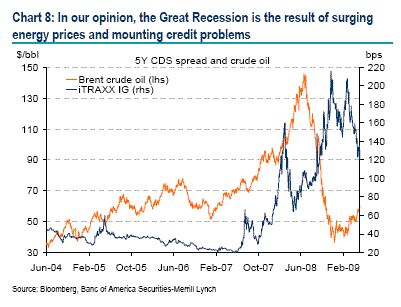

The Merrill Lynch team thinks that a jump in oil prices to $70-80/b could pose risks to growth in the OECD countries and that the emerging markets face problems between $90-100/b. (This jibes with my thoughts on the subject earlier. To wit, that $70-80/b is where you see demand destruction in the US in the past--see Daily Sources 5/8 #3--or about $2.50-$3.00/gallon average national gasoline and diesel prices--see VMT vs Real Gasoline and Diesel Prices 1980-Oct 2008. Insofar as emerging market economies are dependent upon exports to the OECD countries and that those exports tend to be production inputs or relatively unsophisticated manufactured goods, I am unclear as to why $90-100/b is acceptable to them, given that high petroleum products prices essentially act as a regressive tax, ie hurts the pocketbook of their target market.)


Meanwhile, Kate Dourian at Platts reports that in an interview with Kuwait's Al-Seyassah newspaper, King Abdullah of Saudi Arabia said,
"We still believe that $75 or maybe $80/b is a fair price for oil, particularly in current circumstances."
And Tarek El-Tablawy at the Associated Press reports in an interview, Ali al-Naimi, the Saudi Oil Minister, told the Saudi daily Al-Hayat that OPEC was likely to maintain its current production quotas.
"Boosting production 'will not happen until we are sure that global inventories are reduced to their normal levels,' said al-Naimi, whose country is the world's largest exporter of crude. He said world crude inventories are currently at between 61 and 62 days of forward cover and the group wants to see them down to 52 or 54 days."
But, Ayesha Daya at Bloomberg reports that the latest Joint Oil Data Initiative [JODI] data indicates that Saudi Arabian oil output jumped from 8.065 mb/d in February to 8.358 mb/d in March, well above the implied quota of 8.051 mb/d. And Platts reports that despite a week's worth of fighting in the Niger Delta, which has recently forced Chevron to shut in 100 kb/d of production, a Nigeria National Petroleum Corp [NNPC] official said crude exports, including condensates, will export 2.01 mb/d in June and 2.04 mb/d in July. Nigeria's implied OPEC quota has been reported from 1.74 mb/d to 1.67 mb/d. The NNPC official said that the country is currently at 1.66 mb/d. Meanwhile, Platts reports that Sinopec's Chairman Su Shulin was quoted by the People's Daily yesterday as saying that he expected the government to lift the guidance price of petroleum products by May 28, which is when OPEC is set to meet.
"Sinopec's refining business has been in the red recently as international crude prices have risen above $60/barrel, Su said.

'According to the information released on May 8--regarding the [new] oil pricing mechanism--prices of oil products sold in the domestic market will be revised when the moving average of international crude prices over 22 consecutive working days falls outside a 4% fluctuation range,' Su said, indicating that domestic oil prices should be adjusted following the recent uptick in global crude oil prices.

The 22-day moving average of the crude basket rose above the 4% fluctuation range from May 1, hovering around 5-10%, Platts data showed."
14. CHINA HOLDS SO MANY U.S. DOLLARS THAT IT MUST BUY MORE TO SUPPORT THEIR PRICE

Jamil Anderlini at the Financial Times writes that China is stuck in a "dollar trap," meaning that it has no choice but to continue buying dollars with its growing reserves if it wants to conserve the value of its current holdings.
"Chinese and western officials in Beijing said China was caught in a 'dollar trap' and has little choice but to keep pouring the bulk of its growing reserves into the US Treasury, which remains the only market big enough and liquid enough to support its huge purchases.

In March alone, China’s direct holdings of US Treasury securities rose $23.7 billion to reach a new record of $768bn, according to preliminary US data, allowing China to retain its title as the biggest creditor of the US government."
Rebecca Wilder at News N Economics notes that according to IMF data China is by far the world's largest capital exporter, just as the US is the largest capital importer.


Ms. Wilder comments:
"China's current account flows are likely to end up in US capital markets. This makes sense, as the US is expected to be one of the forces to pull the globe out of recession through renewed import demand for global exports in the wake of massive fiscal and monetary policy. Eventually, though, push will have to come to shove when it comes to the US-China current account imbalance. The only question is when!"
Worth reading in full. Meanwhile, Ambrose Evans-Pritchard at the UK Telegraph reports that the yield on US 10 year treasuries has risen over 90 basis points since March, suggesting some resistance to the product in the market. (The People's Bank of China has rerouted its purchases of agencies and long term treasuries to treasury bills.)
"The US is not alone in facing a deficit crisis. Governments worldwide have to raise some $6 trillion in debt this year, with huge demands in Japan and Europe. Kyle Bass from the US fund Hayman Advisors said the markets were choking on debt.

'There isn't enough capital in the world to buy the new sovereign issuance required to finance the giant fiscal deficits that countries are so intent on running. There is simply not enough money out there,' he said. 'If the US loses control of long rates, they will not be able to arrest asset price declines. If they print too much money, they will debase the dollar and cause stagflation.'"
Olivier Accominotti pointed out that France was in much the same situation in terms of holdings of UK sterling in the years leading up to WWII--see Daily Sources 4/23 #1--the dispute over which, by the way, was one key reason that the UK and the US were late to heed Paris' warnings as events began to hint at maleficent intent from Berlin at the time.

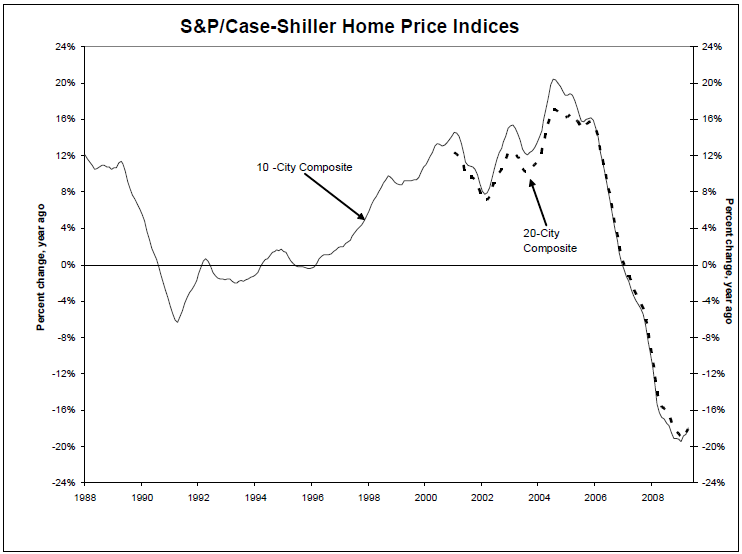
15. U.S. CONFIDENCE UP AS CASE-SHILLER PRICE INDEX DECLINES BY 19.1% IN THE FIRST QUARTER FROM A YEAR AGO!

The Associated Press reports that the Conference Board's Consumer Confidence Index in May rose to 54.9, from a revised 40.8 in April. The reading is the highest seen in eight months.
"'Looking ahead, consumers are considerably less pessimistic than they were earlier this year, and expectations are that business conditions, the labor market and incomes will improve in the coming months,' Lynn Franco, director of the Conference Board Consumer Research Center, said in a statement. 'While confidence is still weak by historic standards, as far as consumers are concerned, the worst is now behind us.'"
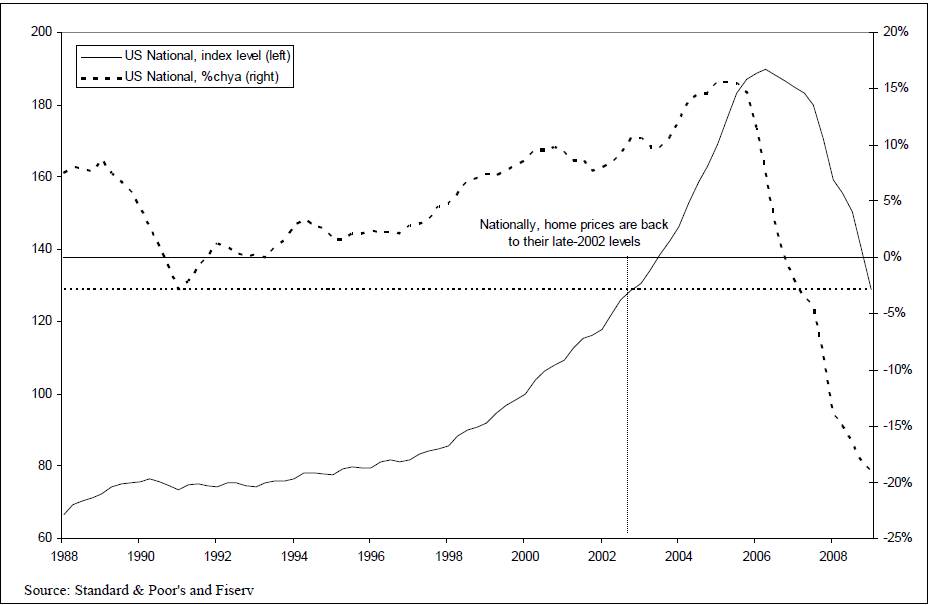
Interestingly, the Case-Shiller Home Price Index declined 19.1% in the first quarter from a year ago, and 7.5% from the fourth quarter, per Barry Ritholtz at the Big Picture. Ritholtz notes that prices are now at their 2002 levels:
Thursday, March 26, 2009

Daily Sources 3/26

1. Eurointelligence reports that the Netherlands CPB Institute yesterday published January's data for global trade, which shows that global trade is down 20% from October. "FT Deutschland quotes a CPB staffer as saying this is faster than during the Great Depression (the estimates there range from 25-35% during 1929 and 1932)."

2. Lucy Hornby at Reuters reports that China estimates that the number of migrant workers that are now unemployed has risen to 23 million since the lunar year holiday in January. (h/t Yves Smith at naked capitalism.)

3. Upstream online.com reports that Liu Qi, deputy head of China's National Energy Administration, told an industry forum that
"Appropriately obtaining global resources is our inevitable choice and legal right...Winning foreign resources is even more important than stepping up domestic production."
Liu told the conference that China will offer oil companies tax and other policy incentives to continue exploring for purchases and concessions abroad. Meanwhile, Lydia Polgreen at the New York Times reports that analysts see Chinese decision makers becoming more conservative about their African investment decisions:
"'We have seen in the recent past Chinese companies wade into countries nobody else would,' said Philippe de Pontet, an analyst at ... a private research firm. 'That may be changing.'"
Meanwhile, Franz Wild and Helene Fouquet at Bloomberg report that Aveda, accompanying French President Nicolas Sarkozy on a two day business junket to central and western Africa, signed a joint venture uranium exploration agreement with the Democratic Republic of Congo.


4. Rebecca Christie at Bloomberg reports that Treasury Secretary Timothy Geithner told a forum hosted by the Council on Foreign Relations yesterday that the recent proposal to replace the dollar as a reserve currency by China is
"designed to increase the use of the IMF’s special drawing rights. And we’re actually quite open to that."
"The dollar slid as much as 1.3% against the euro within 10 minutes of news accounts of Geithner’s remarks. It recouped much of the loss about 15 minutes later, when Geithner then predicted no change in the US currency’s role."
Meanwhile, Eurointelligence reports that Dominique Strauss-Kahn, the head of the IMF, told a parliamentary finance committee in Paris that
"it is absolutely legitimate to discuss the possibility of a new international currency. This is not a new question but the current crisis renews the interest in this question. He also said that he does not consider that the dollar ceases to be an international reserve currency. Even the Chinese don’t think that."
Meanwhile, Mriganka Jaipuriyar at Platts reports that the chief economist of the Paris-based IEA, Fatih Birol, said that the organization is working very closely with Beijing to improve the flow of data, but that there is a long way to go.
"'Both on the IEA's side and the Chinese side, there are strong efforts to harmonize how we collect and analyze the statistics. I should say there are some improvements in that area but we are not yet at a level we would like to see,' Birol told Platts in an interview Thursday.

'We are at the beginning of a very long journey and it would be too premature to say that we have the information we need to make our analysis,' he added.

The IEA is pursuing similar talks with India and hopes to be able to better analyze the situation in these countries and their implication for the rest of the world, Birol said."
Platts reports that OPEC oil exports excluding Ecuador and Angola in the four weeks to April 11 are to fall to 22.23 million b/d, down by 770 kb/d from the previous four week period.

5. Thom Shanker at the New York Times reports that an annual Pentagon study released yesterday--"Military Power of the People’s Republic of China 2009"--argues that China is seeking weapons and technology which counter traditional American advantages. This seems natural enough to me, but China's Foreign Ministry was sufficiently disturbed to have its spokesman say "This report issued by the US side continues to play up the fallacy of China’s military threat." At his regular news briefing in Beijing the spokesman "suggested that the Pentagon stop issuing the annual report to avoid 'further damage to the two sides’ military relations.'" The report can be found here.

6. Wall Street Journal Asia has an editorial piece which points out that the EU and South Korea just signed a free trade agreement on Tuesday.
"Details haven't been released yet, but it's expected to be a comprehensive accord that will reduce or eliminate most tariffs on goods and liberalize European investment in Korea's tightly regulated service sector. Both sides are aiming to iron out the final details at next week's Group of 20 summit in London."
7. Veit Medick at Der Spiegel interviewed Martin Schulz, chairman of the Socialist group in European Parliament and head of foreign policy at the German Social Democratic Party's federal executive committee, about the consequences and causes of the fall of Prime Minister Mirek Topolánek's government in the Czech Republic while he was president of the EU. Key excerpts:
"Schulz: Topolánek was one of George W. Bush's closest allies when it came to the missile-defense system in eastern Europe. Now he uses the platform of the European Parliament to campaign against Bush's successor. He can do that in Prague, but not in the EU.

SPIEGEL ONLINE: Is the Lisbon Treaty now in danger?

Schulz: We'll see. The fact is, the two legislators who caused the collapse of his government were opponents of the treaty. That's not an encouraging sign."
SPIEGEL ONLINE: This fall, the Irish also plan to vote on the Lisbon Treaty. If the Czechs reject the treaty, would the Irish vote still be relevant?

Schulz: If the Czechs reject the treaty, we're going to be in a serious crisis. We might as well then bury the treaty. We'd then be thrown back to the Treaty of Nice, which was passed by 15 member states. But those same 15 governments, not to speak of the new member states, are unsatisfied with the old arrangements. That's why there was supposed to be a constitution. When that failed, we tried to include the essence of the reforms in the Lisbon Treaty. If that also fails, it would be a fiasco.
Worth reading in full. Meanwhile, Reuters reports that Irish GDP fell at an annual rate of 7.5% in the fourth quarter. "GDP fell 2.3% for the whole of 2008, data from the Central Statistics Office showed on Thursday."

8. Der Spiegel reports that in a speech calling for the reform of NATO, German Chancellor Angela Merkel said today:
"It is also in Germany's interest that dialogue between the new US administration and Russia gains momentum again. ... NATO wants Russia as a good partner ... We have not been rivals for 20 years now. The time of the Cold War is irrevocably over."
9. Doris Leblond at the Oil & Gas Journal put the kibosh on the notion, reported in the Russian press, that Moscow had been left out of discussions on how to pay for the modernization and increased transparency of the Ukrainian gas pipeline system. In fact, "Russian Energy Minister Sergei Schmatko and an important delegation was present." This was in addition to representatives from the EU, Canada, the US, World Bank, European Investment Bank, and European Bank for Reconstruction and Development. Meanwhile, RIA Novosti reports that the Russian Ambassador to Ukraine, Viktor Chernomyrdin, told the press that the deal struck Tuesday to modernize the system "looks as if a deaf man and a blind man sat at a table and signed the paper without even understanding what they had signed."

10. Johan Carlstrom at Bloomberg reported that the Norges Bank cut the benchmark interest rate by 0.5% to 2% yesterday.
"'The decline in activity in the Norwegian economy will be more pronounced than previously assumed,' Deputy Governor Jan. F. Qvigstad said in the statement. The bank may cut the rate as low as 1% 'in the course of the autumn.'"
11. Edward Hugh at Fistful of Euros notes that Serbia and the IMF have agreed to a €3 billion, 27 month, stabilization program.

12. Reuters reports that UK retail sales fell by 1.9% in February from January. "The annual rate of growth fell to 0.4%, its weakest since September 1995, the Office for National Statistics said."

13. The Associated Press reports that Ali Larijani, the Iranian Speaker of the Parliament and former nuclear negotiating point man, told the media yesterday that in Najaf that Iran's problems with the US are not a "sentimental issue" soluble with "a blessing and congratulations." "Larijani says the differences stem from 30 years of hostility, including Saddam Hussein's 1980 invasion of Iran which he said was 'instigated by America.'" For the record, it is my understanding that Saddam Hussein's 1980 invasion of Iran was not instigated by the Carter Administration, but never mind.

14. The AFP reports that Turkish President Abdullah Gul in Iraq promised his hosts that the water allocation from the Tigris and the Euphrates would be doubled this year. Juan Cole surmises that this is likely in return for a crackdown by Baghdad on Kurdish Workers Party guerrillas hiding in the mountains in Iraq just outside the Turkish border.

15. Fausta Wertz at The Compass notes that today Hugo Chávez had the military presence increased at the La Fría and San Antonio airports, saying
"we have begun the reversal process over everything that meant the dismemberment of national unity, the territory, and sovereignty, because prior governments fractured the country into pieces."
(Both airports are found in the state of Táchira, a small region on the border of Colombia.)


Chávez also ordered the creation of a new state company to manage the ports which will be required by law to "work under socialist guidelines and seek the development of the regions in which their respective seaports and airports operate." As Wertz notes, after the opposition won several major municipalities and regions in the November elections, Chávez has moved to strip them of control of the various ports, and with it valuable tariff revenues.

16. Juan Forero at the Washington Post reports that in January, Ecuador enacted a number of provisions to try and reduce the number of imports coming into the country.
"'What is the objective? To dampen demand for imported good and to increase consumption of domestic goods,' said Diego Borja, minister of economic policy. 'It was a difficult measure, but necessary and indispensable. We know that there are costs to getting out of a crisis.'

Borja said that because Ecuador's currency is the U.S. dollar, the country has been particularly exposed as imports rose in relation to exports. Unable to print money, or devalue to help Ecuadoran companies that export, the government decided to levy tariffs that reach 35%, decrease import volume as much as 35% and implement a range of surcharges. In all, 627 products fall under the new measures, including furniture, cellphones, electronic parts, shoes, alcohol and food products such as cookies and pastas. The government said the restrictions would reduce imports this year by nearly $1.5 billion compared with 2008.

Without the restrictions, officials here say, Ecuador could run out of money -- leading to economic collapse and political instability. 'We depend on dollars,' Borja said. 'If we don't have a revenue of dollars, then we have a very, very big problem.'"
In December Ecuador defaulted on its debt--see Daily Sources 12/15 #1--and then had its social security system purchase $1.2 billion in new sovereign debt--see Daily Sources 12/29 #14. The CIA estimates that Ecuadoran GDP was $107 billion in 2008 and that government expenditures (which were less than revenues) were about $17.79 billion.)

17. Ronald Buchanan at Platts writes that Mexican oil export revenues in February fell 56.4% year on year on $1.66 billion, according to a report by the National Statistics Institute, or Inegi, released yesterday. WTI on NYMEX averaged $95.35/b in February 2008 versus $39.26/b in February 2009, which at a 58.8% decline is consistent with a 56.4% decline. According to the EIA, Mexican sales of Isthmus crude--a medium sour crude with an APIº33.3 and 1.492 sulfur wt/%--averaged about $89.48/b in February 2008 and $39.22/b in February 2009. Sales of Maya crude--a heavy very sour crude with an APIº22.2 and 3.3 sulfur wt/%--averaged about $78.35/b in February 2008 and $37.17/b in February 2009. But in November, the Associated Press reported that the Mexican Treasury Secretary announced that the country had spent $1.5 billion to buy put options to sell 330 million barrels of Mexican crude--or about a third of its total 2008 output--at $70/b. Even considering the decline in total output, how does this add up?

18. Mary Beth Sheridan at the Washington Post reports that in a speech in Mexico Secretary Clinton said of the anti-narcotics effort:
"Clearly what we've been doing has not worked ... . Our insatiable demand for illegal drugs fuels the drug trade. Our inability to prevent weapons from being illegally smuggled across the border to arm these criminals causes the deaths of police, of soldiers and civilians.'"
19. Derek Sands at Platts reports that Scott Borgerson, a fellow for ocean governance at the Council of Foreign Relations told the House Committee on Foreign Relations that:
"It would be a mistake to assume that all these flashpoints [of new resource opportunities opening up due to melting ice in the Arctic] will remain sleeping dogs. The combination of new shipping routes, trillions of dollars in possible oil and gas resources and a poorly defined picture of state ownership make for a toxic brew."
Sands elaborates:
"US ratification of one mechanism to deal with Arctic resource issues--the UN Law of the Sea Treaty -- has been blocked by a small group of senators because of sovereignty concerns. That refusal could contribute to the US missing out on some of the Arctic's resources, according to the witnesses.

Other Arctic countries have ratified the treaty, and former President Bill Clinton signed it, but it still awaits Senate ratification.

Among other things, the treaty sets up a mechanism for countries to arbitrate disagreements over claims to undersea territory."
20. Bob Willis at Bloomberg reports that initial unemployment benefits applications grew by 8,000 in the week ended March 14 to 652,000, per the Labor Department release today. The total number of people receiving unemployment benefits jumped by 122,000 from the week prior to 5.56 million.

21. Shobhana Chandra at Bloomberg reports that the Commerce Department further revised its initial estimate of fourth quarter GDP to a 6.3% annual rate of contraction (from 3.8% and then 6.2% rates of decline).
"For all of 2008, the economy grew 1.1%, the same as previously estimated, as exports and government tax rebates in the first six months helped offset the slump in consumer spending that followed.

Consumer spending, which accounts for about 70 percent of the economy, fell at a 4.3% pace last quarter, marking the first back-to-back decreases in excess of 3% since record-keeping began in 1947.

Retailers are doing better so far this year. Sales fell less than forecast in February and January’s 1.8% gain was the biggest in three years, Commerce reported earlier this month."
Brian Blackstone at Real Time Economics notes that GDI--Gross Domestic Income, another measure of national economic activity--fell in the fourth quarter by 7.5% from 4Q2007.
"GDP is consumption driven: consumer spending, investment, government spending and the like. GDI is income based, meaning things like income and corporate profits. In theory, the two should line up — but not always. In the case of the fourth quarter, a severe slide in corporate profits was likely the root of the discrepancy. Employee compensation, the other main GDI component, held up much better."
22. Barry Ritholtz at the Big Picture takes aim at the news yesterday that new home sales increased by 4.7% in February from January, noting, to start with, that on an annual basis new home sales fell by 41% in February.
"Note that the month over month data at 4.7%--plus or minus 18.3%--is statistically insignificant. (i.e., meaningless). The reported data does not inform us if sales improved month-over-month or not. It is a range, from down -13.6% to plus 23%. Since 'zero' is part of that range, we can draw no conclusion. As the Census Department itself notes, “the change is not statistically significant; that is, it is uncertain whether there was an increase or decrease.”

The data does however, tell us that the year-over-year sales fell 41.1% plus or minus 7.9% gives us a range of -49% to -33.2%. The entire range is negative, therefore we can conclude sales fell year-over-year."
The Census Bureau noted that the seasonally adjusted estimate of new houses for sale indicates a 12.2 month supply at February sales rates.

23. Brian K. Sullivan at Bloomberg reports that the flooding in North Dakota is forecast to exceed 112 year records and thus may well significantly delay the planting of the spring wheat crop.
"Republican Governor John Hoeven declared a flood emergency across the state, while the federal government declared the state a major disaster area and said a public health emergency exists there. Rain and snow blanketed the area this week, covering ground already saturated by snow and rain earlier in the season."
The US is a major global supplier of wheat.

24. Keith Johnson at Environmental Capital posts the very useful observation that water consumption is a key issue--and perhaps the key issue--in evaluating the relative value of various forms of power generation.
"The water issue affects all kinds of power generation—coal, natural gas, and nuclear power; the nuclear industry’s water appetite in particular has become a flashpoint for criticism. The US Geological Survey figures power plants are the second-biggest users of water in the US, behind agriculture."
25. In an interesting side-note, it appears that the online musings of Paul Krugman have struck a nerve in Germany, whose press has taken note of Krugman's disrespectful tone and whose Finance Minister Peer Steinbrück has sent Krugman an invitation to visit him in Berlin to discuss their differences of opinion mano a mano.