Showing posts with label Austria. Show all posts

Tuesday, June 9, 2009

Daily Sources 6/9

1. PAKISTANI ARMY JOINS POSSE EFFORTS TO PUNISH TALIBAN, TALIBAN RESPONDS BY KILLING MORE PAKISTANIS

Griff Witte at the Washington Post reports that a truck bomb exploded outside a hotel at the provincial capital of Pakistan's North-West Frontier Province, Peshawar, killing 11 people and wounding at least 50.


Alamgir Bitani at Reuters reports that the Pakistani army is coordinating attacks with the citizen's militias:
"[O]n Tuesday, the army came to the help of a pro-government militia fighting the Taliban in a northwestern district after outrage over a suspected Taliban bomb attack at a mosque last week that killed about 40 people.

The villagers' action is the latest in a series of examples of people turning on the Taliban in recent weeks, underscoring the shift in public opinion away from the Islamists.

Army helicopters had attacked militants surrounded by militia fighters in a village in the Upper Dir district, senior police officer Rahim Gul told Reuters by telephone.

Gul said more people were joining the militia and it was making advances after heavy clashes. Paramilitary soldiers set up mortars on high ground above the village. About 25 militants were killed in the fighting, police and the military said."
2. HERITAGE TO AQUIRE TURKEY'S GENEL ENERJI, KNOC, SINOPEC, CNPC, CNOOC ALL MAY BE BIDDING FOR ADDAX--IS ANKARA EDGING TOWARDS COOPERATING WITH THE KRG AS OPPOSED TO BAGHDAD--IS TEHRAN WORRIED ABOUT THIS POTENTIAL?

Ben Lando at the Iraq Oil Report writes that Canada's Heritage Oil is likely to acquire Turkey’s Genel Enerji, which has a 44% share in a joint venture with Addax, the Taq Taq Operating Co. (TTOPCO).

"If shareholders approve, Heritage will purchase Genel for about $2.5 billion in stock, forming the new company HeritaGE Oil.

Genel is spread throughout the KRG, beyond its 44% stake in TTOPCO. It owns a 25% share in DNO’s Tawke project--the other field to begin exports earlier this month--as well as 40% in the Norwegian firm’s Dohuk project. It owns 40% and 20%, respectively, in two other young projects in the KRG.

And, it has a 25% stake in Heritage’s Miran project."
KRG's Minister of Natural Resources Ashti Hawrami has estimated that the field has recoverable reserves of one billion barrels. Miran is thought to have a 2.3-4.2 billion barrels of recoverable oil--see Daily Sources 5/6 #4. Tawke is thought to have total volumes of oil in place are ranging from 0.9 to 1.9 billion barrels, with an estimate of 1.3 billion barrels in place, and total recoverable oil from 150 million barrels to 370 million barrels, as of 2007. Genel Enerji is a subsidiary of Çukurova Holdings Group, a Turkish conglomerate which has roots dating back to the foundation of the Turkish Republic in 1923 with interests in automotive, paper, chemicals, textiles, telecommunications, construction, banking, insurance, media and services to maritime transportation and information technology services. It has foreign operations in Azerbaijan, Spain, Germany, Switzerland, the Netherlands, Northern Cyprus, the UAE, Moldova, Georgia, Kazakhstan, Qatar, and Ukraine as well as Iraq. Çukurova's business dealings in Iraq date back to 1979, when it worked on water projects for the Hussein government. Ed Crooks and William Macnamara at the Financial Times report that Korea National Oil Corp. (KNOC) is considering a takeover or asset deal with Addax, a partner in the TTOPO joint venture with several interests in Africa. As Lando reports, SK Energy, a South Korean refining firm, was cut off from Iraq's crude supply when it joined a consortium of South Korean firms operating in Kurdish Iraq. It left the consortium, and now is receiving crude as normal. Sinopec, CNPC, and CNOOC are also reportedly considering some sort of participation with or acquisition of Addax, but their participation could jeopardize their potential participation in bidding via Baghdad. For example, Sinopec and CNPC are in a joint bid agreement with Shell for developing the Kirkuk oil field.

However, the KRG effectively presented Baghdad with a fait accompli when it said that oil would begin to flow through the Kirkuk pipeline to Turkey on June 1 from these fields, given that they control the fields and part of the pipeline--see Daily Sources 5/12 #8--and so the oil has begun to flow. In the middle of May, Austria's OMV, Hungary's MOL and UAE-based Crescent Petroleum and Dana Gas entered a partnership to invest as much as $8 billion into the Kurdish Autonomous Region--see Daily Sources 5/18 #4. Russia's Putin-connected Surgutneftgas has recently purchased a 21.2% stake of MOL from OMV and Gazprom signed a deal in March with MOL to establish a 1.3 billion cubic meter natural gas storage facility in Hungary, nearer to Gazprom's potential market than western Ukraine--see Daily Sources 3/18 #4. Of course, no one wants to upset Baghdad, but the KRG is manifestly capable of providing security for operations, and Baghdad is not.

Add to the mix the recent reporting by Delphine Strauss posted at FT Energy Source that Turkey appears to have resurrected the demand that 15% of any gas being sent through Anatolia by the potential Nabucco pipeline be reserved for Turkish consumption.
"Turkey’s ongoing bilateral negotiations over the price and quantity of the gas it buys from Azerbaijan will certainly influence its stance on Nabucco--which could soften if it secures its own share of gas to be pumped from Azerbaijan’s Shah Deniz field.

But analysts say the stubborn negotiating tactics are less about supply concerns and more about Turkey’s ambition of becoming an energy hub, not just a transit country. Turkey is already able to re-export gas it buys from Azerbaijan and is seeking the same right from Russia.

Mr Morningstar puts it differently, saying 'Turkey does have to satisfy internal gas demand but it also has a strategic vision--I believe it wants to play a major role in the Caucasus and Central Asia and this project is a way to do it.'"
Of course, in the middle of May Gazprom's Alexei Miller told Bloomberg TV that the company stood ready to purchase all of the gas from the second phase of the development of the Shah Deniz field--see Daily Sources 5/15 #7.


Clearly Iraq could eventually provide feedstock for Nabucco, but just now only the Kurdish Regional Authority appears ready to provide the relative security required for such a project to really begin. Further, Iran has lately suggested that it's Pars Pipeline could obviate Turkey altogether, going through Iraq to the Syrian Mediterranean Coast--which would make sense, perhaps pressure Anakara, but most likely go directly through KRG-controlled territory, also obviating Baghdad.


Without saying it's gonna happen, it does strike me as ironically possible that Ankara could be considering the KRG a better partner in terms of its goal of regional energy hub than Baghdad. I can't imagine, for example, that folks in Ankara were especially thrilled with the news reported by the Associated Press' Hamza Hendawi and Qassim Abdul-Zahra today that there are negotiations ongoing between al-Maliki's Dawa Party and the Supreme Iraqi Islamic Council to reform the so-called United Iraqi Alliance. The UAE's participation in the Kurdish Autonomous Region [KAR] may well also be designed to off-set the so-called "Shia Crescent." Moscow now may be part of the natural gas troika with Iran and Qatar--see Daily Sources 10/24 #2--but they are still competitors. The fact that MOL--and by extension Surgutneftgas and Gazprom--is also getting involved in the KAR underscores the potential calculation on the part of Ankara that one key bit of leverage they might like to have, vis-a-vis, getting closer to EU acceptance, would likely be being a larger node in their energy supply picture. I further would not be surprised if US diplomats quietly made this point to folks in Ankara, and pointed out how helpful good relations with the KRG might be in terms of Ankara's long-term goals.

Hell, even Tehran's talk of having begun construction of the Pars Pipeline without having actually figured out where it will eventually go--see Daily Sources 6/4 #6--though the first assumption is Turkey, may be an attempt to try and secure a more secure role in European energy supply via supplying Nabucco, pace what Baghdad, even a Shi'a Baghdad, thinks. All speculation, I guess, but interesting speculation.

3. ISRAELI MINISTER URGES SANCTIONS ON U.S.--BOOK SAYS ATTACK ON THE 1967 USS LIBERTY WAS DONE WITH KNOWLEDGE THAT IT WAS AMERICAN

In a fascinating bit of news, Gil Hoffman and Hilary Leila Krieger at the Jerusalem Post report that Likud Minister-without-Portfolio, Yossi Peled, wrote a letter proposing sanctions on the US to the Israeli cabinet this Sunday! Apparently Peled believes that the Obama Administration has an activist agenda which does not mesh with Israel.
"[T]he minister suggests reconsidering military and civilian purchases from the US, selling sensitive equipment that the Washington opposes distributing internationally, and allowing other countries that compete with the US to get involved with the peace process and be given a foothold for their military forces and intelligence agencies.

Peled said that shifting military acquisition to America's competition would make Israel less dependent on the US. For instance, he suggested buying planes from the France-based Airbus firm instead of the American Boeing."
(h/t Michael Collins Dunn at MEI Editor's Blog.) And, Jeff Stein at Spy Talk reports that a new book by James Scott, The Attack on the Liberty: The Untold Story of Israel's Deadly 1967 Assault on a US Spy Ship, alleges that Israeli pilots which were involved in the attack on the US spy ship were told "two times" that the ship was American after radioing the hull number back to air control.
"'There clearly were individuals inside Israel's chain of command who knew this was an American ship in time to prevent the fatal torpedo boat attack that left more than two dozen of the Liberty's sailors dead," Scott says.

Yet the Israelis informed Johnson administration officials that they were innocent--and outraged by such suggestions.

That prompted the State Department's number two official, Nicholas B. Katzenbach, to summon Israel's ambassador Abraham Harman, Scott writes.

'The secret memo of the meeting,' Scott writes, 'declassified 33 years later, records Katzenbach telling the Israeli ambassador' that Tel Aviv's initial protest 'contains some statements they might find hard to live with if the text some day became public.'"
At the time the Johnson Administration was a bit too preoccupied with the Vietnam War and pushing forward the civil rights movement to want to focus on the attack.

4. CHINA DRIVING UPTICK IN BALTIC DRY INDEX / IRON ORE RATES, DOES BEIJING'S BINGE COMMODITIES PURCHASES POLICY UNDERMINE LIKELIEST SOURCE OF RECOVERY?; CHINESE STIMULUS MAY FORCE LOCAL GOVTS INTO BANKRUPTCY; CHINESE SUPREME COURTS INSTRUCTS LOWER COURTS TO COOPERATE WITH AUTHORITIES TO CATCH MASS INCIDENTS BEFORE THEY HAPPEN

Maritime Global Net reported yesterday that Thailand-based Precious Shipping has said that the current rise in the Baltic Dry Index is unsustainable, given binge iron ore purchases in China. The post quotes Precious Shipping as arguing that the:
"rise in iron ore imports is despite the fact that steel production in China in the first four months of 2009 has been roughly at the same levels as we had seen in 2008. An explanation for these increased iron ore imports could be the fact that domestically produced iron ore in China is of a rather poor quality and quite expensive when compared to spot imported prices. Another explanation could be that of speculators getting into the import market to try and get hold of 'cheap' iron ire that would possibly be required under the Chinese government's US$586bn stimulus plan. And a third could be the impending conclusion of the iron ore contract price negotiations."
In any case, the company expects iron ore cargoes to level off. (h/t Yves Smith at naked capitalism.) In the meantime, Michelle Wiese Bockmann at Lloyd's List reports that Chinese steelmakers have accepted contracts on iron ore (from Rio Tinto) at a 33% discount to last year's prices, apparently abandoning allegedly holding out for a 40% discount. Dow Jones reports that the Chinese Ministry of Transport estimated that 3.26 mb/d of crude were delivered to China via seaports in May, up 5.1% from the same month last year.
"However, seaborne imports fell 9.8% from April, according to calculations by Dow Jones Newswires, which may indicate crude demand is slowing from the high levels recorded earlier this year."
On June 1, Zhang Guobao, the director of China's National Energy Administration, told reporters that crude storage facilities in the country had been completely filled--see Daily Sources 6/1 #2. A few days later, journalists were taken to heretofore secret strategic petroleum reserves by the State Council Information Office, apparently to show them that the tanks were indeed full to the brim--see Daily Sources 6/4 #2. All of which followed a report by Sanford Bernstein which used satellite images to deduce that about 400 kb/d of oil was being added to China's SPRs--see Daily Sources 5/22 #2. I wonder to what extent Beijing's central planners' decision to green light large purchases of commodities as the complex's prices have collapsed is based on an effort to provide some economic support to the commodity producing nations, with which Beijing wants a good long-term relationship looking forward. On the other hand, I wonder whether the decision to purchase counter-cyclically may support commodity producing nations while simultaneously undermining the main potential source of recovery: it's export market, or the developed world. Michael Pettis at China Financial Markets wonders whether the stimulus package will bankrupt China's local governments, quoting from Australian paper the Age:
"Beijing will have to jam on the economic brakes to save cities from bankrupting themselves, says a top Chinese adviser. He Fan, an assistant director at the Chinese Academy of Social Sciences who frequently advises top leaders, says as much as two-thirds of Beijing’s 4 trillion yuan ($A773 billion) stimulus program will be spent by local governments, financed mainly by state-owned banks.

'Some local governments will virtually go bankrupt,' Professor He told BusinessDay. 'Previously, local governments got all their money from selling land. This is not sustainable. Some areas have already sold quotas from the next 30 years.' A number of large cities are thought to be at risk, including Kunming and Hangzhou, with their funding problems exacerbated by a slump in real estate sales."
Of the monies already committed to the stimulus, the great majority has come from the central government, while local governments have reportedly lollygagged. In any case, the Professor He notes that the lending institutions can apply for a bailout if their loans go bad--and pretty much expect one--given that they were asked to make the loans by Beijing. Meanwhile, Xie Chuanjiao at China Daily reports that the Supreme People's Court has released guidelines to local courts which requires them to cooperate closely with authorities to reduce "mass incidents."
"'The courts will focus on dealing with a sharp increase in mass incidents especially in the mediation of demonstrations. If there is any trend seen in "mass petitions", the courts should also work closely with local administrative departments,' the document said.

Judicial departments should 'establish an early warning mechanism' and direct their resources in line with law enforcement, the SPC said."
Worth reading in full. In late May, apparently as a warning and part of an effort to anticipate and ward off incendiary cases, Beijing bgean denying license renewals to law firms which practice human rights law in the country--see Daily Sources 5/28 #1.

5. SEOUL PLACES FINANCIAL SANCTIONS ON 3 NORTH KOREAN COMPANIES NOT OPERATING IN SOUTH KOREA

Choe Sang-Hun at the New York Times reports that Seoul has imposed its first financial sanctions on North Korea.
"On Tuesday, the Ministry of Strategy and Finance in Seoul said that it has banned trading with three North Korean firms--Korea Mining Development Trading Corporation, Tanchon Commercial Bank, and Korea Ryongbong General Corporation--and will freeze their assets. But officials said that these firms have no trading with South Korea or assets in the South."


6. JATROPHA TREE WATER GUZZLER

Phil McKenna at MIT Technology Review reports that a recent study done by researchers at the University of Twente, in the Netherlands, shows that the jatropha tree
"requires five times as much water per unit of energy as sugarcane and corn, and nearly ten times as much as sugar beet--the most water-efficient biofuel crop, according to the same study."
Jatropha had been touted as a potential solution because it does relatively well in arid situations. But, according to the research, the Jatropha only really thrives in extremely wet conditions.
"The team calculated that jatropha requires an average of 20,000 liters of water for every liter of biodiesel produced in India, Indonesia, Nicaragua, Brazil, and Guatemala--the only countries for which jatropha production figures were available. For all the other crops, the researchers used much more comprehensive--and thus truly global--data from the Food and Agriculture Organization of the United Nations. Soybeans and rapeseed, the two other biodiesel crops considered in the study, were next highest in terms of water consumption, each requiring roughly 14,000 liters of water per liter of fuel."
India has bet heavily on the jatropha, and apparently the Energy and Resources Institute (TERI)--an Indian research group--began a $9.4 million project to produce genetically altered jatropha with a higher oil content. Protests have taken place in parts of India over government plans to reclassify lands for the seeding of jatropha; unrest over reduced food crop yields due to biodiesel programs via the jatropha tree have also broken out in the Philippines and Myanmar--see Daily Sources 5/6 #6.

7. AVERAGE US HOURS PER WORK WEEK TO 1964 LOW, MEANS NEW HIRING UNLIKELY ANY TIME SOON, POSSIBLY MEANS HOUSING MARKET GOT A LONG WAY TO GO TO RECOVER

Jeff Frankel, a member of the National Bureau of Economic Research's Business Cycle Dating Committee, on his blog argues that the labor market has yet to signal a turnaround, contra much of the reporting last week. Frankel explains why average hours worked is a better indicator of direction, in his estimation, than jobs added or lost:
"I like to look at the rate of change of total hours worked in the economy. Total hours worked is equal to the total number of workers employed multiplied by the average length of the workweek for the average worker. The length of the workweek tends to respond at turning points faster than does the number of jobs. When demand is slowing, firms tend to cut back on overtime, and then switch to part-time workers or in some cases cut workers back to partial workweeks, before they lay them off. Conversely, when demand is rising, firms tend to end furloughs, and if necessary ask workers to work overtime, before they hire new workers. (The hours worked measure improved in April 1991 and November 2001 which on other grounds were eventually declared to mark the ends of their respective recessions.) The phenomenon is called 'labor hoarding' and it is attributable to the costs of finding, hiring and training new workers and the costs in terms of severance pay and morale when firing workers."
By that metric the latest data from the Bureau of Labor Statistics is not so encouraging as the length of the average workweek fell to it's lowest since 1964.


Worth reading in full. Barbara Kiviat at the Curious Capitalist adds the observation that the number of temporary layoffs is low, while the number of people who are involuntarily working part time is "uncharacteristically" high. Thus,
"When sales pick back up, businesses don't have to go out and hire more people--they simply return their workers to full-time schedules.

Put those two things together, and you've got an economic recovery without a particular jump in job growth. The implication, according to the economists: 'a longer and slower recovery path for the unemployment rate.'"
Mark Thoma at Economist's View links to a graph from a report from the Atlanta Fed by Melinda Pitts and Menbere Shiferaw which raised some animal spirits on the job data front:


Note that the only sector hiring since the beginning of 2008 has been the government and that manufacturing has been shedding jobs from the beginning of the data set at the start of '07.

Monday, May 18, 2009

Daily Sources 5/18

1. GLOBAL HOUSING BUBBLE STILL LOOKS UNPOPPED

On Saturday, Rebecca Wilder at News N Economics took a look at the global housing bubble. She plots a graph of price-rent ratios for Ireland, Spain, the UK, Germany and the US indexed to 1997:


She says she "included the German price-rent ratio to show that housing bubbles are not uniformly the root cause of economic decline." Worth a look.

2. SUPPORT FOR LISBON TREATY IN IRELAND, ITS NEXT BATTLEGROUND, GROWS

Stephen Collins at the Irish Times reports that 52% of respondents in a new survey indicated that they would support the upcoming referendum for the Lisbon Treaty.
"Asked if, in the current crisis, it is better for Ireland to be part of the EU, an overwhelming majority of 79 per cent to 10 per cent say Yes, with a very small number of undecided voters at 11 per cent.

There is a substantial majority in favor of the EU among all social classes, age groups and party supporters.

Not surprisingly, Sinn Féin supporters are easily the most negative about the EU, although a decisive majority are still in favor.

What is surprising is that the most enthusiastic supporters of the EU are Green Party supporters, followed by Fianna Fáil, Fine Gael and Labour in that order."
The largest trend spotted by the survey was a softening of the stance of women toward the treaty, where a significant percentage switched from "No" to "I Don't Know." Dublin registered the largest majority in support of the treaty. (h/t Eurointelligence.)

3. EU ENERGY COMMISSIONER GIVES CREDENCE TO PEAK OIL THEORY

The Oil Drum has reproduced the comments of Andris Piebalgs, the European Energy Commissioner, in which he suggests that he thinks that peak oil analysts may well be right.Key excerpt:
"The world is aware that the production of the existing oil wells is decaying and that new discoveries are more scarce and more expensive. Some experts consider that global oil production may have peaked at [84] million barrels a day. The current economic crisis can make the situation worse. The lower prices that we are enjoying now can be in fact bad news. At this price oil producers have been forced to postpone many necessary investments in new production capacity. These investments take decades to be accomplished. In consequence, if the current economic crisis finished and demand recovers we could be facing huge shortage of supplies that can lead to extremely high prices."
4. BAGHDAD-KRG DISPUTE HEATING UP FURTHER ON KURDISH INDEPENDENT OIL EXPORTS, KRG BECOMES LINKED TO BATTLE BETWEEN THE NABUCCO AND SOUTH STREAM PIPELINE ALTERNATIVES, RUSSIA STRENGTHENS LINKS TO KEY TRANSPORT AND DELIVERY NATIONS--ITALY, AUSTRIA, HUNGARY

Missy Ryan and Mohammed Abbas at Reuters report that Iraqi Prime Minister Nuri al-Maliki said in a televised interview last Thursday that power-sharing pacts that have Sunnis and Kurds a greater say in the affairs of the country need to be pared back. He said,
"In the beginning, consensus was necessary for us. In this last period, we all embraced consensus and everyone took part together. We needed calm between all sides and political actors. But if this continues it will become a problem, a flaw, a catastrophe. The alternative is democracy, and that means majority rule ... From now on I call for an end to that degree of consensus."
The rule of consensus has resulted in minority groups taking posts in senior administrative roles regardless of their share of the national vote. Moves to end the custom would clearly benefit the Shi'a majority in the country. In the meantime, Saifur Rahman at Gulf News reports that Sharjah-based upstream energy explorers Dana Gas and Crescent Petroleum, in conjunction with Austrian energy group OMV and Hungary's MOL have signed a partnership to invest as much as $8 billion in the Kurdish region's energy sector.
"The strategic partnership is expected to boost gas output in Iraq's ... northern Kurdistan province from the current 90 million standard cubic feet of gas per day to a potential 3 billion by 2014 and help meet the growing energy demand in the region and beyond."
Part of the notion touted by OMV and MOL is to find gas supply for the Nabucco pipeline. However, in March Gazprom signed a deal with MOL to establish a 1.3 billion cubic meters storage facility in Hungary--see Daily Sources 3/18 #4. And Euroactive today reports that Russian oil company Surgutneftgas recently took a 21.2% stake in MOL, for €1.4 billion (~ $1.86 billion at the interbank exchange rate of the time.) OMV had launched a failed takeover bid for MOL in 2007, which led to it selling its stake to Surgutneftgas in March. Surgutneftgas is thought to be close to Prime Minister Vladimir Putin.


The Kurdish Regional Government's oil minister, Ashti Hawrami indicated last week that oil from concessions signed without Baghdad's approval will begin to flow through the Iraq-Turkish pipeline and that the only way for Baghdad to put a stop to that would be to shut all exports via that line--see Daily Sources 5/12 #8. In a likely related development, Faleh al-Khayat at Platts reports that Iraq's parliamentary committee has asked the speaker to summon Iraqi oil minister Hussein al-Shahristan to be queried on his failures to move central government oil policy forward.
"The call for a summons came in a statement read out by an official from the speaker's office on Iraq's Al-Sharqiya satellite television channel. The official said the request was signed by 140 of parliament's 275 members."
Shahristani is in open conflict with the Kurdish Regional Government, refusing to grant the legitimacy of 20 oil and gas concessions the region has granted without central government say so. In the meantime, Isabel Gorst at the Financial Times reported Saturday that Berlusconi and Putin signed a deal in Sochi Friday to increase the capacity of the planned South Stream gas pipeline to 63bn cubic meters a year.
"Paolo Scaroni, Eni chief executive, said South Stream would improve Europe's energy security. "What is the meaning of this capacity extension of South Stream? It means 1 billion cubic meters more here will be 1 billion cubic meters less gas crossing Ukraine.""
It is interesting in this context that Iran appears to be arguing at this time for the Pars Pipeline, and now has it moving not through Turkey, but through Iraq and Syria to the Mediterranean, which could potentially thread it through Iraqi Kurdistan. Iran has its own concerns about its Kurdish minority, and has an interest in maintaining strong relations with a Shia-dominated government in Baghdad, so the fact that such a move has even been placed on the table is of some interest.

5. RUSSIAN ANALYSTS SAYING MOSCOW SHOULD FOLLOW THE US AND TURN TO THE FAR EAST

Yevgeny Bendersky at the Compass translates some geopolitical analysis from Russia's Daily Izvestia:
"So whats for Russia in all of this? At present, we stand on the sidelines of the revolutionary transformation of the economic world order. We pray for high oil prices. Why? So that once again we can accumulate dollar reserves and invest in the United States? What for? At the same time, Russia does not belong to any serious economic bloc.

The world will be divided into three main regions: the Americas, Europe and the East, warn the economists. United States will lose some of its power, the leadership will shift towards Asia. That is why America is in a hurry to make friends with China, in order to prevent the creation of a powerful Asian bloc. Where is Russia in the new structure of the world? The East, of course, is closer to us. Already, 96% of Russia's far eastern exports are geared for consumption by the neighboring Asian countries. We need to unite with them--especially in an era of globalization."
6. THE PLA ORDERED TO ESCHEW HEDONISM

Sky Canaves at China Journal reports that the Central Military Commission, the powerful Communist Party organ that controls the People’s Liberation Army, issued a directive over the weekend warning PLA officers against ostentatious displays of wealth. It is only anecdotal, but I have been led to understand that in order to do business in China, you must have contacts with the PLA.
"Today the People’s Liberation Army Daily carried a front-page article ... on the directive, pledging more stringent controls over mid-level and senior military officers, emphasizing accountability and party loyalty."
7. BRAZILIAN PRESIDENT IN BEIJING TO TRY AND MAKE FINANCING DEALS REALITIES

Andre Soliani at Bloomberg reports that Brazil's President, Luiz Inacio Lula da Silva, is in Beijing today where he hopes to make reality financing plans for a variety of projects.
"If Lula’s plans pan out, he’ll return with a $10 billion credit for Petroleo Brasileiro SA, an $800 million loan for the state development bank, and financing for ports and waterways. He expects he’ll be able to open China to Brazilian poultry."
(In February, Petrobras announced it had signed a $10 billion loan agreement with China’s Development bank--see Daily Sources 2/19 #1.)
"China, according to central bank figures, has invested $141.6 million in Brazil since Nov. 12, 2004 when Lula, with Hu beside him, said Brazilians could look forward to $7 billion of Chinese financing.

'Given the potential of both economies, the investments both ways could be much bigger,' China’s ambassador to Brazil, Qiu Xiaoqi, told reporters May 7 in Brasilia when asked why the plans hadn’t materialized.

The biggest Brazilian project announced by the Chinese, a joint venture of Baosteel Group Corp. and Vale to build a $3.6 billion steel-slab plant, was canceled in January.

'The Chinese have made Africa their priority,' said Sandra Rios, coordinator of Brazil-China Observatory, a study group created by Brazil’s Industrial Confederation. 'They expect to have a bigger political influence in that region than in Brazil.'"
8. INDIAN ELECTIONS STRENGTHEN THE MODERATE CONGRESS PARTY

Arvind Subramanian, a senior fellow at the Peterson Institute for International Economics, posts at the Baseline Scenario that the recent elections in India have resulted in a significant victory for the incumbent Congress Party and its allies and defeats for the Communists and the Hindu-nationalist BJP. He comments:
"Going forward, these results augur well for Indian economic policy reform. The Congress will be numerically strong enough not to have to rely on partners for political support and will be able to push through new policy initiatives.

Another likely consequence is that the Nehru family will probably provide India, not immediately but within the next couple of years, with its fourth Prime Minister—Rahul Gandhi, son of Rajiv Gandhi, grandson of Indira Gandhi, and great grandson of India’s first Prime Minister Jawaharlal Nehru.

These results are surprising for two reasons. Indian elections have traditionally been characterized by the phenomenon of anti-incumbency: ruling politicians get routinely thrown out of power. This government is the first in over 40 years that has been re-elected after a full term in office."
Subramanian notes that part of the reason for the Congress Party's success has been that India has been weathering the financial crisis relatively well. Well worth reading in full.

9. US SENATE TOLD PAKISTAN RAPIDLY ADDING TO NUCLEAR ARSENAL

Thom Shanker and David E. Sanger at the New York Times report that a Senate committee Thursday was told that Pakistan is rapidly adding to its arsenal of nuclear weapons. Adm. Mike Mullen, the chairman of the Joint Chiefs of Staff, in response to a question of whether or not aid sent to Islamabad might be diverted to nuclear programs said, "Yes."

10. ISRAEL ALLEGEDLY URGED BY OBAMA ADMINISTRATION TO TONE DOWN IRAN RHETORIC

Steve Linde at the Jerusalam Post reports that the US has been urging Israel to tone down its rhetoric on Iran in advance of Prime Minister Benjamin Netanyahu's visit to DC this week.
"This was one of the purposes of a secret trip to Israel three weeks ago by CIA Director Leon Panetta, foreign diplomatic sources said.

Ostensibly, the CIA chief came to share information on Iran's nuclear program with Israeli intelligence officials and find out how serious the new Israeli government was in its stated position that Jerusalem cannot allow Iran to become a nuclear power.

Panetta was hosted by Mossad chief Meir Dagan and intelligence officials, but also met with Netanyahu and Defense Minister Ehud Barak."
Worth reading in full.

11. MALAYSIAN STATE TO SET UP NEW SOVEREIGN WEALTH FUND ON OIL REVENEUS

Netty Ismail at Bloomberg reports that the Malaysian state of Terengganu is planning to organize a sovereign wealth fund of 11 billion ringgit (~$3 billion).
"The Terengganu Investment Authority, the first sovereign wealth fund set up by a Malaysian state, said it will manage the long-term oil revenue of the state, located on the east coast of peninsular Malaysia."
12. CONFLICT IN NIGERIA CONTINUES TO HEAT UP

Platts reports that tensions continue to escalate in Nigeria as MEND threatened in an emailed statement Sunday to shut all waterways to oil industry vessels. In addition,
"MEND claimed Sunday to have blown up two major oil and gas pipelines in the state. Sources told Platts that one belonged to the state-owned Nigerian National Petroleum Corp. and supplied crude to the 110,000 b/d Kaduna refinery, while the other was a gas pipeline operated by Shell that fed natural gas to power plants in the region. The extent of the damage was unclear."
13. AL-SHABAAB OFFENSIVE APPEARS TO BE MAKING HEADWAY AGAINST CENTRAL GOVT IN SOMALIA, ERITREAN SUPPORT ALLEGED

Stephanie McCrummen at the Washington Post reports that al-Shabaab has launched a ten day offensive across the Somali capital in an attempt to topple the Transitional Federal Government under the new President, Sharif Ahmed.
"Momentum has been swinging back and forth between the government and rebels for days, but on Sunday it seemed to be with the rebels, who include several leaders who US officials have said maintain ties to al-Qaeda. In a major blow, they took a key government stronghold, Ahmed's home town of Jowhar, about 50 miles north of the capital, giving them control of major routes to the north."
Apparently as al-Shabaab has scored military successes, fighters who had switched allegiances to Ahmed have switched back again.
"The Somali government and the United States accused Eritrea of supporting the group by flying cargo planes full of AK-47 assault rifles, rocket-propelled grenades and other weapons to a sandy airstrip outside the capital just before the rebel advance began. Eritrea has denied the allegations."


I am unclear on why it would be in the interests of Eritrea to support a hard line Islamist group's ascent in Somalia, given that it is 98% Orthodox Christian and Sunni Muslim (more or less even divided.) It's longstanding enmity with Ethiopia may account for some sympathy for any organization at odds with Addis Ababa, perhaps Asmara believes that al-Shabaab is the only organization capable of truly creating a state which will impose law and order in Somalia. Still, having done so, it seems that al-Shabaab's ties with al-Qaeda would mean that that would simply result in a state which would seek to export instability to the region.

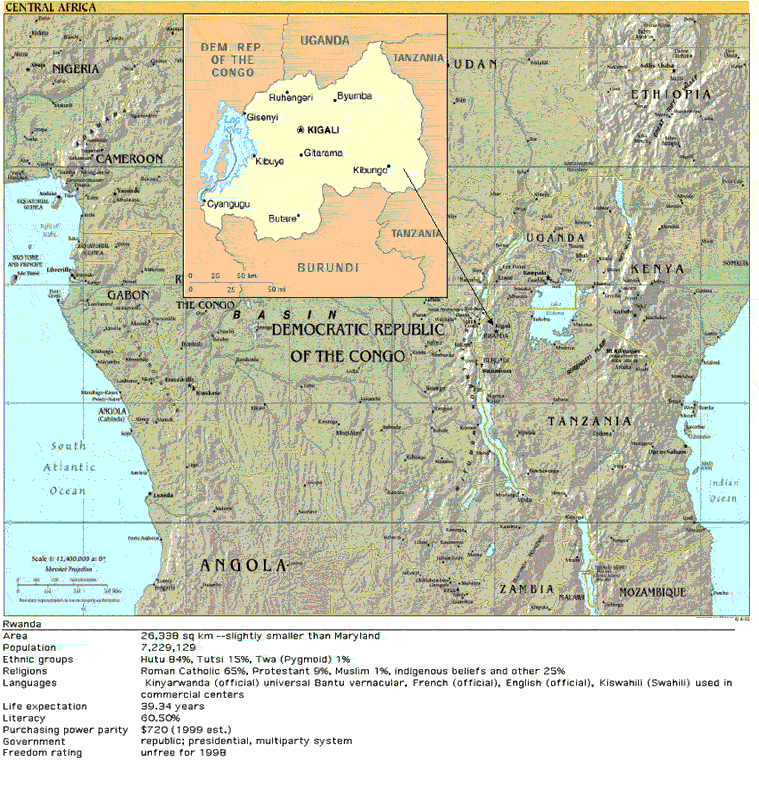
14. RWANDA TELLS SECURITY COUNCIL TO PUT THE KIBOSH ON FOREIGN FINANCING OF REBEL ACTIVITY IN EASTERN CONGO

Anita Powell at the Associated Press reports that Rwandan Foreign Minister Rosemary Museminali told reporters following a meeting of UN Security Council representatives in Rwanda that:
"There are movers and shakers (of the [Hutu opposition group FDLR]) in Europe and the rest of the world. We believe they should be sanctioned, we believe they should be dealt with, if we are to support the peace process in Congo."
Rwandan forces joined the Congolese in a joint military action against rebel Hutu forces in eastern Congo in late January--see Daily Sources 1/23 #9. In that offensive, a rebel Rwandan Powell reports that in 2006 the US imposed sanctions on businessmen and "warlords" who were allegedly financing instability in eastern Congo, near the Rwandan border.


In November, Angola had reportedly sent troops to help Congolese forces combat rebels in the region, but it apparently took the active cooperation of the Rwandan government to make any serious progress--see Daily Sources 11/10 #8.

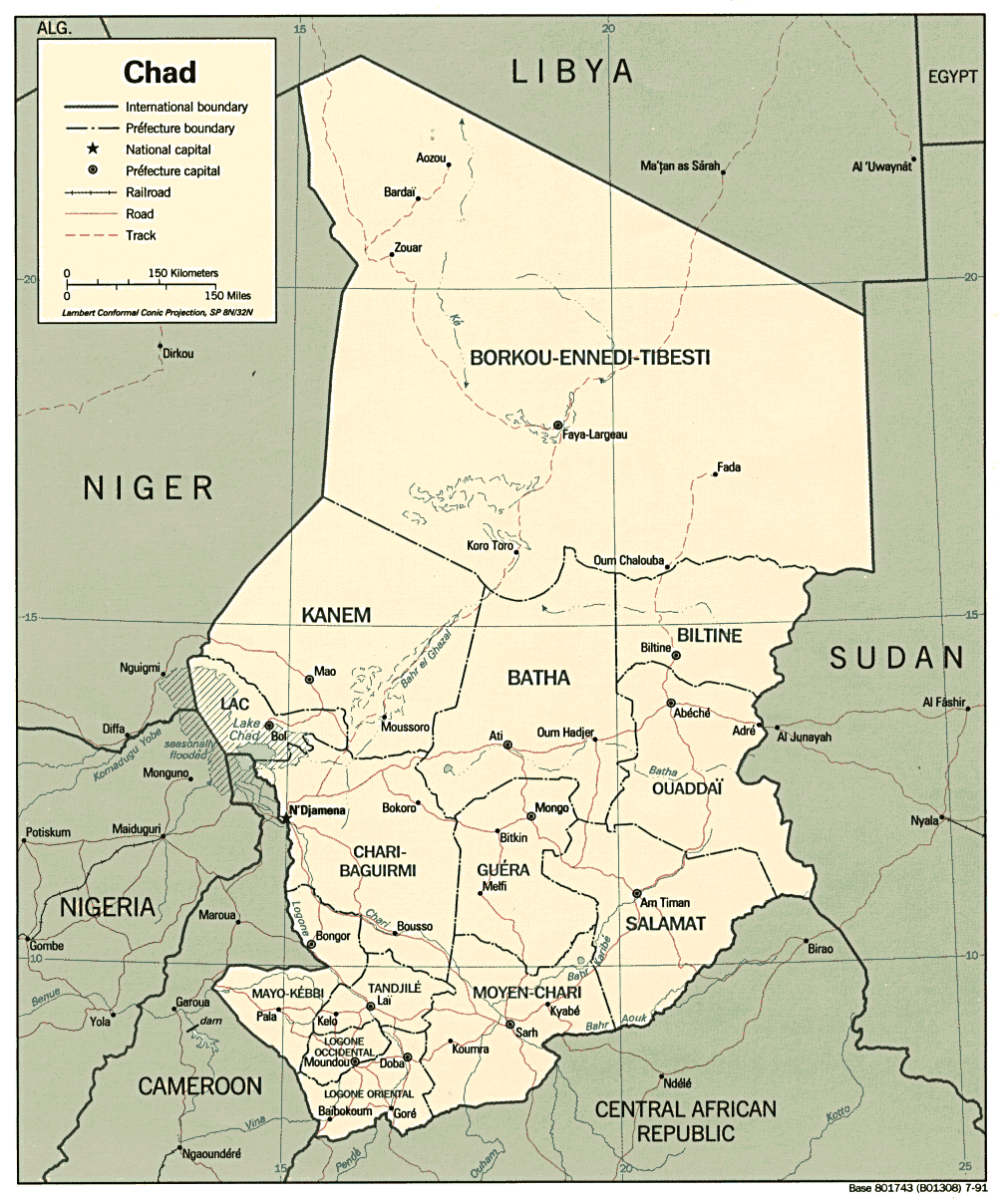
15. CHAD ENDS AIR STRIKES INTO SUDAN, SUDANESE REBEL APPEARS BEFORE THE ICC

Dany Padire at the Associated Press reports that Chad's interim defense minister, Adoum Younousmi, told the media that N'Djamena had ended air raids against Chadian rebel groups operating out of Sudan Sunday. Younousmi said,
"Our target was not the Sudanese government and less so the general population. Our objective was the Sudanese mercenaries wherever they were to be found, without causing any collateral damage."
The recent air attacks were the first attacks into western Sudan proper, where rebels have allegedly been operating, and whom N'Djamena has alleged Khartoum supports.

"Eastern Chad is a temporary home to about 300,000 refugees who have fled Sudan's Darfur conflict. The region also has camps for 187,000 Chadians displaced by fighting locally and in Darfur."
Younousmi said that the raids had destroyed seven pockets of rebels and that around 100 prisoners had been captured by ground forces operating in conjunction with the air attacks. In the meantime, BCC reports that a former member of the Darfur rebel group, the Justice and Equality Movement (JEM), Bahr Idriss Abu Garda has voluntarily appeared before the International Criminal Court to address charges of crimes against humanity leveled against him. (JEM is an Islamist group fighting the central government.) He is charged with taking part in an attack with killed 12 African Union peacekeepers in northern Darfur.


Mr. Abu Garda has since left JEM to form his own rebel movement, the United Resistance Movement. A spokesman for Mr. Abu Garda has argued that the charges against him are the result of fall out between him and JEM. The President of Sudan, Omar Hassan al-Bashir was charged with war crimes by the ICC in March and promptly expelled aid groups working in the Darfur region in response--see Daily Sources 3/6 #5.

16. NORWEGIAN PARLIAMENTARY VOTE ON CANADIAN OIL SANDS PARTICIPATION PUT OFF

Wojciech Moskwa and Terje Solsvik at Reuters report that the Norwegian government has delayed a parliamentary vote on whether StatOilHydro should withdraw from a $2 billion investment in Canada's oil sands.
"The oil sands issue has put the government in a bind four months before a general election, with political opponents saying state support for the oil sands project was hypocritical given the cabinet's self-professed environmental ambitions."
17. OBAMA ADMINISTRATION TO PROPOSE NEW NATIONAL CAFE STANDARDS

John M. Broder at the New York Times reports that the Obama Administration is set to announce as early as Tuesday new regulations for the emissions and mileage of cars and light trucks which will combine California's new auto-emissions rules with the existing corporate average fuel economy (CAFE) standard to create a single new national standard.
"Under the new standard, the national fleet mileage rule for cars would be roughly 42 miles a gallon in 2016. Light trucks would have to meet a fleet average of slightly more than 26.2 miles a gallon by 2016."
This is a big deal. Transportation accounts for about 60% of US oil consumption.

18. INDUSTRIAL REVOLUTION CAUSED BY CHEAP ENERGY, EXPENSIVE LABOR

In an extremely interesting piece, Robert C. Allen on Friday posted an article asking why the Industrial Revolution took place in England at Vox EU. His answer:
"The famous inventions of the Industrial Revolution were responses to the high wages and cheap energy of the British economy. These inventions also substituted capital and energy for labor."


It was difficult to transfer the technologies to places where either coal was expensive or labor was cheap. A must read. Note, just now many analysts expect the West, and the world, to enter a period where energy is expensive and labor is cheap.

Friday, March 6, 2009

Daily Sources 3/6

1. Eurointelligence reports that credit default swaps for Austria traded yesterday at 264 basis points (2.64%), "meaning it costs €264,000 to insure €10m worth of Austrian bonds."
"Austria’s CDS are trading higher than Italy’s CDS. This has not yet translated into actual bonds spreads, which Austrian bond yields trading at 4.2%, while Greek bonds are at 5.8%. But sharp movements in the CDS are often an early warning of a change in bond rates. This is one to watch out for."
Meanwhile, Simon Johnson at Baseline Scenario points out that credit default swaps for major American banks have spiked again to levels not seen since mid-October.


American Express CDSs traded yesterday at 652.2. Johnson, a credible interpreter of markets being the former chief economist of the IMF and a professor at MIT, comments:
"The events of mid-September 2008 were traumatic and awful to behold. I saw that trailer and I don’t want to see the movie. But it is exactly into that scary future that we now head."
Worth reading in full. Rebecca Wilder at News N Economics points out that a recent OECD study shows that the fall in house prices in Europe has not passed through to construction as of yet.


European household consumption does not account for as large a share of GDP as it does in the US, and thus the cascade effects of rising debt to equity ratios on consumption and thus GDP should be less pronounced, if I understand correctly. However, construction will still get hit--and Ms. Wilder reports that German construction is already less than 6% of GDP, a historic low. Worth a look.

2. Charles Hawley at Der Spiegel reports that most observers in Germany believe that Chancellor Merkel's "grand coalition" is beginning to fray as the parties head into campaign mode. Not particularly good news given that international cooperation will thus be complicated.

3. Brad Setser at Follow the Money has a graph of Russian estimated treasuries and agencies holdings on the news yesterday that Moscow banned its wealth funds from investing in foreign government agencies--see Daily Sources 3/5 #4.


Setser comments:
"Russia’s sovereign fund was always quite conservative. Or at least its external portfolio was always managed fairly conservatively. It was primarily a fiscal stabilization fund, not an endowment fund — so this made some sense. Its existing guidelines implied that it couldn’t buy much of anything other than Agencies and Treasuries. Before the current crisis, Russia was planning to lift those restrictions so that its 'future' fund could take on a bit more risk to try to eke out higher returns. But the world has changed. And now even government-backed Agencies are too risky."
Emma O’Brien at Bloomberg reports that the ruble has not lost much value since Moscow gave notice to its banks that it would take a dim view of banks using bailout money to speculate against the ruble--see Daily Sources 2/9 #8.
"[Bank Rossii] purchased a net $862 million and €99 million (~ $125 million) in February, after selling a net $178 billion and €24 billion in the previous six months, it said yesterday. Bank Rossii’s Ulyukayev said last month the central bank will confine the ruble to a 39 to 41 trading range versus the basket in the first quarter, in an interview with Reuters."
Glenn Kessler at the Washington Post reports that Secretary Clinton will meet with Russian Foreign Minister Sergey Lavrov in Geneva today.
"In [an] NPR interview today, Clinton cast the overtures to Russian as part of a larger effort to engage antagonists such as Syria and Iran. 'We have a sense of urgency in the Obama administration,' Clinton said. 'We believe that there are a lot of challenges and threats that we have inherited that we have to address. But there are also opportunities. We are being extremely vigorous in our outreach because we are testing the waters, we are determining what is possible, we're turning new pages and resetting buttons. We are doing all kinds of efforts to try to create more partners and few adversaries.'"
Mark Landler at the New York Times reports that at a town hall meeting at the European Parliament today Secretary Clinton described Europe as "an essential partner" for the US in fighting climate change, terrorism, and the financial crisis.
"In her session at the European Parliament, the assembly’s president, Hans-Gerd Pöttinger, praised Mrs. Clinton, saying she sounded 'like a European.' The election of Mr. Obama, he predicted, would allow the administration to 'restore your country’s influence and its standing around the world.'"
Meanwhile, Secretary Clinton may have gone a bit overboard while declaiming that in regards to climate change, "we are long overdue in stepping up" and that "the United States has been negligent in facing up to its responsibilities." While I agree that climate change is a critical and pressing issue, the EU has passed quite a lot of laws to address the change, but its net carbon output isn't falling--and it is not clear that the current crisis will permit particularly strong actions in this arena.

4. Winnie Lee at Platts reports that in January, Chinese crude imports fell by 10.8% from December as imports from Angola and Iran grew by 50%.


Historically, there have often been large changes in suppliers share of China's crude import market. However, it is possibly significant that Sudan's exports to China fell by 56.2% from December as the ICC was heading for a decision--though I think it is unlikely. It is very notable that Brazil's crude exports have gone from basically nothing to 88 kb/d--almost 3% of total Chinese imports. NICOMEX reports that Petrobras concluded a deal with Beijing today to supply 100-160 kb/d. It is in the process of negotiating a $10 billion loan with China. It was earlier reported that the $10 billion loan had already been agreed to--see Daily Sources 2/19 #1.) It is also interesting that Venezuela is not even among the top 10 exporters to China in January.

The large number from Iran indicates that the country is likely cheating on its OPEC quota, which is more or less what everyone pretty much thought in the first place. Xinhua reports that the primary reason behind China's drop in imports is that most of the available storage is full, thus complicating its effort to purchase as much crude and products as it can in the current low price environment.

5. Stephanie McCrummen and Colum Lynch at the Washington Post report that president Omar Hassan al-Bashir has responded to the ICC warrant by expelling foreign aid groups from Sudan. Meanwhile, Bashir has moved to consolidate his political position domestically, framing himself as an anti-colonialist, saying, "We have refused to kneel to colonialism, that is why Sudan has been targeted." Ironically, Bashir was a major player in Chinese colonialism in Sudan, helping to bring its oil corporations in. Crowds yelled "Down, Down USA!" even though the US is not a party to the ICC.

6. Juan Cole at Informed Comment reports that former Iranian president, Ayatollah Akbar Hashemi-Rafsanjani met yesterday with Grand Ayatollah Ali Sistani in Najaf. "Sistani is said to have expressed concern about violence by extremists from both the Sunni and the Shiite side. Sistani declined Rafsanjani's invitation to visit Iran."

7. Samuel Cisnuk at UPI reports that Iraqi Prime Minister al-Maliki has put his support behind a two-pronged oil development strategy, which envisions rather incredible production increases:
"A plan has been drafted to boost Iraq's 2.4 mb/d crude-production capacity by 500 kb.d within six months, to 4 million bpd in two years and 6 million to 8 mb/d by 2013, relying in the first two phases mainly on domestic competencies and a recreated Iraqi National Oil Co. and a Supreme Petroleum Council.

The two-pronged plan means that development will be launched immediately on some of the fields that are simultaneously being tendered to IOCs in the ongoing licensing rounds, muddying the waters considerably. The plan has been launched to weaken the Oil Ministry, and the creation of an SPC will take much of the ministry's political steering power away and hand it to Iraq's political factions."
The Oil Ministry is regarded by many as a catspaw of the US government. The government's production plan is extremely optimistic, perhaps even manic. (h/t Jim Lobe's Iraq Oil Report.)

8. Robert Mackey at the Lede reports that Mullah Omar, leader of the Taliban, recently issued a letter calling upon the organization's members to halt attacks in Pakistan itself:
"Attacks on the Pakistani security forces and killing of fellow Muslims by the militants in the tribal areas and elsewhere in Pakistan is bringing a bad name to mujahedeen and harming the war against the US and NATO forces in Afghanistan."
Well worth reading in full.

9. John F. Burns at the New York Times reported yesterday the UK was to reestablish direct contact with Hezbollah in Lebanon.
"'It’s an interesting and positive development,' Paul Salem, the director of the Carnegie Middle East Center in Beirut, said of Britain’s move. 'Once the US starts talking with Syria and Iran, Hezbollah will be a difficult issue, and Britain’s opening up a direct channel with Hezbollah now could help defuse that.'"
10. Nariman Gizitdinov at Bloomberg reports that Kazakh President Nursultan Nazarbayev in his annual address at Astana promised to spend 600 billion tenge ($4 billion) in oil revenues to stimulate the economy. Nominal 2008 Kazakh GDP was about $141.2 billion, and the government has already announced it plans a 2.2 trillion tenge (~ $14.6 billion) plan (a little more than 10% of GDP). Oil revenues are thus expected to account for about 27% of the total stimulus budget.

11. Matthew Walter and Daniel Cancel at Bloomberg have a summary of recent moves by Chávez to nationalize basic foodstuff manufacturers, like Cargill earlier this week and Polar.
"National Guard troops occupied a rice mill owned by Mendoza’s company, Empresas Polar SA, last week, and Chávez directly warned Mendoza, 43, whose family has a net worth of $5 billion according to Forbes magazine, that he is now in the government’s cross hairs.

'You can’t work beyond the law, Mendoza,' Chávez said during a televised March 4 cabinet meeting, where he alleged the company was evading rules that require it to produce food at government-set prices. 'We could expropriate all of Polar’s plants.'"
If the government decides to expropriate Polar's assets, it will not offer cash as it has in past nationalizations, but rather bonds.
"In his latest crackdown, the president sent troops into rice mills to verify whether they’re complying with government regulations on production of price-controlled foods. The government began the process this week of seizing a rice plant owned by Cargill Inc., the biggest US agricultural company.

'We can’t allow monopolies like Polar,” Chávez said yesterday. 'That’s why we’ve ordered the intervention and possible expropriation of the plants, just like Cargill.'"
Well worth reading in full.

12. Sudeep Reddy at Real Time Economics reports that the Bureau of Labor Statistics announced that the official employment rate climbed to 8.1% in February, up from 7.6% in January. The broader employment category--U6--rose to 14.8%.
"We’ve already blown through the prior high point of the data series, which the Bureau of Labor Statistics started in 1994. An even broader (since discontinued) series hit 15% in late 1982, and we’re likely to fly right through that one next month."


Justin Fox at the Curious Capitalist posts a graph of the unemployment rate in the current slowdown versus previous recessions:


"What I get from the chart ... is that job losses from this recession are now worse than in 1981-1982, which is generally considered to have been the most severe economic downturn in the US since the Great Depression. Barring a more or less unimaginable turnaround in the month or two, they will be much worse. Just look at how steep that brown line is!"

Tuesday, February 17, 2009

Daily Sources 2/17

1. Hiroko Tabuchi at the New York Times reported on Monday that the Japanese government announced that GDP had shrunk by 3.3% in the fourth quarter from the third. The annualized rate is a 12.7% contraction.

2. Eurointelligence reports that Le Monde has a story on the recent four country tour of the Austrian finance minister, Josef Pröll, to Bucharest, Sofia, Kiev and Zagreb in support for a €150 billion plan to support the eastern European economies. He has been arguing that the Austrian financial sector is solvent. However, as Yves Smith at Naked Capitalism notes, Austrian banks have apparently lent as much as €230 billion, or 70% of Austrian GDP, to the ex-Soviet bloc. She quotes at length from a piece by Ambrose Evans-Pritchard at the UK Telegraph:
"Stephen Jen, currency chief at Morgan Stanley, said Eastern Europe has borrowed $1.7 trillion abroad, much on short-term maturities. It must repay–-or roll over-–$400 billion this year, equal to a third of the region's GDP. Good luck. The credit window has slammed shut. …

'This is the largest run on a currency in history,' said Mr Jen.

In Poland, 60% of mortgages are in Swiss francs. The zloty has just halved against the franc. Hungary, the Balkans, the Baltics, and Ukraine are all suffering variants of this story. As an act of collective folly – by lenders and borrowers – it matches America's sub-prime debacle. There is a crucial difference, however. European banks are on the hook for both. US banks are not.

Almost all East bloc debts are owed to West Europe, especially Austrian, Swedish, Greek, Italian, and Belgian banks. En plus, Europeans account for an astonishing 74% of the entire $4.9 trillion portfolio of loans to emerging markets. …"
Ms. Smith reports that the Austrians are allegedly confident that Berlin will bail them out. Meanwhile, today Eurointelligence reports that the Narodowy Bank Polski said it was difficult to justify entering the European monetary union, pushing the zloty to its lowest level since joining the EU, and presumably exacerbating the losses of those banks invested in the country. Laura Cochrane at Bloomberg reports that emerging-market stocks today took a beating on the growing fears around the eastern European economic troubles, led by eastern European mining and financial companies.

3. Andrei Batrak, Martin Doerry, Christian Neef and Matthias Schepp of Der Spiegel conducted an interview of Russian foreign minister Sergei Lavrov recently, where he evinced optimism regarding US-Russian relations. In part his optimism is an outgrowth of the crisis; apparently in his view wealth created the luxury for certain conflicts to bloom:
"Lavrov: We can no longer afford the luxury of little geopolitical games, because we all face challenges that directly affect our citizens. So we should no longer ideologize problems, we should instead honestly express our own national interests, understand the legitimate interests of our partners, and have no more hidden agendas, where one thing is said while something else is done behind someone's back. The signals that we are receiving indicate that our Western partners are aiming for the same objectives."
He also indicated that Russia has already agreed to allow the transit of supplies to US troops in Afghanistan, though I infer that Moscow may look for some further quid pro quo for permitting the transit of munitions.
"SPIEGEL: Let's look ahead. The war in Afghanistan is the greatest foreign policy challenge that the new US administration faces. Russia must also have an interest in preventing the West from failing in the Hindu Kush. How can you help?

Lavrov: In April 2008, we signed an agreement with NATO concerning the transit of nonmilitary goods over Russian territory to Afghanistan. Up until now, such agreements have only been made with Germany and France, and recently one was concluded with Spain. In late January, the US asked us to apply the NATO agreement as the basis for supplying the American contingent. We immediately consented and have also agreed with NATO to make Russian military transporters available to the peacekeeping troops in Afghanistan. We could also work more closely together to curb drug trafficking."
Lavrov was Russia's Ambassador to the UN from 1994 until he was appointed Foreign Minister in 2004 by Vladimir Putin. Worth reading in full.

4. Pamela Constable at the Washington Post reports that Islamabad has announced it has agreed with the Taliban to introduce sharia courts into the Swat valley.
"'There was a vacuum . . . in the legal system. The people demanded this and they deserve it,' said Amir Haider Khan Hoti, chief minister of the North-West Frontier Province. The new system will include an appeals process, something the Afghan Taliban justice system did not allow for."


Jane Perlez at the New York Times reports that the new accord puts into effect agreements made by Benazir Bhutto in the early 1990s and Prime Minister Nawaz Sharif in 1999. The agreements to put in place sharia courts had never been honored. Despite the clear desire for a means of legal redress of issues, the lawyers movement appears to regard the decision as a jurisdictional challenge.
"'This means you have surrendered to a handful of extremists,' said Athar Minallah, a leader of a lawyers’ movement that has campaigned for an independent judiciary. 'The state is under attack; instead of dealing with them as aggressors, the government has abdicated.'"
That said, historically the modern nation state was been built in part via competing jurisdictions, and the general desire for rule by law is something that it is in the US interest to encourage. (see The Law in Pakistan.) That said, the Associated Press reports that NATO immediately criticized the decision, with spokesman James Appathurai saying:
"It is certainly reason for concern. We should all be concerned by a situation in which extremists would have a safe haven. Without doubting the good faith of the Pakistani government, it is clear that the region is suffering very badly from extremists and we would not want it to get worse."
5. India's Economic Times reports that today Russia and China signed a $25 billion energy deal whereby Beijing would lend $15 billion to Rosneft and $10 billion to Transneft in return for 20-years supply of 300 kb/d.
"Russian crude will be supplied through a long-delayed pipeline project agreed to late last year. The pipeline, which extends from western Siberia to the Pacific coast, is to be linked to China from the Siberian city of Skovorodino, 70 kilometers (44 miles) north of the Sino-Russian border."
The deal is very similar to the $6 billion loan CNPC provided Rosneft to purchase remaining Yukos assets in 2005. Meanwhile, Michelle Wiese Bockmann at Lloyd's List reports that Lukoil Trading and Shipping Supply chief executive Gati Al-Jebouri told journalists that the company expects to supply more crude to the international markets, given a reduction in domestic consumption.

6. Carola Hoyos at the Financial Times reports that Christophe de Margerie, Total SA CEO, told the media that he doesn't believe the world will ever be able to produce more than 89 mb/d of oil. It was not clear from the story whether Mr. Margerie included biofuels or NGLs in his definition of oil. He noted that in the current financial environment, national oil companies--which control about 70% of the world's proven reserves--will have a hard time financing new investments. He expects more than 1.5 mb/d of potential supply from the Canadian oil sands and Venezuelan Orinoco belt to have been shut in by low prices. Hoyos implies that Margerie expects prices to rebound in the medium term, which make some sense of his decision to focus on development in Venezuela as opposed to Brazil as per reports on Friday. (see Daily Sources 2/13 #9.) Meanwhile, Simon Romero at the New York Times reports that Hugo Chávez's referendum to abolish presidential term limits passed over this weekend. If the economic indicators recently published by the Center for Economic and Policy Research are facts, then it is easy to see why.
"- The current economic expansion began when the government got control over the national oil company in the first quarter of 2003. Since then, real (inflation-adjusted) GDP has nearly doubled, growing by 94.7% in 5.25 years, or 13.5% annually.
- Most of this growth has been in the non-oil sector of the economy, and the private sector has grown faster than the public sector.
- During the current economic expansion, the poverty rate has been cut by more than half, from 54% of households in the first half of 2003 to 26% at the end of 2008. Extreme poverty has fallen even more, by 72%. These poverty rates measure only cash income, and does take into account increased access to health care or education.
- Over the entire decade, the percentage of households in poverty has been reduced by 39%, and extreme poverty by more than half.
- Inequality, as measured by the Gini index, has also fallen substantially. The index has fallen to 41 in 2008, from 48.1 in 2003 and 47 in 1999. This represents a large reduction in inequality.
- Real (inflation-adjusted) social spending per person more than tripled from 1998-2006.
- From 1998-2006, infant mortality has fallen by more than one-third. The number of primary care physicians in the public sector increased 12-fold from 1999-2007, providing health care to millions of Venezuelans who previously did not have access. - There have been substantial gains in education, especially higher education, where gross enrollment rates more than doubled from 1999-2000 to 2007-2008.
- The labor market also improved substantially over the last decade, with unemployment dropping from 11.3% to 7.8%. During the current expansion it has fallen by more than half. Other labor market indicators also show substantial gains.
- Over the past decade, the number of social security beneficiaries has more than doubled.
- Over the decade, the government’s total public debt has fallen from 30.7 to 14.3% of GDP. The foreign public debt has fallen even more, from 25.6 to 9.8% of GDP.
- Inflation is about where it was 10 years ago, ending the year at 31.4%. However it has been falling over the last half year (as measured by three-month averages) and is likely to continue declining this year in the face of strong deflationary pressures worldwide."
The source primarily used in the CEPR paper is the Banco Central de Venezuela. That said, the paper argues that one shouldn't look at the time prior to the government's reorganization of PdVSA as a guide to economic performance. Perhaps, but Caracas can only loot PdVSA for so long--consumption driven growth provided by subsidies via oil revenues and nationalizations can only run as long as production remains normal and there are remaining oil companies willing to make large investments in the country. The nationalization of a national oil company's project would probably put an end to any international interest whatsoever.

Joshua Partlow at the Washington Post has an especially interesting article emphasizing the legal nature of the leftist turn in South America.
"[F]rom the Venezuelan charter in 1999 to the new constitutions in Ecuador last year and Bolivia last month, a team of Spanish legal scholars influenced the conception, drafting or implementation of the documents, which have stirred domestic class tensions and harmed relations with the US government. The leader is Roberto Viciano Pastor, an author and constitutional law professor at the University of Valencia whose technical, and some say ideological, assistance in writing the constitutions is generating new scrutiny across South America."
The effort to win political dominance via democratic appeals to revamp the legal landscape--whatever the criticisms of the protagonists and their true intentions--demonstrates an interest in legitimizing change via established rule of law, and in itself should be encouraging. Partlow quotes Brazilian president Luiz Inácio Lula da Silva who said last month:
"What we have achieved in these last years was, in truth, the result of the deaths of many people, many young people, who decided to take up arms to bring down the authoritarian regimes in Chile, in Argentina, in Uruguay, in Brazil, in almost all the countries. They died, and we are doing what they dreamed of doing--and we have won this by democratic means."
Vis-a-vis the on-going struggle with Exxon-Mobil, Platts reports that Exxon today announced it had a 103% replacement rate for oil produced in 2008. Most of those bookable barrels come from Canada's oil sands--which require expertise to exploit similar to what is found in Orinoco. But, in news consistent with Mr. Margerie's predictions, Matthew Cook at Platts reports that federal agency Statistics Canada announced over the weekend that Canadian oil production fell 3.31% to average about 2.68 mb/d in 2008.

Meanwhile, Spencer Swartz at Dow Jones reports that IEA chief Nobuo Tanaka told reporters:
"If OPEC is aiming at rapid increases by cutting supply maybe it would not be good for economic recovery. We think OPEC countries should take a closer look at the market and make a flexible decision."
And Luke Pachymuthu at Reuters reports that Iraqi Oil Minister Hussain al-Shahristani told journalists that OPEC should make further cuts should prices not recover. Such noise should be taken with more than a grain of salt, given that Iraq is not subject to OPEC supply quotas.

7. Shobhana Chandra at Bloomberg reports that the Federal Reserve Bank of New York’s general economic index fell to minus 34.7% in January from minus 22% in December. The index measures manufacturing activity in New York.

8. Phred Dvorak at Real Time Economics posts the extremely worrisome story that Littler Mendelson, a leading employment-law law firm consulted on roughly half of all layoffs in the US, is currently working on roughly an additional two million layoffs this quarter.
"Applying his admittedly unscientific methodology, Mr. Mathiason estimates the US could lose around three million jobs from January through March, or one million a month."
Worth reading in full.