Showing posts with label NATO. Show all posts

Tuesday, August 3, 2010

Daily Sources 8/3

NETHERLANDS TO LEAVE NATO

Robert H. Reid at the Washington Post reports that the Netherlands became the first NATO country to withdraw its troops from Afghanistan this Sunday.
"Canada has announced that it will withdraw its 2,700 troops in 2011, and Polish President Bronislaw Komorowski has promised to pull out his country's 2,600 troops the year after."
EURO ZONE MANUFACTURING PMI WAS 56.7 IN JULY

Prieur du Plessis at Investment Postcards from Cape Town reports that
"The Euro Zone Manufacturing PMI of 56.7% for July released by Markit yesterday was even better than the earlier flash estimate of 56.5% − a number that surprised on the upside. Despite all the gloom and doom about the prospects for the euro zone, growth of both manufacturing production and new orders accelerated to the fastest growth since April while employment rose at its fastest rate in 26 months."
For a table of PMIs and their trends, click on the link.

CHINA'S US DOLLAR HOLDINGS NOT OUR PROBLEM

Yves Smith at naked capitalism pours cold water on the notion that Chinese holdings of large amounts of US dollar reserves is somehow the US's problem.

KUWAIT COMFORTABLE WITH $75 - $85 /B OIL

Bloomberg reports that Kuwait is comfortable with oil prices in between $75 and $85/b.
"'We are satisfied with the range of $75 to $85,' Sheikh Ahmad Al Abdullah Al Sabah said in Moscow on Tuesday. 'We don’t anticipate any cuts but we do encourage other OPEC countries to be more compliant.'"
MANUFACTURING PMIs FOR EMERGING ECONOMIES POINT TO GROWTH SLOWING

Prieur du Plessis at Investment Postcards from Cape Town notes that "the Markit Manufacturing PMIs for emerging economies generally point to growth slowing in the manufacturing industries in the respective countries." For a table of PMIs and their trends, click on the link.

TREASURY SECRETARY SAYS THE RECOVERY IS WITH US

Treasury Secretary Timothy Geithner has an op-ed at the New York Times entitled Welcome to the Recovery. My guess is that its more than a tad premature, but it's worth reading.

CONSUMER SPENDING STAGNATED IN JUNE

Timothy R. Homan at Bloomberg reports that consumer spending stagnated in June, with purchases unchanged after a revised downward increase of 0.1% in May. The savings rate increased to 6.4%.

PENDING HOME SALES FELL BY 2.6% IN JUNE

Peter Boockvar at the Big Picture reports that "[a]fter dropping a whopping 30% m/o/m in May after the expiration of the tax credit, Pending Home Sales unexpectedly fell by 2.6% in June vs a forecasted rise of 4%."

WORLD BANK PAPER CONCLUDES THAT BIOFUELS NOT THE CAUSE OF GRAIN PRICE SPIKE OF 2006-2008; WORST DROUGHT IN 50 YEARS IN RUSSIA DRIVING UP GRAIN PRICES AGAIN

Renewable Energy World.com reports that a new white paper from the World Bank concludes that biofuels were not responsible for the spike in grain prices from 2006 - 2008. Although the report concludes that ethanol was a factor, it points to a number of other factors that caused the price spike, including energy prices, speculation in the futures market, and poor weather conditions in certain areaas. Meanwhile, Maria Kolesnikova at Bloomberg reports that Russia is facing the worst drought in fifty years is threatening the winter grain sowing plans.
"Wheat jumped to a 22-month high in Chicago trading yesterday, extending a 38 percent advance in July that was the biggest since 1973."

Friday, July 31, 2009

Daily Sources 7/31

1. MESSERLIN AND MAREL ARGUE THE US & EC COULD REAP GAINS BY OPENING SERVICES SECTOR

Patrick A Messerlin and Erik van der Marel at VoxEU argue that the US and the European Commission should launch transatlantic negotiations in opening the services sector as a prelude to multilateral negotiations. Key excerpts:
"Services providers are busy redesigning their strategies for coping with the ongoing economic crisis. To take the appropriate decisions, they need predictable future market access in services. Meanwhile, as many services are still highly protected, opening services markets would deliver large benefits to consumers impoverished by the crisis."
"Is there any appetite for services negotiations now? Yes. The July 2008 Signalling Conference held under the aegis of the Doha Round showed a substantial number of participants expressing strong interests in most services, offers and requests in mode 3 in many services (foreign direct investment), and even a willingness to include mode 4 (movement of natural persons, by far the most contentious part of any service negotiations) in some services.

Such a willingness to negotiate appears particularly strong in three services: business, communication, and distribution services. Together, these three services in the EC, US, and top eight countries represent almost one-third of the world GDP, a size so huge that negotiators could work on deals within as well as between these services sectors. The three services face high levels of regulatory constraints, ensuring huge economic gains in case of market opening. Finally, negotiations are made easier by the fact that business and communication services are resilient to the current crisis, while the inflationist pressures to come should make governments eager to have distribution services as competitive as possible.

Last but not least, the foreign policy dimension of the whole endeavour is crucial for Europe. Many US decision-makers are looking to Asia for good reasons (Bergsten, 2009) while Europeans have not yet fully grasped the growing importance of Asia nor captured its attention, as illustrated by the disappointing June 2009 Asia Europe Ministerial meeting on energy."
2. EUROZONE UNEMPLOYMENT UP TO 9.4% IN JUNE, CONSUMER PRICES FELL AT ANNUAL RATE OF 0.6%

Reuters reports that eurozone unemployment rose to 9.4% in June, up from a revised figure of 9.3% in May.
"The European Union’s statistics office also said on Friday that inflation in the euro area had moved much further into negative territory than forecast in July, with consumer prices falling at an annualized rate of 0.6%.

The drop raised worries about deflation and heightened expectations that the European Central Bank will maintain its loose monetary policy."
3. US OPEN TO BRINGING RUSSIA INTO NATO

Yevgeny Bendersky at the Compass reports that
"Assistant Secretary of State Philip Gordon told US lawmakers Tuesday during the House International Relations Committee hearing that the United States would consider Russian membership in NATO."
Gordon said:
"[I]f Russia meets the criteria and can contribute to common security, and there is a consensus in the alliance, it shouldn't be excluded."
Bendersky points out that some in Eastern Europe might be cold to the idea. Given that membership would freeze, so to speak, the current borders by militarily integrating the members, it may arguably provide superior protection than the current relationship. It certainly would make adventurism a much more complicated affair.

4. NIPPON OIL IN TALKS WITH SK ENERGY TO BUILD NEW REFINERY IN VIETNAM

Megumi Yamanaka and Yuji Okada at Bloomberg report that Nippon Oil Company has announced it might build a refinery in Vietnam with SK Energy Co.
"'We’ve been in talks with SK and have agreed on the need for participating in a refining project' in Asia, Nippon Oil Chairman Fumiaki Watari said in an interview in Tokyo yesterday. Vietnam is a potential location for the first venture between Japan and South Korea’s biggest refiners, and the plant may process 200-300 kb/d of crude oil, he said.

Seo Young Joon, a spokesman at SK Energy in Seoul, said he couldn’t immediately comment. Idemitsu Kosan Co., Japan’s second-largest refiner, and Mitsui Chemicals Inc. plan to spend $5.8 billion to build a 200 kb/d plant in Vietnam."
"'We know that about 25% of Japan’s refining capacity will be unnecessary in the next five years.' Watari said."
Vietnam inaugurated its first refinery this year with capacity of 148 kb/d and which is poised to supply about 30% of Vietnam's product requirement--see Daily Sources 7/28 #8. The EIA projects its total petroleum demand was about 288 kb/d in 2008. Hanoi projects GDP will grow by 5.5% in 2009, adding perhaps as much as 10 kb/d in demand this year.

5. INDIAN FIELD BEGINNING PRODUCTION TO UP INDIAN CRUDE PRODUCTION BY 25%

The Economic Times reports that Indian crude production is expected to rise by about 25% when Cairn begins pumping from the Mangla field of its Rajasthan acreage next month.
"'We are operationally ready to commence oil production in August,' Cairn India CEO Rahul Dhir said. In its various filings to the government, Cairn has indicated that production will quickly touch 30 kb/d by the end of third quarter this year and reach a plateau of 175 kb/d (8.75 million tonnes a year) in 2011. Goldman Sachs, however, has pegged the peak output at 190 kb/d (9.5 million tonnes a year)."
Using EIA projections, Indian crude production in 2008 was 693.7 kb/d. Its imports came in at 2.056 mb/d, so the Mangla field at 175 kb/d would represent about 8.5% of its import requirement. However, some of those imports are reexported as products, for example to the US--Reliance is set to restart its old Jamnagar refinery shortly, bringing another 660,000 kb/d of nameplate capacity on line. It is expected to double Reliance gasoline exports to about 170 kb/d.

6. PAKISTANI SUPREME COURT REJECTS PETITION TO TRY MUSHARRAF ON TREASON CHARGES

BBC News reports that the Pakistani Supreme Court has rejected a petition to try former President Musharraf on charges of treason.
"The court had asked him to explain his decision in 2007 to invoke emergency rule and suspend the constitution.

It has now ruled that parliament is the place to debate Mr Musharraf's actions.

Chief Justice Iftikhar Mohammed Chaudhry rejected a petition to launch a treason case against the former president.

Mr Chaudhry was himself removed from his position as a result of President Musharraf's imposition of emergency rule, but was reinstated after he resigned in August."
For more on the lawyers revolution in Pakistan, I wrote a long piece on it early last year--see The Law in Pakistan.

7. 40 DAY CYCLE OF PROTESTS IN IRAN MIRROR 1979 REVOLUTION, PRESS REPORTS OF CHINESE-IRAN MOU ON SOUTH AZADEGAN FIELD DENIED BY CNPC, US SENATE TO BAR THOSE SELLING PETROLEUM PRODUCTS TO IRAN FROM PARTICIPATION IN SPR

Michael Collins Dunn at the MEI Editor's Blog observes that the 40-day cycle in protests seen in the 1979 Iranian Revolution is being repeated in the current conflict over the elections. Juan Cole at Informed Comment has a good roundup of the recent political events in Iran. Meanwhile, Upstream Online notes that there have been stories that CNPC has signed an MOU with NIOC to develop the South Azadegan oilfield, taking a 70% stake in the field in return for covering 90% of development costs.
"However, a CNPC manager based in Beijing told Reuters today that the MoU was actually signed earlier this year and there has been no real breakthrough in talks with the oil ministry since then.

'The MoU is not a binding contract, and we are still negotiating with NIOC about specific details,' the CNPC source, who declined to be named because he was not authorized to speak to the media, told the news agency."
In the meantime, Jean Chemnick and Katharine Fraser at Platts report that the US Senate has inserted language into the Senate Energy and Water Appropriations bill [H.R. 3183] which would prohibit companies that sell gasoline and diesel to Iran from entering into contracts to fill the Strategic Petroleum Reserve.
"At least three companies fit that bill, Glencore, Shell Trading and Vitol, according to the Foundation for Defense of Democracies. In January, the three were named by DOE as suppliers to the SPR for deliveries this year. While it could not be immediately confirmed whether any of the three currently sell refined products to Iran, all of them are known active traders in oil markets throughout the world."
In June, Reliance--a private oil company in India--halted gasoline exports to Iran, apparently because they expected difficulties for their exports to the US--see Daily Sources 6/4 #8. The UAE provides about 80% of Iranian product requirements, IIRC.

8. BAHRAIN CENTRAL BANK SEIZES TWO BANKS HELD BY SAUDI CONGLOMERATES

Frederik Richter at Reuters reports that the central bank of Bahrain has seized two banks owned by major Saudi conglomerates.
"The central bank said in a statement on Thursday it had assumed control of Awal Bank, owned by Saad Group and The International Banking Corporation, a unit of the Ahmad Hamad Algosaibi and Brothers conglomerate.

The central bank said an investigation at both banks had shown a substantial shortfall in assets compared with their liabilities and that it would appoint an external administrator to identify creditors' claims and manage the distribution of the remaining assets."
9. NIGERIAN PRESIDENT ENTERS TALKS WITH 6 NIGER DELTA GOVERNORS TO PREVENT THREATENED BOYCOTT OF MILITANT AMNESTY PLAN

Platts reports that Nigerian President Umaru Yar'Adua has begun talks with six governors from the Niger Delta in an effort to avert a threatened boycott of the amnesty program for militants in the region.
"The governors of southern Akwa Ibom, Bayelsa, Edo, Delta, Cross River and Rivers states last week said they would pull back their involvement in the amnesty deal for Delta militants in protest of the federal government's plan to relocate the petroleum training college in Delta state to northern city of Kaduna.

'There is a serious misunderstanding about some of the issues raised, but the president is very concerned and has been talking with the Niger Delta governors individually,' Presidential spokesman Olusegun Adeniyi in a statement. 'The president has respect for the Niger Delta region. He did not approach the crisis in the area as a Northerner.'

The governors also had grouse against a provision in the oil sector reform bill, which they said takes away royalties due Delta communities."
Earlier this week, the Nigerian Joint Revolutionary Council--an umbrella group of militants in the Niger Delta which includes MEND--warned a company linked to a current oil minister to stop operations to express their displeasure with the plan to locate the petroleum university in the north--see Daily Sources 7/28 #9.

10. US ENVOY FOR SUDAN RECOMMENDS TAKING KHARTOUM OF TERRORIST LIST

Reuters reports that General Scott Gration, the US special envoy for Sudan, recommended to Congress that Sudan be taken off the state sponsors of terrorism list.
"'There is no evidence in our intelligence community that supports [Sudan] being on the state sponsors of terrorism list,' Gration said. 'It's a political decision.'"
"'We are actually hurting the very development things we need to do help the south become ... if they chose to secede, a viable economic state,' Gration said, noting that Washington could not bring in heavy equipment to build roads and railways.

'At some point we are going to have to unwind some of these sanctions so that we can do the very things that we need to do to ensure a peaceful transition and a state that's viable in the (south) should they choose to do that,' he added.

In its latest report, the State Department described Sudan as 'a cooperative partner in global counterterrorism efforts.'"
11. CHÁVEZ PROPOSES LAW GIVING GOVT ARBITRARY POWER TO CONTROL MEDIA

Fausta Wertz at the Compass has the best summary of the news that Hugo Chávez's administration has now proposed a set of laws which would limit broadcasting rights and would make the rather arbitrarily defined violations are punishable with prison terms.
"The proposed law ... includes all media and applies to not only owners and publishers but also reporters, freelancers and anyone making a statement that could be interpreted as (my translation) 'any person who manipulates or distorts the news, creating a false perception of facts... as long as there is damage to social peace, national security, public order, or the mental health or public morals.'

The charge carries a compulsory 2-4 year prison sentence."
Wertz includes a link to the text of the law. She notes that the UN has registered its worries regarding the proposed legislation, but projects the protest will have little affect upon the administration's decision-making process ... correctly in my view.

12. RESEARCHERS FIND THAT EFFORTS TO HALT OVERFISHING ARE SUCCESSFUL

BBC News reports that a team of researchers have released the findings of a two-year study which concludes that efforts to halt overfishing in 5 of 10 marine ecosytems have helped fishing stocks to recover.
"The authors observed: 'Some of the most spectacular rebuilding efforts have involved bold experimentation with closed areas, [fishing] gear restrictions and new approaches to catch allocations and enforcement.'

But they warned that the signs of recovery should not be interpreted by policymakers as a sign that all was well beneath the waves.

The majority of fisheries were still in trouble, and were not being managed or regulated properly.

But Dr Worm said that the team's 'watershed paper' offered a blueprint for sustainable fishing.

'It clearly shows what needs to be done to not only avoid fisheries collapse, but to actually rebuild fish stocks and ecosystems.'"
(h/t Yves Smith at naked capitalism.)

13. US GDP DOWN AT ANNUALIZED RATE OF 1% IN Q2, CHICAGO PMI INDICATES BOTTOM

The Bureau of Economic Analysis released its estimation today that Q2 GDP fell at an annualized rate of 1%. Ed Harrison of Credit Writedowns observes:
"Down 1.5% was the consensus expectation. But Q1 was revised down to minus 6.4% from 5.5%. The GDP Deflator for Q2 came in at 0.2%, which shows that disinflation risks tipping into deflation still. The dollar is weaker and the short end of the treasury curve is up massively on these data and revisions.

Also ... the 2008 numbers were revised down. Q1 2008 was revised from positive 0.9% to negative –0.7%. Q2 2008 was revised way down as well from 2.8% to 1.5%. Q3 2008 was also very negative, now –2.7%. This confirms the December 2007 recession call.

There was a $140 billion reduction in inventories in Q2. I have been saying for some time that this would set us up for lots of upside come Q3 and Q4 as the inventory purge dissipates. So, we will get a technical recovery in my opinion. The question is whether there is any underlying demand uptick behind the inventory changes. In the data ... from the BEA website, you can clearly see ... that consumers are not even spending on basic items. Spending on non-durable goods was down 2.5% annualized. That is not good."
Peter Boockvar at the Big Picture reports that the Chicago PMI was 43.4 in July, up from 39.9 in June. (PMI readings of above 50 indicate expansion; below 50 indicates contraction.) He observes:
"Inventories remained extremely lean, falling to 25.4 from 34.2, the lowest since 1949 and is the perfect set up for a sharp contribution to GDP from this area in the 2nd half of the year, led by auto’s and related sectors. The employment index rose 6.4 points to 35.3, well below 50 but at the highest level since Dec ‘08. Prices paid fell a touch. Bottom line, the data confirms the backdrop for an improvement in GDP. The degree and sustainability of the recovery will however remain in the hands of end demand, aka, predominantly the US consumer."
Rebecca Wilder at News N Economics observes that
"Households have been 'delevering' for a longer time period than previously thought--as recent as 2008 Q1, the saving rate that was reported to be essentially zero, 0.2%, is now 1.2%."
Her chart of the US savings rate (with revisions as of today):

"The BEA has 'found' that households have been in fact saving roughly 1% of their disposable income per quarter since 1995, 0.9% per quarter in 2008."
Well worth a look, as always.

Monday, June 29, 2009

Daily Sources 6/29

1. IEA REVISES GLOBAL OIL DEMAND DOWN TO AN AVERAGE ANNUAL RATE OF 0.6% FROM 2008-14

Carola Hoyos at the Financial Times reports that the IEA has cut its forecast for incremental global oil demand from 2008-14 to an average annual rate of 0.6% or 540 kb/d, bring total consumption to 89 mb/d from 85.8 mb/d.
"This latest forecast is 3.3 mb/d lower than the previous forecast for 2013 volumes. If the agency’s most pessimistic economic scenario proves correct, oil demand could contract, with consumption falling to 84.9 mb/d by 2014, it said in a report."
Managing Director Nobuo Tanaka suggested that the current environment makes forecasting especially difficult and noted that the data on which the forecast was made, for April, is already old.

2. JAPANESE LNG IMPORTS DOWN 19.6% IN MAY FROM APRIL, BUT INDUSTRIAL PRODUCTION UP 5.9% IN MAY FROM APRIL--BOTH ARE DOWN 18.8% AND 30% FROM MAY 2008, RESPECTIVELY

Jonty Rushforth at Platts reports that Japan imported 4.24 million metric tons of LNG in May, down 18.8% from May 2008 and "19.6% from April, when Japan imported 5.27 million metric tons." (The Platts story includes a table of imports by source, month over month and year over year.) It is interesting in the context of the report released Sunday by the Ministry of Economy Trade and Industry (METI) which showed industrial production up 5.9% in May from April, though still down 30% year over year, as per Jake at Econopix. Their chart:


There has evidently been a rebound in production of passenger cars, which account for about 8.5% of the industrial production index. Worth a look.

3. NDRC RAISES GUIDELINE PRICES ON DIESEL & GASOLINE (SLIGHTLY LESS IN THE SOUTH)

Bloomberg reports that the National Development and Reform Commission announced yesterday that it will raise the price of diesel and gasoline today by as much as 11%. Prices for both will be lifted by 600 renminbi a metric ton ($87.80 or roughly $11.71/b ~ $0.28/gallon).
"Today’s price increases will vary by city and region, according to the NDRC’s statement.

In Beijing, the new ceiling price per ton for the retail grade of gasoline that meets euro III standards, known as 90 octane, will be 7930 yuan a ton (~$1,162/ton ~ $136.71/b ~ $3.26/gallon), while the ceiling price in southern Guangdong province is set at 7795 yuan (~1,142/ton ~ $134.38/b ~ $3.20/gallon)."
Guangdong is the center of economic growth in China, if I understand correctly. The NDRC is raising prices in part due to the surge in demand for cars, driven by the stimulus program.

4. PBOC GOVERNOR SAYS CHINESE RESERVE POLICY WILL NOT CHANGE SUDDENLY

Stephanie Phang at Bloomberg reports that People’s Bank of China Governor Zhou Xiaochuan told journalists today that "Our foreign-exchange reserve policy is always quite stable. There are not any sudden changes." This follows the release of the bank's review on Friday, which appeared to reiterate formally the call for an alternative to the dollar--see Daily Sources 6/26 #1. Yves Smith at naked capitalism comments:
"This certainly looks like a retreat, although Zhou may simply be clarifying the difference between long term policies and immediate plans. But that still begs the question of when and how the transition between the two comes into play.

The tension may also reflect the need to posture aggressively before a domestic audience without unduly rattling markets. But it may also result from the need to appease certain interests within the government. A New York Times article last year explained that as the central bank took foreign exchange losses as the RMB rose, it may have to go hat in hand to the finance ministry, which opposes many of the central bank's policies, particularly on the dollar ...."
5. CHINA PASSES NEW STATISTICS LAW

Andrew Batson at China Journal reports that on Saturday China passed a new law to take effect next year which will stiffen penalties for falsifying social and economic data.
"Recently, officials of the National Bureau of Statistics have become more forthcoming about deficiencies in their data, and have also started publishing a more detailed accounting of economic growth. And this year’s economic census, a quinquennial attempt to obtain basic information on every company of economic significance in the nation, is the centerpiece of the bureau’s effort to build up more accurate figures through the use modern survey techniques."
Batson quotes some examples of the misreporting the government is trying to eradicate:
"* In 2001, a township government in Liaoning province in 2001 instructed the villages it oversees to report quarterly economic indicators that were precisely one-fourth of the annual target, to ensure that the target was met.

* In one town near Ningbo, Zhejiang province, a party secretary reported a total industrial output of 463 million yuan in 2001, which was later determined to be 76% more than the actual figure.

* The leaders of one town near Chongqing in 2004 altered the statistical reports of local companies they sent to higher authorities, in one case changing output of 5 million yuan to 8 million yuan, and in another adding a zero to make output of 3 million yuan into 30 million yuan.

* Over-reporting is not confined to eager officials: one company in Wenzhou, Zhejiang province reported output of 32.15 million yuan in 2003, which was then discovered to exceed the actual figure by 71%."
The post includes a number of links to sources--worth a look.

6. NATO & RUSSIA RESUME OFFICIAL TIES; RUSSIA STARTS WARGAMES IN THE CAUCASUS, A FEW WEEKS AFTER NATO WARGAMES IN GEORGIA

The Associated Press reports that NATO and Russia have resumed ties after NATO suspended them in reaction to the Georgia conflict.
"Russian Foreign Minister Sergei Lavrov met his counterparts from NATO's 28 member nations on the western Greek island of Corfu ahead of a broader informal meeting of ministers from the 56-nation Organization for Security and Cooperation in Europe.

Mr. Scheffer described the talks as 'open and constructive, which means we did not try to paper over our differences on Georgia, for example. But we agreed not to allow those agreements to bring the [NATO-Russia Council] to a halt.'

He said the renewed military contacts would involve meetings of the chiefs of staff of Russia and NATO countries.

The meeting in Corfu, which came as President Barack Obama and Russian President Dmitry Medvedev prepare to hold a summit next week, reflected the trend toward improved relations with Russia."
Meanwhile, Michael Schwirtz at the New York Times reports that Russia has begun war games using 8,500 troops from all branches of the armed services in the Caucasus region.
"The event is also occurring a few weeks after NATO concluded its own exercises in Georgia, drawing complaints from the Russians.

'The Russian exercises, given the timing, are a definitive response,' said Dmitri O. Rogozin, Russia’s envoy to NATO, Interfax reported. 'We are conducting them to ensure the defensive capabilities of Russia in those areas where we see threats.'

Georgia on Monday expressed worry about Russian exercises so close to its borders.

'These exercises are a source of concern because they involve an unprecedented number of servicemen and the newest military hardware of Russia,' said Alexander Nalbandov, Georgia’s deputy foreign minister, Interfax reported. 'We hope that the events of last August, when the Russian army invaded Georgia and occupied its lands, will not repeat.'"
7. GAZPROM SEALS PURCHASE OF 500 MILLION CU M OF NAT GAS FROM AZERBAIJAN IN 2010, SAYS IT WILL RECEIVE PREFERENTIAL TREATMENT ON SHAH DENIZ GAS

Lyubov Pronina and Lucian Kim at Bloomberg report that Russian President Medvedev sealed a deal in Baku today for Gazprom to purchase 500 million cubic meters of natural gas from Azerbaijan next year.
"Gazprom will get priority treatment when the State Oil Co. of Azerbaijan determines the buyers for the [Shah Deniz] offshore field, said Alexei Miller, chief executive officer of the Russian company. Azerbaijan’s gas production will rise 11% to 30 billion cubic meters next year, Aliyev said."
Shah Deniz is a key source of potential supply for the Nabucco pipeline project--the alternative possibility of sourcing from Iran looks particularly politically difficult at the moment.


This follows the news Friday that former German foreign minister Joschka Fischer has been signed on as a consultant to Nabucco--see Daily Sources 6/26 #3.

8. INDIAN REFINERS RUN 2.4% MORE CRUDE IN APRIL, DOWN 4.3% FROM MAY 2008

Vandana Hari at Platts reports that Indian refiners ran 12.77 million metric tons (~3.02 mb/d) of crude in May, up about 2.4% from April, but down 4.3% from May 2008.
"The utilization rate against the country's total installed refining capacity was 102.5% in May, versus 107.1% a year ago.

Between January and May, Indian refiners have run around 65.57 million metric tons of crude, roughly 1.5% lower from a year ago. The trend contrasts with a 3.6% year-on-year increase in 2008 crude throughput over 2007."
Reliance started operating the Jamnagar addition of 500 kb/d capacity on Christmas--see Daily Sources 1/7 #3.

9. IRAQI VP TO BOYCOTT TUESDAY AUCTION, OIL EXPORTS UP 80 KB/D IN MAY (THE ADDT'L OIL CAME FROM THE NORTH), AND THE CABINET WILL NOW DELAY RATIFICATION OF THE OIL AUCTIONS TOMORROW INDEFINITELY

Ahmed Rasheed at Reuters reports that Iraqi Vice President Tareq al-Hashemi has announced on his website that he will boycott the auction on Tuesday to award concessions for eight oil and gas fields.
"'There are many existing reservations over this vital issue concerning Iraq's oil resources,' Hashemi said in a letter, posted on his website, to Oil Minister Hussain al-Shahristani.

He urged the minister to 'hold off on awarding bids to the winning companies and give parliament enough time to study these bids,' said the letter, released by Hashemi's office."
Ben Lando at the Iraq Oil Report notes that Iraqi oil exports grew to 1.9 mb/d in May from 1.823 million in April.
"In the south, where most of Iraq’s production and exports are located, May was a down month, exporting only 1.38 mb/d compared to 1.413 mb/d in April. In the north, however, exports increased to 522.6 kb/d from 410 kb/d in April."
Meanwhile, Faleh al-Khayat at Platts reports that the oil ministry said today that it will not announce the winners of the auction tomorrow, and instead only provide the names of the bidders and a score card of their bidding parameters.
"The cabinet may refer the contracts for approval by the parliament if it
deems this as necessary, marking another new element in the process.

As a result, the August 15 deadline for contract ratification by the council of ministers has been pushed back indefinitely, senior sources close to the licensing department said.

'The winner will not be declared by the score of each bidder and the name of the bidder will be declared,' said one source.

The formula to determine the winning bid has also been changed whereby the ministry will give more weight to the incremental production rather than the remuneration fee submitted by each of the bidding companies, the sources said."
10. ISLAMIC EMIRATE OF AFGHANISTAN THINKS OBAMA IS A BIGGER THREAT TO THE JIHADIST MOVEMENT THAN BUSH

Thomas Hegghammer at jihadica reports that the main story of the July issue of the Arabic-language magazine of the Islamic Emirate of Afghanistan argues that the Obama administration is more dangerous to al-Qaeda than the Bush administration was. The primary reason is that Bush, through foolhardy policies, did much to undermine American power, in language the Obama administration has already disavowed. However, the writer argues that the policies, in effect, will not change. I couldn't agree more insofar as the writer believes that Obama will work to protect the national interest of the US, something that the Bush administration seemed to abandon. (The president's ability to wield soft power is generally more unbounded than hard power--I suggested, as did others, that Obama's credibility advantage will present the largest challenge to our enemies in a piece in March 2008:The Geopolitical Consequences of the Candidates.) Hegghammer's post is worth reading in full.

11. ISRAEL NOT TO PURCHASE LCS'S FROM LOCKHEED MARTIN

Galrahn at Information Dissemination reports that Israel has decided not to go ahead with plans to purchase a number of Lockheed Martin's Littoral Combat Ship (or LCS). Galrahn notes:
"The interesting part of this story isn't necessarily that Israel doesn't want to buy the LCS anymore, and that is a big deal. The interesting thing is that the US would fund the LCS, but not the MEKO [built by the Hamburg-based ThyssenKrupp Marine Systems (TKMS)], through FMS [the Financial Management Service bureau of the Treasury] grant money. By choosing to buy the MEKO, Israel will try to fudge the system and get some of the parts paid for by buying US, with US funding."
12. FAO POLICY BRIEF ON INTERNATIONAL INVESTMENTS IN THE AGRICULTURAL SECTOR IN AFRICA SUGGESTS CONCERN A LITTLE OVERPLAYED

Denis Drechsler and David Hallam at VoxEU argue that concern regarding foreign acquisition of African farmlands is somewhat misplaced. They note that official development assistance going to agriculture has been on a downward trend since 1995:


Key findings:
"* Investments have increased
* Deals seek access to resources, not markets
* Main form of investment: land purchase or long-term lease
* Share of total land assets owned by foreigners is small
* Major investors: Gulf States, China, Republic of Korea
* Main target region: Africa
* Investors: mostly private sector, but governments involved
* Investment partners in host countries: mainly governments
* New focus: production of basic foods and animal feed"
Worth a look.

13. HONDURAN PRESIDENT OUSTED BY MILITARY, HONDURAN SUPREME COURT AND CONGRESS SUPPORT THE MOVE, THE REST OF THE WORLD EXPRESSES CONCERN

William Booth and Juan Forero at the Washington Post report that soldiers forcibly removed President Manuel Zelaya from the Honduran presidential palace yesterday and put him on a plane to Costa Rica.
"Zelaya was removed from office as Hondurans prepared to vote Sunday in a nonbinding referendum asking them whether they would support a constituent assembly to rewrite the constitution. Zelaya's critics said he wanted to use the referendum to open the door to reelection after his term ends in January 2010, an assertion that he denied.

The referendum--which US officials described as more of a 'survey' than a true vote--was condemned by broad swaths of Honduran society as an obvious power grab. The Honduran Supreme Court called the referendum unconstitutional, and leaders of Zelaya's own party denounced the measure."


Both the Honduran National Congress and the Supreme Court voiced support for the move by the military to oust Zeyala. The Honduran military broke off contact with the US following the coup. (The Post article is worth reading in full.) Condemnation of the move was widespread, coming from the OAS to Venezuela to Cuba to the US.

15. CANADA PASSES SUBSIDY FOR PAPER SECTOR IN RESPONSE TO (ALTERNATIVE FUELS) SUBSIDY FOR US PAPER SECTOR

The Wall Street Journal's editorial board notes that in 2007 Congress extended a $0.50 credit for every gallon of a blend of traditional and alternative fuels used to a broad spectrum of corporations, and it turned out that "'black liquor,' a carbon-rich substance the paper industry has used for decades to power its mills, qualified.
"All the paper industry had to do was blend some fossil fuel in with their alternative fuel and--voila!--billions of dollars in federal subsidies were within reach. So they did."
The Journal notes that the US paper industry is set to collect $6 billion in tax credits in 2009, enough to reduce the cost of paper products by 25%.
"Not surprisingly, Canadian paper companies are miffed at this subsidized windfall to their competition. Now they've gotten their Parliament to do something about it. Following the two-wrongs-make-a-right logic of trade wars, Canadian lawmakers recently passed a subsidy worth $882 million for their domestic paper industry."
Worth reading in full.

16. BANK FAILURES UP IN US, CONCENTRATED IN GEORGIA, BUT CONSOLIDATION LIKELY HAS A WAYS TO GO

Rebecca Wilder at News N Economics reports that bank failures are up slightly in 2009 from 2008, but the sector's consolidation has yet to see the number of failures experienced during the S&L crisis. Her graph:

"Notice that roughly 20% of the bank failures in 2008 and 2009 have been in Georgia, or as Camden Fine says to the WSJ, 'Georgia is basically the Chernobyl of banking right now; it's radioactive down there'. And according to the Wall Street Journal, the failures in Georgia have only just begun ..."
Worth reading in full.

17. COLORADO PASSES NEW LAWS PERMITTING RAINWATER HARVESTING

Kirk Johnson at the New York Times reports that two new laws have been passed in Colorado which allow people with private wells to legally collect rainwater, formerly they had only been allowed to do so if they possessed the water rights on their property.
"State water officials acknowledged that they rarely enforced the old law. With the new laws, the state created a system of fines for rain catchers without a permit; previously the only option was to shut a collector down.

But Kevin Rein, Colorado’s assistant state engineer, said enforcement would focus on people who violated water rules on a large scale.

'It’s not going to be a situation where we’re sending out people to look in backyards,' Mr. Rein said.

Science has also stepped forward to underline how incorrect the old sweeping legal generalizations were.

A study in 2007 proved crucial to convincing Colorado lawmakers that rain catching would not rob water owners of their rights. It found that in an average year, 97 percent of the precipitation that fell in Douglas County, near Denver, never got anywhere near a stream. The water evaporated or was used by plants.

But the deeper questions about rain are what really gnawed at rain harvesters like Todd S. Anderson, a small-scale farmer just east of Durango. Mr. Anderson said catching rain was not just thrifty--he is so water conscious that he has not washed his truck in five years--but also morally correct because it used water that would otherwise be pumped from the ground."

Thursday, May 14, 2009

Daily Sources 5/14

1. JAPANESE OPPOSITION PLATFORM TO CONTINUE PURCHASING U.S. DEBT, BUT DENOMINATED IN YEN; ROUBINI SAYS DIFFICULT MEASURES MUST BE TAKEN IF THE DOLLAR IS NOT TO LOSE ITS POSITION AS RESERVE CURRENCY TO THE YUAN; FORMER TRANSLATOR FOR DENG XIAOPING SAYS CHINESE SENTIMENTAL ATTACHMENT TO THE DOLLAR IS ON THE WAY OUT

BBC reports that the chief finance spokesman for the main opposition party in Japan, the Democratic Party of Japan (DPJ), said in an interview with the broadcaster that Tokyo will only continue to purchase US debt if it is denominated in yen.
"However observers say that, while the move would be a remarkable policy shift, it was unlikely that Mr Nakagawa's party will win the forthcoming election, due before mid-September, despite the unpopularity of the ruling Liberal party."
Linda Sieg and Yoko Kubota at Reuters report that former DPJ leader Yukio Hatoyama announced his candidacy to lead the party after Ichiro Ozawa's resignation last week amidst a scandal in an effort to boost the party's chances of winning upcoming elections. The reporters enumerate some key elements of Hatoyama's background, including:
"Hatoyama is known less for economic policies than for his stance on security and diplomacy. He has advocated revising Japan's pacifist constitution to acknowledge the nation's right to defend itself and maintain a military for that purpose. He has also been critical of Japan's foreign and security policies for being too subservient to close ally the United States."
The so-called FACTBOX is worth consulting. Nouriel Roubini, professor at NYU made famous by his forecast accurate in many particulars of the current crisis, has an op ed in the New York Times where he dismisses arguments that the euro could replace the dollar as the world's reserve currency, instead suggesting that the renminbi is likely to take its place. Key excerpt:
"If China and other countries were to diversify their reserve holdings away from the dollar--and they eventually will--the United States would suffer. We have reaped significant financial benefits from having the dollar as the reserve currency. In particular, the strong market for the dollar allows Americans to borrow at better rates. We have thus been able to finance larger deficits for longer and at lower interest rates, as foreign demand has kept Treasury yields low. We have been able to issue debt in our own currency rather than a foreign one, thus shifting the losses of a fall in the value of the dollar to our creditors. Having commodities priced in dollars has also meant that a fall in the dollar’s value doesn’t lead to a rise in the price of imports.

Now, imagine a world in which China could borrow and lend internationally in its own currency. The renminbi, rather than the dollar, could eventually become a means of payment in trade and a unit of account in pricing imports and exports, as well as a store of value for wealth by international investors. Americans would pay the price. We would have to shell out more for imported goods, and interest rates on both private and public debt would rise. The higher private cost of borrowing could lead to weaker consumption and investment, and slower growth.

This decline of the dollar might take more than a decade, but it could happen even sooner if we do not get our financial house in order."
Well worth reading in full. Victor Zhikai Gao--executive director of the Beijing Private Equity Association and a director of the China National Association of International Studies--also has an op ed in the New York Times which points out that many Chinese actually have a sentimental attachment to the US dollar, known by many as mei jin, or "American gold." The dollar had for many years cache simply because it was illegal to hold them--the law required that all private citizens convert dollar holdings into the renminbi, and thus the notion of the dollar being "gold" long outlasted Nixon's decision to delink the dollar from the yellow metal. Key excerpt:
"Beijing recently called for a greater role in international trade for the special drawing rights currency of the International Monetary Fund. But China is also fully aware that the United States can veto an IMF decision. China’s call was more meant to sound an alarm to the United States.

Many Chinese people increasingly fear the rapid erosion of the American dollar. The United States may want to consider offering inflation-protection measures for China’s existing investments in America, and offer additional security or collateral for its continued investments. America should also provide its largest creditor with greater transparency and information.

We still call the dollar American gold. But the United States should not assume that this will never change."
2. THE IEA SAYS CHINESE GDP DATA MAY WELL BE WRONG; KEY CHINESE STATISTICIAN OUTLINES PROBLEMS WITH CHINESE RETAIL SALES DATA

David Winning at the China Journal reports that the Paris-based IEA global energy report today cast doubt on Beijing's official 6.1% GDP growth number for the first quarter, saying it didn't quite reconcile with a 3.5% drop in oil consumption.
"'Admittedly, pinpointing China’s oil demand with accuracy is an exercise fraught with difficulties, given the lack of data and the underlying assumptions analysts must make regarding stocks and refinery output from independent producers,' the IEA said in its latest report on the global oil market.

'Still, one would have expected stronger, positive oil demand growth commensurate with the reported economic resilience, unless income elasticities had drastically changed.'

The IEA floated another possibility: Real GDP data aren’t accurate and shouldn’t be taken at face value."
The IEA also mentioned a fall in electricity generation, which I noted in yesterday's Daily Sources 5/13 #2 were supposed to have fallen by as much as 4% in April after experiencing year over year declines in power generation for the last seven months. Chinese statistics have been in for a lot of rubbishing recently Andrew Batson reports in China Journal: a new essay by Xu Xianchun, a top statistician at the National Bureau of Statistics tries to explain why "one can’t simply add up China’s monthly indicators of investment and spending to get an accurate picture of gross domestic product."
"Yet many economists have long felt that the retail sales figures are not a reliable guide to China’s household consumption. Mr. Xu himself notes these well-known gaps, pointing out that the official retail sales numbers include things that cannot be considered consumer spending.

The most important are retail sales to companies and institutions, which of course are not consumers at all, and sales of construction materials for housing, which should be counted as part of household investment. Retail sales also do not include spending on services like education or health care, or rural households’ consumption of produce they grow themselves, he notes.

'Compared with retail sales, using household consumption expenditure obtained from the rural and urban household surveys is closer to consumer spending,' Mr. Xu writes.

Those measures show much slower growth than the headline retail sales figure. Mr. Xu says the bureau’s household surveys put the real growth in urban household consumption in the first quarter at 9.6%, and 9.3% for rural households. That would mark somewhat faster growth than in the second half of 2008 but somewhat slower growth than in the first half, when food prices soared, according to figures previously released by the bureau."
Worth reading in full. The National Bureau of Statistics is attempting to overhaul its data collection and publication methodologies in the face of growing criticism regarding the accuracy of their data--see Daily Sources 5/7 #2 (near the bottom of the item.)

3. PLANS TO ALLOW MAINLAND CHINESE INVESTMENT FLOWS TO TAIWAN CAUSING IRRATIONAL EXUBERANCE IN TAIWANESE MARKETS

Jonathan Adams at the New York Times reports that after announcing plans late last month to sign accords providing for cross-strait exchange in banking, insurance and access to financial markets the Taipei stock markets and dollar have been posting strong gains in the face of horrible economic data.
"[S]ince Ma Ying-jeou was inaugurated as president nearly a year ago, Taiwan has moved rapidly to forge closer commercial links with China to lift its sagging economy. In the past year, it signed deals with China on tourism, airline flights and shipping.

Investment, however, has remained a one-way street, flowing from the island to the mainland. Taiwan has invested $150 billion in the mainland since the 1980s, according to one Taiwan government estimate. Mainland China has until now been barred from directly investing in Taiwan."
For now, Beijing is capping Taiwan-bound investment at 7.2 billion Taiwan dollars (~ $219 million) leading analysts to remark that the market is likely overreacting.

4. BANK OF ENGLAND WARNS THAT RECOVERY WILL BE PROTRACTED TO 2012, LONDON COMMERCIAL RENTALS AT PRICES LAST SEEN IN 1991

Julia Werdigier at the New York Times reports that Mervyn King, head of the Bank of England, warned yesterday that "Growth has just as much chance of being positive over the next 12 months as it has of being negative."
"The central bank predicted that inflation would slow to as low as 0.4% this year and then accelerate to 1.5% by the end of 2010, revising upward an earlier forecast. But inflation is still unlikely to hit 2% by 2012, the central bank said."
2012. Mr. King said the recovery would likely be "slow and protracted." Meanwhile, Chris Bourke at Bloomberg reports that commercial rent in the city of London, the UK's main financial district, has fallen to levels last seen in 1991.
"The City already has enough empty offices to hold two- thirds of Canary Wharf, the docklands area developed 1 1/2-miles east in the 1980s to lure investment bankers. About 9 million square feet (855,000 square meters) are available in the City and that may climb to 12 million by the end of 2009, according to CB Richard Ellis Group Inc., the biggest commercial property broker. Almost 19% of all City offices may be vacant next year, analysts at CB Richard Ellis estimate."
(h/t Barry Ritholtz at the Big Picture.)

5. SPANISH GDP DOWN 1.8% IN Q1, RECOVERY COMPLICATED BY DEBT TO GDP RATIO

Edward Hugh at Fistful of Euros reports that Spanish GDP fell at a rate of 1.8% in the first quarter following a 1% contraction in the fourth quarter of 2008 which, annualized, results in a contraction of 7.2%.
"Over the first quarter of 2008 (that is year on year) GDP decreased by 2.9%, the sharpest decline recorded in almost 40 years. In fact you would need to go back to 1945 to find a year in which the Spanish economy contracted as strongly as it is likely to this year."
Hugh argues, in the very long post, that the crisis in Spain is mostly due to excessive bank lending--to get 4% annual GDP growth Spanish households and corporations were apparently increasing their borrowing by a rate of 20% per annum. Hugh concludes:
"So as I say, debt to GDP is most probably rising even now, but it is obviously going to have to come substantially down, which is why I insist on saying, this correction has hardly even gotten underway yet."
Long, but with substantial detail and worth reading given time.

6. RUSSIA PROPOSES RENEGOTIATING THE CONVENTIONAL FORCES IN EUROPE TREATY, BELARUSSIAN PRESIDENT COMPLAINS THAT RUSSIA HAS NOT WORKED FOR RENUNION, GEORGIAN OPPOSITION LEADER SAYS SAAKASHVILI IS TRYING TO CREATE AUTOCRATIC STATE

Vladimir Isachenkov at the Associated Press reports that Russian Foreign Ministry spokesman Andrei Nesterenko told the media that Moscow is proposing to renegotiate the Conventional Forces in Europe Treaty, and would honor the agreement if the changes were accepted by Washington and its NATO allies.
"The 1990 treaty limits the number of tanks, aircraft and other heavy non-nuclear weapons that could be deployed west of the Ural Mountains--the edge of European Russia. A new revised version was signed in 1999, but NATO countries have not ratified it and in 2007 Russia suspended its participation."
The West has insisted that Moscow remove troops from the breakaway regions of South Ossetia and Abkhazia as a prerequisite for reconsidering the CFE treaty. Meanwhile, Yevgeny Bendersky at the Compass reports that Belarussian President Aleksandr Lukashenko last week blamed Moscow for failing to reunite Russia with Belarus.
"'The fact that we have not progressed in constructing a federal partnership is not our fault. It is their (Russia's) fault... Who does not fulfill the contract on the construction of the Unified State? We had to hold a joint referendum on that. Why didn't we? Because the Russians did not want to,'--said Lukashenko, advising Moscow to 'look at the internal causes of turmoil in our relationship.'"
Although the Belarussian reunification with Russia would likely be regarded with serious alarm in the West, the standard take on this, if I recall correctly, is that United Russia, the party of Medvedev and Putin, doesn't particularly want Lukashenko as a political challenger for the presidency and that Moscow doesn't particularly want to bear the costs of reintegrating the Belarussian economy, which has been basically destroyed by Lukashenko.


Prime Minister Putin is, by the way, Chairman of the Council of Ministers of the Union of Russia and Belarus. Belarus was one of the nations explicitly targeted by the EU's "Eastern Partnership" initiative, which would offer better trade ties, relaxed visa rules and aid over four years for six countries neighboring Russia--see Daily Sources 5/7 #1. Meanwhile, Benjamin Bidder at Der Spiegel conducted an interview with Georgian opposition leader Salome Zurabishvili in which she calls President Sakaashvili "insane." Key excerpt:
"SPIEGEL ONLINE: But during the war between Russia and Georgia in August of 2008 you united the entire opposition in support of Saakashvili. You even forbade any criticism of the president.

Zurabishvili: That was following the national tragedy! We stood united so that we could prevent Russia from using the situation to their advantage after the war.

SPIEGEL ONLINE: Why is the opposition so set on seeing Saakashvili as the bogeyman?

Zurabishvili: There is simply no one to turn to in other state institutions because none of them have any power anymore. That's the situation in which we find ourselves. The situation is serious and very dangerous. Because if, after these peaceful protests, we don't get any results--not even a small concession--then things could get out of control, as they did on May 6th."
Zurabishvili also accuses the President of faking the mutiny at the Mukhrovani tank camp--see Daily Sources 5/5 #4--saying that he is attempting to intimidate the armed forces as opposition to his administration grows. In short, she accuses the President of trying to establish an autocratic state.

7. TURKISH CENTRAL BANK CUTS BENCHMARK RATE TO 9.25%, CONSUMER PRICES RISING AT SLOWEST RATE SINCE 1970

Steve Bryant at Bloomberg reports that the Turkish Central Bank has reduced its benchmark interest rate by 0.5% to 9.25%.
"Bank Governor Durmus Yilmaz has shaved 7.5 percentage points from the benchmark rate in seven months, joining policy makers worldwide in trying to pull economies out of recession as inflation slows. Turkish consumer prices rose an annual 6.1% in April, the slowest pace since July 1970."
Unemployment rose to 15.5% in January, the highest rate seen since records were inaugurated in 2005.

8. 735 CARGO SHIPS ANCHORED OFF SINGAPORE ON COLLAPSE IN GLOBAL TRADE, 300 OFF ROTTERDAM, 150 OFF GIBRALTAR

Keith Bradsher at the New York Times reports that as many as 735 cargo ships, some weighing as much as 300,000 dead weight tonnes, have anchored off the coast of Singapore in the Strait of Malacca on the global fall in international trade. Charles Pertwee captured a beautiful picture of the situation for the Times, illustrating the concern shipping lines have as the parked behemoths are creating an obstacle course in one of the busiest shipping channels in the world:


"The gathering of so many freighters 'is extraordinary,' said Christopher Pålsson, a senior consultant at Lloyd’s Register-Fairplay Research, the consulting division of Lloyd’s Register-Fairplay. 'We have probably not witnessed anything like this since the early 1980s,' during the last big bust in the global shipping industry.

The world’s fleet has nearly doubled since the early 1980s, so the tonnage of vessels in and around Singapore’s waters this spring may be the highest ever, he said, cautioning that detailed worldwide ship tracking data has been available only for the last five years."
Ships are anchoring off other ports too with about 300 off Rotterdam and 150 off the Strait of Gibraltar.

9. THE IEA CUTS GLOBAL OIL DEMAND FORECAST TO A 3% REDUCTION FROM 2008, WORST DEMAND REDUCTION SINCE THE OIL SHOCK OF 1981, BUT OIL INVENTORIES MAY HAVE STOPPED BUILDING

Mark Shenk at Bloomberg reports that the Paris-based IEA cut its estimate of global oil demand to 83.2 mb/d in 2009, down 3% from 2008 and the steepest fall since the oil shock of 1981. This is triple the decline forecast by the IMF in Global Financial Stability Report of a decline in oil use of 1.5%--see Daily Sources 4/22 #1. (The IMF records an oil use decline of 2.87% in 1982.) OPEC and the EIA also lowered their global demand forecasts this year. John Kingston at The Barrel gives three reasons why the global build in inventories that has happened over the last months has, in his view, probably come to an end. Key excerpt:
"Platts' Sheela Tobben reported that the volume of foreign crude sitting aboard floating storage in the US Gulf has declined to around 20 million barrels Wednesday, from 30-35 million barrels at the end of April, according to market sources. This follows sales that began last week by holders of that oil under pressure from a narrower NYMEX crude contango, a stronger WTI/Brent and the incentive provided by healthy gasoline margins, they said. 'Last count sweet and sour total about 20 million barrels in the USG but seems a little high given many stems moved last week,' said a trader with a major, referring to several sales of Russian Urals last week.

With the world markets seeing tighter inventories, the most visible sign of it is in the spread among different calendar months delivery of crude. Following the release of the API inventories, the spread between June and July crude had narrowed to 70 cts, with July about that much higher than June. At one point in mid-April, the front month to second month spread was more than $3. That sort of movement only occurs when inventories are being drawn down, and the numbers, and stories from the market, are beginning to confirm that."
Worth reading in full. Keith Johnson at Environmental Capital also notes that Barclays' Paul Horsnell thinks that inventories will now start drawing down, which means it is only a question of when, not if, oil goes back above $70/b. (JBC Energy predicted oil would start coming out of storage at sea on May 5th as Goldman Sachs predicted all available oil storage would be full by June, see Daily Sources 5/5 #5.) In the meantime, al-Hayat, a Saudi paper widely watched by the oil patch, reported that in a recent meeting with French Economy Minister Christine Lagarde Saudi King Abdullah and Oil Minister al-Naimi said factors other than supply and demand had pushed the price above $60/b in the first place, according to Reuters.

10. CARBON TAXES WILL MAKE SUPER-POLLUTING CANADIAN OIL SANDS LESS ECONOMICAL

It is an old story, but it bears repeating. Ben Casselman at Environmental Capital reports that carbon taxes will make oil sands production in Canada that much more difficult to make economical. Oil sands production releases huge amounts of carbon into the atmosphere via current technology, and the Canadian Energy Research Institute thinks that new emissions regulations would likely push the price of economically producing oil from oil sands to $105/b. "As a result, CERI expects growth in the oil sands to be as much as 40% lower in the coming years than previous projections." Oil sands represent a considerable portion of Canadian production--and Canada is the largest exporter of oil to the US.

11. OBAMA BLOCKS RELEASE OF ADDITIONAL PRISONER ABUSE IMAGES

Peter Wallsten and Janet Hook at the Los Angeles Times reports that the Obama Administration decided yesterday to block the release of additional images depicting the abuse of prisoners by US military personnel in Iraq. The decision, which may be reversed by the courts, will surely make some rethink their view that the administration represents a clear break with its predecessor. On the other hand, the visceral reaction that people have to pictures of people abusing captives is much more emotional, and potentially explosive, than to a decision to go back on campaign promises of transparency. I suspect that the decision is with the safety of US personnel overseas foremost in mind. That said, the decision begins the process of erosion of the Administration's credibility--perhaps inevitable, but ultimately the load-bearing pillar of soft power for any Administration.

12. S&P INDICATED EXPECTATION FOR BANKING CRISIS TO CONTINUE FOR 3 - 4 MORE YEARS, AIG TELLS CONGRESS IT WILL TAKE 3 - 5 YEARS TO COMPLETELY RESTRUCTURE, US SENATE OK'S 41% INTEREST RATES ON CREDIT CARDS

Jonathan Stempel at Reuters reports that Standard & Poor's Managing Director Tanya Azarchs said--though it did not mention via which medium--"There's nothing to say that this banking crisis can't go on for another three or four years."Stemple writes that the Managing Director indicated that the rating agency thinks the banking crisis has merely entered into a new phase, which should last some time. He writes:
"While efforts to spur lending, take bad assets off banks' balance sheets, and restart the market for packaging and selling securities may help the sector, S&P said banks will have a tough time surviving absent a bigger capital cushion than regulators require."
I'm not sure why anyone would pay attention to the ratings agencies given their total failure to warn the market prior to its meltdown, but, hey, you know what they say in the financial sector--"past performance is no indication of future performance"--so perhaps some credence ought to be extended to Ms. Azarchs. Meanwhile, Edmund L. Andrews at the New York Times reports that the Chairman of AIG, Edward M. Liddy, told the House Committee on Oversight and Government Reform that it would likely take the company three to five years to restructure and fully repay its obligations to the US taxpayer.
"'We must take the time and exercise the diligence to do this restructuring properly,' [Liddy] told lawmakers. 'Let me be clear: our plan is explicitly designed to avoid having to divest A.I.G. assets at fire-sale prices.'"
When pushed for more detail on the restructuring plan, Liddy reportedly "balked," but indicated he would do so under conditions more likely to preserve the plan's confidentiality. In the meantime, Carl Hulse at the New York Times reports that the US Senate has rejected a bill which would cap credit card interest rates at 15%, 33-60. Apparently the US Senate has determined that credit card companies must be allowed to charge its customers rates as high as 41% if they are to remain viable entities. Senator Bernie Sanders (I-VT) introduced the bill arguing that over a third of all credit card holders pay interest of over 20% on their debts to the companies.

13. SEASONALLY-ADJUSTED INITIAL JOBLESS CLAIMS UP TO 637,000 FOR WK ENDED MAY 9, CHRYSLER AND GM SENDS LETTERS LETTING GO THOUSANDS OF RETAIL FRANCHISES

Bob Willis and Shobhana Chandra at Bloomberg report that the Labor Department today released data showing that seasonally-adjusted initial jobless claims grew by 32,000 to 637,000 in the week ended May 9.
"The total number of people collecting unemployment insurance surged in the prior week to 6.56 million, setting a record for the 15th straight week and indicating companies are still not hiring. The lack of jobs may restrain consumer spending, the biggest part of the economy, and put off a return to growth that economists project for later this year."
The unadjusted for seasonality advance number of actual initial claims under state programs totaled 565,395, up 27,856 from the previous week. There were 325,480 initial claims in the comparable week in 2008. The previous week's initial unemployment claims number was revised slightly upwards to 605,000 from 601,000. Nick Bunkley at the New York Times reports that Chrysler filed a list of the car dealers it is cutting from roster in bankruptcy court today. 789 of its 3,200 dealers will lose their franchise with the company as of June 9.
"[S]ome dealerships could be saved by rulings from Chrysler’s bankruptcy judge or if other dealers decide to sell their franchises."
Tomorrow 1,000-1,200 dealers are expected to receive a similar letter from GM. The National Automobile Dealers Association are meeting today with members of the Obama Administration to urge them to reduce the letting as much as possible.

14. PRODUCER PRICES UP 0.3% IN APRIL FROM MARCH, DOWN 3.7% FROM A YEAR PREVIOUS

Jack Healy at the New York Times reports that the Labor Department released data today showing that producer prices rose by 0.3% in April from March, but down 3.7% from a year previous. Most of the price increase came from food prices--which rose by 1.5%--and oil prices. If you exclude energy and food prices from the index it rose 0.1% in April from March.

Friday, April 3, 2009

Daily Sources 4/3

1. Reuters reports that the Markit Eurozone Composite PMI employment index for the eurozone showed that corporations continue to fire workers in response to the crisis, falling to 40.3, down from February's 40.8. Edward Hugh at Fistful of Euros reports that unemployment in Spain rose by 123,543 in March, a slower rate of increase than what was seen in February and March. But if you look at the annual rate, unemployment in March grew by 56.69%. His chart:


Worth reading.

2. Jane Baird and Douwe Miedema at Reuters note that after yesterday's European Central Bank decision, Governor Jean Claude Trichet indicated that the bank was preparing to consider "non-standard measures," by which he is understood to mean "quantitative easing."

3. In a very helpful analysis, Simon Johnson at Economix argues that the Obama Administration managed to pull of a coup by getting the European members of the G20 to agree to make the selection process for the head of the IMF open transparent and competitive.
"The managing director of the IMF is very powerful, with a great deal of authority and discretion, and has always been a European--in effect, appointed by European governments to represent their interests. The G-20 made it clear that this will stop--the communiqué says the selection process will be open, transparent and competitive. But really this is code for saying they will pick someone from an emerging-market country, such as India or Brazil (and there are some excellent candidates). The right person in this job could have a huge positive effect on the IMF’s legitimacy.

To make things matters more interesting, the IMF’s managing director is expected by insiders to resign within a year, to resume his (promising) pursuit of the French presidency. The leadership race for the next managing director effectively starts today; the stakes are high, and competition will be intense.

How did the Obama administration pull this off? In a brilliant move, they took the lead by volunteering to open up the selection process for the World Bank, the IMF’s sister organization, which has always been run by an American. The next president of the World Bank is very likely to be Chinese."
C. Randall Henning at the Peterson Institute for International Economics drew attention to the worries that the nations of the Asia Pacific were going to basically abandon the IMF via the Chiang Mai Initiative [CMI] in a paper published on February 27:
"Steve Weisman: Do you see any danger of them going separately from the IMF and having their own deals to bail out countries in times of crises?
C. Randall Henning: That of course is what a number of people are worried about. I’m not worried about that at this point. First of all, there are differences of view within Asia about how to construct and administer these arrangements, and I don’t
think that they are willing to break with the IMF right now. They’re aware that they have to make more progress in the development of their regional surveillance mechanism. Before East Asia is going to be in a position to define any conditionality that would flow through a multilateralized CMI, until they develop a regional capacity for analysis and surveillance, they’re going to continue to rely on the IMF to help define the conditions that should be attached to the financing. So the way it’s structured now in the bilateral swap arrangements under the CMI is that most of that money would not flow to a borrower in Southeast Asia unless that borrower also negotiated an IMF program. So it’s designed as a parallel line of defense. But that will continue under a multilateralized CMI, although they may change the ratio between the linked portion and the unlinked portion in these arrangements."
(h/t RGE Monitor)

4. Czech Prime Minister Mirek Topolánek has a piece in today's Wall Street Journal which argues that NATO is indispensable.
"When thinking about the further development of NATO, I try to imagine a world without it. I imagine countries threatened with terrorism (and which country would dare say that it is not?) left alone to defend themselves. I imagine invaded countries scrambling to find allies too late. I imagine Afghanistan or another unstable country becoming the center of militant organizations and drug cartels. I imagine countries in strategic locations becoming toys in the hands of powerful neighbors.

As President Barack Obama rightly said in his recent speech unveiling a new strategy on Afghanistan and Pakistan, 'the very idea that free nations can come together on behalf of our common security . . . was the founding cause of NATO six decades ago, and that must be our common purpose today.' If such a world without NATO indeed existed, I would be the first to call, on the basis of historical experience encompassing the Munich Treaty and the end of democratic Czechoslovakia, for the creation of an alliance that would protect freedom, equality and respect for human dignity and life."
One suspects that Topolánek, whose coalition was recently ousted by a no confidence vote, is trying to undo some of the damage done by framing US fiscal policy as "the way to hell"--see Daily Sources 3/25 #4. Meanwhile, Edward Cody at the Washington Post reports that the Europeans are unlikely to commit more troops to Afghanistan in support of the new US plan for addressing the situation there.
"European officials said Obama is likely to come away from the summit Saturday with a broad endorsement of his idea that stabilizing Afghanistan is a strategic goal for NATO and support for his decision to devote more civilian as well as military resources to eliminating al-Qaeda havens there and in Pakistan. But they also said that summit pleasantries are unlikely to mask Europe's refusal to commit to major new troop deployments.

Europe's main new contribution for now, French officials said, will be a 300-member corps of paramilitary gendarmes to mentor Afghan policemen in the provinces. France, Italy, Spain and Portugal have expressed interest in participating, the officials said, but the project is still under discussion and, in any case, the force would be deployed only in areas considered pacified enough for NATO soldiers to turn the area over to Afghan authorities."
That said, the Washington Post has published the transcript of a joint press conference of Chancellor Angela Merkel and President Obama in which she said,
"Well, what is indeed gratifying to note is that the new approach of the new administration of the United States as regards Afghanistan is very much in step with what Germany is envisaging, the sort of networked security, as we call it, or an integrated security, where you have a civilian component of rebuilding, training, and last, but not least, obviously, also, the capacity of the Afghans to really defend themselves.

That is actually what we were after with our mission to Afghanistan."
The transcript is worth reading in full. It seems to me that Obama's commitment to transition the US effort out of Iraq into Afghanistan will remind many in Europe of the original reasons for their support for the US effort in Afghanistan--and may well produce more cooperation in that effort than we have seen so far. I find this line of thinking convincing in part because of the US's decision to include Iran in the recent negotiations. In the meantime, a Spanish magistrate, Baltasar Garzon, has asked a Spanish prosecutor to file charges against Douglas Feith. I believe this is the same magistrate who pursued a case against Pinochet. Feith has written an op ed in the Wall Street Journal, serving as his own defense attorney.

5. Xinhua reports that Russian Prime Minister Vladimir Putin indicated that Moscow supported continuing talks with Ukraine regarding natural gas transit.
"At the corporate level, of course, the dialogue must continue in all areas. Ukraine is our important partner from the standpoint of gas transit."
Meanwhile, CJ Chivers at the New York Times reports that Russia has maintained troops in the breakaway regions of Abkhazia and South Ossetia in violation of the cease fire agreement which called for both sides to withdraw their troops to the positions held before the war broke out.
"Gilles Janvier, deputy head of the European monitoring mission, said in an interview that Russia had told diplomats that it had entered its own military agreement with the two breakaway regions in Georgia, which the Kremlin recognizes as independent states, and that these newer arrangements rendered the troop withdrawal component of the cease-fire plan obsolete."
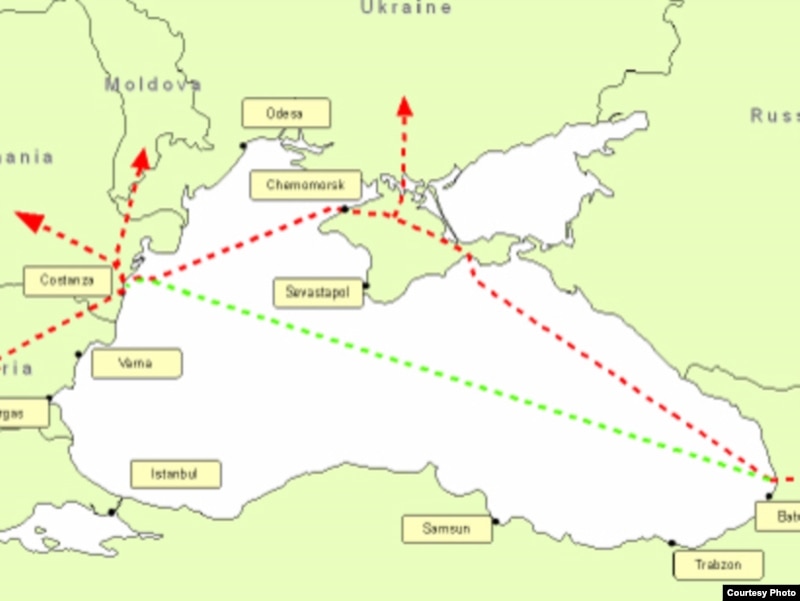
6. John Roberts at Platts reports that the Georgian government signed a memorandum of understanding with the GUEU-White Stream Pipeline Company to support a natural gas pipeline which would pass through Georgia, the Black Sea, to Romania and onwards towards the rest of Europe. Romania has yet to sign an MOU in support of the project. White Stream corporate development director Giorgi Vashakmadze told Platts that "It will take us five years to start laying the first pipeline after we have completed all the necessary agreements," and that the planned pipeline is meant to be complementary with the Nabucco pipeline. Alternatively, the pipeline might pass through the Ukraine, though recent events would seem to make that an unlikely choice. The two proposed paths of the pipeline are indicated in the map below.


7. UPI reports that IRNA reported that Iranian Oil Minister Gholamhossein Nozari in talks with his Syrian counterpart, Sufian Allaw, in Damascus argued that natural gas export deals to Syria should be concluded as quickly as possible. "'Iran will transfer gas to Greece and Italy through Iraq, Syria and the Mediterranean Sea,' Nozari said." The Turkish Weekly reported on Iran's case for an alternative to the Nabucco Pipeline today:
"Safe transit routes will be determined based on political and strategic realities. The Nabucco pipeline will pass through Turkey and the Balkans. The Persian Pipeline might pass through Iraq, Syria and the Mediterranean to Europe. These alternative routes will be discussed by the buyers, suppliers and transit countries."
Up until now, the Persian Pipeline, aka Pars Pipeline, has been envisioned as passing through Bazargan, a city on the Turkish border--completely bypassing Syria and Iraq. Bazargan is about where I indicate on the map below.


The "haste" so "urged" sounds to me like Iran is beginning to get worried about the fact of potential Russian cooperation with US efforts to put the kibosh on the nuclear power program.

8. Shamal Aqrawi and Ahmed Rasheed at Reuters report that South Korea's SK Energy has yet to withdraw from contracts with the Kurdish Regional Government, which Baghdad insists it must cancel in order to be approved as a bidder for the central government's oil concessions.

9. Zhou Xin at Reuters reports that the official Chinese PMI for March indicates expansion, moving from 49.0 in February to 52.4 in March.
"'The continuous increase in PMI, along with positive signs I can witness from different places, showed that the Chinese economy may have started to warm up,' Ma Jiantang, the head of China's National Bureau of Statistics, told the China Information Daily, the statistics bureau's mouthpiece."
The official index stands in contrast to the private CLSA China PMI, which fell to 44.8 in March, down from 45.1 in February--see Daily Sources 4/1 #6. (Readings above 50 imply expansion; below 50 implies contraction.)

10. Robert Campbell at Reuters reports that in a report delivered to the US Congress on Wednesday states that the Mexican finance ministry expects crude oil production to fall below 2.5 mb/d in 2011.
"The finance ministry estimated oil exports would drop to 1.125 mb/d in 2010 from 1.370 mb/d forecast for this year."
11. Jens Erik Gould at Bloomberg reports that Manuel Marrero Faz, senior oil adviser at Cuba's Ministry of Basic Industries, said that the country would welcome US participation in its offshore oil fields were the embargo ended.
"We are open. ... We’re very close to each other. We’re neighbors. Why not do business?"
"The US Geological Survey estimates Cuba’s North Basin region, one of three offshore areas believed to hold oil, has 4.6 billion barrels." To put that in context, 4.6 billion barrels is about 55 days of global oil consumption (at a rate of 84 mb/d).

12. Barry Ritholtz at the Big Picture reports that the non-farm payroll employment number out today from the Bureau of Labor Statistics fell by 663,000 in March, bringing the headline unemployment number to 8.5%, from 8.1% in February. Calculated Risk plots the trajectory of the decline in employment against the post war recessions in a useful graph:


The U-6 number, or total unemployed plus the total of "marginally attached" workers plus total employed part-time for economic reasons has reached 15.6% in March from 14.8% in February.

13. Rebecca Wilder at News N Economics has a post showing that although the number of bank failures due to this financial crisis have been high, at 46, the number is not especially large historically-speaking, "the Fed and the Treasury likely enabled the economy to skirt a depression-sized disaster."


She argues that the financial situation will require consolidation, sooner or later. Well worth a look.

14. James Hamilton at UCSD has authored a very important report for the Brookings Institution which shows--to his own disbelief, evidently--that the oil shock of 2008 was a primary cause of the current financial crisis. As Justin Lahart's post on the piece in Real Time Economics summarizes:
"[Maybe] what happened to oil prices had something to do with credit markets seizing up. The housing bubble saw people of lesser means traveling further afield to buy homes. That gave them long commutes that they were able to afford when gas was $2 a gallon, but maybe they couldn’t at $3. Housing in the exurbs got hit hardest, and one reason why is that high gasoline prices made it hard for people to lived in them to keep up with their mortgage payments, and hard for them to sell their homes without taking a steep loss. In some meaningful way, that has to have contributed to mortgage problems."
Hamilton's own summary is here. The report--quite long at 70 pages, is here.

15. Charles Abbott and Russ Blinch at Reuters reported yesterday that 32.2 million Americans received food stamps in January, or 1 in 10, 10%.
"The average benefit was $112.82 per person in January. ... Food stamp benefits get a temporary 13% increase, beginning with this month, under the economic stimulus law signed by President Barack Obama. The increase equals $80 a month for a household of four."
Seriously worrisome stuff. I personally feel--strongly--that more should be offered ... especially given that food stamps produce the largest "multiplier" of all stimulus measures, as they must be spent in a set time--see Menzie Chinn's post on October 27, 2008. Food security is the most critical measure of stability, always. As Bob Marley put it, "A hungry man is an angry man."