Showing posts with label Cuba. Show all posts

Thursday, July 30, 2009

Daily Sources 7/30

1. DEBATE OVER SUSTAINABILITY OF CHINESE FISCAL STIMULUS HEATS UP: CHINA SHUTTERS LARGE NUMBER OF SMALL COAL SOURCED POWER PLANTS, ONE ARGUES THAT CHINA'S STRENGTH VIS-A-VIS US FISCAL SITUATION OVERSTATED, ANOTHER SAYS CHINESE ARE COMPLAINING OF THEIR OWN BEHAVIOR IN OTHERS, AND YET ANOTHER SAYS TRADE CONFLICTS ARE INEVITABLE

Vitaliy Katsenelson in Morningstar opines:
"Despite everything, the Chinese economy has shown incredible resilience recently. Although its biggest customers--the United States and Europe--are struggling (to say the least) and its exports are down more than 20%, China is still spitting out economic growth numbers as if there weren’t a worry in the world. The most recent estimate put annual growth at nearly 8%.

Is the Chinese economy operating in a different economic reality? Will it continue to grow, no matter what the global economy is doing?

The answer to both questions is no."
I interrupt Katsenelson's point to note that the Associated Press reports that
"[Chinese a]uthorities have closed [small coal-fired] power plants with a total of 7,467 generating units, meeting a previously announced goal 18 months ahead of schedule, said Sun Qin, deputy administrator of the Cabinet's National Energy Administration.

'This couldn't be done when power demand was very intense,' Sun said at a news conference. 'Due to this financial crisis, the power generation has slowed down, so we took this opportunity to accelerate the shutdown.'"
OK, but China depends on coal for about 70% of its electricity generation. As many have noted before, the GDP growth numbers published by China don't seem to be consistent with having taken so much power generation off line--see Daily Sources 5/14 #2. In late May, the China Electricity Council, or association, announced it would stop publishing electricity consumption numbers--see Daily Sources 6/8 #6. Back to Katsenelson:
"Millions of people have migrated to its cities, and now they’re hungry and unemployed. People without food or work tend to riot. To keep that from happening, the government is more than willing to artificially stimulate the economy, in the hopes of buying time until the global system stabilizes. It’s literally forcing banks to lend--which will create a huge pile of horrible loans on top of the ones they’ve originated over the last decade.

But don’t confuse fast growth with sustainable growth. Much of China’s growth over the past decade has come from lending to the United States. The country suffers from real overcapacity. And now growth comes from borrowing--and hundreds of billion-dollar decisions made on the fly don’t inspire a lot of confidence. For example, a nearly completed, 13-story building in Shanghai collapsed in June due to the poor quality of its construction.

This growth will result in a huge pile of bad debt--as forced lending is bad lending. The list of negative consequences is very long, but the bottom line is simple: There is no miracle in the Chinese miracle growth, and China will pay a price. The only question is when and how much."
In this vein, Robert Flint at the Wall Street Journal reports:
"Since the beginning of this week, things have happened quickly on the bubble front. China's banking regulator issued rules Monday governing loans for fixed-asset investments in its latest attempt to ensure bank lending boosts the real economy and isn't funneled into markets.

On Tuesday, two of China's major lenders were quoted as saying they would sharply slow credit growth in the second half. This prompted fears of a sudden tightening of credit that could choke off the loans which have so far eased the effects of the world recession. Shanghai equity prices plunged as much as 7.7% at one point Wednesday and closed 5.0% down on the day.

Later on Wednesday, the PBOC said it will emphasize market-based systems, rather than administrative controls, in guiding the appropriate growth of credit. PBOC Vice Governor Su Ning's comments appeared to signal the PBOC wasn't about to set loan curbs in the second half of this year to cool explosive lending growth, as it had done in 2008."
Meanwhile, David Pilling argues in the Financial Times:
"If anything, it is Beijing--some of whose officials now privately boast they have nothing at all to learn from the Great Spendthrift--that has the upper hand. China’s seeming financial hold over the US has been brought into sharp relief. Beijing has become prone to lecture Washington on the need to safeguard its $2,000bn reserves, the bulk of which are parked in US dollars.

It is wholly appropriate that Washington accords due attention to China, the most important emerging power since America itself. But there is also a danger of taking China too seriously. In compensating for past neglect, things could swing too far the other way. For all the euphoria about the G2--the Sino-US axis that, according to some breathless reckoning, is the only meaningful global forum--it is worth pausing to survey the facts.

For a start, China’s financial grip over the US is not as tight as many suggest. Far from a sign of strength, Beijing’s accumulation of vast foreign reserves is the side-effect of an economic model too reliant on exports. The enormous trade surplus is the product of an undervalued renminbi that has allowed others to consume Chinese goods at the expense of Chinese people themselves.

Beijing cannot dream of selling down its Treasury holdings without triggering the very dollar collapse it purports to dread. Nor are its shrill calls for the US to close its twin deficits--which would inevitably involve buying fewer Chinese goods--entirely convincing. Rather than exposing the superiority of China’s state-led model, the global financial crisis has laid bare the compromising embrace in which the US and China find themselves."
And Brad Setser at Follow the Money notes that Chinese policy makers complaining of US government profligacy might fairly be asked if they aren't the pot calling the kettle black.
"Before the crisis, the Fed’s balance sheet was around 6% of US GDP. Right now, it is around 15% of US GDP. A big increase no doubt. But the balance sheet of the People’s Bank of China (PBoC) is around 70% of China’s GDP. Foreign assets make up about 80% of the PBoC’s balance sheet--or around 55% of China’s GDP. And the PBoC’s estimated holdings of US treasuries and agencies are about equal to 30% of China’s GDP--a level that is far higher, relative to China’s GDP, than the US Fed is ever likely to achieve. The Fed expects its balance sheet to peak at roughly $2.5 trillion, or between 15% and 20% of US GDP."
His colleague Paul Swartz provides a graph of the annual change in PBoC and Fed holdings of treasuries and agencies as a percentage of GDP:


Michael Pettis at China Financial Markets notes that trade lawyers are reporting that they expect a slew of industries to ask the EU for protective tariffs next month.
"As I have been arguing for over a year, as unemployment around the world rises and as the necessary contraction in US net demand picks up pace, there was inevitably going to be a conflict with China as Chinese policymakers responded to the collapse in trade in the only way they could, by substantially stepping up investment. The result is that China’s trade surplus has contracted very slowly--much more slowly than the contraction in the US trade deficit--and the result was a huge squeeze on the tradable goods sectors around the world.

The fact that policymakers in Europe, China, Japan and the US seem to have no clue as to how difficult the transition for each of the other countries is likely to be, and so are doing not nearly enough to coordinate their response (in fact lecturing and finger waggling seem to the favorite forms of policy coordination), makes trade conflict almost a dead certainty. I don’t think there are necessarily any bad guys here--each country is desperately doing what it can to get itself out of this mess--but there is a lot of failed opportunity and I am pretty sure that the trade environment will continue to decline."
Pettis notes that China's share of the US trade deficit (excluding oil) has grown from 26% in 2000 to 83% so far in 2009.
"Perhaps as a consequence of a fiscal stimulus aimed at boosting investment and production, China’s share of the US trade deficit has grown significantly. Since the US trade deficit is shrinking quickly, this means that other exporters are getting killed. As I have argued for a while, this is not sustainable and will almost certainly cause trade tensions to erupt.

Does this mean China is behaving in a predatory way? I don’t thinks so. I have warned for a long time that it would be very difficult for China to make the necessary transition to a consumption-led economy quickly enough to accommodate the global adjustment taking place. Unless it is willing to see its economy collapse, there is simply no way China can reduce its negative net demand quickly enough to match the contraction in US demand and so avoid squeezing the hell out of the global tradable goods sectors. That is why policy coordination is so important, especially between China and the USD, and of course that is why I continue to be a pessimist. I do not think this policy coordination is taking place."
Well worth reading in full.

2. JAPANESE INDUSTRIAL PRODUCTION UP 2.4% IN JUNE FROM MAY, JAPEX TO BID ON DEVELOPING 400 KB/D IRAQI FIELD, AND JAPAN TO START BURNING CRUDE JATROPHA OIL FOR POWER GENERATION

Yoshiaki Nohara at Bloomberg reports that the Japanese Trade Ministry announced that industrial production increased by 2.4% in June from May.
"Output gained 8.3% last quarter from the first three months of 2009, the most since 1953. Companies said they also planned to increase manufacturing by 1.6% in July and 3.3% in August, the report showed.

The heads of the Finance Ministry’s regional bureaus yesterday raised their assessment of the economy for the first time in five years, based on a recovery in exports and industrial production."
Meanwhile, Ashutosh Joshi and Taiga Uranaka at Reuters report that Japan Petroleum Exploration Co (Japex) has entered into negotiations with Iraq to develop the East Baghdad field, according to Nikkei Business Daily.
"Japex has proposed developing the southern portion of the field, with initial output forecast at 400 kb/d, enough to satisfy about 10% of Japanese demand, the newspaper said.

It also said that rival companies are expected to submit bids as well."
Meanwhile, Takeo Kumagai at Platts reports that Biomass Japan, a biodiesel supplier, will begin supplying power companies with crude jatropha oil for direct burning.
"Biomass Japan is scheduled to start receiving some 700 mt/month of crude jatropha oil in Okinawa from August, mainly from its pilot plants in Indonesia, Malaysia, Thailand and India, the source said."
"Biomass Japan declines to officially disclose exact costs for its crude jatropha oil, but according to the source production from the foreign pilot projects will cost less than Yen 50-60/liter (53-63 cents/liter) on a CIF basis, less than equivalent domestic production.

Biomass Japan is currently expanding its overseas jatropha production capacities beyond Southeast Asia, with new operations in Africa due to come on stream in the next few months, the source said.

From December it will be receiving a total of 5,000 mt/month of crude jatropha oil from Africa, said the source, declining to give details of the projects."
Some power plants in Japan directly burn crude oil to generate electricity--generation from jatropha should reduce net greenhouse gas emissions. However, jatropha has recently been abandoned by some producers, in part because it turns out that it is a water hog--see Daily Sources 7/17 #5.

3. SOUTH KOREAN HOUSEHOLD SAVINGS DOWN FROM 25.2% IN 1998 TO PROJECTED 3.2% IN 2010

Blaine Harden at the Washington Post reports that
"The household savings rate in South Korea will have plummeted from a world-beating 25.2% in 1988 to a projected world low of 3.2% in 2010, according to the OECD. Government policies have encouraged borrowing, while Korea's aggressive culture has supercharged spending on signifiers of success, whether they be Ivy League degrees or Louis Vuitton handbags.

'It is not recognized as a virtue to save, not anymore,' said Lee Sun-uk, an investment adviser for an office of Samsung Securities that is located in a wealthy neighborhood of Seoul. 'To maintain a certain status, people are willing to spend, even if their incomes have declined.'

In the past decade, average savings per household have plunged from about $3,300 to $525. On a percentage basis, it is the steepest savings decline in the developed world. Meanwhile, household debt as a percentage of individual disposable income has risen to 140%, higher than in the United States (136%), according to the Bank of Korea."


4. UK HOME PRICES UP 1.3% IN JULY FROM JUNE IN THIRD CONSECUTIVE MONTHLY INCREASE, UK WORRIED ABOUT OIL PRICE EFFECT ON RECOVERY

Real Time Economics reports that the UK Nationwide Building Society said the average home price rose 1.3% in July from June in the third consecutive month of increase.
"House prices have a 'reasonable chance' of ending 2009 up for the year, the Nationwide Building Society said."
Kate Mackenzie at FT Energy Sources reports that following news stories indicating that the Financial Services Authority has determined that speculation is not the source of the 2007-8 oil price spike, it is
"calling in big oil companies, hedge funds, banks and oil traders next week for a closed-door discussion on 'whether the current arrangements [in the oil market] remain appropriate'."
"[T]he FSA said representatives from the Treasury will also be at the meeting, which raises another possibility of what is driving this newfound concern ... over commodities. The UK government has recently aired concerns that high oil prices could threaten economic recovery. Alistair Darling, the chancellor, made this clear when he told the FT that high and volatile oil prices 'has the potential to be a huge problem as far as the recovery is concerned'."
5. EU DELEGATION IN TURKMENISTAN TO DISCUSS ENERGY COOPERATION

Upstream online reports that the EU has sent a delegation to Turkmenistan to discuss energy cooperation.
"'Developing and deepening mutually beneficial and equal ties with EU countries is a priority in (Turkmenistan's) foreign policy strategy,' Reuters quoted a report published by state news agency Turkmen Khabarlary as saying, citing a Foreign Ministry statement.

Turkmen President Kurbanguly Berdymukhamedov said this month his country was ready to supply gas through Nabucco, a pipeline designed to ease Europe's dependence on Russian gas."
6. IRAQ FACING DUSTBOWL ENVIRONMENT

Liz Sly at the Los Angeles Times reports on the emerging environmental catastrophe in Iraq.
"Decades of war and mismanagement, compounded by two years of drought, are wreaking havoc on Iraq's ecosystem, drying up riverbeds and marshes, turning arable land into desert, killing trees and plants, and generally transforming what was once the region's most fertile area into a wasteland.

Falling agricultural production means that Iraq, once a food exporter, will this year have to import nearly 80% of its food, spending money that is urgently needed for reconstruction projects.

'We're talking about something that's making the breadbasket of Iraq look like the Dust Bowl of Oklahoma in the early part of the 20th century,' said Adam L. Silverman, a social scientist with the US military who served south of Baghdad in 2008.

So fragile has the environment become that even the slightest wind whips up a pall of dust that lingers for days."
"Chronic electricity shortfalls also have played a role. People chop down trees for firewood, leaving more bare land, and the shortage of power has made it difficult to pump water through the irrigation channels that had sustained fertile lands far beyond the rivers. Compounding the already dire shortages, power stations have been forced to shut down for days at a time because they lack water.

Then came the regionwide drought that has dramatically depleted the amount of water available. Last year's rainfall was 80% below normal; this year only half as much rain fell as usual."
A must read.

7. US WILL SANCTION ERITREA IF IT DOESN'T HALT SUPPORT FOR SOMALI MILITANTS

BBC News reports that US envoy to the UN Susan Rice told a Congressional Committee that Eritrea will face sanctions if it does not put an end to support for Islamists fighting the transitional federal government in Somalia.
"In April the African Union, another backer of the Somali government, also called for sanctions over the issue.

But Eritrean officials have repeatedly denied the allegations, calling them a 'fabrication' of US intelligence.

The country suspended its membership of the AU in protest at the sanctions call in April."
8. GHANA'S FISCAL SITUATION IMPROVES ON OIL FINDS


Frontier Markets reports that
"Ghana’s Eurobonds have surged 93% since last November and may continue to rise given the country’s increasingly attractive fiscal position due in part to the production of a new oil field that is expected to put it in the world’s top 50 oil producers and to expand growth from an estimated 4.1% this year, to 6.1% in 2010 and 10.5% the year after. The yield on the 8.5% dollar-denominated bonds due 2017 fell from 9.83 to 9.73 percent during trading on Tuesday."
Could be a blessing for Ghanaians, depending on how the government manages it. Crossing my fingers.

9. MORE ON AFRICAN FARMLAND PURCHASES FROM FOREIGN INVESTORS AND GOVTS

Horand Knaup and Juliane von Mittelstaedt at Der Spiegel have a fascinating update on the rush to purchase African farmland story, with a number of additional details and interesting observations. Some key excerpts:
"'According to most prognoses, there could be 9.1 billion people living on earth in 2050, about two billion more than today. In the coming 20 years alone, worldwide demand for food is expected to rise by 50%. "These are pessimistic prospects,' says [an] OECD [analyst]."
"Food is becoming the new oil. Worldwide grain reserves dropped to a historic low at the beginning of 2008, and the ensuing price explosion marked a turning point, just as the oil crisis did in the 1970s. There were bread riots around the world, and 25 countries, including some of the biggest grain exporters, imposed restrictions on food exports."
"If the investors are successful, they could achieve what development agencies have been unable to do in the past few decades: reduce the hunger that now afflicts more people than ever, namely one billion worldwide. In the best case scenario this could be a win-win situation with profit for the investors and development for the poor.

It is not just bankers and speculators, but also governments that are acquiring land in other countries, seeking to reduce their dependence on the world market and imports. China is home to 20% of the world's population, but it has only 9% of the world's arable land. Japan is the world's largest corn importer, and South Korea is the second-largest. The Persian Gulf States import 60 percent of their food, while their natural water reserves are sufficient to support only another 30 years of agriculture."
"Klaus Deininger, an economist specializing in land policy at the World Bank, estimates that 10 to 30% of available arable land could be up for grabs, although only a fraction of the potential number of lease and sale agreements have been signed. 'There was a huge jump in 2008, when plans and applications in many countries more than doubled, in some cases tripled.' In Mozambique, says Deininger, foreign demand is more than double the existing cultivated farmland, and the government has already allocated four million hectares to investors, half of them from abroad."
"Saudi Arabia is one of the biggest and most aggressive buyers of land. This spring, the king attended a ceremony where he took delivery of the first export rice harvest, produced exclusively for the kingdom in hunger-stricken Ethiopia. Saudi Arabia spends $800 million a year promoting foreign companies that cultivate 'strategic field crops' like rice, wheat, barley and corn, which it then imports. Ironically, the country was the world's sixth-largest wheat exporter in the 1990s. But water is scarce and the desert nation aims to preserve its reserves. Exporting food also means exporting water."
"But many of the countries where land is being snapped up--Kazakhstan and Pakistan, for example--suffer from water shortages. Sub-Saharan Africa has adequate natural water reserves, but the only country in the region currently producing a food surplus is South Africa. Most countries, on the other hand, are importers and, with rapidly growing populations, will likely be even more dependent on food imports in the future. Can such countries truly become important food producers?

Audinet, the IFAD expert, knows the risks. 'The way these agreements are structured can harm the country and the farmers in the long term, robbing them of their most important asset: land.' Olivier De Schutter, the UN Special Rapporteur on the right to food, warns: 'Because the countries in Africa are competing for investors, they are undercutting each other.' Some contracts, says De Schutter, are barely three pages long--for hundreds of thousands of hectares of land."
The other must read of today.

10. RUSSIA INKS DEEPWATER EXPLORATION DEAL WITH CUBA

The Associated Press reports that Russian firm Zarubezhneft has signed four accords with the Cuban national oil company--Cubapetroleo--to explore for crude in Cuban deep waters.
"Moscow extended the island $150 million in credit for construction materials and farm machinery, state media said Wednesday.

The credit will give Cuba more time to pay for Russian equipment shipped to areas most affected by three hurricanes that caused more than $10 billion in damage last summer."
11. MEXICAN FEDERAL POLICE RAID PEMEX HEADQUARTERS


Robert Campbell at Reuters reported yesterday that the Mexican police raided the headquarters of national oil company Pemex "in an investigation into rampant fuel theft that costs the company more than $2 billion a year."


12. SEASONALLY-ADJUSTED INITIAL UNEMPLOYMENT CLAIMS DOWN 8,250 TO 559,000; FORECLOSURE ACTIVITY BECOMING A FUNCTION OF INCREASING UNEMPLOYMENT; HARLESS ARGUES THAT INCREASED US SAVINGS RATE HERE TO STAY

The Department of Labor announced today that
"In the week ending July 25, the advance figure for seasonally adjusted initial claims was 584,000, an increase of 25,000 from the previous week's revised figure of 559,000. The 4-week moving average was 559,000, a decrease of 8,250 from the previous week's revised average of 567,250.

The advance seasonally adjusted insured unemployment rate was 4.7% for the week ending July 18, unchanged from the prior week's unrevised rate of 4.7%."
Yves Smith at naked capitalism observes:
"A new dynamic appears to be emerging on the housing front. Heretofore, foreclosures were strongly correlated with where the mania had been most acute. California, Florida, and Arizona in particular showed dramatic declines in prices. But now as those markets have corrected to a considerable degree, foreclosure activity is now starting to be a function of increasing unemployment."
And Andy Harless at Employment, Interest, and Money thinks that an increased rate of savings in the US is here to stay, which should have the consequence of reducing the share of consumption as GDP:
"Undoubtedly the savings rate will fall somewhat as the degree of financial distress declines, but I think there’s a good case to be made that much of the increase is permanent.

For one thing, from the point of view of households, 'financial distress' may be extremely slow to lift. If the Japanese experience is any guide, it is a very slow process to get a severely distressed banking system to start lending normally again, and it’s not clear that things are going to be any easier for the US. Meanwhile, most forecasts expect the unemployment rate to remain quite high for several years. It could take 3 years, or 5 years, or 10 years, or 20 years before the financial distress lifts.

Granted, even 20 years is not forever, and 3 years is certainly not forever, but it’s long enough to stop thinking about household behavior as being continuous over time. We can reasonably surmise that, even without so much financial distress, the savings rate would have trended upward over time. Presumably households would gradually have come to recognize that they weren’t saving enough. (Can zero be anywhere near enough?) And as baby boomers’ children settle into their own careers, they would cease to be a drag on their parents’ savings, and at the same time those parents would have to start worrying seriously about retirement. The financial distress messed up this scenario (or maybe just speeded it up), but the underlying trend should still be going on 'beneath the surface.' By the time the distress lifts, there will be other reasons for the savings rate to be higher than it was in 2006.

That argument is rather speculative, I admit, but there are more solid reasons to expect the savings rate to remain high. While the current, comparatively high savings rate may reflect the effects of financial distress, the low savings rates of the 2005-2007 period did not merely represent the absence of financial distress. What is the opposite of financial distress? Financial ease? The degree of financial ease during that period (which was the culmination of a process that had been building on and off for a couple of decades) was well beyond normal, and well beyond what we can expect in the coming years, even if recent sources of distress are resolved fairly quickly. Consumption was supported (and aggregate saving accordingly reduced) by a fountain of credit that will not re-emerge with such force unless people in Washington and on Wall Street make some big mistakes."
Well worth reading in full. (I would note that if past performance is any indication of future performance, however, that Washington and Wall Street are likely to make some big mistakes.)

13. NEW STUDY SUGGESTS THAT MARCELLUS SHALE FORMATION COULD PRODUCE AS MUCH AS 489 TRILLION CUBIC FEET OF NATURAL GAS,

Rick Stouffer at the Pittsburgh Tribune-Review reports that a new study by Penn State University geosciences professor Terry Engelder projects that 489 trillion cubic feet of natural gas could be produced from the Appalachian Basin's Marcellus Shale formation.
"Engelder said the estimates are based on natural gas flow rates from wells drilled by major Marcellus Shale developers, which have been above expectations."
At the current rate of consumption, 489 trillion cubic feet represents more than 19 years of total US natural gas demand. Incidentally, natural gas is a major feedstock for the production of ammonia for use in fertilizer production.

Thursday, June 4, 2009

Daily Sources 6/4

1. BANKS OF CANADA, ENGLAND, AND EUROPE MAINTAIN BENCHMARK INTEREST RATES, B.O.E. AND E.C.B. REITERATE INTENTION TO ENGAGE IN SOME Q.E., SPEECH BY GERMAN F.M.--AND S.D.P. CHANCELLOR CANDIDATE--INDICATES INTEREST IN CHANGING THE STRUCTURE OF THE EUROPEAN MONETARY UNION

Daniel Kruger and Chris Fournier at Bloomberg report that the Bank of Canada today decided to leave its benchmark interest rate unchanged at 0.25%.
"The Bank of Canada ... said the 'unprecedentedly rapid rise' in the currency could 'fully offset' recent improvements in financial markets and consumer confidence and prolong the recession.

'The bank is confirming that the rise in the currency isn’t backed up by the fundamentals,' said John Curran, a Toronto-based senior vice president at CanadianForex Ltd., an online foreign-exchange dealing firm. 'While we do see some 'green shoots," for the economy to strengthen we can’t have the Canadian dollar as strong as it’s been in recent weeks. Once everyone gets a chance to digest this, you’ll see some US dollar strength."
Meanwhile, Jennifer Ryan at Bloomberg reports that the Bank of England also left its benchmark interest rate unchanged at 0.5 today, and reiterated its intention to purchase £125 billion (~$205 billion) in government and corporate bonds.
"While the bank’s decision last month was unanimous, some policy makers did favor spending the full authorized total of 150 billion pounds and the panel said it will seek permission to print even more money than the maximum if needed. Minutes of today’s decision will be published on June 17."
And Gabi Thesing and Christian Vits at Bloomberg report that the European Central Bank [ECB] also left its benchmark interest rate unchanged today at 1%.
"Asked if the bank will expand its bond plan, [ECB President Jean-Claude] Trichet replied: 'We have decided to embark on a 60 billion-euro purchase of covered bonds, full stop.'"
Meanwhile, Daniela Schwarzer at Eurozone Watch reports that German Foreign Secretary Frank-Walter Steinmeier in a speech yesterday at Budapest suggested that the current structure for the European monetary union ought, under the current circumstances, be rearranged, Schwarzer's analysis:
"# He explicitly acknowledges the problem of divergent economic developments in the EMU. This fact has been on the table for a few years now. As early as 2005, data on the first years of EMU pointed to these problems, and the trend of cyclical and structural divergence has even been acknowledged by the ECB in pursuing its monetary policy for an increasingly heterogeneous Eurozone economy. But Germany (which itself has been diverging from EMU average for instance in the years of its sever economic slump 2003/4 and subsequently recorded a very strong current account surplus) had so far not picked up this issue politically. It is hence the first time that a German member of government says what the current developments are: a possible threat to the existence of the EMU.
# In order to tackle this problem, Steinmeier suggests stronger policy coordination. In other words: the Lisbon Agenda is not sufficient an instrument to cope with divergence and asymmetric shocks in the EMU. This is no surprise to most economic analysts of EMU (even not in the German administration), but a new political statement from Berlin.
# He explicitly names wage, social and tax policies as an object for closer coordination in the EMU and speeks out strongly against tax and wage dumping. Again, this should be no surprise from a social democrat before two important elections dates - but it is a clear departure from the Berlin mainstream. For instance regarding the commonly held view that due to the 'Tarifautonomie' (i.e. the fact that social partners negotiate wages (more or less) independently in Germany) nothing can be done in the field of wage policy anyway. What Steinmeier may in fact mean is that some countries should be pushed towards giving up certain systems (e.g. wages indexed on inflation as is the case in Spain), which reinforce cyclical divergences in the EMU.
# He also requests a stronger coordination of fiscal stimulus in the current crisis--rightly so, but in direct opposition to the position held by the Chancellor and the Finance Minister."
Worth reading in full.

2. REPORTERS TAKEN TO CHINESE S.P.R.S

Denis McMahon at China Journal reports that he was taken on a reporting trip to Zhenhai and Zhoushan, two SPRs located south of Shanghai, arranged by the State Council Information Office.
"On the face of it, the visit was seemingly a massive step forward in transparency for the Chinese government. But, while staring at 50 identical 100,000 cubic meter (~ 630,000 barrel) tanks neatly formed into rows is certainly impressive, it doesn’t really tell much about the state of China’s reserves. And while the officials we met were friendly and open, the key policy questions of where the oil comes from, how they bought it and under what conditions the reserves may be tapped were deferred to more senior officials--who weren’t there.

While the reporters may have been a little unsure as to what they were getting out of the experience, Beijing clearly knew exactly what it was doing from the unity of message coming from the National Energy Bureau officials traveling with us: The reserves are full."
It seems that Beijing is signaling it would like a lower price, no?

3. MALAYSIA CONSIDERING SETTLING TRADE WITH CHINA IN LOCAL CURRENCIES

Shai Oster at the Wall Street Journal reports that Malaysian Prime Minister Najib Abdul Razak told the media after meeting with China's premier, Wen Jiabao, on Wednesday that:
"We can consider whether we can use local currencies to facilitate trade financing between our two countries. ... What worries us is that the [US] deficit is being financed by printing more money. That is what is happening. The Treasury in the United States is printing more notes."
The notion being to replace trade settlements in dollars with the ringgit and yuan. In May Bloomberg reported that Brazil's foreign minister told the media in Beijing that Brazil and China were considering a plan to settle in local currencies--see Daily Sources 5/20 #4.

4. VIETNAMESE NAVAL STRATEGY VS. CHINA TO MIRROR CHINA'S NAVAL STRATEGY VS. U.S., MALAYSIAN SHIPS MAY HAVE ENTERED OIL RICH AREA DISPUTED WITH INDONESIA

Feng at Information Dissemination comments on Vietnam's recent decision to purchase six project 636 kilo submarines for $1.8 billion. (Kilo class is the NATO designation for diesel-electric submarines made in Russia. Wikipedia states that the project 636 submarines are thought to be one of the quietest diesel-electric submarines in the the world.) Feng believes that the submarine purchase was made in an attempt to be able to project force into the China South Sea, and in particular, to the Spratly Islands, control over which is disputed by all the nearby nations, mostly because it is thought that oil and gas reserves lie under them.


Feng points out that the navies of countries further away from Vietnam, like, say, Australia, present a different challenge for the People's Liberation Army Navy [PLAN] than Vietnam, simply because Vietnamese ships would be operating mostly in areas over which the Chinese would be able to assert air superiority. Thus:
"[Vietnam is] actually adopting the same strategy that PLAN [has] supposedly [adopted to counter the capabilities of the US Navy]. Basically, Vietnam is [buying] a lot [of] small, fast ships equipped with long range missiles (and nothing else much ...) [and] quiet submarines."
Of course, Hanoi cannot make purchases on the scale that Beijing can, but it is presented with more or less the same dilemma facing Beijing when considering what it should do in case of a confrontation with the US. Interesting observation. Meanwhile, AFP reports that Malaysia's deputy prime minister Muhyiddin Yassin called for calm amidst reports that Malaysian warships had entered waters off northeastern Borneo also claimed by Indonesia, saying:
"We want to avoid any form of provocation that can cause unpleasantness. We must handle the matter with caution."
"International borders in the area off Borneo island have yet to be determined, with each country claiming the area as its own.

Malaysia claims the area based on a 1979 maritime chart, while Indonesia bases its claims on the 1982 UN Convention on the Law of the Sea (UNCLOS), which states the area belongs to Indonesia.

Muhyiddin said the Malaysian security forces patrolling the Ambalat waters had performed their duties responsibly and in accordance with regulations."
The head of Malaysia's military, Abdul Aziz Zainal, told the media that ships had not entered the Ambalat region, and that he would be in Jakarta Tuesday to discuss the matter.

5. OBAMA'S SPEAKS AT CAIRO TODAY

The New York Times carried the full text of President Obama's much anticipated speech in Cairo today. Key excerpts:
"Islam has always been a part of America's story. The first nation to recognize my country was Morocco. In signing the Treaty of Tripoli in 1796, our second President John Adams wrote, 'The United States has in itself no character of enmity against the laws, religion or tranquility of Muslims.'"
"Just as Muslims do not fit a crude stereotype, America is not the crude stereotype of a self-interested empire. The United States has been one of the greatest sources of progress that the world has ever known. We were born out of revolution against an empire. We were founded upon the ideal that all are created equal, and we have shed blood and struggled for centuries to give meaning to those words – within our borders, and around the world. We are shaped by every culture, drawn from every end of the Earth, and dedicated to a simple concept: E pluribus unum: 'Out of many, one.'"
"Make no mistake: we do not want to keep our troops in Afghanistan. We seek no military bases there. It is agonizing for America to lose our young men and women. It is costly and politically difficult to continue this conflict. We would gladly bring every single one of our troops home if we could be confident that there were not violent extremists in Afghanistan and Pakistan determined to kill as many Americans as they possibly can. But that is not yet the case."
"
The sooner the extremists are isolated and unwelcome in Muslim communities, the sooner we will all be safer."
"Around the world, the Jewish people were persecuted for centuries, and anti-Semitism in Europe culminated in an unprecedented Holocaust. Tomorrow, I will visit Buchenwald, which was part of a network of camps where Jews were enslaved, tortured, shot and gassed to death by the Third Reich. Six million Jews were killed--more than the entire Jewish population of Israel today. Denying that fact is baseless, ignorant, and hateful. Threatening Israel with destruction--or repeating vile stereotypes about Jews--is deeply wrong, and only serves to evoke in the minds of Israelis this most painful of memories while preventing the peace that the people of this region deserve.

On the other hand, it is also undeniable that the Palestinian people--Muslims and Christians--have suffered in pursuit of a homeland. For more than sixty years they have endured the pain of dislocation. Many wait in refugee camps in the West Bank, Gaza, and neighboring lands for a life of peace and security that they have never been able to lead. They endure the daily humiliations--large and small--that come with occupation. So let there be no doubt: the situation for the Palestinian people is intolerable. America will not turn our backs on the legitimate Palestinian aspiration for dignity, opportunity, and a state of their own.

For decades, there has been a stalemate: two peoples with legitimate aspirations, each with a painful history that makes compromise elusive. It is easy to point fingers--for Palestinians to point to the displacement brought by Israel's founding, and for Israelis to point to the constant hostility and attacks throughout its history from within its borders as well as beyond. But if we see this conflict only from one side or the other, then we will be blind to the truth: the only resolution is for the aspirations of both sides to be met through two states, where Israelis and Palestinians each live in peace and security.

That is in Israel's interest, Palestine's interest, America's interest, and the world's interest."
"Palestinians must abandon violence. Resistance through violence and killing is wrong and does not succeed. For centuries, black people in America suffered the lash of the whip as slaves and the humiliation of segregation. But it was not violence that won full and equal rights. It was a peaceful and determined insistence upon the ideals at the center of America's founding. This same story can be told by people from South Africa to South Asia; from Eastern Europe to Indonesia."
"At the same time, Israelis must acknowledge that just as Israel's right to exist cannot be denied, neither can Palestine's. The United States does not accept the legitimacy of continued Israeli settlements."
"And we will welcome all elected, peaceful governments--provided they govern with respect for all their people.

This last point is important because there are some who advocate for democracy only when they are out of power; once in power, they are ruthless in suppressing the rights of others."
A bit later in the speech, President Obama seems to echo yesterday's op ed in the Wall Street Journal by the prince of Dubai which argued that education was key to winning hearts and minds in the Middle East--see Daily Sources 6/3 #8.
"Many Gulf States have enjoyed great wealth as a consequence of oil, and some are beginning to focus it on broader development. But all of us must recognize that education and innovation will be the currency of the 21st century, and in too many Muslim communities there remains underinvestment in these areas. I am emphasizing such investments within my country. And while America in the past has focused on oil and gas in this part of the world, we now seek a broader engagement.

On education, we will expand exchange programs, and increase scholarships, like the one that brought my father to America, while encouraging more Americans to study in Muslim communities. And we will match promising Muslim students with internships in America; invest in on-line learning for teachers and children around the world; and create a new online network, so a teenager in Kansas can communicate instantly with a teenager in Cairo."
The speech is best read in full.

6. IRAN'S L.O.T.R. DISMISSES CAIRO SPEECH IN ADVANCE, IRAN ANNOUNCES CONSTRUCTION ON PARS PIPELINE BEGINS, WITHOUT HAVING DECIDED ON FINAL PATH

Thomas Erdbrink and William Branigin at the Washington Post report that Iran's Leader of the Revolution [LOTR] Ayatollah Ali Khamenei said:
"People of the Middle East, the Muslim region and North Africa--people of these regions--hate America from the bottom of their heart"
shortly before President Obama's speech in Cairo. LOTR Khamenei said that "beautiful speeches" would not reverse this feeling. Meanwhile, PressTV reports that construction on the Pars (or Persian) Pipeline has begun, but that Ahmad Noorani, the head of economic affairs at the Iranian embassy in Turkey, suggested:
"Another route could go through Iraq and Syria and then go through the Mediterranean to Greece and Italy."
(h/t reader Geoff.)

7. HOLBROOKE SAYS ADMINISTRATION HAS ASKED CONGRESS FOR ADDITIONAL $200 MILLION IN AID FOR PAKISTANIS DISPLACED BY FIGHTING WITH TALIBAN

Karen DeYoung at the Washington Post reports that Richard Holbrooke, special representative for Afghanistan and Pakistan, said at a press conference with Pakistani President Asif Ali Zadari in Islamabad yesterday that President Obama had asked Congress for an additional $200 million in aid for those displaced by the fighting with the Taliban.
"[W]ithin hours of his arrival, Holbrooke said the 'dramatic increase' in aid was 'symbolic of our commitment and support.'

Holbrooke emphasized that his hastily arranged three-day visit was 'at the personal instruction of President Obama' and reflected White House concern about Pakistanis fleeing heavy fighting in the Swat Valley and surrounding regions northwest of Islamabad, the capital."
The trip is also an outgrowth of concern that the central government will not reestablish control in areas where the extremists have been flushed out, failing to provide for security and services, making it a simple matter for the Taliban to return once the offensive has ended.

8. RELIANCE TO HALT GASOLINE EXPORTS TO IRAN ON U.S. SANCTION FEARS

Dev Chatterjee & Piyush Pandey at the Economic Times reports that Reliance has decided to stop exports of petroleum products to Iran in an effort to stave off restrictions on sales of products to the US market.
"Reliance was exporting 2% of its total output, worth around $280 million, from its two refineries in Jamnagar to Iran. A top RIL official, who requested anonymity, confirmed that the gasoline exports to Iran were stopped last month. However, he refused to elaborate on this issue.
...
RIL exports petroleum products worth $14 billion annually, of which around 5% is exporting to the US."
As of late, the UAE has been providing Iran with about 80% of its product imports.

9. ETHIOPIAN SOMALI SECESSIONISTS WARN AWAY OIL PROSPECTORS

Barry Malone at Reuters yesterday reported that the Ogaden National Liberation Front (ONLF)--or secessionists from the ethnically Somali Ogaden region--have emailed a warning to oil companies not to operate in that area of Ethiopia.


The email statement said:
"In order to accommodate these immoral and gluttonous rushes for oil in Ogaden, Ethiopia killed, raped and illegally detained thousands of Ogaden civilian and imposed economic and aid blockade at a time of when there was a full-blown drought in the Ogaden.

ONLF has persistently warned these unscrupulous multinational companies and their governments ... the ONLF has been left no alternative but to take all measures necessary to protect the inalienable rights of the Ogaden people."
10. O.A.S. VOTES TO LIFT BAN ON CUBA, BUT CUBA MUST ENGAGE IN DIALOGUE IN ORDER TO RE-ENTER ORGANIZATION

Mary Beth Sheridan at the Washington Post reports that the Organization of American States [OAS] voted to lift its 47 year old suspension of Cuba. The language of the resolution doesn't seem to explicitly require anything specific of Havana, outside of initiating a process of dialogue which itself must be in conformity with the practices, purposes, and principles of the OAS.The press release includes the actual language of the resolution (in Spanish only).
"RESUELVE:

1. Que la Resolución VI adoptada el 31 de enero de 1962 en la Octava Reunión de Consulta de Ministros de Relaciones Exteriores, mediante la cual se excluyó al Gobierno de Cuba de su participación en el Sistema Interamericano, queda sin efecto en la Organización de los Estados Americanos.

2. Que la participación de Cuba en la OEA será el resultado de un proceso de diálogo iniciado a solicitud del Gobierno de Cuba y de conformidad con las prácticas, los propósitos y principios de la OEA."
More or less:
"RESOLVED:

1. That Resolution VI adopted on January 31, 1962, in the Eighth Consultative Meeting of External Relations Ministers, by which the government of Cuba was excluded from participating in the Inter-American System, is hereby repealed in the Organization of the United States.

2. That the participation of Cuba in the OAS will be a result of a process of dialogue initiated at the request of the government of Cuba and in conformity with the practices, purposes, and principles of the OAS."
(Course, I wouldn't rely on my Spanish for this, but it does seem that only the dialogue itself must be conducted with the principles in mind, and that the sticking point is whether the dialogue would be initiated--or even participated in--by Havana.) Sheridan reports that Dan Restrepo, who is head of Western Hemisphere affairs at the White House, argued that the language was stronger that it might appear given the preamble which emphasize democracy and respect for human rights as part of the OAS's fundamental principles.

11. MEXICAN DRUG GANGS MOVING TO HONDURAS--MAY BE ASSISTED BY CROSS-SPECIAL FORCES TIES

Ken Ellingwood at the Los Angeles Times reports that the drug war in Mexico has spilled over into Guatemala, as gangs have found the environment easier to operate in there.
"During the last year and a half, the Zetas have carved a bloody trail across Guatemala's northern and eastern provinces. More than 6,000 people were slain in Guatemala in 2008. Police say most of the killings were linked to the drug trade.

As the recent blood bath shows, the violence is now threatening the capital, deep in the interior.

Authorities say Mexican drug gangs, primarily the Zetas and rivals from the state of Sinaloa, are ramping up operations in Central America to evade increased marine patrols near Mexico as they relay drug shipments to the United States and Europe."
The Zetas are a gang that was formed by former members of the Mexican special forces in the 1990s.
"Guatemalan police commanders say their 20,000 officers cannot match the firepower of the Mexican traffickers, who have made growing use in Mexico of military-type arms, such as 40-millimeter grenades and .50-caliber rifles capable of piercing armor.

Recent seizures in Guatemala have yielded similar weapons. 'These are things we have seen only in photos of Iraq and the Gulf,' said Larios, the police commander. 'Not in Guatemala.'

But devising a response is complicated by Guatemala's troubled past. The memory of the army's brutal conduct during the civil war means that it would be politically dicey for Guatemalan leaders to respond by mobilizing the military, as Calderon has done in Mexico."
Further, the Zetas have reportedly received assistance from former Guatemalan special forces known as the Kaibiles--named for a Mayan leader who evaded capture by conquistadors led by Pedro de Alvarado in the 16th century. Mexican special forces received training from the Kaibiles in the 1990s, as well as from Brazilian special forces, and the US Army. Analysts are worried that the drug war may spill into Honduras as well.


The best English-language coverage of the drug war's effects on Latin America is in the Los Angeles Times. A must read.

12. GLOBAL AIR PASSENGER TRAFFIC DOWN 7.5% IN 1ST 4 MOS., FREIGHT TRAFFIC DOWN 22%

Eileen Ng at the Associated Press reports that the International Air Transport Association recently announced that global passenger demand fell 7.5% in January-April from the same period a year ago while cargo demand fell 22%.
"IATA Director-General Giovanni Bisignani said airlines are facing an 'emergency situation' and should be given greater commercial freedom to serve global markets and consolidate."
Bisignani said that Asian carriers, which represent 44% of the global air cargo market, will be hit hardest by the crisis.

13. PENSIONS GETTING HIT GLOBALLY

Leo Kolivakis at Pension Pulse gives a rough summary of major difficulties facing major pensions globally, as pensions find themselves unable to meet their obligations given the current crisis. "Pension tension" is being seen in the US, Canada, and throughout Europe, including at the European Central Bank. His list is well worth considering, as well as his comment:
"The global pension crisis is really a crisis of modern day capitalism. If we don't figure out a long-term solution to this crisis, we risk having a new class of elderly poor who were cheated out of their pensions."
14. GEORGETOWN UNIVERSITY MAY LEAD NEW GENEVA CONVENTION PROTOCOL EFFORT

Jeff Stein at Spy Talk reports that Georgetown University's new Center on National Security and the Law's legal scholars have been pushing for a new international agreement to update the Geneva Convention to address terrorism and stateless armies. The center was until recently led by Neal Katyal, who joined the Obama Administration to become the Principal Deputy Solicitor General.
"'Soon,' [Matthew] Gerke, [a fellow at the center who worked for three and a half years in the Pentagon and in Iraq on rule of law issues,] said, the Center on National Security and the Law hopes to 'roll out' a campaign for a new Geneva Convention, hopefully boosted by an American figure with international stature.

Its first step would be to mount a new push for Senate ratification of the 'Additional Protocol No. 2, Relating to the Protection of Victims of Non-International Armed Conflicts.'"
In 1977, the Carter administration signed two additional protocols to the Geneva Convention which had provided rules for handling non-state combatants, but the Senate refused to ratify the treaty, "as it has ever since." Worth reading.

15. LOW SULFUR BUNKER FUEL REQUIREMENTS MAY ADD 4 MB/D NEW DIESEL DEMAND TO MARKET--ROUGHLY 10 MB/D ADDITIONAL CRUDE DEMAND

John Kingston at the Barrel reports on the interesting observation about the incoming low sulfur specifications for shipping use by Carlos Cuervo, SVP for supply and trading at World Fuel Services, who argues that low sulfur product from the bottom of the barrel, or low sulfur fuel, will start seeing considerable more demand starting next year. However, after 2015:
"It won't be even lower-sulfur bunker fuel that will allow shipowners to meet the requirements, Cuervo said. Instead, it will be marine diesel. There just simply won't be enough low-sulfur bottoms, of 0.5% sulfur by 2020, to meet the needs of shipowners. Diesel will fill the gap."
Cuervo estimates that the move to diesel by shipowners driven by the incoming low sulfur requirements will mean for an additional 4 mb/d of demand for diesel globally.
"As he noted, given that an efficient refinery can produce about 40% diesel, it's as if we need another 10 mb/d of crude supply to make 4 mb/d of diesel."
It's an interesting concern ... just now refiners would probably welcome additional diesel demand, given the size of inventories here in the US. But, in the run up of prices from 2007-8, some argue that the price of crude was chasing the diesel crack, and that could get real steep given a recovery in the global economy. Kingston notes there hasn't been a lot of interest so far in setting up refineries to produce low sulfur bunker fuel--
"They generally have viewed fuel oil the way Dracula views sunrise. 'How are you going to put a lot of money into something you've been trying to get rid of?' [Cuervo] said."
Worth reading in full.

16. NORTH AMERICAN RAIL TRAFFIC DOWN

Atlantic Systems Inc.'s Railfax report is out, showing that total North American rail traffic for the week ended May 30 was down 24.7% from the comparable week a year earlier. ASI plots the percent change in total North American rail traffic year over year for the week ended May 30, in 13 week rolling averages:


Coal volumes transported by train for the year ended May 30 was down 9.5% from the year previous.

17. INITIAL JOBLESS CLAIMS DOWN SLIGHTLY LAST WEEK, ANALYSTS EXPECT HEADLINE UNEMPLOYMENT TO HIT 9.2%

The Associated Press reports that the Labor Department released data today showing initial jobless claims fell slightly last week to a seasonally-adjusted 621,000 from the previous week's revised total of 625,000.
"The total jobless benefit rolls fell by 15,000 to 6.7 million, the first drop since early January. Continuing claims had set record highs every week since the week ending Jan. 24. The continuing claims data lag initial claims by one week.

Still, the number of initial claims remains stubbornly high, above the 605,000 level reached five weeks ago. That was the lowest level in 14 weeks.

The four-week average of claims, which smoothes out fluctuations, rose by 4,000 to 631,250."
Analysts expect unemployment to rise to 9.2%.

Wednesday, June 3, 2009

Daily Sources 6/3

1. JAPAN MAY NEED TO SHUT MORE THAN A 5TH OF ITS REFINING CAPACITY ON REDUCED DEMAND

Reuters reports that Nippon Oil Corp President Shinji Nishio told the Reuters Energy Summit that Japan may be forced to shut as much as 1 mb/d of refining throughput capacity, more than a fifth of the country's total capacity, as oil demand is falling more quickly than previously expected.
"'I think we are likely to see an even faster decline than the government's projection,' he said in Tokyo.

Japan's trade ministry projects oil sales will fall by an average annual 3.5% to 168.2 million kl (2.9 mb/d) in the year from April 2013, from a total 3.46 mb/d last year. It has the capacity to refine 4.8 mb/d.

'Unless we cut the capacity by (1 mb/d), the nation's production will not be at an optimum level,' he said. 'When you think about the future beyond (2013), we will have to cut even further.'

Major Japanese refiners have slashed refinery production sharply in response to weakening demand, but relatively few have thus far mothballed capacity, despite a downturn in global profit margins that is likely to curtail hopes of shifting to exports."
There will be fierce competition for export markets given the wall of new refining capacity which is hitting the Asia Pacific.

2. C.I.C. TAKES AN ADDITIONAL $1.2 BILLION IN MORGAN STANLEY; AN OBSCURE TOW TRUCK MANUFACTURER TO BUY G.M.'S HUMMER UNIT

Jason Dean and Peter Stein at the Deal Journal report that the China Investment Corporation--one of China's sovereign wealth funds--took an additional $1.2 billion stake in Morgan Stanley yesterday.
"CIC executives and other Chinese officials have talked about how little confidence they had in US and European financial sector, thanks in large part to the heavy paper losses CIC suffered on a previous $5.6 billion stake it bought in Morgan Stanley in December 2007, plus an earlier stake in Blackstone Group. Officials said they worried about the market turmoil and the uncertainty over US and European government bailout programs.

So, the new deal is clearly a new vote of confidence by CIC–though one perhaps foreshadowed in April, when CIC Chairman Lou Jiwei said the fund was starting to see opportunities and planned to expand its overseas investments this year."
This comes a day after the news that Chinese students at Peking University laughed at Secretary Geithner's assertion that Chinese assets were safe. The article also points out that Temasek--Singapore's sovereign wealth fund--sold its entire stake in Bank of America in the middle of May. At that time the New York Times reported that Bank of America sold a consortium of sellers which included Temasek about a third of its 16% holding in China Construction Bank. Meanwhile, Joe McDonald at the Associated Press reports that Sichuan Tengzhong Heavy Industrial Machinery Co. announced yesterday that it would purchase the Hummer unit of GM.
"Tengzhong's Web site says the company is privately owned, though that status can be murky in the Chinese system. Comments posted Wednesday on Chinese Web sites for car lovers asked whether China's military financed the Hummer takeover."
The company is four years old and has 4,300 employees. It makes cement mixers and tow trucks--the Hummer will be its first venture into passenger cars.

3. KASHGAR PARTY SECRETARY SAYS BEIJING HAS DISRUPTED 7 UIGHUR TERRORIST CELLS THIS YEAR

The Associated Press reports that the Communist Party secretary of Kashgar, China, Zhang Jian, told China Daily that the government had uncovered seven Uighur terrorist cells in the city so far this year.
"Zhang was quoted in a Xinhua News Agency article Tuesday saying the government had broken up 591 alleged separatist and terrorist groups from 1990 until 2003.

Last July, the China Daily paper said officials had foiled a dozen terrorist cells linked to foreign-based organizations in the region, making it hard to determine if the seven marked an increase in activity.

China says militants among the Uighurs--Turkic-speaking Muslims--are leading a violent Islamic separatist movement in Xinjiang and are seeking to set up an independent state in the Central Asia border region. A series of several attacks around the Olympics last year were blamed on separatist groups."


(h/t Sky Canaves at China Journal.)

4. CHANCELLOR MERKEL SPEECH ATTACKS Q.E., DER SPIEGEL WORRIES SHE IS BEING LEFT OUT OF THE LOOP

Joellen Perry at Real Time Economics reports that German Chancellor Angela Merkel said in a speech yesterday in Berlin:
"[T]he independence of the European Central Bank must be preserved and the things that other central banks are now doing must be retracted. I view with great skepticism the powers of the Fed, for example, and also how, within Europe, the Bank of England has carved out its own small line. The European Central Bank has also bowed somewhat to international pressure with the purchase of covered bonds. We must return together to an independent central-bank policy and to a policy of reason, otherwise we will be in exactly the same situation in 10 years’ time."
Meanwhile, Gregor Peter Schmitz and Gabor Steingart in Der Spiegel report that the White House views the Chancellor as difficult, and that Berlin is increasingly being left out of the loop in international financial policy decisions.
"Washington has not forgotten how she thwarted the US Treasury's attempts to solve the crisis within the forum of the G-20. The Chancellery instead used diplomatic channels to push for a meeting of G-8 states.

The thinking in Berlin was that Germany would have had more influence over G-8 decisions. And that would have meant that China, the world's third largest economy and the US's biggest creditor, would not have been involved. However, the US regarded Germany's stance as unacceptable both economically and politically. In the end Berlin had to back down.

Ever since, the Germans have been shown time and again that things can be done without them. It was the Americans and the British who were behind the push to triple the International Monetary Fund's lending capacity to $750 billion. The Germans, who had originally specified a lower figure, were persuaded to fall in line.

The IMF's executive board, on which Germany has a seat, didn't even get to meet to discuss the issue. It simply had to implement the decision made at the London G-20 summit. For the first time in the IMF's history huge sums could be doled out without obligations attached. In recent weeks credit lines worth billions of dollars have been granted to Poles, Mexicans and Colombians. A leading IMF employees said: 'We have almost no control over how this money is used.'"
When President Obama visits Germany en route to Normandy to commemorate the beach landing of 1944, he will visit the Buchenwald concentration camp. Well worth reading in full.

5. RIKSBANK SAYS LOAN LOSSES FACED BY MAJOR SWEDISH BANKS LIKELY $22.8 BILLION, 40% OF WHICH ON EASTERN EUROPE EXPOSURE

Mia Shanley and Niklas Pollard at Reuters report that the Swedish central bank, or Riksbank, said in its biannual financial stability report that it expected loan losses at major Swedish banks of 170 billion krona (~$22.8 billion) this year and next.
"The central bank said it estimated just under 40 percent of total losses were expected to stem from the banks' operations in the Baltic countries and the rest of eastern Europe.

'It is primarily the corporate sector, both in Sweden and in other countries where the Swedish banks have operations, that is contributing to the increase in loan losses,' it said.

The Riksbank said the main scenario set out in its report was 'very uncertain' and that conditions for banks could prove more daunting than previously thought, for instance if either the regional or wider downturn worsened."
The report said that Swedish banks were sufficiently capitalized to weather the crisis, and "well-capitalized in an international comparison." (h/t Chuck Butler's Daily Pfenning.)

6. OBAMA IN SAUDI ARABIA TO VISIT BIRTHPLACE OF ISLAM, AL-QAEDA RELEASES OSAMA TAPE

Scott Wilson at the Washington Post reports that President Obama is in Riyadh today to discuss with King Abdullah Iran's nuclear program, the Palestine peace process, and, in all likelihood, the price of oil. On the tarmac the President told reporters:
"Obviously the United States and Saudi Arabia have a long history of friendship, we have a strategic relationship. ... I thought it was very important to come to the place where Islam began and to seek His Majesty's counsel and to discuss with him many of the issues that we confront here in the Middle East."
Al-Qaeda released a new audio-tape, purportedly by Osama bin-Laden, to al Jazeera to coincide with the visit in which it accuses the President of "planting seeds [of] 'revenge and hatred' toward the United States in the Muslim world." Thomas Hegghammer at Jihadica observes that the tape did not reach the news organization by "regular channels" and deduces that bin-Laden may be feeling the squeeze. An excerpt:
"While most statements by AQ Central in recent years have been posted directly on the Internet, this one was distributed 'the old way', in a physical copy delivered by courier to al-Jazeera. As of 2pm EST, the statement has not yet appeared on the forums. Moreover, the absence of references to recent events suggests the tape was recorded several weeks ago. Finally the length of the tape is reportedly only around four minutes, which is unusually short. In all these respects, the latest tape differs from UBL’s three previous statements this year, on Gaza in January and on Gaza and Somalia in March."
Worth reading in full.

7. SYRIA AGREES TO HOST US MILITARY DELEGATION IN DAMASCUS FOR DISCUSSIONS ON IRAQ

Glenn Kessler at the Washington Post reports that Syria has agreed to schedule a meeting with a US delegation of military commanders in Damascus in the coming weeks to discuss how best to put down the insurgency in Iraq.
"US officials said the administration was not committing to drafting a formal plan for improving relations, but the two visits could form the building blocks of a new relationship. Although officials from US Central Command have met their Syrian counterparts at regional security meetings on Iraq, military officials have been unable for years to have a thorough, joint discussion on the situation in Iraq."
8. SHEIK OF DUBAI SAYS MIDDLE EAST NEEDS TO CONCENTRATE ON EDUCATION

Mohammed bin Rashid al-Maktoum, vice president and prime minister of the UAE as well as the ruler of Dubai, has an opinion piece in today's Wall Street Journal where he remarks that over half of the 300 million people in the Middle East are under 25 years of age, meaning that efforts to win hearts and minds should be a priority. Key excerpt:
"[P]erhaps Mr. Obama might want to consider a new American-Arab education and health-care initiative. Arabs have the primary responsibility to create a better investment climate and stronger policies concerning education and economics. This will require greater transparency in governance, a stronger rule of law, and more independent institutions of justice.

Far too frequently in our region, good governance strategies take a back seat to military spending. Such recklessness has cost Arabs decades in lost development. The total expenditure on conflicts in the Middle East in the last six decades has exceeded $3 trillion. In fact, the Middle East is the world's most militarized region. And how much do we spend on education? The per capita expenditure of our region's 22 nations has shrunk in the last 15 years to 10% from 20% of what the world's 30 wealthiest countries spend.

We in the United Arab Emirates are dedicated a new education paradigm, notwithstanding some recent setbacks on account of the world financial crisis. We're urging our Arab brethren to do the same."
Worth reading in full.

9. ISRAELI FOREIGN MINISTER SAYS TEL AVIV WILL NOT ATTACK IRAN

Steve Gutterman at the Associated Press reports that Israel's Foreign Minister Avigdor Lieberman said to reporters after a Moscow meeting with Vladimir Putin:
"We do not intend to bomb Iran, and nobody will solve their problems with our hands. We don't need that. Israel is a strong country, we can protect ourselves. But the world should understand that the Iran's entrance into the nuclear club would prompt a whole arms race, a crazy race of unconventional weaponry across the Mideast. That is a threat to the entire world order, a challenge to the whole international community. So we do not want a global problem to be solved with our hands."
Lieberman also suggested that those most concerned about a nuclear-armed Iran were its Arab neighbors in the Middle East, more so than Israel in any case.

10. CNPC TO REPLACE TOTAL ON SOUTH PARS PHASE 11

Zahra Hosseinian and Fredrik Dahl at Reuters report that IRNA, Iran's state news agency, has reported that CNPC has replaced Total SA as the developer of Phase 11 of the South Pars gas fields. The announcement today was made to coincide with Iran's foreign minister scheduled meeting with President Sarkozy in Paris.
"It was signed in Beijing by Seifollah Jashnsaz, managing director of the state National Iranian Oil Company (NIOC), and his CNPC counterpart, ... IRNA ... said.

'The signing of the cooperation agreement between Iran and China took place as CNPC has replaced the French company of Total,' IRNA said.

Jashnsaz said the aim was to reach daily production of 50 million cubic metres of natural gas and other products.

Total had no immediate comment on the report. In Beijing, CNPC officials were not immediately available for comment."
11. USDOE OFFICIAL REMARKS ON LARGE RESERVES IN UGANDA, HERITAGE OIL IN MERGER TALKS

Edris Kisambira at Kampala's East African Business Week reports that Sally Kornfield, a senior analyst in the USDOE's office of fossil energy, told a visiting Ugandan delegation in Washington DC yesterday that:
"You are blessed with amazing reservoirs. Your reservoirs are incredible. I am amazed by what I have seen, you might rival Saudi Arabia."
Heritage Oil announced that it had found enough oil in Uganda to expect a return on its investment in January, estimating that its blocks by Lake Albert contain 2 billion barrels--see Daily Sources 1/13 #10. In May, Heritage announced a world class giant oil field find in Kurdish Iraq--see Daily Sources 5/6 #4. Fred Pals at Bloomberg reports that Heritage today announced that it is in preliminary discussions which may lead to a merger.
"'No agreement has been reached between the third party and the company and there can be no assurances that any agreement will be reached or even if reached, that any such agreement will be completed,' Heritage said in the statement."
Last year Heritage had received an "unsolicited approach." From the story it is unclear if this is a merger discussion or a takeover.

12. U.S. COMPROMISE ON CUBAN READMISSION TO O.A.S. REJECTED

Mark Landler at the New York Times reports that a compromise fashioned by Secretary of State Clinton regarding the readmission of Cuba to the Organization of American States failed to gain any traction at the club's meeting in Honduras today. The compromise would have given Havana a road map to readmission, enumerating the steps it would have to take in order to rejoin. It was reportedly clear that there was a clear majority in favor of Cuba's readmission, though whether or not a vote would be forced on the issue was yet to be seen. It would take a two-thirds majority for the ban to be overturned.

13. A.D.P. ESTIMATES U.S. COMPANIES CUT 532,000 WORKERS IN MAY, FIVE TIMES AS MANY OFFICIAL UNEMPLOYED AS REPORTED JOB OPENINGS

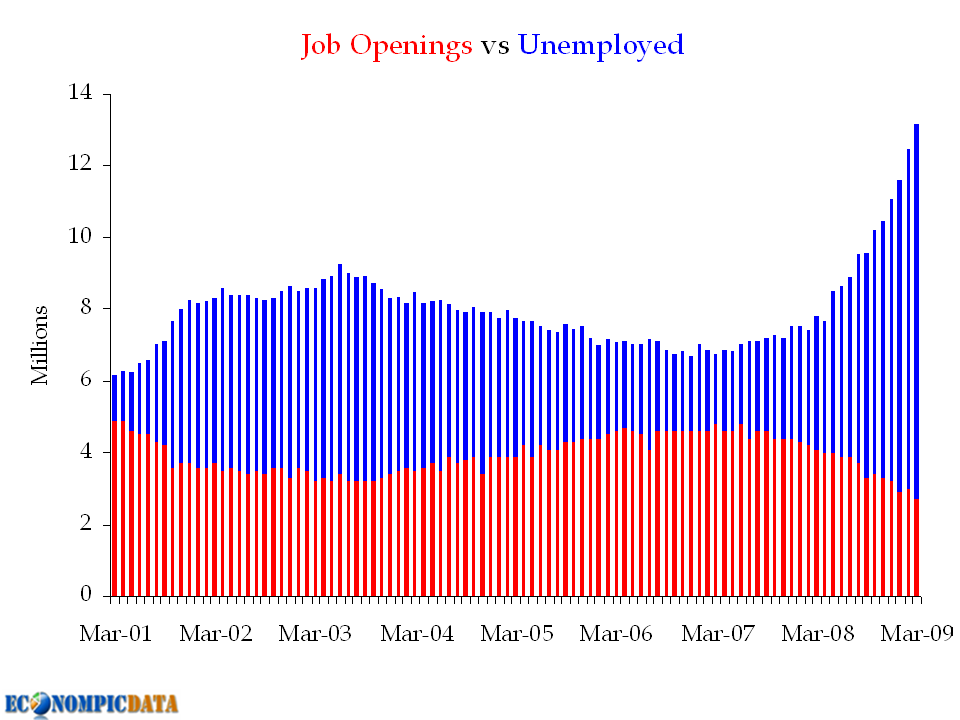
Courtney Schlisserman at Bloomberg reports that ADP Employer Services has released its estimate that US companies cut about 532,000 workers from their payrolls in May. "April’s reading was revised to show a reduction of 545,000 workers, up from a previous estimate of 491,000." Barry Ritholtz at the Big Picture links to Econopic Data's graphs of Job Openings plus number of Unemployed:


There are nearly five times as many reported unemployed people as there are reported job openings.

14. EIA REPORTS CRUDE STOCK BUILD

The EIA reported that, for the week ended May 29, commercial stocks of crude oil grew by 2.9 million barrels to nearly 366 million barrels.


As you can see from the EIA's graph above, commercial stocks remain quite high, historically speaking, and the stock build was contrary to analyst expectations of a 1.5 million barrel draw, per the Bloomberg survey. Gasoline stocks fell by 200,000, versus analyst expectations of a 650,000 build, and are below the five year average historical range for this time of year. Distillate stocks continue to grow by 1.6 million barrels.

Monday, June 1, 2009

Daily Sources 6/1

1. BOTH OFFICIAL AND PRIVATE CHINESE PMI'S SHOW MANUFACTURING GROWING IN MAY, IN BEIJING SPEECH GEITHNER FULLY BACKS INCREASED CHINESE INPUT INTO INTERNATIONAL FINANCIAL SYSTEM DECISIONS

Liu Li at the Wall Street Journal reports that both the official Chinese purchasing managing index (PMI) as well as the privately-produced index produced by the CLSA which has a large following indicate that the manufacturing sector was expanding in May.
"China's official Purchasing Managers Index, issued by the China Federation of Logistics & Purchasing, came in at 53.1 in May, compared with 53.5 in April, the third month the indicator has stayed above 50, after remaining below that level for five consecutive months. A PMI reading above 50 indicates growth, while a reading below 50 indicates contraction.

Meanwhile, the CLSA China PMI, which is compiled by U.K.-based research firm Markit Group Ltd., rose to 51.2 in May, from 50.1 in April, marking the second consecutive month the CLSA PMI was above 50, after eight months below the key level."
Meanwhile, China Journal's Sky Canaves posted the full text of Timothy Geithner's speech at Peking University today. Key excerpt:
"As part of this process of reform[ing the international financial system], the United States will fully support having China play a role in the principal cooperative arrangements that help shape the international system, a role that is commensurate with China’s importance in the global economy.

I believe that a greater role for China is necessary for China, for the effectiveness of the international financial institutions themselves, and for the world economy.

China is already too important to the global economy not to have a full seat at the international table, helping to define the policies that are critical to the effective functioning of the international financial system."
Geithner reiterated the meme that US-Chinese cooperation is required for the successful management of the current roster of problems facing the globe.

2. CHINA'S NATIONAL ENERGY ADMINISTRATION CHIEF TOLD MEDIA THAT SUBSTANTIAL AMOUNT OF CHINESE OIL PURCHASES IN 1H 2009 WERE FOR STOCKPILING PURPOSES AND NOT CONSUMED, ON BACK OF OPEC DECISION TO LEAVE OUTPUT AS IS, CHINA RAISES RETAIL PRICES ON GAS

John Liu at Bloomberg reports that Zhang Guobao, the director of China's National Energy Administration, told reporters today that
"Crude stockpile facilities at most countries have been fully filled in the first half. It will be difficult for those countries to greatly increase crude reserves in the second half as they did in the first."
Mr. Zhang provided more evidence that Chinese stockpiling had put a bottom on the price of crude, saying that "a substantial portion" of the crude oil trade in the first half had been due to stockpiling, and that the consuming countries weren't, in fact, consuming the oil they had purchased. Zhang said:
"Analysts should pay attention to this phenomenon when predicting the future trend of oil prices."
And Ben Sharples at Bloomberg reports that Fereidun Fesharaki suggested at an oil conference in Darwin Australia that there is a scenario where:
"sometime in the middle of summer, there will be a $20 drop in the price of oil because of the huge inventory build-up taking place."
He expects OPEC to cut production again if prices reach $40/b--though it is unclear whether the managers of China's SPRs will cooperate at that point. Meanwhile, Platts reports that China's National Reform and Development Commission announced it was raising the retail price of gasoline and diesel by 400 Yuan/metric ton ($7.85/b) on Sunday.
"In south China's Guangdong market, the retail price of gasoline rose 6% to Yuan 5.35/liter, Yuan 5.76/liter and Yuan 6.24/liter for 90 RON, 93 RON and 97 RON, respectively, while the retail price of gasoil rose 6.6% to Yuan 5.50/liter."
(American markets tend to offer 87-93 RON gasoline. 5.35 Yuan/liter ~ $2.97/gallon.) If $2.50-3.00/gallon begins to cut into demand in the US, I suspect it may limit the growth in consumption in China driven by record new car purchases resulting form the stimulus program.

3. ERNST & YOUNG REPORT THAT MIDDLE EAST OIL COMPANIES TO SPEND LESS ON NEW OIL PRODUCTION CAPACITY THAN REST OF WORLD

Spencer Swartz at Environmental Capital reports that Ernst & Young published a report today which shows that the national oil companies of the Middle East will be outspent by the national oil companies of Russia, China, and South America on developing production capacity. Only African national oil companies will spend less.
"E&Y, which looked at data from 20 of the biggest national oil companies, says spending should total about $270 billion this year. Chinese and Indian companies will top the list with $100 billion; South America, led by Brazil, will spend $91 billion; Russia and the former Soviet republics, $36 billion; the Middle East, $29 billion; and Africa, $21 billion."
I am unsure of what this means, after all the competitive advantage of Middle Eastern oil is mostly that it is relatively easy to get out of the ground and a great percentage of the world's spare production capacity happens to be in the Middle East.

4. SUN ZHE ARGUES BEIJING'S PRIMARY CONCERN RE: PYONGYANG IS WHETHER OR NOT IT CAUSES TOYKO TO CHOOSE TO BUILD NUCLEAR WEAPONS

Andreas Lorenz of Der Spiegel conducted an interview with Sun Zhe, professor at the Institute for International Studies at Beijing's Tsinghua University, regarding North Korea's intentions, Beijing's worries, and potential outcomes given the noise coming from Pyongyang.Key excerpt:
"Sun: The only way to exert pressure on Pyongyang is to cut off deliveries of energy and food.

SPIEGEL: Is that what will happen now?

Sun: No. I don't think that our government will radically alter its policies toward North Korea. It is in a particularly bad position. If it goes along with international sanctions, it gives the impression that it is serving as the handmaid to American foreign policy. It won't let that happen under any circumstance.

SPIEGEL: Will China do anything to antagonize the North Koreans?

Sun: More than anything, Beijing wants to prevent Japan from using the situation in North Korea as an excuse for becoming a nuclear power itself."
Dr. Sun indicated that he thought the way forward would be for the US to engage in direct talks with Pyongyang and to try and arrange a "soft landing" for the country. Worth reading in full.

5. U.K. MILITARY COMMANDERS TELL BROWN HE'S UNDERMINING CENTRAL PILLAR OF U.K. INTERNATIONAL STRATEGY

Kim Sengupta at the UK Independent reports that British senior commanders have warned Gordon Brown that unless the country commits a size-able force to the effort in Afghanistan, it will lose credibility with the US.
"Mr Brown has until now turned down, on cost grounds, the generals' proposal to send 2,500 extra troops in support of the projected US-led 'surge' against the Taliban. Instead, he has authorized a deployment of 700 temporary troops to cover the period of the forthcoming elections in that country. But The Independent has learnt that defense chiefs have persuaded the Government to review the situation in the autumn. Even then, any increase is likely to be in the hundreds rather than in the numbers that the Army believes are needed.

In a sign of the private concern felt by senior military personnel over the Government's stance, General Sir Richard Dannatt, the head of the Army, has publicly warned that Britain's strategic alliance with US is at risk unless British forces are seen to be pulling their weight in Afghanistan.

In a speech to the international relations think-tank Chatham House he said: 'Britain's calculation has long been that maintaining military strategic "partner-of-choice" status with the United States offers a degree of influence and security that has been pivotal to our foreign and defense policy. But this relationship can only be sustained if it is founded on a certain "military credibility threshold".

'Credibility with the US is earned by being an ally that can be relied on to state clearly what it will do and then does it effectively. And credibility is also linked to the vital currency of reputation.' General Dannatt added that 'unfairly or not' British performance in Iraq and Afghanistan has already been called into question by some in the US administration."
Worth reading in full. (h/t Greg Scoblete at The Compass.)

6. SERIOUSNESS ON SETTLEMENTS SURPRISES ISRAELI CABINET, GIVES OBAMA MORE CREDENCE FOR UPCOMING MIDDLE EAST TRIP

Marc Lynch at the Abu Aardvark's Middle East Blog notes that the Israeli negotiating team has reportedly been shocked by the Obama Administration's unwillingness to back down on the issue of no new settlements--and his apparent ability to consolidate support for the position in Congress. Lynch notes that Saudi paper al-Hayat published on the front page today an interview with General Petraeus where he argues that a resolution of the Israeli-Palestinian conflict will increase US security. Lynch remarks:
"As Obama leaves for Saudi Arabia and Egypt, he will thus benefit from the headlines and op-eds in the Arab press featuring his strong stand on the settlements. His team has done an outstanding job setting the stage, establishing its credibility both with Israeli and Arab audiences and generating real momentum. It should help him get a receptive audience for the much-anticipated address, and allow him to point to deeds matching words (the most frequent Arab criticism of his outreach thus far)."
7. FINANCIAL CRISIS WILL LIKELY FORCE CONSOLIDATION OF GULF'S FINANCIAL SECTOR

JCW at Frontier Markets reports that AT Kearney recently published a study which concluded that the Gulf banking sector was ripe for consolidation, given the current financial crisis.
"AT Kearney’s study notes that the banking market in the [Gulf Cooperation Council] is largely fragmented, as the top three banks account for just 14% of market share. 'We see great potential for regional banks to consolidate and grow regionally,' said Dr. Alexander von Pock, senior manager of the Financial Institutions Group of AT Kearney Middle East."
Perhaps the private sector will take the lead in creating a regional market going forward, given that the UAE's recent decision to withdraw from the monetary union project--see Daily Sources 5/20 #5.

8. NEW ATTACK IN BALUCHI IRAN, TEHRAN CLOSES BORDER WITH PAKISTAN, PAKISTAN VOWS TO DESTROY MILITANTS RESPONSIBLE

Thomas Erdbrink at the Washington Post reports that five people have died in an arson attack Monday in Zahedan, where a mosque was destroyed by a bomb attack last week.
"Monday's arson attack capped several days of violence in the volatile southeastern province of Sistan va Baluchistan, where an Islamist group called Jundullah has asserted responsibility for the mosque bombing Thursday."
On Saturday, Iran summoned the Pakistani Ambassador to discuss the group, which is based in Pakistan. Saleem Shahid at the Dawn reports that on Monday Iran completely closed its border to Pakistan. The Tehran Times reports that Pakistan's interior ministry has vowed to wipe out the group, having shared all the intelligence they have on the insurgency with the ISI and military intelligence. Strangely, the story reports that the interior ministry had reported that it had shared its information with the FIA, or the interior ministry's branch of intelligence, the Federal Investigation Agency. (For the last two items, h/t to Juan Cole at Informed Comment.)

9. OPEC SUPPLY UP BY 405 KB/D IN MAY FROM APRIL

Karyn Peterson and Mark Shenk at Bloomberg report that according to a survey by the news wire OPEC supplied the market 405 kb/d more crude in May, or 1.5% more, than it had April.
"Saudi Arabia, the United Arab Emirates, Kuwait and Qatar were the only OPEC members to produce less oil than their respective targets during both April and May.
...
Iran, OPEC’s second-biggest producer, raised daily output by 80,000 barrels to 3.78 million, the biggest increase of any member. The country’s production is now averaging 444,000 barrels a day above its target, exceeding the quota by more than any other member, according to the survey.

Venezuela reduced output by 25,000 barrels to 2.1 million barrels a day, the only production decline. The country produced 114,000 barrels a day in excess of its target of 1.986 million last month, the survey showed."
10. CHÁVEZ NOW TARGETING MILITARY, CONFLICT WITH MARIO VARGAS LLOSA DRAWS IRE OF BRAZILIAN SENATE, AND CHÁVEZ BACKS OUT OF PROMISE TO DEBATE HIS INTELLECTUAL OPPONENTS

Fausta Wertz at the Compass has an excellent summary of recent moves by the Chávez administration to put an end to all significant sources of opposition to his government in Venezuela, including more recently efforts to oust any objectors inside the military. Her account of Chávez's conflict with Mario Vargas Llosa is especially interesting. He was arrested on May 25, causing the Brazilian Senate to, on May 29, officially ask for an explanation for why the Peruvian writer had been detained. Of course, in late May Brazilian papers reported that Caracas was in the process of negotiating loans for as much as $4.3 billion from the Brazilian state development bank--see Daily Sources 5/22 #6--and the Senate has just launched an investigation into Petrobras, the state oil company, itself for tax evasion and the illegal granting of contracts--see Daily Sources 5/28 #7. Wertz's account:
"Chávez is in the middle of a four-day-long cadena, celebrating the 10th anniversary of his TV program Aló Presidente, which all licensed TV and radio stations in the country have to broadcast live. During yesterday's rambling monologue he invited the conference speakers to debate him live at 11AM Saturday morning. Mario Vargas Llosa agreed almost immediately after Chávez issued the invitation, on the condition that it would be a debate with Chávez himself. Enrique Krauze also agreed, requesting that there be clear rules for a debate so it wouldn't become a [Chávez] monologue, saying

'It would be a splendid opportunity for the Venezuelan TV audience, who for ten years have watched president Hugo Chávez daily for four or five hours, in an almost total monologue.'

Jorge Castañeda also agreed under the same conditions.

I have met Mario Vargas Llosa and he is a brilliant speaker, a most erudite and knowledgeable man with a first-rate mind. I have also met Enrique Krauze, who is equally impressive. You better have all your ducks in a row if you're going to debate any of the two, much more so if you are going to debate the two together.

Chávez must have recognized that; he backtracked.

At first Chávez refused to debate Mario Vargas Llosa, stating "In order for me to debate Vargas Llosa, he would have to be president of Peru," but later on he stated he would moderate the debate between the Cedice participants and his - unnamed - supporters,

'I can help as moderate the debate, but the debate is among intellectuals, and I am simply a president, a soldier.'

Of course, Mario Vargas Llosa, upon hearing that, deplored that Chávez is not a man of his word and denounced that Chávez was not interested in a dialogue, since 'autocrats do not know how to dialogue.'

Chávez canceled today's TV show with no explanation."
Well worth reading in full.

11. CUBA & U.S. TO RESUME DIRECT TALKS ON MIGRATION AND DIRECT MAIL, OAS VOTE EXPECTED TO FAVOR HAVANA

John Whitesides at Reuters reports that Cuba has agreed to a US proposal to resume talks regarding migration issues between the two countries and the possible establishment of a direct mail link. Direct talks on migration had been eliminated in 2003. Havana also indicated an interest in counter-terrorism, counter-narcotics trafficking, and hurricane disaster responses--all areas where the two countries have had significant cooperation despite their ideological hostility. Whitesides reports that at the OAS meeting tomorrow the vote to readmit Cuba is expected to pass--readmission requires a two-thirds majority.

12. BRAZILIAN INDUSTRIAL PRODUCTION UP 1.1% IN APRIL FROM MARCH, DOWN 14.8% ON THE YEAR

Andre Soliani and Iuri Dantas at Bloomberg report that Brazilian industrial production rose by 1.1% in April from March, the fourth straight month over month increase seen in the country. April's industrial output was down 14.8% from the year previous.

13. NUMBER OF SUPPLIERS SHIPPING TO THE U.S. NO LONGER IN FREE FALL, BUT 31% ARE SEEING 50% OR MORE DECLINES IN VOLUMES; PRICES FOR SHIPPING APPEAR TO BE RECOVERING, BUT ONLY ON THE BACK OF IDLED CARGO SPACE

Phil Izzo at Real Time Economics reports that according to Panjiva, Inc, the number of companies exporting to the US is no longer in freefall, but that
"Panjiva compiles a Watch List of manufacturers suffering a 50% decline in volume shipped to US customers in the most recent three month period, versus the same period a year ago. In April, 31% of significant suppliers were on that list, up from 30% in March and 24% as recently as December of last year."
Rates appear to be recovering for shipping per the Baltic Dry Index:


but this appears to be due, in part, to the shipping industry idling a considerable portion of their respective fleets.

14. INCOMES RISE BY 0.5% ON INVESTMENTS, NOT WAGES, AND CONSUMER SPENDING FELL 0.1% IN APRIL FROM MARCH; IMF EXPECTS JOB LOSSES TO CONTINUE WELL INTO 2010; ISM PMI STILL INDICATES DECLINE AT 42.8 IN MAY, BUT UP FROM APRIL; GM INDICATES WHICH 14 FACTORIES IT WILL SHUTTER IN THE U.S. AS PART OF BANKRUPTCY FILING

The Associated Press reports that data released today showed that consumer spending fell by 0.1% in April from March, but incomes rose by 0.5%, surprising economists, and on top of flat wages and salaries, meaning, presumably, that the balance was made on returns on investments. Meanwhile, Bob Davis at Real Time Economics reports that the number two man at the IMF, John Lipsky, said in an interview that he didn't expect unemployment to begin to fall in the developed nations until "well into next year." Lipsky said:
"Economic data may indicate that GDP has stopped contracting and started increasing, but the ‘man on the street’ will not be completely convinced things have turned around until they can stop worrying about losing their jobs."
(Though I suppose the survey data on confidence is pretty good, considering.) And Justin Lahart at Real Time Economics reports that the Institute for Supply Management's PMI rose to 42.8 in May from 40.1 in April. (Anything above a 50 indicated expansion; anything below indicates contraction.) Lahart quotes the chair of the ISM, Norbert Orr:
"I believe we’re in the recovery stage right now. We’ve seen a dramatic improvement in new orders that comes as a result of the major inventory correction."
Meanwhile, Nick Bunkley at the New York Times reports that GM has designated 14 factories that it will close in the US as a part of its filing for bankruptcy.