Showing posts with label Ireland. Show all posts

Tuesday, July 20, 2010

Daily Sources 7/20

1. BUNDESBANK SAYS CURRENT-ACCOUNT DEFICITS OF IRELAND, SPAIN, GREECE AND PORTUGAL THREATEN EUROZONE

Thomas Molloy at the Independent reports that the economic policies of Ireland, Spain, Greece, and Portugal represent a threat to the Eurozone as a whole and the entire Euro project.
"'These macro-economically erroneous trends' are 'a source of danger for other member countries and the currency region as a whole,' the Bundesbank wrote in its monthly bulletin. Deficit countries damage the eurozone's stability and 'it is urgently necessary to correct maldevelopments and avoid a repetition in the future'."
2. EUROPEAN COMMISSION TO BAN COAL SUBSIDIES BY 2014

James Kanter at Green reports that the European Commission has tentatively banned subsidies for coal mining starting 2014.

3. PEW SAYS THE DEVELOPED WORLD UNHAPPY WITH CHINA'S RISE

Free Exchange notes that concerns about China's economic might are high in the developed world. Much of the developing world ain't so keen on its rising military prowess either.


4. CHINA NOW THE WORLD'S LARGEST ENERGY USER

Grant Smith at Bloomberg reports that according to the IEA China is now the largest user of energy consuming 2,252 million metric tons of oil equivalent in 2009 versus the 2,170 million tons used by the US. Somewhat oddly, Shai Oster at China Real Time reports that the Chinese leadership has rushed to deny that it is now the largest energy user, saying that by their calculations the US remains top dog in that department.

5. JAPAN AND CHINA TO NEGOTIATE HOW TO DEVELOP UP EAST CHINA SEA GAS

Takeo Kumagai at Platts reports that Japan and China are seeking to schedule negotiations on how best to jointly develop the East China Sea gas fields which have been the source of some friction between the two governments.

6. US AND SOUTH KOREA TO CONDUCT NAVAL DRILLS NEXT WEEK

After a delay which caused some to speculate that the US was worried about upsetting China, Elisabeth Bumiller and Edward Wong at the New York Times report that the US and South Korea have agreed to hold naval exercises in the Sea of Japan and Yellow Sea next week. The exercises are in part a response to the sinking of a South Korean ship by a North Korean submarine four months ago. Beijing has strongly objected to the US holding naval drills in the Yellow Sea.

7. JAPAN TO CONSIDER ENERGY HUB AMBITIONS

Takeo Kumagai at Platts reports that Japan is considering using its spare storage capacity to act as an energy hub in the region. Japanese oil consumption is on a downward trend leaving considerable spare capacity. Some are considering using that spare capacity to export out into regional markets extra petroleum products, becoming the third trading hub in the region after Singapore and South Korea.

8. RUSSIA SENDS MISSION TO CLARIFY BORDER ON ARCTIC SHELF

Elena Kovachich at the Voice of Russia reports that
"The flagship of Russia’s polar fleet “Academician Fyodorov” has left for the Arctic on an expedition to clarify the outer border of the country’s continental shelf."
9. NABUCCO COMPLETES PUBLIC HEARINGS IN TURKEY

Alex Froley at Platts reports that the Nabucco pipeline project has completed the first round of public hearings in Turkey.
"Erdal Tuzunoglu, managing director for Nabucco Turkey, said: 'The completion of the public hearings is an important step towards the realization of the Nabucco project. The communities are very interested in the project and we feel that their concerns were addressed and discussed.'"


10. JUNE UNEMPLOYMENT BY STATE SHOWS IMPROVEMENT

Phil Izzo at Real Time Economics reports that the Bureau of Labor Statistics announced that most states--37--saw unemployment fall in June, while five saw an increase and in six there was no change. 27 saw a decrease in payroll employment while 21 saw an increase. Click on the link for neat interactive map and chart.

11. THE WHITE HOUSE ANNOUNCES FORMATION OF NATIONAL OCEAN COUNCIL

John M. Broder at Green reports that the White House yesterday announced the creation of a National Ocean Council. The new body will not have the power to create new regulations, but will attempt to coordinate the policy of overlapping institutions regulating ocean policy. Worth reading in full.

Monday, July 19, 2010

Daily Sources 7/19

GOLDMAN SACHS BEING FROZEN OUT OF EUROPEAN SOVEREIGN DEBT OFFERINGS

Elena Moya at the Guardian UK reports that European governments are freezing Goldman Sachs out of debt offerings. An observer in France says that there would be rioting in the streets if Paris chose Goldman to lead a bond sale. Worth reading in full.

PRIVATE EQUITY INVESTMENT IN INDIA GROWING RAPIDLY

James Lamont at beyondbrics reports that India's private equity market is predicted to reach $17 billion this year.
"New investments will originate from the US where investors seek to participate in India and China’s high growth profiles. Average deal size among private equity investments this year is already between $50m and $200m, up from an average of $21m last year."
CLINTON ANNOUNCES NEW AID PROJECTS FOR PAKISTAN

BBC News reports that US Secretary of State Hillary Clinton announced a number of new aid projects for Pakistan worth $500 million. The projects include the building of two new hydroelectric dams. The aid money comes from a five year $7.5 billion aid package agreed to by Congress last year.

HUNGARY SUSPENDS BUDGETARY REVIEW BY IMF AND EU

Judy Dempsey at the New York Times reports that Hungary's government has stated that it will not pursue further austerity measures despite pressure from international creditors. The IMF and EU suspended a budgetary review of Hungary over the weekend.

MOODY'S DOWNGRADES IRISH DEBT

Matthew Saltmarsh at the New York Times reports that Ireland's debt has been downgraded by Moody's to Aa2 from Aa1. It's outlook has been changed from stable to negative. Not sure why anyone would pay any attention to the ratings agencies after this last bugaboo, but there you have it. The rating is still well above junk.

IRANIAN REVOLUTIONARY GUARD PULLS OUT OF PHASES 15 AND 16 OF SOUTH PARS

Aresu Eqbali at Platts reports that due to sanctions, the Iranian Revolutionary Guard has pulled out of phases 15 and 16 of the South Pars project.
"The IRGC and its affiliates have grown into an economic power in Iran, largely as a result of a succession of UN sanctions imposed by the international community over suspicions that Tehran is secretly developing nuclear weapons, a charge the Iranians deny.

The involvement of IRGC or its subsidiaries would make it difficult to source parts and equipment from foreign companies, which run the risk of being in breach of the sanctions should they have to deal with Khatam al-Anbiya or any other banned entity."
BOEING SELLS 30 777S TO DUBAI

Christopher Drew at the New York Times reports that the Dubai-based Emirates Airlines has put in a purchase order to Boeing for 30 777s. Airbus has sold 131 commercial airplanes this year; Boeing has sold 177.

WATER START UP SEEKS MARKETS IN INDIA, SAUDI ARABIA, CYPRUS AND IRAQ

John Collins Rudolf reports that a start up company in Texas plans to ship fresh water from Sitka, Alaska, to markets in India, Saudi Arabia, Iraq, and Cyprus. The company has no contracts yet, but has signed a deal with Sitka.

MOZAMBIQUE SOURCE OF COKING COAL FOR CHINA, INDIA, AND SOUTH AFRICA

Frontier Markets reports that interest is growing in Mozambique from China, India, and South Africa due to its reserves of coking coal for use in their steel plants.

BUILDER CONFIDENCE IN NEWLY BUILT, SINGLE FAMILY HOMES DECLINES ACCORDING TO HMI

Free exchange opines that the outlook for housing will be grim for the foreseeable future.


TWO AND HALF MILLION UNEMPLOYED LOSE ACCESS TO UNEMPLOYMENT BENEFITS

Phil Izzo at Real Time Economics reports that 2,502,000 jobless Americans have lost access to unemployment benefits since June 2.
"The Senate is expected next week to vote to extend unemployment benefits, but the delay has caused a lapse in benefits for some 2.5 million of the nation’s jobless."
Meanwhile, Tom Barkley at Real Time Economics reports that the National Association for Business Economics survey of 84 companies found that they were back in hiring mode. Meanwhile, Free Exchange reproduces a Brookings graph which plots the length of time it will take for jobs to reach the height seen prior to the recession with how many jobs need to be created.


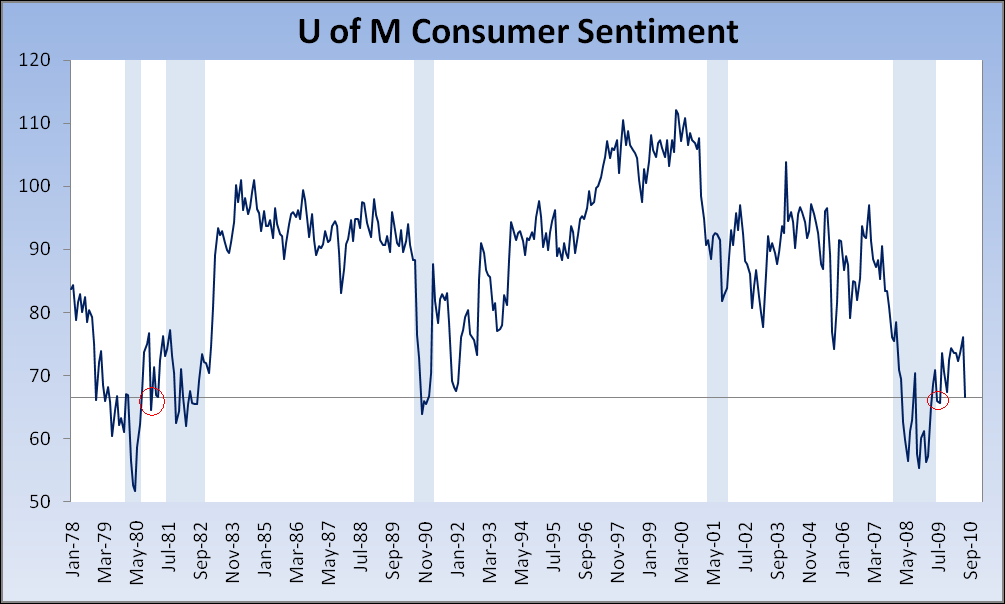
Invictus at the Big Picture reproduces a graph from the University of Michigan's Consumer Sentiment Survey and notes that the reading looks a lot like the last time we had a double dip recession.


THE CLEVELAND FED REPORTS THAT THE PUBLIC EXPECTS INFLATION TO STAY BELOW 2% OVER THE NEXT DECADE
"The Cleveland Fed’s estimate of inflation expectations is based on a model that combines information from a number of sources to address the shortcomings of other, commonly used measures, such as the "break-even" rate derived from Treasury inflation protected securities (TIPS) or survey-based estimates."

Friday, June 19, 2009

Daily Sources 6/19

1. COMPROMISE LEADS TO NEW IRISH REFERENDUM ON LISBON TREATY IN OCTOBER

Carsten Volkery at Der Spiegel reports that the EU leadership have agreed upon a compromise insisted upon by Dublin where guarantees of sovereignty will be included in the text of the Lisbon Treaty. As a result, Irish Prime Minister Brian Cowen has announced that Ireland will hold a referendum on the treaty in October.
"The EU has provided guarantees to Ireland that it will remain independent in determining tax policies, military neutrality and abortion law (Ireland has one of Europe's most restrictive abortion policies). The sovereignty guarantees are expected to be anchored in EU law as a treaty protocol in the mid-term future."
Polls show that the Irish appear more receptive to the treaty, given the current economic crisis. Well worth reading in full.

2. THE EU TO BEGIN CONSIDERING HOW TO TRANSFER CARBON CAPTURE TECH TO CHINA & INDIA

Pete Harrison at Reuters reports that a draft document from the European Commission suggests that the EU will begin to determine how best to help India and China develop carbon capture technology next week.
"The European Union will start a consultation process on how finance and technology should be delivered to China and later India. This could be critical in securing their commitment to a new global deal on climate change at talks in Copenhagen in December.

'China builds, every year, as much coal-fired power plant as the entire UK generating capacity,' said a report prepared for consultations with industry and seen by Reuters on Friday.

'Unless a way can be found of making this climate-compatible, we can never meet our climate objectives, regardless of what action we take in Europe,' it added."
3. CHINA PROTESTS ADB LOAN TO INDIA, 74% OF CHINESE RESPONDENTS REGARD INDIA AS A THREAT

The India Times reports that the Chinese foreign ministry has issued a statement condemning the Asia Development Bank's recent decision to approve a $2.9 billion loan to India, $60 million of which is earmarked for a watershed project in the Arunachal Pradesh, where the border between the two countries is disputed.


The statement said:
"China expresses strong dissatisfaction to the move, which can neither change the existence of immense territorial disputes between China and India, nor China's fundamental position on its border issues with India.
...
As a regional institution on development, the ADB should not intervene in the political affairs of its members. The adoption of the document has not only dealt a severe blow to its own reputation but also undermines the interests of its members."
India has recently been strengthening the defenses in the region, including moving additional troops into it. The Chinese media has in the past few weeks been attacking New Delhi for putting "fresh strains on the relationship." In an interesting data point, a recent poll in China found that 74% of respondents look upon India as a threat.

4. CHINESE IMPLIED OIL DEMAND RISES 5.96% IN MAY YOY

Winnie Lee at Platts reported yesterday that Chinese implied oil demand rose by 5.96% in May from the year previous. Crude imports rose by 3.55% to to 16.62 million metric tons (~ 3.92 mb/d). It is the second consecutive month where implied demand has risen year over year, which could be interpreted as a sign the economy is rebounding. On the other hand, the director of China's National Energy Administration, told reporters on June 1st that "a substantial portion" of the crude oil trade in the first half had been due to stockpiling, and seemed to indicate that China's tanks were full--see Daily Sources 6/1 #2.

5. FRANCE STATS OFFICE PREDICTS ECONOMY WILL STABILIZE IN Q4

Eurointelligence reports that French statistical office INSEE released its latest forecasts this morning which see the economy stabilizing in the fourth quarter.
"Employment is expected to continue to fall, for 2009 the loss is expected to reach 700,000 jobs in the private sector. Consumption growth is still positive (forecast at +0.7%), though saving rates are about to rise slightly. France seems thus in a much better position than the rest of the euro area, for which GDP is forecast to contract by 5.6% and consumption by -1.6%."
6. BANK OF MEXICO CUTS BENCHMARK INTEREST RATE TO 4.75%

Jens Erik Gould at Bloomberg reports that the central bank of Mexico today cut its benchmark interest rate by 0.5% to 4.75%.
"The [bank's] board 'considers that its easing cycle is close to ending,' the bank said in a statement. 'Future actions that might be taken will possibly be of smaller magnitude and consistent with both the evolution of the economy and the performance of inflation.'

The economic contraction has been 'severe' in the first half of the year, and is a greater risk than inflation, the bank said. The comments signal that it will probably cut a quarter point next month and then keep the rate unchanged for the rest of the year, said Gabriel Casillas, chief economist for Mexico and Chile at UBS AG."
7. ANGOLA STILL PLANS TO LAUNCH SOVEREIGN WEALTH FUND THIS YEAR

Henrique Almeida at Reuters reports that Angolan Finance Minister Severim de Morais said today that Luanda intends to launch a sovereign wealth fund in 2009 to invest its oil wealth abroad.
"Plans to create the fund, known as the Fundo Soberano Angolano, were announced in November by President Jose Eduardo dos Santos, but the project has since been delayed due to the global economic downturn.

Asked whether the fund would be launched this year, de Morais replied: 'Yes, our aim is to launch the fund in 2009.'"
8. CREDIT CARD SQUEEZE HURTING SMALL BUSINESSES, UNEMPLOYMENT IN THE WEST RISES TO 10.1% IN MAY

Yves Smith at naked capitalism notes that the credit card squeeze is hurting small businesses, historically the largest source of job creation in the US.
"The importance of credit cards as a source of funding to small companies has gone largely unnoticed in the wider world, yet is well know to experts on entrepreneurship. Indeed, Amar Bhide, in his landmark The Origin and Growth of New Businesses, pointed out that, contrary to popular mythology, venture capital played a trivial role in forming new businesses. Personal savings, loans or investments from friends and family, and credit card borrowings were the most important sources.

And before readers chide supposedly foolish owners for paying interest, consider: using credit cards includes the astute use of float, which can give companies six or seven weeks of free money. And in better days, card companies offered products targeted to small business owners with favorable rates, often from 9% to 14% (and also offered them even cheaper 'life of the balance' deals, now a distant memory). With interest tax deducible, this was a viable source of funds, particularly for companies that faced short-term financing needs, such seasonal sales patterns.

As we noted, American Express, first to target small businesses, halted its credit line programs as of early 2009 (regular corporate ards for small businesses are still in effect). Advanta, which focused solely on this market, has found itself saddled with a heap of bad debt (default rates of 20%) and has stopped extending new credit as of early June."
Well worth reading in full. Meanwhile, the Associated Press reports that the Labor Department announced today that the unemployment rate rose to 10.1% in the American West in May.
"By region, the Midwest had the second-highest rate, at 9.8%, underscoring the toll of job losses in manufacturing. The South’s unemployment rate was 8.9%, and the Northeast had the lowest at 8.3%."
Unemployment rose in all but two states last month.

Monday, May 18, 2009

Daily Sources 5/18

1. GLOBAL HOUSING BUBBLE STILL LOOKS UNPOPPED

On Saturday, Rebecca Wilder at News N Economics took a look at the global housing bubble. She plots a graph of price-rent ratios for Ireland, Spain, the UK, Germany and the US indexed to 1997:


She says she "included the German price-rent ratio to show that housing bubbles are not uniformly the root cause of economic decline." Worth a look.

2. SUPPORT FOR LISBON TREATY IN IRELAND, ITS NEXT BATTLEGROUND, GROWS

Stephen Collins at the Irish Times reports that 52% of respondents in a new survey indicated that they would support the upcoming referendum for the Lisbon Treaty.
"Asked if, in the current crisis, it is better for Ireland to be part of the EU, an overwhelming majority of 79 per cent to 10 per cent say Yes, with a very small number of undecided voters at 11 per cent.

There is a substantial majority in favor of the EU among all social classes, age groups and party supporters.

Not surprisingly, Sinn Féin supporters are easily the most negative about the EU, although a decisive majority are still in favor.

What is surprising is that the most enthusiastic supporters of the EU are Green Party supporters, followed by Fianna Fáil, Fine Gael and Labour in that order."
The largest trend spotted by the survey was a softening of the stance of women toward the treaty, where a significant percentage switched from "No" to "I Don't Know." Dublin registered the largest majority in support of the treaty. (h/t Eurointelligence.)

3. EU ENERGY COMMISSIONER GIVES CREDENCE TO PEAK OIL THEORY

The Oil Drum has reproduced the comments of Andris Piebalgs, the European Energy Commissioner, in which he suggests that he thinks that peak oil analysts may well be right.Key excerpt:
"The world is aware that the production of the existing oil wells is decaying and that new discoveries are more scarce and more expensive. Some experts consider that global oil production may have peaked at [84] million barrels a day. The current economic crisis can make the situation worse. The lower prices that we are enjoying now can be in fact bad news. At this price oil producers have been forced to postpone many necessary investments in new production capacity. These investments take decades to be accomplished. In consequence, if the current economic crisis finished and demand recovers we could be facing huge shortage of supplies that can lead to extremely high prices."
4. BAGHDAD-KRG DISPUTE HEATING UP FURTHER ON KURDISH INDEPENDENT OIL EXPORTS, KRG BECOMES LINKED TO BATTLE BETWEEN THE NABUCCO AND SOUTH STREAM PIPELINE ALTERNATIVES, RUSSIA STRENGTHENS LINKS TO KEY TRANSPORT AND DELIVERY NATIONS--ITALY, AUSTRIA, HUNGARY

Missy Ryan and Mohammed Abbas at Reuters report that Iraqi Prime Minister Nuri al-Maliki said in a televised interview last Thursday that power-sharing pacts that have Sunnis and Kurds a greater say in the affairs of the country need to be pared back. He said,
"In the beginning, consensus was necessary for us. In this last period, we all embraced consensus and everyone took part together. We needed calm between all sides and political actors. But if this continues it will become a problem, a flaw, a catastrophe. The alternative is democracy, and that means majority rule ... From now on I call for an end to that degree of consensus."
The rule of consensus has resulted in minority groups taking posts in senior administrative roles regardless of their share of the national vote. Moves to end the custom would clearly benefit the Shi'a majority in the country. In the meantime, Saifur Rahman at Gulf News reports that Sharjah-based upstream energy explorers Dana Gas and Crescent Petroleum, in conjunction with Austrian energy group OMV and Hungary's MOL have signed a partnership to invest as much as $8 billion in the Kurdish region's energy sector.
"The strategic partnership is expected to boost gas output in Iraq's ... northern Kurdistan province from the current 90 million standard cubic feet of gas per day to a potential 3 billion by 2014 and help meet the growing energy demand in the region and beyond."
Part of the notion touted by OMV and MOL is to find gas supply for the Nabucco pipeline. However, in March Gazprom signed a deal with MOL to establish a 1.3 billion cubic meters storage facility in Hungary--see Daily Sources 3/18 #4. And Euroactive today reports that Russian oil company Surgutneftgas recently took a 21.2% stake in MOL, for €1.4 billion (~ $1.86 billion at the interbank exchange rate of the time.) OMV had launched a failed takeover bid for MOL in 2007, which led to it selling its stake to Surgutneftgas in March. Surgutneftgas is thought to be close to Prime Minister Vladimir Putin.


The Kurdish Regional Government's oil minister, Ashti Hawrami indicated last week that oil from concessions signed without Baghdad's approval will begin to flow through the Iraq-Turkish pipeline and that the only way for Baghdad to put a stop to that would be to shut all exports via that line--see Daily Sources 5/12 #8. In a likely related development, Faleh al-Khayat at Platts reports that Iraq's parliamentary committee has asked the speaker to summon Iraqi oil minister Hussein al-Shahristan to be queried on his failures to move central government oil policy forward.
"The call for a summons came in a statement read out by an official from the speaker's office on Iraq's Al-Sharqiya satellite television channel. The official said the request was signed by 140 of parliament's 275 members."
Shahristani is in open conflict with the Kurdish Regional Government, refusing to grant the legitimacy of 20 oil and gas concessions the region has granted without central government say so. In the meantime, Isabel Gorst at the Financial Times reported Saturday that Berlusconi and Putin signed a deal in Sochi Friday to increase the capacity of the planned South Stream gas pipeline to 63bn cubic meters a year.
"Paolo Scaroni, Eni chief executive, said South Stream would improve Europe's energy security. "What is the meaning of this capacity extension of South Stream? It means 1 billion cubic meters more here will be 1 billion cubic meters less gas crossing Ukraine.""
It is interesting in this context that Iran appears to be arguing at this time for the Pars Pipeline, and now has it moving not through Turkey, but through Iraq and Syria to the Mediterranean, which could potentially thread it through Iraqi Kurdistan. Iran has its own concerns about its Kurdish minority, and has an interest in maintaining strong relations with a Shia-dominated government in Baghdad, so the fact that such a move has even been placed on the table is of some interest.

5. RUSSIAN ANALYSTS SAYING MOSCOW SHOULD FOLLOW THE US AND TURN TO THE FAR EAST

Yevgeny Bendersky at the Compass translates some geopolitical analysis from Russia's Daily Izvestia:
"So whats for Russia in all of this? At present, we stand on the sidelines of the revolutionary transformation of the economic world order. We pray for high oil prices. Why? So that once again we can accumulate dollar reserves and invest in the United States? What for? At the same time, Russia does not belong to any serious economic bloc.

The world will be divided into three main regions: the Americas, Europe and the East, warn the economists. United States will lose some of its power, the leadership will shift towards Asia. That is why America is in a hurry to make friends with China, in order to prevent the creation of a powerful Asian bloc. Where is Russia in the new structure of the world? The East, of course, is closer to us. Already, 96% of Russia's far eastern exports are geared for consumption by the neighboring Asian countries. We need to unite with them--especially in an era of globalization."
6. THE PLA ORDERED TO ESCHEW HEDONISM

Sky Canaves at China Journal reports that the Central Military Commission, the powerful Communist Party organ that controls the People’s Liberation Army, issued a directive over the weekend warning PLA officers against ostentatious displays of wealth. It is only anecdotal, but I have been led to understand that in order to do business in China, you must have contacts with the PLA.
"Today the People’s Liberation Army Daily carried a front-page article ... on the directive, pledging more stringent controls over mid-level and senior military officers, emphasizing accountability and party loyalty."
7. BRAZILIAN PRESIDENT IN BEIJING TO TRY AND MAKE FINANCING DEALS REALITIES

Andre Soliani at Bloomberg reports that Brazil's President, Luiz Inacio Lula da Silva, is in Beijing today where he hopes to make reality financing plans for a variety of projects.
"If Lula’s plans pan out, he’ll return with a $10 billion credit for Petroleo Brasileiro SA, an $800 million loan for the state development bank, and financing for ports and waterways. He expects he’ll be able to open China to Brazilian poultry."
(In February, Petrobras announced it had signed a $10 billion loan agreement with China’s Development bank--see Daily Sources 2/19 #1.)
"China, according to central bank figures, has invested $141.6 million in Brazil since Nov. 12, 2004 when Lula, with Hu beside him, said Brazilians could look forward to $7 billion of Chinese financing.

'Given the potential of both economies, the investments both ways could be much bigger,' China’s ambassador to Brazil, Qiu Xiaoqi, told reporters May 7 in Brasilia when asked why the plans hadn’t materialized.

The biggest Brazilian project announced by the Chinese, a joint venture of Baosteel Group Corp. and Vale to build a $3.6 billion steel-slab plant, was canceled in January.

'The Chinese have made Africa their priority,' said Sandra Rios, coordinator of Brazil-China Observatory, a study group created by Brazil’s Industrial Confederation. 'They expect to have a bigger political influence in that region than in Brazil.'"
8. INDIAN ELECTIONS STRENGTHEN THE MODERATE CONGRESS PARTY

Arvind Subramanian, a senior fellow at the Peterson Institute for International Economics, posts at the Baseline Scenario that the recent elections in India have resulted in a significant victory for the incumbent Congress Party and its allies and defeats for the Communists and the Hindu-nationalist BJP. He comments:
"Going forward, these results augur well for Indian economic policy reform. The Congress will be numerically strong enough not to have to rely on partners for political support and will be able to push through new policy initiatives.

Another likely consequence is that the Nehru family will probably provide India, not immediately but within the next couple of years, with its fourth Prime Minister—Rahul Gandhi, son of Rajiv Gandhi, grandson of Indira Gandhi, and great grandson of India’s first Prime Minister Jawaharlal Nehru.

These results are surprising for two reasons. Indian elections have traditionally been characterized by the phenomenon of anti-incumbency: ruling politicians get routinely thrown out of power. This government is the first in over 40 years that has been re-elected after a full term in office."
Subramanian notes that part of the reason for the Congress Party's success has been that India has been weathering the financial crisis relatively well. Well worth reading in full.

9. US SENATE TOLD PAKISTAN RAPIDLY ADDING TO NUCLEAR ARSENAL

Thom Shanker and David E. Sanger at the New York Times report that a Senate committee Thursday was told that Pakistan is rapidly adding to its arsenal of nuclear weapons. Adm. Mike Mullen, the chairman of the Joint Chiefs of Staff, in response to a question of whether or not aid sent to Islamabad might be diverted to nuclear programs said, "Yes."

10. ISRAEL ALLEGEDLY URGED BY OBAMA ADMINISTRATION TO TONE DOWN IRAN RHETORIC

Steve Linde at the Jerusalam Post reports that the US has been urging Israel to tone down its rhetoric on Iran in advance of Prime Minister Benjamin Netanyahu's visit to DC this week.
"This was one of the purposes of a secret trip to Israel three weeks ago by CIA Director Leon Panetta, foreign diplomatic sources said.

Ostensibly, the CIA chief came to share information on Iran's nuclear program with Israeli intelligence officials and find out how serious the new Israeli government was in its stated position that Jerusalem cannot allow Iran to become a nuclear power.

Panetta was hosted by Mossad chief Meir Dagan and intelligence officials, but also met with Netanyahu and Defense Minister Ehud Barak."
Worth reading in full.

11. MALAYSIAN STATE TO SET UP NEW SOVEREIGN WEALTH FUND ON OIL REVENEUS

Netty Ismail at Bloomberg reports that the Malaysian state of Terengganu is planning to organize a sovereign wealth fund of 11 billion ringgit (~$3 billion).
"The Terengganu Investment Authority, the first sovereign wealth fund set up by a Malaysian state, said it will manage the long-term oil revenue of the state, located on the east coast of peninsular Malaysia."
12. CONFLICT IN NIGERIA CONTINUES TO HEAT UP

Platts reports that tensions continue to escalate in Nigeria as MEND threatened in an emailed statement Sunday to shut all waterways to oil industry vessels. In addition,
"MEND claimed Sunday to have blown up two major oil and gas pipelines in the state. Sources told Platts that one belonged to the state-owned Nigerian National Petroleum Corp. and supplied crude to the 110,000 b/d Kaduna refinery, while the other was a gas pipeline operated by Shell that fed natural gas to power plants in the region. The extent of the damage was unclear."
13. AL-SHABAAB OFFENSIVE APPEARS TO BE MAKING HEADWAY AGAINST CENTRAL GOVT IN SOMALIA, ERITREAN SUPPORT ALLEGED

Stephanie McCrummen at the Washington Post reports that al-Shabaab has launched a ten day offensive across the Somali capital in an attempt to topple the Transitional Federal Government under the new President, Sharif Ahmed.
"Momentum has been swinging back and forth between the government and rebels for days, but on Sunday it seemed to be with the rebels, who include several leaders who US officials have said maintain ties to al-Qaeda. In a major blow, they took a key government stronghold, Ahmed's home town of Jowhar, about 50 miles north of the capital, giving them control of major routes to the north."
Apparently as al-Shabaab has scored military successes, fighters who had switched allegiances to Ahmed have switched back again.
"The Somali government and the United States accused Eritrea of supporting the group by flying cargo planes full of AK-47 assault rifles, rocket-propelled grenades and other weapons to a sandy airstrip outside the capital just before the rebel advance began. Eritrea has denied the allegations."


I am unclear on why it would be in the interests of Eritrea to support a hard line Islamist group's ascent in Somalia, given that it is 98% Orthodox Christian and Sunni Muslim (more or less even divided.) It's longstanding enmity with Ethiopia may account for some sympathy for any organization at odds with Addis Ababa, perhaps Asmara believes that al-Shabaab is the only organization capable of truly creating a state which will impose law and order in Somalia. Still, having done so, it seems that al-Shabaab's ties with al-Qaeda would mean that that would simply result in a state which would seek to export instability to the region.

14. RWANDA TELLS SECURITY COUNCIL TO PUT THE KIBOSH ON FOREIGN FINANCING OF REBEL ACTIVITY IN EASTERN CONGO

Anita Powell at the Associated Press reports that Rwandan Foreign Minister Rosemary Museminali told reporters following a meeting of UN Security Council representatives in Rwanda that:
"There are movers and shakers (of the [Hutu opposition group FDLR]) in Europe and the rest of the world. We believe they should be sanctioned, we believe they should be dealt with, if we are to support the peace process in Congo."
Rwandan forces joined the Congolese in a joint military action against rebel Hutu forces in eastern Congo in late January--see Daily Sources 1/23 #9. In that offensive, a rebel Rwandan Powell reports that in 2006 the US imposed sanctions on businessmen and "warlords" who were allegedly financing instability in eastern Congo, near the Rwandan border.
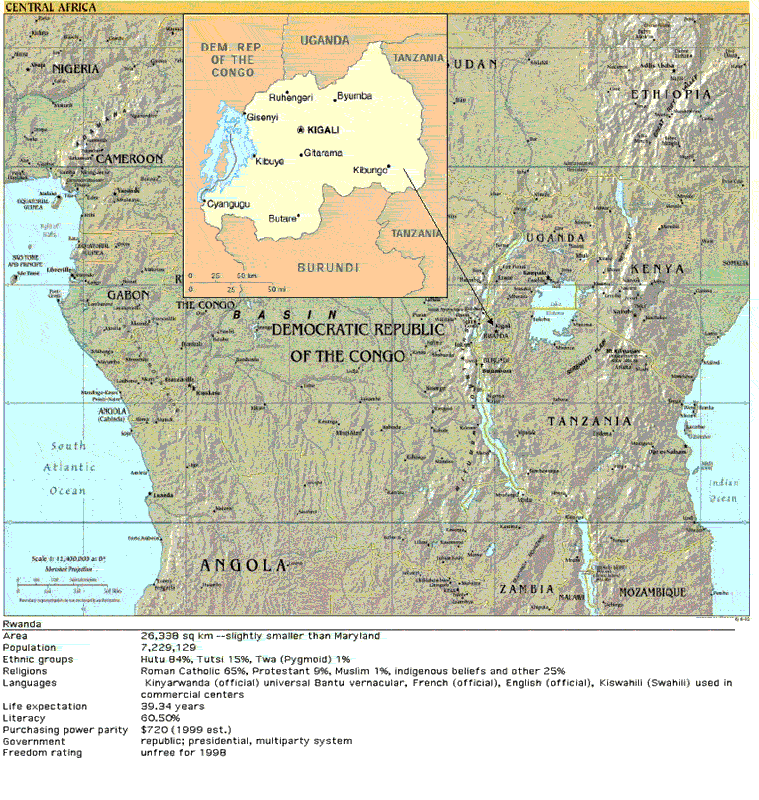


In November, Angola had reportedly sent troops to help Congolese forces combat rebels in the region, but it apparently took the active cooperation of the Rwandan government to make any serious progress--see Daily Sources 11/10 #8.

15. CHAD ENDS AIR STRIKES INTO SUDAN, SUDANESE REBEL APPEARS BEFORE THE ICC

Dany Padire at the Associated Press reports that Chad's interim defense minister, Adoum Younousmi, told the media that N'Djamena had ended air raids against Chadian rebel groups operating out of Sudan Sunday. Younousmi said,
"Our target was not the Sudanese government and less so the general population. Our objective was the Sudanese mercenaries wherever they were to be found, without causing any collateral damage."
The recent air attacks were the first attacks into western Sudan proper, where rebels have allegedly been operating, and whom N'Djamena has alleged Khartoum supports.
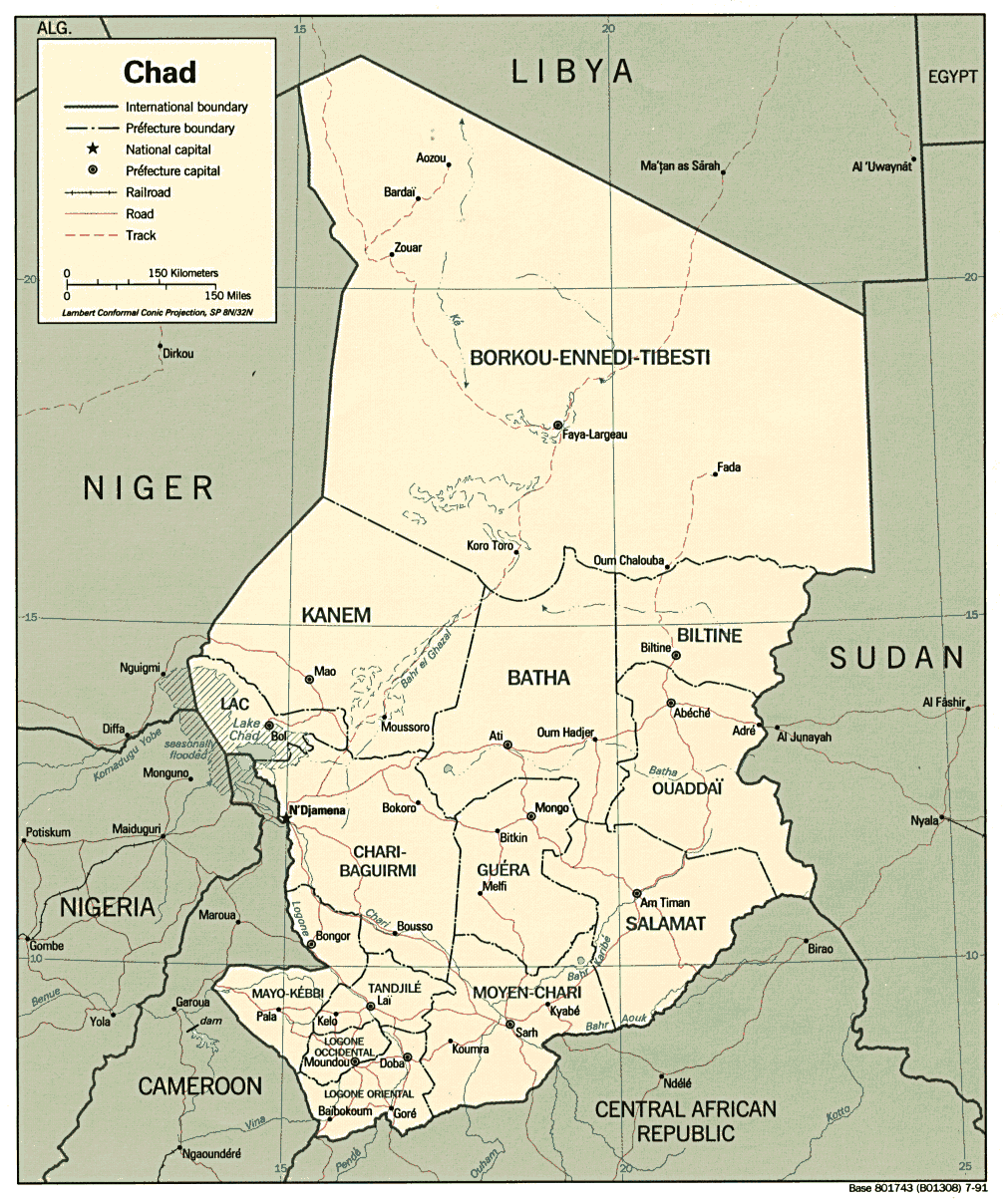
"Eastern Chad is a temporary home to about 300,000 refugees who have fled Sudan's Darfur conflict. The region also has camps for 187,000 Chadians displaced by fighting locally and in Darfur."
Younousmi said that the raids had destroyed seven pockets of rebels and that around 100 prisoners had been captured by ground forces operating in conjunction with the air attacks. In the meantime, BCC reports that a former member of the Darfur rebel group, the Justice and Equality Movement (JEM), Bahr Idriss Abu Garda has voluntarily appeared before the International Criminal Court to address charges of crimes against humanity leveled against him. (JEM is an Islamist group fighting the central government.) He is charged with taking part in an attack with killed 12 African Union peacekeepers in northern Darfur.


Mr. Abu Garda has since left JEM to form his own rebel movement, the United Resistance Movement. A spokesman for Mr. Abu Garda has argued that the charges against him are the result of fall out between him and JEM. The President of Sudan, Omar Hassan al-Bashir was charged with war crimes by the ICC in March and promptly expelled aid groups working in the Darfur region in response--see Daily Sources 3/6 #5.

16. NORWEGIAN PARLIAMENTARY VOTE ON CANADIAN OIL SANDS PARTICIPATION PUT OFF

Wojciech Moskwa and Terje Solsvik at Reuters report that the Norwegian government has delayed a parliamentary vote on whether StatOilHydro should withdraw from a $2 billion investment in Canada's oil sands.
"The oil sands issue has put the government in a bind four months before a general election, with political opponents saying state support for the oil sands project was hypocritical given the cabinet's self-professed environmental ambitions."
17. OBAMA ADMINISTRATION TO PROPOSE NEW NATIONAL CAFE STANDARDS

John M. Broder at the New York Times reports that the Obama Administration is set to announce as early as Tuesday new regulations for the emissions and mileage of cars and light trucks which will combine California's new auto-emissions rules with the existing corporate average fuel economy (CAFE) standard to create a single new national standard.
"Under the new standard, the national fleet mileage rule for cars would be roughly 42 miles a gallon in 2016. Light trucks would have to meet a fleet average of slightly more than 26.2 miles a gallon by 2016."
This is a big deal. Transportation accounts for about 60% of US oil consumption.

18. INDUSTRIAL REVOLUTION CAUSED BY CHEAP ENERGY, EXPENSIVE LABOR

In an extremely interesting piece, Robert C. Allen on Friday posted an article asking why the Industrial Revolution took place in England at Vox EU. His answer:
"The famous inventions of the Industrial Revolution were responses to the high wages and cheap energy of the British economy. These inventions also substituted capital and energy for labor."


It was difficult to transfer the technologies to places where either coal was expensive or labor was cheap. A must read. Note, just now many analysts expect the West, and the world, to enter a period where energy is expensive and labor is cheap.

Monday, April 13, 2009

Daily Sources 4/13

Trying a different way of organizing the daily sources ... all thoughts welcome.

SIGNS OF DEFLATION APPEARING IN EUROPE AND JAPAN ... JAPAN TAKES ADVANTAGE OF THE PRODUCTS AND CRUDE PICTURE IN THE PACIFIC TO ESTABLISH A PRODUCTS SPR

Ambrose Evans-Pritchard notes that Ireland's finance minister, Brian Lenihan, recently remarked that consumer prices were set to fall by 4% this year, indicating that the country is facing a serious bout of deflation.
"This is torture for a debtors' economy. You can survive deflation; you can survive debt; but Irving Fisher taught us in his 1933 treatise 'Debt Deflation causes of Great Depressions' that the two together will eat you alive."
Pritchard argues that the European Central Bank is serving the interests of Germany above those of Europe by continuing to pursue an anti-inflationary monetary regime, noting that both France and Spain are beginning to "tip" into deflation.
"If the ECB continues to serve as the instrument of German tastes, keeping German inflation near zero, then Club Med and Ireland must necessarily deflate into Hell with all their debts. Unless Germany accepts inflation of 4%, 5% or 6% for a while, the only way the South can claw back lost competitiveness is through outright wage cuts, and that is not a macro-economic option for debtors. Is anybody facing up to this core reality in euroland?"
(h/t Yves Smith at naked capitalism.) Worth reading in full.(1) Meanwhile, the Japanese government announced today that wholesale prices fell by 2.2% in March from a year earlier.
"The latest figures follow a revised 1.6% fall in the year to February. It was the third month in a row of annual declines.

Analysts say it is inevitable that changes in consumer prices will soon turn negative after flat annual figures for the years to January and to February.

Overall final goods prices, which track prices of final products charged to businesses, fell 2.6% in March from a year earlier. Domestic final goods prices fell 1.7%."(2)
In the meantime, Japan's METI is planning to introduce strategic storage of refined products for the first time this year.
"Japan first began considering stockpiling refined products in April 2006, after Hurricane Katrina wrought major destruction on the US Gulf producing and refining facilities in August 2005, and global oil consumers concluded what they needed to relieve supply shortages immediately was oil products rather than crude.

METI's priority products for emergency stockpiling are gasoline, gasoil, kerosene, and A-fuel oil (a blend of gasoil and fuel oil in a 90:10 ratio)."(3)
Given the relatively low price of crude just now, and the huge addition of refining capacity over the course of 2008 and slated for 2009, the upward pressure on products prices caused by meeting stocks requirements is not likely to be too severe. John Kingston echoes much of the industry's view when he writes that the recent addition of the 580 kb/d capacity refinery at Jamnagar, India, and throughout the Asia Pacific is making refinery closures more likely.
"The consensus? Refining capacity in Japan is at risk, given the weak economy there and an aging, shrinking population with a demand for petroleum that is destined to keep dropping (and without a tradition of being a significant exporter of products)." (4)
Indeed, this comes on top of the news that the IEA expects Asian crude supply additions to come to 218 kb/d this year in the midst of declining demand globally.(5) Kingston notes that Reliance, the Jamnagar refinery's owner, is not only aiming for the Asian market, but also expects to sell into the US. "About a month ago, Platts' Esa Ramasamy reported that Reliance USA, a subsidiary of Reliance Industries, has taken taken 1.3 million barrels of clean product storage in the New York harbor area.
"We concluded a deal with Hess to take storage at the Port Reading and First Reserve terminals," a Reliance source told Platts. The Port Reading terminal is located in Port Reading, New Jersey, and the First Reserve terminal is in Perth Amboy, New Jersey.

The acquisition of storage at the Port Reading and First Reserve terminals will enable Reliance to participate in the New York Harbor barge and Buckeye gasoline and diesel markets. "Now Reliance can be expected to be a supplier of heating oil to the US Northeast too," said a New York Harbor trader at the time."
CANADA IN A RELATIVELY GOOD FISCAL POSITION

Rebecca Wilder notes that Canada is in a much stronger position to pursue stimulus spending than much of the OECD given a much better balance sheet. Her chart of Canada's debt to GDP ratio:


"2009 will be in sharp contrast to the recent past. Deficit spending of federal and provincial governments is expected to total $57 billion CAD--3.7% of GDP or the biggest ever--on stabilization spending and the stimulus bill. However, compared to other governments, whose economies are in worse shape, the Canada's prudent attention to finances puts it in a better position to respond to the economic downturn." (6)
CHINA CONSIDERING A NEW STIMULUS PLAN ALONG WITH NEW OVERSEAS RESOURCE ACQUISITIONS

China's State Council will reportedly meet on April 15 to discuss an additional stimulus plan.
"On [April 11], Premier Wen Jiabao, said in an interview with state media that China will 'closely' monitor changes in the domestic and world economy and 'hammer out' new response plans when needed."(7)
The government will issue guidelines and use further fiscal and taxation measures in order to boost consumption. Real Time Economics hosts a translation of a selection of the People's Bank of China's recent Monetary Policy Committee's press release indicating that bank liquidity in the country is ample:
"To cope with the serious impact of the international financial crisis, and promote stable and rapid economic development, China adjusted its macroeconomic policy orientation in a timely manner, and adopted a series of measures to expand domestic demand and promote economic growth. At present, the measures taken have obtained some initial results and there have been some positive signs. Liquidity in the banking system is ample, money and credit are growing rapidly, and the financial system is running smoothly."
The markets have reportedly responded enthusiastically to the news, but central bank adviser Fan Gang was quoted in the media today as saying that "My basic judgment is, the recession in the global economy will last at least three or four years."(8) Brad Setser produces a graph showing that Chinese foreign asset reserves growth has basically come to a halt:


He comments:
"But there is some evidence that the pace of the 'hot' outflows has started to slow. Indeed, the evidence showing a turn here--assuming the data on the state banks’ doesn’t have any surprises--is better than the evidence showing a turnaround in trade flows. The non-deliverable forward market is no longer pricing in a depreciation of China’s currency, and in the past, changes in the NDF market have corresponded reasonable well with hot money flows.

I consequently wouldn’t be totally surprised if the pace of China’s reserve growth started to pick up again over the next couple of quarters. The fall in reserve growth over the past two quarters has corresponded to rise in capital outflows — not with a sustained fall in China’s trade surplus.

But even if reserve growth picks up a bit, China’s government will likely buy fewer US assets than it did in 2008. Some of those assets though were in a sense bought with 'borrowed' money-—the hot inflow. This adjustment though isn’t a bad thing; we all should want China to buy more of the world’s goods and fewer of the world’s bonds."(9)
A CNPC official yesterday said that China may agree this week to take a $10 billion minority holding in Kazakhstan's AO Mangistaumunaigas from state-run KazMunaiGaz National Co. when Kazakh President Nursultan Nazarbayev is in Beijing on April 15. (10)


China's customs office announced Friday that its March oil imports had declined 5.5% to 16.34 million metric tonnes of crude (~3.84 million b/d) from 17.3 million mt in March 2008.
"Despite falling from a year ago, the March crude import volume represented a 39.3% rebound from the 11.73 million mt imported in February, which was the lowest in 26 months.

Refined product imports crept up 2.2% from a year ago to 3.2 million mt in March, according to the preliminary customs data, released on April 10. However, the figure was lower than the 3.38 million mt of products imported in February.

Chinese crude exports in March totaled 470,000 mt, 17.5% higher than a year ago. But the figure paled in comparison with the 610,000 mt of crude exported in February."(11)
INDIA TO REJECT BINDING CARBON EMISSIONS REDUCTIONS

Meanwhile, the Indian delegation at the just finished UN conference in Bonn indicated that New Delhi is unlikely to agree to binding carbon emissions cuts:
"'If the question is whether India will take on binding emission reduction commitments, the answer is no. It is morally wrong for us to agree to reduce when 40 percent of Indians do not have access to electricity,' said a member of the Indian delegation to the recently concluded UN conference in Bonn, Germany, which is a prelude to a Copenhagen summit in December on climate change. 'Of course, everybody wants to go solar, but costs are very, very high.'"(12)
THAI PROTESTS SPREAD

The "Red Shirts" protests in Thailand have spread with at least three clashes with security forces in Bangkok and major highways shut down in the provinces just outside the city.(13) The government has announced a state of emergency, and the armed forces have said that they will take every measure to restore order.
"'We will not use weapons unless it is necessary to defend ourselves,' said Gen. Songkitti Jaggabatara, the supreme commander of Thailand’s armed forces. 'We will not use them excessively.'"(14)
(Both of the linked stories include slides of the clash with the military.) The ASEAN summit scheduled to be held in Bangkok this week has been canceled as a result of the protests.

ISREAL TO RESTART PEACE NEGOTIATIONS WITH PALESTINE


Israeli Prime Minister Benjamin Netanyahu said on Sunday that he would start peace talks with Palestine, after taking a phone call from Palestinian President Mahmoud Abbas on Sunday made to extend Passover greetings. "The two had a 'friendly and warm' conversation, according to a statement from Netanyahu's office."(15)

MEXICO TO CONSIDER DECRIMINALIZING MARIJUANA CONSUMPTION

The Mexican Congress's Chamber of Deputies is scheduled to begin debating the decriminalization of marijuana consumption today.
"The forum will bring together experts from around the government and private sector. The forum is being called mainly because of the belief of many experts in Mexico that the prohibitionist policies have not produced the desired effects."
The post also provides the most recent news on the recent killings in Mexico in the fight between the military and the drug cartels. There were at least eight "narco executions" in Chihuahua last week. Worth reading.(16)

OBAMA TO LIFT TRAVEL RESTRICTIONS TO CUBA

The Obama Administration is reportedly set to announce that it is lifting travel restrictions for Cuban Americans who want to travel to Cuba.
"The decision does not lift the trade embargo on communist Cuba but eases the prohibitions that have restricted Cuban Americans from visiting their relatives and has limited what they can send back home."(17)
TEXAS LEADS COUNTRY IN WIND POWER ADDITIONS

The wind power industry association released a report stating that the US is ahead of schedule to generate 20% of its electricity from wind power by 2020. Texas is at the head of the class, having installed almost 2,700 megawatts of wind power in 2008. Only two countries installed more wind power last year than the lone star state. "In fact, if Texas were a country—an idea never entirely out of fashion in the Lone Star state—it would rank 6th in the world in wind power capacity."(18)

1. "Ireland is ECB's sacrifical lamb to satisfy German inflation demands," Ambrose Evans-Pritchard, UK Telegraph, 12 April 2009.
2. "Falling Prices in Japan Feed Deflation Fears," Reuters, Sunday, 12 April 2009.
3. "Japan set to introduce oil products in strategic stocks: sources," Takeo Kumagai, Platts, Monday, 13 April 2009.
4. "New refineries in the US? More likely, a closure," John Kingston, The Barrel, 9 April 2009.
5. "Asia to see bumper oil harvest," Reuters, Monday, 13 April 2009.
6. "Canada: a relatively strong fiscal position," Rebecca Wilder, News N Economics, Monday, April 13, 2009.
7. "China Mulls New Stimulus to Boost Consumption, Bolster Recovery," Paul Panckhurst, Bloomberg News, Monday, 13 April 2009.
8. "China economy won't bottom out soon -c.bank adviser," Aileen Wang and Edmund Klamann, Reuters, Monday, 13 April 2009.
9. "China’s reserves are still growing, but at a slower pace than before," Brad Setser, Follow the Money, Monday, 13 April 2009.
10. "China, Kazakhstan May Sign $10 Billion Accord for Oil," Eugene Tang and Chen Shiyin, Bloomberg News, Saturday, 11 April 2009.
11. "China Mar crude imports down on year but rebound from Feb," Vandana Hari, Platts, Monday, 13 April 2009.
12. "India Rejects Calls For Emission Cuts; Officials Say Growth Will Be Compromised," Rama Lakshmi, Washington Post, Monday, 13 April 2009.
13. "Anti-Government Protests Spread Throughout Thailand," Tim Johnston, Washington Post, Monday, 13 April 2009.
14. "Thai Army Chief Vows to End ‘Chaos’ as Protests Widen," Seth Mydans and Thomas Fuller, New York Times, Monday, 13 April 2009.
15. "First contact between Netanyahu, Abbas," Egypt News, 12 April 2009.
16. "Mexico: Drug Armies vs. Calderon's Army," Paul Talley, The Compass, Saturday, April 12, 2009.
17. "Obama to Lift Cuba Travel Restrictions," Michael D. Shear, 44 The Obama Presidency, 13 April 2009.
18. "Wind Power: Everything’s Bigger in Texas," Keith Johnson, Environmental Capital, Monday, April 13, 2009.

Thursday, January 15, 2009

Daily Sources 1/15

1. Keith Johnson at Environmental Capital argues that nuclear power is the big winner in the Russo-Ukrainian gas dispute. Both Slovakia and Bulgaria are planning to restart nuclear reactors in order to provide electricity and heat, even though doing so violates the conditions for entering the European Union. Italian government officials are calling for additional nuclear power as a security measure and reportedly even the German green party might rethink their no nuke policy. Erik Kirschbaum at Reuters reports that the CEO of Vattenfall--a Swedish energy company whose portfolio is 35% nuclear and operates as the electric utility for a number of German states--told him that he expected the debate over nuclear power to re-open in Germany. Nuclear supplies about 30% of Germany's power needs and so far the Merkel Administration has hewn to the 2001 law which would phase out nuclear reactors by 2021. CEO Lars Jossefson said,
"The discussion in Germany will continue. There are two important components of the discussion: the climate change problem and, secondly, energy security. These two issues will push the discussion forward in Germany."
Worth reading in full. Meanwhile, Maher Chmaytelli reports that Greece has purchased two LNG cargoes on the spot market to replace volumes lost in the Russo-Ukrainian dispute.

David Jolly at the New York Times reports that the Ukrainian prime minister, Yulia V. Tymoshenko, spoke with prime minister Putin by phone today and has agreed to meet in Moscow this Saturday to negotiate. It may be that European Commission President José Manuel Barroso's threat to encourage litigation by European energy companies may have more bite than one might expect, simply because such legislation could bring the actual contracts for the gas into public scrutiny. As it stands we have flat dollar prices per thousand cubic meters--$450/tcm being the Russian proposition, which is allegedly similar to the price European companies have paid, and $201/tcm being the Ukrainian counteroffer. But natural gas contracts are usually tied, by some formula, to front month futures contracts on some exchange--and often have a floor or ceiling provision. If it turns out the numbers quoted to the press are divorced from the commercial reality, it would prove politically problematic--perhaps extremely so. Meanwhile, Jonathan Gleave at Reuters reported that IEA chief economist Fatih Birol told a conference in Madrid that Russia is no longer considered by European policy makers to be a reliable source or supply.

2. Just after having spent $7 billion defending the ruble in a single day, Emma O’Brien at Bloomberg reports that Bank Rossi has allowed the currency to depreciate against the dollar and euro again today. "The currency dropped to as low as 32.4668 per dollar, the weakest since Russia redenominated the ruble at the start of 1998, before the government’s default in August that year."

3. Doug Merrill at Fistful of Euros reports that a senior German defense official said in remarks at a meeting of his counterparts in Tblisi on Tuesday that Georgia was likely to be a NATO member this year. Apparently the German ambassador's jaw dropped. Would definitely be interesting if there was more support for Tblisi's entry following the gas dispute.

4. The European Central Bank cut its benchmark interest rate by 0.5% to 2% today. Real Time Economics carries the full text of ECB President Jean-Claude Trichet's introductory statement. Key excerpt regarding stimulus efforts in member countries:
"Regarding fiscal policies, the Governing Council welcomes the European Council’s reconfirmation of its full commitment to sustainable public finances. In this respect, the current economic situation calls for particular prudence with regard to the adoption of extensive fiscal stimulus measures, taking into account the particular fiscal situation in each country. The operation of automatic stabilisers will provide a relatively large and powerful fiscal impulse to the weakening economy, in addition to already announced expansionary fiscal policy measures and the government support for the banking sector. Taken together, the additional measures decided so far put a considerable burden on public finances in a large number of euro area countries. If not reversed in due time, this will negatively affect in particular the younger and future generations. It is therefore essential to return to a credible commitment to medium-term budgetary objectives as soon as possible."
Worth reading in full.

5. Eurointelligence reports that Greece's debt was downgraded by S&P and that Ireland made an effort to deny that it requires IMF assistance.

6. Ambrose Evans-Pritchard at the UK Telegraph reports that the OECD's gauge of leading indicators has the economic situation in China, Russia, and Germany deteriorating at the fastest speed among the developed economies. Asia and commodities exporting nations are facing the worst difficulties. "The index for Russia has seen the sharpest slide, falling 4.3 in November, China fell 3.1 and Germany was down 2.0, the worst performer in the G5 bloc for the third month in a row."

7. Dan Harris at the China Law Blog reports that China's foreign direct investment policy for 2009 will "highly restrict" any investments in projects that have large energy requirements. "The current response from the PRC regulators suggests that there will be a qualified return to the export led growth model." (h/t Carlos Tejeda at China Journal)

8. David Barboza at the New York Times reports that Beijing announced plans to roll out new media organizations internationally in the South China Morning Post on Monday. "The plan ... includes the creation of a 24-hour news channel modeled on Al Jazeera, the Arabic-language news network, with correspondents around the world." As I wrote on Monday in response to Beijing's internet black lists, China will not willingly abandon control of the flow (or spin) of information.

9. Margaret McQuaile and Robert Perkins at Platts report that OPEC expects global oil demand to fall in 2009 by 180 kb/d, as per their Monthly Oil Market Report published today.
"OPEC expects demand for its own crude this year to average 29.48 mb/d, 1.4 mb/d lower than 2008 demand and partly reflecting Indonesia's exit from the cartel at the end of 2008."
OECD oil demand is expected to fall by 980 kb/d in 2009 to 46.73 mb/d. Asia and the Middle East are expected by the organization to grow by 600 kb/d, with the rest evidently coming from Africa and South America. The OPEC report itself can be found here.

10. Brad Setser at Follow the Money has a post where he and Rachel Ziemba of RGE Monitor argue that the sovereign wealth funds of the Gulf--the Abu Dhabi Investment Authority/ Abu Dhabi Investment Council, the Kuwait Investment Authority, the Qatar Investment Authority and the Saudi Arabian Monetary Agency--suffered capital losses in 2008 that "overwhelmed" gains from high oil prices. They also concluded that the Abu Dhabi Investment Authority (ADIA) was never as wealthy as people suspected, estimating that it had about a $330 billion portfolio at the end of 2008. They think that the Saudi Arabian Monetary Agency took a much more conservative approach than the other sovereign wealth funds from the region, benefited the most from oil price, and is now holds the largest portfolio of the set. They also make the common sense conclusion that the Gulf states care more about the performance of these funds when the price of oil is $40/b than when the price is $140/b, because their budgets were established with oil price assumptions which were higher than $40/b. They published a much longer analysis, which I haven't had time to read yet but should prove very interesting and can be found here.

11. Jay Solomon at the Wall Street Journal reports that the Bush Administration is planning to sign a nuclear power cooperation agreement with the United Arab Emirates today. The pact could help the UAE become the first Arab nuclear power nation by 2017.
"Rep. Ileana Ros-Lehtinen of Florida, the ranking Republican on the House Foreign Affairs Committee, has introduced legislation seeking to hold up the nuclear-cooperation accord until the UAE provides guarantees that it is assisting US efforts to combat Iran. The UAE is among Iran's closest trading partners, and the Emirates have served in the past as a major conduit for military technologies entering into Iran, according to US officials."
Either way, the decision gives the lie to the argument that an oil rich nation would have no economic justification for nuclear power. Stanley Reed at BusinessWeek reports that an Abu Dhabi official told him that the UAE hopes to generate at least 25% of its power requirement from nuclear. That could mean more than six nuclear power plants. The UAE currently generates 60% of its power from natural gas, and gets the bulk of its supplies from Qatar. However, Qatar has already sold the bulk of expected new gas capacity additions for at least a decade out and may not be able to accommodate expected incremental demand increases of 9% in the UAE. Reed's piece is worth reading in full.

12. Upstream online carries a wire story which reports that Iranian president Mahmoud Ahmadinejad told a news conference that an oil embargo in response to Gaza was a good idea, but not in the works yet. To wit:
"I think it is a good proposal if Arab countries co-operate. It can't be that nations give oil and it is turned into a bullet, a missile or a bomb on the heads of the people of Gaza. This is not a fair equation."


13. Simon Romero has the interesting story in the New York Times that PdVSA is soliciting bids from Western companies on Orinoco Belt projects. This comes after the decision to nationalize projects that Western companies had stakes in--sparking law suits just last year. (see my very first blog piece: Venezuela vs ExxonMobil)
“If re-engaging with foreign oil companies is necessary to his political survival, then Chávez will do it,” said Roger Tissot, an authority on Venezuela’s oil industry at Gas Energy, a Brazilian consulting company focusing on Latin America. “He is a military man who understands losing a battle to win the war.”
Perhaps, but what sort of guarantees could Chavez credibly extend to the majors at this stage? I suppose it's possible, if not especially likely, that he could reverse his nationalization of Exxon and Conoco's projects. Chavez could bet that the majors will bet that they will outlast him. That would be thinking like them. That said, he is seeking a change in the constitution which would let him run for president indefinitely.

14. Alex Emery and Karla Palomo at Bloomberg report that Peru's finance minister told them he is in talks with the Fed and the People's Bank of China to set up dollar swaps for the sol. "The country may tap another $9 billion in loans from multilateral lenders to help finance about $35 billion in mining, energy and other development projects." Lima plans a $3 billion stimulus package for 2009 and had enjoyed five years of 7% annual growth prior to the financial crisis.

15. Choe Sang-Hun at the New York Times reports that North Korea has said that normalization of relations with the United States was a prerequisite for Pyongyang to abandon their nuclear program.

16. Shobhana Shandra and Bob Willis at Bloomberg report that the Labor Department announced that initial jobless claims were at 524,000 for the week ended January 10.

17. Dan Levy at Bloomberg reports that US foreclosures rose 81% last year, according to RealtyTrac, Inc. "More than 2.3 million properties got a default or auction notice, or were seized by lenders ... ."

18. Justin Hyde at the Free Press reports that Obama's pick to lead the EPA has promised to quickly revisit the waiver request California has made in order to pursue stricter vehicle emissions standards than federally mandated. 17 other states are in line to follow California's example, but the EPA under the Bush Administration last year denied the waiver request.

19. Ucilia Wang at Greentech media reported yesterday that several states under budgetary pressure are considering cutting solar energy subsidies, including Maryland, Connecticut, and New Jersey.

Tuesday, January 13, 2009

Daily Sources 1/13

1. Andrew E. Kramer and James Kanter at the New York Times reports that the deal resolving the Russo-Ukrainian gas dispute may be falling apart. Access to gas dispatching centers in Moscow and Kiev has been denied to 8 EU monitors--2 in Moscow and 6 in Kiev.
"Pia Ahrenkilde Hansen, a spokesperson for the European Commission, said: 'Little or no gas is currently flowing. We are not at this stage jumping to conclusions. But this situation is obviously very serious and needs to improve rapidly. We do need to get to the bottom of this.'

'The situation is very difficult on the ground. We are urging both Russia and Ukraine to make sure that their commitments are honored. EU experts should be given full access to dispatching centers in Moscow and Kiev.'"
Access to the dispatching centers was part of the monitoring agreement, insisted upon by Moscow, which makes their refusal to grant access especially suspicious and, well, obnoxious. On the other hand, Oleh Dubyna, the head of Naftogaz, told reporters that it was impossible to meet Gazprom's shipping demand without halting supply to parts of Ukraine, which suggests to me that perhaps Ukraine does not have as much natural gas in storage as claimed. Meanwhile, Aleksandr I. Medvedev, the deputy CEO of Gazprom, said that Kiev has not allowed the natural gas through and argued that the US (!) was behind this,
"'The Ukrainians didn’t plan to open the system. It looks like they are dancing under the music that is not orchestrated in Ukraine. They are dancing to music orchestrated elsewhere. I am making reference to the agreement between Ukraine and the United States.'"
The article is worth reading in full.

Eric Watkins at the Oil & Gas Journal reports that on January 9 Secretary of State Condoleeza Rice signed the US-Georgia Charter on Strategic Partnership, in which the US agreed to coordinate stepping up the security of the trans-Caucasus oil and gas pipelines. The agreement reportedly included a US commitment to a new Southern corridor pipeline (away from Georgia's border with Russia). Rice said that:
"The US ... will always support Georgia's sovereignty and its territorial integrity, as well as its Euro-Atlantic aspirations and its integration into the institutions of the Euro-Atlantic."
Emma O’Brien at Bloomberg reports that Bank Rossi sold 6 billion US dollars and 700 million euros in defense of the ruble yesterday. (Bank Rossi pegs the ruble to a basket of 55% US dollars and 45% euros.)

The Associated Press reports that Donald Tusk, the Polish prime minister, told the media that his cabinet decided today to push up the construction of nuclear power plants in that country, and expects first power by 2020. Clearly the dispute makes nuclear that much more attractive--completely outside of the fact that nuclear power plants emit close to zero carbon--and may well reverse Germany's decision to abandon nuclear altogether as a power source.

Either way, both Moscow and Kiev playing games with heat in the middle of the Winter is bound to get tiresome for the rest of Europe rather soon. Germany may especially be likely to consider reversing its integrative policy with Russia.

2. Edward Hugh at Fistful of Euros reports that Standard & Poor's has put Spanish sovereign debt on "ratings watch negative." Hugh points out that a year ago the cost of financing Spanish debt was barely more than for German debt, but that now the 10 year bond spread between the two has reached 92.3 basis points (0.923% or nearly a full percentage point.) Credit default swaps linked to Spanish sovereign debt rose 11 basis points, meaning that they are becoming more expensive as more of the market regards the possibility of default as more likely.
"In a climate where governments across the OECD are preparing to significantly increase their bond issues in 2009 , Spain, Ireland and Greece could find themselves paying significantly more to borrow money if their ratings do in fact fall. Spain is set to increase 2009 debt issuance by around 51 percent to 104.5 billion euros to cover the growing fiscal deficit. This borrowing requirement follows government announcements of something in the region of 90 billion euros in various packages of stimulus measures, in addition to measures to support banks, while at the same time tax revenue is falling due to the contraction in the economy."
Hugh, a Catalan, believes that Madrid will need a stimulus program on the order of 50 to 60% of GDP "to break the back of the credit crunch."

Heidi N. Moore at Deal Journal reports that last week saw the highest volumes of corporate debt offerings since the first full week of 2008 at $152.6 billion in bonds. "Of the 105 debt offerings last week, more than one-third, or 37, were bigger than $1 billion, according to Thomson Reuters." That said, much of the corporate offerings were implicitly or explicitly backed by governments and it does not appear that they were able to get the money cheaply.

Peter Garnham at the Financial Times reports that "Brian Lenihan, the Irish finance minister, accused the UK authorities of, in effect, devaluing the pound by expanding the UK money supply, action that was causing 'immense difficulties' in the Irish economy. 'It is a question for all of us in the EU as to the extent to which a competitive devaluation can be used as any kind of weapon,' he said." Westminster might find the complaint somewhat ironic given Ireland's decision to unilaterally guarantee six domestic banks last year, and thus giving them a competitive advantage to the rest of the European financial system facing the financial crisis (see Daily Sources 10/6 #1), and predictably enough UK officials suggested that Dublin would do better to look to the ECB for blame.

Meanwhile, Eurointelligence writes that German television late last night reported that the German coalition agreed upon a stimulus plan. It's key points include:
"· The government creates a €100bn (~$131.8 bn) fund for loan guarantees to industrial companies through the government-owned KfW bank. KfW will guarantee up to 80% of the loan.

· The heart of the stimulus package itself is a public infrastructure investment programme of €18bn ($23.7 bn).

· The lower tax rate is cut from 15% to 14%, and the tax free allowance raised by €340 to €8004 (~$10,550).

· Health care contributions fall by 0.6pp to 14.9%, for both employers and employees. This means that German wage costs are falling.

· A one-time bonus of €100 (~$132) per child

· More help for employers forced to work reduced hours.

· A €2500 (~$3,295) lump sum for anybody who sells a car at least 9 years old to buy a new one."
The tax measures will not come into effect until July 1.

3. Galrahn at Information Dissemination carries the text of the Arctic region policy of the United States, which was officially established yesterday.

4. Henry Kissinger has an opinion piece in RealClearPolitics where he argues that the Obama Administration has a chance to create the new world order. Key excerpts:
"Not since the inauguration of President John F. Kennedy half a century ago has a new administration come into office with such a reservoir of expectations. It is unprecedented that all the principal actors on the world stage are avowing their desire to undertake the transformations imposed on them by the world crisis in collaboration with the United States.

The extraordinary impact of the president-elect on the imagination of humanity is an important element in shaping a new world order. But it defines an opportunity, not a policy.

The ultimate challenge is to shape the common concern of most countries and all major ones regarding the economic crisis, together with a common fear of jihadist terrorism, into a common strategy reinforced by the realization that the new issues like proliferation, energy and climate change permit no national or regional solution.

The new administration could make no worse mistake than to rest on its initial popularity. The cooperative mood of the moment needs to be channeled into a grand strategy going beyond the controversies of the recent past."
Kissinger argues that a new Bretton-Woods type of arrangement is "by far" the most preferable outcome. He also says:
"The Sino-American relationship needs to be taken to a new level. The current crisis can be overcome only by developing a sense of common purpose. Such issues as proliferation of weapons of mass destruction, energy and the environment demand strengthened political ties between China and the United States.

This generation of leaders has the opportunity to shape trans-Pacific relations into a design for a common destiny, much as was done with trans-Atlantic relations in the immediate postwar period - except that the challenges now are more political and economic than military."
Well worth reading in full. Edward Wong at the New York Times reports on the commemoration of 30 years of diplomatic ties between China and the US in Beijing yesterday.
"The American and Chinese officials who helped engineer China’s re-entry into the world were in attendance, sitting at a long table at the front of the room. Mr. Carter and his wife, Rosalynn, were at the center.

On the American side, the names were familiar: Henry A. Kissinger, Zbigniew Brzezinski and Brent Scowcroft, all former national security advisers, and a handful of other officials and diplomats.

The Chinese were represented by, among others, Qian Qichen, former vice premier of the Chinese cabinet; Tang Jiaxuan, former foreign minister; and Li Zhaoxing, also a former foreign minister."
5. Platts reports that Sinopec announced it began filling its first commercial petroleum reserve on December 29 in Zhejiang province in eastern China. The "Lanshan" reserve is in the Zhenhai district of Ningbo and next to the 5.2 million cubic meter Zhenhai National Strategic Petroleum Reserve which was completed in 2006. (Indeed, the notion of a national oil company possessing a "commercial" as opposed to "strategic" reserve is somewhat odd, but never mind.)
"Sinopec's base, completed late November 2008, has a storage capacity of 3.8 million cubic meters (23.9 million barrels) over 38 tanks. Sinopec has filled 18 tanks with crude to date, while it is unclear when the remaining 20 tanks will be filled, the source said."
Sinopec finished building another 2 million cubic meter reserve at Baishawan in Jiaxing city in Zhejiang in late December. It is unclear whether the company has begun the process of filling that reserve as of yet.

(Friday CNPC indicated that it had begun filling its Shanshan county reserve in Xinjiang, see Daily Sources 1/9 #6.) Winnie Zhu at Bloomberg reports that Chinese crude oil imports grew at the slowest pace in three years in 2008.


Beijing plans to spend 100 billion Yuan (~$14.6 billion) over 15 years to increase the capacity of the country's petroleum reserves.

6. Ayesha Daya at Bloomberg reports that the oil minister of Oman, Mohammed al-Rumhy, said that he did not expect the price of oil to move above $50/b in 2009. In an interview in New Delhi, al-Rumhy said:
"'I don’t see much movement in the oil price this year, prices won’t go much above $50 a barrel. Of course, it depends on Obama’s success--he wants to create 4 million jobs, so if we have 4 million new drivers tomorrow that we don’t have today, demand will rise and so will the price.'"
Oman is not a member of OPEC.

7. Mohamed Ibrahim and Jeffrey Gettleman at the New York Times reports that Ethiopian troops pulled out of their bases in Mogadishu today.

8. Karen DeYoung at the Washington Post reports that President-elect Obama intends to sign off on a plan to send an additional 30,000 troops to Afghanistan in order to "buy time" so as to appraise the situation, strategy and tactics being utilized there.

9. Juan Cole at Informed Comment has a long analysis of the US government's Open Source Center's translation of Israeli Prime Minister Ehud Olmert's remarks in Hebrew yesterday in which he indicated that he overruled Secretary Condoleeza Rice's UN Security Council effort in a phone call with President Bush. Cole does not typically sympathize with the difficulties facing Tel Eviv, but here is the translation:
"[Olmert:] "It transpired all of a sudden that a vote would be held in 10 minutes' time. I tried to find President Bush, and I was told he was attending an event in Philadelphia."

'I know that if somebody tried to find me on the phone right now, it would have to be something unusual and extraordinary for them to say: Leave it all and go to some room to talk to me. In this case, I said: I don't care, I have to talk to him right now.

He was taken off the podium and brought to a side room. I spoke with him; I told him: You can't vote for this proposal.

He said: Listen, I don't know, I didn't see, don't know what it says.

I told him: I know, and you can't vote for it!

He then instructed the secretary of state, and she did not vote for it.

It was a proposal she had put together, one she formulated, one she organized, one she maneuvered. It left her rather embarrassed, abstaining in the vote on a proposal she herself had put together. That was why the French and the Brits said she had pulled a fast one on them, she having been the one to spur them to submit the proposals."
Worth reading. Paul Richter at the LA Times reports that UN counterparts to Rice were somewhat surprised that the US abstained in the measure that she had crafted. Reaction in Washington to the remarks:
"'This is terrible for the United States,' said Daniel Levy, a former Israeli peace negotiator. 'This confirms every assumption they have in the Arab world about the tail wagging the dog. . . . It's a story you're likely to hear quoted there for years to come.'

Levy also accused Olmert of 'unparalleled arrogance.' Olmert, who is about to leave office, may have thought mistakenly that his words would not be widely noticed.

'There are some things you don't say, even in Ashkelon, even in Hebrew,' said Levy, who is now with the Century Foundation in Washington."
10. The Oil & Gas Journal reports that Canada's Heritage Oil Corp. has announced that it has discovered sufficient oil in a reservoir in Uganda to expect a return on development costs.

11. Valerie Rota at Bloomberg reports that the Mexican peso is falling on news of the continuing decline in US imports.

12. Calculated Risk reports that both US imports and exports are falling. The US trade deficit in November was at $40.4 billion, down from $56.7 billion in October.


13. Keith Johnson at Environmental Capital writes that the ethanol industry is facing some rough times as it seeks more government support.
"Corn prices are rising, seemingly without a good explanation after a record harvest, even as crude prices continue sinking. That is killing ethanol, which relies on cheap-ish corn, pricey gasoline, and federal subsidies to stay afloat."
Ethanol currently grabs 75% of the federal alternative energy budget. Problematic, especially because the production of ethanol via corn uses more energy on a Btu basis than it produces--or last I looked anyways. And the corn-producing states have disproportionate representation in our government via the Senate. There is little reason to upset them, and so their constituents will likely continue getting the utterly pointless--from the perspective of ensuring energy supply security--subsidy.

As Parke Wilde at US Food Policy points out, the heartland, though it gets the bulk of agricultural subsidy, is not the largest value adder in terms of US crop production. I need to take a careful look at how energy policy distorts even this picture: