Showing posts with label eu. Show all posts

Monday, July 19, 2010

Daily Sources 7/19

GOLDMAN SACHS BEING FROZEN OUT OF EUROPEAN SOVEREIGN DEBT OFFERINGS

Elena Moya at the Guardian UK reports that European governments are freezing Goldman Sachs out of debt offerings. An observer in France says that there would be rioting in the streets if Paris chose Goldman to lead a bond sale. Worth reading in full.

PRIVATE EQUITY INVESTMENT IN INDIA GROWING RAPIDLY

James Lamont at beyondbrics reports that India's private equity market is predicted to reach $17 billion this year.
"New investments will originate from the US where investors seek to participate in India and China’s high growth profiles. Average deal size among private equity investments this year is already between $50m and $200m, up from an average of $21m last year."
CLINTON ANNOUNCES NEW AID PROJECTS FOR PAKISTAN

BBC News reports that US Secretary of State Hillary Clinton announced a number of new aid projects for Pakistan worth $500 million. The projects include the building of two new hydroelectric dams. The aid money comes from a five year $7.5 billion aid package agreed to by Congress last year.

HUNGARY SUSPENDS BUDGETARY REVIEW BY IMF AND EU

Judy Dempsey at the New York Times reports that Hungary's government has stated that it will not pursue further austerity measures despite pressure from international creditors. The IMF and EU suspended a budgetary review of Hungary over the weekend.

MOODY'S DOWNGRADES IRISH DEBT

Matthew Saltmarsh at the New York Times reports that Ireland's debt has been downgraded by Moody's to Aa2 from Aa1. It's outlook has been changed from stable to negative. Not sure why anyone would pay any attention to the ratings agencies after this last bugaboo, but there you have it. The rating is still well above junk.

IRANIAN REVOLUTIONARY GUARD PULLS OUT OF PHASES 15 AND 16 OF SOUTH PARS

Aresu Eqbali at Platts reports that due to sanctions, the Iranian Revolutionary Guard has pulled out of phases 15 and 16 of the South Pars project.
"The IRGC and its affiliates have grown into an economic power in Iran, largely as a result of a succession of UN sanctions imposed by the international community over suspicions that Tehran is secretly developing nuclear weapons, a charge the Iranians deny.

The involvement of IRGC or its subsidiaries would make it difficult to source parts and equipment from foreign companies, which run the risk of being in breach of the sanctions should they have to deal with Khatam al-Anbiya or any other banned entity."
BOEING SELLS 30 777S TO DUBAI

Christopher Drew at the New York Times reports that the Dubai-based Emirates Airlines has put in a purchase order to Boeing for 30 777s. Airbus has sold 131 commercial airplanes this year; Boeing has sold 177.

WATER START UP SEEKS MARKETS IN INDIA, SAUDI ARABIA, CYPRUS AND IRAQ

John Collins Rudolf reports that a start up company in Texas plans to ship fresh water from Sitka, Alaska, to markets in India, Saudi Arabia, Iraq, and Cyprus. The company has no contracts yet, but has signed a deal with Sitka.

MOZAMBIQUE SOURCE OF COKING COAL FOR CHINA, INDIA, AND SOUTH AFRICA

Frontier Markets reports that interest is growing in Mozambique from China, India, and South Africa due to its reserves of coking coal for use in their steel plants.

BUILDER CONFIDENCE IN NEWLY BUILT, SINGLE FAMILY HOMES DECLINES ACCORDING TO HMI

Free exchange opines that the outlook for housing will be grim for the foreseeable future.


TWO AND HALF MILLION UNEMPLOYED LOSE ACCESS TO UNEMPLOYMENT BENEFITS

Phil Izzo at Real Time Economics reports that 2,502,000 jobless Americans have lost access to unemployment benefits since June 2.
"The Senate is expected next week to vote to extend unemployment benefits, but the delay has caused a lapse in benefits for some 2.5 million of the nation’s jobless."
Meanwhile, Tom Barkley at Real Time Economics reports that the National Association for Business Economics survey of 84 companies found that they were back in hiring mode. Meanwhile, Free Exchange reproduces a Brookings graph which plots the length of time it will take for jobs to reach the height seen prior to the recession with how many jobs need to be created.


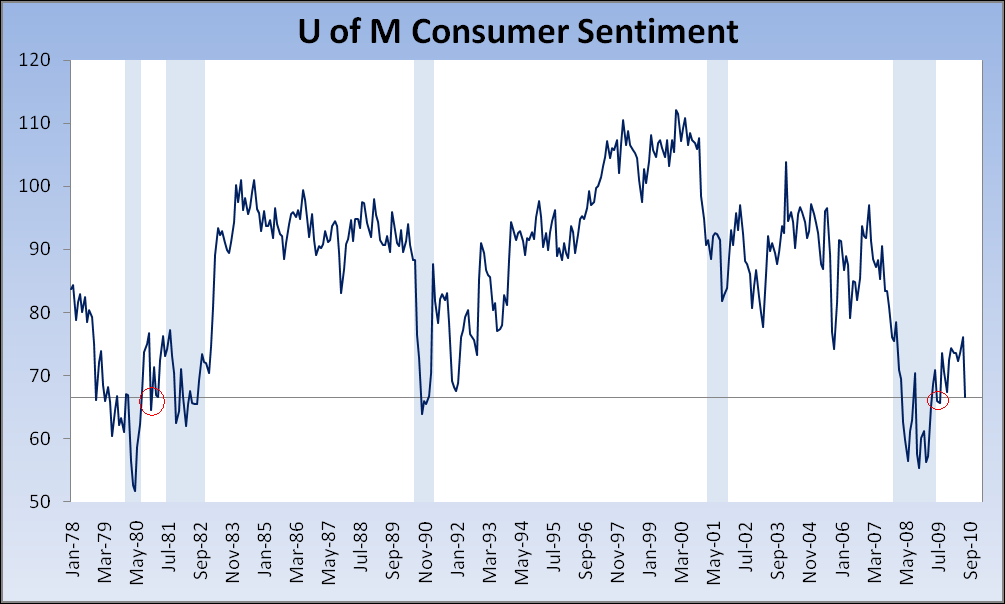
Invictus at the Big Picture reproduces a graph from the University of Michigan's Consumer Sentiment Survey and notes that the reading looks a lot like the last time we had a double dip recession.


THE CLEVELAND FED REPORTS THAT THE PUBLIC EXPECTS INFLATION TO STAY BELOW 2% OVER THE NEXT DECADE
"The Cleveland Fed’s estimate of inflation expectations is based on a model that combines information from a number of sources to address the shortcomings of other, commonly used measures, such as the "break-even" rate derived from Treasury inflation protected securities (TIPS) or survey-based estimates."

Thursday, July 15, 2010

Daily Sources 7/15

1. FRANCE, GERMANY AND THE UK WORKING TO CONVINCE EU TO ADOPT 30% CARBON REDUCTIONS BY 2020

Paul Whitehead at Platts reports that France, Germany and the UK have launched an effort to convince the EU as a whole to adopt a measure calling for 30% carbon reductions by 2020. The current goal for the EU is a 20% reduction by 2020.

2. TURKISH CENTRAL BANK LEAVES BENCHMARK RATE UNCHANGED

Steve Bryant at Bloomberg reports that the Turkish central bank left its key benchmark rate unchanged at 7%.

3. CHINESE GDP GROWTH UP BY 10.3% IN THE SECOND QUARTER

BBC reports that GDP in China grew by 10.3% in the second quarter, down from the 11.9% seen in the first quarter.
"Other official Chinese figures show retail sales are growing at around 18% a year, which suggests that consumption is still rising."
Meanwhile, Frontier Markets reports that manufacturing is already switching from China to other, cheaper, locales. Michael Schuman at the Curious Capitalist notes that some economists expect China to relax lending quotas again in a second stimulus.

4. MICHAEL PETTIS ARGUES THAT A FLOOD OF MONEY TO THE US IS MORE LIKELY THAN CHINA DUMPING US TREASURIES

Michael Pettis at Chinese Financial Markets argues that the US is more likely to see a "tsunami" of foreign capital entering the country than China exercising the "nuclear option" and selling its US treasuries holdings. He says the latter cannot and will not happen. Worth reading in full.

5. JAPANESE CARBON EMISSIONS CUTS GOALS INCOMPATIBLE WITH PROJECTED INDUSTRIAL DEMAND GROWTH

Hong Chou Hui at Platts writes that a new report by a consultancy predicts that Japanese manufacturing may be forced overseas if its goal for carbon emissions reductions--25% by 2020--are to be met. Forecasts of growth in industrial power demand are incompatible with the carbon emissions goals.

6. UAE AMBASSADOR SAYS AN ATTACK ON IRAN PREFERABLE TO IRANIAN NUCLEAR WEAPONS

Alexander Smoltczyk and Bernhard Zand at Der Spiegel report that the UAE ambassador to the US said
"A military attack on Iran by whomever would be a disaster, but Iran with a nuclear weapon would be a bigger disaster."
Spiegel concludes that an axis is forming against Iran in the Middle East.

7. TWO HOUSES BEING KEPT OFF MARKET FOR EVERY HOUSE ON SALE

Yves Smith at naked capitalism reports that for every house on sale there are two houses being kept off the market, or shadow housing.
"James Saccacio, CEO of RealtyTrac, said at the current pace, more than 3m properties will receive a foreclosure filing by the end of the year, and lenders will repossess more than 1m of them. According to a report from the Toronto-based Capital Economics, the weight of the shadow inventory may contribute to a double dip in the housing market. The report found that for every home currently on the market, two homes are waiting to be sold."


8. 429,000 NEW JOBLESS CLAIMS LAST WEEK

Kelly Evans at Real Time Economics reports that there were 429,000 initial jobless claims last week.

9. INDUSTRIAL PRODUCTION UP 0.1%

Courtney Schlisserman at Bloomberg reports that industrial production rose 0.1% in June.

Wednesday, July 14, 2010

Daily Sources 7/14 (Bastille Day)

THE EU IS HALFWAY TO MEETING THEIR GOAL OF 20% RENEWABLE FUELS CONSUMPTION BY 2020

Reuters reports.

THE EURO'S INTERNATIONAL ROLE

The European Central Bank has released a 84 page paper on the international role of the Euro.

RUSSIAN SPENDING MORE THAN THE PRICE OF OIL WOULD ALLOW

Toni Vorobyova at Reuters reports that Russian spending is well above what the price of oil would allow without running a deficit.

GERMANS WORRIED THEIR RELATIONSHIP WITH RUSSIA IS COOLING

Matthias Schepp at Der Spiegel worries that the Merkel administration has not continued a strong tradition of courting Moscow, allowing other nations to attempt to get pride of place. In the meantime, John Roberts at Platts reports that RWE has decided to consider an offer from Moscow to join the South Stream pipeline plan, but loudly asserted its commitment to Nabucco.

BERLIN CONSIDERS AUCTIONING OFF EXTRA TIME FOR NUKE PLANTS

David Crossland at Der Spiegel reports that the Merkel Administration, which wants to bypass the plan to shutter all nuclear power plants by 2020, is considering auctioning off more time for the plants to operate. That is, the power companies could bid for additional time past 2020 in which they could operate. A key reason for the idea is that nuclear power makes it easier to meet carbon reduction goals.

SPANISH SOLAR POWER NOW BIGGER THAN US

Sharon Hong at News Watch Energy reports that with the commissioning of a new solar plant Spain now leads the US in solar power energy production.

SOUTH KOREAN PLAN FOR PRIVATE COS TO SPEND $18 BILLION ON GREEN TECH SMOKE AND MIRRORS

Christian Oliver at FT Energy Source warns us that the news yesterday that the plan for South Korean companies to spend $18.6 billion on green technologies is not quite what it seems.

NIGERIAN CRUDE EXPORTS TO US ON THE RISE

Jacinta Moran at Platts writes that NIgerian exports to the US are averaging 945 kb/d in the first quarter of 2010, up from 606 kb/d in the same quarter last year. A key reason is that efforts to mollify Niger Delta rebels have had some success. Meanwhile, Sharon Hong at News Watch Energy reports that the Nigerian state oil company is insolvent as it waits for the government to pay it its subsidies.

MORE THAN 4 PEOPLE ARE LOOKING FOR JOBS FOR EACH AVAILABLE JOB

Per Mark Thoma at Economist's View:


OIL PRICES MODERATING SOMEWHAT IN US

James Hamilton at Econobrowser updates some charts he uses to monitor energy costs in the US, including a chart of US retail gasoline prices.


Note that prices are in the range where they begin to affect driving behavior in the US, or $2.50/g. They are just short of $3.00/g where prices will have a strong effect on driving behavior.

CRUDE OIL STOCKS DOWN 5.1 MILLION BARRELS

The EIA reports that crude oil stocks fell by 5.1 million barrels in the week ended July 9th, though they are still well above the 5 year historical average. Gasoline stocks built by 1.6 million barrels and distillates grew 2.9 million barrels. The average price of gasoline for the week ended July 12th fell by 0.8 cents to 271.8 cents/gallon. For the week ended July 9th, refinery utilization grew to 90.5%.

Wednesday, July 7, 2010

Daily Sources 7/7

1. CHINA'S US TREASURY HOLDINGS UP $5 BILLION IN APRIL

Bloomberg reports that China's State Administration of Foreign Exchange urged markets to not consider changes in US treasuries political statements. It further indicated that gold is not likely to become a major part of its reserves holdings because of its volatility and lack of interest payments. Some think this is just Beijing talking its book so it can buy further gold at depressed prices. Last year Beijing doubled its gold holdings.

2. FREE EXCHANGE HOSTS A NEAT INTERACTIVE MAP OF THE EU


3. NEW POLISH PRESIDENT AN EUROPEANIST

Greg Scoblete at Real Clear World reports that the new Polish President is a committed Europeanist as opposed to his predecessor, who was a committed Atlanticist.

4. US RHETORIC IN GEORGIA DESIGNED TO CALM FEARS IN T'BLISI

Mary Beth Sheridan at the Washington Post reports that in her visit to Georgia, Secretary Clinton indicated the US's opposition to Russia's "invasion and occupation" of Georgia. Prime Minister Putin took issue with the characterization of the Secretary of State, calling the Russian troop presence an effort to liberate the Abkhazians and South Ossetians.

5. DRILLING IN GREENLAND'S ARCTIC WATERS BEGAN LAST WEEK

Kate MacKenzie at FT Energy Source reports that deep water drilling in Greenland's Arctic waters began last week. And so the race for Arctic natural resources begins.


6. AUSTRALIA KEEPS BENCHMARK RATE AT 4.5%

Jacob Greber at Bloomberg reports that Central bank Governor Glenn Stevens yesterday left the benchmark cash rate at 4.5% for a second month. Australia's central bank had raised interest rates six times since October when it stood at a low of 3%. Inflation is expected to increase to more than 3% in the coming months.

7. INDIA DEPLOYS TROOPS IN KASHMIR IN EFFORT TO SUPPRESS UNREST

Lydia Polgreen at the New York Times reports that the Indian Army has deployed troops in Kashmir in an effort to calm the region after large street protests resulted in paramilitary units firing into the crowds.

8. RUMORS THAT MUBARAK'S HEALTH IS IN SERIOUS DECLINE

Michael Collins Dunn at the MEI Editor's Blog reports that Ha'aretz has picked up a rumor from a London-based daily that Mubarak's trip to France was for medical reasons. The story is that Mubarak's health is in serious decline and that his son is in line for succession.

9. OBAMA EXPECTS NETANYAHU TO BEGIN TALKS WITH PALESTINIANS BEFORE MORATORIUM ON NEW SETTLEMENT BUILDING EXPIRES IN SEPTEMBER

Sheryl Gay Stolberg and Mark Landler at the New York Times report.

10. BANK CARD DELINQUENCIES FALL BELOW 4%; SERVICE SECTOR NOT ADDING JOBS QUICKLY ENOUGH

In a good sign for the economy, Darrell A. Hughes at Real Time Economics reports that bank credit-card delinquencies dropped below 4% for the first time in eight years.
[ABA Chief Economist James] Chessen said the anticipated slow growth is unlikely to cause delinquencies to rise significantly, but there could be some impact. 'Until we get a sustained level of new jobs in this economy, we’re not going to see delinquencies fall to very low levels,' he said.
In the meantime, Phil Izzo at Real Time Economics reports that the Institute for Supply Management subindex for employment fell below 50, indicating a fall in employment.


11. THE EIA REPORTS THAT CRUDE STORAGE IS DOWN 2 MILLION BARRELS, STILL 12.9 MILLION MORE IN STORAGE THAN LAST YEAR

The EIA reports that crude stocks fell to 363.1 million barrels, down 2 million from last week, up 12.9 million from last year. Gasoline stocks rose by half a million while diesel stocks rose 2.5 million. Average US gasoline prices rose by 1.4 cents to 275.7 cents the week ended June 28. In the week ended June 25, refinery capacity utilization stood at 88.4%, down 1% from the week previous.

Friday, July 31, 2009

Daily Sources 7/31

1. MESSERLIN AND MAREL ARGUE THE US & EC COULD REAP GAINS BY OPENING SERVICES SECTOR

Patrick A Messerlin and Erik van der Marel at VoxEU argue that the US and the European Commission should launch transatlantic negotiations in opening the services sector as a prelude to multilateral negotiations. Key excerpts:
"Services providers are busy redesigning their strategies for coping with the ongoing economic crisis. To take the appropriate decisions, they need predictable future market access in services. Meanwhile, as many services are still highly protected, opening services markets would deliver large benefits to consumers impoverished by the crisis."
"Is there any appetite for services negotiations now? Yes. The July 2008 Signalling Conference held under the aegis of the Doha Round showed a substantial number of participants expressing strong interests in most services, offers and requests in mode 3 in many services (foreign direct investment), and even a willingness to include mode 4 (movement of natural persons, by far the most contentious part of any service negotiations) in some services.

Such a willingness to negotiate appears particularly strong in three services: business, communication, and distribution services. Together, these three services in the EC, US, and top eight countries represent almost one-third of the world GDP, a size so huge that negotiators could work on deals within as well as between these services sectors. The three services face high levels of regulatory constraints, ensuring huge economic gains in case of market opening. Finally, negotiations are made easier by the fact that business and communication services are resilient to the current crisis, while the inflationist pressures to come should make governments eager to have distribution services as competitive as possible.

Last but not least, the foreign policy dimension of the whole endeavour is crucial for Europe. Many US decision-makers are looking to Asia for good reasons (Bergsten, 2009) while Europeans have not yet fully grasped the growing importance of Asia nor captured its attention, as illustrated by the disappointing June 2009 Asia Europe Ministerial meeting on energy."
2. EUROZONE UNEMPLOYMENT UP TO 9.4% IN JUNE, CONSUMER PRICES FELL AT ANNUAL RATE OF 0.6%

Reuters reports that eurozone unemployment rose to 9.4% in June, up from a revised figure of 9.3% in May.
"The European Union’s statistics office also said on Friday that inflation in the euro area had moved much further into negative territory than forecast in July, with consumer prices falling at an annualized rate of 0.6%.

The drop raised worries about deflation and heightened expectations that the European Central Bank will maintain its loose monetary policy."
3. US OPEN TO BRINGING RUSSIA INTO NATO

Yevgeny Bendersky at the Compass reports that
"Assistant Secretary of State Philip Gordon told US lawmakers Tuesday during the House International Relations Committee hearing that the United States would consider Russian membership in NATO."
Gordon said:
"[I]f Russia meets the criteria and can contribute to common security, and there is a consensus in the alliance, it shouldn't be excluded."
Bendersky points out that some in Eastern Europe might be cold to the idea. Given that membership would freeze, so to speak, the current borders by militarily integrating the members, it may arguably provide superior protection than the current relationship. It certainly would make adventurism a much more complicated affair.

4. NIPPON OIL IN TALKS WITH SK ENERGY TO BUILD NEW REFINERY IN VIETNAM

Megumi Yamanaka and Yuji Okada at Bloomberg report that Nippon Oil Company has announced it might build a refinery in Vietnam with SK Energy Co.
"'We’ve been in talks with SK and have agreed on the need for participating in a refining project' in Asia, Nippon Oil Chairman Fumiaki Watari said in an interview in Tokyo yesterday. Vietnam is a potential location for the first venture between Japan and South Korea’s biggest refiners, and the plant may process 200-300 kb/d of crude oil, he said.

Seo Young Joon, a spokesman at SK Energy in Seoul, said he couldn’t immediately comment. Idemitsu Kosan Co., Japan’s second-largest refiner, and Mitsui Chemicals Inc. plan to spend $5.8 billion to build a 200 kb/d plant in Vietnam."
"'We know that about 25% of Japan’s refining capacity will be unnecessary in the next five years.' Watari said."
Vietnam inaugurated its first refinery this year with capacity of 148 kb/d and which is poised to supply about 30% of Vietnam's product requirement--see Daily Sources 7/28 #8. The EIA projects its total petroleum demand was about 288 kb/d in 2008. Hanoi projects GDP will grow by 5.5% in 2009, adding perhaps as much as 10 kb/d in demand this year.

5. INDIAN FIELD BEGINNING PRODUCTION TO UP INDIAN CRUDE PRODUCTION BY 25%

The Economic Times reports that Indian crude production is expected to rise by about 25% when Cairn begins pumping from the Mangla field of its Rajasthan acreage next month.
"'We are operationally ready to commence oil production in August,' Cairn India CEO Rahul Dhir said. In its various filings to the government, Cairn has indicated that production will quickly touch 30 kb/d by the end of third quarter this year and reach a plateau of 175 kb/d (8.75 million tonnes a year) in 2011. Goldman Sachs, however, has pegged the peak output at 190 kb/d (9.5 million tonnes a year)."
Using EIA projections, Indian crude production in 2008 was 693.7 kb/d. Its imports came in at 2.056 mb/d, so the Mangla field at 175 kb/d would represent about 8.5% of its import requirement. However, some of those imports are reexported as products, for example to the US--Reliance is set to restart its old Jamnagar refinery shortly, bringing another 660,000 kb/d of nameplate capacity on line. It is expected to double Reliance gasoline exports to about 170 kb/d.

6. PAKISTANI SUPREME COURT REJECTS PETITION TO TRY MUSHARRAF ON TREASON CHARGES

BBC News reports that the Pakistani Supreme Court has rejected a petition to try former President Musharraf on charges of treason.
"The court had asked him to explain his decision in 2007 to invoke emergency rule and suspend the constitution.

It has now ruled that parliament is the place to debate Mr Musharraf's actions.

Chief Justice Iftikhar Mohammed Chaudhry rejected a petition to launch a treason case against the former president.

Mr Chaudhry was himself removed from his position as a result of President Musharraf's imposition of emergency rule, but was reinstated after he resigned in August."
For more on the lawyers revolution in Pakistan, I wrote a long piece on it early last year--see The Law in Pakistan.

7. 40 DAY CYCLE OF PROTESTS IN IRAN MIRROR 1979 REVOLUTION, PRESS REPORTS OF CHINESE-IRAN MOU ON SOUTH AZADEGAN FIELD DENIED BY CNPC, US SENATE TO BAR THOSE SELLING PETROLEUM PRODUCTS TO IRAN FROM PARTICIPATION IN SPR

Michael Collins Dunn at the MEI Editor's Blog observes that the 40-day cycle in protests seen in the 1979 Iranian Revolution is being repeated in the current conflict over the elections. Juan Cole at Informed Comment has a good roundup of the recent political events in Iran. Meanwhile, Upstream Online notes that there have been stories that CNPC has signed an MOU with NIOC to develop the South Azadegan oilfield, taking a 70% stake in the field in return for covering 90% of development costs.
"However, a CNPC manager based in Beijing told Reuters today that the MoU was actually signed earlier this year and there has been no real breakthrough in talks with the oil ministry since then.

'The MoU is not a binding contract, and we are still negotiating with NIOC about specific details,' the CNPC source, who declined to be named because he was not authorized to speak to the media, told the news agency."
In the meantime, Jean Chemnick and Katharine Fraser at Platts report that the US Senate has inserted language into the Senate Energy and Water Appropriations bill [H.R. 3183] which would prohibit companies that sell gasoline and diesel to Iran from entering into contracts to fill the Strategic Petroleum Reserve.
"At least three companies fit that bill, Glencore, Shell Trading and Vitol, according to the Foundation for Defense of Democracies. In January, the three were named by DOE as suppliers to the SPR for deliveries this year. While it could not be immediately confirmed whether any of the three currently sell refined products to Iran, all of them are known active traders in oil markets throughout the world."
In June, Reliance--a private oil company in India--halted gasoline exports to Iran, apparently because they expected difficulties for their exports to the US--see Daily Sources 6/4 #8. The UAE provides about 80% of Iranian product requirements, IIRC.

8. BAHRAIN CENTRAL BANK SEIZES TWO BANKS HELD BY SAUDI CONGLOMERATES

Frederik Richter at Reuters reports that the central bank of Bahrain has seized two banks owned by major Saudi conglomerates.
"The central bank said in a statement on Thursday it had assumed control of Awal Bank, owned by Saad Group and The International Banking Corporation, a unit of the Ahmad Hamad Algosaibi and Brothers conglomerate.

The central bank said an investigation at both banks had shown a substantial shortfall in assets compared with their liabilities and that it would appoint an external administrator to identify creditors' claims and manage the distribution of the remaining assets."
9. NIGERIAN PRESIDENT ENTERS TALKS WITH 6 NIGER DELTA GOVERNORS TO PREVENT THREATENED BOYCOTT OF MILITANT AMNESTY PLAN

Platts reports that Nigerian President Umaru Yar'Adua has begun talks with six governors from the Niger Delta in an effort to avert a threatened boycott of the amnesty program for militants in the region.
"The governors of southern Akwa Ibom, Bayelsa, Edo, Delta, Cross River and Rivers states last week said they would pull back their involvement in the amnesty deal for Delta militants in protest of the federal government's plan to relocate the petroleum training college in Delta state to northern city of Kaduna.

'There is a serious misunderstanding about some of the issues raised, but the president is very concerned and has been talking with the Niger Delta governors individually,' Presidential spokesman Olusegun Adeniyi in a statement. 'The president has respect for the Niger Delta region. He did not approach the crisis in the area as a Northerner.'

The governors also had grouse against a provision in the oil sector reform bill, which they said takes away royalties due Delta communities."
Earlier this week, the Nigerian Joint Revolutionary Council--an umbrella group of militants in the Niger Delta which includes MEND--warned a company linked to a current oil minister to stop operations to express their displeasure with the plan to locate the petroleum university in the north--see Daily Sources 7/28 #9.

10. US ENVOY FOR SUDAN RECOMMENDS TAKING KHARTOUM OF TERRORIST LIST

Reuters reports that General Scott Gration, the US special envoy for Sudan, recommended to Congress that Sudan be taken off the state sponsors of terrorism list.
"'There is no evidence in our intelligence community that supports [Sudan] being on the state sponsors of terrorism list,' Gration said. 'It's a political decision.'"
"'We are actually hurting the very development things we need to do help the south become ... if they chose to secede, a viable economic state,' Gration said, noting that Washington could not bring in heavy equipment to build roads and railways.

'At some point we are going to have to unwind some of these sanctions so that we can do the very things that we need to do to ensure a peaceful transition and a state that's viable in the (south) should they choose to do that,' he added.

In its latest report, the State Department described Sudan as 'a cooperative partner in global counterterrorism efforts.'"
11. CHÁVEZ PROPOSES LAW GIVING GOVT ARBITRARY POWER TO CONTROL MEDIA

Fausta Wertz at the Compass has the best summary of the news that Hugo Chávez's administration has now proposed a set of laws which would limit broadcasting rights and would make the rather arbitrarily defined violations are punishable with prison terms.
"The proposed law ... includes all media and applies to not only owners and publishers but also reporters, freelancers and anyone making a statement that could be interpreted as (my translation) 'any person who manipulates or distorts the news, creating a false perception of facts... as long as there is damage to social peace, national security, public order, or the mental health or public morals.'

The charge carries a compulsory 2-4 year prison sentence."
Wertz includes a link to the text of the law. She notes that the UN has registered its worries regarding the proposed legislation, but projects the protest will have little affect upon the administration's decision-making process ... correctly in my view.

12. RESEARCHERS FIND THAT EFFORTS TO HALT OVERFISHING ARE SUCCESSFUL

BBC News reports that a team of researchers have released the findings of a two-year study which concludes that efforts to halt overfishing in 5 of 10 marine ecosytems have helped fishing stocks to recover.
"The authors observed: 'Some of the most spectacular rebuilding efforts have involved bold experimentation with closed areas, [fishing] gear restrictions and new approaches to catch allocations and enforcement.'

But they warned that the signs of recovery should not be interpreted by policymakers as a sign that all was well beneath the waves.

The majority of fisheries were still in trouble, and were not being managed or regulated properly.

But Dr Worm said that the team's 'watershed paper' offered a blueprint for sustainable fishing.

'It clearly shows what needs to be done to not only avoid fisheries collapse, but to actually rebuild fish stocks and ecosystems.'"
(h/t Yves Smith at naked capitalism.)

13. US GDP DOWN AT ANNUALIZED RATE OF 1% IN Q2, CHICAGO PMI INDICATES BOTTOM

The Bureau of Economic Analysis released its estimation today that Q2 GDP fell at an annualized rate of 1%. Ed Harrison of Credit Writedowns observes:
"Down 1.5% was the consensus expectation. But Q1 was revised down to minus 6.4% from 5.5%. The GDP Deflator for Q2 came in at 0.2%, which shows that disinflation risks tipping into deflation still. The dollar is weaker and the short end of the treasury curve is up massively on these data and revisions.

Also ... the 2008 numbers were revised down. Q1 2008 was revised from positive 0.9% to negative –0.7%. Q2 2008 was revised way down as well from 2.8% to 1.5%. Q3 2008 was also very negative, now –2.7%. This confirms the December 2007 recession call.

There was a $140 billion reduction in inventories in Q2. I have been saying for some time that this would set us up for lots of upside come Q3 and Q4 as the inventory purge dissipates. So, we will get a technical recovery in my opinion. The question is whether there is any underlying demand uptick behind the inventory changes. In the data ... from the BEA website, you can clearly see ... that consumers are not even spending on basic items. Spending on non-durable goods was down 2.5% annualized. That is not good."
Peter Boockvar at the Big Picture reports that the Chicago PMI was 43.4 in July, up from 39.9 in June. (PMI readings of above 50 indicate expansion; below 50 indicates contraction.) He observes:
"Inventories remained extremely lean, falling to 25.4 from 34.2, the lowest since 1949 and is the perfect set up for a sharp contribution to GDP from this area in the 2nd half of the year, led by auto’s and related sectors. The employment index rose 6.4 points to 35.3, well below 50 but at the highest level since Dec ‘08. Prices paid fell a touch. Bottom line, the data confirms the backdrop for an improvement in GDP. The degree and sustainability of the recovery will however remain in the hands of end demand, aka, predominantly the US consumer."
Rebecca Wilder at News N Economics observes that
"Households have been 'delevering' for a longer time period than previously thought--as recent as 2008 Q1, the saving rate that was reported to be essentially zero, 0.2%, is now 1.2%."
Her chart of the US savings rate (with revisions as of today):

"The BEA has 'found' that households have been in fact saving roughly 1% of their disposable income per quarter since 1995, 0.9% per quarter in 2008."
Well worth a look, as always.

Thursday, July 30, 2009

Daily Sources 7/30

1. DEBATE OVER SUSTAINABILITY OF CHINESE FISCAL STIMULUS HEATS UP: CHINA SHUTTERS LARGE NUMBER OF SMALL COAL SOURCED POWER PLANTS, ONE ARGUES THAT CHINA'S STRENGTH VIS-A-VIS US FISCAL SITUATION OVERSTATED, ANOTHER SAYS CHINESE ARE COMPLAINING OF THEIR OWN BEHAVIOR IN OTHERS, AND YET ANOTHER SAYS TRADE CONFLICTS ARE INEVITABLE

Vitaliy Katsenelson in Morningstar opines:
"Despite everything, the Chinese economy has shown incredible resilience recently. Although its biggest customers--the United States and Europe--are struggling (to say the least) and its exports are down more than 20%, China is still spitting out economic growth numbers as if there weren’t a worry in the world. The most recent estimate put annual growth at nearly 8%.

Is the Chinese economy operating in a different economic reality? Will it continue to grow, no matter what the global economy is doing?

The answer to both questions is no."
I interrupt Katsenelson's point to note that the Associated Press reports that
"[Chinese a]uthorities have closed [small coal-fired] power plants with a total of 7,467 generating units, meeting a previously announced goal 18 months ahead of schedule, said Sun Qin, deputy administrator of the Cabinet's National Energy Administration.

'This couldn't be done when power demand was very intense,' Sun said at a news conference. 'Due to this financial crisis, the power generation has slowed down, so we took this opportunity to accelerate the shutdown.'"
OK, but China depends on coal for about 70% of its electricity generation. As many have noted before, the GDP growth numbers published by China don't seem to be consistent with having taken so much power generation off line--see Daily Sources 5/14 #2. In late May, the China Electricity Council, or association, announced it would stop publishing electricity consumption numbers--see Daily Sources 6/8 #6. Back to Katsenelson:
"Millions of people have migrated to its cities, and now they’re hungry and unemployed. People without food or work tend to riot. To keep that from happening, the government is more than willing to artificially stimulate the economy, in the hopes of buying time until the global system stabilizes. It’s literally forcing banks to lend--which will create a huge pile of horrible loans on top of the ones they’ve originated over the last decade.

But don’t confuse fast growth with sustainable growth. Much of China’s growth over the past decade has come from lending to the United States. The country suffers from real overcapacity. And now growth comes from borrowing--and hundreds of billion-dollar decisions made on the fly don’t inspire a lot of confidence. For example, a nearly completed, 13-story building in Shanghai collapsed in June due to the poor quality of its construction.

This growth will result in a huge pile of bad debt--as forced lending is bad lending. The list of negative consequences is very long, but the bottom line is simple: There is no miracle in the Chinese miracle growth, and China will pay a price. The only question is when and how much."
In this vein, Robert Flint at the Wall Street Journal reports:
"Since the beginning of this week, things have happened quickly on the bubble front. China's banking regulator issued rules Monday governing loans for fixed-asset investments in its latest attempt to ensure bank lending boosts the real economy and isn't funneled into markets.

On Tuesday, two of China's major lenders were quoted as saying they would sharply slow credit growth in the second half. This prompted fears of a sudden tightening of credit that could choke off the loans which have so far eased the effects of the world recession. Shanghai equity prices plunged as much as 7.7% at one point Wednesday and closed 5.0% down on the day.

Later on Wednesday, the PBOC said it will emphasize market-based systems, rather than administrative controls, in guiding the appropriate growth of credit. PBOC Vice Governor Su Ning's comments appeared to signal the PBOC wasn't about to set loan curbs in the second half of this year to cool explosive lending growth, as it had done in 2008."
Meanwhile, David Pilling argues in the Financial Times:
"If anything, it is Beijing--some of whose officials now privately boast they have nothing at all to learn from the Great Spendthrift--that has the upper hand. China’s seeming financial hold over the US has been brought into sharp relief. Beijing has become prone to lecture Washington on the need to safeguard its $2,000bn reserves, the bulk of which are parked in US dollars.

It is wholly appropriate that Washington accords due attention to China, the most important emerging power since America itself. But there is also a danger of taking China too seriously. In compensating for past neglect, things could swing too far the other way. For all the euphoria about the G2--the Sino-US axis that, according to some breathless reckoning, is the only meaningful global forum--it is worth pausing to survey the facts.

For a start, China’s financial grip over the US is not as tight as many suggest. Far from a sign of strength, Beijing’s accumulation of vast foreign reserves is the side-effect of an economic model too reliant on exports. The enormous trade surplus is the product of an undervalued renminbi that has allowed others to consume Chinese goods at the expense of Chinese people themselves.

Beijing cannot dream of selling down its Treasury holdings without triggering the very dollar collapse it purports to dread. Nor are its shrill calls for the US to close its twin deficits--which would inevitably involve buying fewer Chinese goods--entirely convincing. Rather than exposing the superiority of China’s state-led model, the global financial crisis has laid bare the compromising embrace in which the US and China find themselves."
And Brad Setser at Follow the Money notes that Chinese policy makers complaining of US government profligacy might fairly be asked if they aren't the pot calling the kettle black.
"Before the crisis, the Fed’s balance sheet was around 6% of US GDP. Right now, it is around 15% of US GDP. A big increase no doubt. But the balance sheet of the People’s Bank of China (PBoC) is around 70% of China’s GDP. Foreign assets make up about 80% of the PBoC’s balance sheet--or around 55% of China’s GDP. And the PBoC’s estimated holdings of US treasuries and agencies are about equal to 30% of China’s GDP--a level that is far higher, relative to China’s GDP, than the US Fed is ever likely to achieve. The Fed expects its balance sheet to peak at roughly $2.5 trillion, or between 15% and 20% of US GDP."
His colleague Paul Swartz provides a graph of the annual change in PBoC and Fed holdings of treasuries and agencies as a percentage of GDP:


Michael Pettis at China Financial Markets notes that trade lawyers are reporting that they expect a slew of industries to ask the EU for protective tariffs next month.
"As I have been arguing for over a year, as unemployment around the world rises and as the necessary contraction in US net demand picks up pace, there was inevitably going to be a conflict with China as Chinese policymakers responded to the collapse in trade in the only way they could, by substantially stepping up investment. The result is that China’s trade surplus has contracted very slowly--much more slowly than the contraction in the US trade deficit--and the result was a huge squeeze on the tradable goods sectors around the world.

The fact that policymakers in Europe, China, Japan and the US seem to have no clue as to how difficult the transition for each of the other countries is likely to be, and so are doing not nearly enough to coordinate their response (in fact lecturing and finger waggling seem to the favorite forms of policy coordination), makes trade conflict almost a dead certainty. I don’t think there are necessarily any bad guys here--each country is desperately doing what it can to get itself out of this mess--but there is a lot of failed opportunity and I am pretty sure that the trade environment will continue to decline."
Pettis notes that China's share of the US trade deficit (excluding oil) has grown from 26% in 2000 to 83% so far in 2009.
"Perhaps as a consequence of a fiscal stimulus aimed at boosting investment and production, China’s share of the US trade deficit has grown significantly. Since the US trade deficit is shrinking quickly, this means that other exporters are getting killed. As I have argued for a while, this is not sustainable and will almost certainly cause trade tensions to erupt.

Does this mean China is behaving in a predatory way? I don’t thinks so. I have warned for a long time that it would be very difficult for China to make the necessary transition to a consumption-led economy quickly enough to accommodate the global adjustment taking place. Unless it is willing to see its economy collapse, there is simply no way China can reduce its negative net demand quickly enough to match the contraction in US demand and so avoid squeezing the hell out of the global tradable goods sectors. That is why policy coordination is so important, especially between China and the USD, and of course that is why I continue to be a pessimist. I do not think this policy coordination is taking place."
Well worth reading in full.

2. JAPANESE INDUSTRIAL PRODUCTION UP 2.4% IN JUNE FROM MAY, JAPEX TO BID ON DEVELOPING 400 KB/D IRAQI FIELD, AND JAPAN TO START BURNING CRUDE JATROPHA OIL FOR POWER GENERATION

Yoshiaki Nohara at Bloomberg reports that the Japanese Trade Ministry announced that industrial production increased by 2.4% in June from May.
"Output gained 8.3% last quarter from the first three months of 2009, the most since 1953. Companies said they also planned to increase manufacturing by 1.6% in July and 3.3% in August, the report showed.

The heads of the Finance Ministry’s regional bureaus yesterday raised their assessment of the economy for the first time in five years, based on a recovery in exports and industrial production."
Meanwhile, Ashutosh Joshi and Taiga Uranaka at Reuters report that Japan Petroleum Exploration Co (Japex) has entered into negotiations with Iraq to develop the East Baghdad field, according to Nikkei Business Daily.
"Japex has proposed developing the southern portion of the field, with initial output forecast at 400 kb/d, enough to satisfy about 10% of Japanese demand, the newspaper said.

It also said that rival companies are expected to submit bids as well."
Meanwhile, Takeo Kumagai at Platts reports that Biomass Japan, a biodiesel supplier, will begin supplying power companies with crude jatropha oil for direct burning.
"Biomass Japan is scheduled to start receiving some 700 mt/month of crude jatropha oil in Okinawa from August, mainly from its pilot plants in Indonesia, Malaysia, Thailand and India, the source said."
"Biomass Japan declines to officially disclose exact costs for its crude jatropha oil, but according to the source production from the foreign pilot projects will cost less than Yen 50-60/liter (53-63 cents/liter) on a CIF basis, less than equivalent domestic production.

Biomass Japan is currently expanding its overseas jatropha production capacities beyond Southeast Asia, with new operations in Africa due to come on stream in the next few months, the source said.

From December it will be receiving a total of 5,000 mt/month of crude jatropha oil from Africa, said the source, declining to give details of the projects."
Some power plants in Japan directly burn crude oil to generate electricity--generation from jatropha should reduce net greenhouse gas emissions. However, jatropha has recently been abandoned by some producers, in part because it turns out that it is a water hog--see Daily Sources 7/17 #5.

3. SOUTH KOREAN HOUSEHOLD SAVINGS DOWN FROM 25.2% IN 1998 TO PROJECTED 3.2% IN 2010

Blaine Harden at the Washington Post reports that
"The household savings rate in South Korea will have plummeted from a world-beating 25.2% in 1988 to a projected world low of 3.2% in 2010, according to the OECD. Government policies have encouraged borrowing, while Korea's aggressive culture has supercharged spending on signifiers of success, whether they be Ivy League degrees or Louis Vuitton handbags.

'It is not recognized as a virtue to save, not anymore,' said Lee Sun-uk, an investment adviser for an office of Samsung Securities that is located in a wealthy neighborhood of Seoul. 'To maintain a certain status, people are willing to spend, even if their incomes have declined.'

In the past decade, average savings per household have plunged from about $3,300 to $525. On a percentage basis, it is the steepest savings decline in the developed world. Meanwhile, household debt as a percentage of individual disposable income has risen to 140%, higher than in the United States (136%), according to the Bank of Korea."


4. UK HOME PRICES UP 1.3% IN JULY FROM JUNE IN THIRD CONSECUTIVE MONTHLY INCREASE, UK WORRIED ABOUT OIL PRICE EFFECT ON RECOVERY

Real Time Economics reports that the UK Nationwide Building Society said the average home price rose 1.3% in July from June in the third consecutive month of increase.
"House prices have a 'reasonable chance' of ending 2009 up for the year, the Nationwide Building Society said."
Kate Mackenzie at FT Energy Sources reports that following news stories indicating that the Financial Services Authority has determined that speculation is not the source of the 2007-8 oil price spike, it is
"calling in big oil companies, hedge funds, banks and oil traders next week for a closed-door discussion on 'whether the current arrangements [in the oil market] remain appropriate'."
"[T]he FSA said representatives from the Treasury will also be at the meeting, which raises another possibility of what is driving this newfound concern ... over commodities. The UK government has recently aired concerns that high oil prices could threaten economic recovery. Alistair Darling, the chancellor, made this clear when he told the FT that high and volatile oil prices 'has the potential to be a huge problem as far as the recovery is concerned'."
5. EU DELEGATION IN TURKMENISTAN TO DISCUSS ENERGY COOPERATION

Upstream online reports that the EU has sent a delegation to Turkmenistan to discuss energy cooperation.
"'Developing and deepening mutually beneficial and equal ties with EU countries is a priority in (Turkmenistan's) foreign policy strategy,' Reuters quoted a report published by state news agency Turkmen Khabarlary as saying, citing a Foreign Ministry statement.

Turkmen President Kurbanguly Berdymukhamedov said this month his country was ready to supply gas through Nabucco, a pipeline designed to ease Europe's dependence on Russian gas."
6. IRAQ FACING DUSTBOWL ENVIRONMENT

Liz Sly at the Los Angeles Times reports on the emerging environmental catastrophe in Iraq.
"Decades of war and mismanagement, compounded by two years of drought, are wreaking havoc on Iraq's ecosystem, drying up riverbeds and marshes, turning arable land into desert, killing trees and plants, and generally transforming what was once the region's most fertile area into a wasteland.

Falling agricultural production means that Iraq, once a food exporter, will this year have to import nearly 80% of its food, spending money that is urgently needed for reconstruction projects.

'We're talking about something that's making the breadbasket of Iraq look like the Dust Bowl of Oklahoma in the early part of the 20th century,' said Adam L. Silverman, a social scientist with the US military who served south of Baghdad in 2008.

So fragile has the environment become that even the slightest wind whips up a pall of dust that lingers for days."
"Chronic electricity shortfalls also have played a role. People chop down trees for firewood, leaving more bare land, and the shortage of power has made it difficult to pump water through the irrigation channels that had sustained fertile lands far beyond the rivers. Compounding the already dire shortages, power stations have been forced to shut down for days at a time because they lack water.

Then came the regionwide drought that has dramatically depleted the amount of water available. Last year's rainfall was 80% below normal; this year only half as much rain fell as usual."
A must read.

7. US WILL SANCTION ERITREA IF IT DOESN'T HALT SUPPORT FOR SOMALI MILITANTS

BBC News reports that US envoy to the UN Susan Rice told a Congressional Committee that Eritrea will face sanctions if it does not put an end to support for Islamists fighting the transitional federal government in Somalia.
"In April the African Union, another backer of the Somali government, also called for sanctions over the issue.

But Eritrean officials have repeatedly denied the allegations, calling them a 'fabrication' of US intelligence.

The country suspended its membership of the AU in protest at the sanctions call in April."
8. GHANA'S FISCAL SITUATION IMPROVES ON OIL FINDS


Frontier Markets reports that
"Ghana’s Eurobonds have surged 93% since last November and may continue to rise given the country’s increasingly attractive fiscal position due in part to the production of a new oil field that is expected to put it in the world’s top 50 oil producers and to expand growth from an estimated 4.1% this year, to 6.1% in 2010 and 10.5% the year after. The yield on the 8.5% dollar-denominated bonds due 2017 fell from 9.83 to 9.73 percent during trading on Tuesday."
Could be a blessing for Ghanaians, depending on how the government manages it. Crossing my fingers.

9. MORE ON AFRICAN FARMLAND PURCHASES FROM FOREIGN INVESTORS AND GOVTS

Horand Knaup and Juliane von Mittelstaedt at Der Spiegel have a fascinating update on the rush to purchase African farmland story, with a number of additional details and interesting observations. Some key excerpts:
"'According to most prognoses, there could be 9.1 billion people living on earth in 2050, about two billion more than today. In the coming 20 years alone, worldwide demand for food is expected to rise by 50%. "These are pessimistic prospects,' says [an] OECD [analyst]."
"Food is becoming the new oil. Worldwide grain reserves dropped to a historic low at the beginning of 2008, and the ensuing price explosion marked a turning point, just as the oil crisis did in the 1970s. There were bread riots around the world, and 25 countries, including some of the biggest grain exporters, imposed restrictions on food exports."
"If the investors are successful, they could achieve what development agencies have been unable to do in the past few decades: reduce the hunger that now afflicts more people than ever, namely one billion worldwide. In the best case scenario this could be a win-win situation with profit for the investors and development for the poor.

It is not just bankers and speculators, but also governments that are acquiring land in other countries, seeking to reduce their dependence on the world market and imports. China is home to 20% of the world's population, but it has only 9% of the world's arable land. Japan is the world's largest corn importer, and South Korea is the second-largest. The Persian Gulf States import 60 percent of their food, while their natural water reserves are sufficient to support only another 30 years of agriculture."
"Klaus Deininger, an economist specializing in land policy at the World Bank, estimates that 10 to 30% of available arable land could be up for grabs, although only a fraction of the potential number of lease and sale agreements have been signed. 'There was a huge jump in 2008, when plans and applications in many countries more than doubled, in some cases tripled.' In Mozambique, says Deininger, foreign demand is more than double the existing cultivated farmland, and the government has already allocated four million hectares to investors, half of them from abroad."
"Saudi Arabia is one of the biggest and most aggressive buyers of land. This spring, the king attended a ceremony where he took delivery of the first export rice harvest, produced exclusively for the kingdom in hunger-stricken Ethiopia. Saudi Arabia spends $800 million a year promoting foreign companies that cultivate 'strategic field crops' like rice, wheat, barley and corn, which it then imports. Ironically, the country was the world's sixth-largest wheat exporter in the 1990s. But water is scarce and the desert nation aims to preserve its reserves. Exporting food also means exporting water."
"But many of the countries where land is being snapped up--Kazakhstan and Pakistan, for example--suffer from water shortages. Sub-Saharan Africa has adequate natural water reserves, but the only country in the region currently producing a food surplus is South Africa. Most countries, on the other hand, are importers and, with rapidly growing populations, will likely be even more dependent on food imports in the future. Can such countries truly become important food producers?

Audinet, the IFAD expert, knows the risks. 'The way these agreements are structured can harm the country and the farmers in the long term, robbing them of their most important asset: land.' Olivier De Schutter, the UN Special Rapporteur on the right to food, warns: 'Because the countries in Africa are competing for investors, they are undercutting each other.' Some contracts, says De Schutter, are barely three pages long--for hundreds of thousands of hectares of land."
The other must read of today.

10. RUSSIA INKS DEEPWATER EXPLORATION DEAL WITH CUBA

The Associated Press reports that Russian firm Zarubezhneft has signed four accords with the Cuban national oil company--Cubapetroleo--to explore for crude in Cuban deep waters.
"Moscow extended the island $150 million in credit for construction materials and farm machinery, state media said Wednesday.

The credit will give Cuba more time to pay for Russian equipment shipped to areas most affected by three hurricanes that caused more than $10 billion in damage last summer."
11. MEXICAN FEDERAL POLICE RAID PEMEX HEADQUARTERS


Robert Campbell at Reuters reported yesterday that the Mexican police raided the headquarters of national oil company Pemex "in an investigation into rampant fuel theft that costs the company more than $2 billion a year."


12. SEASONALLY-ADJUSTED INITIAL UNEMPLOYMENT CLAIMS DOWN 8,250 TO 559,000; FORECLOSURE ACTIVITY BECOMING A FUNCTION OF INCREASING UNEMPLOYMENT; HARLESS ARGUES THAT INCREASED US SAVINGS RATE HERE TO STAY

The Department of Labor announced today that
"In the week ending July 25, the advance figure for seasonally adjusted initial claims was 584,000, an increase of 25,000 from the previous week's revised figure of 559,000. The 4-week moving average was 559,000, a decrease of 8,250 from the previous week's revised average of 567,250.

The advance seasonally adjusted insured unemployment rate was 4.7% for the week ending July 18, unchanged from the prior week's unrevised rate of 4.7%."
Yves Smith at naked capitalism observes:
"A new dynamic appears to be emerging on the housing front. Heretofore, foreclosures were strongly correlated with where the mania had been most acute. California, Florida, and Arizona in particular showed dramatic declines in prices. But now as those markets have corrected to a considerable degree, foreclosure activity is now starting to be a function of increasing unemployment."
And Andy Harless at Employment, Interest, and Money thinks that an increased rate of savings in the US is here to stay, which should have the consequence of reducing the share of consumption as GDP:
"Undoubtedly the savings rate will fall somewhat as the degree of financial distress declines, but I think there’s a good case to be made that much of the increase is permanent.

For one thing, from the point of view of households, 'financial distress' may be extremely slow to lift. If the Japanese experience is any guide, it is a very slow process to get a severely distressed banking system to start lending normally again, and it’s not clear that things are going to be any easier for the US. Meanwhile, most forecasts expect the unemployment rate to remain quite high for several years. It could take 3 years, or 5 years, or 10 years, or 20 years before the financial distress lifts.

Granted, even 20 years is not forever, and 3 years is certainly not forever, but it’s long enough to stop thinking about household behavior as being continuous over time. We can reasonably surmise that, even without so much financial distress, the savings rate would have trended upward over time. Presumably households would gradually have come to recognize that they weren’t saving enough. (Can zero be anywhere near enough?) And as baby boomers’ children settle into their own careers, they would cease to be a drag on their parents’ savings, and at the same time those parents would have to start worrying seriously about retirement. The financial distress messed up this scenario (or maybe just speeded it up), but the underlying trend should still be going on 'beneath the surface.' By the time the distress lifts, there will be other reasons for the savings rate to be higher than it was in 2006.

That argument is rather speculative, I admit, but there are more solid reasons to expect the savings rate to remain high. While the current, comparatively high savings rate may reflect the effects of financial distress, the low savings rates of the 2005-2007 period did not merely represent the absence of financial distress. What is the opposite of financial distress? Financial ease? The degree of financial ease during that period (which was the culmination of a process that had been building on and off for a couple of decades) was well beyond normal, and well beyond what we can expect in the coming years, even if recent sources of distress are resolved fairly quickly. Consumption was supported (and aggregate saving accordingly reduced) by a fountain of credit that will not re-emerge with such force unless people in Washington and on Wall Street make some big mistakes."
Well worth reading in full. (I would note that if past performance is any indication of future performance, however, that Washington and Wall Street are likely to make some big mistakes.)

13. NEW STUDY SUGGESTS THAT MARCELLUS SHALE FORMATION COULD PRODUCE AS MUCH AS 489 TRILLION CUBIC FEET OF NATURAL GAS,

Rick Stouffer at the Pittsburgh Tribune-Review reports that a new study by Penn State University geosciences professor Terry Engelder projects that 489 trillion cubic feet of natural gas could be produced from the Appalachian Basin's Marcellus Shale formation.
"Engelder said the estimates are based on natural gas flow rates from wells drilled by major Marcellus Shale developers, which have been above expectations."
At the current rate of consumption, 489 trillion cubic feet represents more than 19 years of total US natural gas demand. Incidentally, natural gas is a major feedstock for the production of ammonia for use in fertilizer production.

Tuesday, July 28, 2009

Daily Sources 7/28

1. MAYER AND WOOD ARGUE THAT CHINA'S ENTRANCE INTO THE WORLD ECONOMY HAS NOT SIGNIFICANTLY DE-INDUSTRIALIZED REST OF DEVELOPING WORLD

Jörg Mayer and Adrian Wood at Vox EU argue that China's integration into the world's economy has not had the effect of substantially de-industrializing other developing nations.
"The biggest possible effect would be for a country which initially produced or exported equal amounts of manufactures and of primary products, where a 15% fall in the ratio would reduce the share of manufactures by 3.5 percentage points.

These estimates are imprecise and subject to error; the true answer may lie outside their range. But there is no plausible modification of the calculations that could make the true answer much larger. This is mainly because, despite its size, China’s opening had only a modest effect on world average endowments. The upper-limit estimates, obtained by simply adding China’s endowments to the rest of the world’s, are a 9% rise (from 0.43 to 0.47) in the share of the global workforce with a complete primary or secondary education, and a 17% fall in the average land/labour ratio, from 2.9 to 2.4 square kilometres of land per 100 workers ... . The average effect on the structure of output and trade in other countries is unlikely to have been larger than these world average endowment changes and was probably smaller.

The significance of the China effect varied widely among developing countries. This is partly because its size varied with the composition of each country’s manufacturing and primary production – how closely its industrial products competed with Chinese exports, and how much demand there was from China for its primary exports (more, say, for copper than for coffee). It is also because there were many other forces acting on sectoral structures--including changes in countries’ own trade policies--whose effects often outweighed those of China."
Worth reading in full.

2. NEPAL HARASSING TIBETAN REFUGEES

Gopal Sharma at Reuters reports that Nepal is responding to pressure from Beijing by cracking down on Tibetan refugees in the country.
"Nepali authorities have regularly broken up protests by Tibetan exiles and arrested them for protesting against China's crackdown on demonstrations in Tibet.

The Washington-based [International Campaign for Tibet] said Tibetan refugees were 'increasingly demoralized' as Nepal 'relinquishes its historic and sovereign interests in response to incentivized political pressure from Beijing and its sympathizers.'

ICT said 'pre-emptive arrests of Tibetans, ID checks and house searches' by authorities were contributing to a 'widespread sense of fear and insecurity' among the exiles.

'Nepal's political leadership is betting that the internal benefits of assuaging China in the cause of oppressing Tibetans will be greater... than the traditional legal and historical concepts,' Mary Beth Markey, Vice President at ICT said."
3. INDIA TO ANNOUNCE SOLAR POWER TARGETS OF 1/8TH TOTAL ELECTRICITY DEMAND, CENTRAL BANK LEAVES INTEREST RATE UNCHANGED ON INFLATION CONCERNS

Krittivas Mukherjee and David Fogarty at Reuters reports that India will announce its targets for solar power generation in September. The plan promises to
"boost output from near zero to 20 gigawatts (GW) by 2020 as it firms up its national plan to fight global warming, draft documents show.

The target, which would help India close the gap on solar front-runners like China, is part of an ambitious $19 billion, 30-year scheme that could could increase India's leverage in international talks for a new UN climate pact in December, one of several measures meant to help cut emissions.

If fully implemented, solar power would be equivalent to one-eighth of India's current installed power base, helping the world's fourth-largest emitter of planet-warming greenhouse gas emissions limit its heavy reliance on dirty coal and assuaging the nagging power deficit that has crimped its growth.

The 'National Solar Mission', yet to be formally adopted by Prime Minister Manmohan Singh's special panel on climate, envisages the creation of a statutory solar authority that would make it mandatory for states to buy some solar power, according to a draft of the plan, which provided detailed proposals for the first time, obtained by Reuters ... ."
Meanwhile, Cherian Thomas at Bloomberg reports that India's central bank decided today to leave its benchmark interest rate unchanged at 3.25%.
"The central bank raised its inflation forecast for the year to March 31 to 'around 5%' from an April estimate of 4%, citing 'elevated' food and commodity prices."
4. EU TO TRAIN SOMALI SECURITY FORCES TO POLICE PIRACY

BBC News reports that the EU has announced plans to train Somali security forces to tackle the piracy plaguing their coasts.
"It will send a planning team to the region next month. The training will take place in neighboring Djibouti, which has French and US military bases."
(h/t Joshua Keating at FP's Morning Brief.)

5. IMF AND LATVIA REACH ACCORD, MAY OPEN UP NEW FUNDING

Aaron Eglitis and Timothy R Homan at Bloomberg report that the IMF and Latvia have reached an accord paving the way for the country to receive its first financial assistance from the organization since December.
"The review may unlock about 195 million euros ($285 million), which the IMF withheld in March after the Baltic country failed to commit to budget cuts, the fund said in an e- mailed statement.

Latvia turned to a group led by the European Commission and the IMF for a 7.5 billion-euro stabilization loan in December after its second-biggest bank needed a state rescue. The IMF announcement followed a 1.2 billion-euro transfer by the European Commission yesterday, helping quell concern about a lats devaluation that may have destabilized currencies across the region."
6. MOUSAVI CALLS FOR NEW STREET PROTESTS NEXT WEEK IN IRAN

Borzou Daragahi at the LA Times reports that opposition candidate Mir-Hossein Mousavi has called for more street protests during religious festivals next week.

7. KENYA TO BUILD AFRICA'S LARGEST WIND FARM

Xan Rice at the UK Guardian reports that Kenya plans to build the largest wind farm in Africa.
"Some 365 giant wind turbines are to be installed in desert around Lake Turkana in northern Kenya – used as a backdrop for the film The Constant Gardener--creating the biggest wind farm on the continent. When complete in 2012, the £533m (~ $758.8 million) project will have a capacity of 300MW, a quarter of Kenya's current installed power and one of the highest proportions of wind energy to be fed in a national grid anywhere in the world."
8. FUEL OIL APPROACHING COST OF CRUDE, HURTS SHIPPING, CHINESE FUEL OIL IMPORTS ROCKET UPWARD (FROM LOW BASE), VIETNAMESE MAIDEN REFINERY TO TAKE SPOT GASOLINE DEMAND OFF MARKET, WALL OF ASIAN PACIFIC REFINING YET TO PLAY OUT

Christian Schmollinger and Alaric Nightingale at Bloomberg report that the price of fuel oil--bunker fuel, the bottom of the barrel, which is used to power ships in great part because it is cheap, generally trading at a considerable discount to crude, is approaching the price of light crude and may surpass it.
"Fuel oil may surpass crude 'for quite some time, six months is possible,' JPMorgan Chase & Co. vice president of energy strategy Vima Jayabalan said in a phone interview from Singapore."
This means that the effect of rising crude prices is having a more pronounced affect upon the cost of shipping than it did during the 2003-2008 run up in the price of crude.
"'It’s really hurting' ship owners, said Parul Bhambri, a Singapore-based analyst at Drewry.

Maersk said May 12 that falling demand for freight hobbled its ability to pass on fuel costs to customers in the first quarter, when its shipping line lost $559 million after taxes, compared with an $80 million profit a year earlier. The shares are down 40% in the past year in Copenhagen trading."


As the price of fuel oil rises, however, many simple refineries, which do not have the equipment to maximize gasoline and diesel output, can become profitable again, which may undergird a recovery in overall crude demand. That said, it still doesn't look like there's much demand for gasoline and diesel out there, which could push down the crack spread and thus the price of crude. Winnie Lee at Platts reports that Chinese fuel oil imports in June were up 6.26% from May and 45.94% from June 2008 to 13.7 kb/d. It's largest supplier was Venezuela. In that vein, Irene Tang at Platt's the Barrel blog reports that the commissioning of Vietnam's first refinery at Dung Quat is poised to erase about 30% of the country's product import demand, which will in turn erase its demand for spot gasoline purchases. The wall of new refining capacity in Asia has yet to fully be appreciated,
"China has now joined India in becoming a major swing exporter of gasoline. Apart from greenfield refineries coming onstream in the country, Beijing's decision to adopt a new products pricing formula for the domestic market and the resulting price revisions in tandem with the global benchmarks has encouraged more speculative buying at the wholesale level, causing wide fluctuations in refiner inventories.

This, in turn, has made Chinese gasoline export volumes unpredictable. The latest customs figures show gasoline exports hit a two-year high of 560,000 mt in June, a 273% surge from the corresponding month of last year. The previous high was in April 2007, at 590,000 mt.

The figures point to Chinese 'apparent' gasoline demand in June being just 1.8% higher than the same month a year ago, a contrast with on-year growth rates of 20.2% in May and 13% in April. The anomaly of the June figure, in the backdrop of staggering double-digit growth rates of automobile sales in China and a 7.7% on-year average gasoline demand growth in the first half of the year, can only be explained by wild swings in stock builds and draws."
"The full impact of the start-up of Reliance Industries' new 580,000 b/d refinery in Jamnagar should be apparent as early as August, as the company's older 660,000 b/d refinery is now restarting from a partial shutdown. Monthly gasoline exports from RIL are expected to more than double to well above 600,000 mt."
9. NIGERIAN REBELS IN SOUTH TARGET OIL MINISTER'S COMPANY, NORTHERN ISLAMISTS CONTINUE UNREST

Platts reports that the Nigerian Joint Revolutionary Council has issued a warning to UK-based independent producer Afren Resources to stop operating in the Niger Delta or risk attacks on its equipment and personnel.
"The Joint Revolutionary Council, which styles itself as a coalition of militant groups based in southern Rivers and Bayelsa states, said in a statement that its ultimatum to Afren was aimed at expressing the group's opposition to the policies of Nigeria's Oil Minister Rilwanu Lukman--policies the group sees as skewed against the Niger Delta region in the country's south.

Lukman was a co-founder of Afren and stepped down from his position as chairman of the company's board of directors once he was appointed oil minister for Nigeria in late 2008. His shares in the company were to be held in a blind trust, the company said in a statement at the time."
Lukman wants to site an oil university in his home state in the north--Kaduna. Meanwhile, Ibrahim Mshelizza at Reuters reports on the increasing Islamist inspired unrest in northern Nigeria.
"The violence was triggered when some members of the group called Boko Haram, which wants a wider adoption of Islamic sharia law across Africa's most populous nation, were arrested Sunday in Bauchi state.

Unrest spread to the northern states of Kano, Yobe and Borno, whose capital Maiduguri is home to the group's leader, Mohammed Yusuf, and has seen the worst violence.


'The situation has been contained in Bauchi and Yobe. The bad situation we have now is in Borno where the leader of the group is residing ... We are going to launch an operation, a main operation to flush them out,' [Nigerian President Umaru] Yar'Adua told reporters after meeting security chiefs and state governors."
10. PRESSURE TO CHANGE DRUG WAR STRATEGY BUILDING IN MEXICO, MEXICAN CRUDE PRODUCTION WAY DOWN

William Booth and Steve Fainaru at the Washington Post report on the growing pressure on Mexican President to change Mexico's "surge" strategy in dealing with its drug cartels.
"Dan Lund, president of the MUND Group polling organization, said public support for Calderón's strategy appears to be weakest in the places where the federal government needs it most. 'In a series of national surveys, polls consistently have found a reasonable but cautious level of support for using the military in the front lines against the cartels,' he said. 'But in all the states where the military is actually deployed, the support goes down, sometimes dramatically.'

The situation has been exacerbated by the global economic crisis, which has cast millions of Mexicans into poverty. José Luis Piñeyro, a Mexican military analyst who maintains close ties with the armed forces, said rising unemployment and poverty 'is creating what I call an "army in reserve,"' for the traffickers.

In Michoacan, La Familia has used the media to try to align itself with the disenfranchised. After the recent attacks, one of its leaders, Servando Gómez, called a local television station and told viewers: 'I want to say to all Michoacanans, we love them and respect them.'"
Meanwhile, there was plenty of stories on the decline in Mexican production last week. John Kingston at the Barrel notes:
"But here's the more stunning figure: what's happened in two years. In July 2007, Pemex reported crude output of 3.165 million b/d. That's a 20.4% decline in 23 months."
11. VATICAN AIMS AT FREE MARKETEERS, SAYING MARKETS WITHOUT ETHICS DESTROY WEALTH AND CREATE POVERTY

Flavia Krause-Jackson at Bloomberg reports that the Vatican has attacked free markets, saying that they have legitimized greed. On June 7, the pope published an encyclical which examined the financial crisis and means out of it, saying that once profit becomes the exclusive goal of business, it destroys wealth and creates poverty.
"Last November, Italian Finance Minister Giulio Tremonti said the pope had pronounced a 'prophecy' in a paper Benedict wrote when he was a cardinal.

In 1985, then-Cardinal Joseph Ratzinger presented a paper titled 'Market Economy and Ethics' at a Rome event on the Catholic Church and the economy. He said a decline in ethics 'can actually cause the laws of the market to collapse.'"
I think it is plain that markets cannot sustain themselves without a modicum of trust, engendered by ethics held in common.

12. CFTC MAY OR MAY NOT REVISE LAST YEAR'S REPORT EXONERATING SPECULATION IN PRICE VOLATILITY, LONDON'S FSA EXONERATES SPECULATORS

Ianthe Jeanne Dugan and Alistair MacDonald at the Wall Street Journal report that the CFTC
"plans to issue a report next month suggesting speculators played a significant role in driving wild swings in oil prices--a reversal of an earlier CFTC position that augurs intensifying scrutiny on investors."
However, I understand that the Chair of the CFTC indicated today that the story in the WSJ that the report will be redone and altered are premature and inaccurate. From the WSJ story,
"In the US, the CFTC begins public hearings Tuesday to determine whether to limit speculative investments in commodities. Congress also is weighing whether to give the CFTC the authority, under a broader proposal to revamp financial regulation, to regulate commodities investments that occur off traditional exchanges. Byron Dorgan, a North Dakota Democrat, has called on the CFTC to curb 'oil speculators looking for a quick buck at the expense of American consumers.'"
I suspect that the direction of these accusations is misdirected, given that commercials may choose to purchase futures to profit on price just as much as to hedge their obligations.


Positions net long and short for the week ended July 21 only comprised 1% of the market. Note that from 2008 open interest--or the total number of contracts--has been steadily falling for both futures and options--though the trend for options was up through February.


If you include options, the number of positions held by traders net long or short represent 3.17% of the market--not an especially large share. Meanwhile, Alistair MacDonald and Carolyn Cui at the Wall Street Journal report that the Financial Services Authority in London has found no evidence that speculators are behind the wild swings in oil price seen from 2008.
"One person familiar with the matter said the FSA had seen no evidence to suggest that speculators are driving up the price of oil.

'More than they ever were before, [investors] are looking to the global economic climate and nobody is sure on that, and that is perhaps driving the volatility,' he said.

Given that view, the FSA doesn't believe that limiting the size of trading positions would be 'beneficial' for the market, said a person familiar with the matter. Still, the FSA acknowledges it doesn't have a 'full explanation' as to why the market has moved the way it has, said a person familiar with the matter.

The FSA's conclusion contradicts British Prime Minister Gordon Brown, who has linked the recent rises in oil to speculation.
...
Politicians around the world are worried about the effect of rising oil prices on the recovery potential of their recession-hit economies. World leaders from French President Nicolas Sarkozy to the leaders of Asia's biggest oil-consuming nations have tied these rises to oil speculators."
"Speculation," of course, is sufficiently vague to represent a politically useful bogeyman, and it seems likely that someone will call financial protectionism. That said, I do think it is in the global economic interest to make the cost of energy--and in particular transportation fuels--more stable and predictable, I just don't think that attacking "speculation" is a particularly productive way of doing so.

13. TRUCKING VOLUMES IN US DOWN 13.6% IN JUNE YOY

The American Truckers Association yesterday announced that their
"advance seasonally adjusted (SA) For-Hire Truck Tonnage Index fell 2.4% in June. In May, SA tonnage jumped 3.2%. June’s decrease, which lowered the SA index to 99.8 (2000=100), wasn’t large enough to completely offset the robust gain in the previous month."
Over June 2008, tonnage fell 13.6%, which exceeded the year over year drop of 11%.
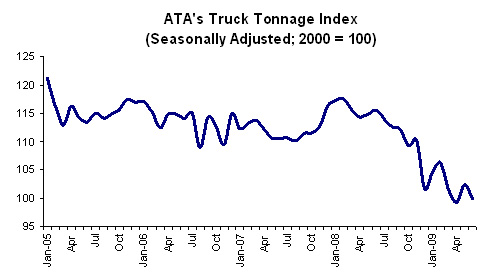


The ATA release warns:
"The sample includes an array of trucking companies, ranging from small fleets to multi-billion dollar carriers. When a company in the sample fails, we include its final month of operation and zero it out for the following month, with the assumption that the remaining carriers pick up that freight. As a result, it is close to a net wash and does not end up in a false increase. Nevertheless, some carriers are picking up freight from failures, and it may have boosted the index. Due to our correction mentioned above, however, it should be limited."
(h/t Barry Ritholtz at the Big Picture.)

14. HOME PRICE DECLINE SLOWING, CALIFORNIA FORECLOSURES DOUBLE NEW HOME SALES IN JUNE

Barry Ritholtz reports that home price declines are "slowly abating." Here is his graph:
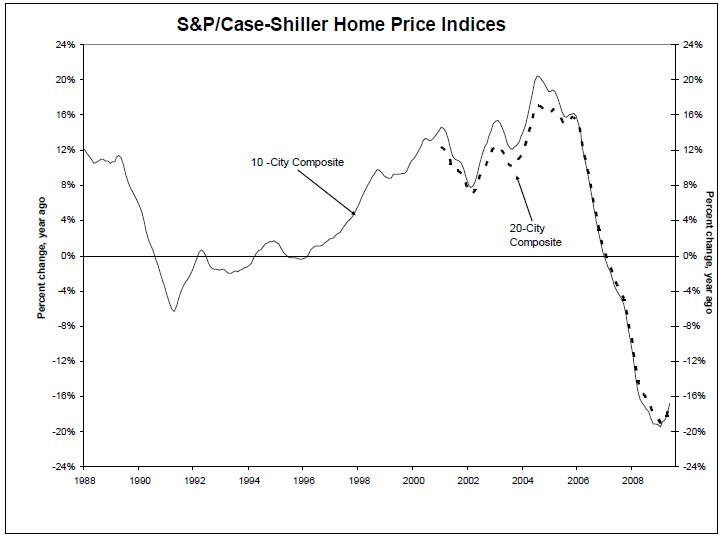


Jake at Econopic picked up on the Big Picture's quote of the day of Mark M Hanson which notes that California foreclosures are more than double the national new home sales for June. His graph:


15. EPA MAY GIVE ALGAE BIG BOOST

Russell Gold at Environmental Capital notes that Blair Carter at the Renewable + Law Blog reports that "that the Environmental Protection Agency will count algae as an advanced biofuel under Renewable Fuel Standard rules being developed."
"Why do EPA’s steps towards including algae matter? Because when Congress created its mandate to blend advanced biofuel into the fuel pool, it created a big market for these fuels. By 2012, the law mandates that two billion gallons of these advanced biofuels be blended, a figure that rises by tenfold by 2022. It’s all in Section 202 of the Energy Independence and Security Act of 2007.

... For algae to be included, the law says it needs to have no more than 50% of the 'lifecycle greenhouse gas emissions' of gasoline and diesel. This could be tricky, says David Woodburn, an alternative energy analyst with ThinkEquity. 'The hard part for me is understanding how the EPA plans to calculate the GHG emissions of algae fuels, based on the variety of feedstocks (sugar, CO2, other), processes (open ponds, photobioreactors), and algae varieties being explored--especially before November,' he says, noting when the rules are supposed to be finished."
Blair Carter's post can be found here.

16. TEXAS DROUGHT GETS WORSE

Tom Benning at the Wall Street Jounral reports on the drought in Texas.
"Nearly 80 of Texas' 254 counties are in 'extreme' or 'exceptional' drought, the worst possible levels on the US Department of Agriculture's index. Though other states are experiencing drought, no counties in the continental U.S. outside Texas currently register worse than 'severe.' In late April, the USDA designated 70 Texas counties as primary natural-disaster areas because of drought, above-normal temperatures and associated wildfires."
The Journal carries an interactive graphic: